
Visiting Kusatsu Onsen, Where the Hot Spring Cools in the Town Square
Kusatsu Onsen (Yubatake)
By Kei · Born and raised in JapanIs Kusatsu Onsen worth the trip? Among the posts we collected, mostly yes. In 93 of 111 posts by visitors from abroad, the writer was happy with the trip, and in 199 of 249 Japanese reviews of Yubatake, the writer speaks warmly of it. Yubatake is the field of wooden channels where the spring is cooled, and it is not itself a bath. Three free public baths and Netsunoyu, the hall where yumomi is shown, are a few minutes' walk from it. From Tokyo it takes about 2 hours 20 minutes by limited express plus 25 minutes by bus, or a little over four hours by direct highway bus. The last limited express back to Tokyo leaves in mid-afternoon, so if you want to see Yubatake lit up after dark, it is simplest to stay one night.
The Meaning
In the middle of Kusatsu, hot water comes straight out of the ground at 52.7°C, more than 4,000 liters of it every minute, with a pH of 2.1. That is too hot to bathe in as it comes. The quick fix would be to pour in cold water. Kusatsu has long tried not to, and the reason given in the town is that adding water to cool the spring would weaken it. Instead the water is cooled in other ways, and much of that work happens where anyone can watch.
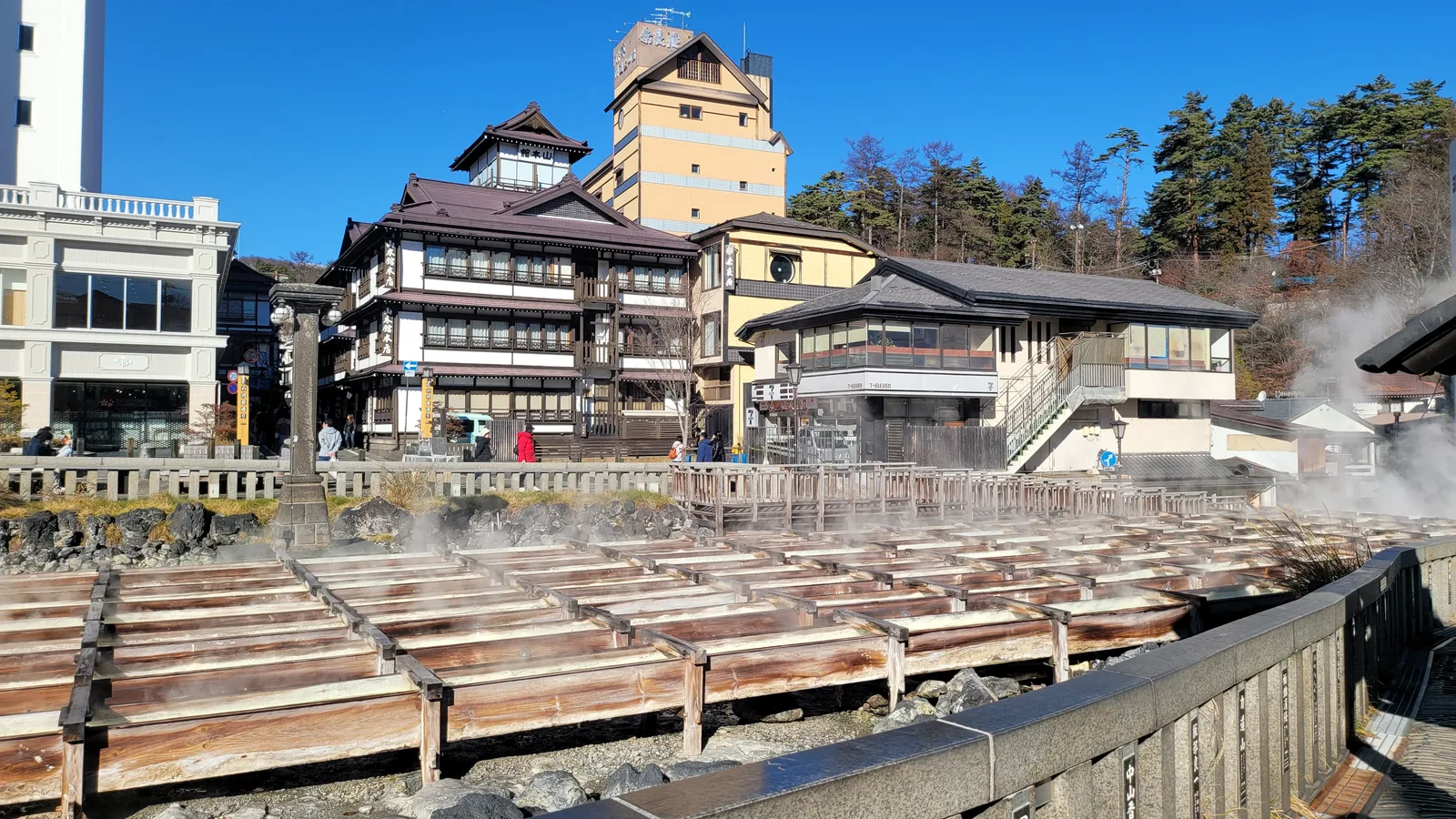
The cooling starts at Yubatake, the "hot water field," at the center of the hot spring town. In 2017 the national government designated Yubatake a Place of Scenic Beauty, as a scene that represents Kusatsu's distinctive hot spring culture.
Kusatsu's water has been praised for more than five hundred years. In 1491 the poet Banri Shūkyū, a former Zen monk, wrote that the finest springs in Japan were Kusatsu, Arima and Yushima, today's Gero. Water from Kusatsu was presented to the eighth Tokugawa shogun, Yoshimune, in 1726 and again in 1743. The German physician Erwin von Bälz, who taught medicine in Tokyo, first came in 1878 and returned many times to study the water and the local ways of bathing in it.
At the heart of Kusatsu's town charter, adopted in 1979, is a single line: "Peace for those who arrive, happiness for those who leave." The words are the painter Higashiyama Kaii's translation of a Latin inscription on a city gate in Rothenburg, Germany. Performers in the hall beside Yubatake still sing a folk song that begins "Kusatsu yoi toko, ichido wa oide," Kusatsu is a fine place, come at least once. In 13 of the 249 Japanese reviews of Yubatake we collected, the writer mentions having seen it on TV before. One of them wrote on jalan, "I was finally able to see Yubatake in person after seeing it so often on TV. It was bigger than I'd imagined..."
What Happens When You're There
Step 1: The Hot Water Field
Yubatake is about five minutes' walk from the bus terminal. A visitor from abroad wrote on TripAdvisor, "The smell of sulphur is everywhere in this little town but you get used to it after a while. The main square is at Yubatake, which is surrounded by some interesting shops and a couple of onsen hotels." At its stone fence, follow the water from where it rises at the upper end of the field. It spreads into seven wooden channels laid side by side, each about 40 meters long and made from red pine trees more than 150 years old. Channels like these have been in place here since the late 19th century and are replaced from time to time. As the water runs along them, it gives off steam and loses heat to the air.
The water's minerals settle out on the wood of the channels. Every two months the flow is stopped and these deposits are scraped off by hand, enough to fill about 6,000 small tubs. The deposits are called yunohana, "hot water flowers," and the name Yubatake means a field where yunohana can be gathered. Kusatsu's shops sell the tubs as something to add to a bath at home, with a label warning that yunohana can corrode metal.
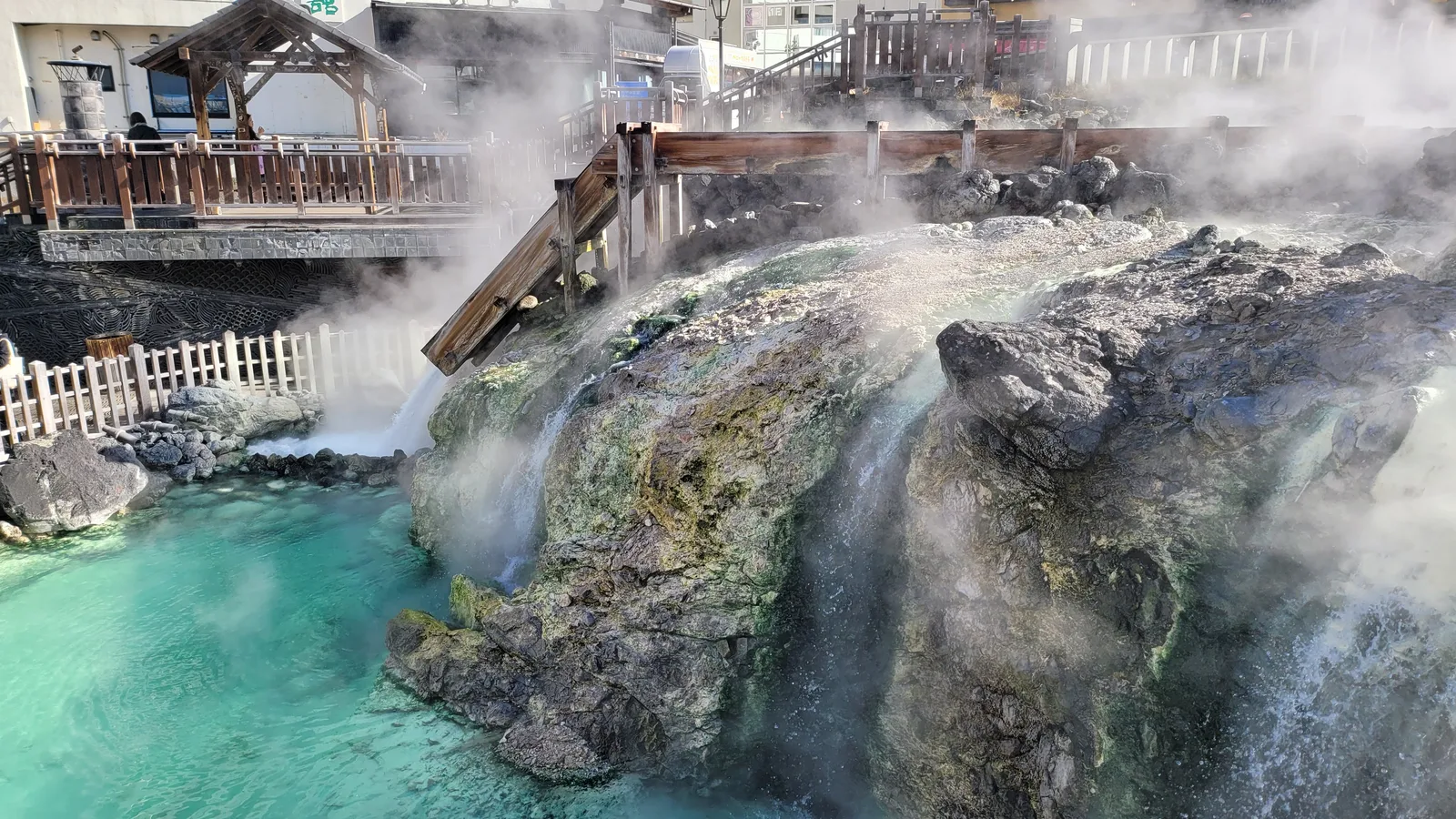
At the lower end, the water spills over a rock face into a turquoise pool as a waterfall. The green on the rocks is a rare alga that grows in strongly acidic water. From here, pipes carry the cooled spring to Chiyo no yu, one of the free public baths, and to the baths of inns around town. You cannot bathe in Yubatake itself. You can soak in its water at those baths, and at the field you can put your feet in it at the Yukemuri-tei footbath.
Then walk the full loop of the fence. The names of 100 people with a connection to Kusatsu are carved on its stone posts: warlords and monks, poets and painters, prime ministers and film stars, and Dr. Bälz and his wife, Hana. The present fence dates from 1975, when it was designed by an institute headed by the artist Tarō Okamoto. Near the source, a frame marks the spot where the shogun's water was drawn. A Japanese reviewer on jalan enjoyed walking around to read the names and the years of their visits, and wrote, "I take my hat off to the wisdom of people long ago who found a way to cool the spring water to bathing temperature without adding water."
Two free footbaths at Yubatake are open around the clock. Yukemuri-tei is a cypress pavilion beside the channels, built to recreate a public bathhouse that stood on this spot in the Edo period. Taki no yu is in front of the waterfall. Test the water with your hand first, and bring a small towel for your feet; a visitor from abroad warned on Google Maps that at the footbath beside the hot water field "the water is really hot." For a view of the whole field from above, climb the stone steps to Kōsenji, the temple on the rise above the source.
Step 2: The Boards at Netsunoyu
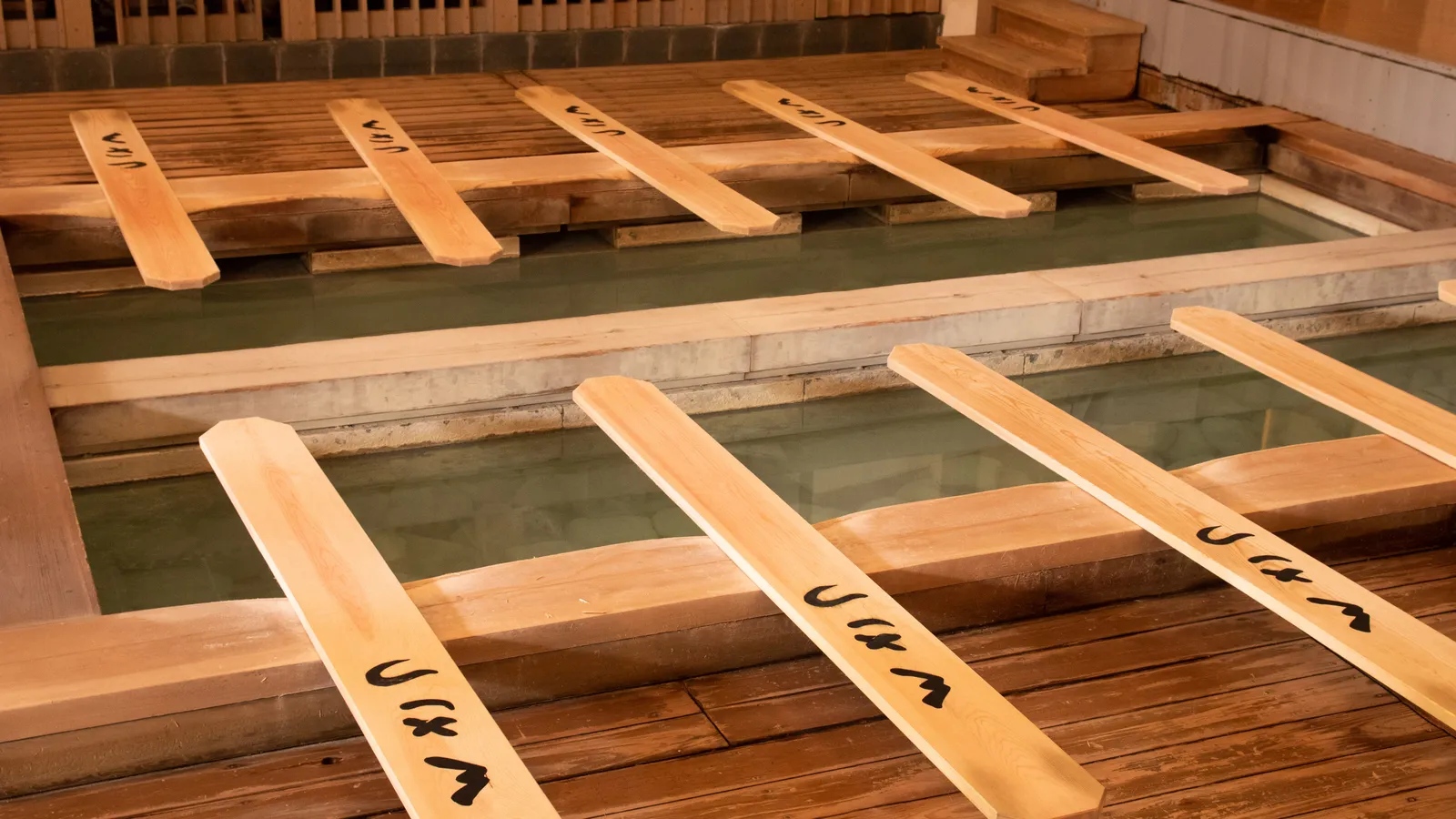
Netsunoyu faces Yubatake. The two-story hall was rebuilt in 2015 in the style of the Taishō era, the 1910s and 1920s, and its high open interior smells of wood. Low wooden tubs of hot spring water sit in the middle of the floor, with long boards resting across them. Performers here show yumomi, Kusatsu's old way of cooling the water by hand.
The boards are about 180 centimeters long. A row of performers dips them into the water and turns it over and over, keeping time with Kusatsu's folk songs and the call "choina, choina," until the water is at a temperature people can bathe in. According to Netsunoyu, the stirring also softens the feel of the water and serves as a warm-up before bathing.
Before there was a show, yumomi was the first part of a way of bathing. In the jikan-yu, the "time bath," which took its settled form in the Meiji era (1868 to 1912), bathers stirred the water, poured more than 30 ladles of it over their heads, and then got into the bath together on a leader's call. They stayed in for three minutes and got out together on the next call, four times a day.
Netsunoyu has put on its yumomi and dance show since 1960. It opens with a short film, followed by a dance to the folk song Kusatsu-bushi, a demonstration of yumomi, and a finale of dance and stirring to the Yumomi-uta. On busy days, Netsunoyu may add shows at other times. A Japanese reviewer on jalan went with a child, who called it amazing. The reviewer was surprised by the line: "It was the first time I had to line up that much before it even started." Another reviewer on jalan was less impressed: "The souvenirs were mostly just manju buns, not much variety. The yumomi show wasn't that interesting either."
On Sundays and Mondays around midday, visitors can take a board and try yumomi themselves.
Step 3: Your First Soak
Kusatsu Town has set up 19 public baths around town for its residents, and local people look after them. Three are open to visitors free of charge: Shirahata no yu, right beside Yubatake; Chiyo no yu, two minutes' walk away; and Jizo no yu, three minutes away. They are simple bathhouses with no lockable lockers, so bring your own towel and leave valuables behind.
The water in these baths comes from springs close by, and it is hot. Pour some over yourself before you get in, keep your towel out of the bath, speak quietly, and dry off lightly before you step back into the changing room. If the water is too hot for you, ask the others before adding a little cold water, and leave the hot water running. The local tourism organizations ask for these things so that the person who comes in after you can enjoy the bath too. On a town poster about these baths, a local sitting in the water greets a traveler: "Where are you from? It's a nice bath, isn't it? Take your time." The poster asks visitors to use the baths with a feeling of thanks, as a treasure that residents have looked after since long ago. If sharing a bath with strangers makes you nervous, it may help to know what Japanese bathers are actually thinking.
Kusatsu's water is strongly acidic. The town says that a traditional five-sun nail, about 15 centimeters long, left in the Yukawa stream dissolves in about ten days. For a first soak, the tourism corporation suggests that you wet your head and neck with hot water, start with a half-body soak, and get out after about 5 to 10 minutes. It also asks you to take off your jewelry, because silver can tarnish in this water, and not to bathe after drinking alcohol. A visitor from abroad wrote on TripAdvisor, "Be careful not to let it get into your eyes as it may hurt a bit!"
If you would like more room and a locker, the three day-use baths run by the Kusatsu Tourism Public Corporation have both, and Otakinoyu and Goza no yu also have places to wash. All three say they do not turn away guests with tattoos. Goza no yu is right at Yubatake, and its indoor baths use water from two different springs. At Otakinoyu, about seven or eight minutes' walk away, the spring runs through a row of pools called the awase-yu and loses a little heat in each, so every pool has its own temperature, between about 38°C and 46°C. The corporation suggests starting in the coolest and working your way up. The third, the open-air bath at Sainokawara, comes in the next step.
Step 4: Down to Sainokawara
From Yubatake, walk west along Sainokawara-dori for about ten minutes, and the scenery changes completely as you reach Sainokawara Park.
Hot water seeps out of the ground here in many places, steaming among the rocks and pines, and runs off as a warm stream, the Yukawa. People once called this place Oni no Sensui, the demons' garden pond, and according to local tradition, you should not raise your voice here, or the demons will come out. Some spots in the park are still named after the demons, such as the Demon's Kettle and the Demon's Sumo Ring. On a small rise partway along, a bust of Dr. Bälz stands near a stone monument to him.
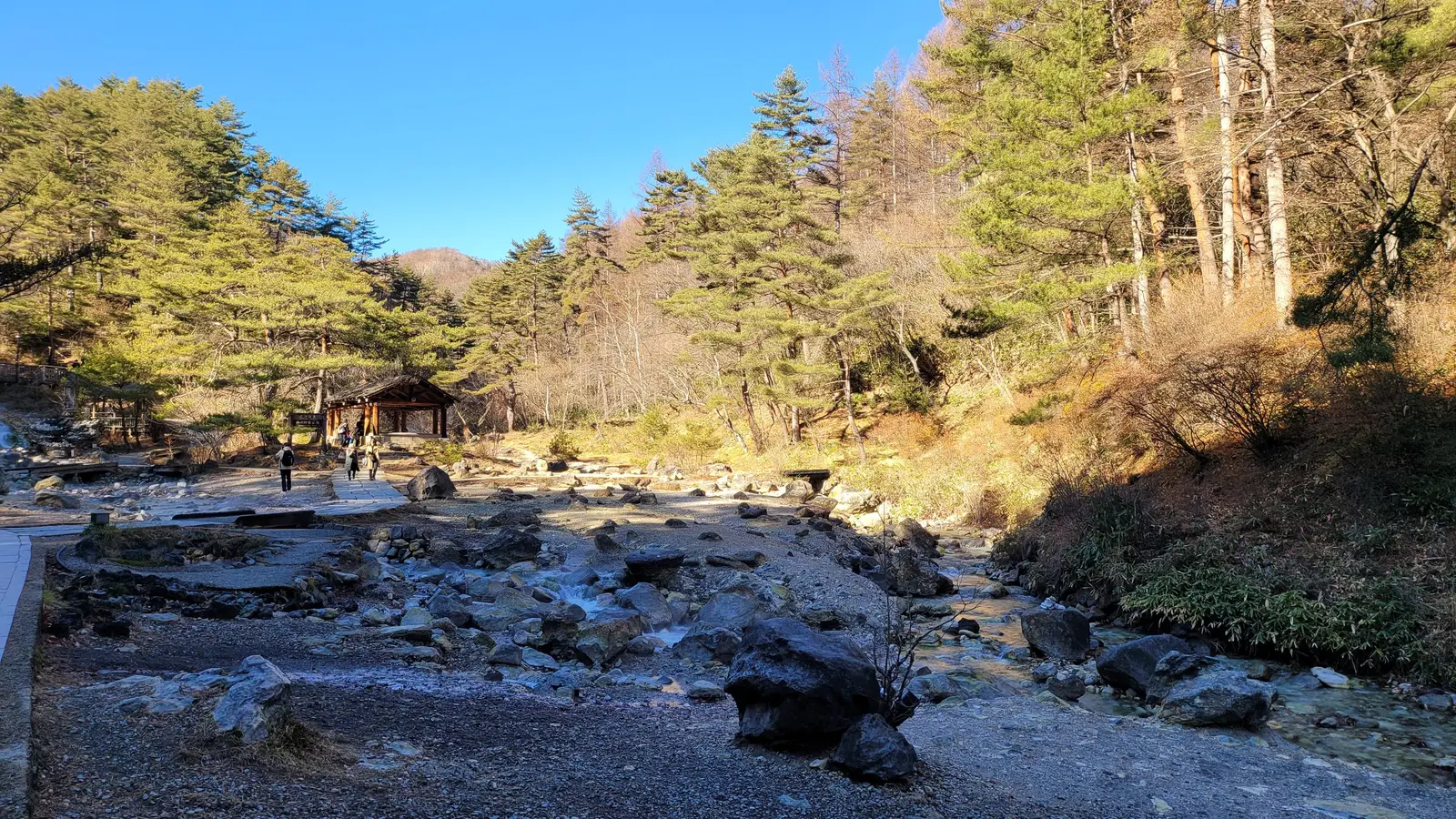
The Sainokawara open-air bath is at the far end of the park. Its pools cover about 500 square meters, split into a men's side and a women's side, and the operator describes it as one of the largest open-air baths in Japan. It draws on the Bandai spring, which comes out of the ground at about 94.5°C. Before that water reaches the baths, a plate heat exchanger brings it down to about 60°C by passing its heat to tap water, without mixing the two. The tap water comes out at about 60°C as well, and the town pipes it to homes as a hot water supply.
Further down the Yukawa, below the hot spring town, the acidic water is neutralized with powdered limestone at a plant that opened in 1964. Japan's Ministry of Land, Infrastructure, Transport and Tourism describes it as the first plant in the world built to neutralize an acidic river.
Step 5: Yubatake After Dark
Walk back up to Yubatake as it gets dark. From sunset until midnight, lights set among the source, the channels, the steam and the waterfall change color slowly. The lighting, designed by Kaoru Mende, was switched on in December 2016, and he called the steam "a three-dimensional screen made by nature." Kusatsu Town particularly recommends the twilight just after sunset. In winter a tall Christmas tree is lit in Yuro Square beside the field, and on one evening in most months, more than 1,200 candles are set out on the stone steps below the gate of Kōsenji.
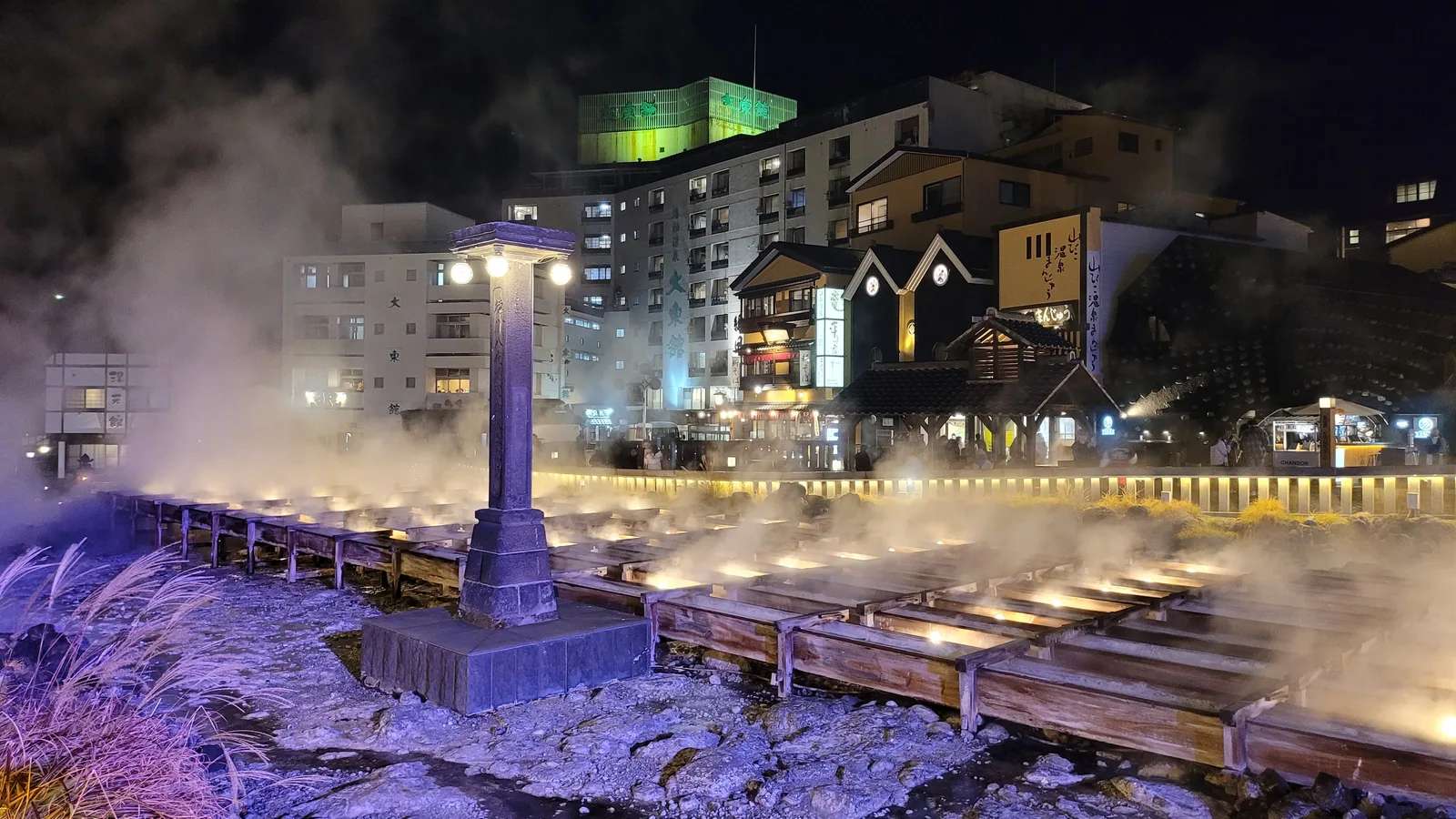
A Japanese reviewer on jalan described the evening this way: "...once the tour buses leave, the day-trippers leave, and the sun goes down, the lit-up Yubatake has such a wonderful atmosphere. Though that's assuming you're staying overnight!" Not every evening is quiet, though. Five Japanese reviewers found Yubatake quieter after dark or suggest going later for that reason, while ten describe it as busy at night, four of them after dinner or on a weekend or holiday.
At midnight the lights go off, and the water keeps running down the channels in the dark.
What Visitors Honestly Say
We collected 111 posts by visitors from abroad who have been to Kusatsu, from TripAdvisor, Google Maps, Reddit and the Japan travel board of a Taiwanese online forum, and sorted them by how each writer felt about the trip.
In the green band, writers praise the baths, Yubatake and the town. A commenter on Reddit, answering someone who was choosing between two hot spring towns, wrote of Kusatsu, "Great variety of baths, heat levels, and styles of water, both public and outside and riverside as well as within hotels. And the town is compact and nice for exploring and strolling." Each of the four writers who were let down gives a different main reason. One found an eight-hour round trip too long, and one named the sulfur smell and the prices. One found too little to do besides bathing, on a visit in June 2015 when buses up the volcano were not running, and one did not recommend coming with young children.
The Japanese reviews of Yubatake on jalan and 4travel fall into almost the same shares.
In seven of the Japanese reviews, the writer was disappointed, and in four of those, the main reason was crowds or queues. One of the four writers said, "During the day it's just packed with people. If you want to visit Yubatake, I'd recommend the middle of the night or early morning."
For what disappointed visitors from abroad and Japanese visitors, and for the times of day when Yubatake is less crowded, see Is Kusatsu Onsen Worth It?
Good to Know
Kusatsu has no train station of its own. The limited express Kusatsu-Shima runs from Ueno in Tokyo to Naganohara-Kusatsuguchi in about 2 hours 20 minutes, and every seat is reserved. In the October 2026 timetable it leaves Ueno at 10:00 and 12:10 every day, with extra trains on weekends, holidays and some other dates. You can also take the JR Takasaki Line from Ueno to Takasaki, in about 1 hour 45 minutes, and change there to a local train on the JR Agatsuma Line, which reaches Naganohara-Kusatsuguchi in about 1 hour 30 minutes. From the station, JR buses take about 25 minutes to the Kusatsu Onsen bus terminal and cost 780 yen. You cannot reserve them, and when a bus is full you wait for the next one, so line up at the stop; transit IC cards are accepted. The JR East Pass covers both the train and this bus. The Japan Rail Pass covers the train and most JR Bus local routes, and the JR Tokyo Wide Pass covers the train only.
The direct highway buses, the Joshu Yumeguri and Tokyo Yumeguri, leave from Busta Shinjuku and Tokyo Station and take a little over four hours, with a 20-minute break on the way. Their seats are reserved, and the standard fare is 3,700 to 4,000 yen depending on the date and the bus. From Karuizawa, on the Hokuriku Shinkansen line, buses reach Kusatsu in about 1 hour 20 minutes to 1 hour 35 minutes for 2,240 yen, so you can stop in Karuizawa on the way. The bus terminal has coin lockers, and Yubatake is about five minutes on foot from there. If you are bringing a suitcase on the train and the bus, there is more on how Japanese riders feel about luggage, IC cards and rail passes.
In the October 2026 timetables, the last daily limited express from Naganohara-Kusatsuguchi to Ueno leaves at 15:43, and the bus that meets it leaves Kusatsu at 14:40. The last direct highway bus from Kusatsu to Tokyo leaves at 17:30.
Most visits to Kusatsu are overnight stays. Of the 4,053,223 visits the town counted in fiscal 2025, 2,713,327 were overnight. Two visitors who each stayed two nights came away with opposite views. A visitor from abroad wrote, "One full day is plenty of time," while a Japanese reviewer on jalan found that "two nights wasn't enough." If you are staying at a traditional inn, you can read about what ryokan hosts hope for from their guests before you go.
These are the main bathing places and their prices as of October 2026:
- Otakinoyu: adults 1,200 yen, children 600 yen; 9:00 to 21:00 (last entry 20:00)
- Goza no yu: adults 900 yen, children 450 yen; 7:00 to 21:00 from April to November, 8:00 to 21:00 from December to March (last entry 20:30)
- Sainokawara open-air bath: adults 800 yen, children 400 yen; 7:00 to 20:00 from April to November, 9:00 to 20:00 from December to March (last entry 19:30); closes at 17:00 on the second Wednesday of each month
- A pass for one visit to each of the three: adults 2,100 yen, children 1,050 yen, with no expiry date
- The free public baths: Shirahata no yu 8:00 to 23:00, Chiyo no yu 6:00 to 23:00, Jizo no yu 8:00 to 22:00, each closed for cleaning at times, mostly in the morning
Children's prices are for ages 3 through elementary school. Otakinoyu rents a towel set for 250 yen, while Goza no yu and the Sainokawara bath only sell towels (a face towel is 380 yen), so bringing your own saves money. The three day-use baths take credit cards, transit IC cards and some QR code payments, and Otakinoyu has a maintenance closure in December. The Sainokawara open-air bath has no washing area, so pour water over yourself before you get in. On Friday evenings from 17:30, except on certain days, its men's side becomes a mixed bath; men are lent bathing wear, and women can rent it for 400 yen or wear a swimsuit. The tourism corporation suggests bathing no more than three times a day and keeping the rinse afterwards brief, so that some of the spring stays on your skin.
The three day-use baths say on their FAQ pages that they do not turn away guests with tattoos. We found no tattoo rule published for the free public baths, so read the notices at the entrance. Inns set their own rules, so ask at yours. There is more on tattoos at Japanese hot springs if you want the wider picture.
The yumomi and dance show at Netsunoyu runs every day. In October and November 2026 the shows are at 9:30, 10:00, 10:30, 15:30, 16:00 and 16:30, with an extra show at 15:00 on some days in October. Winter times differ (from December 2025 to February 2026, the morning shows were at 10:00, 10:30 and 11:00), so check the current schedule. Tickets are sold only at Netsunoyu, from 30 minutes before each show, and cannot be reserved. Adults pay 700 yen and elementary school children 350 yen, in cash or by PayPay only, and the hall holds 200 people. The hands-on yumomi runs on Sundays and Mondays from 11:30 to 13:00 (last entry 12:50) and costs 300 yen for anyone of elementary school age or older.
Yubatake and Sainokawara Park are open at all hours and free, and both are lit from sunset until midnight. The two footbaths at Yubatake are free and open around the clock.
Kusatsu sits about 1,200 meters above sea level and is cool all year. The Japan Meteorological Agency's normals for Kusatsu (1991 to 2020) give a yearly average of 7.6°C and a January average of minus 4.1°C. Bring warm layers and shoes with good grip from late autumn to spring. If you drive in winter, the tourism association asks you to carry chains or use studless winter tires, because the roads are likely to be packed snow or ice. The mountain road north of town toward Shiga Kogen, National Route 292, closes for the winter (for 2026 to 2027, from November 11 to April 21, as planned). The roads into Kusatsu itself stay open, and the trains and buses run all winter. If you are still choosing when to go, there is a month-by-month look at Japan's crowds, weather and welcome.
Mt. Kusatsu-Shirane, above the town, is an active volcano. In October 2026 the Japan Meteorological Agency had both of its peaks at volcanic alert level 1, the lowest, and the town kept people out of the area within about 500 meters of the Yugama crater. The JR bus from the town to the volcano was suspended for the time being because of the road conditions on National Route 292. Whether you can visit the summit area depends on volcanic activity and the season, so check the town's website before you plan a trip up the mountain.
Kusatsu's hot spring town spreads out around Yubatake. If you are planning more than one hot spring town, Kinosaki Onsen in Hyogo has seven public bathhouses along a canal, and people walk between them in yukata. Beppu Onsen in Kyushu has steaming "hells" to look at before you bathe, and Ginzan Onsen is a single gas-lit street in the snow country. Closer to Tokyo, you can ride a mountain railway, a cable car and a ropeway in Hakone and cross Lake Ashi by boat, all in one day. In Shikoku, Dōgo Onsen is a historic public bathhouse still in daily use.
Kusatsu's tourism association counts Kusatsu among Japan's three famous springs, together with Arima and Gero. Jigokudani's snow monkeys, on the Nagano side of the mountains, are reached from Nagano Station; in winter, the road over the mountains from Kusatsu is closed.
Last verified: 2026-10
The official websites are kusatsu-onsen.ne.jp for the Kusatsu Onsen Tourism Association (in Japanese), onsen-kusatsu.com for the three day-use baths (with English pages) and town.kusatsu.gunma.jp for Kusatsu Town (in Japanese).
If Things Don't Go as Planned
You arrive at lunchtime, and the restaurants near Yubatake have lines. A Japanese reviewer who arrived around noon spent two hours looking for somewhere to eat and saw some shops close soon after 1 p.m. Arriving a little before noon may make lunch easier. If you are staying the night, another Japanese reviewer suggested that "it might be easier to just have dinner at your hotel."
The water is hotter than you expected, or your skin stings. The tourism association lists people with very sensitive skin among those for whom bathing in Kusatsu's water is not advised, and suggests asking a doctor if you are unsure. Get out and rest; the tourism corporation's advice is not to force yourself to stay in. Make the next soak a short half-body one, and at Otakinoyu, begin in the coolest pool of the awase-yu.
The yumomi show is full. In the morning and again in the afternoon, shows start 30 minutes apart, so you can usually wait for the next one. Tickets for it go on sale as the earlier show begins.
It is snowing hard. Snow is normal here in winter. The town clears its roads and sidewalks, though packed snow and ice remain. Wear boots with grip and take the steps around Yubatake slowly. If you were planning to drive, taking the train and bus, or the highway bus, means you do not have to drive the mountain roads.
It is raining. Yubatake is lit in the rain too. A Japanese reviewer on jalan wrote that there are fewer people on a rainy weekday, praised "the lights hazy through the rain," and suggested warming up afterwards at one of the town's public baths.
You are traveling with small children. For children who find the water too hot, the tourism association suggests scooping some into a wooden bucket, letting it cool a little, and pouring it over them first. Otakinoyu says babies of about six months and older can bathe, and at the three day-use baths, children up to preschool age can go into the bath of the opposite sex with a parent. A Japanese reviewer on jalan noted that the walk from the parking lot "might be tough with kids." If you are staying the night, ask your inn whether it runs a shuttle bus.
You only have a day. If you come by direct highway bus, you have more time in town than by limited express. The earliest buses from Tokyo arrive around noon and the last one back leaves at 17:30, and seats are reserved, so book both ways. Eat on the way in if you can, then see Yubatake, have a soak in one of the free baths or at Goza no yu, walk down to Sainokawara Park and back, and catch an afternoon yumomi show before your bus home. In the short days of late autumn and winter, you may see the lights come on before you leave. If you take the 10:00 limited express from Ueno and the connecting bus, you reach town a little before 1 p.m. To catch the last express back, you need the 14:40 bus, so you have less than two hours there.
Sources:
- Agency for Cultural Affairs: Yubatake, Place of Scenic Beauty (Japanese): the designation on October 13, 2017 and its reasons, the Yubatake spring at 52.7°C and pH 2.1 with 4,040 liters a minute, the seven channels of about 40 meters in red pine more than 150 years old set up in the late 19th century, the gathering of yunohana and the waterfall, the water presented to Tokugawa Yoshimune in 1726 and 1743, the 1975 fence designed by the institute headed by Tarō Okamoto, and the 1491 naming of Kusatsu, Arima and Yushima (Gero) by Banri Shūkyū, a Zen monk who later returned to lay life
- Kusatsu Onsen Tourism Association: Yubatake (Japanese, 2026-04-26): the name "a field where yunohana can be gathered," the hot spring town spreading out around Yubatake, and the five-minute walk from the bus terminal
- Kusatsu Onsen Tourism Association: Hot spring sources (Japanese), Kusatsu Onsen (Japanese) and Water quality and how to bathe (Japanese): the water piped from below the waterfall to Chiyo no yu and to inns, Kusatsu counted among Japan's three famous springs with Arima and Gero, very sensitive skin listed among the conditions for which bathing is not advised, with the suggestion to ask a doctor, and the tip of cooling water in a bucket for children who find it too hot
- Kusatsu Onsen Tourism Association: Kusatsu Onsen Magazine, spring to autumn 2026 (PDF, Japanese, data as of 2026-03-31): Yubatake and Sainokawara Park open at all hours and free, lit from sunset until midnight, Sainokawara Park about ten minutes' walk from Yubatake, and yumomi as a way to cool the spring without adding water
- Kusatsu Onsen Tourism Association: Kusatsu Jikan magazine, spring to autumn 2017 (PDF, Japanese): the Yubatake lighting switched on on December 24, 2016, designed by Kaoru Mende, his words about the steam as a three-dimensional screen, and the change of scenery on the walk along Sainokawara-dori
- Netsunoyu: History of yumomi (Japanese): boards about 180 centimeters long, why the water is stirred instead of thinned with water, the softer feel and the warm-up before bathing, the show since 1960, the hall rebuilt in 2015, and the time bath, jikan-yu, which Netsunoyu calls dentō-yu, with its ladles, the leader's call and three-minute soaks
- Netsunoyu: Yumomi and dance show (Japanese), show calendar (Japanese, viewed 2026-10-17), October 2026 schedule (PDF, Japanese), hands-on yumomi (Japanese) and group terms (Japanese): the program, show times for October and November 2026 with the extra 15:00 shows in October, extra shows on busy days, winter times from December 2025 to February 2026, 700 and 350 yen in cash or PayPay only, tickets from 30 minutes before each show with no reservations, room for 200, and the hands-on yumomi on Sundays and Mondays from 11:30 to 13:00 for 300 yen
- Kusatsu Onsen Tourism Association: Yukemuri-tei footbath (Japanese, 2025-12-25) and Taki no yu footbath (Japanese, 2025-12-28): free footbaths at Yubatake, open 24 hours, and the cypress pavilion recreating an Edo-period public bath
- Kusatsu Onsen Tourism Association: Shirahata no yu (Japanese, 2025-12-25), Chiyo no yu (2025-12-25) and Jizo no yu (2025-12-28): opening hours, distances from Yubatake, baths set up for residents and looked after by them, no lockable lockers, and cleaning mostly in the morning
- Kusatsu Onsen Senshitsu Shugi (Kusatsu Onsen Tourism Association with the ryokan cooperative and chamber of commerce): Yubatake and the public baths (Japanese), history (Japanese) and sustainability (Japanese): yunohana scraped off by hand every two months, about 6,000 tubs of 95 grams, the three public baths open to visitors, the requests to bathers there and the reason given for them, the 100 names carved in 2000, and the alga on the rocks
- Kusatsu Town: About Kusatsu Onsen (Japanese, updated 2025-04-04): pH around 2.0, the five-sun nail that dissolves in the Yukawa in about ten days, the 19 public baths of which some are free, and the Bandai spring at about 94.5°C cooled to about 60°C in a plate heat exchanger
- Kusatsu Town: Hot water supply (Japanese): the tap water warmed to about 60°C by the Bandai spring and supplied to homes
- Kusatsu Town: Otakinoyu (Japanese, updated 2025-09-19): the maintenance closure of Otakinoyu in December
- Kusatsu Town: Yubatake (Japanese, updated 2025-03-28), 100 people who walked in Kusatsu (Japanese) and Bälz Memorial Museum (Japanese, updated 2025-04-28): the town's recommendation of the twilight after sunset, the names on the fence including Dr. Bälz and his wife Hana, and Bälz's first visit in 1878 and his teaching in Tokyo
- Kusatsu Town: Town charter (Japanese): the 1979 charter and Higashiyama Kaii's translation of the inscription on the Spital Gate in Rothenburg
- Kusatsu Town: Yumomi and dance (Japanese, updated 2025-03-28): the folk song Kusatsu-bushi, beginning "Kusatsu yoi toko, ichido wa oide," sung together in Kusatsu's old group bathing, and the yumomi shown at Netsunoyu
- Kusatsu Town: Visitor numbers for fiscal 2025 (Japanese, 2026-04-15) and Monthly visitor numbers (Japanese): 4,053,223 visits, a record for the third year in a row, of which 2,713,327 were overnight stays
- Kusatsu Town: To everyone using the public baths (Japanese, updated 2026-03-30) and Yunohana (Japanese, updated 2026-04-27): the poster asking bathers to pour hot water over themselves, keep towels out of the bath and use the public baths with thanks, with a local greeting a traveler in the bath (「どこから来ました?いい風呂でしょう。ゆっくりしていきなさいな。」), and yunohana sold in 95-gram tubs for 1,400 yen with a warning about metal
- Kusatsu Tourism Public Corporation: Otakinoyu (Japanese), Otakinoyu guide (Japanese), Goza no yu guide (Japanese), Goza no yu in English, Sainokawara open-air bath (Japanese), Sainokawara hot spring (Japanese), Sainokawara mixed bathing (Japanese) and the three-bath pass (Japanese): prices, opening hours, towels and payment, the awase-yu pools from about 38°C to 46°C entered from the coolest, Goza no yu rebuilt in 2013 with two springs, the Sainokawara bath of about 500 square meters on the Bandai spring with no washing area, the Friday mixed bathing, and the 2,100-yen pass
- Kusatsu Tourism Public Corporation: FAQ for Otakinoyu (Japanese), Goza no yu (Japanese) and Sainokawara (Japanese), notices (Japanese, 2026-07-26), How to bathe (Japanese) and Otakinoyu in English: guests with tattoos not turned away, lockers and places to wash, the 17:00 closing at Sainokawara on the second Wednesday, the advice on bathing in Kusatsu's water and after drinking alcohol, the warning to remove jewelry because silver tarnishes, babies of about six months and older, and preschool children in the bath of the opposite sex with a parent
- Kusatsu Onsen Tourism Association: Sainokawara Park (Japanese, 2026-04-26), Bälz monument (Japanese) and Kōsenji (Japanese): the springs and the Yukawa, the name Oni no Sensui and the tradition of not raising your voice, the bust of Dr. Bälz and the monument to him, and the temple above the Yubatake spring
- Kusatsu Onsen Tourism Association: Yubatake Christmas tree (Japanese, 2026-10-13) and Yubatake candle evenings (Japanese, 2026-03-13): the tree in Yuro Square and more than 1,200 candles on the steps below Kōsenji on one evening in most months
- Ministry of Land, Infrastructure, Transport and Tourism, Kanto Regional Development Bureau: Neutralizing acidic rivers (PDF, Japanese): the Kusatsu neutralization plant of 1964, the first in the world built to neutralize an acidic river, adding powdered limestone to the Yukawa
- JR East: Limited express Kusatsu-Shima and JR East timetable, October 2026 (Japanese): about 2 hours 20 minutes from Ueno to Naganohara-Kusatsuguchi, all seats reserved, the departure times and the last daily train back at 15:43
- JR Bus Kanto: Naganohara fare table (PDF, Japanese, from 2025-04-01), Joshu Yumeguri highway bus (Japanese), Naganohara-Kusatsuguchi to Kusatsu Onsen timetable (Japanese, from 2025-12-22), route bus timetables (Japanese, viewed 2026-10-17) and JR East Pass bus routes (PDF, as of February 2026): the 780-yen bus of about 25 minutes that cannot be reserved and takes no more passengers once full, the 14:40 bus that meets the last daily express, the highway bus fares and times including the earliest arrivals around noon and the last bus back at 17:30, the bus to the volcano suspended for the time being because of road conditions on National Route 292, and the bus covered by the JR East Pass
- Visit Gunma: How to get to Kusatsu (2024-03-28) and Japan Rail Pass: Conditions for use: the bus terminal with coin lockers, the passes that cover the train, and JR Bus local routes covered by the Japan Rail Pass except some
- Kusatsu Onsen Tourism Association: Access by train (Japanese), Karuizawa to Kusatsu timetable (PDF, Japanese, from 2026-10-01) and Driving on snowy roads (Japanese): the JR Takasaki Line from Ueno to Takasaki in about 1 hour 45 minutes and local trains on the Agatsuma Line from Takasaki in about 1 hour 30 minutes, the buses from Karuizawa at 2,240 yen, the request to carry chains or use studless tires, and the cleared but snow-packed roads
- Gunma Prefecture: Winter road closures for 2026 to 2027 (Japanese, 2026-10-14): National Route 292 closed from November 11, 2026 to April 21, 2027, as planned
- Japan Meteorological Agency: Volcanic warnings for Kusatsu-Shirane (Japanese), Mt. Motoshirane (Japanese) and climate normals for Kusatsu (Japanese): alert level 1 for both peaks, and the yearly average of 7.6°C and January average of minus 4.1°C for 1991 to 2020
- Kusatsu Town: Trial opening near Mt. Kusatsu-Shirane (Japanese, 2026-10-08): the area within about 500 meters of the Yugama crater kept closed
- Japan National Tourism Organization: Kusatsu Onsen: the town without its own railway station
- Is Kusatsu Onsen Worth It? (WMJS): the two gauges in "What Visitors Honestly Say" and the counts of Japanese reviews that describe Yubatake after dark; the visitor quotations on this page come from the same collected posts and reviews, and each one is named with the site it was posted on
Image credits: Yubatake's wooden channels (hero), the waterfall at the end of the channels, Sainokawara Park and Yubatake at night, photos by Aspere, CC0 / public domain, via Wikimedia Commons. Yumomi boards at Netsunoyu, photo by Σ64, CC BY 4.0, via Wikimedia Commons.


WMJS is written in Japan, in English, with AI help. We check every page, but English is not our first language. If a sentence reads oddly, tell us. One sentence is enough.
Thank you. A person reads every note.
Real voices
Is it worth it?
Were you there? Share your photos.
Your photo could appear in this guide — with your name and a link to your profile.
Submit a photoRelated Articles
What Japanese Bathers Actually Think When You Walk In
Staying at a Ryokan: What Your Host Wishes You Knew
Surviving Japan's Winter: The Cold Is Indoors, Not Outside
More guides in Kanto
Visiting Akihabara, Tokyo's Electric Town Where You're Allowed to Love What You Love
Is Akihabara worth visiting? We weighed 149 traveler voices: 29% say yes outright, 44% say it depends on whether you love anime, games or electronics, and Japanese reviewers land warmer at 69%. How the district is laid out, getting there, and who it's for, with an audio guide.
Akihabara (Electric Town)
Visiting Harajuku, Where You Can Wear Anything and No One Turns to Look
Is Harajuku worth it? We counted 99 traveler voices: 64% say yes once you skip Takeshita Street's crush for Cat Street and Omotesando. Crepes, kawaii fashion, getting there, and how to walk it well, with an audio guide.
Harajuku
Visiting Meiji Jingu, Where 100,000 Trees Were Planted to Make a Forest That Tends Itself
Is Meiji Jingu worth visiting? We weighed 70 traveler voices: 75% say worth it, and Japanese locals rate it even higher at 82%. Free, a 70-hectare forest planted entirely by hand in 1920, home to the Great Torii and Kiyomasa's Well in the Inner Garden, with an audio guide.
Meiji Jingu
Visiting Senso-ji, Tokyo's Oldest Temple
Is Senso-ji worth visiting? We weighed 125 traveler voices: 54% say worth it outright. Hours, free admission, how long you need, and why the crowd has always been part of the prayer, with an audio guide.
Senso-ji Temple