
Visiting Meiji Jingu, Where 100,000 Trees Were Planted to Make a Forest That Tends Itself
Meiji Jingu
By Kei · Born and raised in JapanIs Meiji Jingu worth visiting? By the voices we gathered, yes: of 70 international travelers who made the trip, weighted by how much each account resonated with fellow readers, 75% called it worth it, and Japanese reviewers rate the shrine even more warmly at 82%. It is a free, 70-hectare forest planted entirely by hand in 1920, a short walk from Harajuku Station, with about a ten-minute path through the trees to the main hall. Come early for the quietest walk, and know before you go that it is plain and green on purpose, rather than gold and ornate. What visitors actually said, including the one letdown you can avoid, is further down this page.
The Meaning
Step out of Harajuku Station, one of the busiest corners in Tokyo, and within a minute you can be standing at the edge of a deep forest. Seventy hectares of trees, about the size of fifteen Tokyo Domes, rise in the middle of the city. It looks ancient. It looks like something the city was built around.
It is the opposite. Every tree was planted by hand.
Meiji Jingu was dedicated on November 1, 1920, to the spirits of Emperor Meiji, who died in 1912, and Empress Shoken. When the shrine was founded, this ground was mostly bare. So people across the country donated roughly 100,000 trees, and about 110,000 young volunteers came to plant them. The shrine's own words are plain about it: the forest "may seem natural but is actually man-made."
The unusual part is not that it was planted, but how it was designed. The foresters who planned it, led by Dr. Honda Seiroku, the same man who designed Hibiya Park, chose every tree based on how it would look not in ten years, but after one or two centuries. They were not planting a garden to be maintained. They were planting a forest engineered to eventually take care of itself: to grow, drop its seeds, replace its own fallen trees, and continue without a gardener, indefinitely. The shrine calls it the "eternal forest."
And because the forest is considered sacred, that intention has been honored ever since. In the shrine's words: "there has been no human intervention since it was created. Nothing is added or taken away, and the plants must sustain themselves." A leaf that falls here is left to become soil. A tree that dies is left to feed the next one. The design assumed this. The 365 species planted at the founding had settled to 234 by a survey in 2013, the kind of slow, natural succession the plan was built around, as some trees gave way to the ones best suited to the soil.
So when you walk in, you are not walking through old nature that survived the city. You are walking through a hundred-year-old gift, planted by people who knew they would never see it finished, designed to be inherited by strangers a thousand years from now. That idea, a gift planted for people the planters would never meet, runs quietly through the whole place.
What Happens When You're There
Step 1: The Great Torii
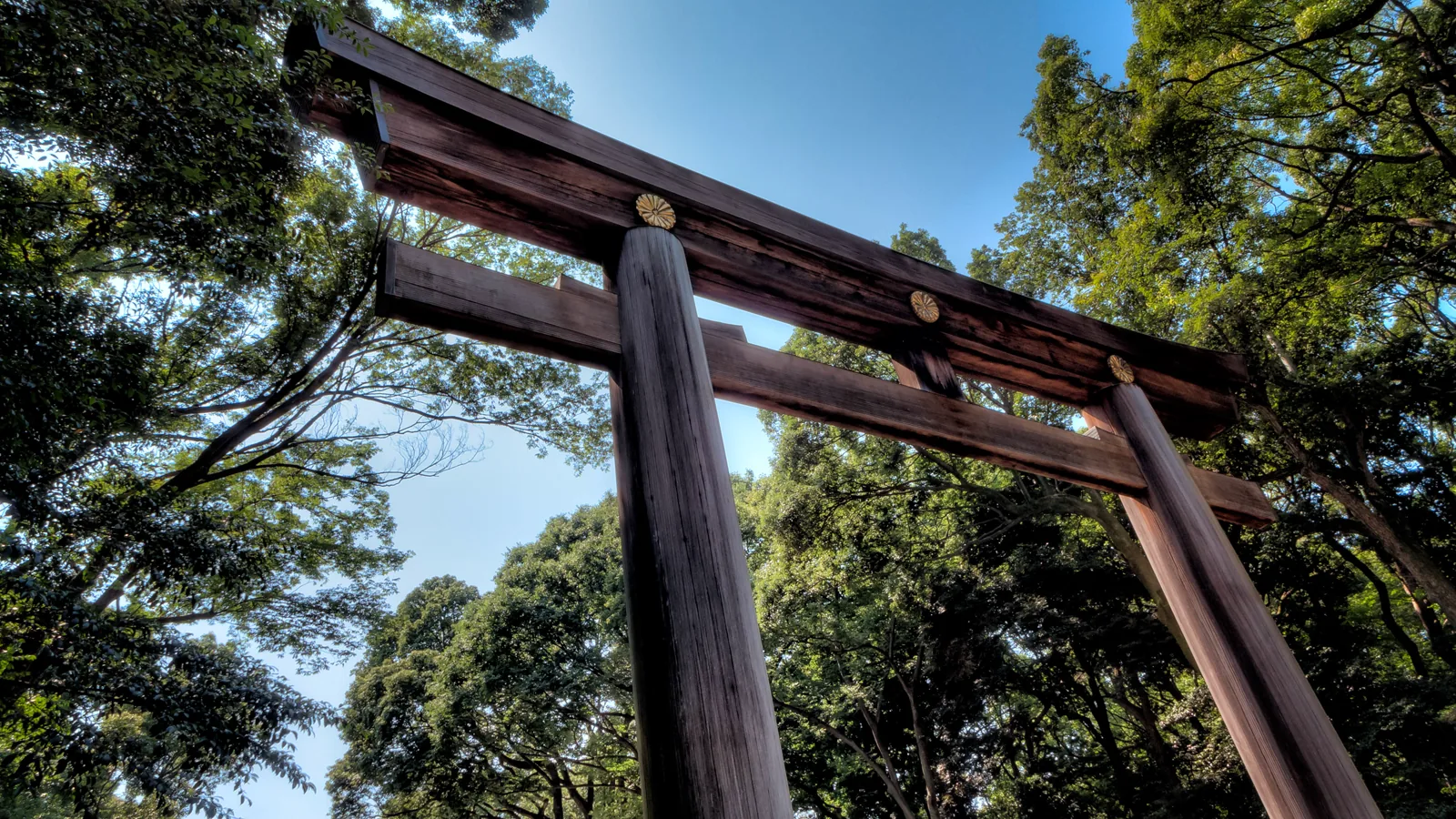
The first thing that marks the boundary is a gate. On the main southern approach from Harajuku stands the Great Torii: twelve meters tall, just over seventeen meters wide, its pillars over a meter thick, weighing thirteen tons. It is the largest wooden myojin-style torii in Japan.
The wood has its own story. It is Japanese cypress, hinoki, cut from a single tree over 1,500 years old on Mount Dandai in Taiwan. This is actually the second Great Torii. The first, raised in 1920, was struck by lightning in 1966; the current one was completed in 1975.
A torii is not decoration. It marks the line between the everyday world and a sacred one. Many visitors pause here and give a small bow before passing through, a gesture that is barely visible, but that Japanese people quietly notice. It is a way of saying: I know where I am now.
Then listen. As you pass under the gate and onto the wide gravel path, the sound changes. Your footsteps turn to a soft crunch. The traffic behind you fades into the trees. The temperature drops a degree. There is no wall and no door, just a gate and a forest doing what it was planted to do.
Step 2: The Forest Path
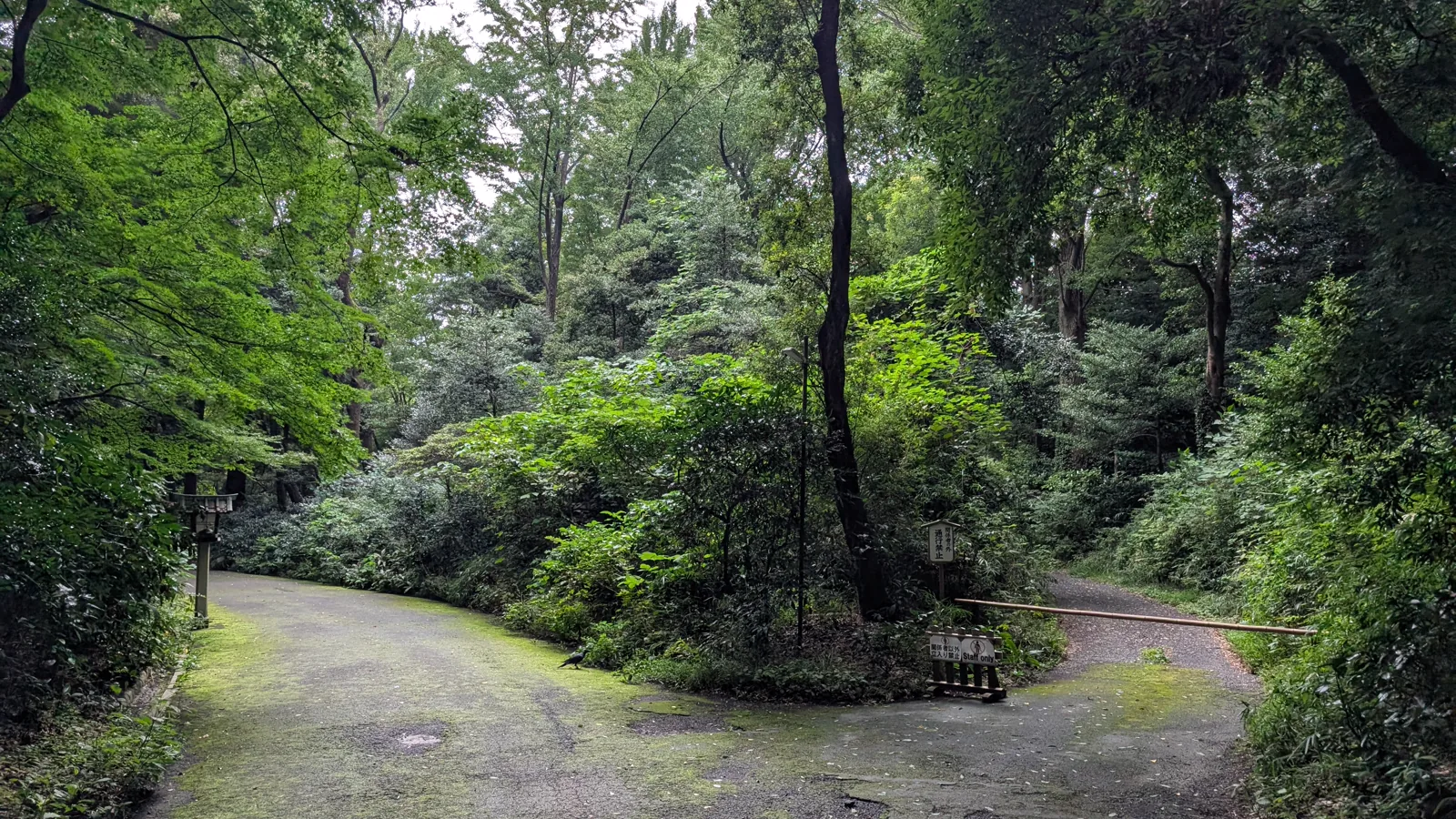
The walk to the main shrine takes about ten minutes from the entrance. For some visitors, this is a surprise: they expected the shrine to be right there, and instead there is a long, quiet path through trees. It is worth knowing this in advance, because the walk is not the wait before the experience. The walk is the experience.
Every tree along this path was donated. Not by the government, and not by a single wealthy patron, but by ordinary people from every part of Japan, who sent a tree to a shrine most of them would never visit. About 110,000 young volunteers then carried and planted them. When you look up at the canopy, you are looking at a forest that began as a hundred thousand separate acts of giving: trees sent from every part of Japan and grown together, over a century, into a single wood.
And no one tends it. There are no gardeners pruning these trees, no one raking these leaves into bags. The shrine deliberately leaves the forest alone so it can renew itself: fallen leaves become the soil, fallen seeds become the next generation. The result is a stillness most cities never hold. The quiet care that Japan tends to keep out of sight is, here, simply the absence of interference. The forest is clean because it is left whole.
If a Tokyo local walked in beside you for the first time, they would feel the same thing you do: the sudden width of the silence, the surprise that something this large is hidden behind a train station. You are not missing a secret everyone else understands. Everyone feels it.
Step 3: The Main Hall
At the center of the grounds stand the main shrine buildings. Before them you will find a large offering box and an open courtyard. The gesture most people make here is simple: two bows, two claps, one bow. The two claps are a kind of greeting, a way of letting the deity know you have come.
If you would like to pray, hold your hands together after the second clap and make your wish in silence, then bow once more. There is no wrong prayer, and there is no wrong visitor. The shrine itself answers the question plainly: yes, you may enter and pray even if you do not follow Shinto. Anyone is welcome.
If the sequence feels unfamiliar, do not worry about getting it perfect. A quiet moment with your hands together is completely enough. What is noticed here is your attention, more than the precision of your technique. (For a closer look at what Japanese people actually think when visitors pray at shrines, we have a whole article on it; the short version is that sincerity matters far more than form.)
Near the approach you may notice two walls of barrels. One is a stack of sake barrels, offered to the shrine each year. Facing them is a row of wine barrels from Burgundy in France, a nod to Emperor Meiji, who encouraged Japan to learn from the West during his reign. The pairing reflects the same openness that runs through this place: old and new, near and far, set quietly side by side.
One small thing to know: you may take photographs almost everywhere, but not directly in front of the main hall, where people are praying. Stepping slightly to the side to take your photo is all it takes.
Step 4: The Inner Garden and the Walk Back
There is one place inside the grounds that asks something extra of you, and gives something back. The Inner Garden, known as Gyoen, is a strolling garden that Emperor Meiji had designed for Empress Shoken. Entering it costs a 500-yen contribution toward its upkeep. (The shrine itself is free; this small fee is only for the garden.)
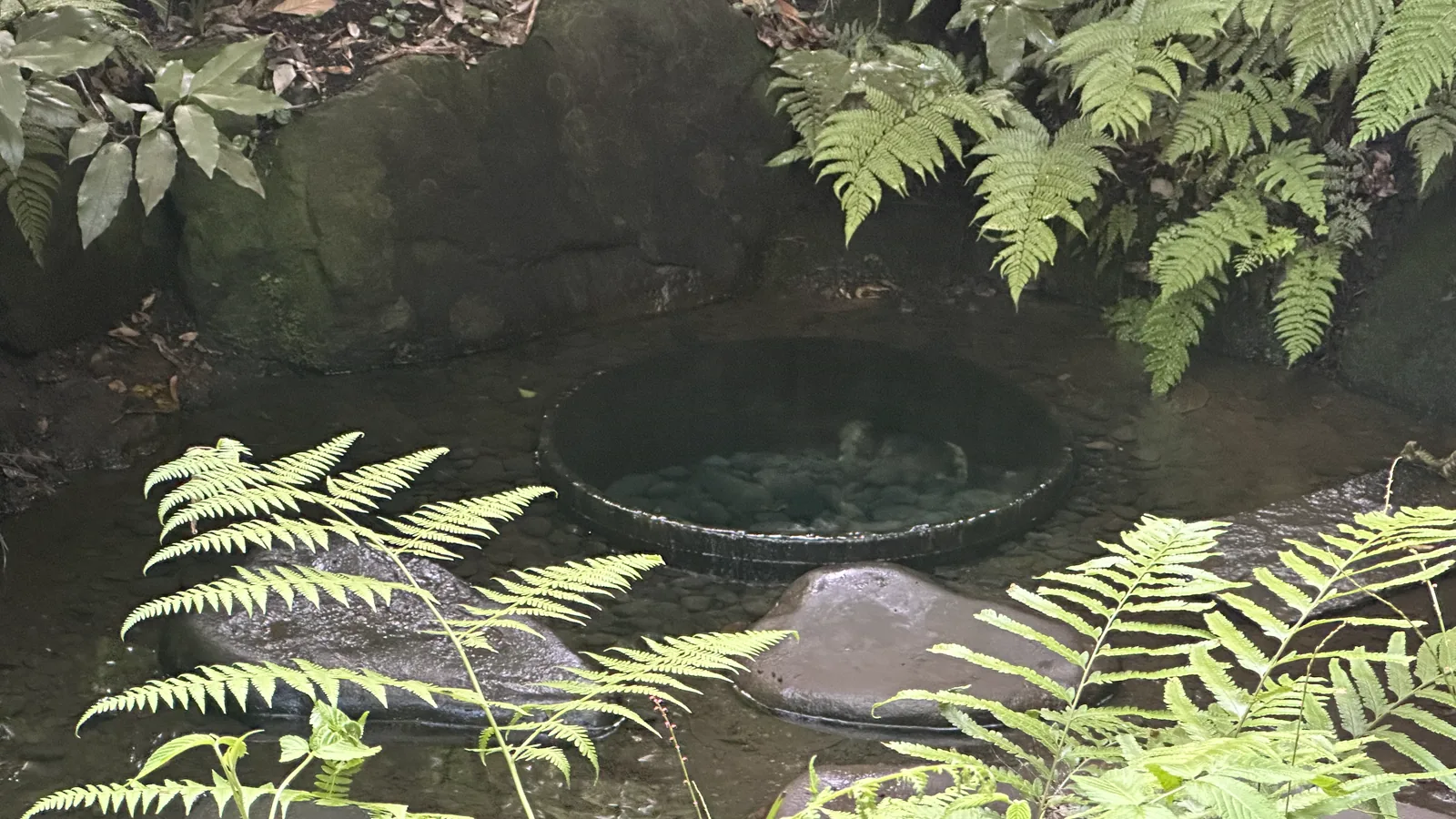
In June, its iris field comes into bloom (around 150 varieties, 1,500 plants), and the garden keeps longer hours to let people see it. But the garden's most visited spot flows year-round. Deep inside is Kiyomasa's Well, a clear spring said to have been dug four centuries ago by the warrior-lord Kato Kiyomasa. It gives about sixty liters of water a minute, holds steady at around fifteen degrees in every season, and has never run dry. People come to stand quietly beside it. There is nothing to do there but notice it: a small, cold, constant source of water in the middle of a forest that, itself, was made to last forever.
Then you walk back the way you came, back along the gravel, back under the Great Torii, and the city returns: the trains, the crowds, Harajuku exactly where you left it, and a short ride away the motion and noise of Shibuya, the forest's opposite. For an hour, you were inside a hundred-year ring of giving: strangers who planted trees, a garden made for one person, a well that keeps flowing. You did not just visit it. For a little while, you were part of it.
What Visitors Honestly Say
Before you plan the visit, it helps to hear from the people who have already made it. We gathered 70 voices from international travelers who had actually been to Meiji Jingu, weighted by how much each account resonated with fellow readers, and this is how they fell:
The thin red sliver is small, but nearly everyone in it made the same mistake: they came expecting drama. "Meiji is kinda meh if you're expecting lots of cool architecture and stuff, like I was," one wrote, "but the grounds are really relaxing to walk through." The travelers who loved it wanted the opposite thing and got it in full. "A quiet oasis right next to Harajuku and Omotesando," one wrote. "Walk the busy streets and then recharge in the shrine." The single most-upvoted voice put the whole calculation in one line: "If you visit one shrine in Tokyo, it should be Meiji Jingu."
Japanese visitors and locals, reviewing the same forest in their own words, land even more warmly:
Across 111 Japanese reviews, the red bar never moves off zero. Not one visitor came away feeling let down, because they arrive for exactly what is there rather than for a monument to tour. "So lush you'd never think it was Harajuku, truly an oasis in the city." "The air is crisp and dignified; you can worship while strolling slowly through nature." The honest edge, where it exists, sits in that middle band: "For all its size, there are no benches or rest spots, so it feels more like a walking course." "From the big torii to the main hall is just so far!"
The full picture, the letdowns included and what prevents each one, is in Is Meiji Jingu Worth It?
Good to Know
Getting there: Meiji Jingu has three entrances, each about a 10-minute walk through the forest to the main shrine. The main south approach is reached from Harajuku Station (JR Yamanote Line) or Meiji-jingumae 'Harajuku' Station (Tokyo Metro Chiyoda and Fukutoshin lines); this is where the Great Torii stands and where most people enter. The north side is reached from Yoyogi Station (JR / Toei Oedo Line) or Kita-sando Station (Fukutoshin Line). The quieter west approach is reached from Sangubashi Station (Odakyu Line). For more on navigating the city, see our guide to getting around Japan.
Hours and cost: Entry to the shrine is free, every day of the year. The grounds open at sunrise and close at sunset, which means the hours change every month: opening as early as 5:00 in midsummer and as late as 6:40 in winter, closing anywhere from about 4:00 in December to 6:30 in June. Because of this, always check the official monthly table before you go.
Time needed: Allow about an hour for the shrine itself, or around two hours if you also visit the Inner Garden and the Meiji Jingu Museum.
The Inner Garden (Gyoen): A 500-yen contribution toward maintenance. Open 9:00–16:30 (March–October) and 9:00–16:00 (November–February); during June it opens earlier, 8:00–17:00, until 18:00 on weekends, for the iris season. Kiyomasa's Well is inside.
What to wear: Comfortable shoes. The main approaches are long gravel paths. A paved route is available for strollers and wheelchairs; ask at the entrance.
When to visit: Early morning is the quietest time, when the light comes through the canopy and the paths are nearly empty. Meiji Jingu draws some of Japan's largest hatsumode crowds (the first prayer of the New Year), with the JNTO noting that nearly three million people come during the first days of January, so the first three days of January are extraordinarily crowded.
Photography: Permitted throughout, except directly in front of the main hall where people are praying.
Last verified: 2026-05
Official website: meijijingu.or.jp/en
If Things Don't Go as Planned
It's a longer walk than you expected. That is by design. The ten-minute forest path from the gate to the shrine is the point of coming here: you are walking through 100,000 donated trees. Slow down rather than rushing it.
You arrived and it's already closing. The hours follow the sun and change every month, which catches many visitors out, especially in autumn and winter when the gates close around 4:00. Check the official monthly hours before you set out, and on short winter days, come earlier than you think you need to.
It's too crowded to feel peaceful. Weekends and holidays draw large crowds, and the New Year is the busiest of all. Come on a weekday morning soon after opening, and you will often have whole stretches of the path nearly to yourself.
You're unsure how to pray. No one is judging your form, and you do not need to belong to any religion to take part; the shrine says so directly. Two bows, two claps, a silent moment, one bow. If you forget the order, a quiet pause with your hands together is perfectly respectful.
Kiyomasa's Well has a long line. On weekends the queue inside the Inner Garden can stretch out. It is shortest right after opening, and the garden itself (quiet, green, and almost empty early in the day) is worth the visit even if you decide not to wait for the well.
You expected something grander and it feels plain. Meiji Jingu is not gold or vermillion or carved with detail. Its scale is horizontal and green. If you came for spectacle, the plainness can feel like a letdown, until you remember that the spectacle here is the forest itself, and that every tree in it was carried in by hand and left to grow on its own for a hundred years.
Sources:
- Meiji Jingu Official Website: About: Founding date (Nov 1, 1920), enshrined deities, ~100,000 donated trees, 70-hectare man-made forest, "eternal forest"
- Meiji Jingu Official: The Forest (English): 110,000 volunteers, 234 varieties, design philosophy ("how it would look after 100 or 200 years"), no-human-intervention policy, Dr. Honda Seiroku
- Meiji Jingu Official: Q&A / FAQ: Great Torii dimensions (12m / 17.1m / 1.2m / 13t), Taiwanese cypress, 1966 lightning, 1975 rebuild, 365→234 species, 110,000 volunteers
- Meiji Jingu Official: Inner Garden (Gyoen): 500-yen maintenance contribution, garden hours, Kiyomasa's Well (~60 L/min, ~15°C), iris field (~150 varieties, 1,500 plants)
- Meiji Jingu Official: Worship Guide & Monthly Hours: Sunrise/sunset monthly open/close table, worship etiquette (two bows, two claps, one bow)
- Meiji Jingu Official: How to Visit & Access (English): Free admission, ~10 minutes from each entrance to the main shrine, anyone may visit regardless of faith, photography rule
- JNTO: Meiji Jingu: New Year (hatsumode) visitor context
- Nippon.com: Creating Serenity, The Forest of Meiji Shrine: Forest design history; foresters Honda Seiroku, Hongo Takanori, Uehara Keiji
- Is Meiji Jingu Worth It? (WMJS): The two visitor-voice gauges reproduced in "What Visitors Honestly Say" (70 international voices, 75/16/9; 111 Japanese voices, 82/18/0) and the verbatim visitor quotations
Image credits: Great Torii and forest path: CC0 / public domain via Wikimedia Commons. Kiyomasa's Well: photo by Nesnad, CC BY 4.0, via Wikimedia Commons.
WMJS is written in Japan, in English, with AI help. We check every page, but English is not our first language. If a sentence reads oddly, tell us. One sentence is enough.
Thank you. A person reads every note.
Real voices
Is it worth it?
Were you there? Share your photos.
Your photo could appear in this guide — with your name and a link to your profile.
Submit a photoRelated Articles
Visiting Temples and Shrines: What Japanese People Notice

The Power of a Small Bow: Why a Simple Nod Makes Japanese People Smile
"Excuse Me, Can You Take My Photo?": What Japanese People Really Think
More guides in Kanto
Visiting Akihabara, Tokyo's Electric Town Where You're Allowed to Love What You Love
Is Akihabara worth visiting? We weighed 149 traveler voices: 29% say yes outright, 44% say it depends on whether you love anime, games or electronics, and Japanese reviewers land warmer at 69%. How the district is laid out, getting there, and who it's for, with an audio guide.
Akihabara (Electric Town)
Visiting Harajuku, Where You Can Wear Anything and No One Turns to Look
Is Harajuku worth it? We counted 99 traveler voices: 64% say yes once you skip Takeshita Street's crush for Cat Street and Omotesando. Crepes, kawaii fashion, getting there, and how to walk it well, with an audio guide.
Harajuku
Visiting Senso-ji, Tokyo's Oldest Temple
Is Senso-ji worth visiting? We weighed 125 traveler voices: 54% say worth it outright. Hours, free admission, how long you need, and why the crowd has always been part of the prayer, with an audio guide.
Senso-ji Temple
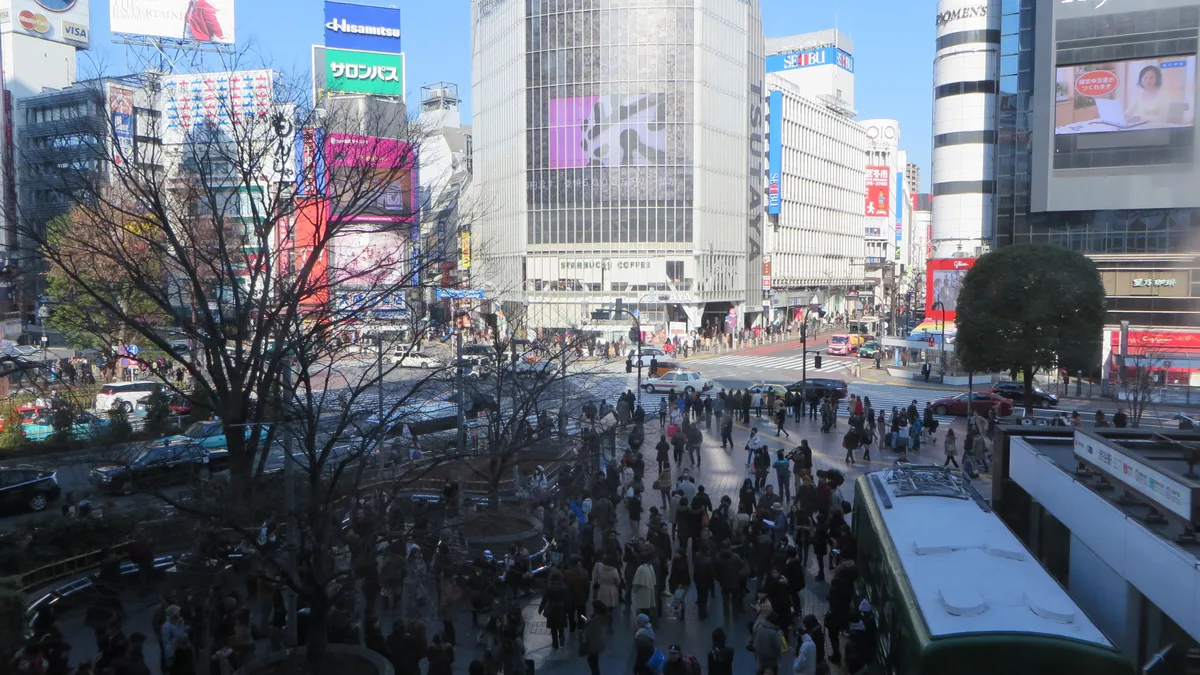
Shibuya — The Crossing No One Directs, and the Dog Who Never Stopped Waiting
An audio walking guide to Tokyo's Shibuya, verified against official sources — the Scramble Crossing, the Hachiko statue, Shibuya Sky, and how to walk it.
Shibuya