
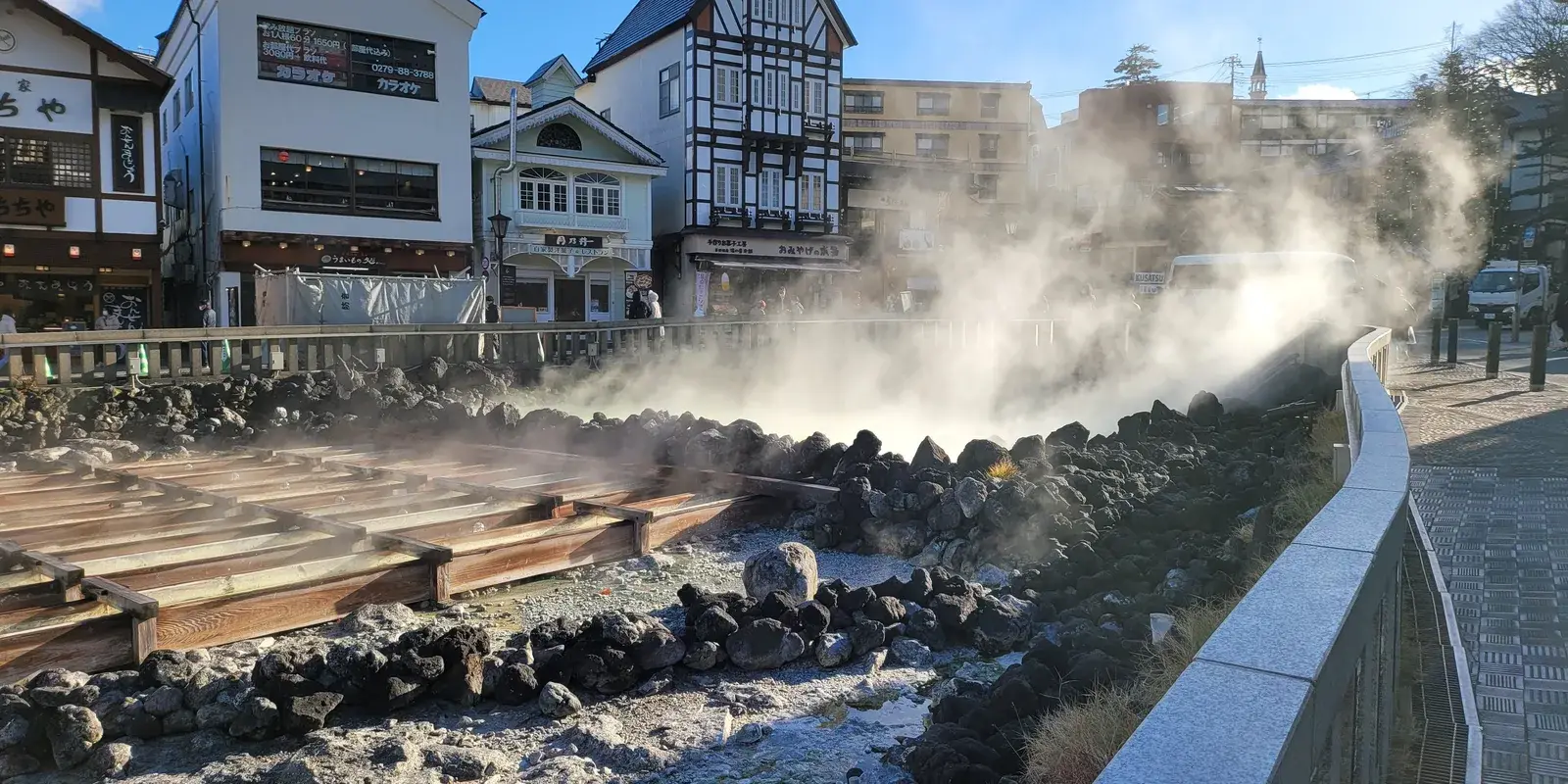
Is Kusatsu Onsen Worth It? Visitors From Abroad and From Japan Mostly Felt the Same Way
Getting to Kusatsu from Tokyo takes about two and a half hours on the direct express train from Ueno, then another 25 minutes by bus. Before you spend a day or a night there, it is fair to ask whether the people who went were glad they did.
We gathered 111 posts by visitors from abroad. In 93 of them, the writer was happy with the trip. In 14, the writer had mixed feelings or a reservation, and in 4 the writer was let down. The 249 Japanese reviews are all about Yubatake, which is the hot spring field in the middle of town. They fall into the same three groups in almost the same proportions, with 199, 43 and 7. None of the four writers from abroad who were let down complains about the baths. For one it was the travel time, for another the smell and the prices, and for a third the lack of things to do besides bathing. The fourth advises against bringing young children. In the Japanese reviews, the main reason for disappointment is the crowds.
Is it worth it? (in visitors' own words)
We gathered posts by visitors from abroad who have been to Kusatsu. They come from TripAdvisor, from Google Maps reviews written in languages other than Japanese, from Reddit, and from the Japan travel board of a Taiwanese online forum. We sorted them by how each writer felt after the trip.
The red band is four posts, and each writer gives a different main reason. One commenter on Reddit liked the town but not the distance: "Kusastu is great but an 8 hour roundtrip is not worth it." A second stayed two days and one night and tried the temple, the traditional show, a public bath and a ryokan. This writer called it "Kinda overrated, I would give a 5/10," naming the sulfur smell and the prices of food and coffee. A visitor from Athens who went in June 2015 could not go up to the volcano, because there was no bus service at the time out of concern about an eruption. This visitor found that "the city didn't seem it had anything to offer other than ryokans with spas." The fourth writer, who went in October 2015, would "not recommend coming here with young children."
In the 14 posts in the middle band, the writers had mixed feelings or a reservation. Two felt they stayed longer than they needed. A visitor from the Sunshine Coast spent two nights and wrote, "One full day is plenty of time." One writer on Reddit who prefers Kusatsu to Arima still added, "Personally, I prefer Kusatsu, but a six-hour round trip might not be worth it." Three mention crowds, among them a traveler from Singapore who wrote that "lunchtime was crowded and difficult to find a seating." Two found Yubatake a little underwhelming once they had seen it. One warned about the strength of the water: "Kusatsu onsen is very famous and indeed very strong, compared to others I've been in Japan. Be careful not to let it get into your eyes as it may hurt a bit!"
One visitor in the green band was glad to have gone despite the long journey. This visitor wrote on the Taiwanese forum about a day trip as a couple. After a ride with a change of transport on the way, the two of them had only about three and a half hours in Kusatsu. Looking back on the whole holiday, the couple liked that day best.
What Japanese visitors say
The second gauge comes from reviews of Yubatake that Japanese visitors wrote in Japanese on jalan and 4travel, two Japanese travel review sites.
The green bands are 84% of the 111 posts from abroad and 80% of the 249 Japanese reviews, and the red bands are 4 of the 111 posts and 7 of the 249 reviews. The Japanese red band is 7 reviews, and in four of them the main reason is crowds or queues. One reviewer, back for a second visit on a weekday, was surprised how much busier Yubatake had become and nearly missed a step on the wooden stairs going down. Another found it hard to take a photo because of the crowds. With so many places to eat and drink, this reviewer also felt the area was in a way more like an entertainment district than a calm hot spring town. A third wrote, "During the day it's just packed with people. If you want to visit Yubatake, I'd recommend the middle of the night or early morning." The fourth arrived at lunchtime and spent two hours looking for a meal: "every kind of restaurant had a huge line... I was disappointed since I'd been looking forward to it."
Of the other three, one found Yubatake smaller than expected, and one noticed closed shops a short walk from the center. The third found Yubatake ordinary, exactly as it looks in photos, and wrote, "The souvenirs were mostly just manju buns, not much variety. The yumomi show wasn't that interesting either. I think once is probably enough..."
Crowds are also mentioned in 18 of the 43 reviews where the writer had mixed feelings. Across all 249 reviews, two reviewers found few people in the morning. Two more suggest going early to avoid the crowds, and two recommend dawn or early morning for the light and the atmosphere. Reviewers who went at night disagree. Two found it uncrowded after dark, one around 9pm on a Saturday and one on a rainy weekday, and three more suggest that it is quieter once the day-trippers have left or late at night. Ten describe it as busy at night. Four of them went after dinner or on a weekend or holiday, and the others say it is busy at night or day and night. The Saturday reviewer wrote: "When I went at night (around 9pm), it was uncrowded and I could take my time looking at the lit-up Yubatake, which was great."
What both groups write about
Both groups also write about the same things. Yubatake at night is the clearest example. It comes up in 23 of the 111 posts from abroad and in 73 of the 249 Japanese reviews. One visitor, writing in French on Google Maps, said it is above all at night that the place becomes magical, "avec les illuminations et l’atmosphère animée" (with the lights and the lively atmosphere). A Japanese reviewer wrote about the same evening view: "Yubatake at night is lit up and looked very dreamlike. It has a different charm from the daytime."
The sulfur smell is the other thing both groups bring up. It is mentioned in 13 of the posts from abroad. For one of the four writers who were let down, it was among the reasons, and two more writers mention it as a drawback or a condition. One of the other writers wrote, "you get used to it after a while," and a visitor writing in Korean on Google Maps found the smell strong and still called the town charming. The smell is mentioned in 44 of the Japanese reviews. In 13 of those reviews the writer calls it strong, harsh or overwhelming, and in 11 of those 13 the writer was happy with the visit. In none of them is it given as a reason for disappointment. One reviewer wrote, "The smell of sulfur makes you really feel 'ah, I've come to a hot spring town.'" Another suggested that people who aren't used to it might find it hard.
What we wish you'd noticed
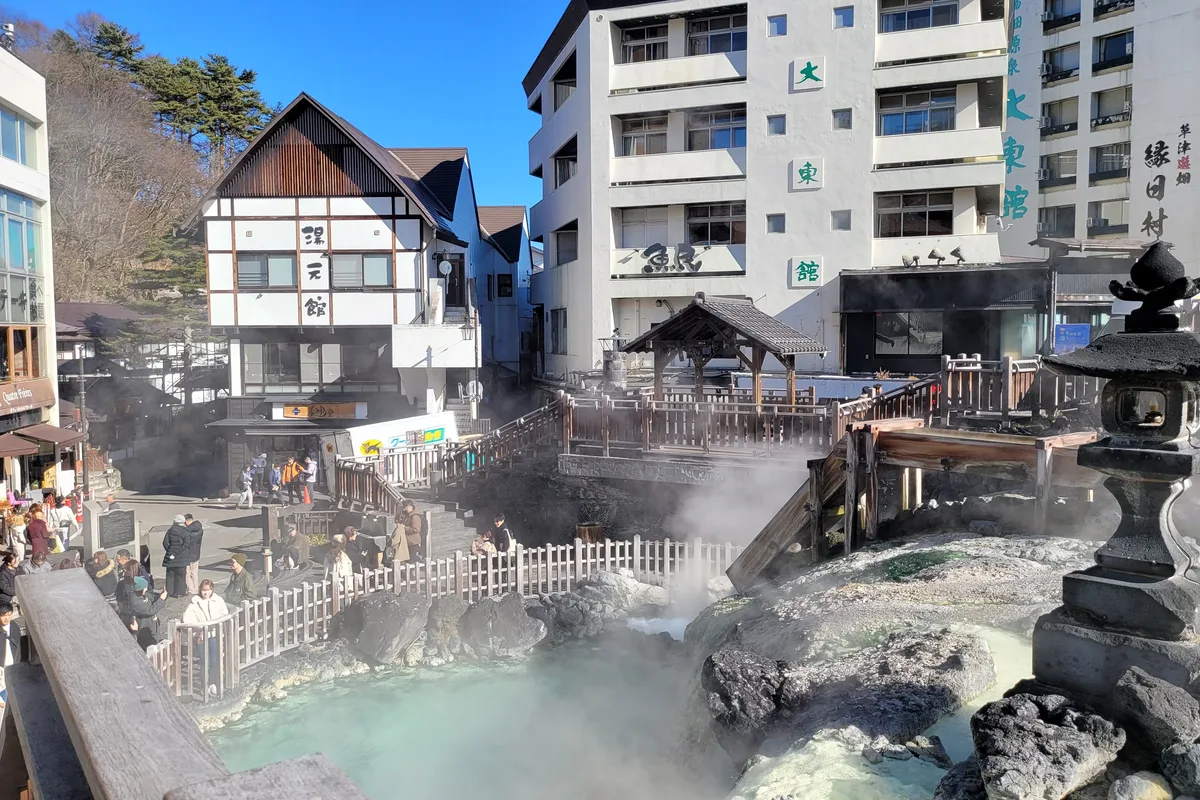
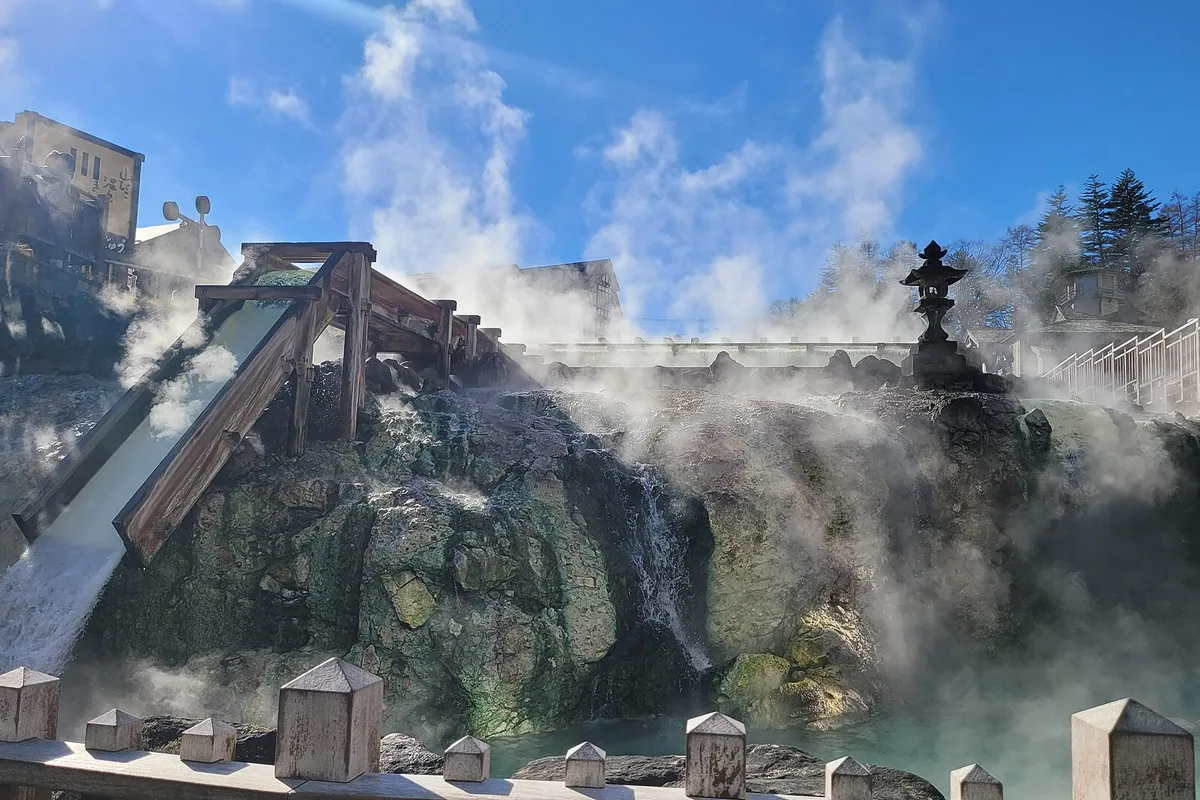
Yubatake is where the spring comes up, and it is not for bathing. Japan's national tourism organization says the water rises straight from the source. It then cools as it runs along a series of connected wooden chutes and keeps its natural mineral content. The Kusatsu Onsen Tourism Association lists two free footbaths at Yubatake, both open 24 hours: Yukemuri-tei, a wooden pavilion at the side of Yubatake, and Taki no yu, in front of the waterfall at the end of the chutes.
The water is strongly acidic. Kusatsu Town describes its springs as acidic at around pH 2.0. It adds that a traditional nail five sun long dissolves in the hot spring stream in about ten days (sun is an old Japanese unit, and five sun is about 15 cm). The tourism association gives pH 2.1 for the Yubatake source and describes the acidity as among the highest in Japan. The association also says Kusatsu has the largest amount of naturally flowing hot spring water in Japan, more than 32,300 liters a minute, which would fill about 230,000 oil drums a day.
You can bathe in several places in town. Kusatsu Town says it has 19 public bathhouses and opens some of them free of charge. These baths were set up for the daily life of local residents, who also look after them, and the tourism association asks visitors to follow the bathing manners there. The association lists three that are free for visitors:
- Shirahata no yu, right beside Yubatake, 8:00 to 23:00
- Chiyo no yu, two minutes' walk from Yubatake, 6:00 to 23:00
- Jizo no yu, three minutes' walk from Yubatake, 8:00 to 22:00
None of them has lockable lockers, and the association asks visitors not to bring valuables. Each closes for cleaning at times, mostly in the morning.
Otakinoyu and the open-air Sainokawara bath are two of the three day-use baths run by the Kusatsu Tourism Public Corporation. As of October 2026, Otakinoyu costs 1,200 yen for adults and is open from 9:00 to 21:00, with last entry at 20:00. The Sainokawara bath costs 800 yen. It opens at 7:00 from April through November and at 9:00 from December through March, and closes at 20:00, with last entry at 19:30. On the second Wednesday of each month, it closes at 17:00 for cleaning. Both sell a face towel for 380 yen, and Otakinoyu also rents a towel set for 250 yen.
At the Netsunoyu hall in front of Yubatake, you can watch yumomi and dance. Kusatsu Town calls yumomi one of the town's old bathing methods. The tourism association lists shows through 30 November 2026 at 9:30, 10:00 and 10:30 in the morning and at 15:30, 16:00 and 16:30 in the afternoon, with an extra 15:00 show on some days in October. Adults pay 700 yen and elementary school children 350 yen, and ticket sales open 30 minutes before each show. Five Japanese reviewers write about yumomi, watching the show or trying it. One of them is the reviewer quoted earlier who found the show not that interesting. Another reviewer went with a child, who said it was amazing. That reviewer was surprised by how long the line was before the show started.
Doing it well, the welcomed way
Visitors who went disagree about how long to stay. The couple in the Taiwanese forum post went on a day trip and liked that short day best. A visitor from Vermont stayed three nights and wrote, "Once you are here do stay a while." Of the two visitors mentioned earlier who felt they stayed longer than they needed, one had spent two nights, and the other had spent three days. If you want to see Yubatake at night, staying one night is the easiest way.
If you can, walk around Yubatake early in the morning, when two of the Japanese reviewers had space to stand and look. At night, how busy it is changes from one evening to the next, as the reviewers quoted earlier found. On the wooden stairs around Yubatake, watch the step edges on the way down, where one reviewer nearly missed a step.
The traveler from Singapore and the Japanese reviewer who searched for two hours were both there at lunchtime, so lunch may be easier a little before the usual lunch hour. The same Japanese reviewer found some shops closing soon after 1pm. If you are staying the night, a Japanese reviewer who has been several times suggested that "it might be easier to just have dinner at your hotel."
For bathing anywhere in Kusatsu, the Kusatsu Tourism Public Corporation suggests pouring hot water over your head and neck before you get in, starting with a half-body soak, and keeping the first soak to about 5 to 10 minutes. The visitor quoted earlier also warned that the water "may hurt a bit" if it gets into your eyes.
One Japanese reviewer noted that the water in the free public baths is very hot and that there are no towels or soap. Since visitors are allowed to use them free of charge, the reviewer asked that people use them considerately. Another reviewer wrote that the walk from the parking lot can be hard with children, and that hotels run their own shuttle buses for guests. One visitor from abroad warned that the water in the footbath next to Yubatake is really hot. Both footbaths at Yubatake are open day and night, for a short soak whenever you pass.
Choosing between onsen towns? We count posts from abroad and Japanese reviews the same way for Kinosaki, Beppu, Arima and Gero, and every gauge is listed in what actually matters in Japan.
Sources
- Kusatsu Town, About Kusatsu Onsen (Official, updated 2025-04-04): strongly acidic water at around pH 2.0, the five-sun nail that dissolves in the hot spring stream in about ten days, and the 19 public bathhouses of which some are opened free of charge
- Kusatsu Town, Yumomi and Dance (Official, updated 2025-03-28): yumomi as one of the town's old bathing methods, and the yumomi and dance show at Netsunoyu in front of Yubatake
- Kusatsu Onsen Tourism Association, Kusatsu Onsen (Official): naturally flowing volume of more than 32,300 liters a minute (about 230,000 oil drums a day), the largest in Japan, and pH 2.1 for the Yubatake source with acidity among the highest in Japan
- Kusatsu Onsen Tourism Association, Netsunoyu (Official): yumomi shows at 9:30, 10:00, 10:30, 15:30, 16:00 and 16:30 through 30 November 2026 (viewed 2026-10-18), the extra 15:00 show on some October days, admission 700 yen for adults and 350 yen for elementary school children, ticket sales from 30 minutes before each show
- Kusatsu Onsen Tourism Association, Yukemuri-tei footbath (Official, 2025-12-25) and Taki no yu footbath (Official, 2025-12-28): free footbaths at Yubatake, open 24 hours
- Kusatsu Onsen Tourism Association, Shirahata no yu (Official, 2025-12-25), Chiyo no yu (2025-12-25) and Jizo no yu (2025-12-28): free public baths: Shirahata no yu beside Yubatake (8:00 to 23:00), Chiyo no yu two minutes' walk away (6:00 to 23:00) and Jizo no yu three minutes' walk away (8:00 to 22:00), cleaning mostly in the morning, no lockable lockers and the request not to bring valuables, and the request to follow the manners of baths set up for local residents
- Kusatsu Tourism Public Corporation, Otakinoyu guide (Official): open from 9:00 to 21:00 with last entry at 20:00, admission 1,200 yen for adults, face towel 380 yen and towel-set rental 250 yen
- Kusatsu Tourism Public Corporation, Sainokawara open-air bath guide (Official): open from 7:00 (April through November) or from 9:00 (December through March) to 20:00 with last entry at 19:30, admission 800 yen for adults, face towel 380 yen
- Kusatsu Onsen Tourism Association, Sainokawara early closing notice (Official, 2026-05-12): closing at 17:00 (last entry 16:30) on the second Wednesday of each month for cleaning
- Kusatsu Tourism Public Corporation, How to bathe in Kusatsu (Official): pouring hot water over the head and neck first, a half-body soak to start, and a first soak of about 5 to 10 minutes
- Japan National Tourism Organization, Kusatsu Onsen: water that rises straight from the source and cools along connected wooden chutes while keeping its natural mineral content, and access from Tokyo by direct express train from Ueno and bus
Last verified: 2026-10
WMJS is written in Japan, in English, with AI help. We check every page, but English is not our first language. If a sentence reads oddly, tell us. One sentence is enough.
Thank you. A person reads every note.
How well do you know Japan?
Built from 635 public posts by Japanese people
Want to know more? Ask Japanese people
Have a follow-up question about this topic? We'll ask real Japanese people.
Voice Box →