
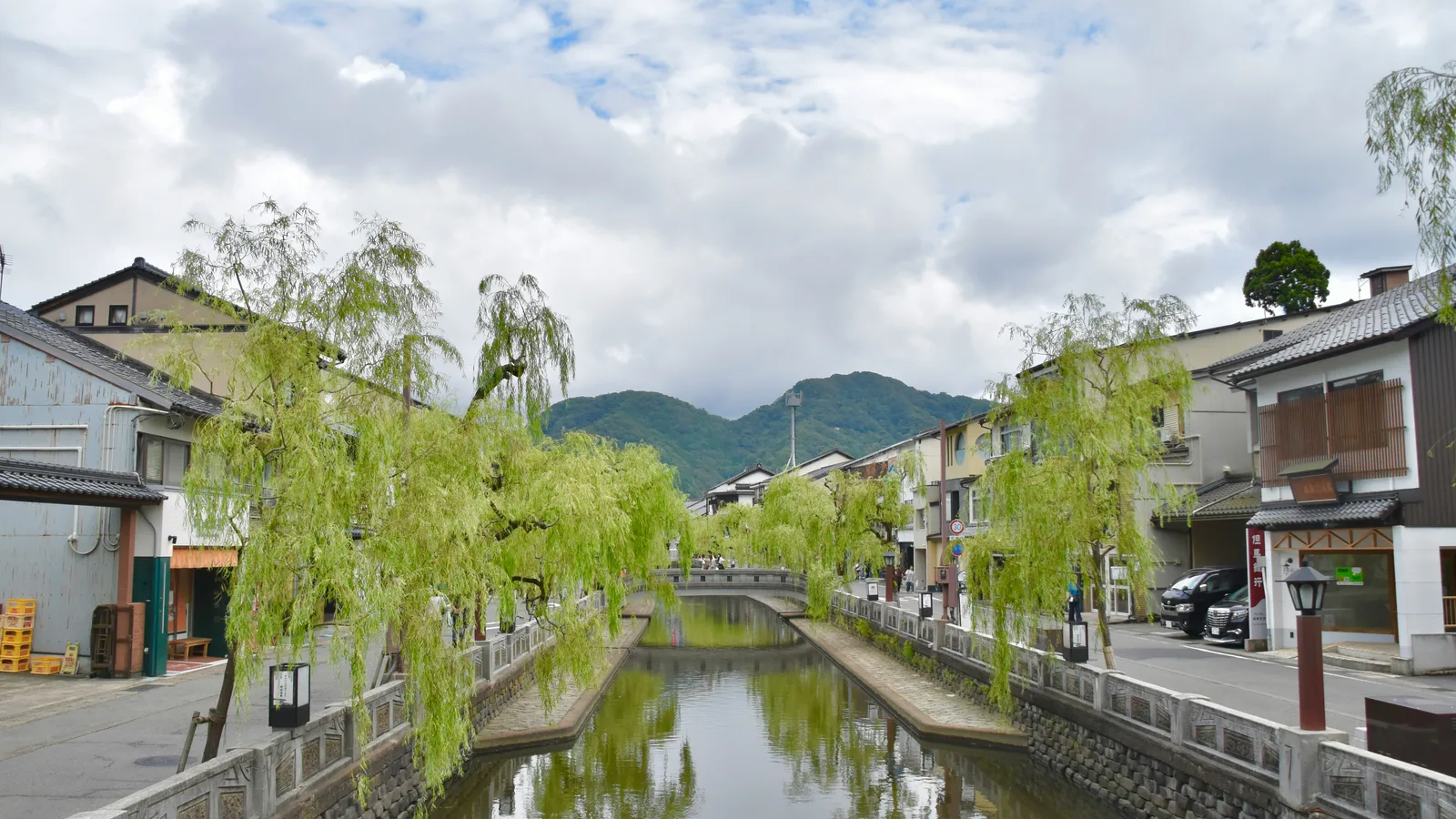
Visiting Kinosaki Onsen, Where the Whole Town Is a Single Inn
Kinosaki Onsen (Otani River)
By Kei · Born and raised in JapanIs Kinosaki Onsen worth it? By the voices we gathered, yes, and the town rarely disappoints once you commit to staying the night. Of 84 international travelers who made the trip, weighted by how much each account resonated with fellow readers, 69% called it a highlight worth the detour, 19% said it depends on how many nights you give it, and only 12% felt let down. Japanese visitors and locals, reviewing the very same seven baths, land close behind at 67%. Almost every doubt traces back to timing, arriving early enough in the afternoon, and not overbooking the nights. What visitors actually said, the disappointed included, is further down this page.
The Meaning
Arrive in Kinosaki in the evening and the first thing you notice is the sound: wooden clogs, geta, knocking softly against stone as people in cotton robes drift along a willow-lined canal, crossing little arched bridges from one bathhouse to the next. They are not in costume, and they are not lost. They are doing the most ordinary thing this town has to offer: walking, in their yukata, from one bath to another, as if the whole place were a single building and these were its halls.
That is, in fact, how Kinosaki describes itself. For generations the town has explained itself with one quiet idea: the whole town is a single inn. The station is the entrance. The streets are the hallways. The inns are the guest rooms. And the seven public bathhouses, the sotoyu, are the great shared bath. The shops are the gift counter; the restaurants, the dining hall. You do not check into an inn and stay inside it. You check into the town.
This is why the bath here is not a private luxury but a shared one. A sotoyu is, by definition, a bath outside your inn, a bath the whole town and all its visitors soak in together. People have been coming to soak and heal in this valley for some thirteen hundred years; one of the springs is said to have been found when an injured stork landed to bathe its wounded leg, and another when a wandering monk prayed here for a thousand days. The writer Shiga Naoya came after a near-fatal accident to recover, and wrote that here, watching small lives and deaths by the river, he came to feel that living and dying were not opposites but close neighbors. Kinosaki has always been a place you come to mend. The town takes you in, hands you a robe, and lets you heal at its own slow pace: one inn, with many rooms of warm water, that happens to have its hallways open to the sky, rather than a checklist of seven baths to conquer.
What Happens When You're There
Step 1: Arriving in the Valley
The way in is by rail, through the mountains of northern Hyogo. From Osaka the limited express Kounotori, named, fittingly, for the stork, curves up through Fukuchiyama; from Kyoto the limited express Kinosaki runs out along the San'in line. Either way the cities fall behind, the hills close in, and after a couple of hours the train sets you down at a small station with a name that is also a promise: Kinosaki Onsen.
Step out and the town is already there at your feet. There is no transfer, no long approach: within a few minutes' walk the main street opens onto the Otani River, a slim canal lined with weeping willows and crossed by low, arched stone bridges. The whole town is built along this water, a single gentle street you can walk end to end in not much more than a quarter of an hour. This compactness is the point. You will not need a bus or a taxi once you are here; you came to walk.
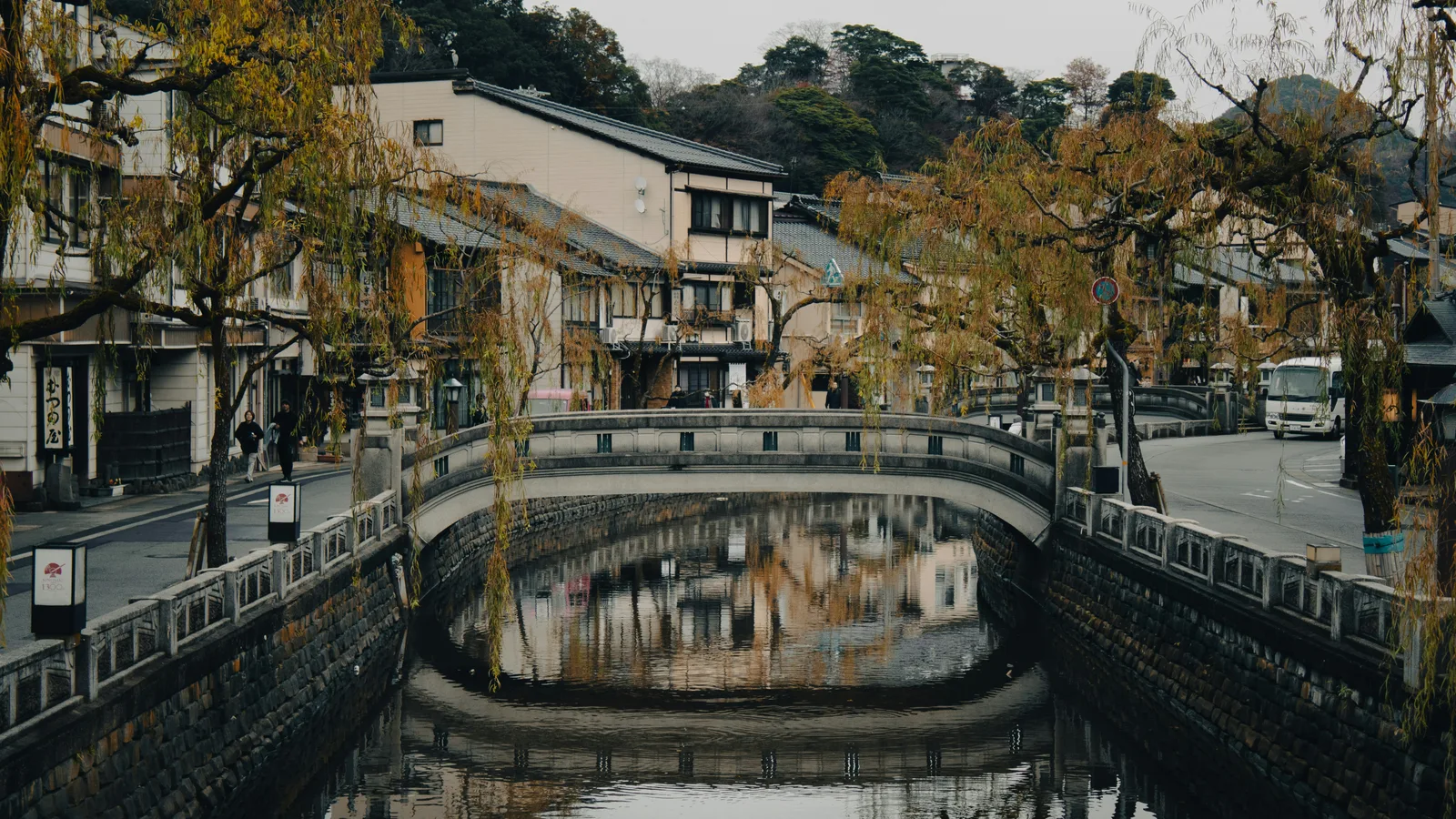
It helps to slow down right away. Drop your bag, and resist the urge to plan a route. Kinosaki is not a place you get through efficiently. The town is asking you, from the moment you arrive, to do the one thing most travel does not allow: nothing in particular, slowly, by the water.
Step 2: Becoming a Local in Yukata
The first thing you do at your inn is change. Most inns lay out a yukata (a light cotton robe) and a pair of geta, and in Kinosaki you wear this out into the town rather than keeping it behind your room door. Slip it on, step into the clogs, and walk out the front door dressed exactly like everyone else on the street.
It will feel strange the first time, and that is worth saying plainly: it feels strange to almost everyone, Japanese visitors included. The robe never seems to close quite right; the geta clack and slide and take a few minutes to trust. No one expects you to have the knack. If the robe slips, the front desk will happily set it right, and the rule of thumb most people learn, left side folded over the right, is the only thing you really need to remember. The art of wearing one well is its own small craft worth knowing, but here, getting it roughly right and stepping outside is the whole of it.
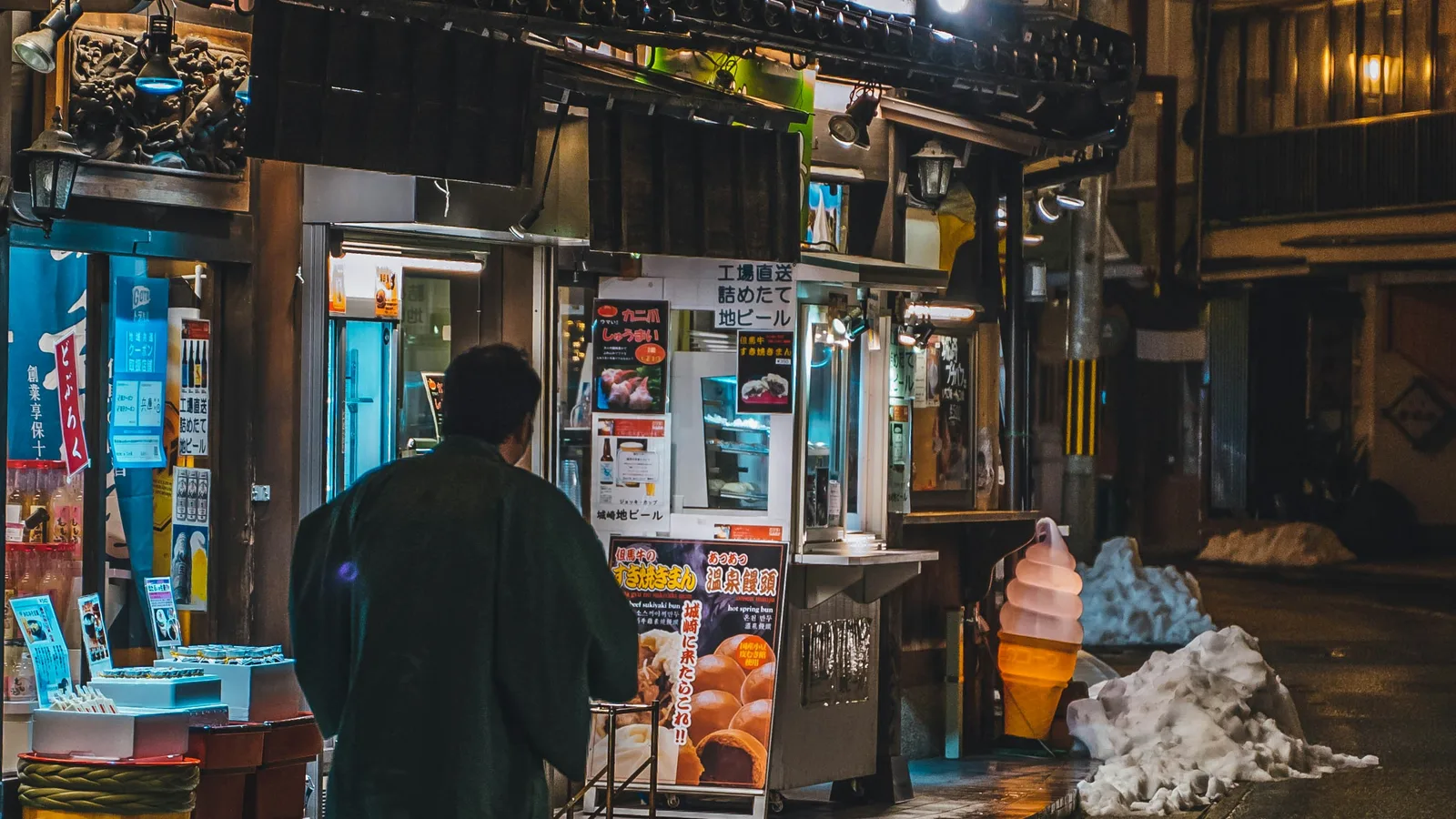
What changes once you are out in it is hard to describe until it happens. In most of Japan, a yukata worn in public would mark you as a tourist or a festival-goer. In Kinosaki it marks you as a guest of the town: someone the place has taken in for the night. The robe is the town's way of saying you belong inside it. The fuller customs of the inn that lent it to you, the welcome and the meals and the small kindnesses, are a quiet world of their own; but the moment you are out the door in cotton and clogs, you have already become, for a night, a local.
Step 3: The Bath-Hopping Night
Now the canal makes sense. With a small basket for your towel under one arm, you walk from bath to bath through the evening, and the seven sotoyu reveal themselves not as seven separate attractions but as the scattered rooms of that single great bath the town keeps talking about. Each has its own character and its own old blessing: a bath said to grant a long and happy marriage, found where the stork healed its leg; one whose waters are remembered as the birth of the whole spring, where the monk's thousand days of prayer were answered; a "beauty" bath under borrowed mountain views; the "number one" bath an old physician once judged the finest in the land. You lower yourself into water kept at a steady, warming heat, and beside you are other guests of the town and people who have lived here all their lives, soaking in the same pool.
That sharing is the quiet heart of it. The reason to leave a perfectly good bath at your inn and pad out into the cold in a thin robe is precisely that the sotoyu is not yours alone. It belongs to the town, and tonight, so do you. If you have ever wondered what is actually going through everyone's mind in a Japanese bath (the rinsing first, the small towel, the etiquette no one announces), that is a world worth understanding before you go in, and a few minutes of reading will make the whole evening easier. One kindness particular to this town: every one of the seven public baths welcomes visitors with tattoos, which is far from true everywhere in Japan, though an inn's own private bath may still have its own rule, so it is worth knowing how tattoos and onsen fit together and asking at the door of your inn.
Here is the part the guidebooks tend to get wrong. They lay the seven baths out like a stamp card, something to be completed before you leave, and it is easy to spend your one evening half-rushing, counting. You do not have to. The baths keep different hours, and they close on different days of the week for cleaning, so on any given night one or two will be dark, and that is fine. No one finishes all seven and feels they have won. Soak in two, or three. Sit on a bridge between them in your robe and let the heat fade slowly in the night air. You will not have missed Kinosaki. You will have understood it.
Step 4: Strolling Between the Baths
The walking between the baths is not the gap in the evening. It is the evening. This is what the town means by sozoro-aruki, strolling with no particular aim, and once you stop hurrying toward the next bath, the canal fills up with small pleasures. The willows trail over the water. The arched bridges throw their shapes under the lanterns. The clatter of everyone's geta becomes a kind of soft, communal music you are now part of.
There are things to eat as you go: a cup of local ice cream, an egg slow-cooked in spring water, the old straw-craft trinkets in the shop windows, and eating a little something on a stroll like this is gentler on the local sense of things than it would be on a crowded city street, though it is always worth knowing how walking and eating sit together in Japan. In winter the whole picture changes: snow gathers on the bridges and the willow branches, people pull a haori jacket over their robes against the cold, and the town fills with the season's great delicacy, the snow crab pulled from the nearby sea. Whatever the month, the lesson is the same. The point was never to get anywhere. The point was the walk.
Step 5: The Morning Bath
Go out once more in the early morning, before breakfast, while the street is nearly empty. The bath you choose will be quiet, the water clear and untroubled, and for a little while it may feel as though the whole town's great shared bath has been left open just for you.
And here, finally, the small mystery of the place answers itself. Your inn had a perfectly good bath. Why did you spend the night going out, in a borrowed robe and clattering clogs, to soak in the town's water instead? Sit in the morning quiet and you will feel the answer rather than have to be told it. You came to be taken in: to spend one night not as a visitor passing through but as a guest of the whole town, sharing its water, walking its halls, healing a little at its pace. That is what the stork found here, and the monk, and the writer who came to mend. You do not have to bathe in all seven baths to understand Kinosaki. Walk the canal once in your yukata, soak once in a bath the whole town shares, and you have already had the whole of it.
What Visitors Honestly Say
Before you decide how many nights to give it, it helps to hear from people who already made the trip. We gathered 84 voices from international travelers who had been to Kinosaki, weighted by how strongly each account resonated with fellow readers, and this is how they fell:
One traveler on a packed schedule called it "probably my favorite memory from the entire trip," and added, "I would pick Kinosaki over Osaka." The middle band is mostly a scheduling question rather than a doubt: "One night in Kinosaki is worth it, but two is overkill," one wrote, while another admitted feeling "onsen-ed out after 2-3 spots."
Japanese visitors and locals, reviewing the same seven baths in their own words, land close behind:
They rarely ask whether Kinosaki is worth it; they call it "the kind of place that makes you want to go back again and again." Their neutral band is entirely practical, timing the baths' rotating hours rather than doubting the town: "next time I'd like to arrive around 3pm so we can enjoy the baths at a relaxed pace," one wrote.
The full picture, the let-downs included and what usually prevents each one, is in Is Kinosaki Onsen Worth It?
Good to Know
Getting there: Kinosaki Onsen sits in the north of Hyogo Prefecture, near the Sea of Japan, on the JR San'in Main Line. From Osaka, the limited express Kounotori reaches Kinosaki Onsen Station in roughly two and a half to three hours; from Kyoto, the limited express Kinosaki takes about two and a half hours. All of these limited expresses require a reserved or non-reserved express seat in addition to a basic fare, so it is worth booking ahead in busy seasons, and a Japan Rail Pass or JR West area pass can be used on them. The station sits at the eastern end of the town, and everything is on foot from there: it is about a fifteen-minute walk from the station to the farthest of the seven baths at the western end. For the wider picture of trains, passes and reservations, see getting around Japan.
How the baths work (sotoyu meguri): The town has seven public bathhouses, each charging the same modest entry fee for a single visit. If you are staying overnight, almost every inn gives its guests a free pass to all seven baths at check-in, valid until check-out; this is the usual way to bathe here. Day visitors can instead buy a one-day pass (Yumepa) that covers all seven baths, sold at the bathhouses themselves. Bring or rent a small towel; the baths keep different opening hours and each closes one day a week for cleaning, so on any given day not all seven will be open. Check the current rotation when you arrive rather than planning a fixed loop.
A note on closures: Individual baths occasionally close for longer renovations (at the time of writing one of the seven was shut for several months of repairs and the bathhouse beside the station was closed indefinitely), so treat "seven open baths" as the ideal rather than a guarantee, and check the official site for the current state before you build your evening around a particular one. A note for now: as of mid-2026, two of the seven are closed for renovation (Sato-no-yu until around 2030, and Kono-yu through late October 2026), so five are open to soak in; the tourism association posts the current status, so it is worth a quick check before you plan your evening.
Yukata and geta: If you stay overnight, your inn provides the yukata and geta, and you wear them out into the town. Day visitors can rent a yukata in town. Wooden clogs take a little getting used to; walk slowly, and if they are uncomfortable, ordinary shoes are perfectly acceptable.
Stay the night, if you can: Kinosaki rewards an overnight stay more than almost any hot-spring town, because the experience (the evening bath-hopping, the lantern-lit canal, the free bath pass, the crab dinner in season) really belongs to those who are dressed in a robe and not watching a train clock. A day trip is possible and pleasant, but it leaves the quietest, warmest part of the town behind.
Crab season: The town's famous winter delicacy is snow crab. The fishing season opens on November 6 each year and runs into spring, with the male matsuba crab caught through around March 20; the local catch landed at nearby Tsuiyama Port is sold under the "Tsuiyama crab" name. Crab dinners are most often served to inn guests, can be expensive at the peak of winter, and are worth reserving in advance. For how the seasons shape a trip more broadly, see the best time to visit Japan.
Beyond the baths: Above the town, a ropeway climbs Mt. Daishi to Onsenji, the temple founded in the eighth century by the monk said to have opened the springs; the town also has literary monuments and a small museum honoring the writers who came to stay. None of it is essential (Kinosaki is, first and last, a town for soaking and strolling), but it fills a gentle morning well. And if Kinosaki's on-foot, bath-hopping evenings leave you curious about how a hot-spring trip can take an entirely different shape, Dōgo Onsen in Matsuyama, one of Japan's oldest hot springs with its grand wooden public bathhouse still open to bathers, gathers that same shared soak into a single historic hall, while Hakone near Tokyo offers a very different kind of journey, one you travel around by mountain train, cable car, ropeway and boat rather than on foot. And where Kinosaki sends you walking from bath to bath, Ginzan Onsen in the Tohoku snow country asks almost nothing of you but to stand still on its single gas-lamp-lit street and look: a hot-spring town whose quiet, glowing winter evenings truly belong to those who stay the night. And if it is the walking itself that draws you to Kinosaki, Yufuin in Kyushu is another town best taken in on foot, its inns and small shops strung along a slow lane that runs toward a twin-peaked mountain, a place made for strolling more than for any single bath. South again, in Kyushu, Beppu Onsen is a hot-spring town of a different kind: one that breathes steam from the ground itself, where you spend an evening looking at water too hot to enter before you ever step into a bath. Closer to Tokyo, in the mountains of Gunma, Kusatsu Onsen cools its spring in open wooden channels in the middle of town before the water reaches the baths.
Last verified: 2026-06
Official websites: visitkinosaki.com (Kinosaki Onsen official tourism, English) and kinosaki-spa.gr.jp (Kinosaki Onsen Tourism Association, Japanese)
If Things Don't Go as Planned
The bath you wanted was closed. The seven baths keep different hours and each takes one day off a week for cleaning, and now and then one shuts for longer repairs, so on any evening one or two will be dark. This is normal, not bad luck. Check which baths are open when you arrive and start with those: the water is the same warm water everywhere, and no one manages to soak in all seven anyway.
You froze at the door of a crowded bath. Undressing and stepping into a busy bathing room is the moment almost everyone dreads, and you are in good company: Japanese first-timers feel it too. The simplest fixes: go early in the morning or late at night when the baths are quietest, carry a small towel for the walk between the washing area and the pool, and remember that no one is looking at you; everyone is simply there to soak. If it helps, your own inn's bath is a calmer place to find your feet first.
You have tattoos and aren't sure where you can bathe. Good news here: all seven of the town's public bathhouses welcome bathers with tattoos, which makes Kinosaki one of the easier hot-spring towns in Japan for this. The one thing to check is your own inn's private bath, since those can set their own rules; a quick question at check-in settles it.
The clogs are killing you. Geta are charming and genuinely awkward at first; the trick is to walk slowly and let them slap rather than gripping with your toes. If they simply do not work for you, wear your own shoes: no one will mind. The robe is the part that matters more than the footwear.
You only have a day, no overnight stay. You can still have a fine time: buy the day pass, soak in two or three baths, walk the canal, and eat something by the water. Just know that the town's real magic (the evening stroll in a robe, the lantern light, the dawn bath) belongs to those who stay over, so if you fall for the place, come back and sleep here.
You came for crab and the season hadn't started. The snow-crab season opens in early November and runs into spring, so an autumn visit before the opening, or a late-spring one after it closes, will miss it. The town is lovely in every season regardless (cherry blossoms over the canal in spring, cool green in summer), but if crab is the reason you are coming, time your trip to the winter months and reserve a dinner ahead.
Sources:
- Kinosaki Onsen Tourism Association: "Spending Time in Kinosaki" (Japanese): The town's "whole town as a single inn" self-description (station as entrance, streets as hallways, inns as guest rooms, public baths as the great shared bath), the Otani River, willows and arched stone bridges, the five-minute walk from the station, and yukata as everyday town wear
- Kinosaki Onsen Tourism Association: The Seven Sotoyu (Japanese): Names, founding stories and blessings of the seven public baths, the stork legend at Kono-yu, the common spring temperature (42°C), single-visit fee (adult ¥800 / child ¥400), the one-day pass (Yumepa, adult ¥1,500 / child ¥750), and the different opening hours and weekly closing days
- Kinosaki Onsen Tourism Association: History / The Beginning (Japanese): The founding by the monk Dochi Shonin (a thousand days of prayer answered at Mandara-yu, 720), kept explicitly as legend, and the note that Dochi Shonin's historical existence is itself uncertain
- Visit Kinosaki: The 7 Mystic Onsen (Official, English): Standard English bath names, all seven baths tattoo-friendly, free pass for inn guests, the one-day Yumepa pass
- Visit Kinosaki: A Brief History & 1,300 Years of Legends (Official, English): The 720 founding, the "Legend says" framing of the Oriental White Stork discovering Kono-yu, and the town's "one inn" motto in English
- Visit Kinosaki: Strolling the Town in Yukata (Official, English): Yukata as the town's everyday wear, the origin of yukata as a bathing garment, sozoro-aruki ("to walk leisurely with no apparent aim"), winter haori, and the town of some 3,500 residents
- Visit Kinosaki: Getting Here (Official, English): Access by limited express from Osaka and Kyoto (about 2.5 hours from Kyoto), the requirement to reserve seats on all limited expresses, and JR Pass / JR West Pass validity
- Visit Kinosaki: Onsenji Temple (Official, English): Onsenji on Mt. Daishi, the Kinosaki Ropeway, and the temple's connection to the monk who opened the springs
- Toyooka City Tourism: Crab Fishing Season (Japanese): Snow-crab season opening November 6, the male matsuba crab caught through around March 20, and the "Tsuiyama crab" brand landed at Tsuiyama Port
- Hyogo Prefecture: 2025 Snow Crab Resource Status (Official press release, Japanese): The November 6 opening date for snow-crab fishing in the Sea of Japan
- JNTO: Kinosaki Onsen (English): Standard English framing of Kinosaki as a historic northern-Hyogo hot-spring town, the sotoyu and Sotoyu Meguri terms, and the seven public bathhouses within walking distance of one another
- Is Kinosaki Onsen Worth It? (WMJS): The two visitor-voice gauges reproduced in "What Visitors Honestly Say" (84 international voices, 69/19/12; 110 Japanese voices, 67/23/10) and the verbatim visitor quotations
Photos: sourced under free commercial-use licenses; see captions where attribution applies.
WMJS is written in Japan, in English, with AI help. We check every page, but English is not our first language. If a sentence reads oddly, tell us. One sentence is enough.
Thank you. A person reads every note.
Real voices
Is it worth it?
Were you there? Share your photos.
Your photo could appear in this guide — with your name and a link to your profile.
Submit a photoRelated Articles
What Japanese Bathers Actually Think When You Walk In
Staying at a Ryokan: What Your Host Wishes You Knew
More guides in Kansai
Arashiyama — Why Japan Lists This Bamboo Grove Among the Sounds Worth Saving
An audio cultural guide to Arashiyama in Kyoto, verified against official sources. Understand why Japan lists the bamboo of Sagano among the sounds it wants to keep, how the Moon-Crossing Bridge earned its name, and how to walk the river, the grove, and Tenryu-ji's borrowed-mountain garden away from the crowds.
Arashiyama
Fushimi Inari Taisha: Ten Thousand Gates, Each One a Thank-You
The ten thousand vermilion gates at Fushimi Inari are thank-you notes you can walk through. A cultural audio guide verified against official sources: why the foxes are messengers not gods, why the summit has no view, and how to walk past the crowds.
Fushimi Inari Taisha
Ginkaku-ji — Why the Silver Pavilion Has No Silver, and Why Japan Finds That Beautiful
Why the Silver Pavilion has no silver — a free audio guide to Ginkaku-ji, Kyoto, verified against official temple sources. Higashiyama culture and the art of restraint, the sea of silver sand, hours, admission (1,000 yen), access from Kyoto Station, and the Philosopher's Path.
Ginkaku-ji (Jishō-ji)
Gion — Walking Kyoto's Flower District, a Town That Is Still Lived In
An audio guide to Kyoto's Gion flower district: what geiko and maiko really are, the walk from Yasaka Shrine through Hanamikoji to the Shirakawa canal, when to go, and how to enjoy a town still lived in.
Gion