
Ginzan Onsen — Where the Gas Lamps, and the Night, Belong to Those Who Stay
Ginzan Onsen (Ginzan River)
By Kei · Born and raised in JapanThe Meaning
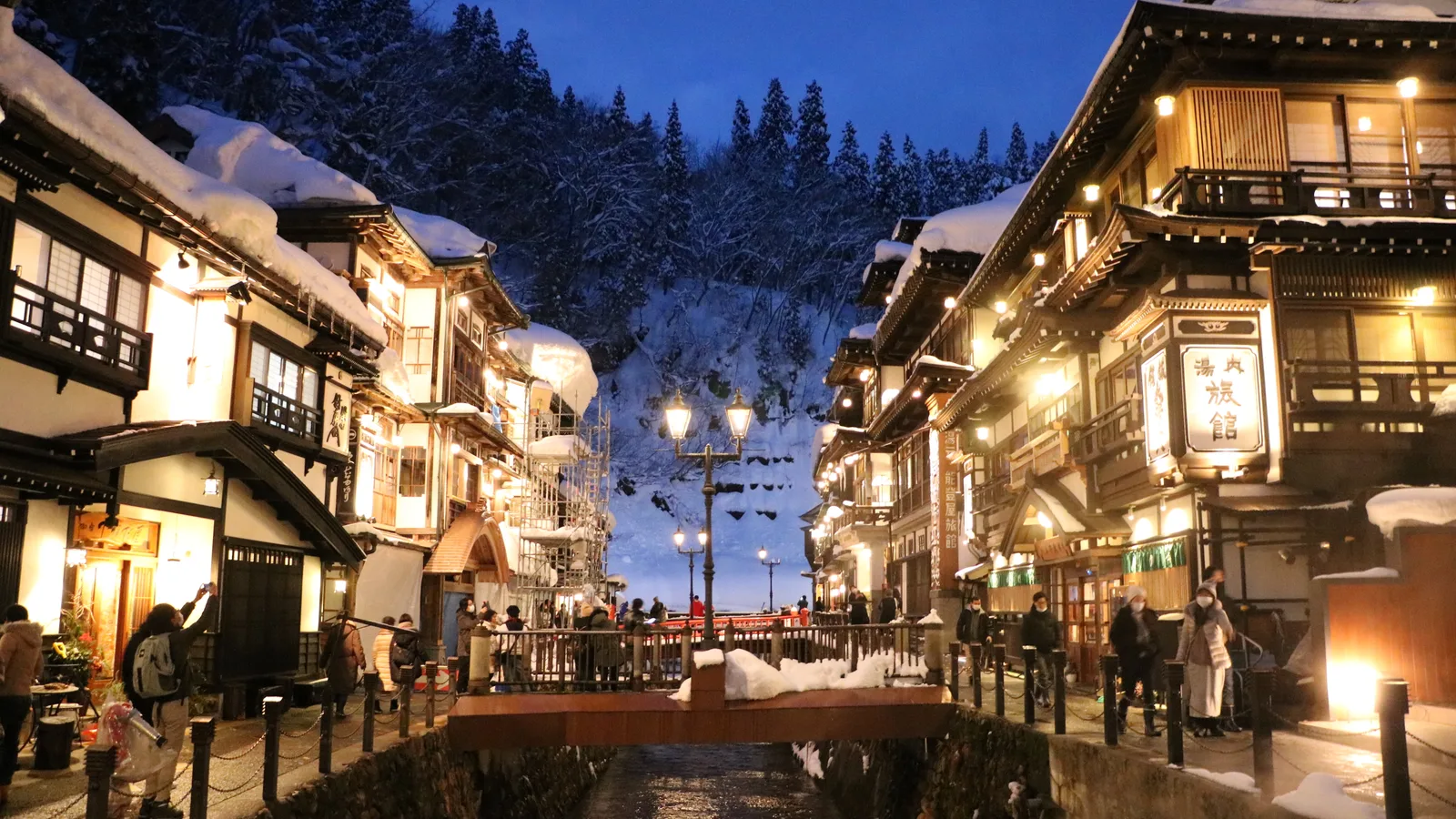
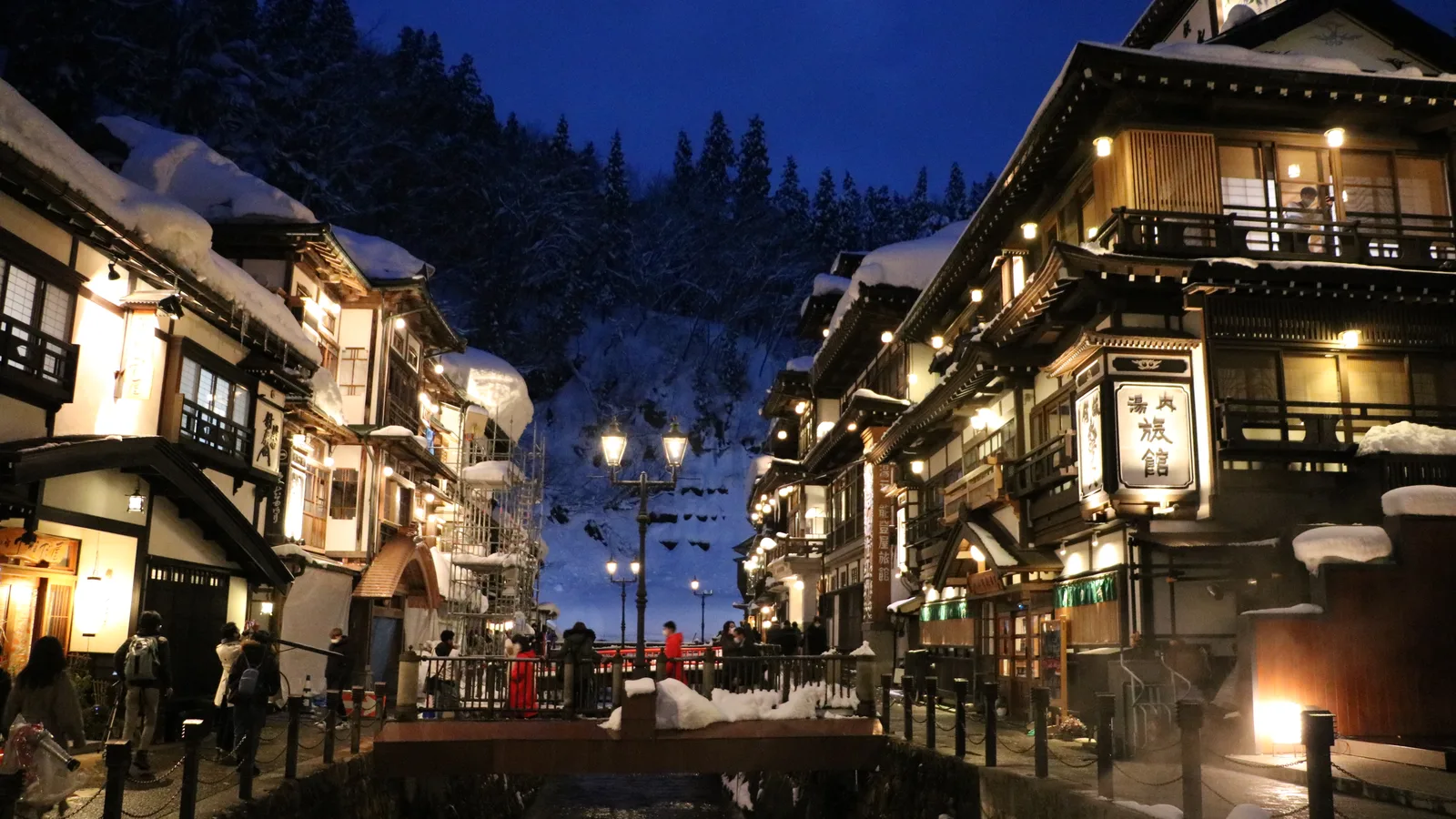
Most photographs of Ginzan Onsen are taken at the same moment: dusk, in winter, when the gas lamps have just been lit and snow is falling on a narrow river lined on both banks by tall wooden inns, three and four storeys high, their windows glowing gold. It is one of the most photographed streets in Japan, and almost everyone who sees the picture wants to stand in it.
What the picture does not tell you is that the street did not always look like this, and that the moment in the photograph is, increasingly, a moment you have to stay the night to be standing in.
Start with the name. Ginzan means "silver mountain," and that is exactly what this was: one of the great silver mines of the Edo period, the Nobesawa mine, discovered in the fifteenth century and worked so hard that for a time tens of thousands of people are said to have crowded this quiet valley. The silver ran out and the mine closed in 1689. But the miners had found something else in the mountain, hot water, and the spring outlived the silver. The town you see today is the town the spring built after the silver was gone.
And it built it all at once. In 1913 a great flood swept down the Ginzan River and washed most of the old inns away. When a new boring struck abundant hot water in the 1920s, the inns were rebuilt together, in a single span of years, in the Western-influenced wooden style of the late Taisho and early Showa era, which is why the whole street shares one face, one period, one mood, as if a single decade had been kept under glass. It was not preserved by accident, and it is not a film set. People still live and work in these buildings; one of them, the Notoya inn's main hall from around 1925, is a registered cultural property that is also, simply, an inn you can book a room in. In 1986 the town passed an ordinance to keep the street as it is. This is a living place that decided, by choice and by law, to stay itself.
That is the first thing to understand about Ginzan. The second is quieter, and it shapes the whole visit: the street's most beautiful hour (the lamps, the snow, the gold-lit windows) comes after the day visitors have gone home. The town is small and fragile, the winter roads are narrow, and the deep evening increasingly belongs to the people sleeping there. You can come for the day and love it. But the photograph belongs to those who stay.
What Happens When You're There
Step 1: The Train to a Valley
Ginzan is not on the way to anywhere, and that is part of what it is. The bullet train does not stop here. From Tokyo you take the Yamagata Shinkansen north to a small station called Oishida, and from there a local bus winds about half an hour up into the hills to a village at the end of the road. The buses are not frequent (there are only a handful a day), so the journey rewards a little planning, and the practical thread of trains, passes and connections is worth reading before you set out.
It is easy to read "three and a half hours from Tokyo" as a warning, and from Tokyo, treated as a day trip, it is a long way to go. But the distance reads very differently if you let go of Tokyo as your anchor. From a base in the Tohoku north, woven into a few days that take in the golden hall at Hiraizumi or the cities of Yamagata and Sendai, Ginzan stops being a far-flung detour and becomes a natural stop on a northern line. The village feels remote because it is remote; the trick is not to fight that, but to arrive as if you meant to come all this way.
Step 2: One Street, Two Banks
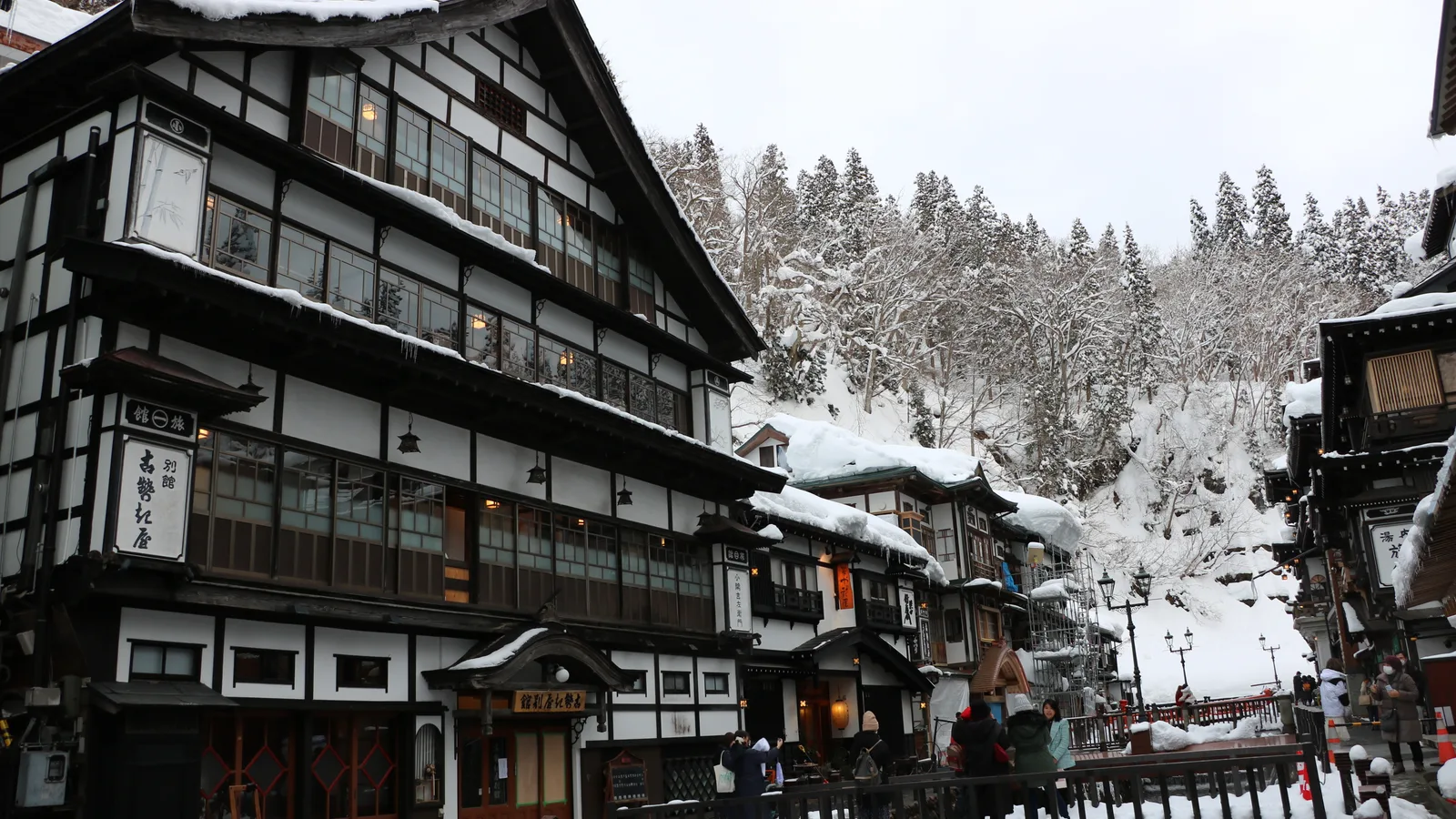
Step off the bus and the town is, at first, almost startlingly small. It is essentially one street, following a shallow river, with the wooden inns standing shoulder to shoulder along both banks and little bridges crossing between them. You can walk from one end to the other in a few minutes. Some visitors feel a flicker of "is this all?", and if you came to tick off sights and move on, an hour will exhaust the list.
That feeling is worth meeting head-on, because it is the wrong measure for this place. Ginzan is not a town you get through; it is a town you stay in. Look up instead of along. The three- and four-storey timber facades, some painted with the coloured plaster reliefs called kote-e, are the real exhibit: a whole street rebuilt in one short era and held there ever since, the reason a single decade of Japan is still standing here in wood. The smallness works in the visit's favour. It is what lets the place slow you down: there is nowhere to rush to, so you stop rushing.
Step 3: The Silver That Became Water
Spend the afternoon the way the town wants you to: slowly, and on foot. There is a free public footbath right by the river where you can sit with your feet in the spring water and watch the street go by, and a small public bathhouse (a spare, modern building by the architect Kuma Kengo, grafted onto the old street) if you want a proper soak before your inn's own bath. Ginzan is not a town of many baths to collect; the soaking here is intimate, a footbath and a quiet pool and, above all, the bath waiting at your inn. The unspoken etiquette of a Japanese bath, if you have ever wondered what everyone around you is actually thinking, is a small world worth understanding first, and tattoos are best checked at the door, though most inns can offer a private bath if the public one has its own rule; here is how tattoos and onsen fit together.
Then walk to the head of the valley, and the meaning of the name comes back. Past the inns a path leads up to a slender 22-metre waterfall, and beyond it the old mine itself: the silver tunnels of Nobesawa, now a national historic site, lit and walkable, so that you can stroll in your yukata straight into the mountain that was once dug for silver. The hole that men once crawled into for ore is now a thing you wander through for pleasure. The mountain gave up its silver, and the town it left behind kept on giving: water, and a place to walk, and a street worth a photograph. One caution: this upper path, the falls and the mine, closes in the snow season, when it cannot be safely cleared. In deep winter the mine sleeps, and the street becomes the whole of it.
Step 4: When the Gas Lamps Light
Toward dusk, something happens that no daytime photograph catches. One by one, the gas lamps along both banks are lit, and the wooden facades warm from grey to gold, and the river holds the light. If snow is falling, the street arrives at the picture everyone came for. If it is not (and even in deep winter it sometimes rains here rather than snows), the lamps and the steam and the dark timber are still quietly extraordinary; snow is the most famous version of Ginzan, not the only one, and a town that is lovely without it is a safer thing to travel toward than a snow that was never promised.
This is the hour the visit has been building to, and it is the hour the town gently hands to the people staying the night. In recent winters Ginzan has had to protect itself from its own popularity: day visitors' cars are kept out of the narrow village, parked instead at a lot down the valley and brought in by shuttle, and the last shuttle back leaves early in the evening. The exact rules are reworked each winter, so they are something to check before you come rather than memorise. But the shape of them does not change. The deep, quiet, snow-lit night, after the last shuttle has gone, belongs to residents and to guests. It is tempting to read all this as a wall thrown up against visitors. It is closer to the opposite: a tiny village in a snowbound valley deciding, together, how many people it can take in at once without trampling the very thing they came for. The limit is how the place keeps its magic alive. To stay the night is to be let inside it, and the night, the whole quiet ritual of an inn that feeds you and bathes you and lets you wake slowly, is the part of Ginzan that the photographs can never quite hand over.
Step 5: The Morning Quiet
Wake early, before the first bus, and step out into the street while it is still nearly empty. Steam rises off the river; the lamps are out and the morning is grey and clean; a few residents pass on their way to work in a town that, for an hour, is simply itself again rather than a photograph of itself.
Stand there a moment and the small question of the place answers itself. Why come all this way, to a single street you can walk in five minutes, and sleep here, when you could have looked at the picture from home? Because the picture was never the point. You came to be taken in by a small, living village at the end of a northern line: to sit in its water, wait for its lamps to light, sleep above its river, and wake to it quiet. The silver miners found their water here; the flood took the town and the town built itself back in a single decade and chose to keep it; and the most beautiful hour was never for sale, only for staying. You do not have to chase the snow or count the sights. Wait by the river once until the gas lamps come on, sleep one night above the water, and you have had the whole of Ginzan.
Good to Know
Look around
See it at street level
Along the Ginzan River, facing the Notoya inn about 50 m ahead.
Street View shows one day. Crowds, construction and seasons change the scene.Open in Google Maps ↗
Getting there: Ginzan Onsen sits deep in the hills of Obanazawa City, in Yamagata Prefecture, in the Tohoku north. The bullet train does not reach the village. From Tokyo, take the Yamagata Shinkansen to Oishida Station (about three hours and twenty minutes), then a local bus (the "Ginzan Hanagasa" line) for roughly thirty to forty minutes to the onsen. The bus runs only a handful of times a day, often with an hour or more between services, so check the timetable and plan around it; a Japan Rail Pass covers the shinkansen but not the local bus. Many inns offer a pick-up from Oishida Station or the park-and-ride lot if you arrange it in advance. For the wider picture of trains, passes and reservations, see getting around Japan.
Coming by car, and the winter restriction: In the snow season the village centre is closed to day visitors' cars (rental cars included), because the streets are narrow and there is nowhere to park. Day visitors driving in are directed to a park-and-ride lot down the valley (at the Taisho Roman-kan) and brought into the town by a paid shuttle bus, with a queue system on the day and a paid priority pass you can reserve ahead. This is run as a seasonal trial and the exact dates, fares and method are reworked each winter, so check the official restriction site for the current season before you drive. Two things that do not change: visitors arriving by train and local bus do not need the park-and-ride and can go straight to the town, and overnight guests can use their inn's designated parking or pick-up.
Day trip or overnight? You can visit Ginzan as a day trip and have a fine afternoon: the street, the footbath, the falls and mine in green season, a coffee and a curry bun. But the town's most famous hour, the gas-lit dusk and the quiet snow-lit night, increasingly belongs to those who stay, because the last day-visitor shuttle leaves early in the evening and the deep night is left to residents and inn guests. If the lamp-lit street is the reason you are coming, plan to sleep here. Be aware that an overnight stay can be expensive, especially in peak winter, and is worth booking well ahead.
Bathing: Ginzan is not a bath-hopping town. There is a free public footbath by the river (open year-round, roughly early morning to late evening) and one small public bathhouse, the modern Shirogane-yu designed by Kuma Kengo (around ¥500, open through the afternoon); a couple of older public baths in the village have been closed or have irregular hours, so do not build your visit around them. The main soak here is the bath at your inn. Bring cash for the public bath and footbath.
The falls and the silver mine: Beyond the inns, a short walk leads to the 22-metre Shirogane Falls and the old Nobesawa silver-mine tunnels: a national historic site, free to enter, lit and walkable, and a rare place you can stroll into in a yukata. Note that this upper path closes in the snow season (roughly from the first snows until the spring opening), when it cannot be safely cleared, so the falls and mine are a green-season pleasure, not a winter one.
When to go: Winter, December to February, is when the snow, the gas lamps and the wooden street come together into the famous scene, but snow is never guaranteed; even in deep winter it sometimes rains. The town is worth the trip regardless, and the green seasons have their own life: the falls and mine open, and on weekends from late spring through autumn the local hanagasa flower-hat dance is performed on the bridge. For how the seasons shape a Japan trip more broadly, see the best time to visit Japan.
A note on the movies: You may have heard that Ginzan inspired a famous Studio Ghibli film. It is a lovely idea, but Ghibli has never confirmed any real model for the film, the director has said there was no single one, and Ginzan is only one of several hot-spring towns claimed as the inspiration, so come for the town itself rather than the movie, and you will not be disappointed. What is real is that Ginzan was a filming location for the beloved 1983 television drama Oshin, which is what first made the village famous across Japan.
Cash: Many of the inns and shops here take cash only, and there are few ATMs or convenience stores in the village, so bring enough cash for your stay.
Last verified: 2026-06
Official websites: ginzanonsen.jp (Ginzan Onsen, Japanese) and the winter car-restriction site (Obanazawa City park-and-ride office, Japanese); English overview at JNTO.
If Things Don't Go as Planned
You came for the day and had to leave before the lamps lit. This is the most common disappointment at Ginzan, and it is built into how the village protects itself: the last day-visitor shuttle leaves early in the evening, so the deep gas-lit night is for those staying over. If you only have a day, you can still catch the very start of the lamp-lighting at dusk in the depths of winter, when it gets dark early. But if the lamp-lit street is your reason for coming, the real answer is to book a night here. There is no version of the famous night scene that does not involve staying.
It rained instead of snowed. Even in January, Ginzan does not always get snow, and arriving to rain on the street you pictured under snow is a real letdown. It helps to expect it: snow is the most famous version of the town, not the only one, and the gas lamps, the steam off the river and the glowing wooden facades are quietly beautiful in any weather. If snow is essential to you, the depths of winter give you the best odds. But treat it as a gift, not a guarantee.
It felt small, or too touristy. A first walk down the single street can feel like "is this it?", and at busy times the crowds can crowd out the very stillness you came for. Both ease the same way: stay the night and walk the street early in the morning and late at night, after the day visitors have gone, when Ginzan becomes the small, quiet, living village it actually is. The town that feels like a money-making strip at midday feels like something else entirely at dawn.
The bus times defeated you. The local bus from Oishida runs only a few times a day, and missing one can mean a long wait. Build your day around the timetable rather than hoping for a bus when you want one, and if you are staying over, ask your inn about a pick-up from the station or the park-and-ride lot: many arrange this, and it removes the problem entirely.
You have tattoos and aren't sure about the bath. The small public bathhouse may ask you to cover a tattoo, and rules vary, but this is rarely a real obstacle here because the main soak is your inn's bath, and many inns offer a private or family bath you can use without worrying about it. Ask at check-in; it is almost always solvable. For the wider picture, here is how tattoos and onsen fit together.
Ginzan alone felt like a long way to go. It is, from Tokyo and as a single destination. The fix is to stop treating it as one: folded into a few days in the Tohoku north, alongside Hiraizumi and the cities of Yamagata and Sendai, the journey stops feeling like a detour and becomes a stop on a northern route. And if it is the lantern-lit, soak-and-stroll evening you are drawn to more than the remoteness, Kinosaki Onsen near Kyoto and Osaka offers a kindred night in a far more reachable place: a whole town you wander in a yukata, bath to bath, rather than one street you come to stand in. And if what draws you is that idea of an hour kept for those who sleep over, Yufuin in Kyushu is the same promise turned to daylight, another hot-spring town you cross on foot, where the hour reserved for overnight guests is not the lamp-lit night but the early morning, when mist rises off the valley floor before the day visitors arrive. And if you would rather have a snowy hot-spring town that is quicker to reach, Kusatsu Onsen, in the mountains of Gunma, is about 2 hours 20 minutes from Ueno by limited express, plus 25 minutes by bus.
Sources:
- Ginzan Onsen (Ginzan Onsen Ryokan Association, Japanese): The town overview, the "History and Hot Spring" and chronology pages (the Nobesawa silver mine discovered in 1456 and closed in 1689, the 1913 Ginzan River flood, the rebuilding of the inns into Western-style three- and four-storey timber buildings after the 1920s boring), the walking routes, the public footbath and falls, and the gas-lit streetscape
- Ginzan Onsen Winter Car-Restriction Office (Obanazawa City / Tourism Agency trial, Japanese): The winter park-and-ride at the Taisho Roman-kan, the shuttle bus and its time-banded fares, the day-of queue and paid priority pass, the list of regulated vehicles (day visitors' cars, out-of-prefecture taxis, charter buses, motorcycles, bicycles), and the note that train-and-local-bus visitors and overnight guests are exempt
- Obanazawa City: Ginzan Onsen and the Nobesawa Silver Mine Ruins (Japanese): The municipal tourism pages: the winter closure of the shared parking, the Nobesawa silver-mine tunnels (national historic site, free, walkable in yukata, closed in the snow season), and the local bus timetable
- JNTO: Ginzan Onsen (English): The English framing of the Taisho-era hot-spring town, access from Tokyo via the Yamagata Shinkansen to Oishida Station (about 3 hours 20 minutes) and bus (about 35 minutes), the infrequent buses, the note that the JR Pass does not cover the bus, and the 22-metre Shirogane Falls
- Yamagata Prefecture Tourism (English / Japanese): The prefecture's framing of the gas lamps lit at dusk, the kote-e plaster reliefs, the "remote yet well-connected" positioning, the Spirited Away resemblance given only as an impression ("as if the setting of the film"), and Oshin as an actual filming location
- Ministry of the Environment: National Recuperation Hot Spring Resorts: Ginzan Onsen's designation as a nationally recognised hot-spring health resort (designated 1968, plan revised 2021)
- Agency for Cultural Affairs: Nobesawa Silver Mine Ruins, National Historic Site (Japanese): The Edo-period silver mine designated a national historic site in 1985
- Cultural Heritage Online: Notoya Ryokan Main Building, Registered Tangible Cultural Property (Japanese): The Notoya inn's main hall, a wooden three-storey building from around 1925, registered in 1997 and still operating as an inn
Photographs of Ginzan Onsen by さかおり (Sakaori), CC BY-SA 4.0, via Wikimedia Commons.
WMJS is written in Japan, in English, with AI help. We check every page, but English is not our first language. If a sentence reads oddly, tell us. One sentence is enough.
Thank you. A person reads every note.
Real voices
Is it worth it?
Were you there? Share your photos.
Your photo could appear in this guide — with your name and a link to your profile.
Submit a photoRelated Articles

Staying at a Ryokan: What Your Host Wishes You Knew

What Japanese Bathers Actually Think When You Walk In


More guides in Tohoku
Hirosaki Castle — The Keep That Came Back Smaller, and the Cherry Trees Its Old Retainers Planted
A cultural audio guide to Hirosaki Castle in Aomori, verified against official sources — the only original castle keep left in Tohoku, a small tower rebuilt after the great five-story keep burned, the cherry trees its former retainers planted, and the once-in-generations stone-wall repair that has the keep sitting off its own foundation right now, with hours, tickets and how to get there.
Hirosaki Castle
Hiraizumi — A Prayer in Gold, in a Capital That Vanished
An audio cultural guide to Hiraizumi and Chuson-ji's Golden Hall (Konjikido), verified against official sources. Why a lord covered a hall in gold as a prayer for peace, why it alone survived a capital that once rivaled Kyoto, why you cannot photograph it — and how to visit Chuson-ji and the Motsu-ji Pure Land garden, from Ichinoseki.
Chuson-ji & Hiraizumi
Visiting Sendai & Matsushima, A Bay Beyond Words and the Lord Who Planted Its Trees
Is Matsushima worth visiting from Sendai? We weighed 49 traveler voices: 71% say worth it, and Japanese reviews rate the bay even warmer at 84%. One of Japan's Three Views, a 40-minute ride from Sendai to Matsushima-Kaigan Station, with a bay cruise past 260 pine islands and the cedar-built Zuiganji temple, with an audio guide.
Sendai & Matsushima