
Visiting Akihabara, Tokyo's Electric Town Where You're Allowed to Love What You Love
Akihabara (Electric Town)
By Kei · Born and raised in JapanIs Akihabara worth visiting? By the voices we gathered, it depends who's asking: of 149 international travelers, 29% called it worth it outright, 44% said it's worth it only if you're into anime, games, or electronics, and 27% felt let down, while Japanese visitors who go there for something specific land far warmer at 69% treasured. There is no admission fee, since it's a shopping district rather than a ticketed site, and a relaxed first visit from the Electric Town Exit takes about half a day. What those voices actually said, including exactly who this place is and isn't for, is further down this page.
The Meaning
Most guidebooks hand you Akihabara with a half-smile. Electric Town. Otaku paradise. Maid cafes. Weird, geeky, fun. You arrive expecting a curiosity, somewhere to photograph for the story you'll tell back home.
Stand on the main street for a few minutes, though, and watch the people instead of the signs. A man in a work suit has stopped to study a single shelf of model kits, turning a small box in his hands like it matters. Two friends hold a trading card up to the light and argue over it gently, the way you'd discuss a painting. Someone walks past carrying a boxed figure against their chest, unhurried, content. Nobody is laughing at them. Nobody is even looking twice. That is the thing Akihabara offers without any fuss, and almost no guide names it out loud: this is a place where caring about something, openly, seriously, more than is strictly reasonable, is simply normal.
It was never planned this way. In the years just after the war, this corner of the city was a tangle of street stalls selling radio parts, vacuum tubes, and wire to people who wanted to build their own sets. Official histories of the district say the Electric Town grew from exactly that: small stalls that gathered under the railway's raised tracks around 1949 and 1950. The goods kept changing. Radios became televisions, televisions became home computers, computers became anime, games, and figures. But the kind of person who came never changed at all. They came because they wanted one specific thing, badly, and this was the one place that understood precisely which thing they meant. Seventy years of those people, arriving and arriving, is what built the street you're standing on.
So if Akihabara feels overwhelming, and it will, with its towers of neon, its walls of capsule machines, its buildings stacked floor on floor with things you can't yet name, know that you haven't wandered into a circus. You've arrived at the home base a great many people, Japanese and foreign alike, keep for whatever it is they can't stop loving. You're not expected to understand all of it. You only have to find your own one shelf.
What Happens When You're There
Step 1: Out the Electric Town Gate
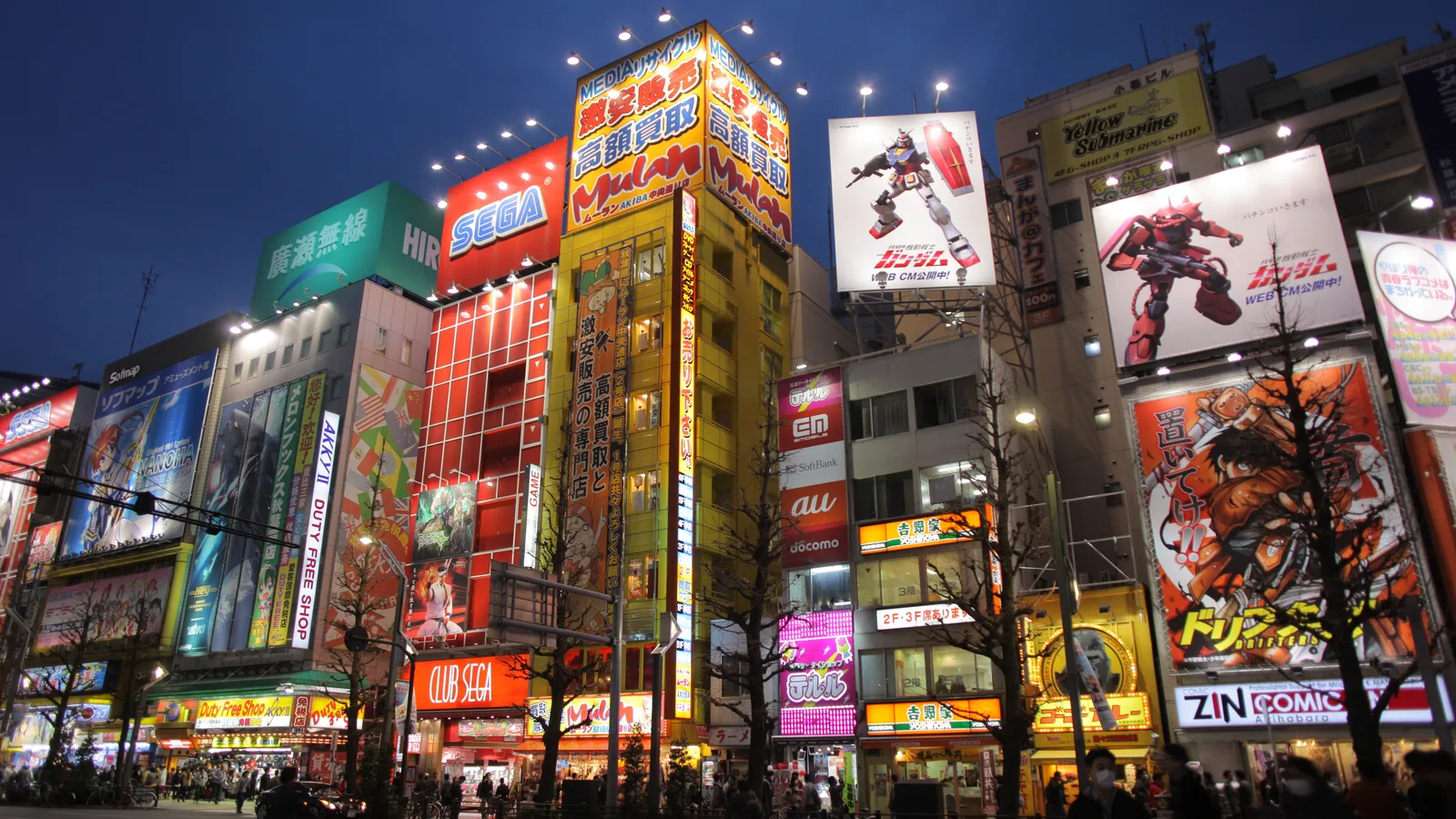
Akihabara Station has several exits, and the one you want announces itself by name: the Electric Town Exit, Denki-gai-guchi. Step through it and the city changes texture in a single doorway. Whole building faces are wrapped in anime characters three stories tall. Banks of capsule-toy machines line the walls in glowing rows. A megastore rises in front of you with floor after floor of cameras, games, and gadgets, open late into the night.
It is a lot, all at once, and here is the first thing worth knowing: feeling overwhelmed is not a sign you've done something wrong. Japanese visitors stepping off the train for the first time feel it too. The street is designed by accumulation, not by plan: decades of shops each shouting for the exact person who's been looking for them. You don't have to decode it. Take the first corner slowly, let your eyes adjust to the volume of it, and remember that nobody here expects you to know where anything is. Half the people around you don't either.
Step 2: The Main Street
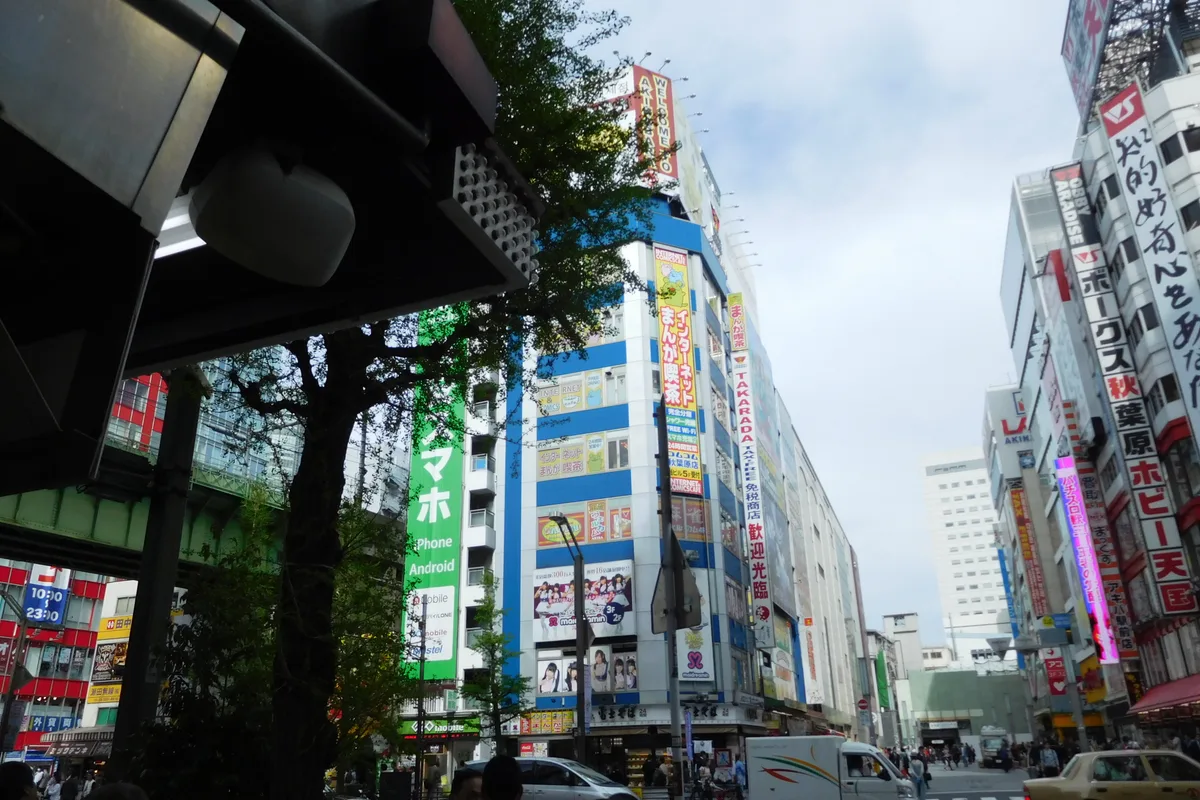
The backbone of the district is Chuo-dori, the wide central avenue that runs north from the station. Walk it once, end to end, before you go into anything, and the chaos starts to sort itself into a rough map. Nearest the station, the big electronics megastores; up along the avenue, the towers of anime, manga, game, and figure shops; and a street or two off to the sides, in the smaller lanes, the specialists: the people who sell only one narrow thing, and know everything about it.
This was, once, almost purely an electronics district, roughly a thousand electric shops packed into about a single square kilometer, which is how it earned the name Electric Town in the first place. You can still feel that density; it simply sells different things now.
On Sundays, weather permitting, the avenue closes to cars and Chuo-dori becomes a hokoten, a pedestrian paradise, for about 570 meters of its length, from early afternoon until evening. It's the easiest, most open way to see the street, and also the most crowded; if you'd rather move at your own pace, a weekday afternoon is calmer. You'll also notice staff in maid costumes standing along the pavement, holding flyers and inviting passers-by inside. They are not a spectacle staged for tourists; they are people at work, often newcomers putting in long hours on a cold sidewalk. A small awareness of that changes how the whole street looks. What happens inside those cafes is its own world with its own gentle etiquette, and it deserves a proper explanation rather than a glance in passing.
Step 3: Going Vertical
Akihabara doesn't spread out so much as it stacks up. Many of its shops are vertical, a single narrow building where each floor is a different world. The ground floor might be new figures, the second floor trading cards, the third secondhand, the fourth self-published doujin works, and the elevator panel reads like a table of contents for somebody's obsession. The famous Radio Kaikan building near the Electric Town Exit is the clearest example: it was the district's very first high-rise when it went up in 1962, full then of radios and parts, and by 1998 the figure and model makers had moved in and helped turn Akihabara into the hobby capital it is today.
The way to enjoy a building like this is not to conquer it. Pick the floor that matches your own particular like, the one thing you've always privately loved, and let the rest go. You will also see floors marked for adults only, usually flagged clearly at the elevator or the stairs; the signage exists precisely so you can choose, at a glance, which floors are for you and which to skip. Whole buildings here are given over to game arcades, too, rising several stories of lights and sound, worth seeing for the sheer scale of them, with their own customs once you step inside and decide to play.
Step 4: Under the Tracks
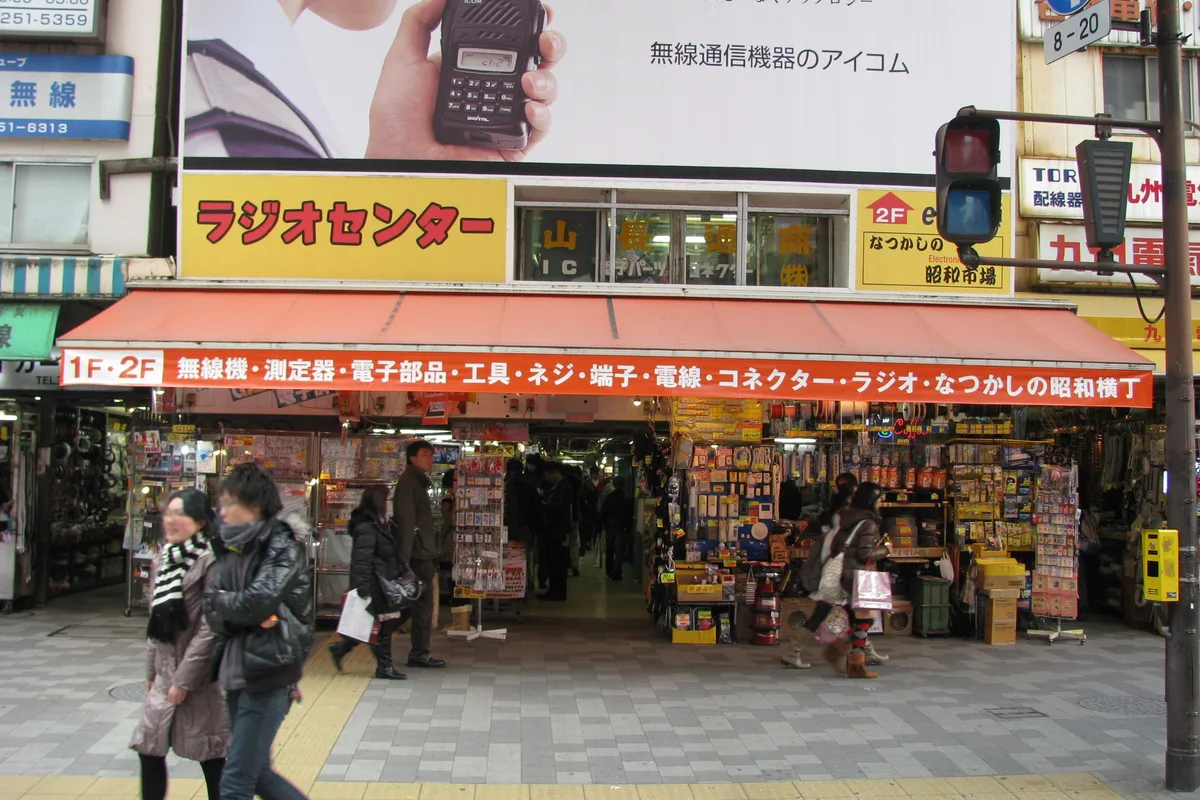
If you want to meet the oldest Akihabara, leave the bright avenue and walk into the smaller lanes, especially the warren of tiny stalls tucked beneath the overhead train tracks. Here, in spaces barely wider than a doorway, are the electronic-parts shops the whole district grew from: drawers of switches, cables, connectors, and components, sold by people who have done it for decades. This is the radio-parts market of the late 1940s, still breathing under it all.
Even the name reaches back further than the electronics. Long before any of this, a great fire in 1869 cleared the land, a firebreak was opened the next year, and a small shrine for protection against fire was built on it. Locals came to believe, not quite correctly, that it honored Akiba, a deity who guards against flames, and so they called the open ground Akiba's field: Akiba-ga-hara. When the railway arrived in 1890, the station took the name, and it stuck. The town has been misread and renamed, again and again, by the people who use it, which is, in its way, exactly how it has always worked.
Stand under the tracks with the trains rumbling overhead and the question almost asks itself: how did a street of radio parts become a street of anime? The answer is in your hands, and in everyone's around you. People who love a thing want to gather where that thing is understood. When enough of them gather, the place reshapes itself to hold them, and then it does it again, for the next thing, and the next. Akihabara isn't the story of electronics, or of anime. It's the story of being allowed to want something completely, and of a town that kept saying yes.
What Visitors Honestly Say
Before you decide how much time to give the place, it helps to hear from people who already went. We gathered 149 voices from international travelers who had been to Akihabara, weighted by how strongly each account resonated with fellow readers, and this is how they fell:
There's no clear yes and no clear no here. The biggest band by far sits in the middle, and it turns out to be less about timing than about who's asking. One frequent comment put it this way: "If you like anime and/or video games, absolutely. If you're just doing it as a sightseeing thing, there is really no point." Another was blunter: "It's targeted to people who really really like anime, games, and electronics. If you don't know anything about [those], you're just standing there." Much of the red band traces back to a single change: the bargain-electronics era is over. "Don't buy your retro games in Akihabara," runs the single most-upvoted comment on the topic; "it just became an attraction park for tourists."
Japanese visitors and locals, reviewing the very same streets in their own words, land far warmer:
They almost never arrive as general sightseers; they come for something. "For me this is a fun spot; I mainly come to source electronic parts and wander through niche shops," one writes. Their small red band echoes the same change the disappointed visitors describe, not a different complaint: "I went to buy electronics like everyone, but now Yamagiwa is gone, Ishimaru Denki is gone, and the atmosphere of the town has changed."
The full picture, the letdowns included and what prevents each one, is in Is Akihabara Worth It?
Good to Know
Getting there: Akihabara is one of Tokyo's most connected stations, about two stops north of Tokyo Station on the JR Yamanote Line. It's served by the JR Yamanote, Keihin-Tohoku, and Chuo-Sobu (local) lines, the Tokyo Metro Hibiya Line, and the Tsukuba Express. The Electric Town Exit is the gateway to the shopping district, about a five-minute walk to the heart of it. Two more lines sit at the edges of the area: the Toei Shinjuku Line's Iwamotocho Station and, at the north end of Chuo-dori, the Tokyo Metro Ginza Line's Suehirocho Station. For the bigger picture of trains, passes, and pairing Akihabara with nearby Ueno, see getting around Japan.
Opening hours: Akihabara is a late riser. Most shops open later in the morning rather than early, and stay open into the evening, so an early start tends to find the shutters down. Hours vary a great deal by shop and building; some megastores run much later than the rest, so it's worth checking a specific store's official page before you set out. The street itself, lit and busy, is at its best in the late afternoon and evening.
The Sunday pedestrian street: When the weather is good, Chuo-dori closes to traffic on Sundays and becomes a pedestrian-only street, roughly from 13:00 to 18:00 between April and September, and 13:00 to 17:00 from October to March. It can be cancelled in poor weather, so treat it as a bonus rather than a fixed plan.
Time needed: Half a day is plenty for a relaxed first visit: a walk up Chuo-dori, one or two buildings explored properly, a look down the back lanes. If your particular like lives here, a full day disappears easily. There's no need to see all of it.
Tax-free shopping: Many larger stores offer tax-free purchases to foreign visitors who show a passport; look for the official tax-free mark, and ask staff if you're unsure. Note that Japan's tax-free system is scheduled to change to a refund-at-departure model on November 1, 2026, so confirm the current procedure before relying on it.
Photography: The street, the signs, and the storefronts are yours to photograph freely. Two gentle lines: many shops don't allow photos inside, so watch for the signs, and the staff in costume, like anyone working, are people rather than props, so it's kind to ask before pointing a camera at someone, and to accept a "no, thank you" easily. A moment of awareness around the people you photograph is the kind of small courtesy that's always noticed.
Last verified: 2026-06
Official guide: GO TOKYO: Akihabara Electric Town
If Things Don't Go as Planned
You arrived in the morning and everything was closed. Akihabara simply starts its day late; many shops don't open until well into the morning. It's the perfect excuse to do the neighborhood in the right order: a coffee first, then nearby Ochanomizu or Ueno in the morning, and arrive in Akihabara as it's waking up. The street rewards the afternoon and evening anyway.
You came out of the station and got lost in a shopping mall. It's an easy mistake: the station has a built-in shopping complex, and it's not the same as the Electric Town. Look for signs to the Electric Town Exit specifically; once you're through it, the megastores and the wide avenue are right in front of you. The Tokyo Metro station is a separate entrance a little to the west, which trips up plenty of first-timers too.
The staff handing out flyers on the street make you nervous. Most are inviting people to maid or themed cafes, and they're generally low-pressure. If you're not interested, you don't have to engage at all; simply not taking the flyer, with a smile, is a perfectly polite "no." There's no need to feel rude, and no need to feel cornered. They're just doing a job.
It feels overwhelming and you don't know where to start. That's the normal first reaction, for locals as much as for visitors; the district is loud by design. Don't try to read the whole thing. Pick one category you actually care about, walk into one building, and follow your own curiosity up the floors. One good shelf is a better afternoon than ten rushed stores.
You're not really into anime or games, is it even worth it? Yes, in a lower key. The architecture of signs, the capsule-machine walls, the sheer human energy of a place built around enthusiasm are worth an hour on their own, and Akihabara sits right on the Yamanote Line, so it's easy to drop in and move on if it isn't your world. Plenty of people enjoy it most as a place to watch other people be unashamedly delighted.
You're visiting with children and worried about the adult-only material. The main street and the great majority of shops are ordinary family fare: toys, games, electronics, snacks. Adult floors do exist, but they're marked as such at the entrances and elevators, so they're straightforward to skip. Sticking to the ground and lower floors of the big buildings keeps the visit easy and light.
Sources:
- Akihabara Electric Town Organization: Official Site (English): Official district body; "Akihabara Electric Town / Denki-gai" naming, pedestrian-zone framing
- Akihabara Electric Town Organization: History & Pedestrian Zone (Japanese): Postwar radio-parts origins under the elevated tracks, Chuo-dori pedestrian street (~570m, Sunday hours by season), name origin (1869 fire, 1870 firebreak and fire-prevention shrine)
- GO TOKYO: Akihabara Electric Town (Official Tokyo Travel Guide): "Once ~1,000 electronics shops in ~1 km²," Electric Town Exit, Chuo-dori, pedestrian-zone hours
- JNTO: Akihabara (Japan National Tourism Organization): Electric Town name origin, otaku culture as a cultural identity, station lines and access
- Akihabara Radio Kaikan: Official History: The Electric Town's first high-rise (1962); arrival of figure makers (1998)
- Visit Chiyoda (Chiyoda City Tourism Association): Akihabara: District location (Sotokanda, Chiyoda), strolling map and spots
- Japan Tourism Agency: Tax-Free Shopping: Current tax-free conditions, passport requirement, and the upcoming change of system
- Tsukuba Express: Akihabara Station (Official): TX01 Akihabara, transfer lines, Iwamotocho proximity
- Is Akihabara Worth It? (WMJS): The two visitor-voice gauges reproduced in "What Visitors Honestly Say" (149 international voices, 29/44/27; 59 Japanese voices, 69/25/6) and the verbatim visitor quotations
Images: "Akihabara Night" by ElHeineken (CC BY 4.0); "Akihabara, Tokyo, Japan 002" by Vasconium (CC BY-SA 2.0); "Akihabara Radio Center" by Aimaimyi (CC BY-SA 3.0), via Wikimedia Commons.
WMJS is written in Japan, in English, with AI help. We check every page, but English is not our first language. If a sentence reads oddly, tell us. One sentence is enough.
Thank you. A person reads every note.
Real voices
Is it worth it?
Were you there? Share your photos.
Your photo could appear in this guide — with your name and a link to your profile.
Submit a photoRelated Articles

"Excuse Me, Can You Take My Photo?": What Japanese People Really Think

Getting Around Japan: The Tiny Things That Earn You a Nod


Anime Pilgrimage and the People Who Live There
More guides in Kanto
Visiting Harajuku, Where You Can Wear Anything and No One Turns to Look
Is Harajuku worth it? We counted 99 traveler voices: 64% say yes once you skip Takeshita Street's crush for Cat Street and Omotesando. Crepes, kawaii fashion, getting there, and how to walk it well, with an audio guide.
Harajuku
Visiting Meiji Jingu, Where 100,000 Trees Were Planted to Make a Forest That Tends Itself
Is Meiji Jingu worth visiting? We weighed 70 traveler voices: 75% say worth it, and Japanese locals rate it even higher at 82%. Free, a 70-hectare forest planted entirely by hand in 1920, home to the Great Torii and Kiyomasa's Well in the Inner Garden, with an audio guide.
Meiji Jingu
Visiting Senso-ji, Tokyo's Oldest Temple
Is Senso-ji worth visiting? We weighed 125 traveler voices: 54% say worth it outright. Hours, free admission, how long you need, and why the crowd has always been part of the prayer, with an audio guide.
Senso-ji Temple
Shibuya — The Crossing No One Directs, and the Dog Who Never Stopped Waiting
An audio walking guide to Tokyo's Shibuya, verified against official sources — the Scramble Crossing, the Hachiko statue, Shibuya Sky, and how to walk it.
Shibuya