
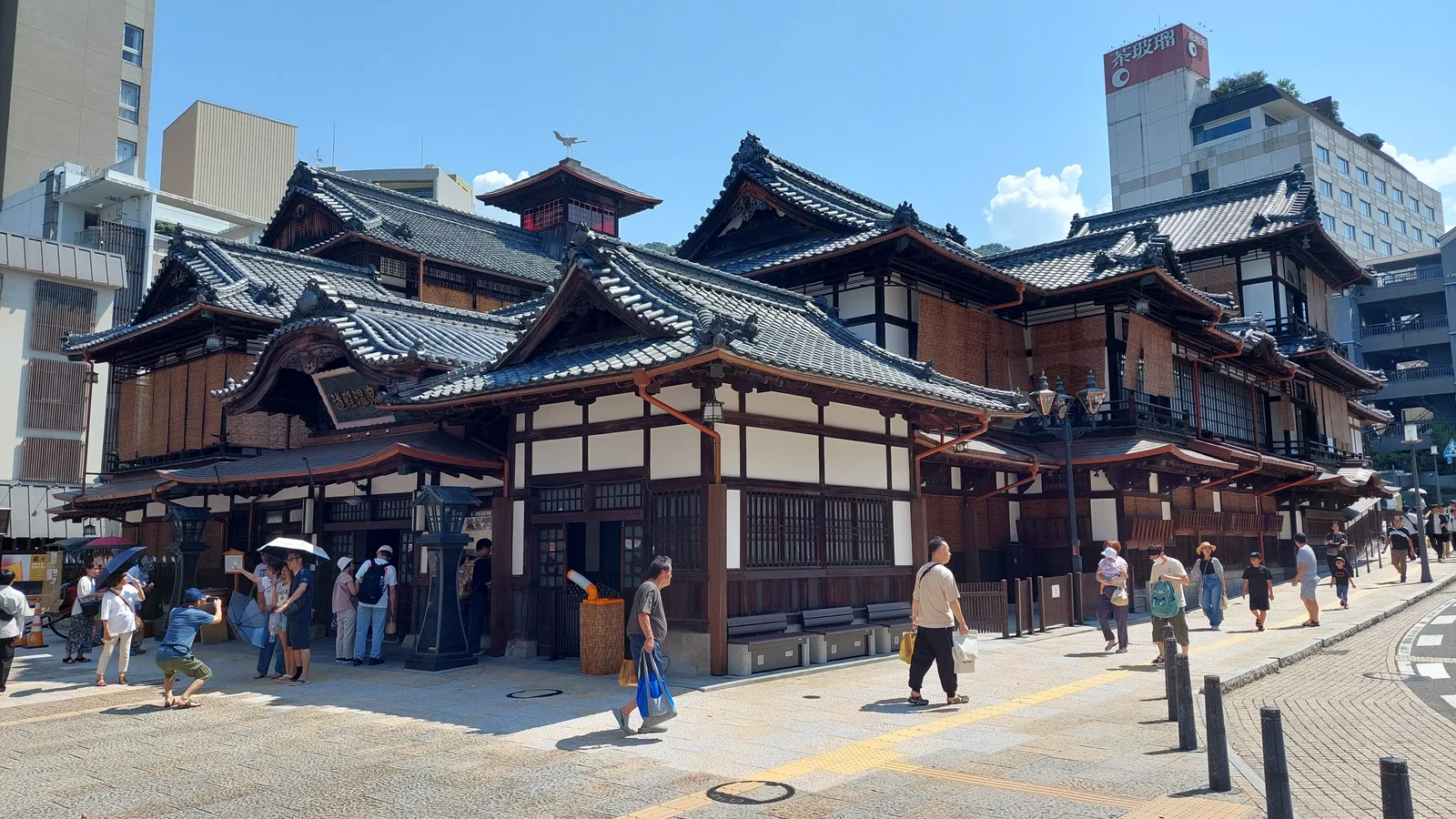
Dōgo Onsen — The 3,000-Year-Old Bath You Step Into, Not Just Look At
Dōgo Onsen (Matsuyama)
By Kei · Born and raised in JapanThe Meaning
Most of the world's oldest treasures, you meet from behind a rope. You file past, you read the small sign, you take the photograph, and you keep your distance. Dōgo Onsen asks something stranger of you. It asks you to take off your clothes.
The building at the heart of it, the Honkan, is a three-storey wooden bathhouse crowned with a small tower and a white heron, and it is a National Important Cultural Property: in 1994 it became the first public bathhouse in Japan ever given that protection. And yet for a few hundred yen you can walk in, undress, and lower yourself into the same hot water as the people of Matsuyama, in a national treasure that is still, every single day, doing the ordinary job it was built for. When the time came to repair and earthquake-proof the aging Honkan, the town did something almost unheard of: rather than close the doors, it kept the baths open through six years of work, the first time in Japan an Important Cultural Property bathhouse has been conserved while staying in business. This is not a monument that was saved by being shut away. It was saved by being used.
And it is old in a way that is hard to hold in the mind. Dōgo is counted among the three ancient springs of Japan (with Arima and Shirahama), named in the Man'yōshū, the country's oldest poetry, and it is said to have welcomed bathers for some three thousand years. The water rises on its own and has never stopped. Up in the rooftop tower, a drum still marks the hours the old way: six beats at six in the morning, twelve at noon, six again at dusk, a sound chosen as one of Japan's hundred soundscapes worth keeping. Legend says it all began when an injured white heron was seen healing its leg in the warm water, and people, watching, understood what they had.
So much story has gathered on this one bath (a famous novel, a beloved little train, a film the whole world thinks it recognizes) that it is easy to forget what lies underneath all of it. Underneath is simply a bath, still warm, still open, where the locals still go. The story is the lovely doorway. The water is the room.
What Happens When You're There
Step 1: Arriving Where the Story Begins
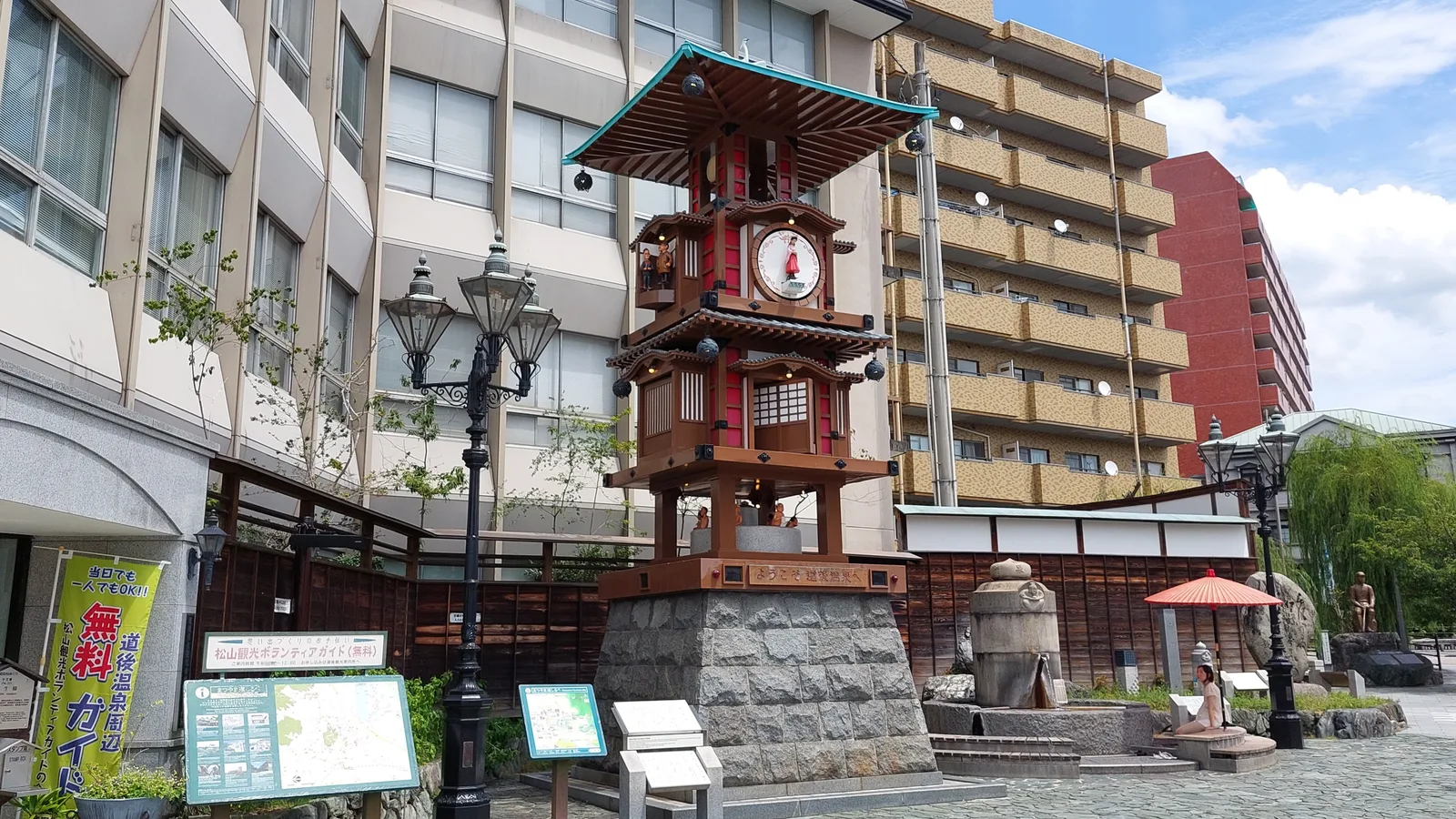
You arrive in Matsuyama, on the island of Shikoku, and make your way to the end of the tram line, to a little station called Dōgo Onsen, itself a piece of Meiji-era romance rebuilt in retro wood and glass. Step out of it and the town greets you, before the bath does, with its stories.
In the small square in front of the station, Hōjō-en, stands a stone of a white heron, the bird of the founding legend, and a clock. On the hour, the Botchan Karakuri Clock opens up and little figures from a famous novel rise and turn to a tune, while travellers soak their feet for free in the footbath beside it. If you happen to ride in on a weekend, you may have come on the Botchan Ressha, a small steam-style train named for that same novel, rebuilt and still running on Saturdays, Sundays, and holidays. None of this is the hot spring yet. It is the wrapping the town has folded around the hot spring over the last century and a quarter, and it is a warm, slightly theatrical welcome. Let it set the mood, and then walk on toward the water it all points to.
Step 2: Walking the Haikara-dōri
A short, covered shopping street runs from the station to the Honkan, and walking it is part of the ritual. This is the Dōgo Haikara-dōri, a few minutes' stroll under one roof, lined with sweet shops and souvenir stalls, most of them open until late. Here you will meet Botchan dango, three little balls of sweet rice dumpling in three colours on a stick, named, like so much else here, for the novel, and the smell of grilling and steaming, and the soft clop of wooden geta sandals on stone as bathers in cotton robes drift toward the baths.
You do not have to know the story behind every name to enjoy this, and it is perfectly fine to eat your dumpling as you walk the arcade, where snacking on the move is part of the fun, though it is worth knowing that eating while walking is read differently in most of Japan. Take your time. The pleasure of Dōgo is partly this slow approach: the town hands you its stories first, one stall at a time, and saves the oldest thing for last.
Step 3: Stepping Inside the Living Treasure
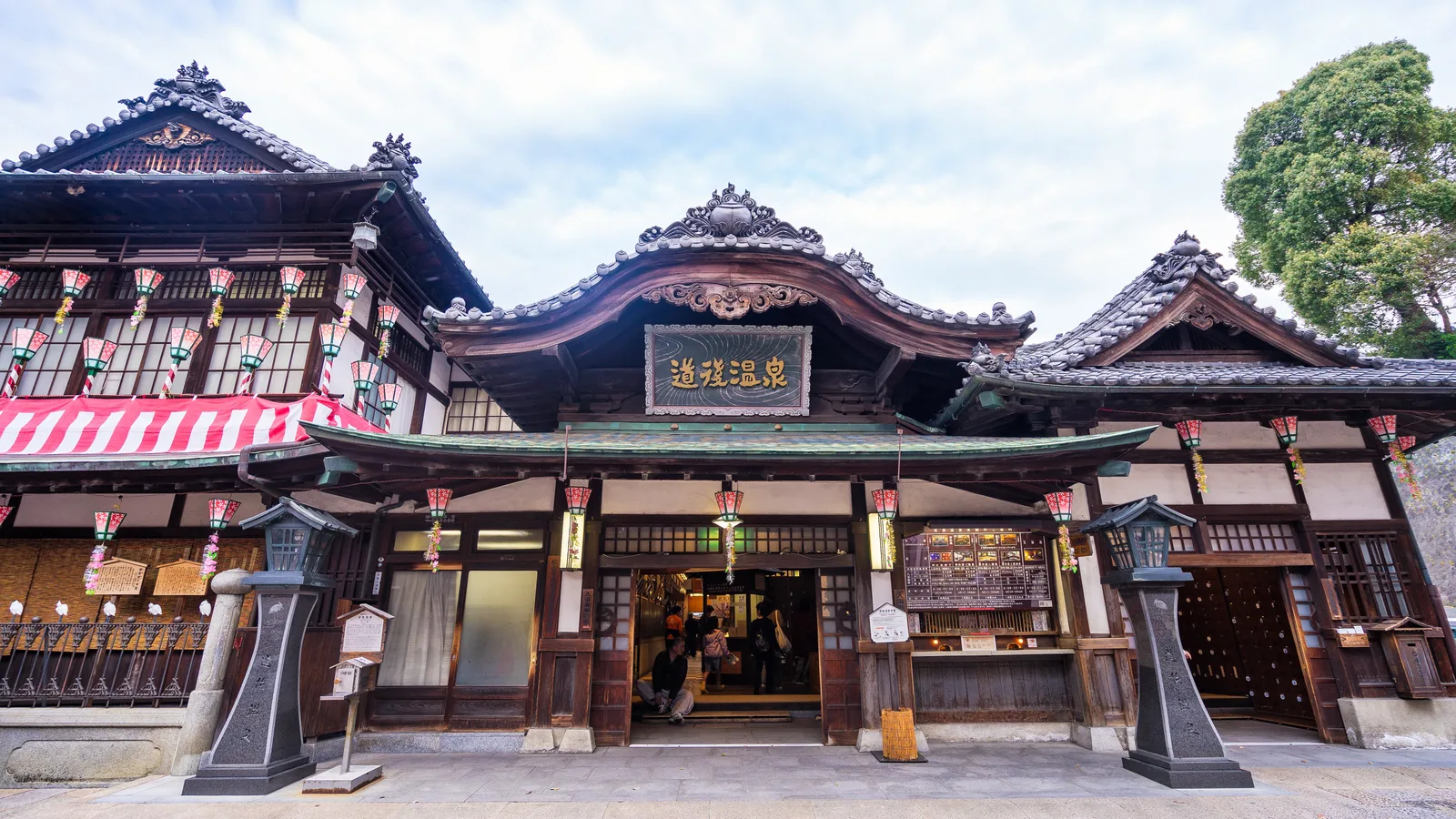
And then it is in front of you: the Honkan, layered roofs and dark timber rising to the little tower, looking less like a public bath than a small wooden castle. The thing to remember, standing here, is that you are allowed inside: not as a viewer, but as a bather.
The one genuine puzzle of Dōgo is the ticket, and it is worth understanding before you reach the counter, because it trips up almost everyone. The Honkan offers not one entry but several, and they differ less in the bathing than in what comes after it. The simplest ticket lets you into the downstairs bath, the Kami-no-yu, and out again: the pure, quick, local way to bathe. The next tiers add a rest afterward: a borrowed yukata, tea and a sweet, and a place to sit and cool down in a tatami hall upstairs, or, higher still, a private room and admission to view the Yūshinden. Many visitors pick the cheapest ticket to save a little, then watch others climb the stairs in their borrowed robes and wish they had, too. There is no wrong choice (the water is the same), but if part of what you came for is the old pleasure of sitting in a place like this afterward, the upstairs ticket is the one to know about. Whichever you choose, the etiquette inside is the gentle, unspoken kind shared by every Japanese bath; if you would like to know what is actually going through everyone's mind in an onsen (the rinsing first, the small towel, the quiet), it is a world worth understanding before you step in.
Two small things ease common worries. The first: the official rules here say nothing against tattoos, and Dōgo is often counted among the more relaxed hot springs on this point, though if it is on your mind, it is always worth understanding how tattoos and onsen fit together in Japan and asking quietly at the door. The second: you cannot sleep here. The Honkan is a bathhouse, not an inn: to stay at Dōgo means taking a room at one of the town's ryokan, with their own quiet customs of welcome, and walking over to the bath in your robe. Bathing itself takes about an hour by the ticket; the choosing is the only hard part.
Step 4: The Drum, the Lamp, and the Story
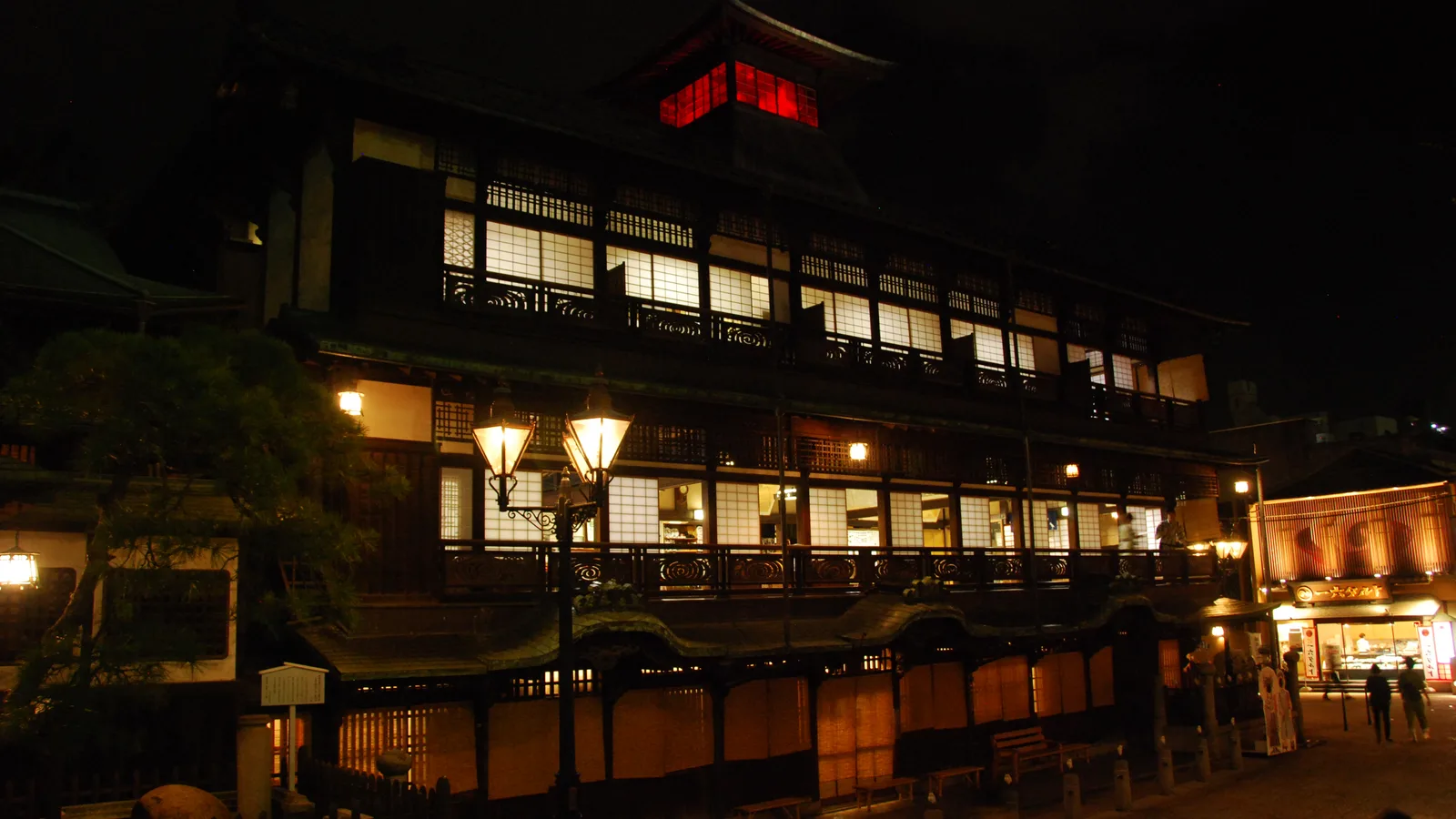
Come back out as the light goes. This is when the Honkan stops being a daytime sight and becomes the thing it really is: a building that is still alive. Lamps come on behind the red glass of the rooftop tower, the Shinrokaku, and three times a day from inside it a drum is struck, the Tokidaiko, marking the hours by hand as it has for generations. A monument that still keeps time is a rare thing to stand beneath. Most of them stopped long ago.
This is also the moment people raise the question they have been carrying since they arrived: isn't this the bathhouse from Spirited Away? It is often said to be (the rounded roof, the maze of stairs and passages do call the film's Aburaya to mind), but Dōgo is only one of several onsen around Japan that fans point to, and Studio Ghibli has never confirmed any single model (the one place the studio's artists are known to have studied is an open-air architecture museum near Tokyo). So enjoy the resemblance as a happy coincidence rather than a fact, and let it lead you in rather than letting it down. The same is true of the novel everyone here keeps naming: Botchan, by Natsume Sōseki, who came to teach in Matsuyama in 1895 and whose young hero bathed in this very spring; there is even a "Botchan room" kept upstairs in his memory. You do not need to have read a word of it. The town wears these stories lightly, like lamplight on old wood, and the bath beneath them asks nothing of you but that you get in.
Step 5: The Morning Bath
Go back once more in the early morning, when the Honkan opens at six and the crowds have not yet formed. This is the quietest, truest version of the place: a few locals with their own towels, the drum sounding its six beats overhead, steam lifting off water that has been rising here, by the old reckoning, for three thousand years.
By now the puzzle of the ticket and the worry about the references have fallen away, and what is left is very simple. The trains and the clock and the little dumplings and the film are all the lovely wrapping a town has folded around one ordinary, extraordinary thing: a bath, still open, where the people who live here have always come. You do not need to read the novel, or settle the question of the film, or climb to every floor. Step into the water once, the way people have for longer than anyone can remember, and you will have understood Dōgo, not the story about the bath but the bath the story is about.
Good to Know
Getting there: Dōgo Onsen is in Matsuyama, the largest city on the island of Shikoku, in Ehime Prefecture. By air, Matsuyama Airport connects to major cities; an Iyotetsu limousine bus reaches Dōgo Onsen in about 40 minutes (around ¥1,200, or roughly ¥830 on the ordinary route bus), though only the marked services run all the way to Dōgo. By rail, the JR limited express Shiokaze runs from Okayama across the Seto Ōhashi bridges to Matsuyama (allow about two and a half to three hours; check a current timetable, as the journey time varies by train). From Hiroshima or Kure, ferries and high-speed boats cross to Matsuyama Kankō Port (the cruise ferry takes about 2 hours 40 minutes; the high-speed boat from around 70 minutes), with a connecting bus into the city. For the wider picture of trains, passes and transfers, see getting around Japan.
Reaching the bath from Matsuyama: From the city, take the Iyotetsu streetcar (tram) to the Dōgo Onsen terminus, but note that only line 3 (from Matsuyama-shi Station) and line 5 (from JR Matsuyama Station) go to Dōgo; the loop lines 1 and 2 do not. The flat tram fare is ¥230 for adults; Matsuyama-shi Station to Dōgo takes about 20 minutes. The Honkan is about a 5-minute walk from Dōgo Onsen Station, along the covered Haikara-dōri shopping street.
The three bathhouses, which to choose: Dōgo has three public baths, and they are different errands. The Honkan is the historic icon, the one you have seen in photographs. The Asuka-no-Yu, opened in 2017, is a modern annex in classical style: it has open-air baths (which the Honkan does not), clearer ticketing, and is usually less crowded. The Tsubaki-no-Yu is the locals' everyday bath: plain, the cheapest, and the place to soak among Matsuyama residents going about an ordinary day. A 3-Bathhouse Tour Ticket (¥1,400 adults, valid two days) covers a basic bath at all three at a discount.
Honkan ticket tiers: The downstairs Kami-no-yu bath (bath only) is ¥700; the second-floor tatami-hall ticket, with a borrowed yukata, tea and a sweet, is ¥1,300; the Tama-no-yu second-floor ticket (¥2,000) and the third-floor private room (¥2,500, reservation needed) both include viewing of the Yūshinden. The Honkan is open from 6:00, with the basic bath running to 23:00 (last entry 22:30); the rest-room tickets close earlier. There are also two reservation-only private rooms at a higher rate.
The Yūshinden (imperial bath): A separate guided viewing of the 1899 imperial bathing wing (Japan's only bathhouse built for the Imperial Family) costs ¥500 (about 30 minutes, 9:00–16:30). It is for looking, not bathing.
Towels, soap and practicalities: Shampoo and body soap are provided at the Honkan and at the Asuka-no-Yu, but not at the Tsubaki-no-Yu (small bottles are sold there cheaply). Towels are rental (around ¥100–300) or bring your own; the Honkan has free lockers. No outside food or drink is allowed inside the bathhouses. All three close for one cleaning day each December.
When to go and how long: The baths are calmest early in the morning (the Honkan opens at 6:00) and late in the evening; the official website shows a live crowding indicator. A bath and a stroll fill a relaxed half-day; staying the night at a Dōgo ryokan lets you do the loveliest things (the lamplit Honkan at dusk and a quiet morning bath) that day-trippers miss. Matsuyama Castle, one of Japan's twelve surviving original keeps, is a short tram ride away and reached by ropeway or chairlift, an easy add-on for a second day.
Last verified: 2026-06
Official websites: dogo.jp (Dōgo Onsen: baths, tickets, hours), en.matsuyama-sightseeing.com (Matsuyama City tourism), and iyotetsu.co.jp (trams, the Botchan train, airport bus)
If Things Don't Go as Planned
The ticket counter confused you. You are not alone: the Honkan's tiers are the single most common stumble at Dōgo. Keep it simple: if you only want to bathe, ask for the Kami-no-yu (¥700) and walk straight in. If you would also like to sit, sip tea and wear a yukata afterward, ask for the second-floor ticket. The water is identical in every case, so there is no way to choose "wrong."
You came hoping to bathe in the imperial bath, the Yūshinden. That one is for viewing only: a short guided look at a room built for the Imperial Family, never for ordinary use. You bathe in the Kami-no-yu or Tama-no-yu downstairs; the Yūshinden is the jewel you admire on the way past.
The Honkan was crowded. It is the famous one, so it fills up. The calm windows are right at opening (6:00) and late evening, and the official site shows live crowding. If it is busy, the Asuka-no-Yu nearby is roomier and has open-air baths, and the Tsubaki-no-Yu is where the locals quietly go; either is a fine, often better, soak.
You wanted to stay overnight in the bathhouse. You can't: the Honkan and its siblings are bathhouses, not inns. The way to "stay at Dōgo" is to book a ryokan in the little hot-spring town around the baths and walk over in your yukata. That is, in fact, the better experience: it gives you the Honkan at dusk and the quiet morning bath.
You came for the Spirited Away bathhouse and weren't sure you'd found it. Dōgo is one of several onsen often said to have inspired the film, and Studio Ghibli has never named an official model, so treat the resemblance as a charming bonus rather than the reason to come. The real reward is older than any film: a working bath three thousand years in the making.
You have tattoos and aren't sure. Dōgo's official rules don't mention tattoos, and it tends to be more relaxed than many onsen, but a quiet word at the entrance settles it. We cover how tattoos and hot springs fit together in Japan, including the simple options that work almost anywhere.
Sources:
- Dōgo Onsen: Official (dogo.jp, English & Japanese): The three bathhouses, the Honkan's ticket tiers and hours, the Yūshinden imperial bath (viewing only, 1899), the rooftop Shinrokaku and the Tokidaiko drum (six beats at 6:00, twelve at noon, six at 18:00; one of Japan's 100 Soundscapes), the white-heron founding legend and the "three ancient springs" (kept as told tradition), and the no-tattoo-rule and amenity details
- Dōgo Onsen Honkan: Official ticket & fee page: Honkan tiers (¥700 / ¥1,300 / ¥2,000 / ¥2,500 and reserved rooms), hours and last-entry times, Yūshinden viewing fee (¥500), provided soap and lockers, public-bath (no overnight) status
- Dōgo Onsen: Conservation report: Repair and seismic work (2019–2024), full reopening on 11 July 2024, and the official statement that this was the first time in Japan an Important Cultural Property public bathhouse was conserved while staying open for business
- Dōgo Onsen: "Man'yō no Dōgo" history page: Dōgo, Arima and Shirahama as the three ancient hot springs named in the Man'yōshū
- Matsuyama City: Official tourism (English): Dōgo Onsen Station, the Haikara-dōri shopping street, the 5-minute walk to the Honkan, and Matsuyama's framing as the city of haiku and Botchan
- Matsuyama City: Sōseki, Botchan and Dōgo: Sōseki's 1895 arrival as an English teacher, the spring as the model for the bath in Botchan, and the "Botchan room" kept in the Honkan
- Iyotetsu: Botchan Ressha & trams (Official): The Botchan steam-style train (weekends and holidays, no reservation, both routes via Dōgo Onsen), the streetcar lines that serve Dōgo (3 and 5) and the flat fare, and the airport limousine bus
- Matsuyama City: Botchan Karakuri Clock & Hōjō-en: The clock's hourly operation (8:00–22:00; every 30 minutes on weekends, holidays and peak months) and the free footbath
- Setonaikai Kisen: Hiroshima/Kure–Matsuyama ferries: The cruise ferry (about 2h40m) and high-speed boat (from about 70 minutes) to Matsuyama Kankō Port
- Matsuyama Castle: Official: One of Japan's twelve surviving original keeps, reached by ropeway or chairlift
- JNTO: Dōgo Onsen (English): Visitor-facing overview, standard English terms, and Dōgo as one of Japan's oldest hot springs
Image credits: Dōgo Onsen Honkan (hero), photo by CT-May, CC0, via Wikimedia Commons. Dōgo Onsen Honkan façade, photo by Wei-Te Wong, CC BY-SA 2.0, via Wikimedia Commons. Dōgo Onsen Honkan at night, photo by Maarten Heerlien, CC BY 2.0, via Wikimedia Commons. Botchan Karakuri Clock, photo by CT-May, CC0, via Wikimedia Commons.
WMJS is written in Japan, in English, with AI help. We check every page, but English is not our first language. If a sentence reads oddly, tell us. One sentence is enough.
Thank you. A person reads every note.
Real voices
Is it worth it?
Were you there? Share your photos.
Your photo could appear in this guide — with your name and a link to your profile.
Submit a photoRelated Articles

What Japanese Bathers Actually Think When You Walk In


Staying at a Ryokan: What Your Host Wishes You Knew

More guides in Shikoku
Naoshima — The Island That Art Brought Back to Life
A walking guide to Naoshima, the Seto Inland Sea art island — Kusama's pumpkins, the underground Chichu Art Museum, and houses turned into art in a living village.
Naoshima Island
Ritsurin Garden — The Masterpiece Japan Left Off Its Famous List, Because Its Best View Is the Walk
An audio cultural guide to Ritsurin Garden in Takamatsu, verified against official sources. Understand why this daimyo strolling garden — a Special Place of Scenic Beauty with three Michelin stars — is not on Japan's famous list of three great gardens, which station to actually get off at, and why its masterpiece is the walk, not any single view.
Ritsurin Garden
Kochi Castle — Where the Whole Castle Survived, Not Just the Tower
A cultural audio guide to Kochi Castle — the only original Japanese castle where the keep and its lord's palace both survive. Plus the 300-year Sunday market, hours, fees and how to visit.
Kochi Castle