
Visiting Jigokudani Snow Monkey Park, and Why the Monkeys Bathe Only When It's Cold
Jigokudani Yaen-koen (Snow Monkey Park)
By Kei · Born and raised in JapanIs Jigokudani Snow Monkey Park worth visiting? By the voices we gathered, yes, with one condition: of 70 international travelers who actually made the trip, weighted by how much each account resonated with fellow readers, 38% called it a highlight outright and another 42% called it worth it in winter or if it was already on their way, while 20% felt the detour wasn't worth it, almost always because they went in the wrong season. Japanese visitors and locals, reviewing the same valley in their own words, rate it warmer still, at 64% treasured and just 17% naming the season or the climb as the hard part. The wild macaques bathe in the hot spring only in the coldest months, December through February, to survive the cold rather than to charm you, and the walk in from Kanbayashi Onsen is about two kilometres, thirty to forty minutes on foot. What those voices actually said, including the one season mistake you can avoid, is further down this page.
The Meaning
You will have walked a long way by the time you see the first one, and when you do, it will not look up at you.
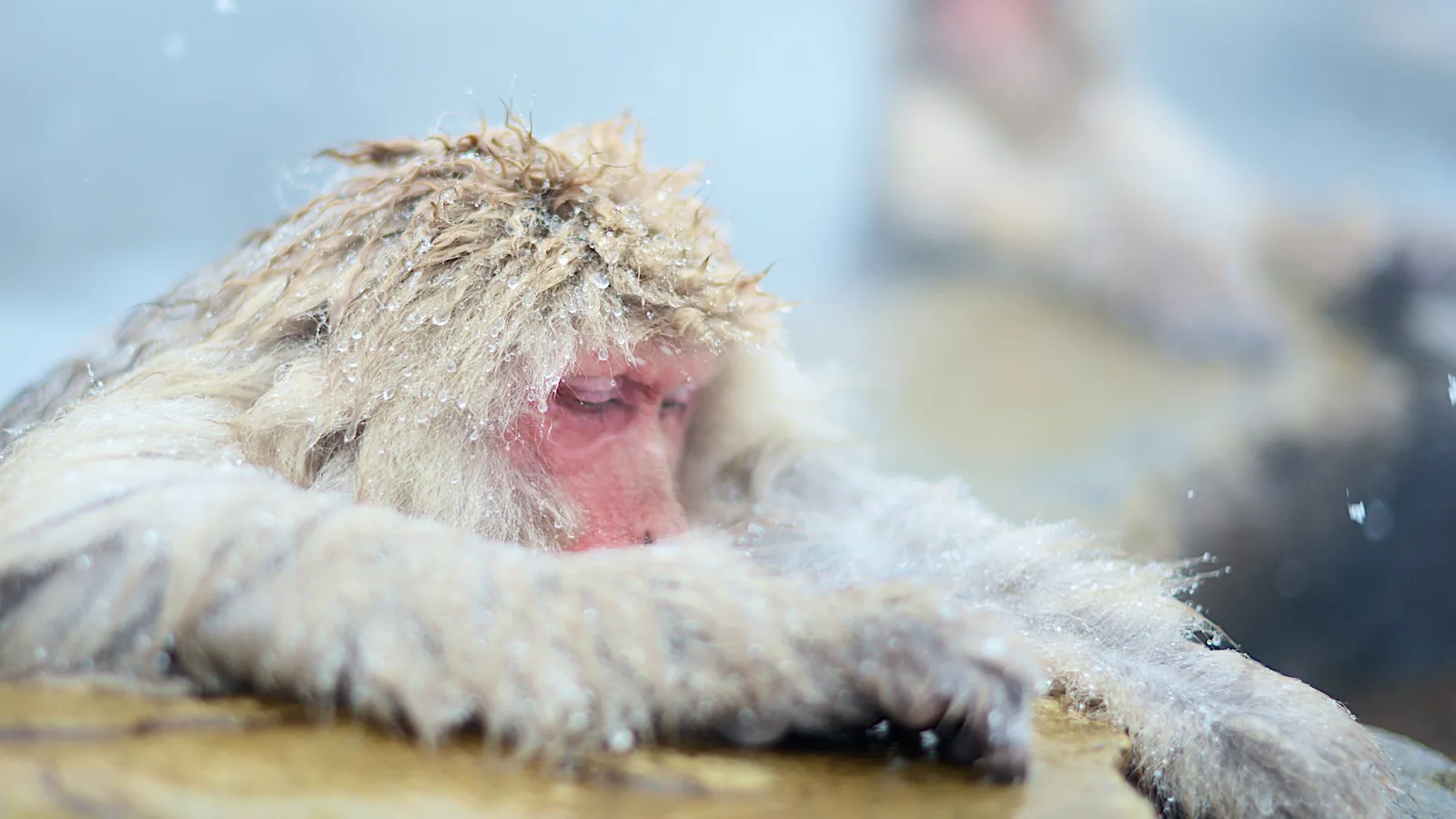
The path comes in along a river through the snow, past steam rising from the cliffs, and then the valley opens and there they are: wild monkeys, sitting in a steaming pool of hot water with the snow falling on their shoulders, eyes half-closed, doing nothing at all for your benefit. There is no fence between you and them. No glass, no moat, no keeper holding them back. They came down off the mountain this morning of their own accord, and when they have had enough they will climb back up, and nothing you do will change either decision. For most visitors this is the quiet surprise of Jigokudani: you have travelled here to see the monkeys, and the monkeys have not travelled anywhere to see you. You have simply been allowed, for an hour, to stand at the edge of a wild animal's ordinary day.
This is the thing worth understanding before you go. The famous photograph (the red face, the closed eyes, the snow, the steam) is real, but it is not what the picture suggests. These monkeys are not bathing because it is charming. The Japanese macaque is the northernmost monkey on earth; no wild primate other than ourselves lives in colder country. Here, at eight hundred and fifty metres, the snow can lie more than a metre deep and the nights fall below minus ten, and in the coldest months this troop has learned to do something almost no other wild animal does: borrow the heat of a hot spring to hold off the winter. When researchers studied the monkeys of this valley, they found that a soak in the hot water measurably lowers their stress in the depth of the cold. The bath is not a pastime; it is a way of staying alive.
And it is not ancient, either. By the park's own account, the bathing began only in the early 1960s, around the time the park opened in 1964, when one young monkey, almost by accident, climbed into the open-air bath of a hot-spring inn at the foot of the valley. Others copied it. The young learned it first, then their mothers, and the troop has carried the habit down the generations ever since, the way people carry down a custom. What you are watching, in other words, is not instinct and not a trick, but something closer to culture: a single small discovery, kept and passed on, for more than half a century.
So here is what this guide asks of you. Come to see the monkeys, by all means; take the photograph you came for. But come understanding that the kindest way to be here is to ask nothing of them at all. You will not feed them, you will not touch them, you will not even meet their eyes. It can feel, at first, like a strange sort of welcome. It is, in fact, the warmest one a wild animal can be given: to be left entirely alone to live its own day, while a stranger stands quietly nearby and is glad of it.
What Happens When You're There
Step 1: The Walk Into the Valley
The monkeys do not come to the road, and that is the first thing to make peace with.
From the bus stop and the car park at Kanbayashi Onsen, a single trail runs about two kilometres up the valley to the park entrance, roughly a thirty- to forty-minute walk through forest, mostly gentle but unpaved, with steps and uneven ground that no stroller or wheelchair can manage. In summer it is an easy woodland path. In winter it is something else: packed snow and stretches of ice, narrow in places, climbing quietly between the cedars with the river below. People in ordinary city shoes slow to a careful shuffle; people who have brought proper boots, and the small strap-on crampons sold at the trailhead, walk it without a thought. This is worth saying plainly, because the walk surprises people who pictured a car park beside a zoo. There is no shortcut. The distance is part of what keeps the place wild.
It is also, many visitors find, half of why they remember the day. The forest in snow is its own reward: steam drifting off the cliffs where the valley earned its old name, Jigokudani, "Hell Valley," from travellers who saw boiling water leap from the rock and could think of nothing gentler to call it. Walk it slowly. You are not late for anything. The monkeys keep no schedule, and neither, for this half-hour, do you.
Step 2: The Rule of Distance
At the entrance you meet the rules, and they are worth reading properly, because they are not really a list of prohibitions. They are a single idea, written several ways.
Do not feed the monkeys. Do not touch them. Do not stare into their eyes; in their world, a fixed stare is a threat. Do not crowd them; if a curious young one comes toward you, it is you who steps back. The park keeps no fences and no barriers, on purpose, so that the monkeys live as close to wild as a watched troop can. And then it asks one thing that no guidebook quite captures: to imagine the encounter from the monkey's side, to consider how you would feel if a stranger you did not know behaved toward you the way you are about to behave toward them. That single sentence is the whole philosophy of the place. Everything else is detail.
If you have come from a place like Nara, where a thousand-year tradition lets you feed the sacred deer from your own hand, the rule here can feel like its exact opposite, even, at first, a little cold. It is not. In Nara the relationship is built on giving; here it is built on restraint, and the restraint is the gift. A monkey that learns to take food from people stops being wild: it begins to wait by the path, to follow, to snatch, and in the end to come into conflict with the very people it has learned to depend on, which never ends well for the monkey. So the park feeds the troop itself, carefully and out of sight of any show, only enough to keep them coming down where they can be watched, and asks you to give nothing. Not because the monkeys are unworthy of your kindness, but because not giving is the kindness itself, one of the harder things to feel in the moment, and one of the truer ones: that here, the most generous thing your open hand can do is stay empty.
Step 3: The Monkeys in the Steam
Then you are among them, and the strangeness gives way to something very plain.
A mother sits in the water with a baby clinging to her chest. Two young ones chase across the snow and tumble into a drift. An older monkey soaks to its shoulders with its eyes shut and the steam beading on its face, utterly indifferent to the ring of cameras a few metres off. It is tempting to read all of this as performance, to see the closed eyes as bliss and the bath as a spa. Watch a little longer and a truer picture settles in. They bathe in the coldest months, December through March, and are reluctant to in the warmth of summer; some never bathe at all. The ones in the water are doing exactly what the snow on the rocks is telling them to do: keeping warm, in the only way this valley offers, on a day that would otherwise be very hard to survive.
Photography here is allowed, and the park even permits a flash (which surprises people who assume the opposite), but the spirit of the rule still holds: do not push a lens or a phone close to a monkey's face, do not reach into the bath, and leave the selfie sticks and drones in your bag. The same quiet awareness that makes any crowded place easier for everyone in it is all that is asked. The best photograph you will take is the one where the monkey has forgotten you are there.
Step 4: When They Climb Back
After a while, without ceremony, a monkey will rise from the water, shake itself, and start up the slope, and others will follow, and the troop will begin to drift back toward the mountain.
No one calls them down and no one sends them home. There is no fence to open. They came because the valley floor was warmer and the food was here, and they leave because the day is ending and the mountain is where they live. If you have stayed into the late afternoon you will see the pools empty by degrees, the snow settling into the prints they leave behind, and you will understand the place better in that quiet than you did at the busy middle of the day. You did not, in the end, do anything to them. You watched, you kept your distance, you carried nothing of theirs away and left nothing behind. For an hour you were simply a guest at the edge of a wild animal's winter, and the whole arrangement worked precisely because you asked for nothing.
Some days the monkeys are few, or slow to come, or already gone back up; they are wild, and a wild animal owes no one an appearance. If that is your day, the snow and the steam and the long walk through the forest are still yours, and the monkeys are still up there, living their winter exactly as they should. That, too, is the place keeping its promise. Thank you for walking with us.
What Visitors Honestly Say
Before you plan the trip, it helps to hear from the people who have already gone. We collected 70 voices from international travelers who had actually been, weighted each by how much it resonated with fellow readers, and this is how they fell:
Read the middle bar first: it's the biggest one on the page, and the shape says it plainly. This isn't a highlight-or-bust place; it's a place that rewards good timing. One visitor summed up the trip math exactly: "It is worth it, if you make a weekend of it: stay in the nearby town, Shibu Onsen... If you have to travel 4 hours and take all manner of bus and train just to look at the monkeys and turn back around, [I'm] not sure if it's worth it." Another, on the one thing that decides everything: "It's only worth it if there is snow on the ground."
Japanese visitors and locals, reviewing the same valley in their own words, rate it warmer still:
Notice that both red bars point at the same cause: the wrong season. "I expected them soaking in the bath, but not one got in that day. I asked, and apparently they don't go in unless it's cold," one wrote. Another only found out after the walk was already decided for them: "only to be met with the sign: 'no monkeys today.' They're wild animals, so it can't be helped." Go in deep winter and that risk falls away almost entirely.
The full picture, timing checklist included, is in Are the Jigokudani Snow Monkeys Worth It?
Good to Know
The most important thing to know first: the monkeys are wild, and they do not appear on schedule. They come down to the valley most days in winter, but not every day, and how many arrive, and when, depends on the weather and the mountain. The park posts the day's monkey activity on its official social media; checking before you set out can save a long trip on a quiet day. And because the bathing is for warmth, the famous scene of monkeys in the steaming pool is a deep-winter sight: they soak in the coldest months and are reluctant to in summer, though the troop itself can be seen year-round.
Getting there: Jigokudani sits up a valley in the town of Yamanouchi, and reaching it takes a few connections, and this is the part visitors most often misjudge. From Tokyo, the Hokuriku Shinkansen reaches Nagano in as little as 79 minutes. From Nagano there are two common ways in: take the Nagano Dentetsu line to Yudanaka Station (about 38 minutes by limited express), then a local bus to the "Snow Monkey Park" stop (roughly 8–15 minutes); or take the direct express bus from Nagano Station's east exit straight to the "Snow Monkey Park" stop (about 41 minutes). From either stop, the only way to the monkeys is the walk up the valley (see below). A day trip from Tokyo is genuinely possible, but it is a long day; many visitors prefer to stay a night nearby. For the wider picture of trains, buses, and transfers, see getting around Japan. Last verified: 2026-06.
The walk in: From the bus stop and free car park at Kanbayashi Onsen, it is about two kilometres, roughly 30–40 minutes, on an unpaved forest trail with steps and uneven footing, unusable for strollers or wheelchairs. In winter the trail is snow-packed and icy in places: bring waterproof, well-gripping snow boots, and consider the simple strap-on crampons sold near the trailhead. If you drive, the Kanbayashi car park is free and open year-round (a separate, paid Jigokudani car park closer in is closed each winter, roughly December through March); winter tyres or chains are essential on these mountain roads. Last verified: 2026-06.
Hours and admission: the park is open roughly 8:30–17:00 in the warmer season (about April–October) and 9:00–16:00 in winter (about November–March), aiming to have everyone out by closing; arriving at least half an hour before close is wise. Admission is around 800 yen for adults (18 and over) and 400 yen for children (6–17), with under-fives free. The park is open year-round with no fixed holidays, but bad weather can shorten hours or close it without notice, so check the official site before a winter visit. A dated online-ticket system for busy winter days has been announced for introduction; check the park's official site for the current arrangement. Last verified: 2026-06.
Passes and tickets: Nagano Dentetsu offers a "Snow Monkey Pass" that bundles transport with park admission, and a separate bus pass covers the express bus; the exact coverage and price change by season and have been revised recently, so confirm the current versions with Nagano Dentetsu rather than older guides. Last verified: 2026-06.
Feeding: there is none for visitors; it is not sold and not permitted. The park feeds the troop itself, quietly and only to keep them coming down to be watched; your part is to give nothing, show no food, and keep snacks and plastic bags out of sight (a monkey learns quickly that a bag may hold food). This is the reverse of feeding the deer at Nara, and the contrast is the whole point: there, giving; here, restraint.
When to visit: for the snow-and-steam scene, the coldest months, roughly December to February, are the surest. Mornings into early afternoon (the park is liveliest around the middle of the day) are when the troop is most reliably down in the valley. For how the seasons trade off across a wider trip, see the best time to visit Japan. Last verified: 2026-06.
Photography: cameras and phones are fine, and the park even permits flash, but do not hold a device close to a monkey's face, do not put a camera into the bath, and selfie sticks and drones are not allowed.
Last verified: 2026-06
Official sources: Jigokudani Yaen-koen (official) · Snow Monkey & Nagano (Nagano Prefecture official tourism) · JNTO
If Things Don't Go as Planned
There are no monkeys, or only a few. This is normal, not bad luck; the troop is wild and comes down when it suits them, not when the timetable says. If you can, check the park's official social media for the day's activity before you leave. Once there, give it time: a valley that looks nearly empty at first can fill as the morning goes on, as monkeys come down from the slopes. And if the day stays quiet, the forest walk and the snow are still worth the trip: the monkeys are simply up the mountain, where wild animals are supposed to be.
A monkey has come close, or is eyeing my bag. Step away from it calmly; you move, not the monkey. Do not show food, and keep bags, especially rustling plastic ones, closed and out of sight, because a monkey may have learned that a bag means a snack. Do not stare into its eyes or bare your teeth in a grin; both read as threats. None of this means you are in danger. You are simply among genuinely wild animals, and a little distance keeps the encounter easy for both of you.
The trail is harder than I expected. The walk is about two kilometres of unpaved path, and in winter it can be properly icy. If you have only city shoes, slow right down and use the handrails where they exist; the strap-on crampons sold near the trailhead make a real difference, as do trekking poles. There is no vehicle access to the park itself, only the walk in and out, so pace yourself and allow more time than the distance suggests.
I'm travelling with small children or someone less steady on their feet. The snow trail rewards planning. A baby carrier works where a stroller cannot, and warm, grippy footwear matters for everyone. Give yourselves extra time, take the walk in stages, and don't be shy about turning back if the ice feels like too much on the day; the mountain will still be there. Our notes on travelling Japan with children cover the wider rhythm of it.
It's crowded, or there's no snow and the valley looks plain. The deep snow that makes the famous photograph is a midwinter thing; earlier and later in the season the scene is barer, and the busiest stretches are right at the pools in the middle of the day. Step back a little and wait a few minutes; the crowd moves in waves, and a quieter spot usually opens up. The monkeys are unbothered by either the crowd or the bare ground; only your photograph minds.
I've come all this way and I'm worried it won't live up to the pictures. It is an easy worry, and a common one. The honest truth is that some days are quieter than the postcards, and that the long walk and the cold are real. But a great deal of what people remember from Jigokudani is not the single perfect shot; it is the snow, the steam, the forest, and the plain strangeness of standing a few metres from a wild animal that has decided you are not worth worrying about. If you go expecting a day rather than a photograph, it very rarely disappoints.
Sources:
- Jigokudani Yaen-koen Official: About the Park (English): Park opened 1964, the origin of the bathing behaviour at the Korakukan inn's open-air bath, the no-fence policy, the name "Jigokudani / Hell Valley"
- Jigokudani Yaen-koen Official: Visitor Information / Hours & Admission (English): Seasonal opening hours (8:30–17:00 Apr–Oct, 9:00–16:00 Nov–Mar), admission (adults ¥800, children ¥400, under 5 free), open year-round, possible unannounced weather closures
- Jigokudani Yaen-koen Official: Visitor Rules / Caution (English): Do not feed, touch, or stare; keep a distance; photography and flash permitted but no selfie sticks, drones, or camera-in-bath; the request to consider the encounter from the monkey's point of view
- Jigokudani Yaen-koen Official: First-Time Visitor's Guide (English): Monkeys are wild and not present every day, daily activity posted on official social media, winter footwear and crampons, bathing in the coldest months
- Jigokudani Yaen-koen Official: Access & the Yumichi Trail (English): The ~2 km / ~30–40 min trail from Kanbayashi Onsen, train and bus connections, free Kanbayashi car park, winter closure of the Jigokudani car park
- Jigokudani Yaen-koen Official: About the Japanese Macaque (English): Macaca fuscata as the world's northernmost non-human wild primate; bathing as protection from the cold
- Jigokudani Yaen-koen Official: The Monkeys and the Hot Spring (English): Bathing as warmth in the coldest months, reluctance in summer, that not all monkeys bathe
- Jigokudani Yaen-koen Official: The Valley Through the Year (English): Elevation 850 m, winter snow over a metre, lows below −10°C, why the deep valley drives the monkeys to the warm water
- Snow Monkey & Nagano: The Jigokudani Wild Snow Monkey Park Guide (Nagano Prefecture official tourism, English): Resident troop of more than 200, access and transfer times, seasonal notes, nearby onsen-town stays at Yudanaka, Shibu, and Kanbayashi
- Takeshita, Bercovitch, Kinoshita & Huffman (2018), "Beneficial effect of hot spring bathing on stress levels in Japanese macaques," Primates 59(3):215–225 (Kyoto University): Study of this troop finding that bathing lowers winter stress-hormone levels: a thermoregulatory, adaptive behaviour rather than play
- Matsuzawa (2018), "Hot-spring bathing of wild monkeys in Shiga-Heights: origin and propagation of a cultural behavior," Primates 59:209–213: The early-1960s origin and the generational, socially learned spread of the bathing habit
- Government of Japan: Highlighting Japan, "Native Creatures of Japan: Japanese Macaque" (January 2026): The Japanese macaque as the northernmost-living non-human primate, with the species' northern limit in Aomori's Shimokita Peninsula
- JNTO: Snow Monkeys / Joshinetsu Kogen National Park (English): Official English visitor framing, the park within Joshinetsu Kogen National Park, broad-area access via Nagano
- Are the Jigokudani Snow Monkeys Worth It? (WMJS): The two visitor-voice gauges reproduced in "What Visitors Honestly Say" (70 international voices, 38/42/20; 89 Japanese voices, 64/19/17) and the verbatim visitor quotations
Photos: sourced under free commercial-use licenses; see captions where attribution applies.
WMJS is written in Japan, in English, with AI help. We check every page, but English is not our first language. If a sentence reads oddly, tell us. One sentence is enough.
Thank you. A person reads every note.
Real voices
Is it worth it?
Were you there? Share your photos.
Your photo could appear in this guide — with your name and a link to your profile.
Submit a photoRelated Articles
"Excuse Me, Can You Take My Photo?": What Japanese People Really Think

Getting Around Japan: The Tiny Things That Earn You a Nod
Traveling Japan with Kids: What Parents Don't Know About How Japan Welcomes Children
More guides in Chubu
Visiting Mount Fuji, the Mountain That Hides for Half the Year
Is Mount Fuji worth seeing? We weighed 53 traveler voices: 36% saw it clear and call it unforgettable, and Japanese reviewers land warmer at 64%. The Fuji Five Lakes, the Fifth Station without climbing, and the short climbing season, with an audio guide.
Mount Fuji
Matsumoto Castle — Why a Fortress Built for War Has a Room for Watching the Moon
A cultural audio guide to Matsumoto Castle, verified against official sources — one of Japan's twelve original wooden keeps, why a black war-fortress on the plain grew a moon-viewing tower, plus hours, tickets and how to climb it well.
Matsumoto Castle
Kanazawa — The Castle Town That Turned a Fortune Into Gardens and Gold Leaf, Not Armies
A cultural audio guide to Kanazawa, verified against official sources — why the Maeda domain spent a million-koku fortune on gardens, gold leaf and crafts instead of armies, plus Kenroku-en hours, access and how to visit well.
Kanazawa
Ghibli Park: A Forest You Walk Into, Not a Theme Park You Ride
Ghibli Park is a forest you walk into, not a theme park you ride. What the tickets really unlock, how to reserve, and how to enjoy it even if you are not a fan.
Ghibli Park