
このページは日本語でも読めます。日本語で読む →
이 페이지는 한국어로도 읽을 수 있습니다.한국어로 읽기 →
這個頁面也有繁體中文版。閱讀繁體中文版 →
这个页面也有简体中文版。阅读简体中文版 →
หน้านี้มีภาษาไทยด้วยอ่านภาษาไทย →
Trang này cũng có bản tiếng Việt.Đọc bằng tiếng Việt →
Halaman ini juga tersedia dalam Bahasa Indonesia.Baca dalam Bahasa Indonesia →
Cette page existe aussi en français.Lire en français →
Diese Seite gibt es auch auf Deutsch.Auf Deutsch lesen →
Esta página también está disponible en español.Leer en español →
Questa pagina è disponibile anche in italiano.Leggi in italiano →
When to come
Winter Japan, snow, onsen and light
One westbound line from Tokyo's clearest air into the snow country and down to the hush of Kyoto — read the way the people who love a Japanese winter read it, where the cold isn't the price of the trip but the instrument the whole season is played on
Last verified: 2026-06-23
Days
About 4 on the core westbound line — Tokyo, the Nagano snow country, Kanazawa, Kyoto — and a fifth if you take the northern winter fork; composable, and you can also turn south to leave the snow behind
Best season
December to February. Early December is illuminations with light snow; late January into February is the deep-winter heart (soaking monkeys, laden snow gardens, the festivals, the clearest Fuji). I'd plan around the New Year days and mid-February's Lunar New Year
Base yourself
Two cities and a hot-spring night: a few nights in Tokyo, one onsen night up in the Nagano snow country, then Kanazawa and Kyoto on the way south
Getting around
An IC card taps across the cities; the Hokuriku Shinkansen runs as one continuous line west from Tokyo through Nagano to Kanazawa; one change at Tsuruga drops you into Kyoto. Layers, an early start, and a little slack for snow
Who this plan suits
- First tripWorks well
- Been beforeGreat fit
- With kidsWorks well
- SoloGreat fit
- As a coupleGreat fit
- Gentle paceNot the focus
When to goDec to Feb
Late January into February is the deep-winter heart — the snow monkeys soak, the snow gardens lie laden, the great snow festivals peak, and Mount Fuji is at its clearest. Early December has the illuminations at full blaze with less snow. I'd plan around the first days of January (when much of the country closes for its own New Year, though the shrines are the experience then) and mid-February's Lunar New Year week, when inbound crowds swell.
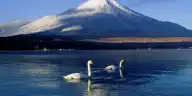
Is winter a good time to visit Japan? Yes, if you don't mind the cold: December through February brings the country's driest, clearest air, making these the most reliable months to see Mount Fuji (visible on the majority of winter days, against only a small fraction of summer days), wild snow monkeys soak in hot springs only when it's genuinely cold enough, and temples and gardens that are shoulder-to-shoulder in spring stand nearly empty. What you trade is real: no cherry blossoms, short days, true cold. Two stretches are worth planning around rather than through: the first days of January, when much of the country closes for New Year (shrines stay busy with hatsumode), and mid-February's Lunar New Year week, when inbound crowds swell again. The route below threads Tokyo, the Nagano snow country, Kanazawa and Kyoto along a single rail line to make the most of the season.
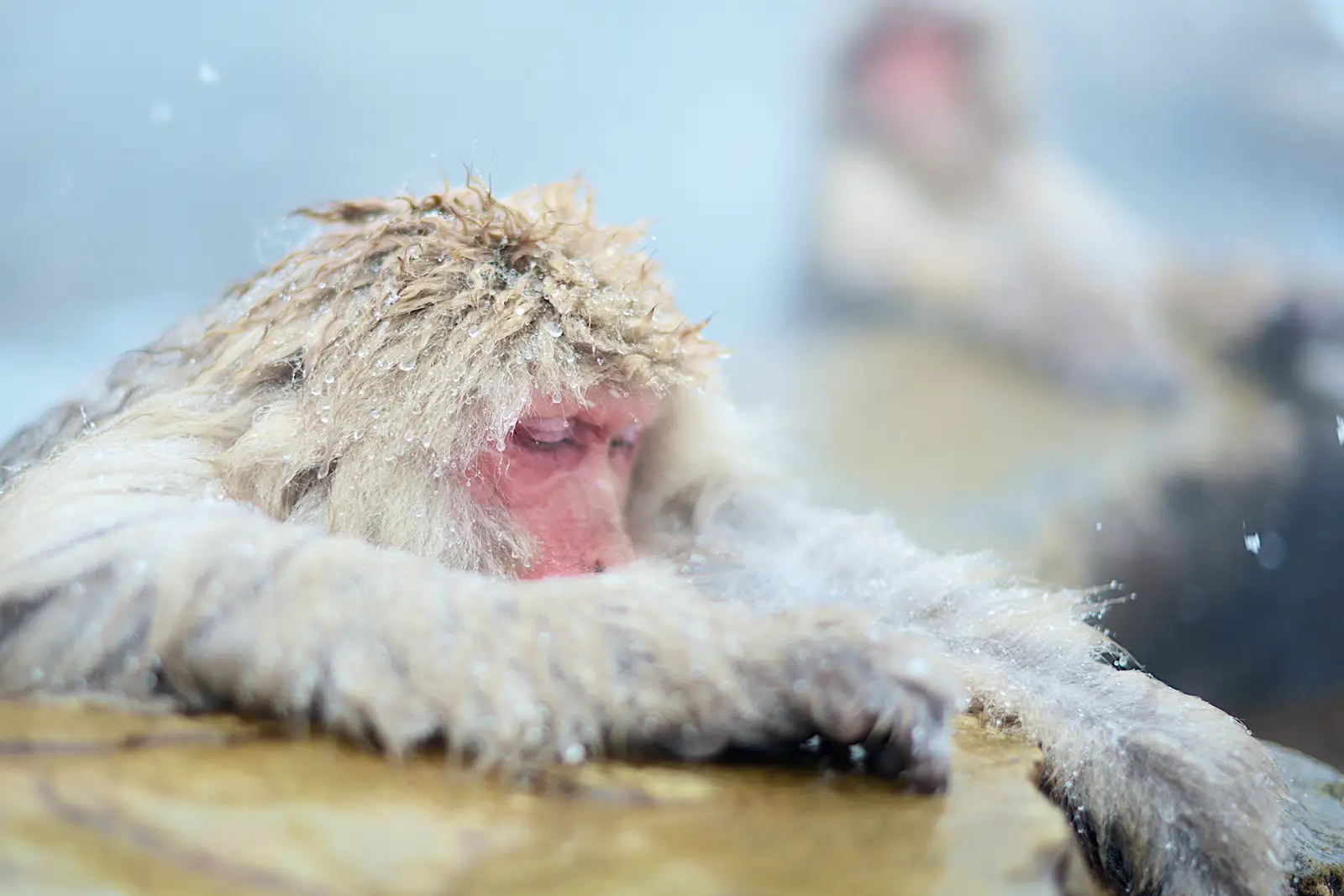
Most people file winter under 'off-season' — the consolation prize for missing the cherry blossoms, a few cold weeks to be endured rather than chosen. I'd gently turn that around, because the people who love a Japanese winter most see it the other way: this is the season the country composes most deliberately. Japan rarely tries to escape the cold in winter; it keeps the cold in the frame so the warmth can be felt against it. You sit in a steaming bath precisely so the snow can fall on your shoulders; gardeners dress a pine in ropes so the snow has something beautiful to land on; a thousand lamps are strung up because the night is long. The cold isn't the price of the trip — it's the instrument the whole season is played on. Once you see winter that way, it stops being a lesser spring and becomes its own clear, quiet, deliberate thing.
So the first thing I'd do is hold your dates against the season. Coming in early December? The cities are at the height of their illuminations and the air is already turning clear, with the deep snow only just starting up north and the holiday crowds not yet arrived — a bright, gentle on-ramp to winter. Coming late January into February? That's the deep-winter heart of this plan: the snow monkeys actually soak, the snow gardens lie laden, the great snow festivals peak, and the dry air gives the clearest, most reliable Mount Fuji of the whole year. Worried winter just means grey and bare? What you trade is real — no blossom, short days, genuine cold — but what comes back is the country at its clearest and quietest: an empty temple at dawn, snow on an old roof, the whole landscape looking freshly rinsed. Two stretches I'd simply plan around rather than through: the first days of January, when much of the country closes for its own New Year (the shrines, as you'll see, are the experience then), and the mid-February Lunar New Year week, when inbound crowds swell again.
I'd thread the trip along a single westbound rail line — out of Tokyo's bright clear winter, up into the snow country of the Japan Alps, then down toward the hush of Kyoto — so each day turns the same idea another way. As ever, this is only how I'd move; pull it apart and rebuild it around your own dates and the kind of cold you're chasing.
Where to base yourself
This is a trip strung on a single line — Tokyo, then a hot-spring town in the Nagano mountains, then Kanazawa and Kyoto — and in winter when you step out the door matters as much as where you sleep. Two of the season's loveliest sights are gated by the hour: the clearest Mount Fuji burns off by mid-morning, and snow on a temple roof can be gone by noon.
In Tokyo, I'd base on or near the JR Yamanote loop — around Tokyo Station, Shinjuku or Shibuya — so the winter illuminations and an early Fuji-lookout are all a short ride away, and the airport links are easy. (More on the illuminations in Day 1.)
Up in the snow country, the whole point is to sleep where the snow falls. The little hot-spring towns nearest the snow monkeys — Shibu and Yudanaka Onsen — are where I'd spend the trip's keystone night, in a ryokan with an outdoor bath, so you can do by choice what the monkeys do by instinct. (Neither town has a WMJS guide yet, so I'm naming them honestly rather than linking them.)
In Kanazawa, anywhere near the station or the Kenrokuen side keeps the garden and the market within an easy walk. In Kyoto, near the station for the simplest hops, or in Higashiyama to wake among the eastern temples and reach them before the day warms.
The move that matters all winter is layers and an early alarm. Cold, dry, bright mornings are the gift of the season — Fuji at its sharpest, a temple garden to yourself, the snow still clean — and they all belong to whoever is out first.
Tokyo — the clear, bright cold
north by Shinkansen, into the snowNagano snow country — soaking monkeys + a snow-view bath
the same line west, no changeKanazawa — the garden built for snow
south, one change at TsurugaKyoto — the winter hush
Getting around & tickets
Sort an IC card first — a prepaid tap card (Suica, ICOCA and the rest are interoperable nationwide) — and the cities mostly stop asking you for tickets: tap on and off the local trains, subways and buses. Two winter caveats, both in the fact box: a single tap has to begin and end inside the same IC area, and the card won't carry you onto a Shinkansen or limited express — those need their own ticket.
The spine of this trip is the Hokuriku Shinkansen, and the lovely thing about it is that it runs as one continuous line heading west: Tokyo to Nagano (for the snow monkeys), then the same line on to Kanazawa, with no doubling back. The fastest trains carry no non-reserved seats at all, so I'd book a seat — details in the fact box.
One current catch worth knowing for the last leg. Getting from Kanazawa down to Kyoto used to be a single train; since the line was extended in 2024 it isn't anymore. You now ride the Hokuriku Shinkansen to Tsuruga and change there — same station, a short signposted walk across — onto a limited express into Kyoto. It's one easy transfer, but plenty of older guides still describe a through train, so it's worth knowing before you reach the platform (fact box).
And the winter-specific part: the mountain legs are not the tap-and-go of central Tokyo. The bus up toward the snow monkeys can want cash on weekdays, and the very last stretch to the monkeys is on foot — a snowy uphill walk no vehicle covers (Day 2). More broadly, heavy snow can slow even the Shinkansen now and then, so on a multi-city winter route I'd leave a little slack in each day rather than chain tight connections. Boots with grip, layers you can peel off indoors, and something for the dry air will quietly make or break the trip.
Tokyo, the clear cold and the long night
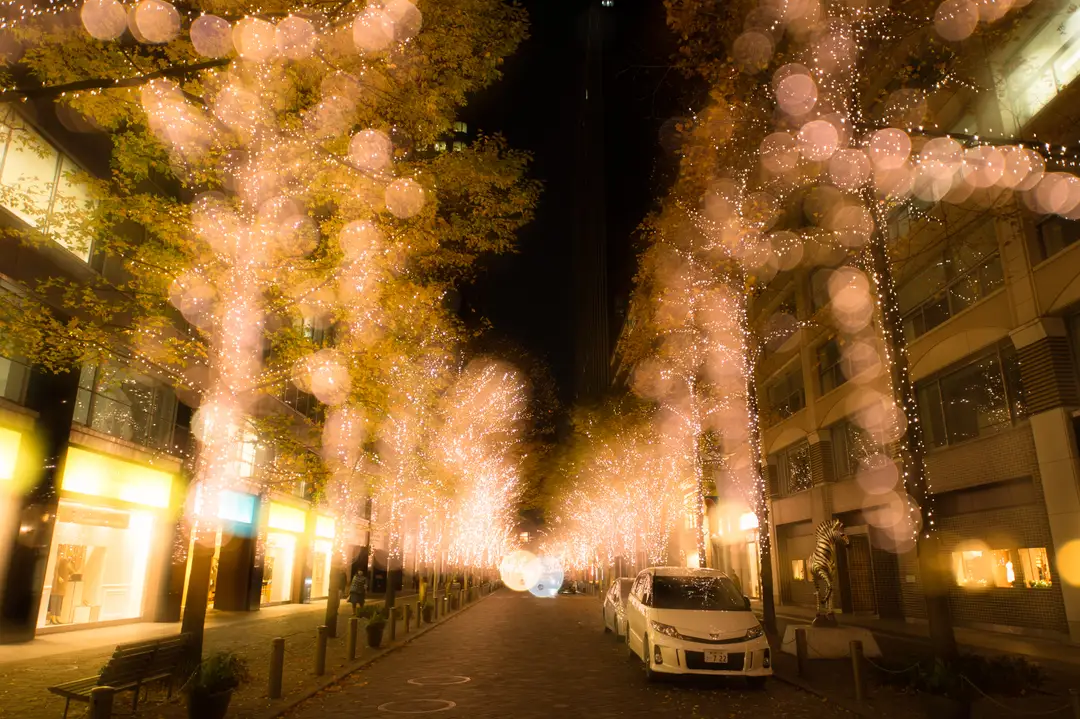
I'd open in Tokyo, on the two gifts winter quietly hands the city: clarity and darkness. The same cold, dry winds that make the season feel sharp also scrub the air clean, so winter — not summer — is when Mount Fuji shows itself most reliably, often visible right from the city's high points if you look before the morning hazes over. And because the nights are long, Tokyo answers them the way it does best, stringing whole avenues with light. So the day runs from a clear-air morning to a lit-up evening, with the warmth of the city's winter food in between. Nothing here is compulsory; the pleasure is simply that winter shows you a crisper, brighter Tokyo than any other season.
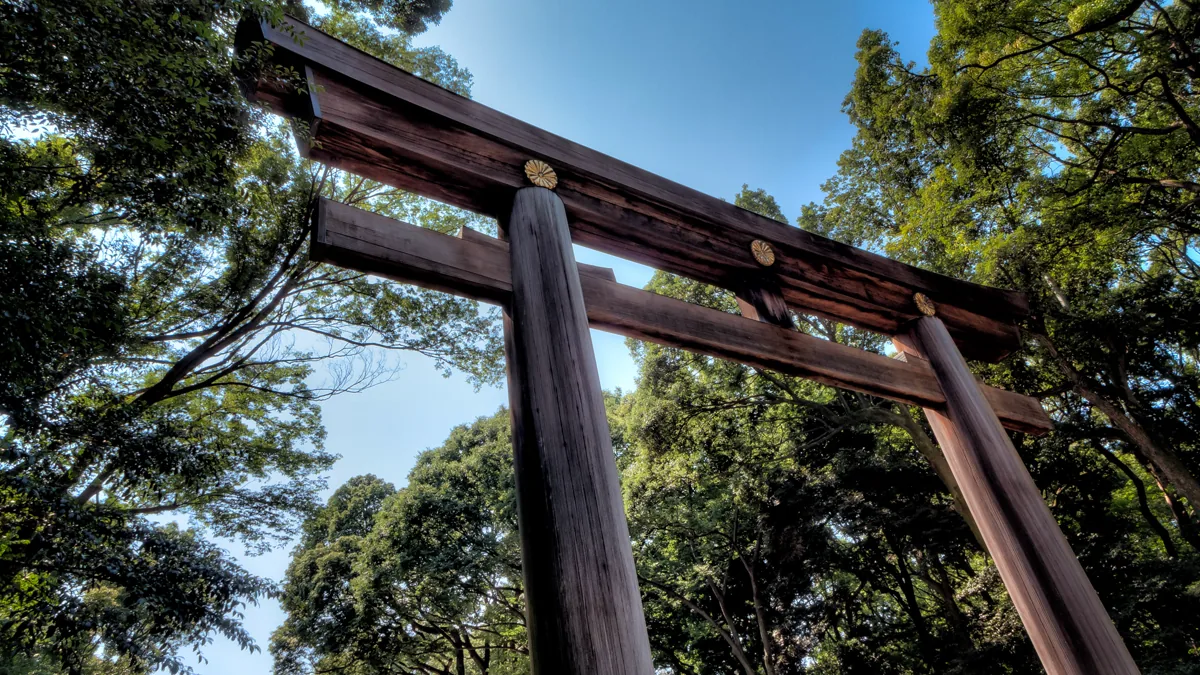
- Early morningA clear-air start, and maybe FujiWinter mornings are the season's clearest, so if the sky's out I'd start high — an observation deck or a west-facing rise — for the chance of Mount Fuji on the horizon before the air softens (the why, with the seasonal odds, is in the fact box). If you'd rather begin gently, Meiji Jingu's evergreen forest is at its stillest in the bare months, a calm first hour just off Harajuku. Linked guide: Meiji Jingu.
- If you're here for the New YearHatsumode, the first shrine visitShould your trip fall in the first days of January, the city is doing something specific and lovely: hatsumode, the year's first visit to a shrine or temple. There's no membership and no wrong way to take part — you join the slow, good-natured shuffle to the offering box, drop a coin, bow, and wish for the year. Meiji Jingu and Senso-ji draw enormous crowds; a smaller neighbourhood shrine gives the same welcome with room to breathe. What's open and what's shut over New Year is in the fact box.
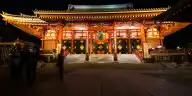
- AfternoonA winter temple, or the warm indoorsThe cold is a fine excuse for the things that reward sitting and looking — a garden in its bare, structural winter dress, or the warm indoors of a museum. Or carry into the old east of the city: Senso-ji at Asakusa feels bracing and far less crowded in the cold, the incense smoke hanging in the chill. Linked guide: Senso-ji.
- EveningThe avenues of lightAfter dark, the illuminations — the city's whole-hearted answer to the long night. Marunouchi's main avenue glows champagne-gold from late autumn deep into February, which makes it the dependable one for a deep-winter trip; the Roppongi slope frames its lights against a floodlit Tokyo Tower, though only into late December; the Meguro River runs pink along the water. It's a warm, slow way to close the first day (the windows are in the fact box, since the December-only displays won't be lit later in winter). Tokyo's illuminations have no WMJS guide yet.
North to the snow monkeys, and a bath in the snow
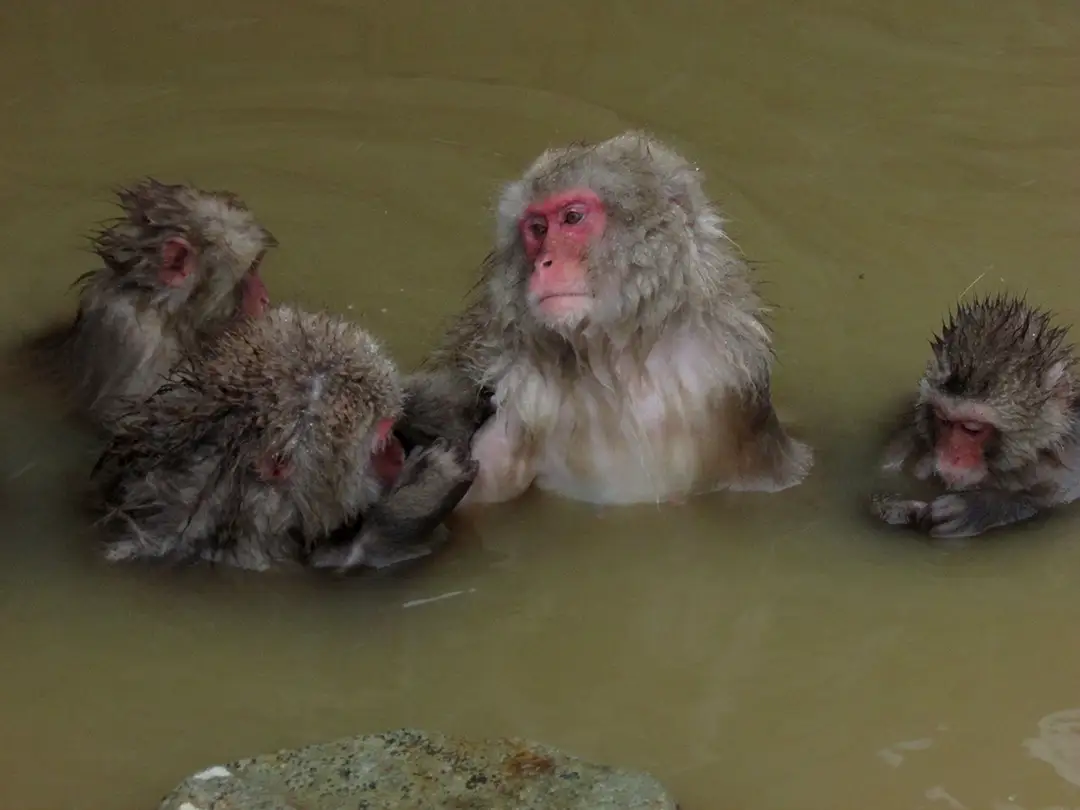
This is the day the whole idea steps out of the abstract, because you watch a wild animal do exactly what you'll do that night. I'd take the bullet train north into the Nagano mountains, climb the last snowy stretch on foot to the hot-spring valley where the macaques bathe, then go to ground in an onsen town — sitting in hot water with snow on the air, the human version of the same ancient logic. Stay warm by keeping the cold in view: monkey and guest, the same instinct, a few hours apart.
- MorningHokuriku Shinkansen into the snowFrom Tokyo the Hokuriku Shinkansen runs up to Nagano in well under two hours — the fastest trains have no unreserved seats, so I'd book ahead (fact box). Nagano's own great temple, Zenko-ji, is a short ride from the station if you want it (no WMJS guide yet); otherwise press on toward the monkeys while the morning's still young.
- MiddayThe last stretch on footFrom Nagano you reach the monkeys by a local train or an express bus, and then — there's no way around this, and it's part of the charm — a fair walk uphill through snowy forest to the park itself (the walk time, and the cash-on-the-bus caveat, are in the fact box). It's a snowy slope, so boots with grip earn their place. Going in the morning gets you ahead of the early-afternoon tour crowds. Linked guide: Jigokudani snow monkeys.
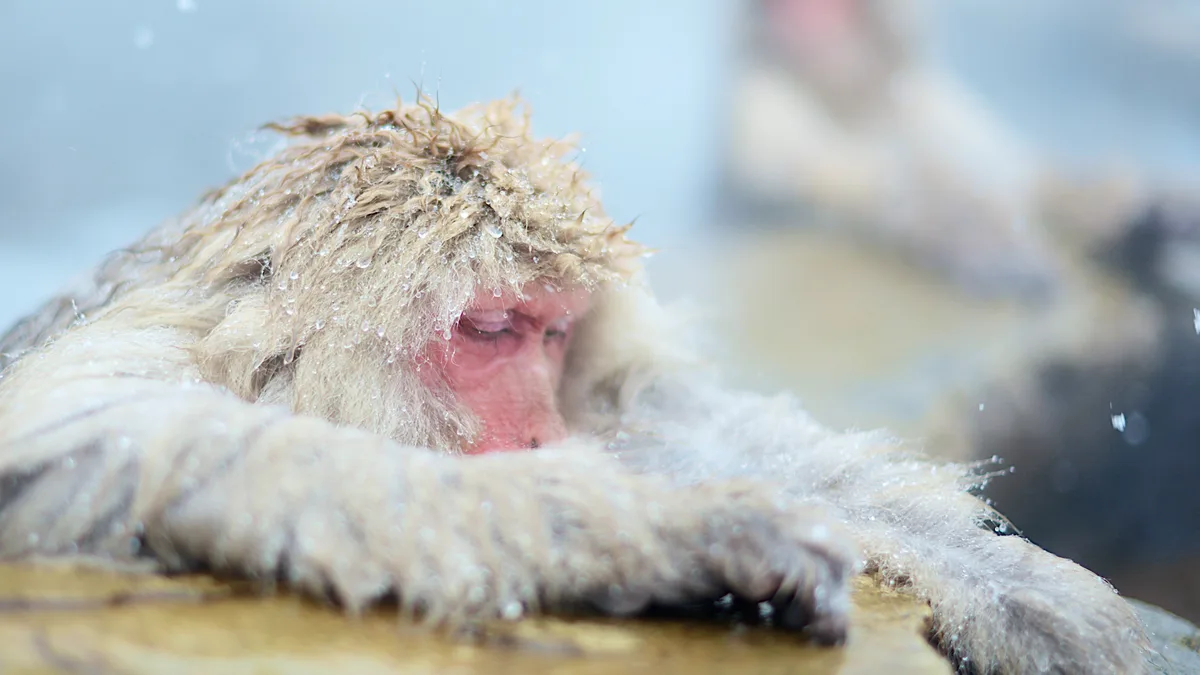
- AfternoonJigokudani — the monkeys in the bathAt Jigokudani Yaen-koen the wild Japanese macaques climb into a hot-spring pool to warm up — but only in winter, when it's genuinely cold enough, so it's a cold-day reward rather than a year-round certainty. The bath is theirs; the joy is in watching, not joining (and joining isn't permitted). Sitting in the steam watching a snow-dusted monkey doze is, I think, the single clearest picture of what this whole trip is about. Linked guide: Jigokudani snow monkeys.
- EveningYour own snow-viewing bathThen down to a hot-spring town nearby — Shibu or Yudanaka — for the night, and an outdoor rotenburo: hot water, freezing air, snow drifting onto your shoulders. The contrast is the entire point, a habit old enough to have its own name, yukimi-buro, the snow-viewing bath. You'll have spent the afternoon watching the monkeys do it; now it's your turn. (These onsen towns have no WMJS guide yet.)
Kanazawa, the garden built for snow
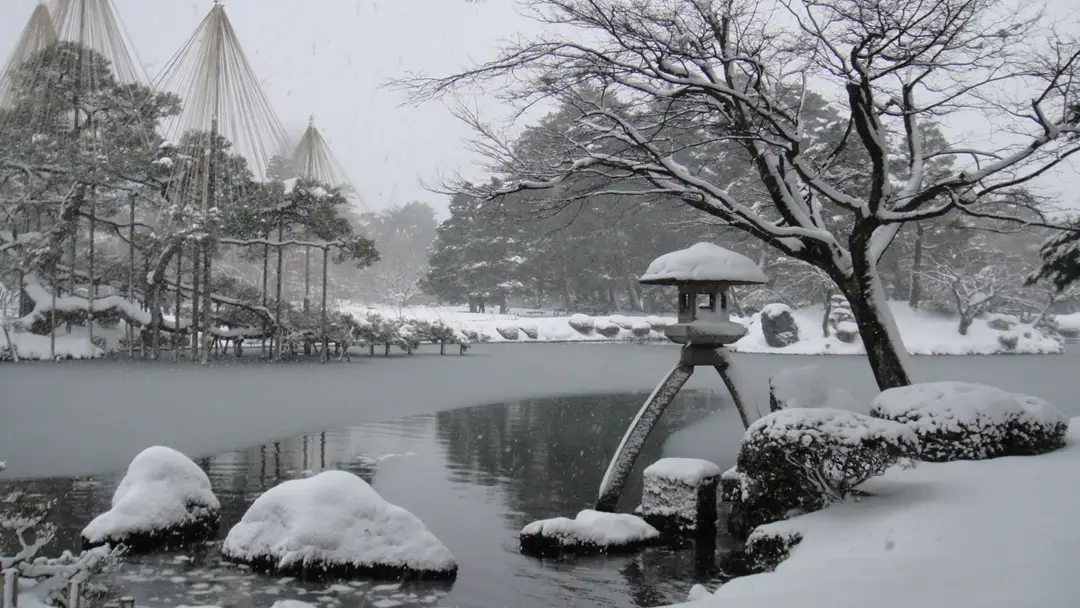
Day three carries the same line west — the Hokuriku Shinkansen runs straight on from Nagano to Kanazawa, no backtracking — into a city that makes the whole through-line visible in a single place. Of Japan's three great gardens, each was long ago assigned one beauty to embody, and Kanazawa's Kenrokuen was given snow. Everything about it is built to wear the heavy snow of the Japan-Sea coast beautifully rather than merely survive it — which is the national attitude to winter, set in one garden.
- MorningWest to KanazawaThe same Shinkansen carries on to Kanazawa in about an hour (fact box). It's a compact, walkable city, so I'd drop bags and make for the garden while the light is good. Linked guide: Kanazawa.
- MiddayKenrokuen and the yukitsuriIn Kenrokuen the pines stand under yukitsuri — elegant cones of rope rigged from tall poles, raised every autumn so the branches can carry deep snow without breaking. They protect the trees, yes, but the gardeners made the protection a sculpture, and under fresh snow the whole garden reads as composed rather than endured. The Kotojitoro lantern by the pond is the picture everyone knows; the ropes are the reason to come in winter (admission and the rope-season window in the fact box). Linked guide: Kanazawa.
- AfternoonTea houses and the old townA short walk away, the old geisha and samurai quarters the Kanazawa guide covers — the Higashi Chaya teahouse lanes, the earthen-walled streets — are at their quietest under winter light. Gold leaf is the city's craft; a cup of tea dusted with it is a warm, only-here pause out of the cold.
- EveningWinter crab at the marketKanazawa's winter table is built on the same cold Japan Sea whose snow loads the garden's pines — one cold sea, answered twice. Its prize is snow crab, landed only in the winter months and shown off at Omicho Market — boiled, grilled, or as sashimi. A warm, generous end to a cold day (which crab is in season depends on the month — see the fact box).
Kyoto, the hush
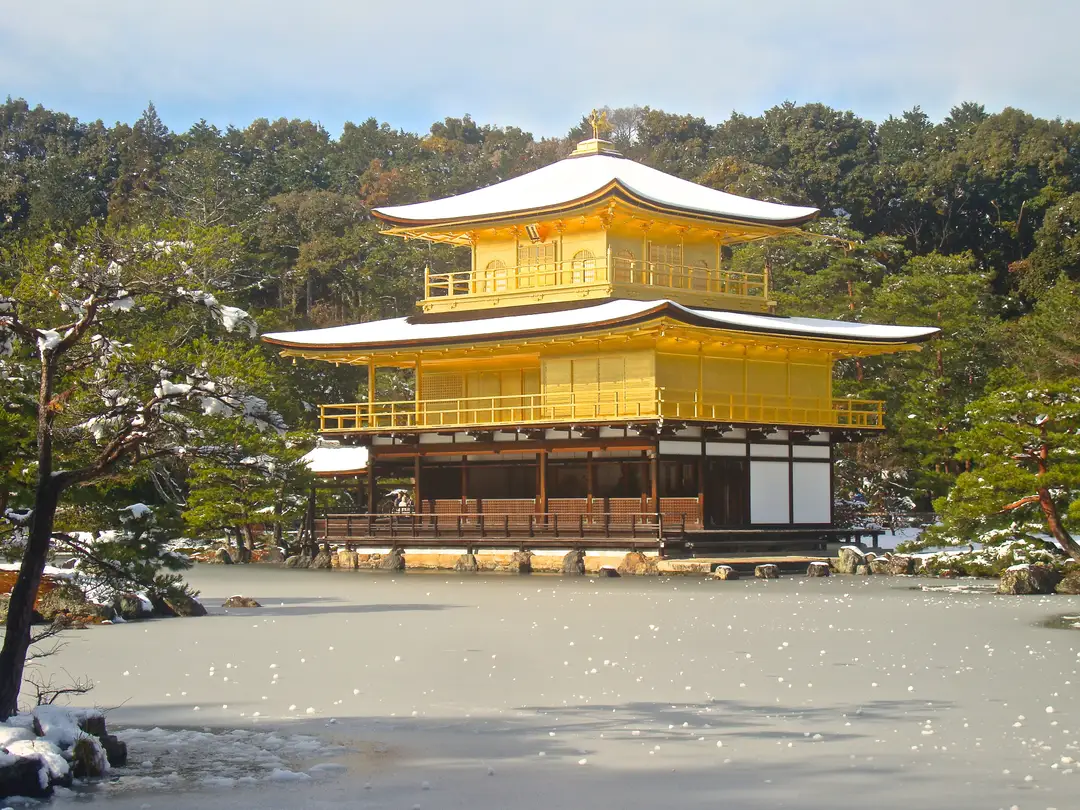
The trip ends where winter is quietest. After one easy change of trains down to Kyoto, you arrive in a city that in the cold months becomes a different, stiller place than the one the spring crowds know. This is the trade made plain: you gave up the cherry blossom, and what you got back is the empty temple, the clean cold light, and — if the sky is kind — the rarest sight of all, snow on gold.
- MorningDown to Kyoto, one change at TsurugaFrom Kanazawa it's the Hokuriku Shinkansen to Tsuruga and a single short change onto a limited express into Kyoto — about a couple of hours all in (fact box). Older guides may promise a through train; this is the current way, and it's painless.
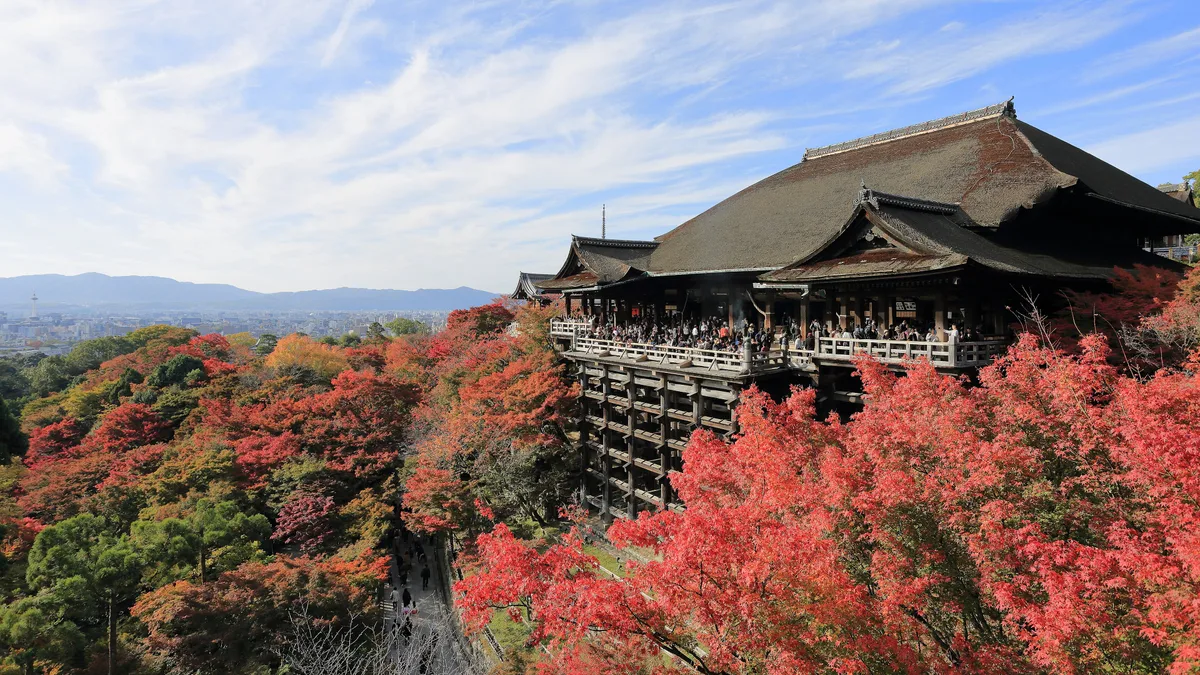
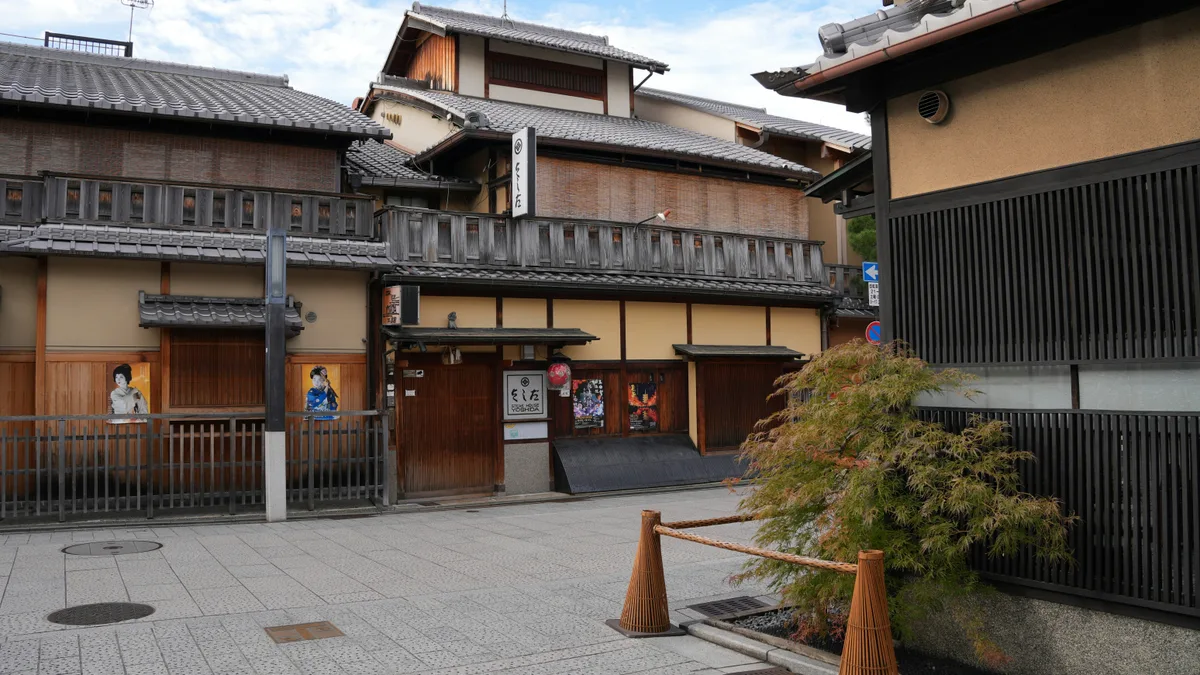
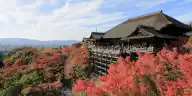
- MiddayA temple with room to breatheWinter is when Kyoto's great sights hand themselves back to you. The Kiyomizu-dera hillside and the lanes of Gion, shoulder-to-shoulder in spring, are calm and clear-aired in the cold; the same stones, a wholly different city — bundled up, it's a slow, easy walk. Linked guides: Kiyomizu-dera, Gion.
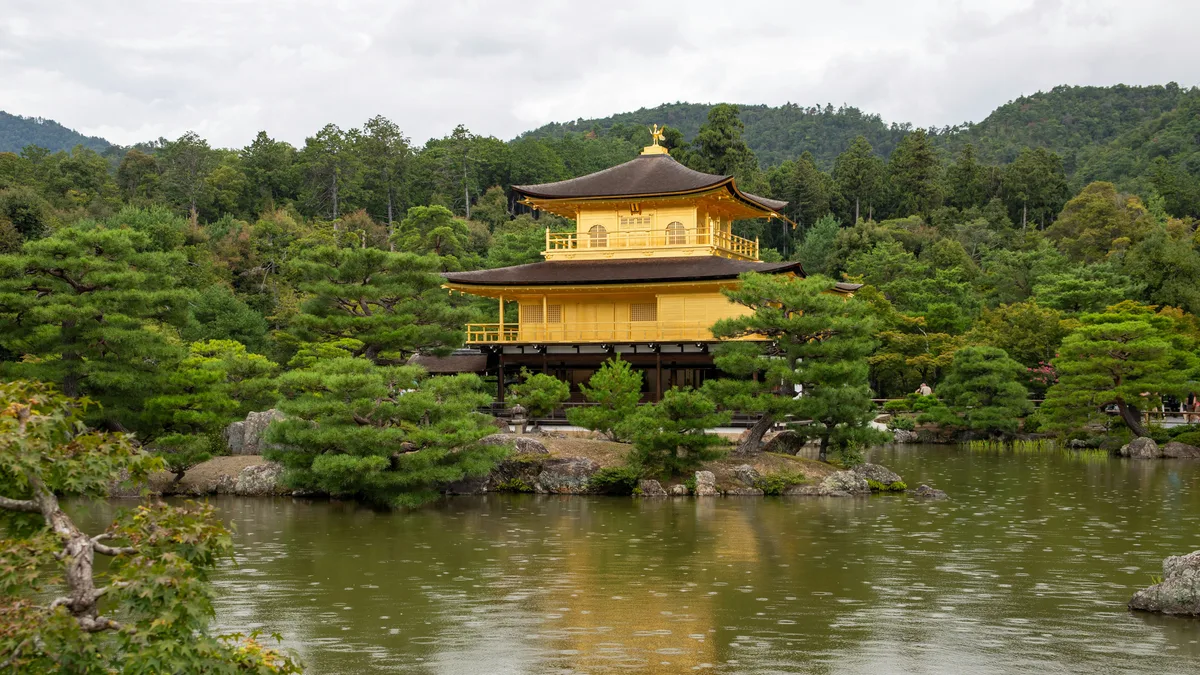
- If the forecast turns whiteSnow on the Golden PavilionSnow settling on Kinkaku-ji, the Golden Pavilion — gold roof under white, doubled in the pond — is one of the most coveted sights in the country, and it happens only a handful of mornings a year and is usually gone by midday. It's pure luck, never a promise. But if you wake to snow in the forecast, I'd drop whatever the plan said and go early; the reward goes to whoever moves fast. Linked guide: Kinkaku-ji.
- EveningSomething warm, slowlyEnd on Kyoto's winter comfort: yudofu, silken tofu simmered at the table, or a bowl of something hot by the Kamo. After four days of keeping the cold in view, the warmth lands all the harder — which was the whole idea.
If you have one more day
+1 dayTo go deeper into winter, you turn north — the season only grows more itself the further up the country you push.
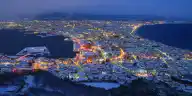
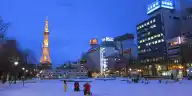
Into Hokkaido. The far north is winter at full volume: the Sapporo Snow Festival fills a downtown park with carved-ice palaces in early February, Otaru's canal glows under the Snow Light Path, Niseko has the powder snow skiers cross the world for, and out east the sea itself freezes into drift ice off Abashiri. It folds straight onto the Hokkaido plan, whose winter fork is built for exactly this; Hakodate is the natural hand-off by Shinkansen.
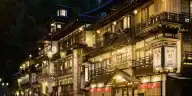
The Japan-Sea snow country. Closer in, two sights distil winter to an image. Ginzan Onsen in Yamagata is a Taisho-era street of wooden inns where gas lamps glow on the snow after dark — so loved now that winter evenings are capped and ticketed, which means it rewards planning ahead (fact box). And at Zao, the firs on the ridge freeze solid into rime-ice 'snow monsters' (juhyo), reached by ropeway and lit at night. (Neither has a WMJS guide yet.)
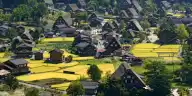
Shirakawa-go in the snow. The steep thatched roofs of the Shirakawa-go farmhouses were shaped to shed exactly this snow, and on a few set evenings each winter the village is lit after dark — a sight so sought-after it is now reservation-only, with no same-day entry (fact box). It pairs with Takayama and the Chubu plan.
If you're short a day
−1 dayShort on time, winter keeps its whole heart in two or three days: one lit Tokyo evening and one snow-onsen day. If the Nagano monkeys are a stretch, the gentlest version swaps in Hakone — an easy hot-spring run from Shinjuku on the Romancecar (fact box), with its own outdoor baths and, on a clear winter day, Mount Fuji across the water. Pair that with a Tokyo illumination night and you've caught the season's two halves — the clear cold and the warm answer to it — without a single rushed connection. Winter rewards being fully present in one warm place far more than chasing five cold ones.
Extend from here
OnwardThis whole trip is really the Kanto, Chubu and Kansai routes wearing their winter coats — the same cities and line, led by the cold — so it folds into a fuller loop whenever you want more days. If you'd rather meet winter without the snow, turn the other way: south to Beppu, where Kyushu's steaming 'hells' make hot water the town's daily weather. And winter brings the clearest Mount Fuji of the year, if seeing it is high on your list. This plan also has siblings in other seasons — the cherry-blossom trip and the autumn-leaves trip read the same country as the year turns.
WMJS is written in Japan, in English, with AI help. We check every page, but English is not our first language. If a sentence reads oddly, tell us. One sentence is enough.
Thank you. A person reads every note.
Good to know — fares & times
Tokyo to Nagano (Hokuriku Shinkansen)
The Hokuriku Shinkansen runs Tokyo to Nagano in about 80-90 min on the fastest Kagayaki. The Kagayaki carries no non-reserved seats at all, so a seat reservation is required; the slightly slower Hakutaka does have non-reserved cars. This is the northbound line toward the snow-monkey country. Times and seating vary by train and timetable revision — confirm when you book.
Nagano to the snow monkeys (Jigokudani access)
From Nagano Station, either the Nagano Dentetsu (Nagaden) limited express to Yudanaka then a short local bus, or the Nagaden Snow Monkey Express Bus from the East Exit (roughly 40-50 min). Either way ends with an unavoidable uphill forest walk of about 30-40 minutes (around 1.6 km, partly unpaved, with steps and snow) to the park gate. The mountain bus can be cash-only on weekdays, so carry some cash; crowds spike around early afternoon when day tours arrive.
Jigokudani Yaen-koen (official, Access)as of 2026-06
Jigokudani Yaen-koen — winter hours, admission, why the monkeys bathe
Winter season (about Nov-Mar): open 09:00-16:00; admission adults (18+) ¥800, children (6-17) ¥400, under 5 free; tickets bought at the park on the day (no advance booking). The wild macaques enter the hot spring 'as a means of staving off the cold during winter,' so the bathing is seasonal and weather-dependent — likeliest on genuinely cold, snowy days, never guaranteed on a mild one. Humans may not bathe with them.
Jigokudani Yaen-koen (official, Guide)as of 2026-06
Nagano to Kanazawa (Hokuriku Shinkansen)
The same Hokuriku Shinkansen continues west, Nagano to Kanazawa in about 65 min by the fastest Kagayaki (longer on the Hakutaka, which makes more stops). It runs as one continuous line, so there is no backtracking between Days 2 and 3. Tokyo to Kanazawa end-to-end is officially 2 hr 28 min.
JR-West (official, Hokuriku Shinkansen)as of 2026-06
Kenrokuen — the snow garden and its yukitsuri
Kenrokuen (Kanazawa), one of Japan's Three Great Gardens and the one assigned the beauty of snow, fits its pines with conical yukitsuri rope cones to bear the heavy Sea-of-Japan snow; they go up from about Nov 1 and stay until around Mar 15, with the best snow-laden views in Jan-Feb. Admission adults (18+) ¥320, children ¥100, 65+ free with proof; winter hours roughly 08:00-17:00; open every day, with free admission Dec 31-Jan 3.
VISIT KANAZAWA (official Kanazawa/Ishikawa guide)as of 2026-06
Kanazawa to Kyoto now changes at Tsuruga (since March 2024)
Since the Hokuriku Shinkansen extension to Tsuruga on Mar 16, 2024, the Thunderbird limited express no longer runs Kanazawa-Kyoto direct. The current way: Hokuriku Shinkansen Kanazawa to Tsuruga, transfer at Tsuruga (same station, a short signposted walk), then Limited Express Thunderbird Tsuruga to Kyoto — about 2 hours in total including the change. Many older guides still describe a one-seat ride; this transfer routing is the current reality.
JR-West (official, Hokuriku one-way ticket)as of 2026-06
The simple version — Tokyo to Kyoto direct (Tokaido Shinkansen)
If you'd skip the scenic Hokuriku arc, the Tokaido Shinkansen runs Tokyo to Kyoto direct in about 2 hr 15 min by Nozomi (a little longer by Hikari). A plain IC card cannot tap onto the Shinkansen — book via Smart-EX or buy a paper ticket; note the Japan Rail Pass does not cover the fastest Nozomi.
JR-Central (official, Tokaido Shinkansen / Kyoto)as of 2026-06
IC cards (Suica / ICOCA) — and two winter caveats
Suica, ICOCA and the other IC cards are interoperable nationwide for local trains, subways, buses and shops. Two limits to remember: a single tap-in/tap-out ride must start and finish within the same IC area (you can't cross area boundaries on one local ride), and the card does not cover the Shinkansen or limited expresses (those need a separate ticket or Smart-EX). On snow-country and mountain legs, some buses are cash-preferred on weekdays — carry a little cash for the hills.
JNTO (official, IC travel cards)as of 2026-06
Tokyo winter illuminations (the long dark, answered with light)
Marunouchi Illumination runs about mid-November to mid-February along roughly 1.2 km of Naka-dori in champagne-gold — its long window is the dependable choice for a deep-winter trip. Roppongi Hills Keyakizaka (with the Tokyo Tower view) runs only about early November to Dec 25, so it is not lit in Jan-Feb. The Meguro River 'Minna no Illumination' glows pink, evenings only. Exact dates shift each year and December-only displays won't be lit later in winter — confirm before you go.
japan-guide.com (Tokyo winter illuminations)as of 2026-06
Mount Fuji is clearest in winter
Winter's cold, dry continental winds scour the air, so December to February are far and away the most reliable months to see Mount Fuji — recent seasons suggest it is fully visible on the majority of winter days, against only a small fraction of summer days, and it is often visible from Tokyo's elevated viewpoints, best early in the morning before the air softens. Treat the exact percentage as a recent-seasons observation rather than a fixed figure; the seasonal pattern is robust.
LIVE JAPAN (Mt Fuji visibility by season)as of 2026-06
Yukimi-buro — the snow-viewing bath
Yukimi-buro ('bathing while viewing snow') is the winter onsen tradition of soaking in an outdoor rotenburo — water around 40-42C — while snow falls and the air sits below freezing; the warm-water, cold-air contrast is the deliberate pleasure, at its best mid-January to late February. Shibu and Yudanaka Onsen near the snow monkeys both offer outdoor baths, so the night after you watch the macaques warm themselves in falling snow you can do the human version of the same instinct.
Japan Experience (best rotenburo in winter)as of 2026-06
Sapporo Snow Festival
The Sapporo Snow Festival runs for about a week in early February (the 76th edition is Feb 4-11, 2026), across three sites: Odori Park (the main run of giant snow sculptures, lit at night), Susukino (ice sculptures) and Tsudome (family/play). Entry is free and most sculptures are illuminated after dark. Dates shift each year — confirm on the official site for any later winter.
HOKKAIDO LOVE! (official Hokkaido tourism)as of 2026-06
Zao juhyo — the 'snow monsters'
Juhyo are firs encased to their tips in rime ice and snow, formed as moist Siberian wind off the Sea of Japan deposits supercooled droplets that freeze and build up. The season runs roughly late December to early March, with peak frost-tree viewing about late January to late February and night illuminations through the period. Reached via the Zao Ropeway up to Jizo Sancho (about 1,661 m).
JNTO (official, Zao Juhyo Festival)as of 2026-06
Ginzan Onsen — lantern-lit snow street (winter caps)
Ginzan Onsen (Obanazawa, Yamagata) is a Taisho-era hot-spring town of four- and five-storey wooden inns along a river, with gas lamps glowing on the snow after dark — its winter signature. In recent winters the evening window (around 17:00-20:00) has been capped: only a limited number of day-trippers per hour, holding a pre-bought ticket, with a mandatory park-and-ride shuttle (day-trippers can't drive in); daytime is unrestricted, and after 20:00 it is overnight guests only. These rules are re-announced and tweaked every winter, so re-confirm the exact caps, hours and fare on the official source close to travel.
LIVE JAPAN (Ginzan Onsen winter rules)as of 2026-06
Shirakawa-go winter light-up — reservation required, only a few nights
The winter light-up of the gassho-zukuri farmhouses (lit about 17:30-19:30) is held on only a handful of select evenings each winter (in 2026, four nights: Jan 12, 18, 25 and Feb 1). An advance reservation and dated ticket is mandatory for everyone — there are no same-day sales, and gate checks are enforced; observation-deck slots are limited to overnight guests or selected tours. Re-verify the exact dates and booking mechanics on the official tourist-association site each winter.
New Year (about Jan 1-3) — closures, and hatsumode is the experience
Many businesses, restaurants, banks, museums and shops close for the year-end and the first three days of January (oshogatsu); some that stay open keep shorter hours, and a few ATMs may not dispense cash. The experience in this window is hatsumode — the year's first shrine or temple visit — for which shrines and temples stay open (major ones often around the clock from New Year's Eve) and draw immense, good-natured crowds; Tokyo's Meiji Jingu alone welcomes around three million people in the first three days. Coming from about Jan 4, or choosing a smaller neighbourhood shrine, gives the same welcome with more room.
JNTO (official, New Year in Japan guide)as of 2026-06
Kanazawa winter snow crab
Ishikawa's snow-crab season runs about Nov 6 to Mar 20. The male crab (locally kano-gani, port-certified with a blue tag) is the dependable deep-winter reference, in season across Nov-Mar; the smaller, roe-prized female (kobako-gani) is available only until about Dec 29, so it is usually out of season for a January or February trip. Omicho Market is the city's crab showcase — boiled, grilled or as sashimi.
In-Kanazawa (Kanazawa winter crab)as of 2026-06
The gentle version — Tokyo to Hakone (Odakyu Romancecar)
For an easier snow-onsen day than the Nagano monkeys, the Odakyu Romancecar runs from Shinjuku to Hakone-Yumoto in about 85 min, the gateway to the Hakone hot-spring area and its outdoor baths, with Mount Fuji views across the caldera lake on a clear winter day. Times and the Hakone Freepass on the official Odakyu site.
Odakyu Railway (official, Romancecar)as of 2026-06
Go deeper
10 min· 5 ch
Before you goWhile you walk
Visiting Jigokudani Snow Monkey Park, and Why the Monkeys Bathe Only When It's Cold
Is Jigokudani Snow Monkey Park worth visiting? We weighed 70 traveler voices: 38% call it a highlight, another 42% say yes in winter, and Japanese locals rate it warmer at 64%. Wild macaques bathe only in the coldest months, Dec-Feb, to survive the cold, not to charm you. The walk in, hours, and the one season mistake to avoid, with an audio guide.
Jigokudani Yaen-koen (Snow Monkey Park)
11 min· 6 ch
Before you goWhile you walk
Kanazawa — The Castle Town That Turned a Fortune Into Gardens and Gold Leaf, Not Armies
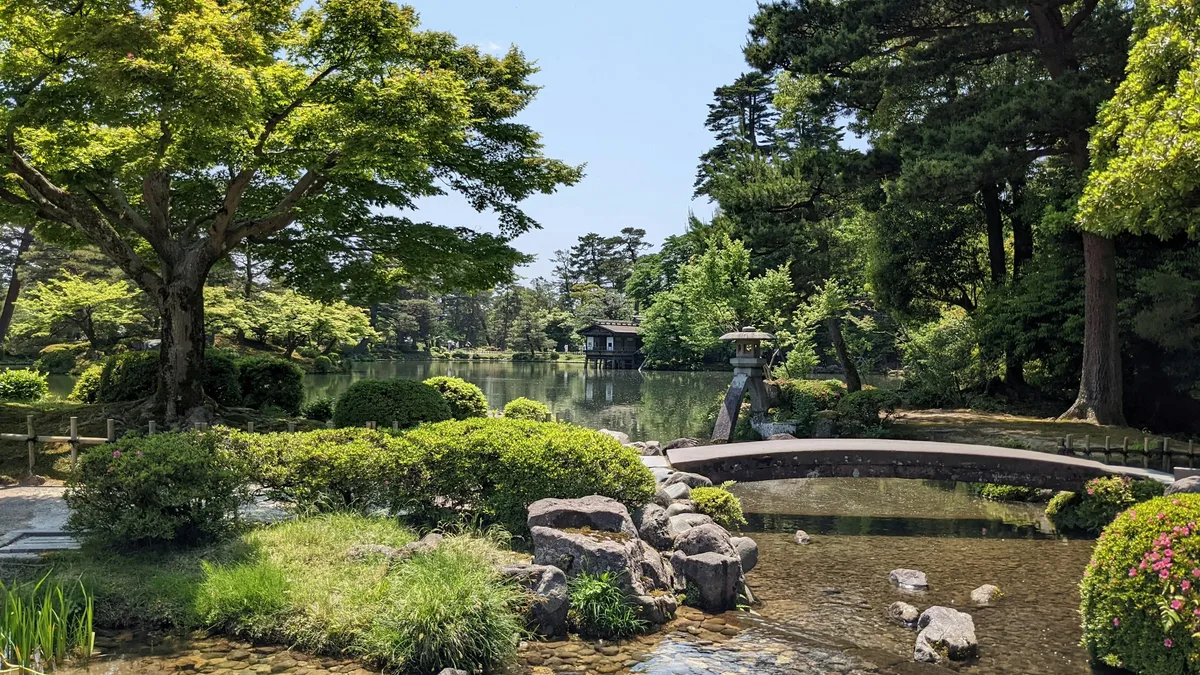
A cultural audio guide to Kanazawa, verified against official sources — why the Maeda domain spent a million-koku fortune on gardens, gold leaf and crafts instead of armies, plus Kenroku-en hours, access and how to visit well.
Kanazawa
7 min· 6 ch
Before you goWhile you walk
Kinkaku-ji — Why Everyone Stops at the Same Spot to Photograph the Golden Pavilion
An audio cultural guide to Kinkaku-ji, Kyoto's Golden Pavilion, verified against official temple sources. Why you view it from across the pond, what the gold really means, plus hours, admission, and access from Kyoto Station.
Kinkaku-ji (Rokuon-ji)
8 min· 5 ch
Before you goWhile you walk
Kiyomizu-dera: Why People Climb a Hill to Stand on a Cliff and Make a Wish
Is Kiyomizu-dera worth it? Yes, say 48% of 55 international voices and 76% of 111 Japanese voices, if you time it right. Covers the 6 a.m. opening.
Kiyomizu-dera Temple
6 min· 5 ch
Before you goWhile you walk
Gion — Walking Kyoto's Flower District, a Town That Is Still Lived In
An audio guide to Kyoto's Gion flower district: what geiko and maiko really are, the walk from Yasaka Shrine through Hanamikoji to the Shirakawa canal, when to go, and how to enjoy a town still lived in.
Gion
8 min· 5 ch
Before you goWhile you walk
Visiting Meiji Jingu, Where 100,000 Trees Were Planted to Make a Forest That Tends Itself
Is Meiji Jingu worth visiting? We weighed 70 traveler voices: 75% say worth it, and Japanese locals rate it even higher at 82%. Free, a 70-hectare forest planted entirely by hand in 1920, home to the Great Torii and Kiyomasa's Well in the Inner Garden, with an audio guide.
Meiji Jingu
9 min· 6 ch
Before you goWhile you walk
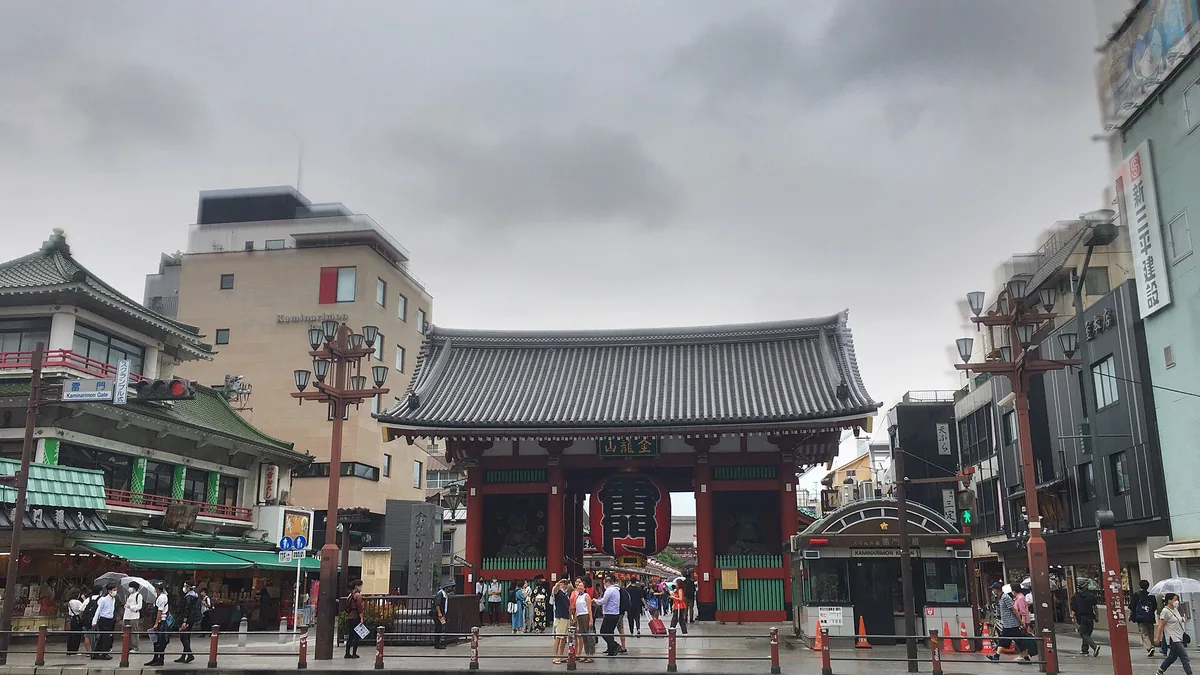
Visiting Senso-ji, Tokyo's Oldest Temple
Is Senso-ji worth visiting? We weighed 125 traveler voices: 54% say worth it outright. Hours, free admission, how long you need, and why the crowd has always been part of the prayer, with an audio guide.
Senso-ji Temple
10 min· 5 ch
Before you goWhile you walk
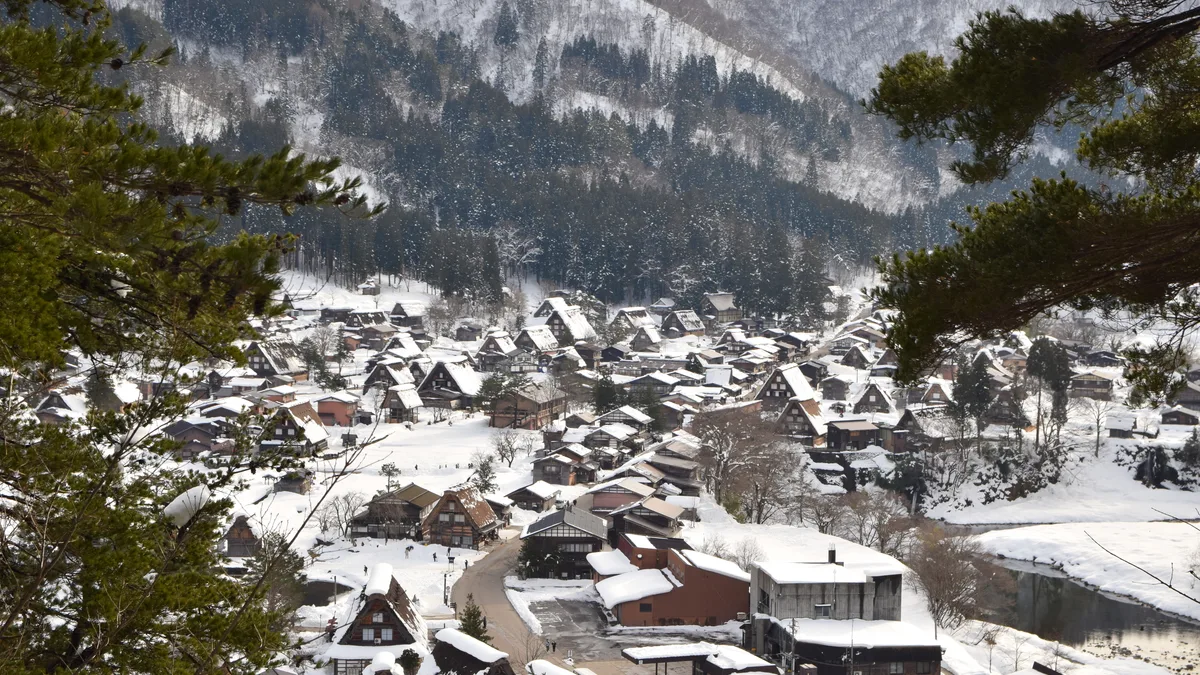
Visiting Shirakawa-go, the Thatched-Roof Village That's Still Lived In
Is Shirakawa-go worth visiting? We weighed 120 traveler voices: most say it depends on timing, only 1 in 16 was let down. Bus access, viewpoint, the light-up, and when to go, with an audio guide.
Ogimachi, Shirakawa-go
7 min· 5 ch
Before you goWhile you walk
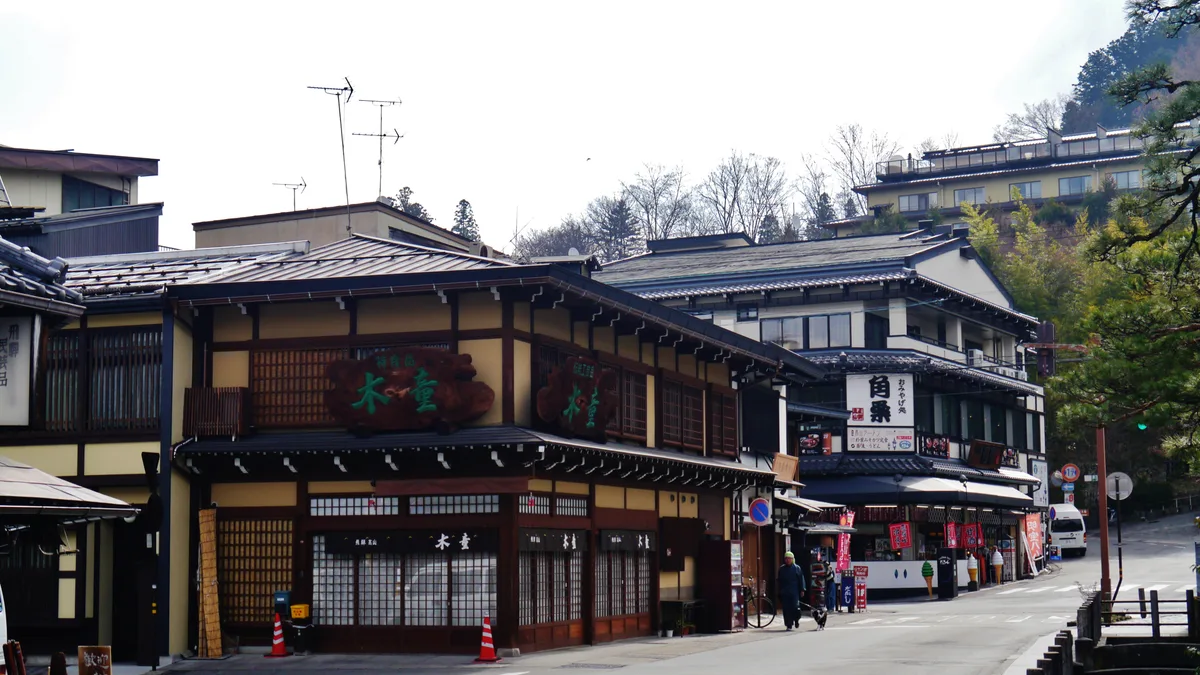
Takayama — The Old Town That Never Became a Museum
An audio cultural guide to Takayama, verified against official sources. Why this preserved Edo merchant town in the Hida mountains never became a museum — the riverside morning markets that are still neighbors' commerce, the Sanmachi old town where people still live, the Takayama Jinya, and the bus to Shirakawa-go.
Takayama Old Town (Sanmachi)
11 min· 6 ch
Before you goWhile you walk
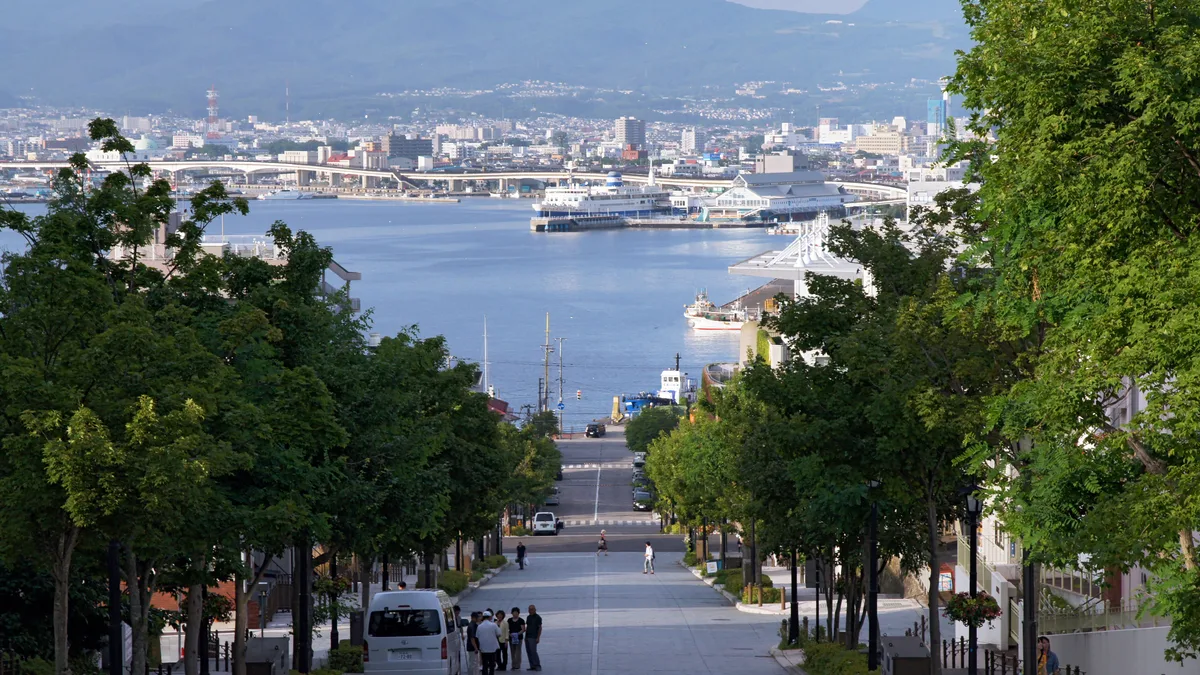
Hakodate — Where Japan Opened Its Northern Door to the World
An audio guide to Hakodate, the northern port that reopened Japan to the world — why its night view is shaped by the land, and how to visit it well.
Hakodate
11 min· 6 ch
Before you goWhile you walk
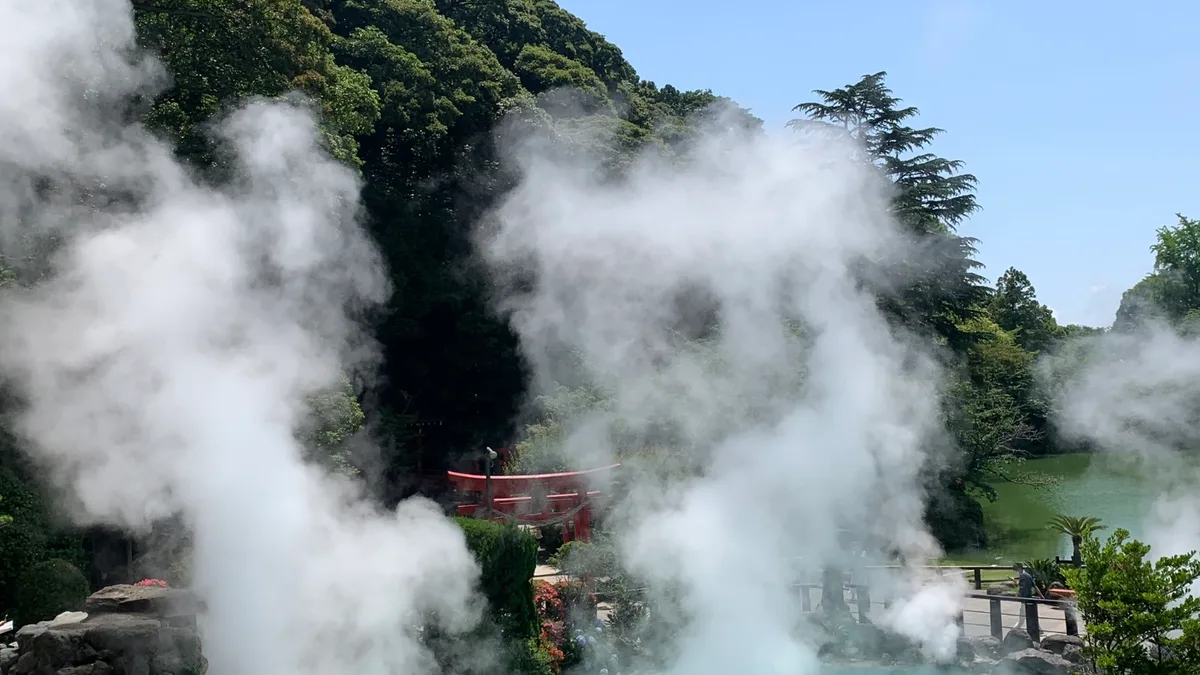
Visiting Beppu Onsen, the Town Where the Earth Boils Just Beneath Your Feet
Is Beppu worth it? We weighed 102 traveler voices: 46% say yes for the baths and boiling town, 44% say it depends on why you came, and Japanese reviewers are far warmer at 72%. The seven hells you look at but don't bathe in, steam-cooked eggs, the sand bath, and Beppu Hatto, with an audio guide.
Beppu Onsen (Kannawa)
9 min· 6 ch
Before you goWhile you walk
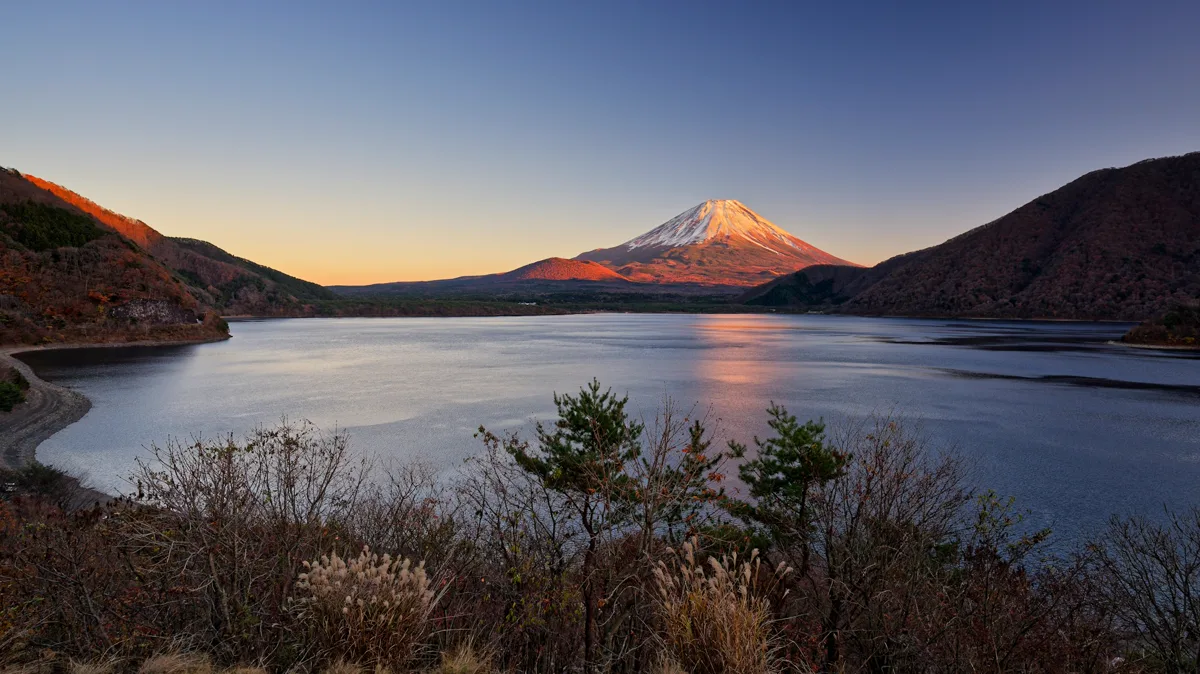
Visiting Mount Fuji, the Mountain That Hides for Half the Year
Is Mount Fuji worth seeing? We weighed 53 traveler voices: 36% saw it clear and call it unforgettable, and Japanese reviewers land warmer at 64%. The Fuji Five Lakes, the Fifth Station without climbing, and the short climbing season, with an audio guide.
Mount Fuji
Read before you go



Combine with another plan
Tokyo & around, an easy few days
The capital and its day trips — old-city Tokyo, seaside Kamakura, mountain Nikko — at a comfortable pace
Kansai, an easy few days
Japan's older heart — Kyoto, Nara, Osaka — at a comfortable pace
Chubu & the Japan Alps, a slower few days
Mountains and old towns — Matsumoto, Takayama, Shirakawa-go, Kanazawa — at a reserve-ahead pace
Hokkaido, an easy few days
Japan's frontier north — Sapporo and Otaru, the lavender hills or the snow, the steaming onsen valleys, and Hakodate — at an unhurried, season-led pace
Sources
- JR-West (official) — Hokuriku Shinkansen line (Nagano-Kanazawa, Tokyo-Kanazawa 2h28)
- JR-West (official) — Hokuriku one-way ticket (the post-2024 Kanazawa-Tsuruga-Kyoto routing)
- JR-Central (official) — Tokaido Shinkansen to Kyoto (the simple direct version)
- Smart-EX (JR-Central / JR-West official) — Shinkansen booking & fares
- Odakyu Railway (official) — Romancecar to Hakone
- JNTO (official) — IC travel cards (interoperability & limits)
- JNTO (official) — New Year in Japan (closures, hatsumode)
- JNTO (official) — Zao Juhyo (snow monsters) Festival
- Jigokudani Yaen-koen (official) — access to the Snow Monkey Park
- Jigokudani Yaen-koen (official) — winter hours, admission, why the monkeys bathe
- VISIT KANAZAWA (official) — Kenrokuen, yukitsuri and winter hours
- HOKKAIDO LOVE! (official Hokkaido tourism) — Sapporo Snow Festival
- Sapporo Snow Festival (official)
- Shirakawa-go winter light-up — Tourist Association (via japan-guide.com)
- japan-guide.com — Nagano & the Hokuriku Shinkansen (Tokyo-Nagano)
- japan-guide.com — Tokyo winter illuminations (windows by display)
- japan-guide.com — when to travel (winter tradeoffs, snow in the cities)
- LIVE JAPAN — Mount Fuji visibility by season
- LIVE JAPAN — Ginzan Onsen winter day-trip rules
- Japan Experience — the best rotenburo in winter (yukimi-buro)
- In-Kanazawa — Kanazawa winter snow crab (kano-gani / kobako-gani at Omicho)