
Kanazawa — The Castle Town That Turned a Fortune Into Gardens and Gold Leaf, Not Armies
Kanazawa
By Kei · Born and raised in JapanThe Meaning
Somewhere in Kanazawa, right now, a craftsman is beating a small button of gold into a sheet so thin you could almost read a newspaper through it: one ten-thousandth of a millimetre, thinner across than a single human hair. Nearly all of the gold leaf made in Japan, somewhere around ninety-nine percent of it, is made here, in this one city on the Japan Sea coast. That is the first clue to what Kanazawa is.
A traveler's first feeling in Kanazawa is often a quiet puzzle: why is there so much here? One of the three most famous gardens in the country. Three preserved teahouse districts. Gold, lacquer, hand-dyed silk, Noh theatre, a cuisine of its own, all of it crowded into a mid-size city that, until the bullet train arrived in 2015, most travelers outside Japan had never heard of. Cities do not usually gather this much by accident.
The answer is a decision made four hundred years ago. The lords of Kanazawa, the Maeda family, ruled the wealthiest domain in Japan after the shogun's own, with an official yield of one million koku of rice, more than any other domain in the country. A family that rich could have raised one of the largest armies in Japan. And that was exactly the danger. The shoguns in Edo watched their powerful lords closely for any sign of ambition, and great wealth in the wrong hands looked like the beginning of a rebellion. The official heritage account of the Maeda describes the choice they made in plain words: wary that their wealth might be read as a threat, they "intentionally directed their resources into cultural pursuits instead." They poured the fortune into Noh, the tea ceremony, lacquer, dyeing, and gold, and they invited some of Japan's finest artisans to come and live in Kanazawa on generous stipends.
So the abundance that puzzles you is not an accident of taste; it is what a domain does with a fortune when it decides, very deliberately, to be admired rather than feared. This is also why Kanazawa is sometimes sold as a "little Kyoto," and it is worth setting that phrase down at the city gate. Kanazawa is not a smaller copy of Kyoto; it is what a different family built, separately, far up the coast, with money it chose not to spend on war, one of those places in regional Japan whose whole character was shaped by who once ruled it. And because the city was spared the wartime bombing that erased so much of old Japan, a great deal of it is still standing: the same earthen walls, the same latticed teahouses, the same garden. You are about to walk through what a domain did with its money when it decided not to fight.
What Happens When You're There
Step 1: Kenroku-en, the Garden of Six
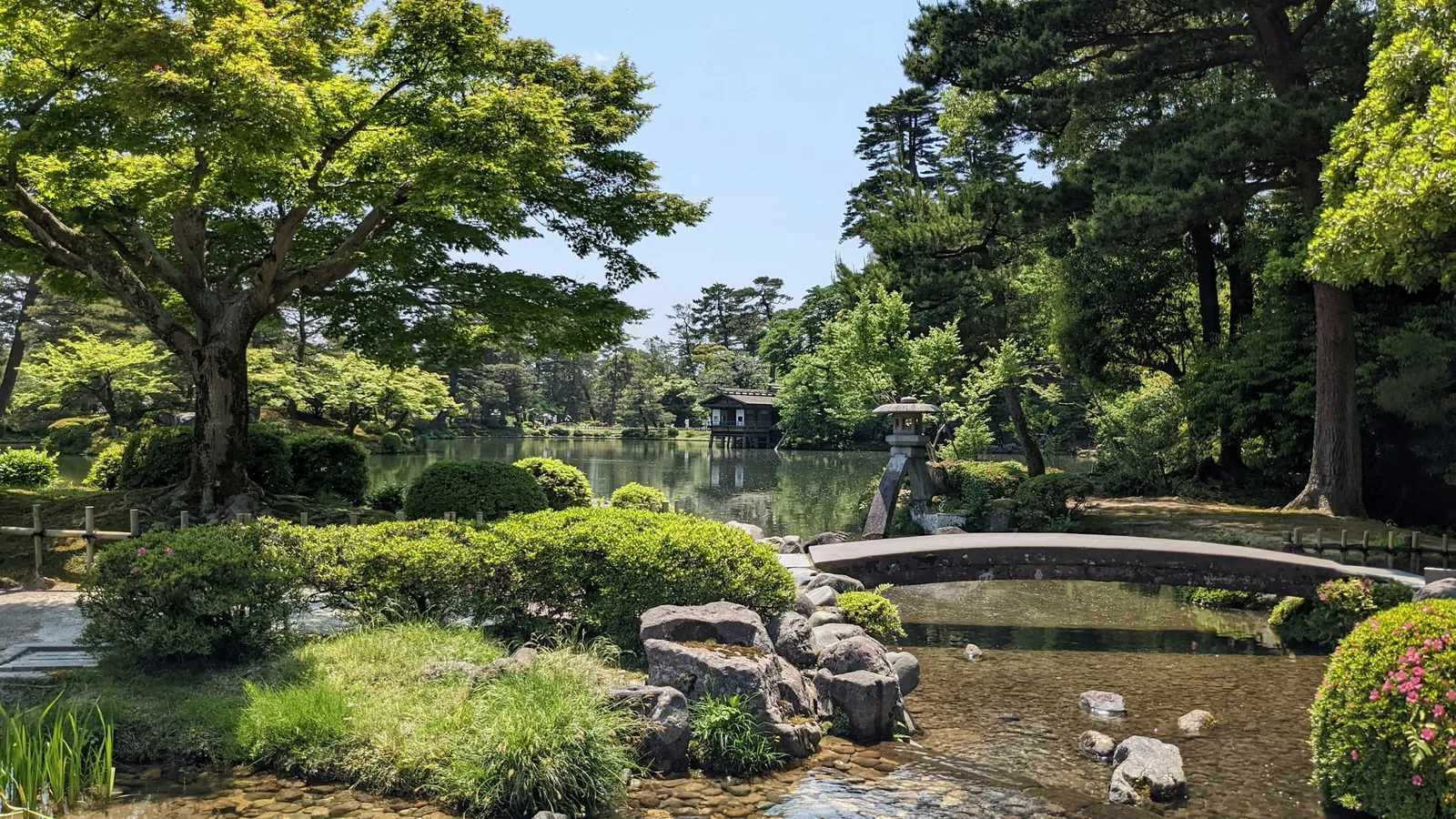
Begin in the garden, because it is the clearest single thing the domain made with its money. The Maeda lords laid it out over roughly two centuries, starting in 1676 as a private garden just outside their castle wall, and opened it to the public in 1874. At a little over eleven hectares, planted with some eight thousand trees, it is counted as one of the three great gardens of Japan, the famous trio that, to many, conspicuously leaves out Ritsurin Garden in Takamatsu.
The name is a small riddle. Kenroku-en means "the garden that combines the six": six qualities, taken from a classical Chinese essay on gardens, that are not supposed to be able to live together. A garden can be wide and open, the old text said, or it can be secluded and intimate, but not both. It can show the human hand, or it can feel ancient and wild, but not both. It can run with water, or it can command a long view, but water lies low and views lie high, so not both. Kenroku-en was given its name in 1822 by a visiting lord because it was judged to hold all six contradictions at once: spaciousness and seclusion, artifice and age, flowing water and the distant view, each impossible pair somehow reconciled in a single garden.
If you come in winter, the first thing you will see is rope. From the first of November, the gardeners climb the garden's grandest pine (the Karasaki pine, grown from a seed carried here from the shore of Lake Biwa), set a tall pole at its centre, and hang dozens of ropes from the top, drawing each long branch gently upward into a wide cone. These are yukitsuri, snow suspensions. The wet snow of the Japan Sea coast is heavy enough to break a pine bough under its own weight, and the ropes simply carry that weight so the tree comes through the winter whole. They are, in other words, entirely practical, and they have become the single most photographed thing in the garden, the image on every Kanazawa postcard. No one set out to make the ropes beautiful. They were made to save the tree. You can decide for yourself why they turned out the way they did.
At the edge of the garden's largest pond, Kasumiga-ike, stands the garden's best-known object: a stone lantern resting on two slender legs of unequal length, one foot on the bank and one in the water. It is the Kotoji lantern, named for the small movable bridge that supports the strings of a koto, the Japanese zither, which is what its two legs are said to resemble. On most days a patient, good-humoured line of people waits to stand in front of it, and somewhere in that line are as many Japanese visitors as foreign ones.
The garden opens early, and for the first stretch of the morning, before the ticket gates begin, it opens for nothing at all: details below. Take that hour if you possibly can. Kenroku-en at eight in the morning and Kenroku-en at noon are two different places: one is a garden, the other is a crowd around a garden.
Step 2: The Castle That Stopped Fighting
The garden sits just outside the castle gate (for most of its life it was literally the castle's outer garden), and a short walk across a stone bridge brings you into Kanazawa Castle Park.
In 1583, the warlord Maeda Toshiie rode into this castle and made it the seat of his family for the next three centuries. It should have been the most fortified place in the region, and for a while it was. But the great keep (the tall central tower that is the heart of most Japanese castles) burned down in a lightning strike in 1602, barely twenty years after Toshiie arrived. The Maeda never rebuilt it. A family that ruled a million koku, that could have answered the fire by raising the tallest tower in the north, left the most warlike part of its own castle as a bare stone foundation and turned its attention somewhere else entirely.
That somewhere else is the whole reason you came. The same record that explains the Maeda's choice puts it directly: rather than build power that the shoguns might fear, they spent it on art and ceremony, a peaceful way, it notes, to show the domain's standing while still bowing to Edo. So the castle you are standing in is, in an odd and quiet way, a castle that was permitted to stop being one. Its long, low turreted storehouses, with their pale fireproof walls, were rebuilt faithfully in 2001 using traditional carpentry, more than a century after an earlier fire took them, and even rebuilt, they read less like a war machine than like the careful, expensive woodwork of a family that had decided its real strength lay elsewhere.
Step 3: Nagamachi, Where the Samurai Stayed
A ten- or fifteen-minute walk from the castle, the streets narrow and turn, and you find yourself in the Nagamachi district, where the domain's samurai once lived. Earthen walls (tsuchi-kabe, the colour of dried clay) run along both sides of the lanes, and water still moves in stone channels at your feet, the same irrigation network the whole quarter was built around.
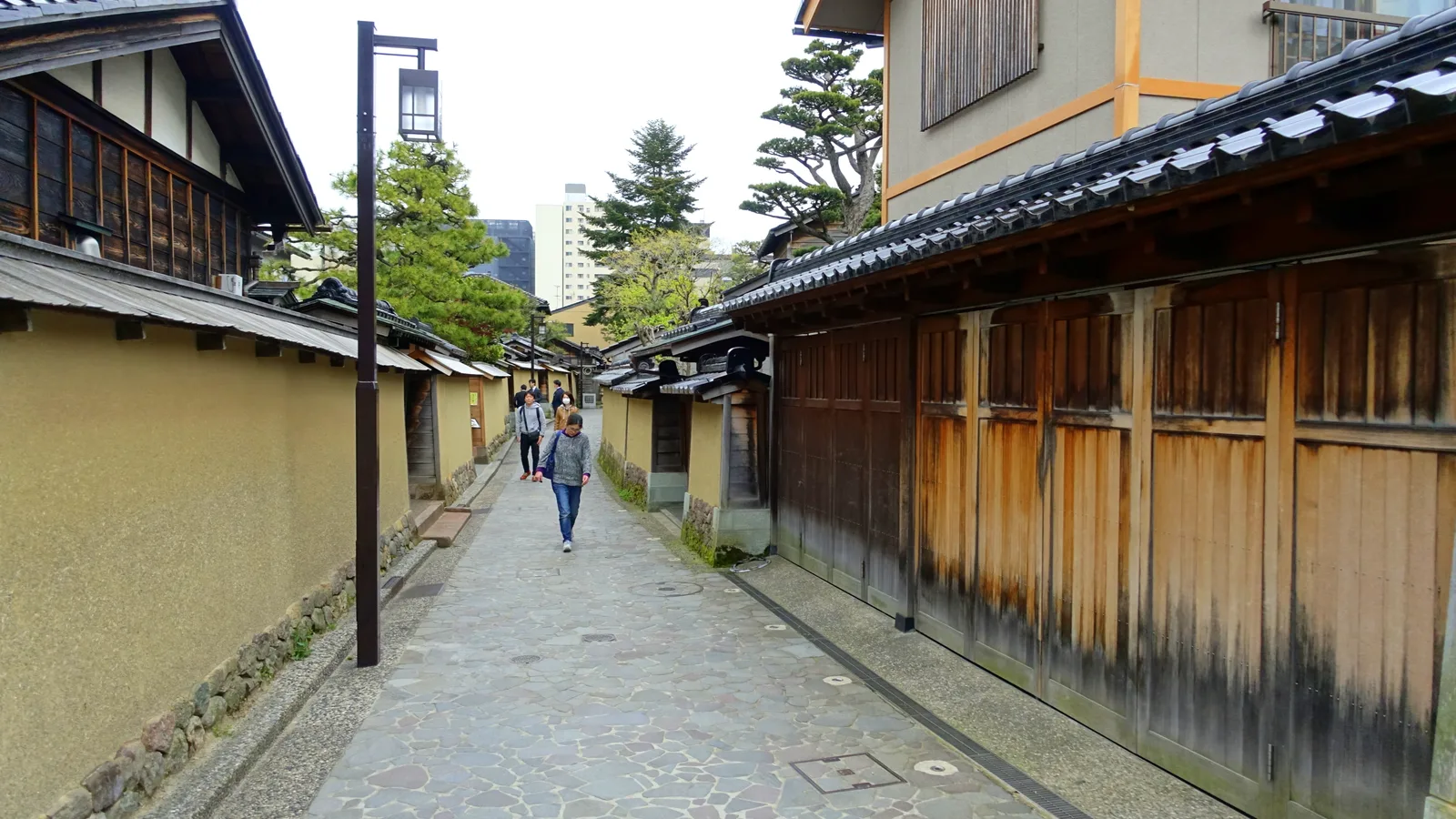
If you come in winter, you may find the walls dressed for the cold: panels of woven rice straw, komo, hung over the clay to shield it from frost and snow, then taken down again in spring. It is an ordinary piece of seasonal maintenance, and like the ropes in the garden, it has quietly become something people stop to look at.
This is where it helps to remember what kind of domain this was. In a place that had chosen not to go to war, a samurai's life was mostly not a soldier's life. The men who lived behind these walls drew their stipends and spent their days administering the domain, keeping its accounts, studying, and ordering the town: the slow, unglamorous work of running a place that intended to stay at peace. And these lanes survived where most of old Japan did not. Kanazawa was never bombed, so the walls you are walking between are the real thing, softened by four hundred winters rather than rebuilt for visitors.
Step 4: Higashi Chaya and the Gold
Cross the Asano River to the east side of the city and you reach Higashi Chaya, the largest of Kanazawa's three teahouse districts. Two-storey wooden teahouses stand shoulder to shoulder along the main lane, their ground floors fronted by a fine, dense wooden lattice the locals call kimusuko. The whole district is a nationally protected preservation area (the first such district designated in Ishikawa, protected since 2001), which carries one fact that is easy to forget in the crowd: people live here. These are not film-set facades. They are houses, shops, and working teahouses where, in the evenings, geisha (geiko, in the local word) still come to perform, as they have for two hundred years.
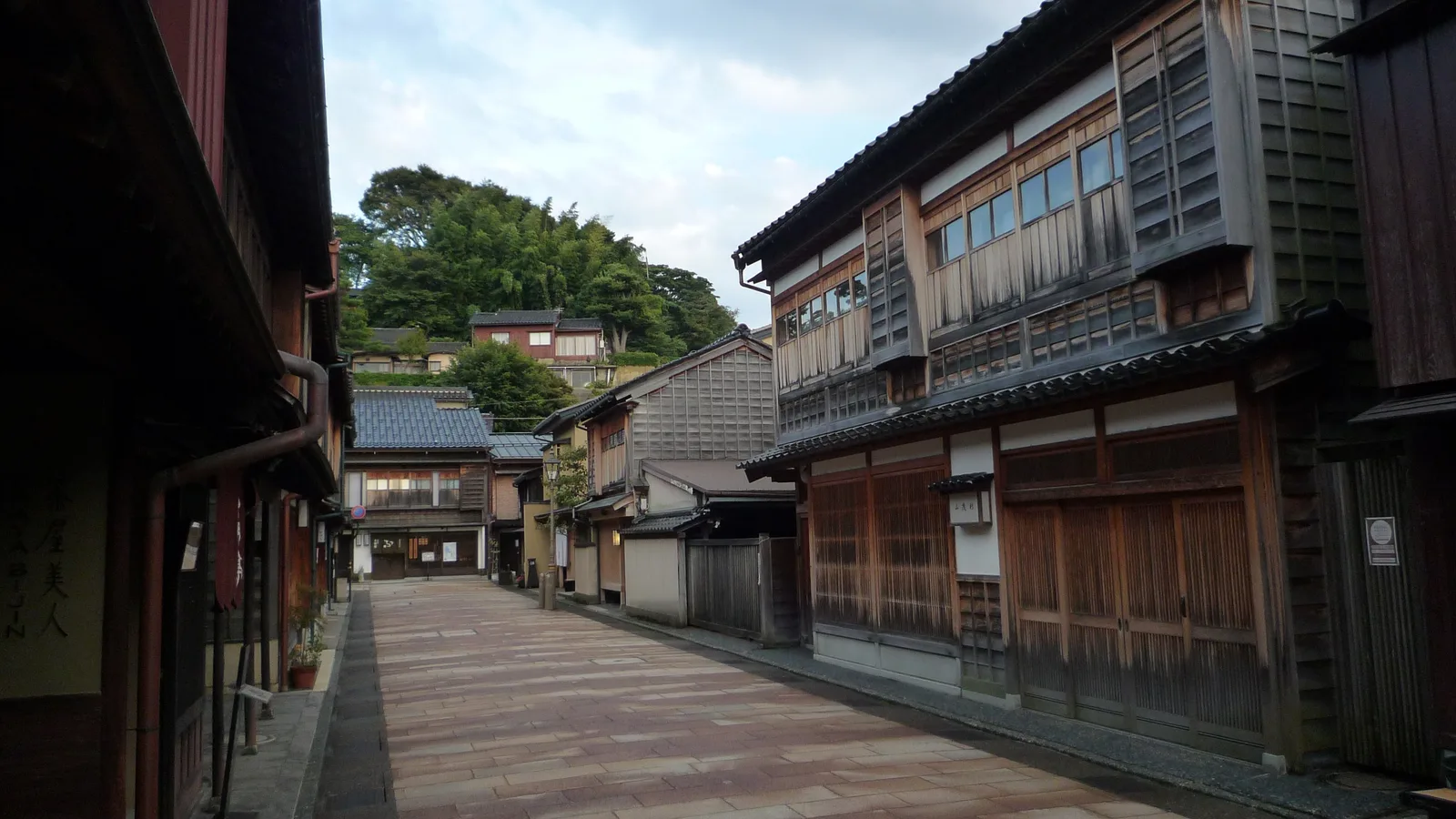
This is also where you finally meet the gold. Shop windows fill with gold-leafed lacquer, gold-dusted sweets, and (the photograph nearly everyone takes) soft-serve ice cream wrapped in an entire sheet of gold leaf. It is easy to file all of this under "tourist gimmick." It is worth knowing what you are actually looking at. The leaf on that ice cream was beaten, here or close by, to one ten-thousandth of a millimetre, in a process the national tourism board counts at more than twenty separate steps; the finest method of all, called entsuke, was added to UNESCO's list of intangible cultural heritage in 2020. And almost every sheet of it in the country begins in this city.
You may have seen Kyoto's Golden Pavilion, a single temple sheathed in gold as a symbol of one shogun's power. Kanazawa's relationship with gold is the reverse of a symbol. Here gold is an industry and an everyday material: pressed into household Buddhist altars, brushed into lacquer and folded into the trades the domain gathered and kept alive, by the kind of patient makers who quietly hold a craft together. When the Golden Pavilion in Kyoto needed re-gilding, and when the great carved gate at Nikkō was restored, the gold leaf came from here.
Why here, of all places? Part of the answer is the weather. The damp air of the Japan Sea coast ("even if you forget your lunch, don't forget your umbrella," the local saying goes) keeps the leaf supple enough not to tear as it is hammered thinner and thinner. Part of it is faith: the region's strong Buddhist tradition meant a steady demand for gilded family altars. And part of it, once again, is the domain that gathered the craftsmen in the first place and made sure they had work.
One small kindness keeps this district livable. Because it is a real neighbourhood of wooden houses that have stood for two centuries, it is the kind of street where eating as you walk is best done gently: most visitors enjoy a gold-leaf treat near the shop that made it, rather than carrying it down the lanes, and pocket the wrapper to take with them, since bins are few. None of that is a rule so much as the ordinary courtesy of being a welcome guest in a place where people are at home. Do that, and the neighbourhood stays exactly as lovely as the reason you came to see it.
Step 5: Walking Back Through the Castle Town
By late afternoon the tour groups thin out, and the city softens. If you have stayed the night (and the empty early-morning garden is the single best argument for staying the night), you will meet a quieter Kanazawa in the off-hours: lanes with no one in them, the river running under stone bridges, the smell of the sea market closing up. Kanazawa is mostly a daytime city, and its evenings are low and calm rather than bright; that catches some visitors off guard, but it is simply the temperament of the place, a town that the bullet train has only recently turned from a well-kept secret into a name everyone seems to be saying.
And the things you did today are, almost exactly, the things the Japanese travelers beside you were doing: waiting your turn at the two-legged lantern, photographing the gold on an ice cream, slowing your steps on a samurai lane because the quiet asked you to. You came to a city that, four centuries ago, was handed an enormous fortune and decided to turn it into something beautiful instead of something dangerous. You have just spent a day walking through the result.
Good to Know
Kenroku-en hours and admission. The garden is open every day. From March 1 to October 15 it opens 7:00–18:00 (last entry 17:30); from October 16 to the end of February it opens 8:00–17:00 (last entry 16:30). Admission is ¥320 for adults (18 and over) and ¥100 for children; visitors aged 65 and over enter free with proof of age. The neighbouring Kanazawa Castle Park grounds are free to enter on the same daily hours, with a small charge only for the rebuilt turret buildings inside. Last verified: 2026-06. Confirm before you go on the official Kenroku-en / Kanazawa Castle site.
The free early-morning hour. Kenroku-en opens for free for a window before the regular ticketed hours every day of the year, through two gates only (Renchimon and Zuishinzaka). The window shifts with the season: it can begin as early as 4:00 in midsummer and around 6:00 in winter, ending shortly before paid opening. It is the calmest and most photogenic time in the garden, and it costs nothing. Check the current times on the official site above.
Getting there. The Hokuriku Shinkansen runs direct from Tokyo to Kanazawa with no transfer, in about two and a half hours (the fastest Kagayaki service is around 2 hours 28 minutes). Since the line was extended to Tsuruga in March 2024, coming from Kyoto or Osaka means taking the Thunderbird limited express to Tsuruga and changing to the Shinkansen there, roughly 2 hours 10 minutes from Kyoto. (For passes, IC cards, and how Japan's trains connect, see getting around Japan.)
Getting around the city. Kanazawa has no subway, but its main sights sit within about two kilometres of the castle, so it is a very walkable city. The Kanazawa Loop Bus circles the sights from stop 7 at the station's east exit, running clockwise and counter-clockwise; a single ride is ¥220 (¥110 for children) and a one-day pass is ¥800 (¥400 for children). The electric Machi-nori shared bicycles, with docking ports across the centre, are another easy option on a dry day. Last verified: 2026-06.
A day, ideally with a night. A common route is station → Omicho Market → Kenroku-en and the castle → Nagamachi samurai district → Higashi Chaya, and it fits into a single full day; the city is compact enough to do it mostly on foot with a few bus hops. You can do Kanazawa as a day trip from Tokyo, but the early-morning garden and the soft evening are the best of it, so one night is well repaid, and Kanazawa makes a comfortable base for a night in a traditional inn before heading on to the mountains or the coast.
Seasons. Winter is the classic Kanazawa image: the rope yukitsuri over the pines and snow on the garden, with the suspensions going up from the first of November. Spring brings plum and cherry blossom (with special evening openings of the garden), and autumn its colour. The city's biggest event is the Kanazawa Hyakumangoku Festival on the first weekend of June, when a long costumed procession re-enacts Maeda Toshiie's 1583 entry into the castle; in 2026 it runs June 5–7. Festival and seasonal dates change yearly: check the official tourism site close to your trip.
Gold leaf, beyond the ice cream. If the gold interests you, the city's official tourism site lists workshops where you can try applying leaf yourself or watch it being made: a closer look at the craft than the soft-serve, and a better souvenir.
Official tourism site: visitkanazawa.jp
If Things Don't Go as Planned
It feels smaller than you expected. This is the most common surprise, especially for travelers coming straight from Kyoto: the famous teahouse street is short, and the historic core can be walked in a few hours. The fix is in the expectation rather than the city. Kanazawa was never meant to be a bigger Kyoto; it is a different place that one domain built with its own fortune, and it rewards slowing down (an hour in the garden, a quiet lane, a long lunch at the market) far more than it rewards rushing to tick off sights.
The teahouse street is crowded and the photos look impossible. The main lane of Higashi Chaya is busiest in the middle of the day. Come early in the morning or in the early evening and it empties out and grows atmospheric, and remember there are two more teahouse districts (Nishi and Kazue-machi) that see a fraction of the crowds.
It's raining, or snowing. It very likely will; this is one of the rainiest parts of Japan, which is exactly why the gold-leaf trade settled here. Rain is not a washout in Kanazawa. The garden is arguably at its most beautiful under rain or snow, the crowds thin, and the city is unusually rich in indoor culture: craft museums, gold-leaf workshops, the covered market. Pack an umbrella (you will be in good local company) and let the weather set the pace.
The evening feels quiet, like nothing is open. Kanazawa is a daytime city, and the historic districts wind down early. That is the city's nature rather than a disappointment. For a livelier evening, the Katamachi area is where locals go to eat and drink; otherwise, the quiet itself (a lit garden, a still riverside, an unhurried dinner) is part of what makes the place restful rather than relentless.
You only have one day, or it's a day trip. That is enough for the heart of it. Prioritize Kenroku-en and the castle together, then one teahouse district, and let the market handle lunch. The city's compactness is on your side. If you can convert the day trip into one overnight, do. Either way, a single well-paced day still shows you what Kanazawa is.
The gold-leaf ice cream feels like a gimmick. It is a souvenir, and that's fine. But it is also the visible tip of a real industry: almost all of Japan's gold leaf, beaten by hand to a hair's fraction of a millimetre, made in this one city. If the novelty leaves you cold, a short gold-leaf workshop or a craft museum turns the same gold into something far more memorable than a photograph.
Sources:
- Ishikawa Prefecture: Kenroku-en Garden, Visitor Information: Seasonal opening hours (7:00–18:00 / 8:00–17:00), last admission, admission fees (¥320 adult / ¥100 child / free for 65+), and the daily free early-morning opening through the Renchimon and Zuishinzaka gates
- Ishikawa Prefecture: Kanazawa Castle & Kenroku-en, Shared Visitor Information: The seasonal start times for the free early-morning opening
- Kenroku-en Tourism Association: Garden Overview, Naming, and Highlights: Area of about 11.4 hectares and roughly 8,200 trees; designation as a Special Place of Scenic Beauty; counted among the three great gardens of Japan
- Kenroku-en Tourism Association: The Six Attributes (Rokushō) and the Garden's Name: The "six combined attributes" from the Chinese essay Record of the Celebrated Gardens of Luoyang, and the naming of the garden in 1822 by Matsudaira Sadanobu
- Kenroku-en Tourism Association: History: The garden begun in 1676 by the Maeda lords and opened to the public in 1874
- Kenroku-en Tourism Association: Highlights (Kotoji Lantern, Kasumiga-ike, Karasaki Pine, Yukitsuri): The two-legged Kotoji stone lantern beside Kasumiga-ike pond, and the yukitsuri snow suspensions begun each year on November 1 from the Karasaki pine
- Ishikawa Prefecture: Kanazawa Castle, History: Maeda Toshiie's entry into the castle in 1583, the keep lost to a lightning fire in 1602 and never rebuilt, and the 2001 reconstruction of the turret storehouses
- Japan Tourism Agency / MLIT Multilingual Commentary: "Samurai, Culture, and Art: The Power and Wealth of the Maeda Family": The Maeda's official yield of one million koku (more than any other domain), and their deliberate redirection of resources "into cultural pursuits instead" to avoid being seen as a threat to the shoguns
- JNTO (Japan National Tourism Organization): Higashi Chaya District: Kanazawa as the source of about 99% of Japan's gold leaf, the more-than-twenty-step process, and the kimusuko-latticed teahouses where geisha still perform
- Kanazawa City Tourism Association: Kanazawa Gold Leaf: Gold leaf beaten to one ten-thousandth of a millimetre; the entsuke method recognized by UNESCO in 2020; the role of the region's humidity, Buddhist demand, and domain patronage
- Visit Kanazawa (Kanazawa City Official Tourism): Getting To, Getting Around, and Itineraries: Direct Tokyo–Kanazawa Shinkansen (about 2.5 hours), the post-2024 transfer at Tsuruga from Kyoto/Osaka, the walkable two-kilometre core, the Higashi Chaya preservation district, and gold-leaf experiences
- Hokuriku Railroad (Hokutetsu): Kanazawa Loop Bus: The Loop Bus from the station east exit, single fare ¥220 (¥110 child) and one-day pass ¥800 (¥400 child)
Image credits: Hero and thumbnail of Kenroku-en by Ikko Nishimura via Unsplash. The Nagamachi lane by Daderot (CC0) and the Higashi Chaya teahouse street by Sjaak Kempe (CC BY 2.0), both via Wikimedia Commons (cropped and resized).
WMJS is written in Japan, in English, with AI help. We check every page, but English is not our first language. If a sentence reads oddly, tell us. One sentence is enough.
Thank you. A person reads every note.
Real voices
Is it worth it?
Were you there? Share your photos.
Your photo could appear in this guide — with your name and a link to your profile.
Submit a photoRelated Articles

Getting Around Japan: The Tiny Things That Earn You a Nod

Japan's Regional Welcome Map: What Residents Really Say About Their Own Prefecture

Staying at a Ryokan: What Your Host Wishes You Knew
More guides in Chubu
Visiting Mount Fuji, the Mountain That Hides for Half the Year
Is Mount Fuji worth seeing? We weighed 53 traveler voices: 36% saw it clear and call it unforgettable, and Japanese reviewers land warmer at 64%. The Fuji Five Lakes, the Fifth Station without climbing, and the short climbing season, with an audio guide.
Mount Fuji

Visiting Jigokudani Snow Monkey Park, and Why the Monkeys Bathe Only When It's Cold
Is Jigokudani Snow Monkey Park worth visiting? We weighed 70 traveler voices: 38% call it a highlight, another 42% say yes in winter, and Japanese locals rate it warmer at 64%. Wild macaques bathe only in the coldest months, Dec-Feb, to survive the cold, not to charm you. The walk in, hours, and the one season mistake to avoid, with an audio guide.
Jigokudani Yaen-koen (Snow Monkey Park)
Matsumoto Castle — Why a Fortress Built for War Has a Room for Watching the Moon
A cultural audio guide to Matsumoto Castle, verified against official sources — one of Japan's twelve original wooden keeps, why a black war-fortress on the plain grew a moon-viewing tower, plus hours, tickets and how to climb it well.
Matsumoto Castle
Ghibli Park: A Forest You Walk Into, Not a Theme Park You Ride
Ghibli Park is a forest you walk into, not a theme park you ride. What the tickets really unlock, how to reserve, and how to enjoy it even if you are not a fan.
Ghibli Park