
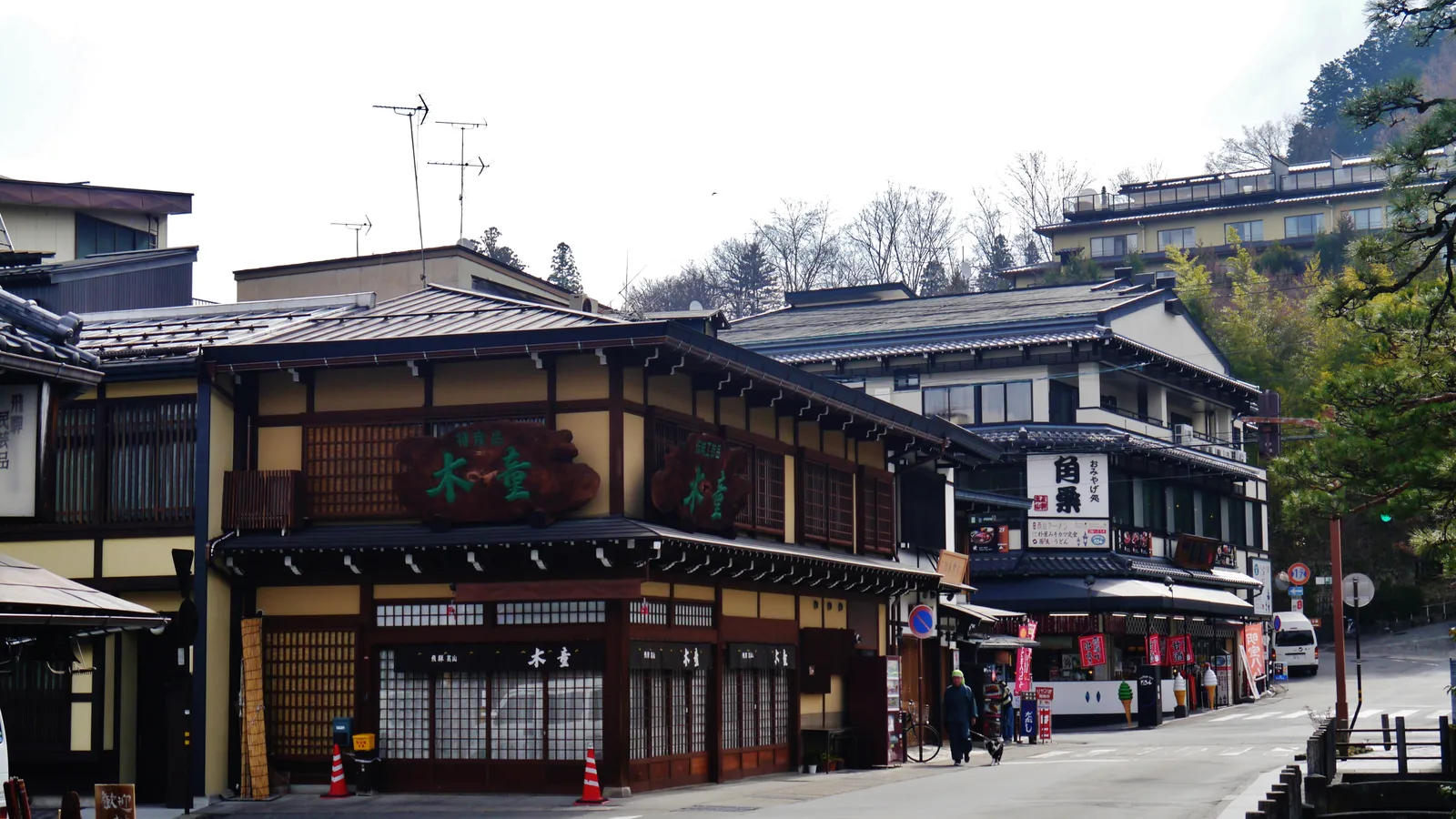
Takayama — The Old Town That Never Became a Museum
Takayama Old Town (Sanmachi)
By Kei · Born and raised in JapanThe Meaning
More than thirteen centuries ago, a mountain province too poor to pay its taxes in rice was ordered to pay in people. Under an ancient eighth-century law, Hida sent roughly a hundred of its finest carpenters to the capital every year — not goods, not coins, but hands. For around five hundred years they raised the great temples and palaces of Nara and Kyoto, then walked home to the mountains. The province kept almost nothing from this arrangement. Except the skill. That stayed.
Takayama is what that skill built once it had nowhere else to go. You can read it in the joinery of the old houses, in the carved wooden floats that come out at festival time, in the lattice fronts that have faced the same streets for centuries. This was never a town that decorated itself for visitors. It was a town of woodworkers, merchants, and farmers who happened to be very good at making things last.
For over a hundred and seventy years, from 1692 until 1868, Hida was governed directly by the shogunate in Edo — prized for its forests — rather than handed to a local lord. The merchants who grew wealthy under that arrangement poured their money into the festival floats, and into the town itself. Then the modern world arrived, and unlike a thousand other places, this one was never torn down and rebuilt.
So the streets you walk in Takayama are not a reconstruction of the past. They are the past, still occupied. People live behind the lattice. The sake breweries still brew. And every morning, before the tour buses arrive, a market opens by the river that has been feeding this town for longer than anyone can remember.
What Happens When You're There
Step 1: The Morning Market — Where the town buys its breakfast
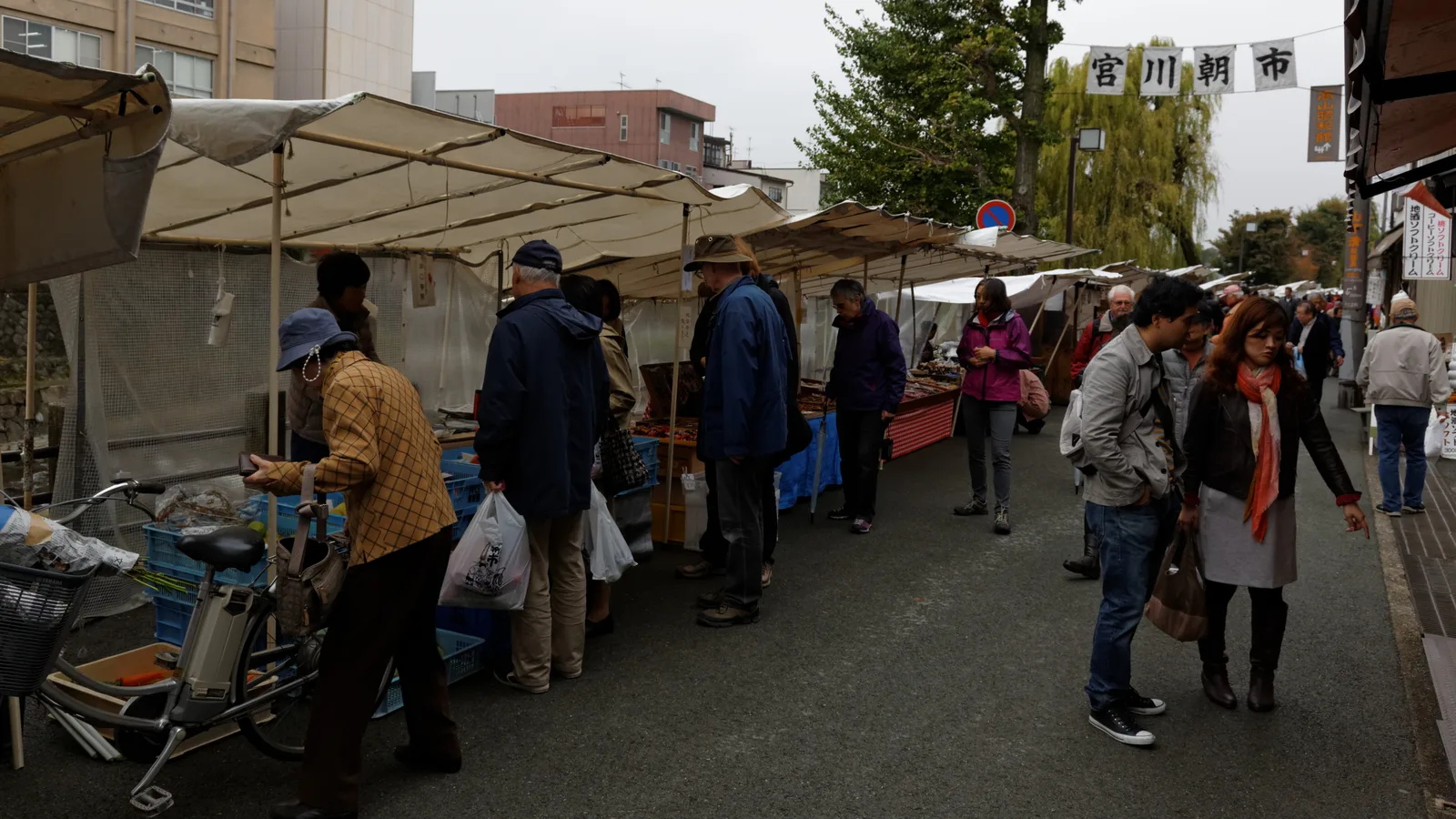
Come early. By seven in the morning — eight in the colder months — wooden tables are already lined along the east bank of the Miyagawa river, and the people behind them are not vendors hired for the season. They are farmers, many of them older women, selling what they grew: mountain vegetables, fruit, pickles weighted under stones, cut flowers, small things made by hand through the winter.
This is not a market built for tourists, though tourists are welcome at it. It descends directly from the rice and mulberry markets of the Edo period. When the silk trade faded in the late nineteenth century, the farmers' wives of Hida began bringing their own homegrown vegetables to sell by the river instead — and that simple act, repeated every morning since the 1890s, is the market you are standing in. Takayama's two morning markets are counted among the three great morning markets of Japan.
Watch how the seller talks to you. It is the same way she talks to the neighbor who arrives next — unhurried, a little curious, ready to explain how you might cook the thing you are holding. There is no haggling here; a Japanese market is not that kind of market. You ask, she answers, you buy or you don't, and either way you have had a small conversation with someone who has done this since before you were born. The early start is the whole point. By noon the tables are folded and the river is just a river again.
Step 2: The Old Town — Sanmachi, still open for business
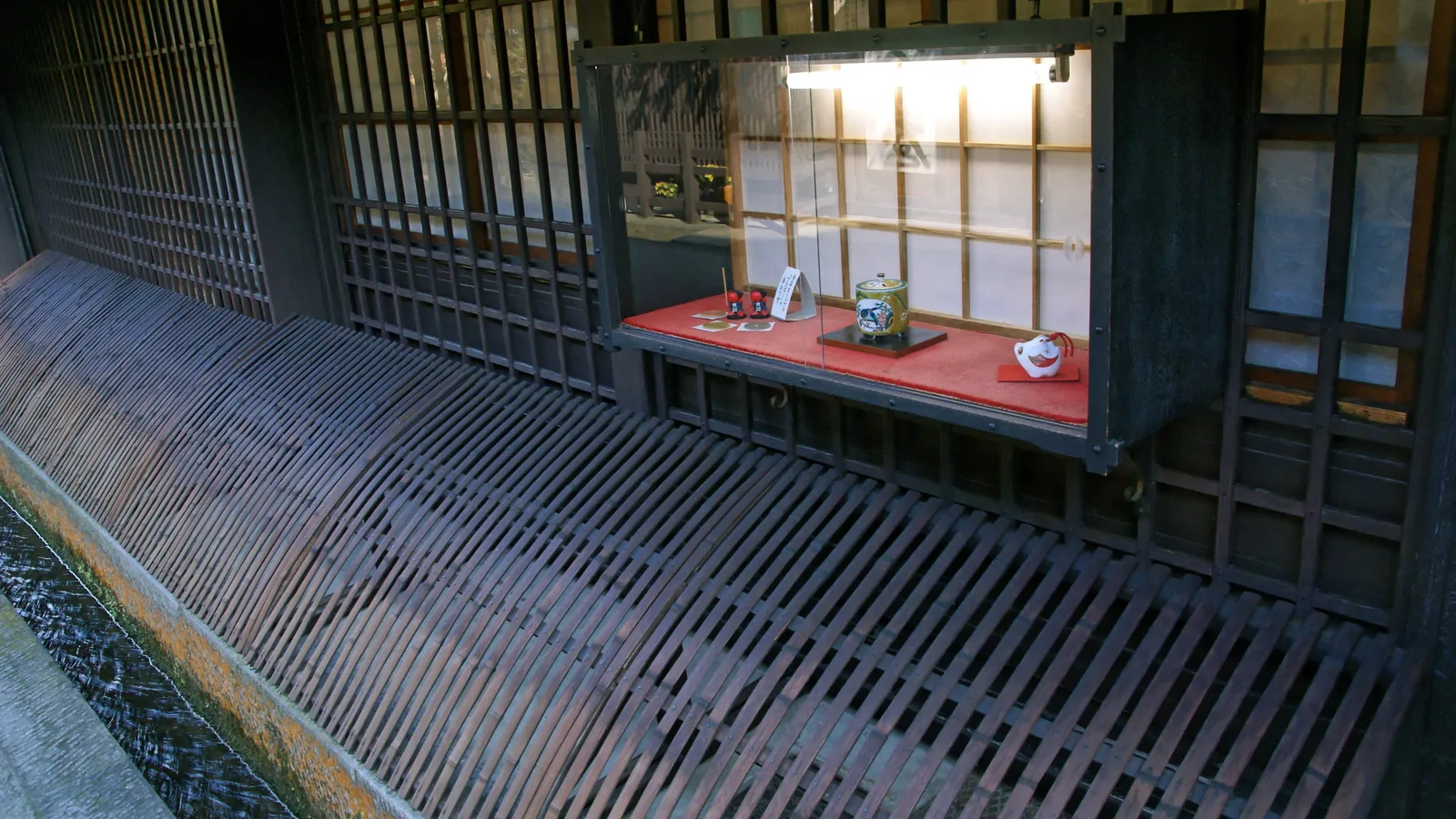
A short walk from the river brings you to Sanmachi — three narrow streets of dark-wood merchant houses that look, in photographs, like a film set of old Japan. They are not a set. This is a nationally protected preservation district, about 4.4 hectares of it, with more than 170 traditional buildings, and people still live and trade inside them.
Notice the details the carpenters left. The degōshi — the projecting wooden lattice across the shop fronts — was built so those inside could see out without being seen. The clear water running in the channels at the edge of the street once carried the threat of fire away from these wooden walls. And above the doorway of each of the seven sake breweries hangs a sakabayashi, a great ball of cedar that turns from green to brown as the new year's sake matures. These are not props. The breweries are still brewing.
The upper streets have become cafes, craft shops, and stalls selling skewers of Hida beef. But walk a block down into the lower town and the souvenirs thin out: a confectioner, a tatami maker, a shop selling farm tools, the post office. This half of the old town is simply where people live. You will also see power lines, vending machines, and cars easing down lanes never built for them. None of that is a flaw in the picture. It is the proof that the town is alive rather than embalmed — and the reason it survived at all is that nobody ever asked the residents to leave. When you raise your camera here, remember you are often pointing it at someone's front door. A little of the quiet awareness Japanese people bring to photographing lived-in places goes a long way.
Step 3: Takayama Jinya — Where the mountains were governed
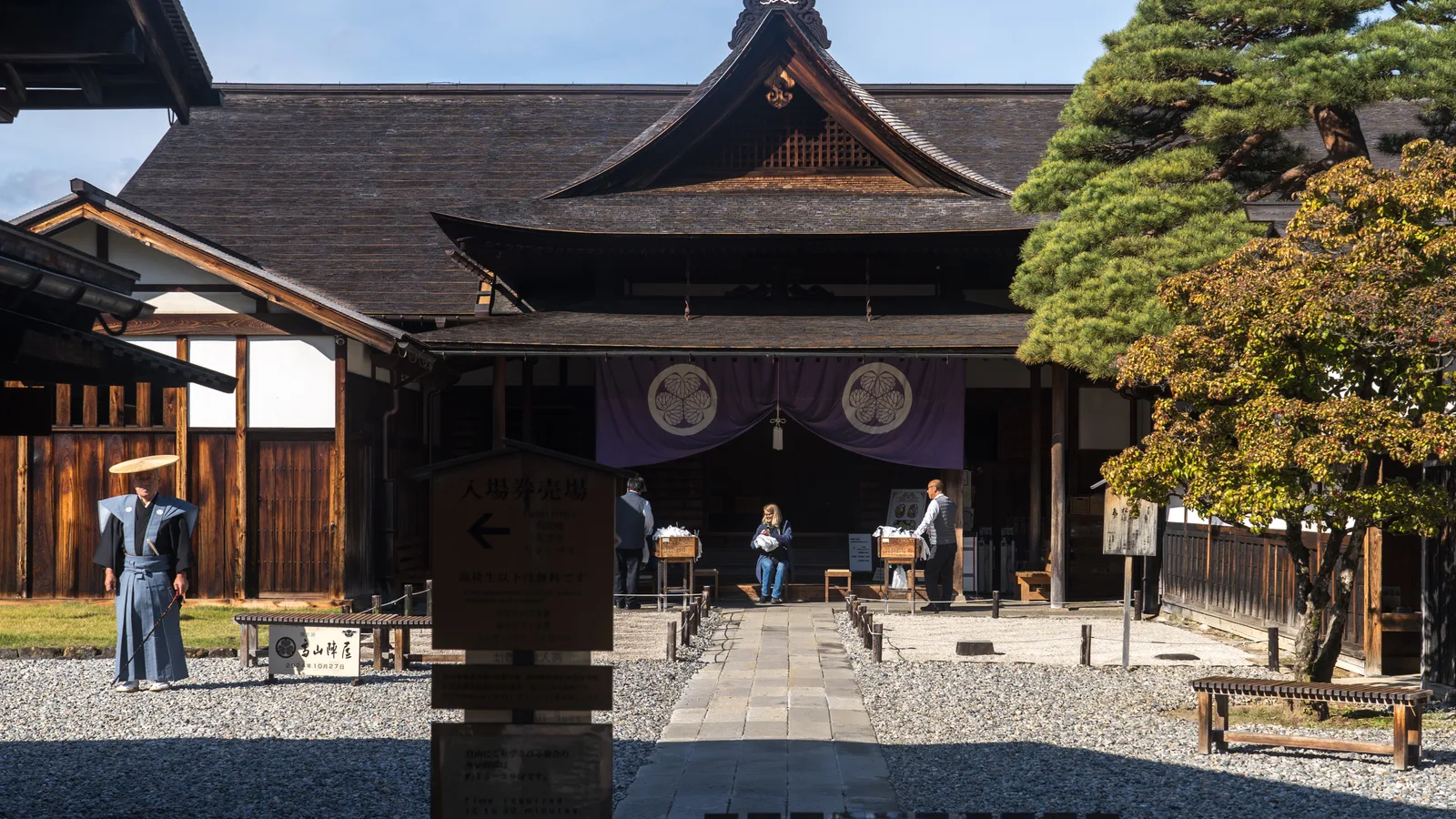
At the edge of the old town stands a long, low building that looks like a grand farmhouse but was something far more serious: the Takayama Jinya, the government office from which the shogunate ruled Hida. Of the roughly sixty such offices that once administered the shogun's directly held lands across Japan, this is the only one whose main buildings still stand. To step inside is to walk through the actual rooms where, for generations, this province was counted, taxed, and judged.
Here the abstract history of the last chapter becomes physical. You can stand in the rooms where officials tallied the rice and the timber that made Hida worth holding. You can see the courtyard where justice was administered, and the vast attic of the rice storehouse — its beams, fittingly, a quiet masterclass in the carpentry this province was born owing. For one hundred and seventy-six years, twenty-five successive administrators worked from this spot. When you understand that the town outside was a merchant town under direct shogunate rule, the wealth behind the festival floats and the old houses stops being a mystery.
Step 4: Walking Out Into the Town — A place people still call home
By mid-morning the market tables are gone, the tour groups have arrived, and the town settles into its ordinary day. This is a good moment to stop performing the role of sightseer and simply be there.
Takayama has welcomed travelers from abroad longer than most towns its size — in 2024 it recorded around 770,000 overnight stays by international visitors, a record for the city. That long habit shows in small, wordless ways. It is, by the account of the people who actually live in Japan's most welcoming places, the kind of town where an elderly resident who cannot share your language will simply take you by the hand and walk you to where you are trying to go. No one decided to be hospitable for the tourists. It is just how a small mountain town treats a guest.
If you are continuing to the thatched-roof village of Shirakawa-go, the bus leaves from beside the station and the ride is under an hour. But you do not have to rush. Buy a skewer of Hida beef from a stall and eat it there, by the counter, the way the town does — the unhurried local habit around eating in public is easy to fall into once you see it. Then walk one more time down a lower-town lane where nothing is for sale, and let it be what it is: not a museum of old Japan, but a town that simply never stopped being one.
Good to Know
Getting there: Takayama sits in the mountains of Gifu, reached by the JR Limited Express Hida on the Takayama Main Line — about 2 hours 20 minutes from Nagoya. From Tokyo, the usual route is the Tōkaidō Shinkansen to Nagoya (about 1 hour 40 minutes) and then the Hida, for roughly four to four and a half hours total. Nohi Bus also runs reserved-seat highway buses from Shinjuku in Tokyo (around 5.5 hours) and from Nagoya, Kanazawa, and Matsumoto.
Getting around: Everything in this guide is walkable from JR Takayama Station — the old town (Sanmachi) is about a 15-minute walk, and the Takayama Jinya and Miyagawa morning market are each about 10 minutes. The Nohi Bus Center is right beside the station.
The morning markets: There are two — the Miyagawa market along the river and the Jinya-mae market in the plaza in front of the Takayama Jinya. Both open early (around 7:00, or 8:00 in the colder months) and wrap up around noon, and both run year-round. Arrive early: the selection — and the quiet — are best before mid-morning. Many stalls take cash only.
Takayama Jinya: Admission ¥500 for adults; free for ages 18 and under. Open 8:45–17:00 (April–October) and 8:45–16:30 (November–March); last entry 30 minutes before closing. Closed December 29–January 3.
The old town (Sanmachi): Free to walk at any hour. Shops generally open around 9:00 and close by early evening; some close on Tuesdays or Wednesdays. It is a residential district as much as a tourist one — please keep lanes clear for residents and the occasional car.
Day trip to Shirakawa-go: Nohi Bus runs the route from the Takayama Nohi Bus Center in about 50 minutes, ¥2,800 one way, with around 16 round trips a day. Some departures require a reservation and others do not — in peak seasons, reserve ahead online or you may not get a seat. Allow buffer time on the return: the bus can be significantly delayed by parking congestion at the village, heavy snow, or expressway closures.
Takayama Festival: The town's famous festival of ornate wooden floats runs twice a year — the Spring Festival on April 14–15 and the Autumn Festival on October 9–10. The float events are inscribed on UNESCO's Intangible Cultural Heritage list. These are among the busiest days of the year; book accommodation far in advance.
How long to stay: The markets, old town, and Jinya make a comfortable half-day to a full day. If you are pairing Takayama with Shirakawa-go, stay a night — the early-morning market is reason enough, and it rewards those who are already in town when it opens.
Last verified: 2026-06
Official website: hida.jp/english
If Things Don't Go as Planned
The old town feels too crowded to enjoy. Come back at first light. Before the tour buses arrive, Sanmachi belongs to the residents sweeping their doorsteps, and the streets you saw packed by noon are silent and beautiful. Failing that, walk one block down into the lower town, where everyday shops replace the souvenir stalls and the crowds simply aren't.
The morning market looks smaller than you expected. It is meant to. This is a neighborhood market, not a grand bazaar — a few rows of farmers selling what they grew. The reward is not scale; it is the early-morning quiet and the conversation with the person who grew your breakfast. Arrive early, before the tables thin out.
You're worried about getting stranded at Shirakawa-go. Reserve your return bus when you book your outbound one — some Nohi Bus departures require it, and seats sell out in peak season. Build in extra time, since the return can be delayed by traffic or weather. A half-day at the village is plenty for most visitors.
Restaurants seem to be closed or fully booked. Takayama winds down early, and many of its best small restaurants are reservation-only. Book your dinner earlier in the day, and treat the morning market and the old town's stalls as a fine lunch.
It isn't the untouched Edo town you pictured. The power lines, the vending machines, the cars — they are there because real people live here, not because the town was poorly preserved. The version frozen in time is the theme-park village down the road. This one is the real thing, which is messier and warmer and worth more.
You only have a couple of hours. Do this loop: the Miyagawa morning market, then a slow walk up through Sanmachi, then the Takayama Jinya. It is barely two kilometers, all flat, and it gives you the market, the old town, and the history in one unhurried morning.
Sources:
- Hida Takayama Tourism Association (Japanese) — Morning markets (hours, location, history), Sanmachi old town, Takayama Jinya, official model course
- Takayama City Official Site (English) — Tourist information, town history, practical guidance
- Takayama City — Sanmachi Preservation District (Japanese) — Designation (1979), area (~4.4 ha), 172 traditional buildings; town history and visitor statistics
- Takayama Jinya Official Site (English) — Hours, admission, the only surviving shogunate government office, the tenryō (direct-control) history
- Nohi Bus — Takayama–Shirakawa-go Line (English) — Bus time, fare, frequency, reservation rules, delay warning
- Gifu Prefecture Official Tourism — Old town, the castle-town layout, Takayama Festival
- Agency for Cultural Affairs — Japan Heritage: The Hida Craftsmen (Japanese) — The Hida no Takumi carpenter-tax system
- JNTO — Hida Takayama — Visitor overview, access, regional context
- Takayama Yatai Preservation Society (Japanese) — Festival floats, merchant patrons, cultural designations
Photos: Sanmachi old town street (hero, thumbnail) by Zairon, CC BY-SA 4.0, via Wikimedia Commons; the Miyagawa morning market by KimonBerlin, CC BY-SA 2.0, via Wikimedia Commons; the latticed Sanmachi shopfronts by 663highland, CC BY 2.5, via Wikimedia Commons; the Takayama Jinya by Alexkom000, CC BY 4.0, via Wikimedia Commons. All cropped and resized.

.jpg)


WMJS is written in Japan, in English, with AI help. We check every page, but English is not our first language. If a sentence reads oddly, tell us. One sentence is enough.
Thank you. A person reads every note.
Real voices
Is it worth it?
Were you there? Share your photos.
Your photo could appear in this guide — with your name and a link to your profile.
Submit a photoRelated Articles

Is It Rude to Eat While Walking in Japan? — What Japanese People Actually Think
"Excuse Me, Can You Take My Photo?": What Japanese People Really Think
More guides in Chubu
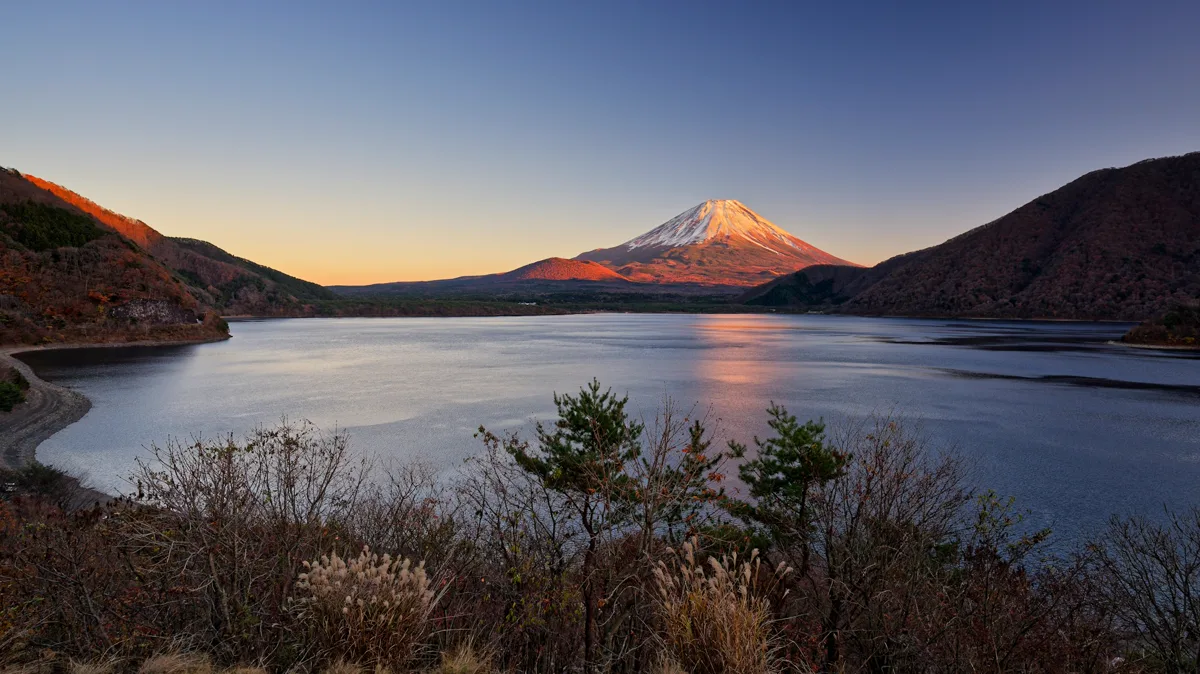
Visiting Mount Fuji, the Mountain That Hides for Half the Year
Is Mount Fuji worth seeing? We weighed 53 traveler voices: 36% saw it clear and call it unforgettable, and Japanese reviewers land warmer at 64%. The Fuji Five Lakes, the Fifth Station without climbing, and the short climbing season, with an audio guide.
Mount Fuji

Visiting Jigokudani Snow Monkey Park, and Why the Monkeys Bathe Only When It's Cold
Is Jigokudani Snow Monkey Park worth visiting? We weighed 70 traveler voices: 38% call it a highlight, another 42% say yes in winter, and Japanese locals rate it warmer at 64%. Wild macaques bathe only in the coldest months, Dec-Feb, to survive the cold, not to charm you. The walk in, hours, and the one season mistake to avoid, with an audio guide.
Jigokudani Yaen-koen (Snow Monkey Park)
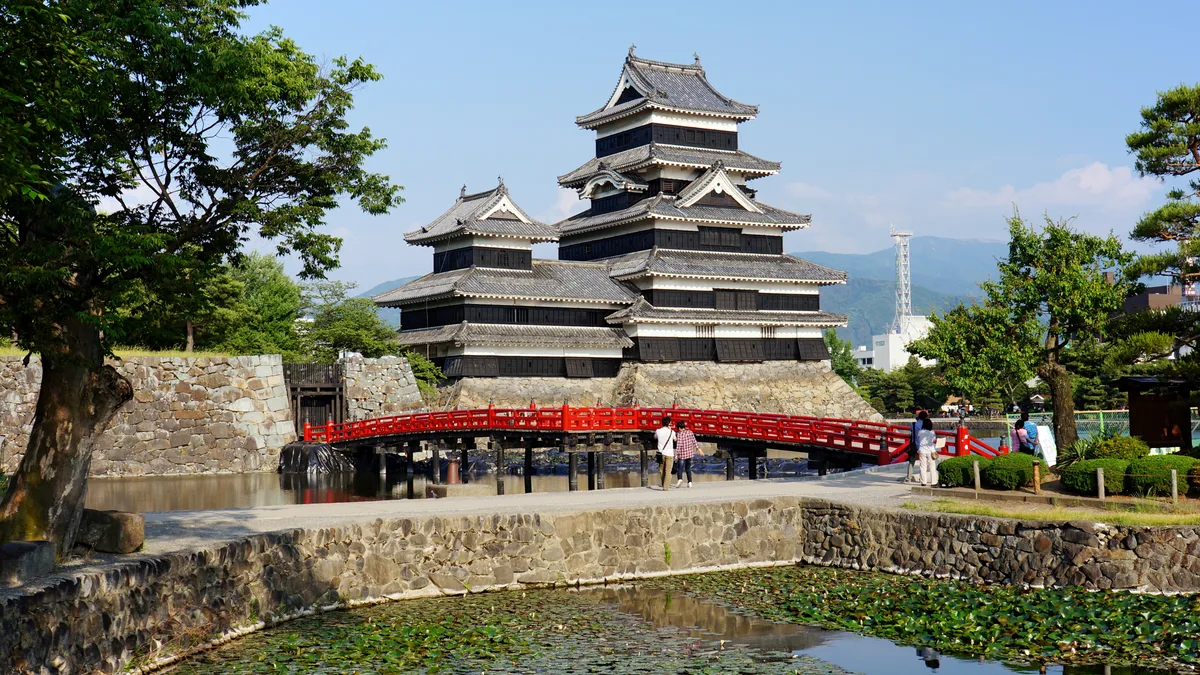
Matsumoto Castle — Why a Fortress Built for War Has a Room for Watching the Moon
A cultural audio guide to Matsumoto Castle, verified against official sources — one of Japan's twelve original wooden keeps, why a black war-fortress on the plain grew a moon-viewing tower, plus hours, tickets and how to climb it well.
Matsumoto Castle
Kanazawa — The Castle Town That Turned a Fortune Into Gardens and Gold Leaf, Not Armies
A cultural audio guide to Kanazawa, verified against official sources — why the Maeda domain spent a million-koku fortune on gardens, gold leaf and crafts instead of armies, plus Kenroku-en hours, access and how to visit well.
Kanazawa