
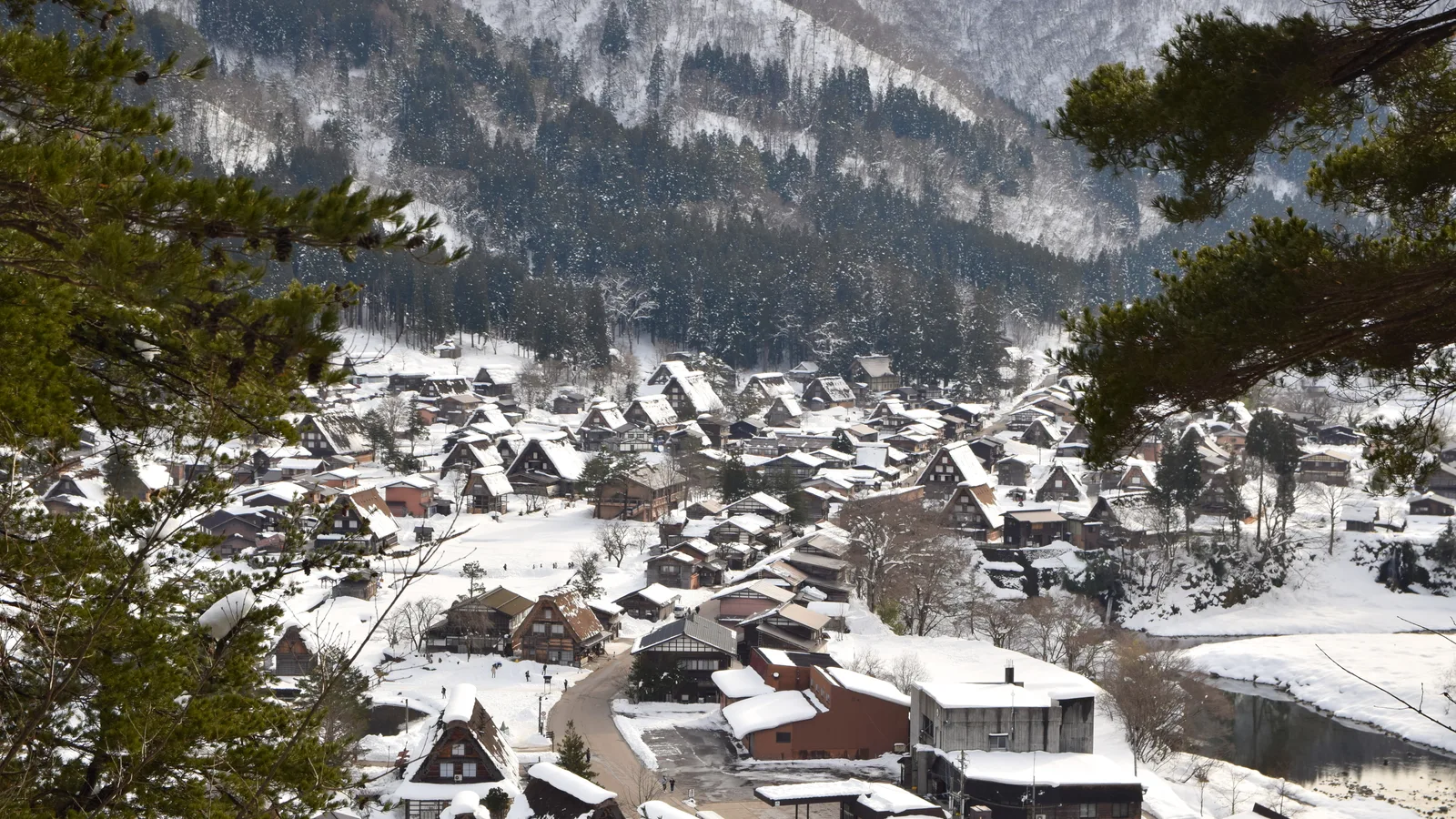
Visiting Shirakawa-go, the Thatched-Roof Village That's Still Lived In
Ogimachi, Shirakawa-go
By Kei · Born and raised in JapanIs Shirakawa-go worth visiting? By the voices we gathered, mostly yes, but timing decides it: only about 1 in 16 international visitors came away let down, while the largest group say it depends entirely on when you go and how long you stay. There is no train, so you arrive by highway bus, about 50 minutes from Takayama, roughly 1 hour 15 from Kanazawa, and around 3 hours from Nagoya, and half a day is enough to walk the village and climb to the viewpoint. Come on the first bus, or stay until the lanes empty out after five o'clock, and you meet the quiet version everyone came for. What visitors actually said, including the one scenario worth avoiding, is further down this page.
The Meaning
On a winter morning in Shirakawa-go, before the first bus arrives, you might see smoke rising from a chimney in one of the great thatched roofs. Someone has lit a fire. Someone slept here last night, and will sleep here tonight. That small thread of smoke is the most important thing to understand about this place, and the easiest one to miss.
Almost every photograph you have seen of Shirakawa-go shows the same thing: a cluster of steep, snow-covered roofs in a mountain valley, looking exactly like an illustration from a folk tale. Travel sites call it a fairy-tale village, a storybook village, a place out of time. All of that is true, and all of it quietly leaves out the part that matters most: the houses in the picture are not a set, not a museum, and not the past. They are homes. Roughly five hundred people still live in this one village of Ogimachi, and many of the farmhouses you will walk past have a family inside, a kitchen in use, a name by the door.
The steep roofs that make the photographs are not a decoration either. This is one of the snowiest inhabited places in Japan; in a normal winter the snow lies two to three metres deep. A roof this steep sheds that weight before it can crush the house: the shape is an answer to the snow, not to the camera. The local name for it, gassho-zukuri, means "built like hands pressed together in prayer," because the great triangular timbers of the roof meet the way two palms meet. Inside, that tall triangle was never wasted: for generations the attics were workrooms where families raised silkworms, a whole second economy living in the rafters above the hearth.
And here is the thing the postcards never explain. A thatched roof this size is far too big for one family to maintain. So it never was maintained by one family. When a roof needs re-thatching, the whole village turns out for a tradition called yui, the old system of mutual help in these snowbound valleys. The roof of a large house is stripped and re-laid in a single day, because on the day it is open to the sky it must be closed again by nightfall, and a job that big in a day takes people. The village remembers gatherings of as many as two hundred, neighbours arriving at dawn, in the old days carrying their own bundles of thatch and coils of rope to add to the pile. There is a written record of one such roof-raising from 1792. It still happens today.
So before Shirakawa-go is a beautiful village, it is a working one: a place where the houses are large because families were large, where the roofs are steep because the snow is deep, and where the roofs stay up at all because the village agreed, centuries ago, to hold each other's roofs up. UNESCO did not list these mountain hamlets in 1995 because they were pretty. It listed them as a rare surviving example of human beings living in near-perfect adaptation to a hard place, and that only works if the living part continues. You are about to walk into a World Heritage Site where the heritage is the life still being lived in it.
What Happens When You're There
Step 1: Crossing the Suspension Bridge
Most visits begin the same way. There is no train to Shirakawa-go, and there never has been, so you arrive by bus or car at the edge of the valley, and to reach the village itself you cross the river on foot. The bridge is a long suspension bridge called Deai-bashi, and it sways, very gently, as people walk it. Below you the Shogawa River runs fast and clear and cold off the mountains.
It is a small thing, but the bridge does something useful: it marks a threshold. On one side is the car park and the bus terminal and the ordinary apparatus of arriving somewhere. On the other side, the first of the great roofs rises into view, and the ground underfoot becomes a village: narrow lanes, vegetable plots, water channels, a shrine, and houses. The moment you step off the bridge, you have walked into a place where people live. The lane you are standing on is someone's route to the shop. The quiet is not an effect arranged for you; it is just a small mountain village being itself on an ordinary day.
If you can, come on the earliest bus. The village wakes slowly, the tour groups have not yet arrived, and for an hour or two you can walk lanes that are nearly empty, which is both the most beautiful way to see it and the gentlest on the people who actually live here. The single road into the valley is narrow, and when it clogs with afternoon traffic it is the residents, not the visitors, whose day is interrupted.
Step 2: Walking Among the Homes
Inside the village the lanes are unhurried and the houses are extraordinary up close: far larger than they look in photographs, three and four storeys of dark timber and pale thatch, the roof ridges thick as a wall. Within the protected district fifty-nine of these gassho-zukuri farmhouses still stand, sixty if you count the great thatched kitchen of Myozen-ji temple, and around a hundred and twenty-eight households still call Ogimachi home.
That last figure is the one to keep in mind as you walk, because it changes how you move. A handful of the houses are open to visitors and clearly marked: the Wada House, the largest in the village and once home to a family grown wealthy on silk and gunpowder, keeps its rooms and its soot-blackened rafters open to walk through. But most of the farmhouses are simply people's homes. The garden with the drying daikon, the entrance with the boots lined up, the window with a light on: those belong to a family rather than to the visit. The kindest and simplest way to tell the difference is to look for the signs: where a house invites you in, go in; where it doesn't, it is a home, and you let it be one.
This is the one piece of Shirakawa-go etiquette worth carrying with you, and it is gentler than a rulebook. In most famous places, the thing you are asked to be careful about photographing is people. Here, what fills your frame is mostly someone's home: their doorway, their washing, their lane, so the courtesy shifts accordingly: photograph the roofs and the valley freely, and treat private gardens and entrances the way you would a neighbour's anywhere. (The broader habits of photographing well at busy sights, and what it feels like to be on the other side of the lens, are worth knowing before any trip in Japan.) The village asks only a few concrete things, and they are easy: take your rubbish out with you, since there are almost no bins; never bring an open flame near the thatch, which is why smoking is limited to a few marked spots; and leave the drone at home, because a camera in the sky over people's houses is a different thing from a camera in your hand. None of it is a list of don'ts so much as the ordinary grace of being a good guest in a place where people are at home. The residents even run fire-watch patrols through the village three times a day, quietly looking after the roofs that took the whole village to build.
Look closely at one of the open houses and you can see why the village had to build them together. The frame carries no nails. The huge roof timbers are lashed to the structure with straw rope and supple withies of witch-hazel, tied so the whole roof can flex in wind and under snow-load instead of snapping; a single large roof can take many hundreds of these bindings. It is a structure designed, from the first knot, to be raised and repaired by many hands at once. The beauty you came to photograph is, underneath, a diagram of cooperation.
Step 3: The Viewpoint Above the Valley
Sooner or later you will want the view from above: the one in every photograph, the whole village of roofs laid out along the valley floor with the mountains behind. It is taken from the Ogimachi Castle observation deck, on the wooded hill at the north end of the village, where a small fortress once stood. You can walk up in about fifteen to twenty minutes on a gentle path, or take the shuttle bus that runs up from near the village for a few hundred yen each way. There is no public car park at the top; the way up is on foot or by shuttle, which keeps the hill quiet.
From up here the shape of the place finally makes sense. The farmhouses are not scattered at random; they line the narrow strip of flat land along the river, every roof turned the same way so the morning sun dries the thatch evenly, the rice fields filling the spaces between. You are looking at something that has held nearly the same shape for centuries, not because anyone froze it, but because each generation kept rebuilding it the same sensible way. In deep winter, when the valley fills with snow, this is the view that draws the largest crowds of the year, and on a few special nights it becomes the famous illuminated scene. A quiet word on that, below, because it is not as simple as showing up.
The deck is busiest in the middle of the day and closes in the late afternoon, so the soft golden view of the village at dusk is one you take from down among the houses rather than from the hill.
Step 4: Walking Back as the Lights Come On
By late afternoon the buses begin to leave, and Shirakawa-go does something most famous places cannot. It empties. The tour groups pull out of the valley, the lanes go quiet, and one by one the windows of the farmhouses turn yellow as the families inside switch on their lamps and start dinner. After five o'clock the village belongs almost entirely to the people who live there: the car parks close, and night is left to residents and to the few guests staying over.
That is the other way to experience this place: to stay. A number of the farmhouses take guests as minshuku, family-run inns, and a night in one is a night inside the thing you came to see: a hearth, a thick-beamed room, dinner made by the family, the deep mountain silence after the day-trippers have gone. They are real homes with only a few rooms, so they book up far in advance and the welcome comes with the house rules of a family's home rather than a hotel's anonymity; if you'd like to understand the rhythm of staying somewhere like this before you go, it helps. But whether you stay the night or catch the last bus out, try to be there for this hour. It is when the village stops being a view and becomes, plainly, what it has always been: not a display, but a place where, tonight again, someone is coming home.
You have spent a day in a village that the world keeps photographing as if it were a memory. It isn't. It is two hundred years of families deciding, every snowbound winter, to hold one another's roofs up, and still deciding it. You came to see a fairy tale, and found, underneath the snow, something better: a real one.
What Visitors Honestly Say
Before you plan the trip, it helps to hear from people who have already made it. We gathered voices of international travelers who had actually been to Shirakawa-go, weighted by how strongly each resonated with fellow readers, and this is how they fell:
The middle bar, not the green one, is the real story here: most travelers say it comes down to timing. "'Tourist trap' for a World Heritage site is pushing it a little," said the most upvoted voice of all, adding only that the village is small and best avoided at the busiest hour. The thin red band is that exact scenario: "beautiful and snow covered, but I would honestly not go back," wrote a day-tripper who arrived on a packed weekend bus.
Japanese visitors and locals, reviewing the same valley in their own words, land in a warmer place, and their green band traces back to the same one habit: never coming at midday.
"In the morning sun, the steam rising from the gassho-zukuri roofs was magical," one wrote. Their slightly larger red band is the most candid on this page about the real costs, crowds on holidays and a ¥2,000 parking fee one visitor wondered aloud about, yet the same reviewers are the ones who insist the magic is real once you meet it at the right hour.
The full picture, timing advice included, is in Is Shirakawa-go Worth It?
Good to Know
Getting there: there is no train. Shirakawa-go is reached by highway bus or car only; the nearest railways are well away over the mountains. The usual gateways are Takayama (about 50 minutes by Nohi Bus, around ¥2,800 one way, with roughly 16 round-trips a day), Kanazawa (about 1 hour 15 minutes, around ¥2,800), Toyama (about 1 hour 10–20 minutes, around ¥2,400) and Nagoya (about 2.5–3 hours; the fare varies by date). The Tourist Association sums it up as roughly an hour and a half from Kanazawa or Toyama and about three hours from Nagoya. Last verified: 2026-06. Buses fill up in peak seasons; the Kanazawa, Toyama and Nagoya routes use reserved seating, so book ahead, and timetables change, so confirm with each operator. (For passes and how Japan's transport connects, see getting around Japan.)
Reaching the village itself. Buses stop at the Shirakawa-go Bus Terminal, a minute's walk from the houses. If you drive, the main Seseragi Park car park sits across the river (around ¥2,000 per car, open about 8:00–17:00, no reservations: first come, first served, and part of the fee goes to maintaining the World Heritage village); from there it is a two-minute walk across the Deai-bashi suspension bridge into the village. Last verified: 2026-06.
The houses you can go inside. Most farmhouses are private homes, but a few are open to visitors, including the Wada House (a National Important Cultural Property; around ¥400 for adults). Separately, at the south end of the area, the Gassho-zukuri Minka-en open-air museum gathers more than two dozen relocated farmhouses you can freely explore (around ¥800 for adults), a good option if you want to walk through several houses without entering anyone's home. Hours and fees vary by season; check before you go.
The viewpoint. The famous overhead view is from the Ogimachi Castle observation deck, a 15–20 minute walk up a gentle path at the north end of the village, or a short ride on the shuttle bus (a few hundred yen each way). There is no visitor parking at the top. The deck is open through the day and closes in the late afternoon.
The winter light-up is special, and it isn't a turn-up event. A few evenings in January and February, the snow-covered village is illuminated after dark. In recent years this has been cut to only a handful of nights per season (the 2026 event ran just four evenings, roughly 17:30–19:30), and it is now fully reservation-based and ticketed: there are no same-day tickets, parking switches to reservation-and-bus-only, and demand far exceeds the space. If you are hoping for the lit-up scene, plan months ahead and book through the official channel; if you are visiting in winter without a light-up booking, the snowy village by day is magnificent and free. Dates and the booking system change every year. Last verified: 2026-06. Confirm on the Shirakawa-go Tourist Association site.
When to come, and for how long. Half a day is enough to walk the village, go inside a house or two, and climb to the viewpoint; many people visit Shirakawa-go as a stop between Takayama and Kanazawa. Winter is the iconic season but also the most crowded and the most weather-dependent; spring, summer and autumn each have the valley to a different light, with far smaller crowds. Whenever you come, the early morning and the late afternoon are the quietest and loveliest hours.
Coming in winter. This is heavy snow country, and snow can lie two to three metres deep. Wear warm, waterproof boots with good grip, dress in layers, and allow extra time, as bus services can be delayed by weather. Done right, the cold is exactly what you came for.
A few village kindnesses. Take your rubbish with you (there are very few bins); keep flames away from the thatched roofs (smoking only in marked spots); don't fly drones over the houses; and where a house is a home rather than an open exhibit, enjoy it from the lane. These few courtesies are simply what keeps a lived-in World Heritage village livable.
Official tourism site: Shirakawa-go Tourist Association · Shirakawa Village
If Things Don't Go as Planned
There's no snow, and you came for the snow. The winter photographs set a trap: they make it seem the village only works in white. It doesn't. The same roofs, lanes and valley are beautiful in cherry-blossom spring, deep-green summer and golden autumn, often with a fraction of the winter crowds. If snow was the only reason the place appealed to you, that is worth noticing; if the village itself appeals to you, any season rewards the visit.
It's smaller than you expected, and quickly walked. Ogimachi is a real mountain village, not a sprawling attraction, and you can walk it end to end in well under an hour. That is the point rather than a shortfall. Slow down instead of speeding up: go inside a farmhouse and look at the rafters, sit by the river, climb to the viewpoint, have a quiet lunch. The reward here is atmosphere, not a checklist.
The streets are packed with tour groups. Midday is the busiest, especially in winter. The fix is timing: come on the earliest bus or stay overnight, and walk the lanes before about ten in the morning or after the day-trippers leave in the late afternoon, when the village is at its most peaceful and most itself.
You couldn't get a light-up booking, or a farmhouse stay. Both sell out far ahead: the light-up by months, the minshuku often as soon as bookings open. If you missed them, the daytime village in winter is still extraordinary and needs no reservation, and there are hotels and inns in nearby Takayama and along the route with their own charm. Don't let a missed booking cancel the trip; the village itself is the thing.
The bus is full, or the schedule doesn't fit. Because there is no train, the buses are the lifeline, and in peak periods they sell out. Reserve seats in advance wherever the route allows, build in a little slack, and remember that the Shirakawa-go-to-Takayama direction is often the easiest leg to get a seat on at short notice. If you're driving in winter, check road conditions before you set out.
It feels more like a tourist site than a living village. At the busiest hours, in the busiest spots, it can. The cure is to step one lane back from the main flow, where you'll find vegetable plots, someone's laundry, a resident clearing snow: the ordinary life that is the actual reason this village still stands. Meeting it on those terms, quietly and as a guest, is the whole experience.
Sources:
- Shirakawa-go & Gokayama World Heritage Site Center (Shirakawa Village Board of Education): Gassho-zukuri Structure: The roof pitch close to 60 degrees, the nail-free frame lashed with straw rope and witch-hazel withies (neso), and the triangular attic divided into layers for silkworm raising
- Shirakawa-go & Gokayama World Heritage Site Center: "Yui" and Roof Re-thatching: The mutual-help system of yui, a large roof re-thatched in a single day, gatherings of as many as 200 people, and neighbours bringing their own thatch and rope
- Shirakawa-go & Gokayama World Heritage Site Center: The Village of Ogimachi: 59 gassho-zukuri farmhouses in the preservation district (60 with the Myozen-ji kitchen), 128 households (2023), the crescent river terrace about 1,500 m long, and the 1995 UNESCO inscription
- Shirakawa Village Office: Responsible Tourism: Nearly 500 residents still living in the village, "this is not a theme park," the five village requests (designated parking, no open flames, take your rubbish home, no nighttime sightseeing, no drones), the 1971 charter ("don't sell, don't rent, don't demolish"), and the 1792 record of a yui roof-raising
- Shirakawa Village Office: Cultural Property Information: Snow depth of two to three metres in a typical winter
- Shirakawa Village Office: Parking Information: Seseragi Park car park fees and hours, no reservations for ordinary cars, the two-minute walk across the Deai-bashi suspension bridge, and the light-up-day parking rules
- Shirakawa Village Office: 40th (2026) Light-Up Event: The four evenings of the 2026 light-up (17:30–19:30) and the fully reservation-based, ticketed system, with the number of nights reduced for reasons of snowfall and daylight
- Shirakawa-go Tourist Association: Access: No train access; about 1.5 hours by highway bus from Kanazawa and Toyama and about 3 hours from Nagoya; bus terminal and Seseragi car park
- Nohi Bus: Takayama–Shirakawago Line: About 50 minutes from Takayama, ¥2,800 one way, 16 round-trips a day, and reservation requirements by route
- JNTO (Japan National Tourism Organization): Shirakawa-go: Gassho-zukuri meaning "like praying hands," houses built without nails, and access best made by bus from Takayama
- Gassho-zukuri Minka-en Open-Air Museum: More than two dozen relocated gassho farmhouses open to walk through, with admission and seasonal hours
- Is Shirakawa-go Worth It? (WMJS): The two visitor-voice gauges reproduced in "What Visitors Honestly Say" (120 international voices, 37/57/6; 70 Japanese voices, 70/22/8) and the verbatim visitor quotations.
Image credits: Hero and thumbnail: the village of Ogimachi seen from the observation point in winter, by Raita Futo via Wikimedia Commons (CC BY 2.0; cropped and resized).
WMJS is written in Japan, in English, with AI help. We check every page, but English is not our first language. If a sentence reads oddly, tell us. One sentence is enough.
Thank you. A person reads every note.
Real voices
Is it worth it?
Were you there? Share your photos.
Your photo could appear in this guide — with your name and a link to your profile.
Submit a photoRelated Articles
"Excuse Me, Can You Take My Photo?": What Japanese People Really Think

Staying at a Ryokan: What Your Host Wishes You Knew

Getting Around Japan: The Tiny Things That Earn You a Nod
More guides in Chubu
Visiting Mount Fuji, the Mountain That Hides for Half the Year
Is Mount Fuji worth seeing? We weighed 53 traveler voices: 36% saw it clear and call it unforgettable, and Japanese reviewers land warmer at 64%. The Fuji Five Lakes, the Fifth Station without climbing, and the short climbing season, with an audio guide.
Mount Fuji

Visiting Jigokudani Snow Monkey Park, and Why the Monkeys Bathe Only When It's Cold
Is Jigokudani Snow Monkey Park worth visiting? We weighed 70 traveler voices: 38% call it a highlight, another 42% say yes in winter, and Japanese locals rate it warmer at 64%. Wild macaques bathe only in the coldest months, Dec-Feb, to survive the cold, not to charm you. The walk in, hours, and the one season mistake to avoid, with an audio guide.
Jigokudani Yaen-koen (Snow Monkey Park)
Matsumoto Castle — Why a Fortress Built for War Has a Room for Watching the Moon
A cultural audio guide to Matsumoto Castle, verified against official sources — one of Japan's twelve original wooden keeps, why a black war-fortress on the plain grew a moon-viewing tower, plus hours, tickets and how to climb it well.
Matsumoto Castle
Kanazawa — The Castle Town That Turned a Fortune Into Gardens and Gold Leaf, Not Armies
A cultural audio guide to Kanazawa, verified against official sources — why the Maeda domain spent a million-koku fortune on gardens, gold leaf and crafts instead of armies, plus Kenroku-en hours, access and how to visit well.
Kanazawa