Hakodate — Where Japan Opened Its Northern Door to the World
Hakodate
By Kei · Born and raised in JapanThe Meaning
Hakodate sits at the very bottom of Hokkaido, on a thin neck of land pinched between two seas, with a single steep mountain rising at its tip. For most of Japan's history this was the edge of the country, the last harbor before the cold northern water. Most visitors come for three things: the night view from the mountain, the seafood in the morning market, and the old foreign-looking streets that climb the hill. Guidebooks file all of it under "retro port town."
But there is one fact the postcards leave out, and it explains everything else. This is one of the places where Japan opened back up to the world.
For more than two centuries, the country had kept its doors shut. Then, in 1854, after American ships forced the question, Japan signed its first treaty with a Western power, and Hakodate, together with Shimoda far to the south, became one of the first two ports it agreed to open. Five years later, in 1859, Hakodate opened again as a full trading port, one of the very first three in the nation alongside Yokohama and Nagasaki. After two hundred years of looking inward, this small northern harbor became a doorway.
Everything you see here grew from that. Ships brought Russians, Chinese, Americans and Europeans, and they built their churches side by side on one hillside. Japan, bracing for those same powers, built a Western-style fort here in the shape of a star. The bay filled with foreign trade. So when you walk Hakodate, you are not strolling through a quaint old town. You are reading the place where the inside of Japan and the outside of the world first had to learn to share a street.
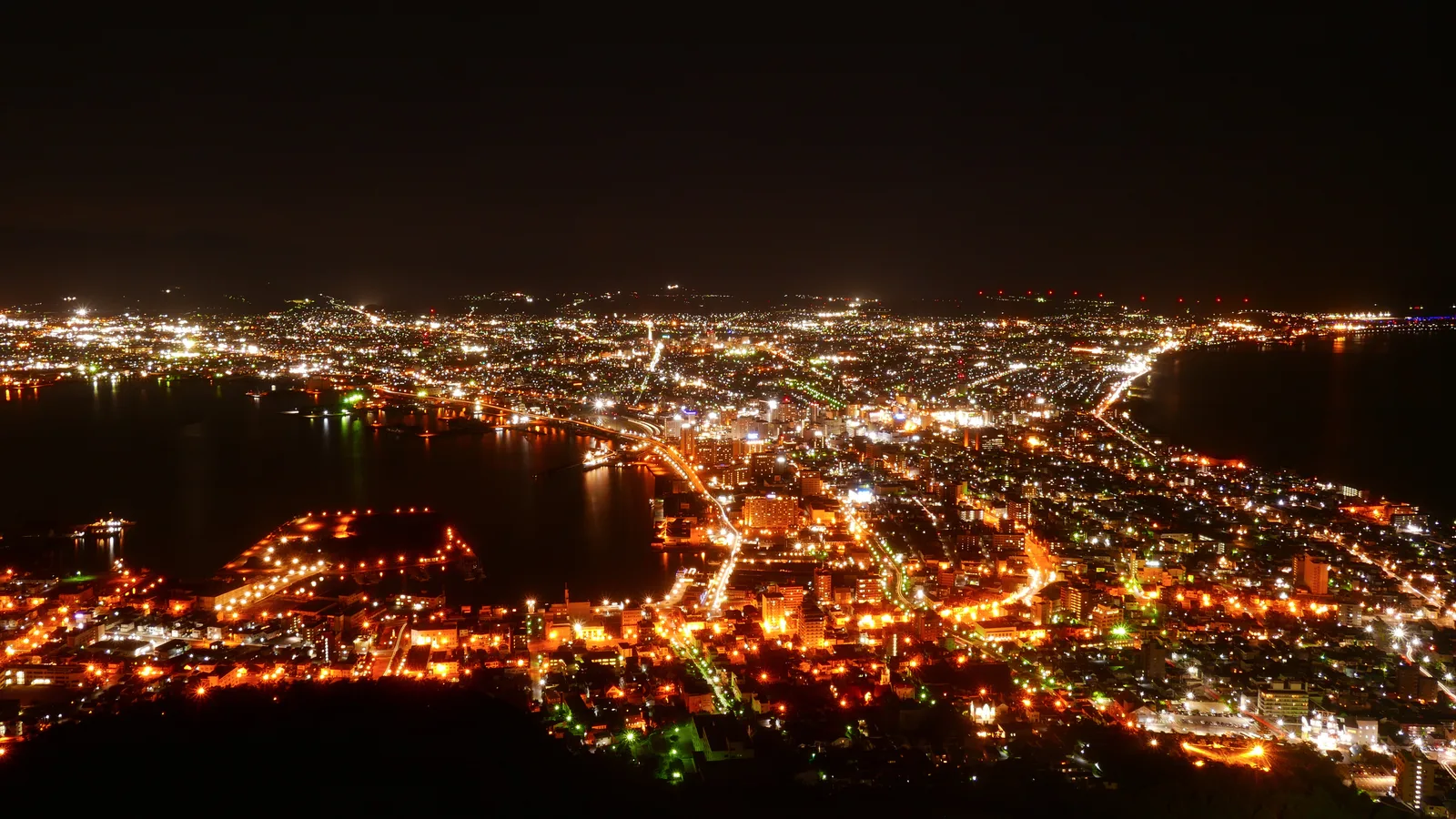
And the famous night view, the thing everyone rides the mountain to see, turns out to be the plainest lesson of all. The reason it glitters in that strange, pinched hourglass shape has nothing to do with decoration: it is the shape of the land itself, finally lit up. We will climb to it last.
What Happens When You're There
Step 1: The Morning Market
Start where the town has started its mornings for generations. The Hakodate Morning Market is barely a minute's walk from the train station, a dense grid of stalls and small eating-houses that opens at five in the morning (six from January through April) and is mostly winding down by early afternoon. Come hungry, and come early; this is a breakfast that does not wait for you.
It is tempting to treat a market like this as a thing to look at: bright crates of crab and sea urchin, salmon roe glistening in the cold air, photographs taken and feet kept moving. Hakodate's market asks for something different. Here you are not a spectator. You are a participant.
At one corner is a shallow tank of living squid. You are handed a small rod, and you fish your own out of the water, and a moment later it is sliced and set in front of you, so fresh the flesh is still clear and faintly moving. A few stalls over, you build your own breakfast bowl: you carry a bowl of warm rice from counter to counter and choose, piece by piece, what goes on top, a slab of tuna here, a spoon of urchin there, a bright orange heap of salmon roe, until the bowl is yours and no one else's.
None of this is a performance staged for tourists. It is simply how a working port eats in the morning, and the quiet pleasure of it is that an outsider is allowed to join. The vendor who slices your squid, the woman who spoons roe over your rice: for a few minutes you are part of the same small ritual the town runs every dawn. If you feel shy about the squid, or unsure which stall to choose, take comfort: Japanese visitors hesitate at exactly the same spots. Everyone is a beginner at someone else's morning.
Step 2: The Bay and the Bricks
Walk west from the market and the streets open onto the water. This is the bay where the open port actually happened, where, for over a century and a half, goods and people went out and came in. The long red-brick warehouses along the quay, the first commercial warehouses built in the city in 1909, are the physical memory of that trade: thick brick raised to hold the cargo of a port that had suddenly joined the world. Today they hold shops and restaurants, but the shape is honest. Stand with your back to them and look at the harbor, and you are standing where Hakodate's foreignness arrived by sea.
A port that opened early to the world also became a place where new tastes were invented, and Hakodate is one of the homes of Hokkaido's clear, light salt ramen, a broth as pale and unfussy as the northern sea it came from. (Japan's bowls of noodles vary wildly by region, and the map of where each style belongs is a small geography lesson in itself.) It is the kind of thing a harbor town makes: simple, warming, built for cold mornings off the water.
From the bay, the land begins to climb. Turn toward the mountain, and the slope ahead of you is the part of Hakodate that the rest of Japan does not have. Hakodate is the door Japan opened; the planned capital of Hokkaido, Sapporo, a few hours north, is the page it drew on a blank grid: the two faces of the north.
Step 3: The Hill of Many Faiths
The streets of Motomachi run straight up the hillside toward the mountain, and they are unusually wide, some of them about thirty-six meters across. That width is not for grandeur. Hakodate burned again and again in its early years, and after the great fires of the 1870s the slopes were rebuilt broad and straight on purpose, as firebreaks. Even the shape of the streets is a memory of hard lessons.
Climb one, and turn around. The most famous of these is Hachiman-zaka, and the reward is sudden: a long stone slope falling away beneath you in a perfectly straight line, and at the bottom, framed between the buildings, the sea. There are said to be nineteen such sloping streets in Motomachi with a view of the water, and travelers have photographed this one for a century. But before it was a view, it was simply the way people walked home from the harbor.
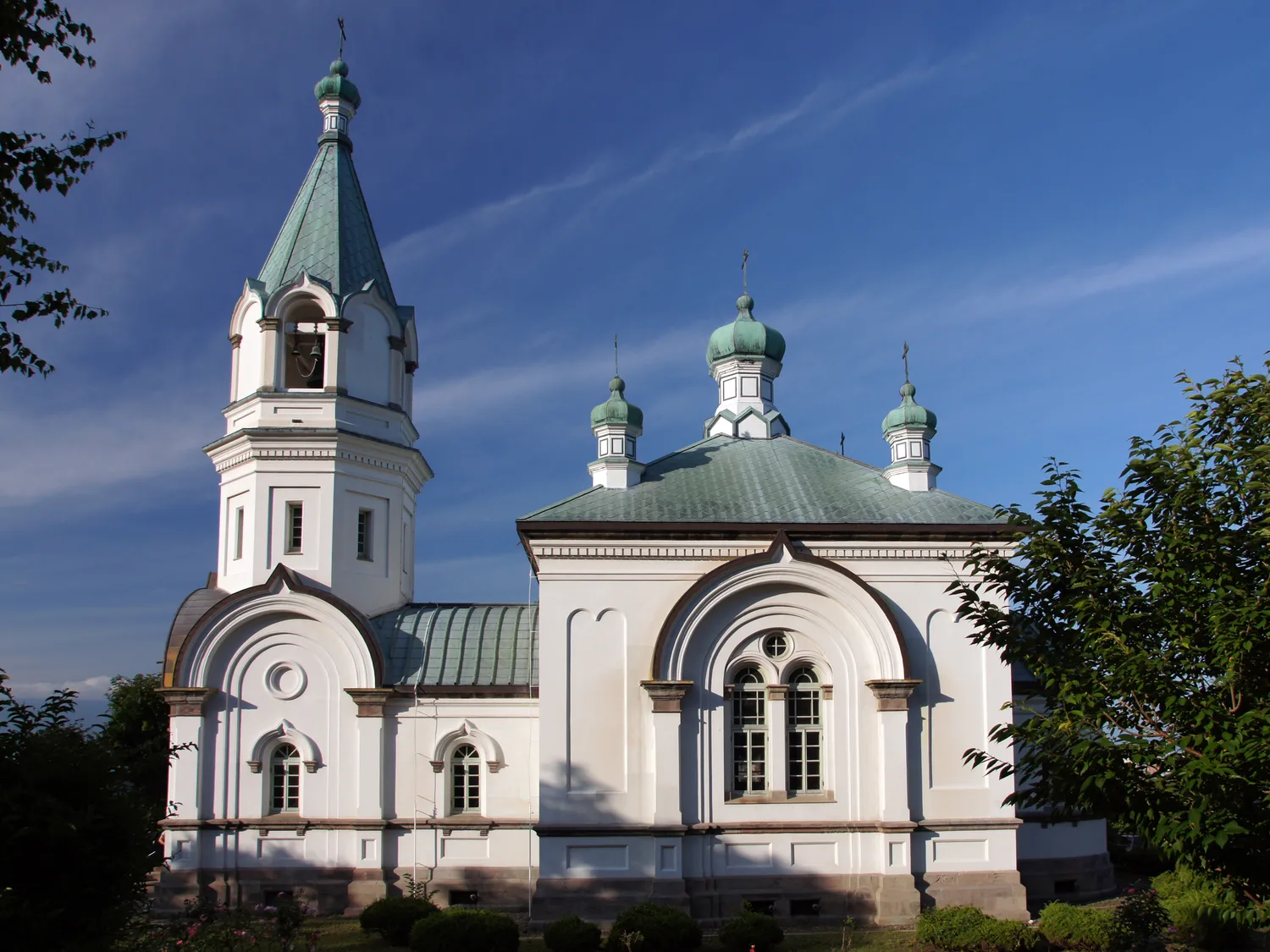
What makes this hill unlike anywhere else in Japan is what stands on it. Within a few minutes' walk of each other, on the same slope, sit a Russian Orthodox church with green onion domes, a Roman Catholic church, an Anglican church with a roof shaped like a brown cross, and a Buddhist temple, all neighbors. When the port opened, the world came up this hill and built its houses of prayer here, each beside the next. The Orthodox church traces its first chapel to 1860, when it rose beside the Russian consulate; the present building dates to 1916. The Catholic church's current building went up in 1923, its altar a gift sent from the Pope in Rome. These are not museum pieces. They are working churches, and people still pray inside them, which is exactly why a quiet voice and a still camera matter here (the same instinct that serves you well at any place of worship). Stand at the crossing of these streets and you can see, almost in a single glance, several of the world's faiths that arrived together by ship and decided to stay as neighbors. No one designed it as a monument to coexistence. It is just what an open port grew.
Step 4: The Shape That Becomes Light
In the evening, ride the mountain. Mount Hakodate is only 334 meters high, and the ropeway lifts you to the top in about three minutes. But what waits up there is the picture that put this town on a thousand posters.
Most guides describe it as a ranking: one of Japan's "three great night views," alongside Kobe and Nagasaki, a box to be ticked. Stand at the rail, though, and try a different question. Ask why it has that shape: why the light below pinches in the middle into a glowing hourglass, dark sea pressing in from both sides until the city narrows to a band of brightness and then flares out again.
The answer is underfoot. Mount Hakodate was once an island. Over thousands of years, sand drifting in the current built a slender bridge of land between it and Hokkaido, and the town grew along that bridge: sea on the left, sea on the right, only a thin waist of solid ground in between. So the night view's famous curve traces something real: it is the outline of the only land people could build on, finally drawn in light. You are looking at the literal shape of where it is possible to live here.
And look closer at the light itself. Those are not the neon signs of an entertainment district. They are streetlights, and harbor lamps, and the lit windows of ordinary homes: the everyday glow of a small city going about its evening. The view moves you precisely because nobody staged it. It is just people, home, with the lights on.
A few honest things. The view is best about thirty minutes after the sun goes down, in the deep blue of dusk, which is also, naturally, when it is most crowded, so the platform will be shoulder to shoulder. The summit juts out over the sea and is colder and windier than the streets below; even in summer, bring a layer. And the mountain keeps its own counsel: on a foggy or stormy night you may ride up into a grey blank and see nothing at all. If that happens, you are in good company. Japanese visitors make this exact gamble, climb into the same fog, and come back down philosophical. The night view has never owed anyone a clear sky.
Step 5: The Star-Shaped Fort
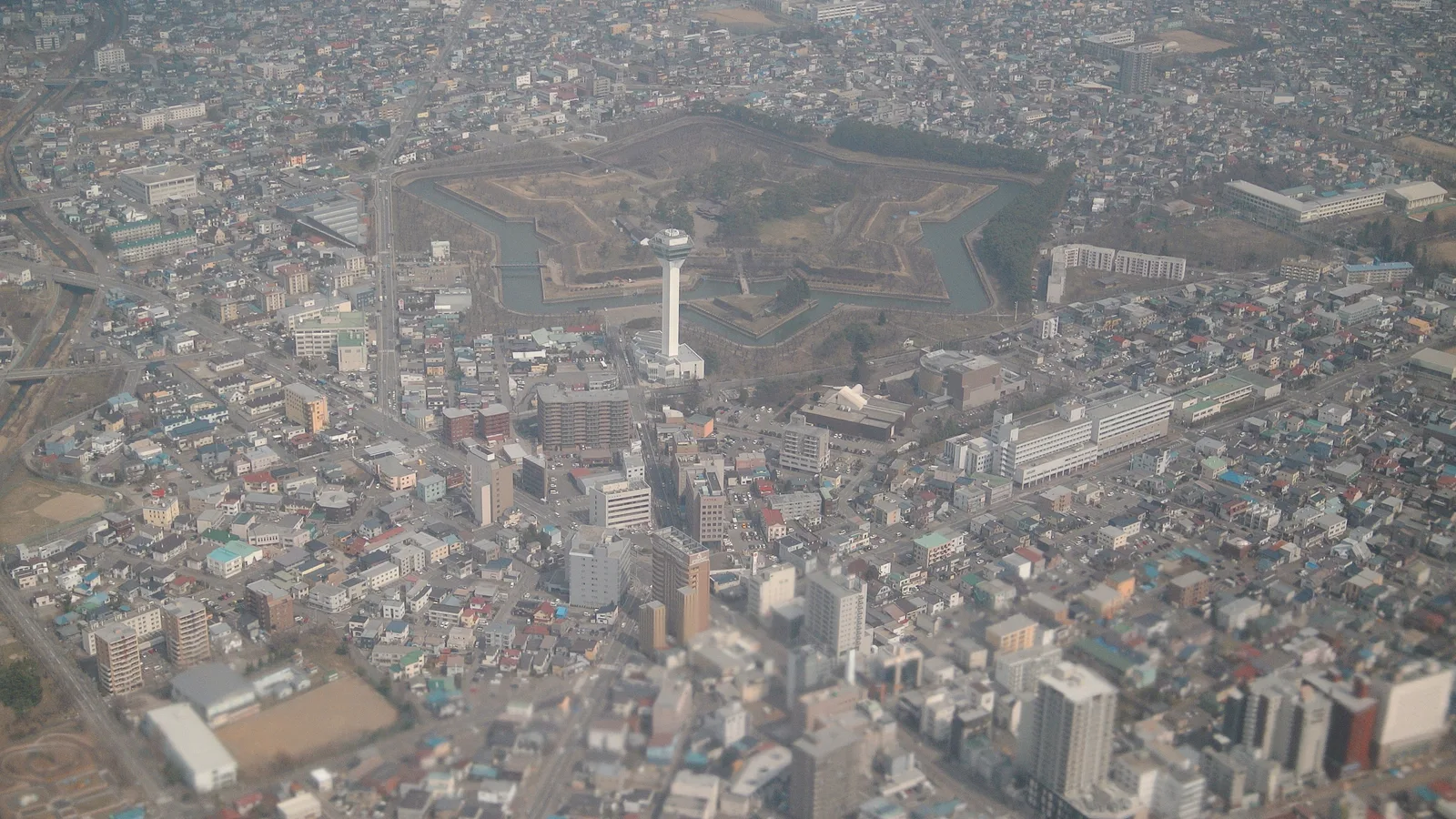
Save one thing for the next day, a little inland: a fort shaped like a five-pointed star.
From the ground, Goryokaku barely looks like a fortress at all: low earthen ramparts and a wide moat, an unusually pleasant park. You cannot see the star. To read its shape, you ride up the Goryokaku Tower beside it, and from the observation deck, ninety meters up, the whole figure resolves at once: five sharp points reaching out symmetrically into the moat.
That shape is not for beauty. When the American ships arrived and Japan's long isolation cracked open, the country suddenly had to defend a coastline against modern Western guns. Goryokaku was Japan's answer, built between 1857 and 1864 by a scholar named Takeda Ayasaburo, who studied European military design and copied the bastion forts of sixteenth-century Europe. The points exist so that defenders firing from one could cover the walls of the next, leaving an attacker nowhere to hide in the angles. It is the same anxious logic that built the fort and opened the port: a country, all at once, having to reckon with a wider and more dangerous world.
So the star is no decoration: it is the exact moment of Japan's turn outward, frozen in earth and stone, the most modern thing the country knew how to build, at the edge it most needed to defend. A few decades later the soldiers were gone and the walls were planted with cherry trees, and today some fifteen hundred of them line the moat. They bloom late here, in the cold north (usually around the start of May, weeks after the rest of the country has finished), so that Hakodate gets its spring just as everyone else's is ending. Stand on the deck in that first week of May, with the star outlined in pink below you, and the whole story of this town is in one frame: a fort built in fear of the outside world, softened into a place where families come to picnic under the trees.
Thank you for walking with us.
Good to Know
First, the station that isn't Hakodate. The single most common stumble here is the name of the train station. The Hokkaido Shinkansen does not stop in Hakodate. It stops at Shin-Hakodate-Hokuto, a station about eighteen kilometers away in a different town. From Tokyo, the Hayabusa reaches Shin-Hakodate-Hokuto in as little as 3 hours 57 minutes; from there you transfer (usually across the same platform) to the Hakodate Liner, a connecting train that runs the last stretch into Hakodate Station in 15 to 22 minutes for ¥440. Build that transfer into your plan and it is effortless; expect to "arrive" at the bullet-train station and you will be confused. Last verified: 2026-06. (For the wider logic of Japan's trains, passes and IC cards, see getting around Japan.)
Getting around town. Hakodate's sights are spread out, but a single tram line strings most of them together. The streetcar runs from ¥250 a ride, and a one-day tram pass (¥800 for adults) pays for itself quickly if you are hopping between districts. The stops to know: Hakodate Ekimae for the morning market, Suehirocho or Jujigai for Motomachi and the bay (then a walk uphill), Jujigai for the ropeway to the night view, and Goryokaku-koen-mae for the fort. Last verified: 2026-06.
The night view: how, and when. The Mt. Hakodate Ropeway runs roughly from 10:00 to 22:00 in the warmer months and closes a little earlier in winter; a round trip is ¥1,800 for adults. Aim to be at the summit about half an hour after sunset, and accept that this is the crowded hour. A few seasonal catches worth knowing before you go:
- In the warmer months you can also reach the summit by mountain bus (about ¥700 one way from the station).
- The mountain road is closed to private cars in the evenings for much of the year and closed entirely in deep winter, so plan on the ropeway or bus rather than a rental car after dark.
- The ropeway takes an annual maintenance closure, usually for a couple of weeks in autumn, and can also stop in strong wind. During the maintenance closure the buses keep running.
Because the dates shift each year, confirm hours, fares and any closure on the official ropeway site before you build your evening around it. Last verified: 2026-06.
The morning market. Open from 5:00 (6:00 from January through April) and largely finished by early afternoon, this is a morning destination best visited before lunch, about a minute on foot from Hakodate Station. The signature experiences are fishing your own squid from a tank (priced at the day's market rate) and building a make-your-own seafood rice bowl from whatever toppings you choose. Many stalls will also ship seafood to your home address, which is the sensible way to enjoy the crab without carrying it. Last verified: 2026-06.
Motomachi and its churches. The district is a hillside, so wear shoes you can climb in. The churches are active places of worship, and each sets its own rules, which matter:
- The Hakodate Orthodox Church opens to visitors for a small donation (around ¥200 for adults) but suspends interior viewing in deep winter (late December through February) and does not permit photography inside the chapel.
- The Catholic Motomachi Church is generally open daytime but prohibits all interior photography.
- The Hakodate St. John's Church (Anglican) can be admired from outside year-round; its interior is opened to visitors only in the warmer half of the year and by prior arrangement.
When a service is underway, the doors are for worshippers, not sightseers. Last verified: 2026-06.
Goryokaku. To see the star, go up the Goryokaku Tower (open 9:00–18:00; ¥1,200 for adults). The park itself is free. The roughly 1,500 cherry trees peak around late April to early May (Hokkaido blooms weeks after Honshu), and in the depths of winter the moat is lit up at night in a "stars" illumination. Last verified: 2026-06.
Best time to visit, and what to wear. Hakodate is noticeably cooler than mainland Japan. Summers are mild and pleasant even when Honshu swelters; the cherry blossoms arrive late, around the start of May; and winters bring real snow and icy footing, with the night-view summit colder still. Pack a windproof layer for the mountain in any season, and proper grip for your shoes in winter. (More on choosing your season and what to pack for Japan's very different climates.)
Time needed. Because the night view depends on the evening, Hakodate is really an overnight town. A comfortable plan is one full day for the market, Motomachi, the bay and the mountain at night, with the morning of a second day given to Goryokaku.
Official websites: Travel Hakodate (city tourism) · Mt. Hakodate Ropeway · Goryokaku Tower
If Things Don't Go as Planned
You rode up the mountain and saw only fog. This is the oldest disappointment in Hakodate, and it happens to everyone eventually: the summit sits out over the sea and makes its own weather. If a clear night is anywhere in your forecast, save the climb for it rather than spending your one good evening on a grey one. And if you are fogged out anyway, you are sharing the experience with generations of travelers, Japanese and foreign alike, who came back down and shrugged. The town is just as good at sea level.
The ropeway is closed. Once a year, usually for a couple of autumn weeks, the ropeway shuts for maintenance, and it can also pause in strong wind. The view is still reachable: the mountain buses keep running during the maintenance period. If you are relying on a bus, board it down at Hakodate Station rather than partway up, since it can fill before it reaches the mid-mountain stops.
You got off at Shin-Hakodate-Hokuto and the town wasn't there. You are not lost. The bullet-train station is a deliberate eighteen kilometers from the city; the Hakodate Liner on the connecting platform takes you the rest of the way in about twenty minutes. Almost every first-time visitor does a double-take at this. It is simply how the railway is laid out, nothing you did wrong.
The morning market feels like a tourist trap. It has the look of one: crowds, English signs, vendors waving you over. But step past the loudest stalls and the food is the real thing, often at gentler prices than the seafood counters back home. You do not have to buy a whole crab to belong here; a modest make-your-own bowl, eaten standing in the cold, is the genuine article.
The hills are wearing you out. Motomachi is genuinely steep, and the climb is part of why the views are what they are. Take the tram to Suehirocho or Jujigai to start higher up, rest on the church benches, and remember there is no prize for rushing. The slopes were built for people walking home, not racing.
Goryokaku looked like a flat park. From the ground it is supposed to. The star only appears from above, which is the whole point of the tower beside it. If the weather is poor and you skip the tower, you have seen a pleasant park but missed the thing that makes it Goryokaku; on a clear day, the ¥1,200 up the tower is the experience itself.
It's winter and half of Motomachi seems closed. Hakodate's quieter season really does dim the hill: some churches suspend interior visits, and small shops keep short hours. Build your winter day around what stays open (the market in the morning, the tower, the night view bundled up warm) and treat the snow-quiet streets as their own kind of beauty rather than a letdown.
Sources:
- Hakodate City: Outline of the Motomachi-Suehirocho Preservation District: The 1854 Treaty opening, the 1859 opening as one of Japan's first trade ports with Yokohama and Nagasaki, the wide fire-break slopes (~36 m), the "birthplace of Hakodate" designation
- Hakodate City: History of Goryokaku: Goryokaku designed by Takeda Ayasaburo, the bastion (star) plan, completion in 1864
- Hakodate City: Cherry trees of Goryokaku, Hakodate and Mihara Parks: Roughly 1,500 (1,515) Someiyoshino cherry trees at Goryokaku, originally planted from 1914
- Hakodate City: Tram fares and day passes: Streetcar fares from ¥250 and the ¥800 one-day pass
- Hakobura (Hakodate City official tourism): Motomachi walking course: The slopes and churches, the Old Public Hall, the walking route and timing
- Hakobura: Mount Hakodate Observatory: Michelin three-star rating, the tombolo (land-tied island) geography behind the night view, free rooftop observatory
- Hakobura: Hakodate Liner access from the Shinkansen: Shin-Hakodate-Hokuto to Hakodate by Hakodate Liner: 15–22 minutes, ¥440
- Mt. Hakodate Ropeway Official: Operating hours and fares (round trip ¥1,800), the ~3-minute ride, the 334 m summit, mountain-bus access, winter road and annual maintenance closures, "best about 30 minutes after sunset"
- JNTO: Mount Hakodate Night View: The view at its best about 30 minutes after sunset, blue-hour framing, access from the Jujigai tram stop
- JNTO: Motomachi, Hakodate: Nineteen sloping streets and Hachiman-zaka's view, the Russian/Catholic/Anglican churches, the Kanemori Red Brick Warehouses built 1909
- JNTO: Goryokaku Tower: Japan's first Western-style fort completed in 1864, the park open since 1914, the tower and its view of the star
- Goryokaku Tower Official: History: The fort as a special historic site, designation history, the 107 m tower and 90 m observation deck
- Cultural Heritage Online (Agency for Cultural Affairs): Goryokaku Site: Designed by Takeda Ayasaburo, bastion-style construction begun 1857 and largely finished 1864, designated a historic site in 1922
- Hakodate Morning Market Official and Ekini Market: live squid fishing: Opening hours (5:00, or 6:00 Jan–Apr), the make-your-own bowl and live squid fishing at market-day prices
- HOKKAIDO LOVE! (Hokkaido official tourism): Hakodate Morning Market: About 250 shops over roughly 3 hectares, one minute from the station
- Hakodate Orthodox Church Official: Services & visiting: Visiting hours, the small donation, the winter suspension of interior viewing, and the no-interior-photography rule
Image credits: Night view from Mount Hakodate by MaedaAkihiko (CC BY-SA 4.0); Hachiman-zaka slope and the Hakodate Orthodox Church by 663highland (CC BY 2.5); aerial view of Goryokaku by MIKI Yoshihito (CC BY 2.0); all via Wikimedia Commons.
WMJS is written in Japan, in English, with AI help. We check every page, but English is not our first language. If a sentence reads oddly, tell us. One sentence is enough.
Thank you. A person reads every note.
Real voices
Is it worth it?
Were you there? Share your photos.
Your photo could appear in this guide — with your name and a link to your profile.
Submit a photoRelated Articles
Getting Around Japan: The Tiny Things That Earn You a Nod

The Ramen Map: What Locals Want You to Know Before You Line Up