
Japan in November: Weather, What to Wear, and What Japanese People Say About the Month
Key Takeaways:
- In Tokyo and Kyoto, November afternoons average about 17°C (63°F) and early mornings about 8°C to 9°C (46°F to 48°F). In both cities the last day of the month is about 5°C cooler than the first (Japan Meteorological Agency, 1991–2020 averages)
- Sapporo averages 5.2°C, with about 30 cm of snowfall over the month, and Naha in Okinawa averages 22.5°C
- At 51 of the 78 autumn-leaf spots on Kyoto City's official page, mid-to-late November is the usual best time. The agency's reference maples turn red on 28 November in Tokyo and 5 December in Kyoto on average
- Of 63 posts by Japanese people about what they wear in November, 16 describe dressing in layers or taking a layer off and putting it back on, and 12 mention a light down jacket or vest
- From 1 November 2026, tax-free shopping becomes a refund: you pay the price with tax, then get the tax back after a customs check when you leave Japan
What is Japan like in November? In Tokyo and Kyoto, November afternoon temperatures average about 17°C and early-morning temperatures about 8°C or 9°C, and at 51 of the 78 leaf spots on Kyoto City's official page, mid-to-late November is the usual best time. We collected 186 public posts by Japanese people about November and about how autumn has changed. Of the 63 about what to wear, 16 describe dressing in layers or taking a layer off and on.
Quick Guide
| Topic | In short |
|---|---|
| Weather | Tokyo: high 16.7°C and low 8.8°C on average. Kyoto: 17.3°C and 8.4°C. Sapporo averages 5.2°C, Naha 22.5°C. In Tokyo and Kyoto, 30 November is about 5°C cooler than 1 November |
| What to wear | 16 of 63 posts describe layering or taking a layer off and on. Light down jackets and vests come up in 12 |
| Autumn leaves | At 51 of 78 Kyoto spots, mid-to-late November is the usual best time. Reference maples: Tokyo 28 November, Kyoto 5 December on average |
| Is November a good time? | Tokyo gets less than half of October's rain. 32 of 60 posts about the month are from people who like it, 12 of them for the temperature. 9 of the 18 posts from people who find it hard are about how early it gets dark |
| How autumn has changed | 29 of 63 posts miss the longer autumn they remember. Since 1953, the agency's maple dates have moved 3.0 days later per decade |
| Events | Culture Day 3 November. Tori no Ichi in Asakusa 7 and 19 November 2026. Shichi-Go-San around 15 November. Three-day weekend 21 to 23 November 2026 |
| Tax-free shopping | From 1 November 2026, pay with tax and get it refunded after a customs check at departure |
November Weather, City by City
Temperatures are in Celsius. For reference: 5°C = 41°F, 10°C = 50°F, 15°C = 59°F, 20°C = 68°F, 25°C = 77°F.
These are the Japan Meteorological Agency's 30-year averages for November, from Sapporo in the north to Naha in Okinawa. The high and low columns are the average afternoon high and early-morning low.
| City | Average | High | Low | Rain | Sunshine |
|---|---|---|---|---|---|
| Sapporo | 5.2°C | 8.7°C | 1.6°C | 113.8 mm | 99 hours |
| Sendai | 9.8°C | 14.1°C | 5.6°C | 58.7 mm | 143 hours |
| Tokyo | 12.5°C | 16.7°C | 8.8°C | 96.3 mm | 150 hours |
| Kyoto | 12.5°C | 17.3°C | 8.4°C | 73.9 mm | 141 hours |
| Osaka | 13.8°C | 17.8°C | 10.2°C | 72.5 mm | 153 hours |
| Hiroshima | 12.9°C | 17.7°C | 8.9°C | 69.3 mm | 153 hours |
| Fukuoka | 14.2°C | 18.2°C | 10.6°C | 91.4 mm | 137 hours |
| Naha | 22.5°C | 25.0°C | 20.4°C | 119.1 mm | 122 hours |
In Tokyo, November gets less than half of October's rain and more sunshine: 96.3 mm compared with 234.8 mm, and 150 hours of sun compared with 129. Temperatures also drop quickly through the month. On the agency's day-by-day averages, Tokyo's afternoon high is 19.4°C on 1 November and 14.2°C on 30 November, and the early-morning low goes from 11.6°C to 6.4°C. In Kyoto the high goes from 20.2°C to 14.5°C and the low from 10.9°C to 5.9°C. Averaged over each week, early mornings in the last week of the month are about four degrees colder than in the first week.
Within a single day, Kyoto's average high and low are about nine degrees apart (17.3°C and 8.4°C over the month), and Tokyo's about eight (16.7°C and 8.8°C).
In Hokkaido, November is early winter. Sapporo averages 5.2°C, its average low on 30 November is -1.3°C, and snowfall over the month adds up to 30 cm in an average year. In Okinawa, at the other end of the country, Naha's average November low of 20.4°C is warmer than Tokyo's average high.
The sun sets early. According to the National Astronomical Observatory of Japan, it sets in Tokyo at 16:46 on 1 November 2026 and at 16:28 on 30 November, and in Kyoto at 17:03 and 16:46. In Sapporo it sets at 16:27 on 1 November and at 16:01 on the 30th, and in Naha at 17:48 and 17:37.
How We Gathered These Voices
We collected 186 Japanese-language posts across three topics: what people wear in November (63 posts), how autumn has changed in their lifetime (63), and how November feels (60). They were written between the mid-2000s and October 2026 on public Japanese discussion boards, Q&A sites, a long-running discussion forum, social media, compilations of social media posts and blogs, and we collected them in October 2026. When the same comment turned up under two topics, we counted it once, and we left out posts by people living outside Japan.
These posts are a collection of what Japanese people chose to write, not a scientific survey. Of the 186, 139 come from threads on discussion boards and Q&A sites, where people answer questions such as which month they like or what they are wearing, so they lean toward people who had something to say. Each gauge note gives its own counts. Temperatures, leaf dates, sunset times, holidays and the tax-free rules come from government bodies and official sites, listed under Sources.
What to Wear in November
If you are packing for Tokyo or Kyoto, expect afternoons around 17°C and early mornings around 8°C to 9°C on average, a little warmer early in the month and colder late in it. Of the 63 posts we collected from Japanese people about what they wear in November, 16 describe dressing in layers or taking a layer off and putting it back on, and 8 of those describe changing during the same day. Light down jackets and vests come up in 12 posts, trench coats in 10 and cardigans in 8.
A writer in Shiga, east of Kyoto, puts a vest on in the morning, takes it off at midday and puts it back on for the evening.
私は滋賀 近畿圏て朝晩は一桁代近くまで冷え込むのに昼は20度ぐらい上がるよね 服装悩むから最近は 朝→トップスの上にウルトラライトダウンのベスト来てからジャケット羽織る 昼→ベスト脱いでジャケット羽織る 夕方→ベストもう一回着てジャケット羽織って帰宅 忙しい… I'm in Shiga. Around Kansai it drops close to single digits in the morning and evening but climbs to about 20 degrees at midday, right? Deciding what to wear is a headache, so lately it's: morning, an ultra-light down vest over my top, then a jacket. Midday, vest off, jacket on. Evening, vest back on, jacket on, and home. So much work…
In a thread about what to wear in the Kansai region in November, one reply also covered what to do if you get cold anyway.
…私はウルトラライトダウン着ました。 昼間着ていたニットのコートでは寒かったので。 夜と昼の温度差が本当に激しいです。 今の時期は重ね着できる格好が一番よいと思います。 寒くてもユニクロがどこにでもあるので、いざとなったら買えばよいでしょうし。 …I wore an ultra-light down jacket, because the knit coat I'd had on in the daytime wasn't warm enough. The difference between night and day is really big. At this time of year I think clothes you can layer are best. And if you're cold, there's a Uniqlo everywhere, so you can always buy something.
Four posts mention trains and buildings being warm inside. A Tokyo commuter described the trip to work.
東京 厚手のロングカーディガン着てます 外出てすぐとかホームで電車待つ間は寒いけど電車の中は暑くて汗かく…電車降りて汗冷えて寒い!会社着いてしばらくは暑い!の繰り返しで先週体調崩しかけたので気をつけなきゃ!とは思うけどほんと難しいですよね Tokyo. I'm wearing a thick long cardigan. Right after I step outside and while I wait on the platform it's cold, but inside the train it's hot and I sweat… I get off, the sweat goes cold, and I'm freezing! Then I'm hot for a while after I get to the office! Over and over, and last week I nearly got sick, so I know I need to be careful, but it's really hard, isn't it?
One writer found the evening in the mountains much colder. This writer, from southern Gifu Prefecture, added an inner down jacket to a mountain parka for an early-November weekend in Azumino, in Nagano Prefecture.
…昼間はインナーダウンなしで気持ちよかったけど、 夜はインナーダウンあってもそれだけだとかなり寒かった。 やっぱり違うもんだなぁと思ったよ。 ちゃんとしたダウン持っていけばよかったよ。 …In the daytime it was pleasant even without the inner down jacket, but at night, even with it, that alone was pretty cold. It really is different there. I wish I'd brought a proper down jacket.
Five posts say that people in Hokkaido dress more lightly than tourists and people from other parts of Japan. One of them is from a Hokkaido resident who still finds November the hardest month for cold, and who also says what is enough.
これは本当にそう思う。道民薄着。 ただ、道民としては 11月が一番、体感的に寒くてつらい。 … しかし11月はスノーブーツは絶対に要らん。 まーインナーライナー付きの厚手のマウンテンジャケットとかN-3Bみたいなやつでいいよ。 I really think so too. People in Hokkaido dress light. Still, speaking as someone from Hokkaido, November is when the cold feels worst and hardest… But in November you absolutely don't need snow boots. A thick mountain jacket with an inner liner, or something like an N-3B parka, is fine.
Three writers in Sapporo name a lined trench coat or lined mountain parka with a scarf, a light down jacket over a hoodie with boots, and a knit coat with a neck warmer. When someone new to Hokkaido asked about coats, a writer born and raised in Sapporo answered this way.
…私なら少し厚着の方がいたら道外からの方かな、と思うだけで、野暮ったいとかは全く思わないです。… …If I saw someone dressed a bit more warmly than everyone else, I'd just think they might be from outside Hokkaido. I wouldn't think they looked frumpy at all.…
In one regional thread, a resident of Okinawa replied only that short sleeves are standard and air conditioning is a must. A Japanese traveler who goes in mid-November wears short sleeves, a zip-up hoodie, jeans and sneakers, often takes the hoodie off in the daytime, and suggests a thin layer for the evenings.
Nine posts are from people who enjoy dressing for November or find it easy.
気温に幅があるので調整が難しいけど 色んなコーデの選択肢がある今の時期が一番楽しいな。 The temperature swings around so it's hard to adjust, but with so many outfit options, this is the most fun time of year.
Where the Leaves Are in November
Kyoto City's official tourism site lists 78 autumn-leaf spots, and for 51 of them the usual best time is mid-to-late November. The earliest spots are at their best in early November, at mountain temples such as Enryaku-ji on Mount Hiei and Jingo-ji in Takao, in the hills northwest of central Kyoto. The latest is Shimogamo Shrine, from early December. As of October 2026, the site said it would start posting color reports for the year on 30 October.
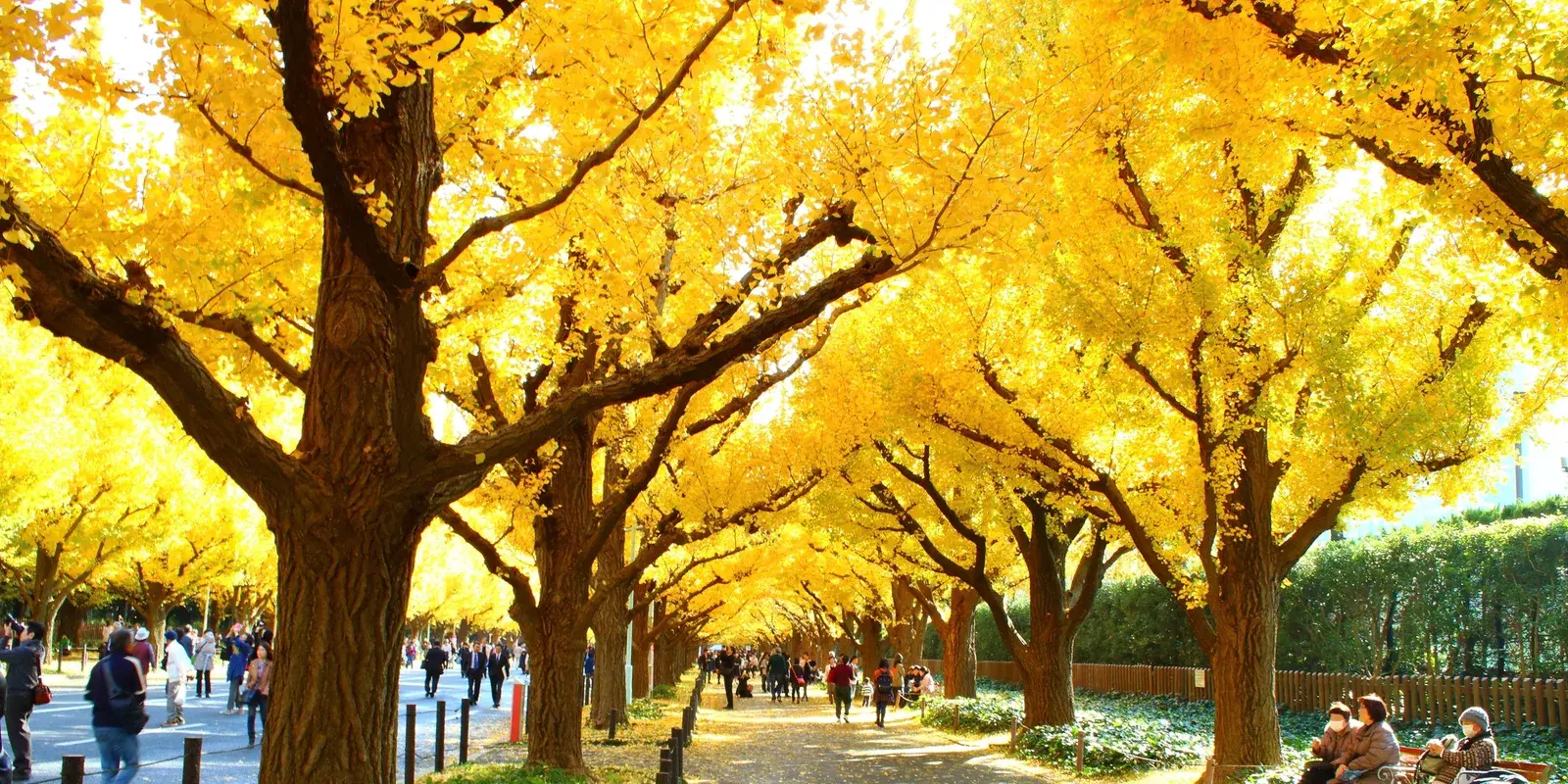
The Japan Meteorological Agency records leaf color on reference trees: for each city, the date is the first day most leaves on a maple at or near the weather station have changed color. On the 1991–2020 averages, these maples broadly turn in mid-October in eastern Hokkaido, by 10 November in southern Hokkaido, by 20 November in Tohoku (the north of Honshu, Japan's main island) and eastern Hokuriku (the Sea of Japan coast of central Honshu), and by 30 November in Kanto (the Tokyo area), Hokuriku, Tokai (around Nagoya), Chugoku (western Honshu), Shikoku and northern Kyushu. Reference trees on the Pacific coast of Kanto and Tokai, in Kansai and in southern Kyushu turn in early to mid-December. Single cities can differ from this broad pattern, as the table shows.
| City | Maple turns red | Ginkgo turns yellow |
|---|---|---|
| Sapporo | 28 October | 4 November |
| Sendai | 21 November | 23 November |
| Kanazawa | 24 November | 10 November |
| Tokyo | 28 November | 23 November |
| Nagoya | 28 November | 18 November |
| Nara | 21 November | 18 November |
| Kyoto | 5 December | 24 November |
| Osaka | 1 December | 22 November |
| Hiroshima | 22 November | 15 November |
| Fukuoka | 1 December | 20 November |
These dates move from year to year. In 2025, Tokyo's maple turned red on 23 November, five days early, and Kyoto's on 10 December, five days late.
The leaves have also been turning later. Since 1953, the agency's maple dates have moved later at a rate of 3.0 days per decade, and the agency names long-term warming as one likely cause. Some Japanese people have noticed the change in their own lives. Of the 63 posts we collected comparing autumn now with the past, nine are about the leaves, and three of those say the leaves now turn later. One of them came from Kyoto, in reply to a question on a Q&A site asking whether the leaf season is getting later every year.
暑い時期が長すぎてどんどん遅くなっているように思います。こちら京都ですが、20年ほど前は11月下旬が見頃でしたが、ここ数年はもっと遅いですね。 I think it's getting later and later because the hot season goes on too long. I'm in Kyoto, and about 20 years ago the leaves were at their best in late November, but for the last few years it's been later.
Of the 63 posts we collected comparing autumn now with the autumns people remember:
One reply on a Q&A site gave a length for autumn, then and now.
25年くらい前までは秋が2ヶ月くらいありましたが、最近は3週間くらいですね。 Until about 25 years ago autumn lasted around two months. These days it's about three weeks.
Another writer compared November with ten years earlier.
10年くらい前は、11月は外に出ると肌が痛いくらい寒くてマフラー巻いてガチガチに防寒してたけど、最近はマンションの中で暑くて昼間は半袖で過ごしてる。 子供も日中は半袖で過ごして朝晩だけパーカー着てる。 About ten years ago, going out in November was so cold it stung my skin, and I'd wrap a scarf around and bundle up tight. Lately it's hot inside our apartment, and I spend the daytime in short sleeves. The kids are in short sleeves during the day too, and put on a hoodie only in the morning and evening.
Among the 20 posts in the green bar, one writer, posting in September 2026, was happy for a younger generation.
最近の子たちが知らなかった秋を体感してるの、とても嬉しい そう、これが秋だよ…秋って瞬間的に通り過ぎる台風みたい季節じゃないんだよ… I'm so happy that kids these days are getting to feel the autumn they never knew. Yes, this is autumn… Autumn isn't a season that blows through in an instant like a typhoon…
Timing can also differ within one city. In 2025, Kyoto's reference maple turned red five days late, on 10 December. That year, a writer from Kobe who visits Tofuku-ji in Kyoto every autumn found that the leaves there seemed to have fallen early, and in December 2025 wrote down a plan for the next year.
ここ数年はピーク時を避けて12月に入ってから行くことが多くなっていたが、今年は落葉が早かったよう。 酷暑が影響か。 来年は11月最終週に行こう。 For the last few years I'd been going after December started, to avoid the peak, but this year the leaves seem to have fallen early. Maybe the extreme heat had something to do with it. Next year I'll go in the last week of November.
Kyoto City's color reports show how far each spot has turned in the year you travel. For how Japanese people feel about leaf viewing itself, and how to enjoy momiji-gari (autumn-leaf viewing) at busy spots, see Autumn Leaves in Japan.
Is November a Good Time to Visit Japan?
On these averages, Tokyo is drier and sunnier in November than in October, and afternoons in Tokyo and Kyoto are around 17°C. Kyoto's main leaf window is mid-to-late November. In Tokyo and Kyoto the sun sets between 16:28 and 17:03 depending on the day, and Saturday 21 to Monday 23 November 2026 is a three-day weekend that falls inside that leaf window.
Japanese people's own feelings about the month vary. In a board thread asking people which month they like best, one reply was about sightseeing.
11月 台風の心配もないし、雪も降らないし、寒過ぎなくて 観光しても汗をかかなくて過ごしやすい。 November. No typhoons to worry about, no snow, not too cold. Even when you're out sightseeing you don't get sweaty. It's comfortable.
Of the 60 posts we collected about how November feels:
Twelve of the 32 posts in the green bar are about the temperature, and two of them compare it with October.
11月 気温がちょうどいい 10月はまだ暑いしカメムシが出る November. The temperature is just right. October is still hot, and the stink bugs come out.
Another writer likes the middle to the end of the month best.
私も11月が好き(特に中旬から下旬)。その年に初めてコートを着る位の気温。 寒すぎないけど、空気が澄んでピリッとした雰囲気になってくる。 冬の匂いがするよね。 I like November too, especially the middle to the end. It's about the temperature when you put on a coat for the first time that year. Not too cold, but the air turns clear and crisp. It smells like winter, doesn't it?
Nine of the 18 posts in the red bar are about how early it gets dark.
私は11月中旬〜冬至までがやばいです。日が短いからメンタルが😰 Mid-November to the winter solstice is a hard stretch for me. The days are so short that it gets to my mood.
In Hokkaido, one writer finds the start of winter harder than midwinter.
11月。雪の降り始め、冬の始まりの方が真冬より、身も心も寒くなる。道民です。 November. The first snow, the start of winter, chills me body and soul more than midwinter does. I live in Hokkaido.
In Okinawa, a writer from Miyakojima who lives on the main island describes a warmer November.
宮古島出身で本島在住ですが気温は離島・本島は年間通して変わらないです。11月ならたまに暑くてクーラーつけることもありますし、12月頃までなら本土のような厚着の必要はないです。… I'm from Miyakojima and live on the main island, and the temperature is the same on the outer islands and the main island all year round. In November it's sometimes hot enough that we turn on the air conditioning, and until around December there's no need to bundle up the way people do on the mainland.…
Holidays, Festivals and Events in November
Two national holidays fall in November. Culture Day is on 3 November, a Tuesday in 2026. Labor Thanksgiving Day is on 23 November, a Monday in 2026, so Saturday 21 to Monday 23 November is a three-day weekend. The Cabinet Office describes Culture Day as a day for loving freedom and peace and promoting culture, and Labor Thanksgiving Day as a day for honoring work, celebrating what it produces and thanking one another.
In Asakusa, Tokyo, Otori Shrine holds its Tori no Ichi (rooster fair) for 24 hours from midnight, on Saturday 7 November and Thursday 19 November in 2026. The shrine counts about 150 stalls selling kumade, bamboo rakes decorated with lucky charms, and about 750 other stalls, with 700,000 to 800,000 people coming each year. Kumade began as a charm for good business, and the shrine says people now buy them for all kinds of wishes. When a sale is agreed, it is sealed with tejime, a round of rhythmic hand-clapping.
Around 15 November you may see small children in kimono at shrines and temples. This is Shichi-Go-San ("seven-five-three"), when families with girls of three and seven and boys of five dress up for a shrine or temple visit, according to Nippon.com, and the children carry decorated bags of chitose-ame, a long, thin "thousand-year candy." Photo Etiquette in Japan covers how Japanese people feel when visitors photograph children.
In the evenings, Kyoto City's official autumn-leaves page carries information on light-ups and special openings at temples and gardens. In Tokyo, the Marunouchi Illumination lights the trees along Marunouchi Naka-dori from 12 November 2026 to 14 February 2027, according to Mitsubishi Estate.
Last verified: 2026-10
Tax-Free Shopping Changes on 1 November 2026
From 1 November 2026, tax-free shopping for visitors moves to a refund system, according to the Japan Tourism Agency. Until 31 October 2026, eligible visitors pay the tax-free price at the counter. For purchases made on or after 1 November, you pay the full price, including consumption tax, at a tax-free shop. The tax comes back after customs confirms, when you leave Japan, that you are taking the goods with you.
Visitors of foreign nationality who have been in Japan for less than six months since arriving, such as those staying as a Temporary Visitor, are eligible, and you show your passport at the shop. The check happens at the airport or seaport, in the departure lobby before check-in. Within 90 days of the purchase, you show your passport at a tax-free procedure terminal. A green result means you are done. A red result means customs wants to see the goods, so you take them to the inspection area. You need every item from that purchase with you, and the check can't be done after your luggage is checked in, so leave time before boarding. At Narita, Haneda, Kansai, Chubu, Fukuoka, New Chitose and Naha airports, you can also do it online through Visit Japan Web, within the designated Wi-Fi areas of the departure lobby.
Purchases of 5,000 yen or more, before tax, at one shop on one day are eligible. Food, drinks and cosmetics no longer go into sealed bags, but anything you have eaten or used up in Japan can't be refunded. The refund is paid by the shop or by a refund company working for it, so ask the shop how you will receive yours.
Last verified: 2026-10
The Three-Day Weekend and Kyoto's Crowd Map
Saturday 21 to Monday 23 November 2026 is the Labor Thanksgiving three-day weekend, and it falls inside Kyoto's main leaf window in mid-to-late November. Kyoto City's official crowd forecast map (in Japanese) shows the expected number of people by hour around areas such as Arashiyama, Gion and Kiyomizu-dera, the Philosopher's Path and Kitano, on a five-level scale, with live camera images for some spots.
Share Your Experience
Have you been to Japan in November, or are you packing for it now? Through Voice Box, tell us what the weather was like and what you were glad you packed, and we'll add visitors' experiences to this article.
More Japanese Perspectives
- Autumn Leaves in Japan covers how Japanese people feel about leaf viewing and how to enjoy the busiest spots.
- Best Time to Visit Japan compares all twelve months by visitor numbers, hotel occupancy and weather.
- What to Wear in Japan covers what Japanese people notice about visitors' clothes all year.
- Winter Illuminations in Japan covers what Japanese people say about going to see the lights.
- Autumn Food in Japan covers sweet potato trucks, grilled sanma and other food of the season.
- Is Japan Overtouristed? covers what residents of busy places say about visitors.
- Surviving Japan's Winter explains why Japanese homes feel cold indoors, for trips that run into December.
Sources
Primary research data
WMJS November research data: 186 Japanese-language posts written between the mid-2000s and October 2026 and collected in October 2026 from public Japanese discussion boards, Q&A sites, a long-running discussion forum, social media, compilations of social media posts and blogs.
- What people wear in November: 63 posts
- How autumn has changed in people's lifetime: 63 posts
- How November feels: 60 posts
Every individual post is stored with its own source URL in this site's research data. The months and years given for individual posts in the article (September 2026, December 2025) are when those posts were written.
Government and official sources
- Japan Meteorological Agency: climate normals for 1991–2020, monthly values for Sapporo, Sendai, Tokyo, Kyoto, Osaka, Hiroshima, Fukuoka and Naha. November averages, highs, lows, rainfall, sunshine and snowfall, with October for comparison.
- Japan Meteorological Agency: daily climate normals for November for Tokyo, Kyoto and Sapporo. Average highs and lows for 1 and 30 November.
- Japan Meteorological Agency: Maple leaf coloring dates, 2025 observations and difference from the average and Ginkgo yellowing dates. The average dates in the leaf table are the 2025 observation date minus the published difference from the 1991–2020 average.
- Japan Meteorological Agency: Maple leaf coloring: how it is observed, with the 1991–2020 average front (PDF). Definition of the coloring date and the regions the front reaches by 10, 20 and 30 November.
- Japan Meteorological Agency: Climate Change Monitoring Report 2023, section 2.7 (PDF). Since 1953, maple coloring dates have become later at a rate of 3.0 days per decade (statistically significant at the 99% confidence level), with long-term temperature rise considered one of the causes.
- National Astronomical Observatory of Japan: sunrise and sunset for November 2026 in Tokyo, Sapporo, Kyoto and Naha.
- Kyoto City Tourism Association (Kyoto City official tourism site): Autumn leaves reports. Usual best times for 78 spots, light-up information, and, as of October 2026, color reports for the year scheduled to start on 30 October. Kyoto sightseeing comfort map: hourly crowd forecasts on a five-level scale and live cameras for some spots.
- Japan Tourism Agency: What is the Refund Method?, Frequently asked questions for travelers and List of eligible tax-free goods purchasers (PDF). Tax-free shopping rules for purchases on or after 1 November 2026: purchases of 5,000 yen or more before tax per shop per day; a customs check at a tax-free procedure terminal at the airport or seaport, before check-in, within 90 days of purchase; eligible purchasers include foreign nationals within six months of entering Japan; the refund is paid by the shop or its refund company.
- Cabinet Office: About national holidays. Culture Day (3 November) and Labor Thanksgiving Day (23 November).
- Otori Shrine, Asakusa: This year's Tori no Ichi (7 and 19 November 2026, midnight to midnight) and About Tori no Ichi (about 150 kumade stalls, about 750 other stalls, 700,000 to 800,000 visitors a year, tejime).
- Mitsubishi Estate: Marunouchi Bright Holiday and Marunouchi Illumination 2026 press release, 17 September 2026. Marunouchi Illumination runs from 12 November 2026 to 14 February 2027 on Marunouchi Naka-dori.
Media sources
- Nippon.com: Shichi-Go-San, 9 November 2015. Observed on 15 November by girls of three and seven and boys of five, with chitose-ame.
Note on Quotations
Quotes from online platforms have been lightly edited for readability (fixing typos, formatting for clarity). Some quotes are excerpts from longer posts. Where we left text out, it is marked with …, and some posters also use … themselves. The meaning and intent of each comment remain unchanged. Each original post's URL is kept in our research data.
This article is available in languages covering 95%+ of visitors to Japan (based on JNTO 2025 data). Need another language? Let us know through Voice Box.
WMJS is written in Japan, in English, with AI help. We check every page, but English is not our first language. If a sentence reads oddly, tell us. One sentence is enough.
Thank you. A person reads every note.
How well do you know Japan?
Built from 635 public posts by Japanese people
Want to know more? Ask Japanese people
Have a follow-up question about this topic? We'll ask real Japanese people.
Voice Box →