
Tofuku-ji — The Maple Bridge Everyone Photographs, and the Zen Garden Almost No One Reads
Tofuku-ji
By Kei · Born and raised in JapanThe Meaning
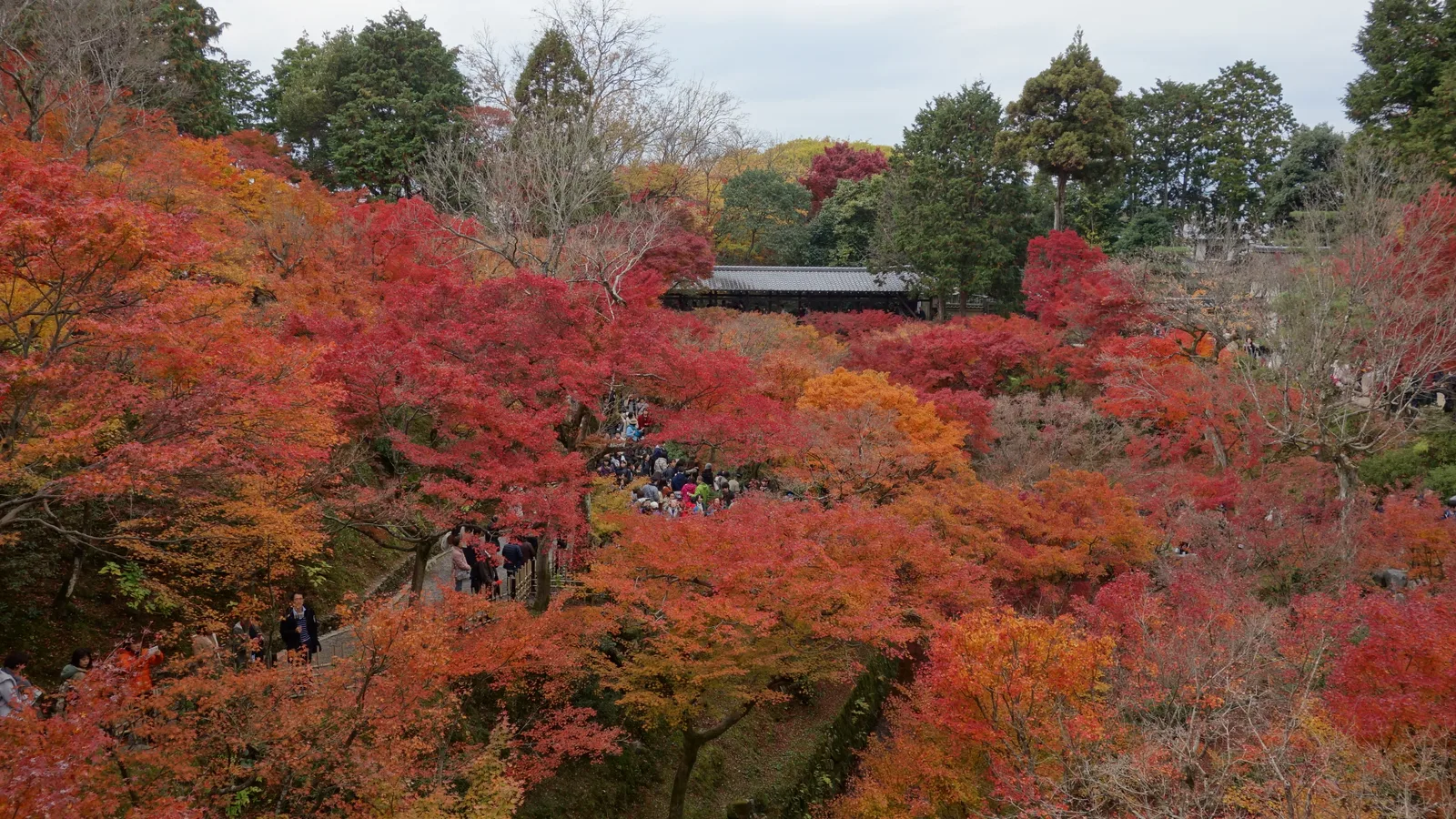
Almost everyone comes to Tofuku-ji for a single photograph: a covered wooden bridge floating over a narrow valley that, for two weeks in late November, turns solid scarlet and gold. It is one of the most famous autumn views in Kyoto, and on a peak weekend the bridge can hold a slow river of people all reaching for the same picture. That image is real, and it is worth coming for. But it is only one of the two reasons this place exists, and it is not the temple's reason. The bridge is the crowd's reason. The temple's reason is older, quieter, and still going on around you while you photograph.
Start with the name, because it tells you what kind of place you have walked into. In 1236 the regent Kujo Michiie, of the Fujiwara line, the most powerful family at court, set out to build a temple in Kyoto grand enough to rival the two greatest temples of Nara, the old capital: Todai-ji, with its giant bronze Buddha, and Kofuku-ji, the Fujiwara family temple. He took one character from each, the To (東) of Todai-ji and the fuku (福) of Kofuku-ji, and fused them into a new name: To-fuku-ji. The ambition was built into the word before a single beam was raised. It took nineteen years to finish, completed in 1255, and to lead it Michiie invited a monk named Enni, who had spent six years training in Zen across the sea in Song China. Enni was later honored as Shoichi Kokushi, the first monk in Japan to be given the title of National Teacher by an emperor.
So Tofuku-ji is more than a scenic spot that happens to be a temple: it is the head temple of its own branch of Rinzai Zen, ranked fourth among the Gozan (the Five Great Zen Temples of Kyoto), with around twenty-five sub-temples still scattered across its grounds, and monks who still sit in meditation here. When you walk in, you are walking into a working monastery that has been doing the same work for nearly eight hundred years.
Here is the thing to settle before you start, because it changes how the whole visit feels. The famous bridge was never built to be stood on; it is a passage, a roofed walkway the monks crossed to get from one hall to another without climbing down into the ravine. And the part of Tofuku-ji that the temple itself would point you to is not the bridge at all, but a set of four gardens beside the abbot's hall that most visitors glance at for a minute and never really see. Photograph the maples, by all means. But if you only photograph the maples, you have seen the crowd's Tofuku-ji and walked straight past the temple's.
What Happens When You're There
Step 1: The Gate That Wanted to Rival Nara
Before you reach any bridge, walk into the open heart of the temple, where there is no ticket gate and almost no crowd, because most people hurry past it toward the maples. Standing here is the Sanmon, the great main gate, and it is worth stopping under. This is the oldest surviving Zen main gate in Japan, and the largest: a two-story timber structure rising more than twenty-two meters, completed in 1425 and named a National Treasure. Stand at its foot and look up the columns. This is the ambition from the temple's name made physical, built not to be pretty but to be immense, the way the founders meant the whole place to be.
Behind it rises the main hall, rebuilt between 1917 and 1934 after fire took the original in 1881, and one of the largest wooden Buddhist halls raised in modern Japan. On the days it opens, you can look up into a dragon painted across its ceiling: the Blue Dragon, made by the Kyoto painter Domoto Insho in 1933, said to have been finished in about seventeen days and stretching some fifty meters overhead. Around these halls stand the plain buildings of a monastery that still works: a wooden bathhouse dated to 1459, and the oldest surviving Zen monks' toilet in Japan, a long hall the temple nicknames the "hundred latrines." Both survived the 1881 fire. They are not glamorous, and that is the point: this was always a place where people lived a disciplined life rather than a stage set for visitors. Hold that in mind, because it is the key to everything you are about to see.
Step 2: The Bridge the Monks Built
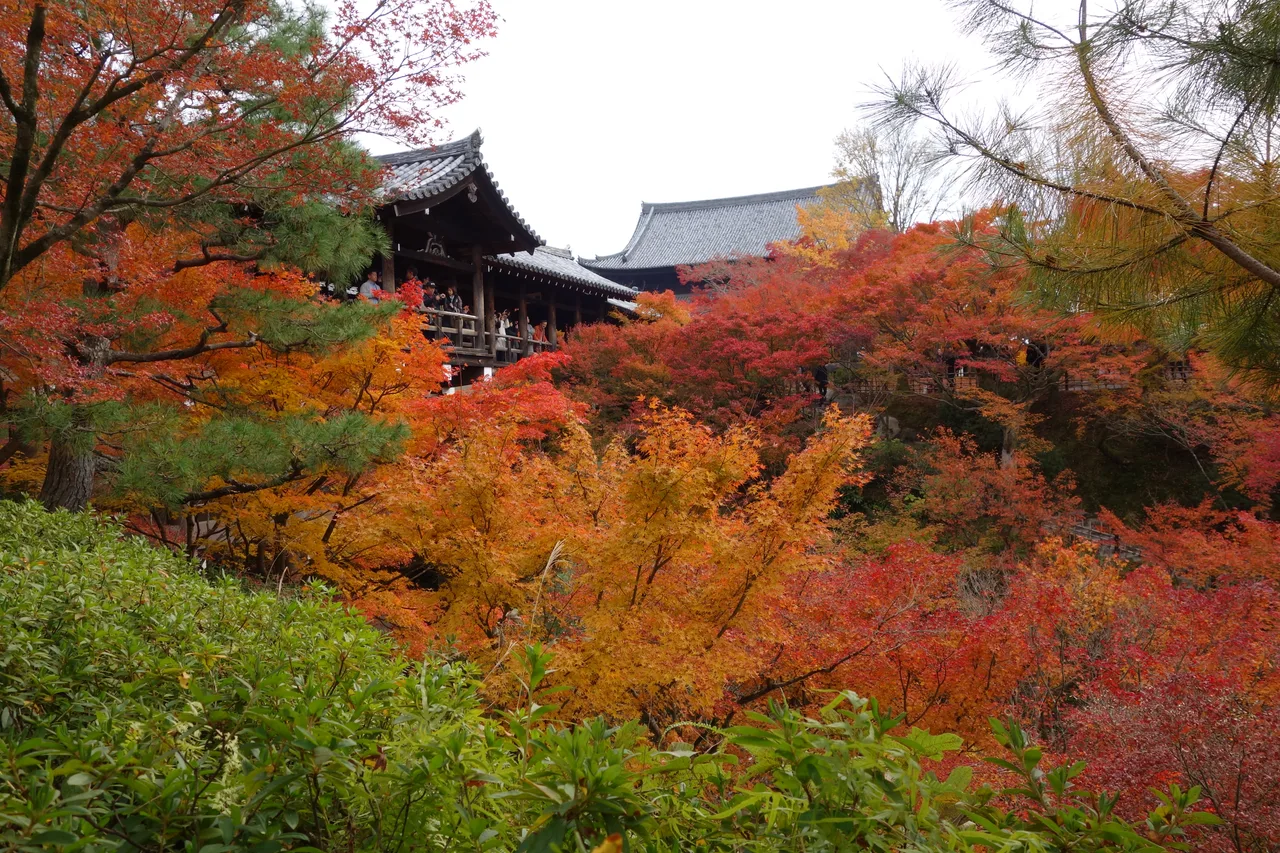
Now toward the valley, and the first kindness of Tofuku-ji is one almost no guide tells you. The single most famous view of this temple, the wooden Tsutenkyo bridge riding above the sea of maples, is best seen not from the Tsutenkyo bridge itself but from a second bridge just downstream called Gaunkyo, and Gaunkyo is free. You can stand there, before you have bought any ticket, and take the postcard. Most of the crowd does exactly this, which is why this approach is where the famous photo is actually made.
The bridge you then pay to cross, Tsutenkyo, was built in 1380 by the monk Shunoku Myoha, and it was built for a practical reason: to let monks walk between the main hall and the founder's hall across the steep Sengyokukan ravine without descending and climbing back up. It is a covered corridor about a hundred meters long, and the ravine it spans holds roughly two thousand maple trees, among them a rare variety with three-pointed leaves that turns not red but pure gold, said to have been carried back as a seedling from Song China by the temple's founder himself, eight centuries ago.
Which brings us to the rule that surprises people, and the gentlest way to understand it. At the height of the autumn season, when the bridges fill, the temple may ask visitors not to stop to take photos while they are on the Tsutenkyo and Gaunkyo bridges. It can read as strange: why ban photos at the most photogenic place in Kyoto? But remember what the bridge is: a narrow working passage rather than a viewing platform, and a few hundred people all stopping at once on a high wooden walkway is genuinely dangerous. The kind move is simply to take your picture from the garden below or from Gaunkyo, and let the bridge be a thing you walk across, keeping the line moving for the person behind you. It is the same quiet courtesy that runs through how Japan handles cameras at its busiest places: the view is shared, so you take your shot and you keep walking.
Step 3: The Four Gardens You Have to Slow Down to Read
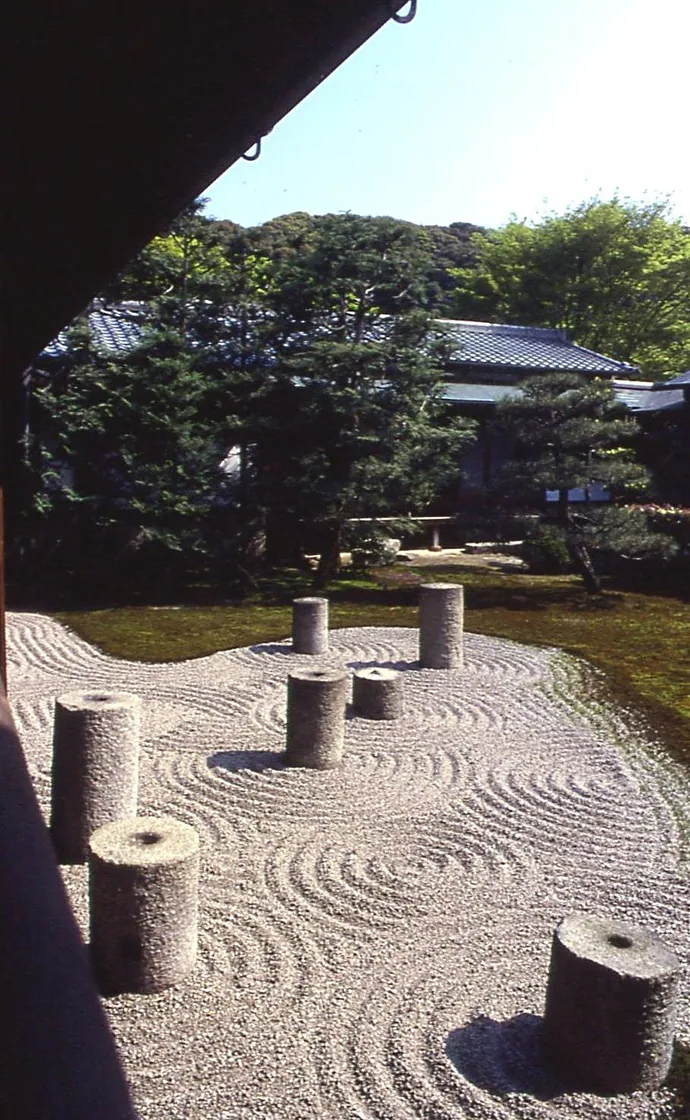
Cross back toward the abbot's hall, the Hojo, and you arrive at the part of Tofuku-ji that rewards the opposite of a quick photo. Here are four small dry gardens, one on each side of the building, and this is the only Zen abbot's hall in Japan ringed by gardens on all four sides. They are called the Garden of Eight Phases, and they were not laid out by some ancient anonymous monk. They were designed in 1939 by Mirei Shigemori, a modern garden master, as his very first major work, right after he had spent three years measuring and drawing every important old garden in the country. In 2014 they were named a National Site of Scenic Beauty.
Slip your shoes off and step up onto the wooden veranda, the same small act of leaving your shoes at the threshold that turns a building from a sight into a place you are quietly inside of, and then look closely, because Shigemori hid a very Japanese idea in the stones. The eastern garden lays out the seven stars of the Big Dipper across raked sand. Look at what the stars are made of: stout cylindrical stones that were once the foundation posts of the monastery's old toilet, kept when it was repaired and set here as a constellation. On the north side, a checkerboard of square stone tiles dissolves into moss and fades away toward the far corner; those tiles were the old paving stones of the path that once led to the imperial messenger's gate, lifted and reused. What would have been rubble in another temple, Shigemori turned into a sky and a quiet, dissolving grid. The southern garden sets four rough stone groupings as the mythical islands of the immortals, with a moss hill behind for Kyoto's five great Zen mountains; the western garden clips azalea and stone into a second, larger checkerboard.
You do not need to remember any of those names. What is worth carrying is the habit of looking the gardens ask of you: nothing here is shouting, and nothing here was wasted. Sit on the veranda for a few minutes. This is the part of Tofuku-ji that is the same in every season and every weather, and on most days you will have far more of it to yourself than you will the bridge.
Step 4: Walking Back Out
As you walk back toward the gate, try the day on once more. If you came at the peak of autumn, you earned the crowd along with the color, and you saw the maples at the one moment the whole country is trying to see them. But if you came in spring or summer, when those same two thousand maples are a cool, luminous green and the bridge is nearly empty, or in the bare quiet of winter, you did not miss Tofuku-ji. You saw the temple's own version of it, the one the monks live with all year, when the gate is the gate, the bridge is just the way across, and the four gardens are exactly as full of meaning as they are in November. Both are the real place. One is simply louder than the other.
Good to Know
Hours. Tofuku-ji's paid areas keep seasonal hours, and the autumn schedule is different from the rest of the year. From April 1 to November 14, and again from when the foliage ends, the broad pattern is 9:00–16:00 (reception closes 16:00, gates 16:30); from December 8 to March 31 it shortens to 9:00–15:30. During the autumn peak, roughly mid-November to early December, the Tsutenkyo bridge opens earlier, at 8:30, specifically to absorb the morning rush, while the Hojo gardens stay on 9:00. The temple states plainly that the autumn dates shift every year, so treat any fixed date as approximate. Last verified: 2026-06. Confirm current hours on the official temple site before you rely on them.
Admission. Two areas are ticketed separately. In the normal season: the Tsutenkyo bridge and Kaisando hall is ¥600 for adults, and the Hojo gardens are ¥500 for adults; a combination ticket covering both is ¥1,000 (children, meaning elementary and junior-high students, pay less). During the autumn peak, the Tsutenkyo ticket rises to ¥1,000 and the combination ticket is not sold; you buy each area separately. The central grounds, including the great Sanmon gate, are free to walk. Last verified: 2026-06.
Getting there. Tofuku-ji sits in southeastern Kyoto, an easy hop from Kyoto Station. Take the JR Nara Line about 3 minutes (¥150) to Tofukuji Station, then walk about 10 minutes. A small thing that trips people up: there are two adjacent stations both called Tofukuji, one on the JR Nara Line, one on the Keihan Main Line, and either one is correct, both about a 10-minute walk away, so don't worry about which line you're on. Kyoto City Bus 88 or 208 also reaches the "Tofukuji" stop in about 15 minutes. (For how passes, IC cards and the lines fit together, see getting around Japan.) Last verified: 2026-06.
The free view. The classic shot of the Tsutenkyo bridge over the maples is taken from the Gaunkyo bridge on the approach, which costs nothing; you only pay if you want to walk out onto Tsutenkyo itself and down into the ravine.
Photography and conduct. Handheld photos are fine, but tripods are not allowed anywhere on the grounds, and in the autumn crush the temple may ask you not to stop for photos while on the Tsutenkyo and Gaunkyo bridges (shoot from the garden instead). The temple also asks for no eating or drinking on the grounds, no sketching along the approach, and that cyclists dismount on Gaunkyo bridge. None of it is fussy once you remember this is a working monastery, not a park.
How long, and when. Budget about 45–60 minutes for the bridge alone, or 90 minutes to two hours if you give the gardens their due. The single best move for the famous maples is to arrive at opening: in autumn, the 8:30 bridge opening on a weekday morning is a different, calmer place than the same bridge at 11:00. Outside autumn, the green-maple seasons are quiet almost any hour.
Pair it with Fushimi Inari. Tofuku-ji is one stop further down the same JR Nara Line from the famous Fushimi Inari shrine, and the two make a natural half-day together: most people do Tofuku-ji first thing, then the shrine.
Official website: tofukuji.jp/en
If Things Don't Go as Planned
The bridge was a wall of people, and you couldn't stop for the photo. This is the most common autumn-peak experience, so it helps to plan around it rather than be surprised by it. Take your photo from the free Gaunkyo bridge on the way in, where you can frame Tsutenkyo over the maples without standing on a crowded walkway, and treat the crossing of Tsutenkyo itself as a walk, not a photo stop. Arriving at the 8:30 opening, on a weekday, is the single biggest difference between a serene morning and a shuffle.
The maples weren't at their peak, too early, or already falling. The color in Kyoto's lowland temples usually peaks from mid-to-late November into early December, but it shifts a week or more every year with the weather, and no one can promise a date. Two comforts: the ravine's fallen-leaf stage, when the maples carpet the valley floor in red, is beautiful in its own right; and the four Hojo gardens and the Sanmon gate look exactly as they should on any day you come.
You're visiting outside autumn, and worried it isn't worth it. It is. The same two thousand maples are a cool, glowing green in spring and summer (the Japanese have their own word of praise for green maples), and you will have the bridge, the ravine, and especially the gardens nearly to yourself. Many people who have seen Tofuku-ji in both seasons quietly prefer the quiet one.
You got confused about which Tofukuji station to use. Don't worry about it. There genuinely are two stations with the same name right next to each other, one JR, one Keihan, and both are about a 10-minute walk from the temple. Whichever line your route uses, get off at Tofukuji and follow the signs (or the crowd, in autumn).
You did the bridge and left, then realized you'd skipped the gardens. You're in good company; most people do. If you can, the four Hojo gardens are a short walk from the bridge area and take only fifteen or twenty minutes; they are the part of Tofuku-ji that needs the least time and gives the most if you let it. If you've already left, it's a gentle reason to come back on a quieter day, when the gardens can be the main event instead of the maples.
You only have one morning, and you're combining it with Fushimi Inari. That works well. Do Tofuku-ji at opening, while it's calm, then ride one stop on the JR Nara Line to Fushimi Inari, which stays busy later into the day. Half a day covers both comfortably without rushing either.
Sources:
- Tofuku-ji Temple Official Site: History (歴史): Founded in 1236 (Katei 2) by the regent Kujo Michiie to rival Nara's Todai-ji and Kofuku-ji, the name fusing 東 (To) from Todai-ji and 福 (fuku) from Kofuku-ji; completed in 1255 after 19 years; founding abbot Enni / Shoichi Kokushi (1202–1280), who trained in Song China; successive fires (1319, 1334, 1336) and the great fire of December 1881; the main hall rebuilt 1917–1934
- Tofuku-ji Temple Official Site: Visiting Guide, Hours, Fees and Conduct (拝観案内): Seasonal opening hours; normal-season admission (Tsutenkyo + Kaisando ¥600 adult, Hojo garden ¥500 adult, combination ¥1,000) and the autumn-season change (Tsutenkyo ¥1,000, no combination ticket); the note that autumn dates change yearly; the visitor-conduct rules, including no tripods, the autumn bridge-photography request, no eating/drinking on the grounds, and dismounting bicycles on Gaunkyo bridge
- Tofuku-ji Temple Official Site: Sanmon Gate (三門): The oldest existing and largest Zen Sanmon gate in Japan; completed in 1425; designated a National Treasure in 1952; roof height over 22 meters; Daibutsu architectural style
- Tofuku-ji Temple Official Site: Tsutenkyo Bridge (通天橋): A covered corridor bridge connecting the main hall to the founder's hall (Kaisando) across the Sengyokukan ravine; built in 1380 by Shunoku Myoha
- Tofuku-ji Temple Official Site: Hojo (Honbo) Garden (本坊庭園): The "Garden of Eight Phases," designed by Mirei Shigemori (1896–1975) in 1939; the only Zen abbot's hall in Japan with gardens on all four sides; the east garden's Big Dipper of stones reused from the old toilet's foundation pillars, the north garden's checkerboard of reused paving stones; designated a National Site of Scenic Beauty in 2014
- Tofuku-ji Temple Official Site: Access (アクセス): About a 10-minute walk from either JR Nara Line Tofukuji Station or Keihan Main Line Tofukuji Station; about 3 minutes from Kyoto Station on the JR Nara Line; Kyoto City Bus 88 / 208 to the Tofukuji stop
- Rinzai-Obaku Zen Official (Joint Council for Japanese Rinzai and Obaku Zen): Tofuku-ji: Head temple of the Tofuku-ji branch of Rinzai Zen; founder Enni Ben'en, who received transmission from Wuzhun Shifan in China; the temple's place among the Kyoto Gozan (fourth-ranked of the Five Mountains)
- JNTO (Japan National Tourism Organization): Tofukuji Temple: Official English overview: founding, the roughly 25 sub-temples, the autumn foliage over the Sengyokukan ravine, and the four 1930s Hojo gardens including the checkerboard north garden
- Agency for Cultural Affairs, National Cultural Properties Database: Tofuku-ji Honbo Garden, National Site of Scenic Beauty: The official designation of the Hojo (Honbo) garden as a National Site of Scenic Beauty (2014)
Image credits: Hero, thumbnail, and the Tsutenkyo bridge by Luka Peternel (CC BY-SA 4.0); the Hojo garden by Bigjap (CC0, public domain), both via Wikimedia Commons. All cropped and resized.
WMJS is written in Japan, in English, with AI help. We check every page, but English is not our first language. If a sentence reads oddly, tell us. One sentence is enough.
Thank you. A person reads every note.
Real voices
Is it worth it?
Were you there? Share your photos.
Your photo could appear in this guide — with your name and a link to your profile.
Submit a photoRelated Articles
Visiting Temples and Shrines: What Japanese People Notice
Autumn Leaves in Japan: What Locals Really Feel When You Come for Koyo
"Excuse Me, Can You Take My Photo?": What Japanese People Really Think
More guides in Kansai
Arashiyama — Why Japan Lists This Bamboo Grove Among the Sounds Worth Saving
An audio cultural guide to Arashiyama in Kyoto, verified against official sources. Understand why Japan lists the bamboo of Sagano among the sounds it wants to keep, how the Moon-Crossing Bridge earned its name, and how to walk the river, the grove, and Tenryu-ji's borrowed-mountain garden away from the crowds.
Arashiyama
Fushimi Inari Taisha: Ten Thousand Gates, Each One a Thank-You
The ten thousand vermilion gates at Fushimi Inari are thank-you notes you can walk through. A cultural audio guide verified against official sources: why the foxes are messengers not gods, why the summit has no view, and how to walk past the crowds.
Fushimi Inari Taisha
Ginkaku-ji — Why the Silver Pavilion Has No Silver, and Why Japan Finds That Beautiful
Why the Silver Pavilion has no silver — a free audio guide to Ginkaku-ji, Kyoto, verified against official temple sources. Higashiyama culture and the art of restraint, the sea of silver sand, hours, admission (1,000 yen), access from Kyoto Station, and the Philosopher's Path.
Ginkaku-ji (Jishō-ji)
Gion — Walking Kyoto's Flower District, a Town That Is Still Lived In
An audio guide to Kyoto's Gion flower district: what geiko and maiko really are, the walk from Yasaka Shrine through Hanamikoji to the Shirakawa canal, when to go, and how to enjoy a town still lived in.
Gion