
Japan's Winter Illuminations, According to 493 Japanese Voices
What you'll learn in this article:
- What Japanese people say about illumination season when they're talking among themselves: the crowds, the cold, who they go with, and the photos
- Why the season runs from autumn to spring, and how little of it is about Christmas
- The small habits that make a winter evening out easier for everyone standing there
If you're picturing Japan's winter lights and quietly worrying that you'll be in the way, or too cold, or the only person there without a date, this article is mostly going to reassure you. The evening you're imagining is more ordinary than the photos suggest.
We collected 493 Japanese voices about winter illumination season from public sites where people were writing for each other, not for visitors. Almost none of it is advice for tourists. It's Japanese people telling each other where to park, what to wear, and which display repays the trip.
Are Japan's winter illuminations worth the trip, and what makes the evening go well? Of the 493 Japanese voices we collected, the 82 about crowds run 37% negative, and those complaints cover both getting there and the density once you arrive. A train ticket removes much of the first kind.
The advice that comes up most often in these voices is about your feet. Warm shoes and thick socks came up more than twice as often as coats, and the reason people give is that the cold comes up through the pavement.
Quick Guide
| At a winter illumination | What Japanese People Said | |
|---|---|---|
| 🟡 Good to know | The crowds | Over a third are worn out by them too. Traffic and parking are a large part of that, and the crowd thins as the evening goes on. |
| 🟢 Solved problem | The cold | One heat pad, and somewhere warm to duck into. Nobody here treats enduring it as part of the outing. |
| 🟢 You're fine | Coming alone or with friends | 39% say come with anyone, or alone. Solo visitors, friends and families all turn up in these voices, and the reply that comes back is that couples are only looking at each other. |
| 🟢 Relax | Taking photos | Photographing is expected. What draws complaints is standing still in the way, whether that's a tripod or a phone. |
| 🟢 Worth knowing | What locals love | Half look forward to the season, and the voices with the most feeling in them are about their own neighborhood rather than the famous displays. |
The one thing to remember: most people standing there are out for the same reason you are, on an evening that got dark at half past four.
How We Gathered These Voices
We collected 493 Japanese-language voices across six questions about illumination season: getting through the crowds (82), handling the cold (81), who people come with (77), sharing photo spots (75), how attitudes differ by generation (107), and what people feel about the lights themselves (71). They came from public Japanese Q&A sites, forums, venue review pages, personal blogs and social posts. The six counts overlap: a single comment can answer more than one of those questions, and some writers contributed more than one passage. The 493 figure covers 461 distinct comments, so it is a count of voices rather than of people.
About the method: these are public posts we gathered and read, not answers to a questionnaire we sent out, and the people who post about illuminations are not a random sample of Japan. Treat the percentages as the shape of a conversation rather than as a measurement. A small number of the comments we found criticized other visitors by nationality. We left those out, so the counts above are the collection with them removed.
The Temperature Gauge
Six questions, starting with the one visitors ask about most.
🟡 The Crowds
The famous places do get busy. The complaints, read closely, split into two very different problems.
Of 82 voices about illumination crowds, 30 were negative. Twelve of those mention traffic, parking or shuttle queues. The other eighteen are about the density of people once you're there.
The car stories are the ones with real defeat in them. This person never reached the lights at all:
イルミネーション、なめていました。花火が18時開始なので余裕をもって16時30分に現地到着しましたが、駐車場はすでに満車。車窓越しにツリーの上部を覗いて、そのまま帰りました。 I underestimated it. The fireworks started at six, so I got there at half past four to be safe, and the parking lot was already full. I looked at the top of the tree through the car window and drove home.
They ended the review by saying they'd arrive earlier next time. That is a Japanese visitor, on roads they know, and several more describe the same trip in different words.
The density complaints are just as real, and they read differently from what you might expect:
規模や世界観・美しさは文句なしですが、人が多すぎますね。 No complaints at all about the scale, the world it creates, or the beauty. There are just too many people.
Several of the density complaints take that shape: the display is fine, the volume isn't.
Two things reliably change the experience. The first is depth. Inside a venue the crowd is not evenly spread:
ロープウェイ付近は出店や土産物屋が密集していて、前に進むだけで一苦労。だが、少し奥へ進むと、不思議と人は減っていく。 Near the ropeway the food stalls and souvenir shops are packed together and it's hard work just to move forward. But go a little deeper in and, strangely, the people thin out.
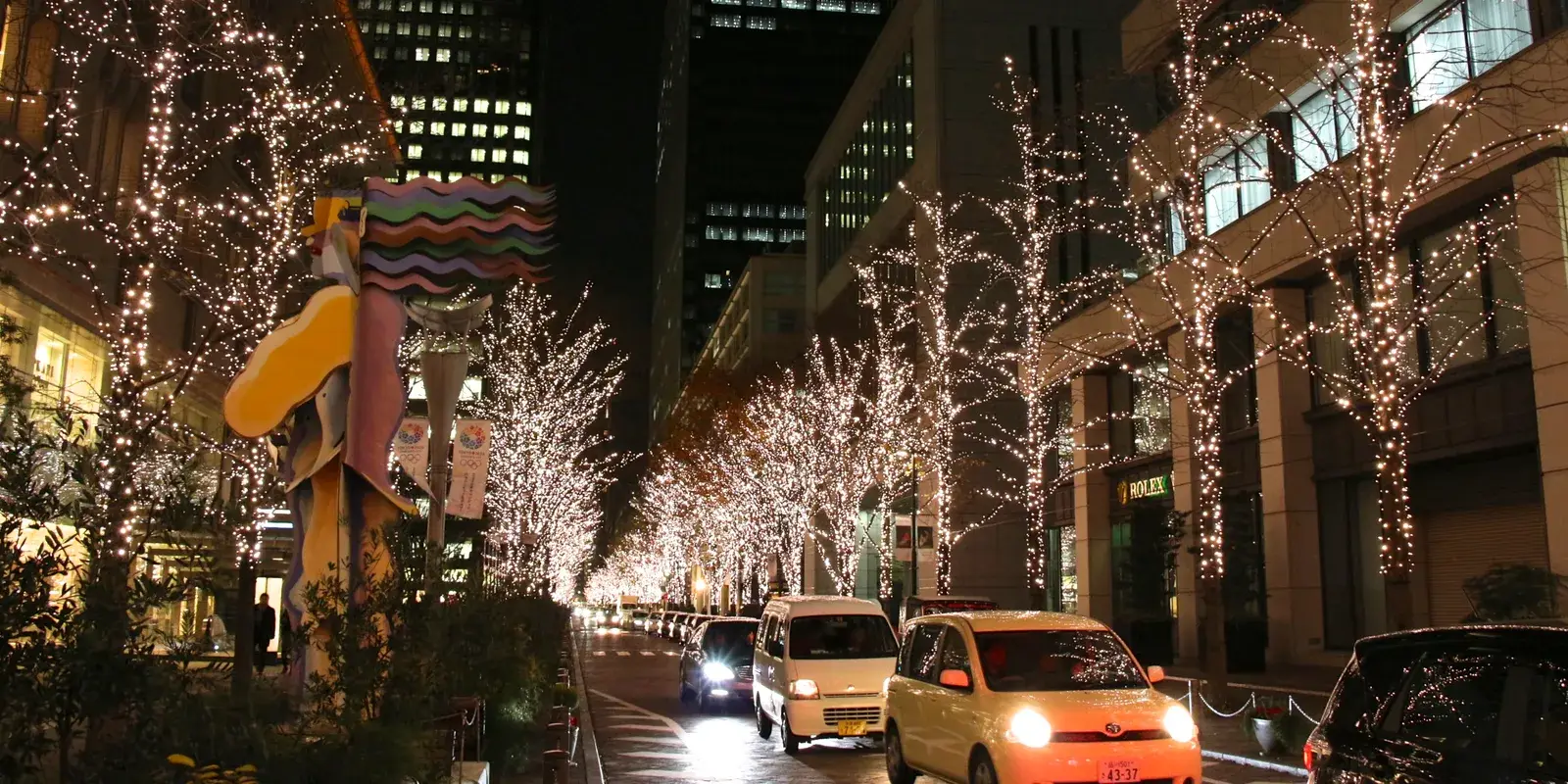
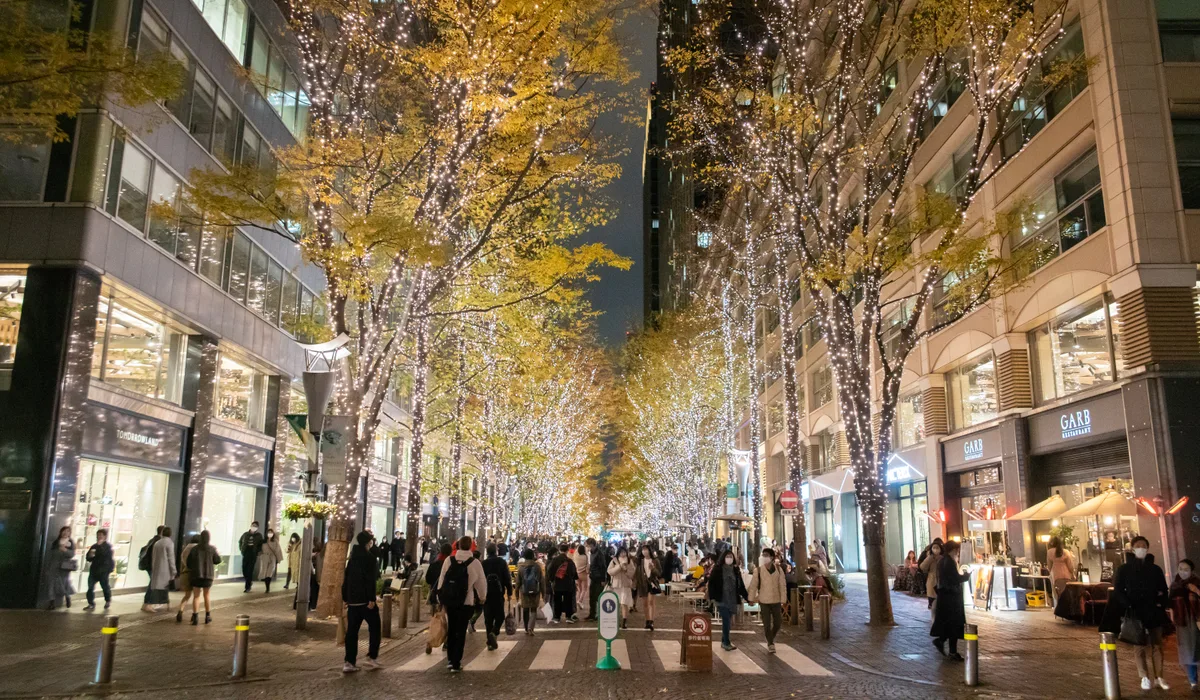
The second is width. A reviewer at the Marunouchi avenue in Tokyo noticed the obvious thing:
道幅が広いので人は多いですがゆっくりできます。 The street is wide, so there are a lot of people but you can still take your time.
And one view turns up that rarely makes it into a guidebook. For plenty of people here, an illumination isn't a destination at all:
通りすがりに見るくらいで充分だよなあ わざわざ行って歩き回って見るようなもんでもない Seeing them in passing is plenty. They're not really something you make a trip for and walk around.
If you catch a lit-up street on the way to dinner and feel no pull toward the famous one, you've had an evening a lot of people here would recognize as their own.
For the wider story of how certain places came to absorb so many visitors, is Japan overtouristed? has the numbers, and the best time to visit Japan covers which winter weeks are calmer.
💡 Twelve of the thirty mention the journey
Full parking lots, two-hour backups, buses that never come. Arrive by train and much of that is not part of your evening.
🟢 The Cold
Eighty-one voices describe how people here handle a long winter evening outdoors, and the answers read like something worked out over several winters.
Of 81 voices about staying warm on a winter night out, most of them at illuminations, 33 were positive. The useful ones pass on a specific method.
Start at the ground. This came up more than any other single piece of advice:
足先とか手先とか体の先っぽからどんどん冷えていきます。なので、靴とか靴下とかはしっかり暖かいものにしましょう。 Your toes and fingers, the far ends of your body, get colder and colder. So make sure your shoes and socks are properly warm.
A blogger writing a cold-weather guide explained why shoes matter more than the coat does:
アスファルトの地面から伝わる寒さは尋常ではない。短い距離ならまだしも、イルミネーションを見て歩くとなると、いつの間にか足先が凍えるように痛く寒く感じるようになって、足先から上へ向けて徐々に堪え難い寒さを感じるようになる。 The cold coming up through the asphalt is extraordinary. A short walk is one thing, but when you're strolling around looking at lights, at some point your toes start to feel frozen and painful, and the unbearable cold works its way up from your feet.
Then there are the stick-on heat pads, sold in every convenience store through the winter for small change. People here have firm opinions about where they go. One answerer, who mentions living in Sapporo and was replying to somebody heading north in February, gave the placements:
足首~ふくらはぎにかけて、下っ腹、肩甲骨の下、ここに貼ると、普通に貼るより温かさ保持できますよ。 Stick them from your ankles up your calves, on your lower belly, and under your shoulder blades. Placed there they hold the warmth better than usual.
The same writer narrows the placement question down: one pad, on the belly or between the shoulders, is enough to warm the whole body.
Skip the pads made for the soles of your feet. Two different writers on two different sites hit the same problem:
足の裏に貼るタイプは歩いているうちにめちゃくちゃ熱くなってきて痛い思いをしてからずっとこちらを使用しています。 The kind you stick on the sole of your foot got seriously hot while I was walking and it hurt, so since then I've used this type instead.
The blogger above hit it physically: the filling gets kneaded into lumps as you walk, and by the end you just want them off. The alternative the note writer recommends is the type that sticks to the top of the foot.
The other half of the answer is somewhere warm to go into:
めちゃくちゃ綺麗なんだけど寒過ぎて後半早足になるから、あったかい店内で食事しながら眺めたりするのが一番良い It's incredibly pretty but you get so cold that you speed up in the second half, so the best thing is to eat somewhere warm and look at it from inside.
You may hear the phrase oshare wa gaman, roughly "you have to suffer to look good". Some people still live by it. Others have quietly retired it:
まぁおしゃれは我慢とは聞くけど 私はもう寒がりだから完全防備w They say you have to suffer to look good, but I feel the cold, so I go fully armored, lol.
How cold is cold? Tokyo averages 7.7°C in December, with typical overnight lows near 3.8°C, and January is colder at 5.4°C. A normal winter coat handles that. Mountain and northern venues are a different proposition. One reviewer went to a mountain lake in ordinary city winter clothes:
僕は、町歩きくらいの冬服で行った。もちろんコートとか着ていきましたがそれが大失敗です。 I went in the sort of winter clothes you'd wear around town. I wore a coat and everything, of course, but that was a big mistake.
One reviewer put the cold the other way round:
キリっと寒かったですがイルミネーションの綺麗さがより引き立ちます。 It was bitingly cold, but that makes the beauty of the lights stand out all the more.
For general advice on packing for a Japanese winter, what to wear in Japan has the full picture.
💡 The method, in the order people give it
Thick socks and shoes you would walk a long way in. One heat pad, on the belly or the upper back, never on the sole of the foot. Something hot to carry. And somewhere warm to step into, because the second half of the evening is where people give up.
🟢 Who You Come With
On whether illuminations belong to couples, the answers split. One commenter points out that the association was made domestically in the first place.
Of 77 voices on who people come with, 30 said come with anyone or alone, and 27 admitted the couples atmosphere can genuinely sting.
On where the couples idea came from, one commenter put it bluntly:
本来のクリスマスは家族と過ごすものらしいから別にいいんじゃない。クリスマス=恋人の概念は日本が勝手につけたイメージでしょう。 Christmas is supposed to be for family anyway, so what's the problem. The Christmas-equals-lovers idea is an image Japan attached to it on its own.
The replies to "will I stand out on my own" are remarkably consistent, and one of them contains a genuinely useful observation:
勇者ですね笑 浮かないと思いますよ。カップルたちは自分たちしか見ていませんから。自分がカップルたちを見てどう思うかだと思います。 Brave of you, ha. I don't think you'd stand out. Couples only look at each other. It's more about how you feel when you look at them.
Another compressed the same thought:
大丈夫です。浮いたところで、みなさんイルミネーションしか見ていませんよ。 You'll be fine. Even if you did stand out, everyone is only looking at the lights.
And one grouping turns up more warmly than the couples image would suggest:
恋人いない同士女2人でホットドリンク片手にイルミネーション見に行くの定番化しちゃってるw 別に何するっていうわけじゃないけど楽しいよ Two of us with no partners going to see the lights with a hot drink in hand has become our standard thing, lol. We don't really do anything in particular but it's fun.
The other side belongs here too, because some people do feel it:
カップル、グループ、友達同士、みんな楽しそうに笑っていて、私のような一人で来ている人間は、まるで異物のように感じられる。 Couples, groups, friends, everyone laughing happily, and someone like me who came alone feels like something that doesn't belong there.
Both of those are in the same collection, written by people who live here. If you turn up alone and feel a flicker of the second one, you're having a very local experience. And one small thing from these voices carries over: something warm in your hands changes what standing there feels like.
💡 The reply that comes back
Couples are looking at each other. One commenter’s standard winter outing is two friends with no partners, hot drinks in hand, doing nothing in particular.
🟢 The Photo Spot
Cameras are out everywhere at an illumination, and what draws complaints is not the equipment.
Of 75 voices about photographing at illuminations, the largest group, 45%, landed on "it depends". Reading the 23 negative ones shows what it depends on: only four mention a tripod or a professional rig.
One answer to a question about shooting at a crowded illumination listed nine courtesies. Two of them sit at the center of everything else people said:
良い場所は独占しないである程度撮ったら譲る。 Don't monopolize the good spot. Take a reasonable number of shots and then give way.
撮影中の三脚に歩行者や鑑賞者の足が当たっても、睨まない、文句言わない、からまない。 If a passer-by or a viewer bumps your tripod while you're shooting, don't glare, don't complain, don't pick a fight.
The turnover can do the work by itself. A photographer at a packed spot found that waiting was enough:
混んではいましたが、撮り終わった人は抜けていくので、リュックを前に抱えて順番を待っていれば、一番前に行くことは難しくなかったです。 It was crowded, but people who'd finished shooting kept leaving, so if you held your backpack in front of you and waited your turn, getting to the front row wasn't hard.
Once at the front, the same person cut their own time down rather than settle in:
あまり先頭で長居するのも顰蹙だったので、連写設定にしてバシャバシャと数を撃つ作戦でいきました Hanging around at the front too long would have been frowned upon, so I switched to burst mode and fired off a lot of frames quickly.
One behavior generates far more anger than any camera does. This writer is describing a narrow, very popular street in Tokyo, and does not recommend it, though they add that the lights themselves are lovely:
けやき坂のイルミは本当に騒がしいよ 道狭くて人多くて若い女の子たちがあちこちでtiktok撮ってるし、唯一の横断歩道ではみんな道の真ん中で写真撮ろうとして警備員がめちゃくちゃ笛吹いたり大声で指示してる The Keyakizaka illumination is genuinely noisy. The street is narrow, it's packed, young women are filming TikToks everywhere, and at the one crosswalk everyone tries to take photos in the middle of the road while the guards blow their whistles and shout instructions.
Somebody else, on a different thread, put the principle in one line:
迷惑行為をして撮った写真には何の価値もない。 A photo taken by getting in everyone's way is worth nothing.
If you want to bring a tripod, check the venue first. Nabana no Sato's own FAQ asks visitors to refrain from using one when the site is busy, and says tripods are fine at quiet times. Signage on the ground can be stricter than the website.
One commenter had worked out the timing:
イルミネーションが点灯して1時間位は非常に混んでます。みんなが飽きた頃に撮影を始めるとスムーズに回れますよ。 For about an hour after the lights come on it's extremely crowded. If you start shooting once everyone has had their fill, you'll get around smoothly.
Opinion on other people appearing in your frame splits, and both sides are here. One writer likes it:
人の後ろ姿が入るとなんか雰囲気出るよな Having someone's back in the shot gives it a bit of atmosphere, doesn't it.
Another doesn't want to be in yours:
例え後ろ姿でも他人の写真にうつりたくない 見ず知らずの人の手元に自分の一部が残るのが気持ち悪くて Even from behind, I don't want to be in a stranger's photo. The idea of a piece of me sitting in a stranger's hands creeps me out.
For how this works at temples, shrines and street corners the rest of the year, photo etiquette at tourist spots goes further.
💡 The problem is standing still
Take your shots and move out of the walkway, and keep off the crossings. Those are the complaints that name a specific place.
🟢 Generations
The assumption is that the older you get, the less patience you have for all this. Among the writers whose age can be placed, it runs the other way.
Of 107 voices touching on how illumination habits change with age, 43 were positive. The age bands here are thin: only two dozen of these writers can be placed in one at all, and the clearest signal comes from the oldest of them.
What reversal there is concerns being comfortable alone. One writer in her forties describes a weight she used to feel at Christmas and no longer does:
若い頃はクリぼっちとかこの世の終わりのように寂しかったけど、アラフォーの今、クリスマス用に美味しそうなケーキやらオードブルやらたくさん売ってるし、いろいろ買って1人で自分のペースで楽しめるの最高とおもってるよ〜。 When I was young, spending Christmas alone felt like the end of the world. Now that I'm around forty, there are all these delicious cakes and party platters on sale, and buying a load of things and enjoying them alone at my own pace feels great.
A woman who was an adult in the bubble years listed the ski hotels and the jewelry, was nostalgic about the era, and then said something generous about the generation that followed:
あの頃はすごかったな 今の若い子はお金を上手に使うよね しっかりしてる Those days were something. Young people now are good with money, aren't they. They've got their heads screwed on.
One reply shows the couples assumption being handed down. This parent's teenagers asked to go and see the lights on the way home from shopping, and the reasons for saying no were partly practical, hands full and the place packed, and partly the norm they had absorbed:
その歳の子と親子姉弟でそれはおかしいからと笑って、もうちょい大きくなったら、彼氏彼女と行ってらっしゃいと言った。あれから9年、まだ行った気配はない。 I laughed and said that at their age it would be odd to go as a parent and siblings, and that when they were a bit older they should go with a boyfriend or girlfriend. Nine years on, there's still no sign they've been.
Set that beside how the oldest reviewers in the collection actually behave. One of them wrote:
もう子供が小さな時から毎年行ってます!去年から子供も着いてこなくなり寂しいと思っていたら末っ子とチェンジで孫参戦でベビーカーで行きました。 We've gone every year since the kids were small. Last year they stopped coming along and I was feeling sad about it, then the youngest was swapped out for a grandchild and we went with a stroller.
What sits under that label is not what it suggests. Very little of it is about young people. The largest share is people describing their own excitement fading with age, and reviewers disappointed that a display they loved has shrunk.
💡 The oldest voices are the warmest ones
The oldest writers in this collection are the warmest about the season, and they are the ones still turning up: one has gone every year since the children were small, and last winter went with a grandchild in a stroller.
🟢 What Locals Love About the Lights
Most of the warm voices in this group are not about the famous displays at all.
Of 71 voices about the lights themselves, 35 were warm about them.
Some of the warm voices are enthusiasm for the big organized displays, several of them for the same one venue. Most are about something much smaller:
近所の一軒家のイルミのほうが感動する 毎年ありがとうございますと思う A single house in the neighborhood doing its own lights moves me more. Every year I think, thank you for this.
住宅街に一件でもポッとあると安心するけどね 前住んでたマンション大通りから一本入った結構暗い閑静なところだったけど 毎年冬になるとその家が明るくなるから安心できたし なんかほっとしてたな Even one house glowing in a residential street is comforting. The apartment I used to live in was one street off the main road, quite dark and quiet, but every winter that house would light up and it reassured me. It just made me feel at ease.
The same warmth attaches to displays a town builds for itself:
商工会の青年部の方達が主力となって、全て地元の素人さん達が飾り付けをしているらしい。暖かい雰囲気があって良いです。 Apparently the young members of the local chamber of commerce lead it and the decorating is all done by local amateurs. It has a warm atmosphere and it's lovely.
町内の人が楽しんでるっていうのが一番の強みね。 The greatest strength of it is that the people of the town are enjoying it themselves.
That matters for a visitor. The display to walk to may not be the one on the poster.
💡 The display to walk to may not be the famous one
Two of the warmest replies in this group are about a residential street in the town you are already sleeping in, and about a display the local chamber of commerce put up by hand.
The Cultural Engine: Why the Season Is So Long
The run dates say more about these displays than the marketing does. They are built around the winter evening, not around 25 December.
In Tokyo the sun sets at 16:28 from late November through 13 December, the earliest sunset of the year, and it is still going down at 16:37 on New Year’s Eve. For months, the hours when people are out of work and out of school are hours after dark. The Marunouchi Illumination in central Tokyo switches on at 16:00, and in its 2025 edition it ran from 13 November to 15 February. Through 13 December that means the lights are up twenty-eight minutes before the sun is down. Nabana no Sato in Mie Prefecture lights up from mid-October to the end of May. Christmas is roughly two weeks inside all of that.
The other thread in this story is civic. Kobe Luminarie began in December 1995, eleven months after the Great Hanshin-Awaji Earthquake, as a memorial to the people the city had lost. The first edition used around 150,000 bulbs and drew 2.54 million people over eleven days, far beyond what the organizers expected, and it returned the following year because the public asked for it. Three decades on it is still running. The review that best explains what it means came from a Hyogo resident writing about taking their children:
開催の意味も含め、兵庫県民として子供達に体感させることは大事だと思ったので良い機会になりました。続く限りまた行きますよ。 Including what the event means, I think it's important as a Hyogo resident to let my children experience it, so it was a good opportunity. I'll keep going as long as it continues.
That is the range these lights cover: a shopping street filling three dark months, and a city marking what it had lost.
Where the Warmth Is
Across these 493 voices, the strongest feeling attaches to the smallest displays: one lit house on a dark street, a festival a town built for itself, and in Kobe a memorial that came back for a second year only because people asked for it.
The famous displays draw the crowds they do for a reason, and the notes above will get you through them comfortably: go by train, go later in the evening, warm shoes and thick socks, a heat pad on the belly or the upper back, somewhere warm to duck into, and shots taken from anywhere except the middle of a crossing. Come with friends, with family, or on your own. All three are ordinary here.
But the evening people come back to is usually the smaller one, in the town they already live in, on the way home. If you're staying somewhere for a few nights this winter, walk the streets around your accommodation after dark before you queue for the famous one.
Still working out when in winter to come? The best time to visit Japan breaks down the months, the weather and the crowds.
Share Your Experience
Have you stood under Japan's winter lights, or are you planning to? We'd love to hear how it went. Your story helps us build a bridge between cultures, and we may add new perspectives to this article.
Share your experience on Voice Box →
More Japanese Perspectives
Curious about other parts of a trip to Japan? These articles explore what Japanese people actually think, based on hundreds of real voices.
- The Best Time to Visit Japan: month by month, including what a Japanese winter is really like to travel in.
- What to Wear in Japan: how to pack for the season without overdoing it.
- Photo Etiquette at Tourist Spots: what changes when the subject is a person, a shrine, or somebody else’s shop.
- Is Japan Overtouristed?: the bigger picture behind why certain places fill up.
- Surviving Japan's Winter: why the cold that catches people out is indoors, and what Japanese people carry to deal with it.
Sources
Primary Research Data
WMJS winter illumination research data, 493 Japanese-language voices collected August 2026 across 461 distinct comments:
- Getting through the crowds: 82 voices
- Handling the cold: 81 voices
- Who people come with: 77 voices
- Sharing photo spots: 75 voices
- Generational attitudes: 107 voices
- Feelings about the lights themselves: 71 voices
Factual Sources (Tier 1–2)
- National Astronomical Observatory of Japan: sunset times for Tokyo, December 2026 (16:28 on 1–13 December, 16:37 on 31 December): https://eco.mtk.nao.ac.jp/koyomi/dni/2026/s1312.html
- National Astronomical Observatory of Japan: sunset times for Tokyo, November 2026 (16:28 from 29 November): https://eco.mtk.nao.ac.jp/koyomi/dni/2026/s1311.html
- Japan Meteorological Agency: Tokyo climate normals, 1991–2020 (December mean 7.7°C, mean daily minimum 3.8°C; January mean 5.4°C): https://www.data.jma.go.jp/stats/etrn/view/nml_sfc_ym.php?prec_no=44&block_no=47662
- Mitsubishi Estate (Marunouchi Illumination official release): 2025 edition ran 13 November to 15 February, lighting from 16:00: https://prtimes.jp/main/html/rd/p/000000002.000163832.html
- Kobe Luminarie official site: origin as a memorial to the Great Hanshin-Awaji Earthquake, first held December 1995 with approximately 150,000 bulbs, 2.54 million visitors over eleven days: https://kobe-luminarie.jp/about/
- Nabana no Sato official site: illumination period from mid-October to the end of May: https://www.nagashima-onsen.co.jp/nabana/illumination/index.html
- Nabana no Sato official FAQ: tripods are asked to be refrained from when the site is busy, and are usable at quiet times: https://www.nagashima-onsen.co.jp/nabana/guide/faq.html
Opinion Collection Sources
The voices in this article were gathered from public Japanese Q&A sites, discussion forums, venue review pages, personal and photography blogs, and social posts. They are not cited as factual authorities. They are first-hand opinions about illumination crowds, the cold, who people come with, photo-spot etiquette, generational attitudes, and the displays themselves.
Note on Quotations
Quotes from online platforms have been lightly edited for readability, fixing typos and formatting for clarity. The meaning and intent of each comment remain unchanged.
WMJS is written in Japan, in English, with AI help. We check every page, but English is not our first language. If a sentence reads oddly, tell us. One sentence is enough.
Thank you. A person reads every note.
How well do you know Japan?
Built from 635 public posts by Japanese people
Want to know more? Ask Japanese people
Have a follow-up question about this topic? We'll ask real Japanese people.
Voice Box →