
Is Ashikaga Flower Park Worth It? What Visitors Found, Depending on the Week
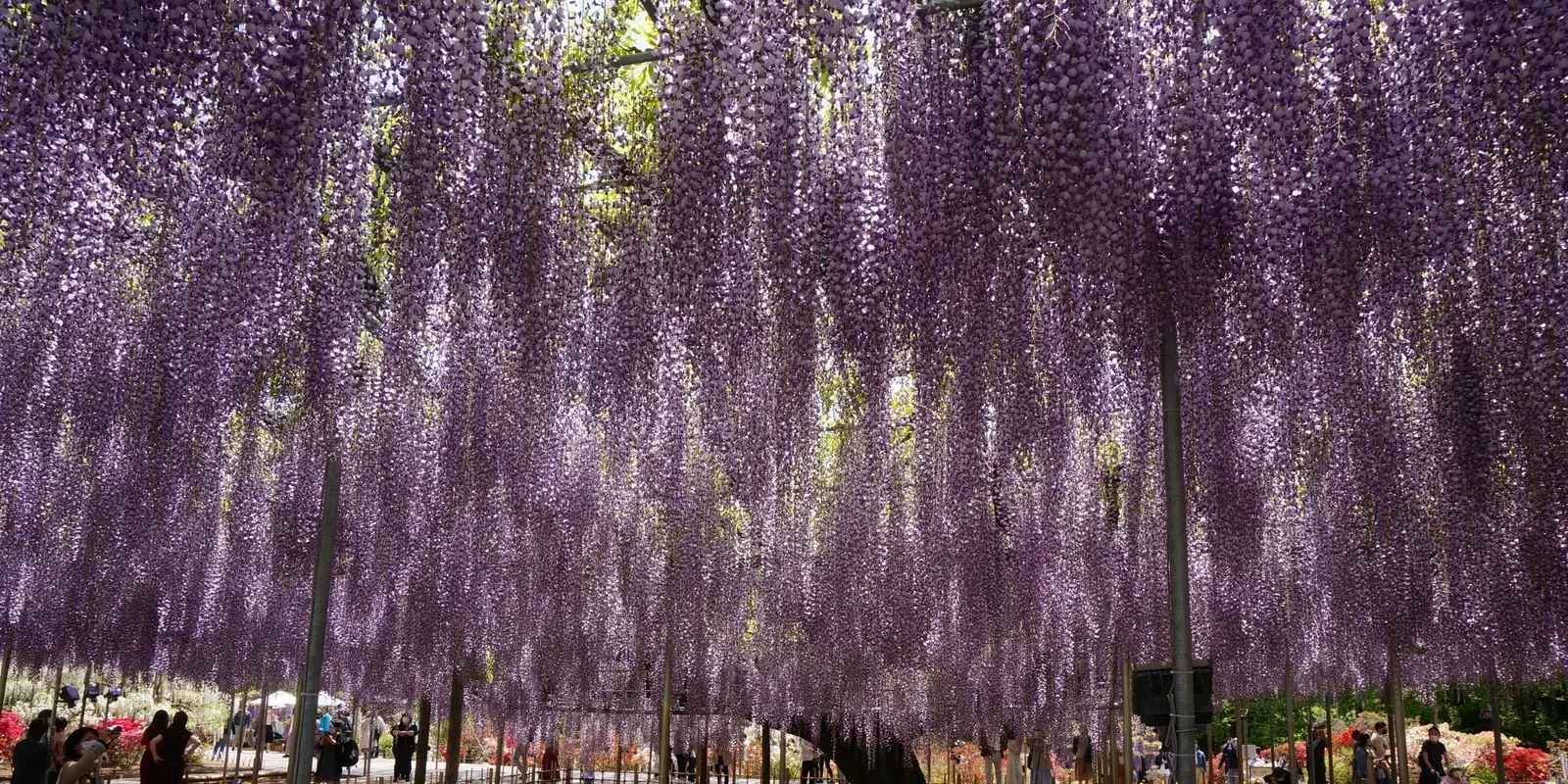
The photo that pulls people in is always the same one: a tunnel of white wisteria or a canopy of purple, lit from below, somewhere in Tochigi. It looks like it was built for Instagram. Then someone starts planning the two-hour trip from Tokyo and runs into a strange problem: the official website sets the admission price early each morning, because the price depends on how the flowers are blooming. For a day trip with a fixed number of vacation days, that's an odd thing to have to gamble on.
So, is it worth it? Yes, almost every time someone actually goes. The one thing that decides whether they loved it or felt let down isn't the park. It's the week.
Did it live up to the photos? (in international visitors' own words)
We gathered posts by travelers from outside Japan on TripAdvisor, Reddit, travel forums, and Google Maps: mostly reviews from people who had been, plus forum threads where travelers weighed whether to go.
Read the neutral and red bars together and a pattern jumps out: only 3 of those 19 posts fault the park itself, while 13 come down to timing. "The blooms are probably better in the spring," wrote one visitor who came in November. "It takes 2 hours each way so plan your vacation accordingly." Another, who went in July knowing the wisteria would not be in bloom: "Given it takes close to two hours and multiple trains from Tokyo to get there, I don't feel it was worth it today." On Reddit, someone asked whether a mid-May trip was still worth the detour, and one reply didn't hedge: "Certainly not worth going all the way there ... for wilted wisteria."
The sharpest version of the complaint came from a traveler who went expecting peak wisteria and found far less of it in bloom: "It was pretty, yeah, but we expected way more wisteria to be in bloom. We went in what was considered 'prime time' but we were underwhelmed... I would not recommend Ashikaga Flower Park to anyone visiting the Tokyo area." Even a week considered prime time was no guarantee of the wisteria they had come for.
On the other side of the ledger, the people who loved it don't hold back either. "If you love flowers/plants, I highly recommend it," wrote one visitor who went at the beginning of April, before the wisteria was out. Another, who went in November for the evening illumination rather than the flowers: "Would definitely recommend going to Ashikaga, don't sleep on it." A Google Maps review from May 2026 summed up the gap between the two groups in one line: "Don't expect to see a lot of purple wisteria from the ads at this time. However - at night something magical happens and even the withered wisteria looked beautiful!" Of the 9 international visitors who came in spring but missed the wisteria at its peak, 7 still came away positive. The other 2 had come for flowers that were already over.
How the people who can just come back next week feel
Visitors from within Japan answer a quieter version of the same question, in reviews on jalan, 4travel, TripAdvisor, and Google Maps; 31 of the 116 mention an earlier visit or a plan to come back.
The gap between the two gauges has almost nothing to do with the flowers being different for each group. It has to do with what a missed week costs. One visitor arrived during what should have been peak wisteria and found it already fading, then wrote: "The wisteria have already started to fall. I'll have my revenge next year." Another, on a first visit outside the wisteria season, in March: "Outside wisteria season there aren't many people, and you can take your time looking at the flowers slowly." A reviewer who deliberately chased the roses after wisteria season ended put it simply: "The wisteria season is over, but you can enjoy the beautiful sight of roses in full bloom." For someone who can take the local train back in two weeks, a bad week is a footnote.
The one sharply negative review in the whole Japanese corpus makes the contrast exact. A visitor came in October in the daytime, found the season given over to the evening illumination and nothing in bloom on the wisteria trellis, and left after twenty minutes: "The flowers aren't blooming in October. There was no point in coming." That reviewer treated the trip the way the disappointed international voices did: one shot, one expectation, no slack if it doesn't line up. Of the 20 reviewers from within Japan who arrived after the wisteria had peaked, 15 were still positive and none was negative; most wrote about the roses or other flowers they found instead, and 4 said they would come back for the wisteria.
What we wish you'd noticed
The admission price is actually telling you something. The park doesn't charge one flat entry fee. It sets the price early each morning depending on how the flowers are doing that day, and it publishes a flower-status page alongside it. A cheap day is the park's own way of saying the headline bloom is thin right now. Six of the 43 international posts tell other travelers to check the current bloom before going, on the official site, the park's social media, or Instagram.
The giant wisteria that shows up in every photo you've seen is one chapter out of eight the park runs through the year: early spring blossoms, a spring festival of tulips, the wisteria story, a rainbow garden, blue-and-white hydrangeas, tropical water lilies floating on the ponds, an amethyst-sage purple garden in autumn, and a winter light festival built around that same wisteria trellis, lit rather than blooming. The wisteria window itself is short: roughly late April into early May for the purple varieties, with pale pink wisteria before them and white and the rarer yellow wisteria after, so the wisteria display as a whole runs for more than a month. Treat that one bloom as the whole park, and you've set yourself up for a coin flip. The park, taken as a year, almost never runs out of things to show you.
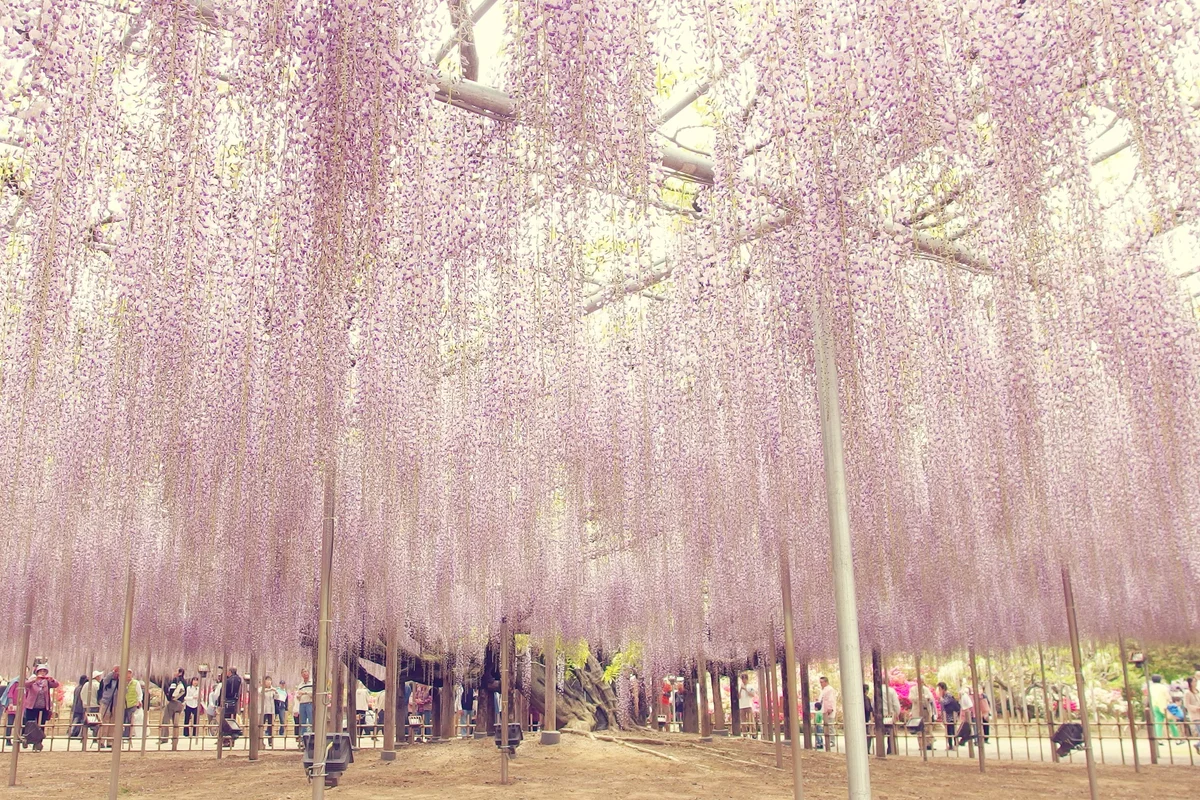
The wisteria you're picturing was moved here on purpose. The garden started in 1968 at a different site in Ashikaga and only became "Ashikaga Flower Park" in 1997, when city development forced a move. The team relocating it laid over 250 tons of charcoal into what had been wetland to revive the soil, then transplanted the giant wisteria itself, already 130 years old, under Konami Tsukamoto, Japan's first certified female tree doctor. Nobody had pulled off a transplant like it before. The four great wisteria trees and the 80-meter white wisteria tunnel are now a designated Tochigi Prefecture Natural Monument. Even a garden built this deliberately gives each chapter's bloom only as a range of weeks, and reviewers from within Japan report the wisteria coming a week or two early in some years.

Doing it well, the welcomed way
Check the official flower-status page a day or two before you commit rather than a month out. It updates with current photos and the state of each wisteria, and the admission page posts the day's price early each morning; both tell you something real about what you'll actually see.
Decide what you're chasing before you buy a ticket. If it has to be the purple wisteria specifically, the real window is narrow, roughly late April through early May, and even that shifts a week or two depending on the year's weather. If you're open to whatever the park happens to be doing that month, roses, hydrangeas, water lilies, amethyst sage, or the winter lights, you are very hard to disappoint. If wisteria is the goal, lean toward the early side of the forecast window. All 7 visitors in our corpus who arrived before the peak came away positive, with tulips, cherry blossoms, or azaleas filling the gap; of the 26 who arrived after the peak, 19 were positive and 7 mixed, many of them finding roses in its place.
Give the illumination season its own weight in the decision. It runs from October through mid-February (October 17 to February 14 is planned for 2026-27), built around the same wisteria trellis, now strung with lights, and 25 of the 26 reviews from within Japan written about it are positive.
Build slack into the day. Visitors put the trip at roughly two hours each way from Tokyo by train. A tour guide on a TripAdvisor forum said the guests they had sent there loved it, but that "they had the time in their schedule to make the trip," and one Google Maps reviewer, rained on the first time, went back for a second visit within four days.
Timed well, this park barely feels like a gamble. Its staff spend the whole year keeping something in bloom, so a quiet week for one flower never has to mean a wasted day for you. Timed badly, on a single rigid afternoon, it can feel like a long ride out to see a trellis with nothing on it. The park publishes which outcome you'll get, in yen, every single morning.
Planning a Tochigi detour around Ashikaga? Our Nikko guide covers the other major reason travelers head to this prefecture, the shrines and lacquered gates of Nikko Toshogu, and for more on which famous Japan sights are actually worth the trip, start with what actually matters in Japan.
Sources
- Ashikaga Flower Park, official English site: open year-round except the third Wednesday and Thursday of February and December 31; hours 10am-5pm (extended during flower and illumination events); admission varies with flower condition.
- Ashikaga Flower Park, Eight Floral Seasons (8つの花の季節): the park's year divided into eight themed chapters, including a spring festival of tulips (season02), the wisteria story (season03: pale pink, purple, white, and finally yellow wisteria in turn, for more than a month; purple wisteria late April to early May), the amethyst-sage purple garden (season07, early October to mid-November), and the winter light garden (season08, from late October).
- Ashikaga Flower Park, current flower status (花の状況): the official bloom report, posted daily with photos in the wisteria season, giving the state of each wisteria variety.
- Ashikaga Flower Park, admission fees and opening hours (入園料・開園時間): the day's admission is decided early each morning and varies with how the flowers are blooming; the 2026-27 winter illumination is planned for October 17 to February 14.
- Ashikaga Flower Park, park history (園の歴史): opened 1968 at a different Ashikaga site; relocated and reopened as Ashikaga Flower Park in 1997 after the giant wisteria, then 130 years old, was transplanted by Konami Tsukamoto, Japan's first certified female tree doctor; the four great wisteria and the 80m white wisteria tunnel are a designated Tochigi Prefecture Natural Monument, and the wisteria festival runs for the month from mid-April to mid-May when they peak; the winter illumination is ranked one of Japan's three best by the Night View Convention Bureau.
WMJS is written in Japan, in English, with AI help. We check every page, but English is not our first language. If a sentence reads oddly, tell us. One sentence is enough.
Thank you. A person reads every note.
How well do you know Japan?
Built from 635 public posts by Japanese people
Want to know more? Ask Japanese people
Have a follow-up question about this topic? We'll ask real Japanese people.
Voice Box →