
Arashiyama — Why Japan Lists This Bamboo Grove Among the Sounds Worth Saving
Arashiyama
By Kei · Born and raised in JapanThe Meaning
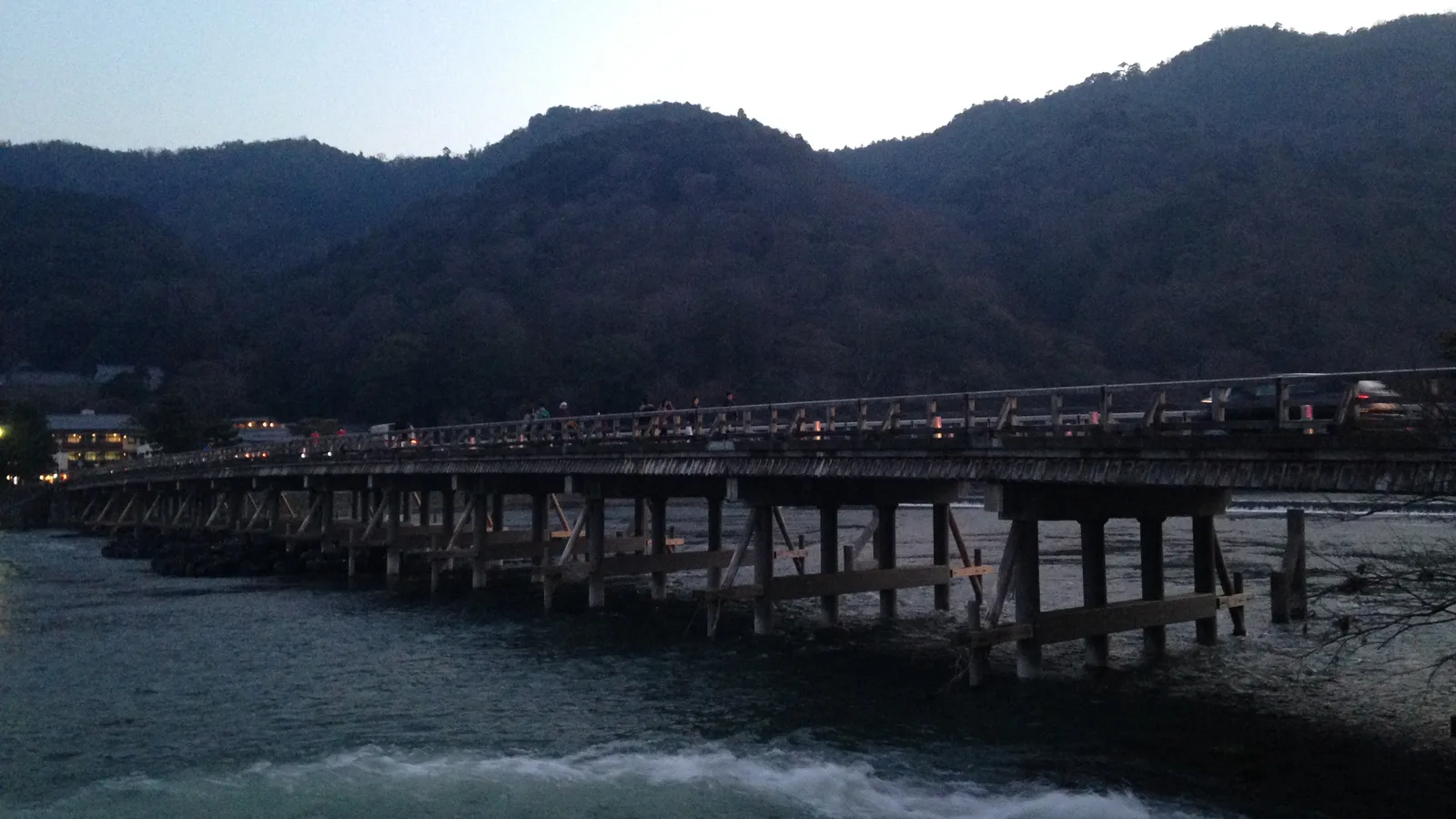
There is a moment, just before you reach the famous bamboo, when most people stop without quite knowing why. They are standing at the foot of a wooden bridge, looking up at a low green mountain that drops straight into a river. There is no monument here, no gate, nothing built to be photographed. And yet people pause. The view in front of you, a river, a mountain, and an arched bridge between them, is one that has stopped travelers in this exact spot for more than a thousand years.
This is the thing worth understanding before you go: Arashiyama is not a single attraction. It is a landscape, and in Japan a landscape can be a treasure in its own right. The name means "Storm Mountain," and the mountain, the river that curves beneath it, and the bridge that ties them together have been admired as one composition since the Heian period, when emperors and court nobles came here to float boats, watch the moon, and write poems about exactly what you are looking at now. The whole of it, mountain, river, and shore, is registered by the nation as a Place of Scenic Beauty, the same kind of designation a country might give to a painting or a temple. You are not looking at scenery. You are looking at something Japan decided, long ago, to keep.
That instinct, to protect a view, a sound, a feeling, and hand it down unbroken, runs through everything here, and it is easy to miss if you arrive expecting a photo opportunity. The bamboo grove that draws most people to Arashiyama is small; you can walk its main path in ten minutes, and on a crowded afternoon you will walk it shoulder to shoulder. Many visitors leave a little deflated, because they came for a picture and the picture was full of other people. But the Japanese have never come here for the picture. They come for something the camera cannot hold: the sound of wind moving through countless stalks of bamboo, the cool of the shade, the particular hush of a place that has been loved carefully for centuries.
So this guide asks one small thing of you. Slow down. Arashiyama rewards the unhurried far more than the rushed, and it gives almost nothing to anyone moving fast. Come early, or come late, walk a little farther than the crowd does, and stop once, just once, to close your eyes and listen. You will understand, in that moment, what a thousand years of visitors understood: that the most beautiful thing about this place was never something you could see.
What Happens When You're There
Step 1: Crossing the Moon Bridge
You begin at the bridge, because Arashiyama has always begun at the bridge.
The Togetsukyo spans the river just below the mountain: a low wooden arc about 155 meters long. It looks ancient, and the view it frames is, but the bridge itself is younger than it appears: the structure you cross was completed in 1934, its piers and beams of reinforced concrete, with cypress railings laid over the top so that it still reads, from the bank, as the wooden bridge of old prints. A crossing has stood near this point since the ninth century, when a monk first bridged the water; the bridge took its present position centuries later, rebuilt again and again, always returning to the same line across the same river.
Its name is the reason to linger. Togetsukyo means "Moon-Crossing Bridge," and the story behind it is a small, exact piece of poetry. In the Kamakura period, a retired emperor named Kameyama was holding a boating party here on an autumn night, and as the full moon traveled over the arch of the bridge he said it looked like a cloudless moon crossing over. The name stuck. For seven hundred years, people have come to this bridge on autumn evenings to watch the same moon make the same crossing, and they still do.
The river itself carries two names as it passes you. Officially it is the Katsura River, but here, beneath the mountain, it has been called the Ōi River since the days when court nobles floated lacquered boats across it, one boat for poetry, one for music, one for song. If you pause at the foot of the bridge before you step onto it (many Japanese visitors do, almost without thinking), you are doing the oldest thing anyone does at Arashiyama: acknowledging a view before entering it. It is a small gesture, the kind Japanese people notice and quietly appreciate, and it costs you nothing but a breath.
Step 2: The Garden That Borrows the Mountain
From the bridge, the main street leads north a few minutes to Tenryu-ji, and it is worth turning in, even if temples are not usually your thing, and even if the bamboo is the only reason you came.
Tenryu-ji was founded in 1339 by the shogun Ashikaga Takauji, to pray for the soul of an emperor he had been at war with, Go-Daigo, and to lead it, he chose one of the great Zen masters of the age, the monk Musō Soseki. It became the first-ranked of Kyoto's five great Zen temples, and today it is registered as a UNESCO World Heritage Site. But the reason to come is not the buildings, most of which burned and were rebuilt over the centuries. It is the garden behind them, and what the garden does with the mountain you have just been looking at.
The pond garden here, the Sōgenchi, was laid out by Musō Soseki himself some seven centuries ago, and it has survived almost unchanged, one of the earliest grounds the nation ever recognized as a place of historic and scenic importance. Stand at the edge of the pond and look across it, and you will see the trick at the heart of it: the garden does not end at its own fence. It reaches out and pulls the wooded slope of Arashiyama into its own composition, so that the mountain becomes the garden's back wall, its borrowed peak. The Japanese call this shakkei, "borrowed scenery," and it is a quietly radical idea. You do not own the mountain. You cannot move it or improve it. But you can build so humbly, and frame so carefully, that the mountain agrees to belong to your garden. It is the same instinct as the bridge: not to conquer a view, but to be welcomed into it.
If you would like the fuller picture of what Japanese people quietly notice about visitors at temples and shrines, it travels well from here, but at Tenryu-ji, the main thing is simply to stand at the pond a moment longer than feels necessary, and let the mountain do its work.
Step 3: Into the Bamboo
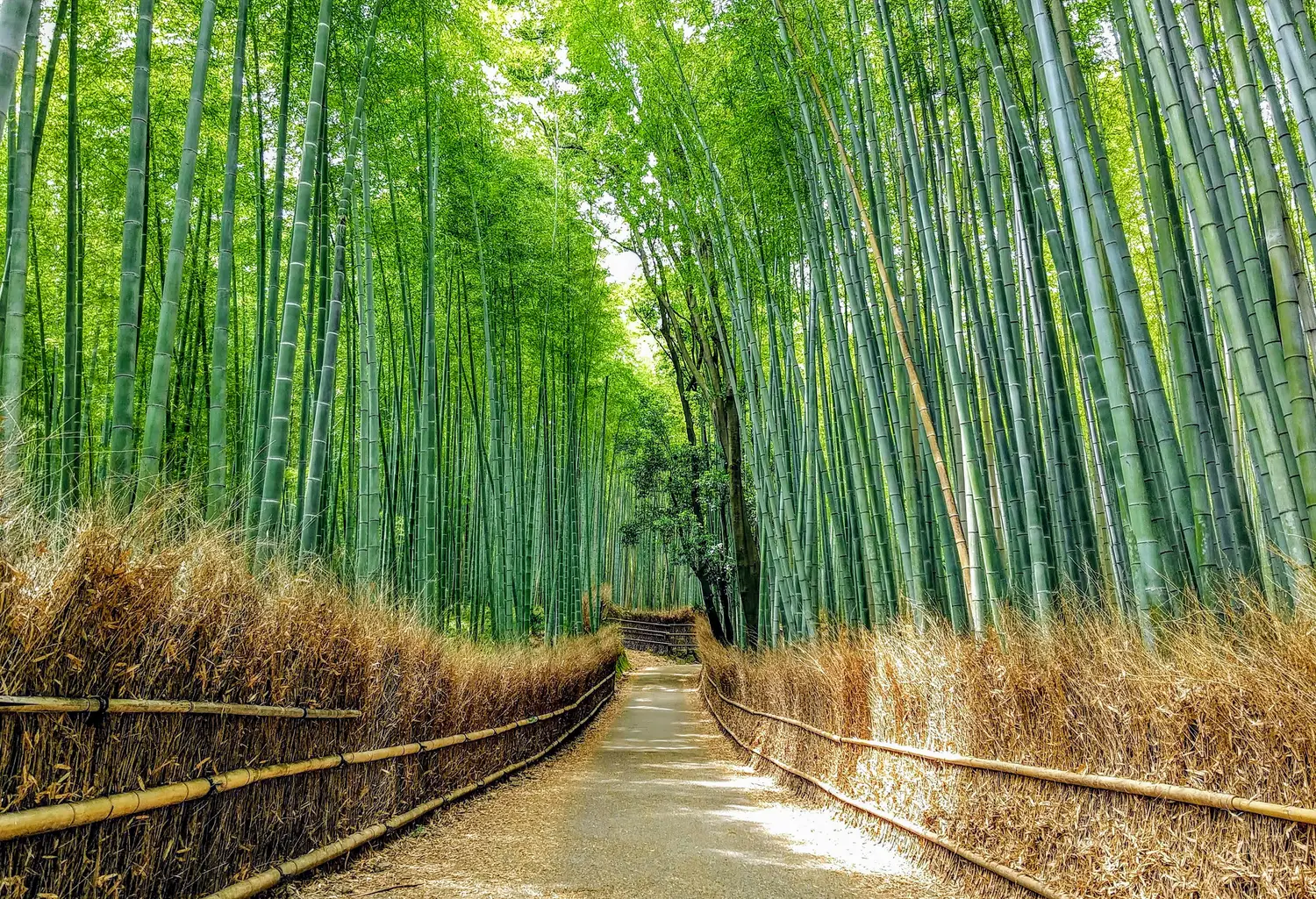
Leave Tenryu-ji by its north gate, and the bamboo begins almost at once.
This is the Chikurin-no-Komichi, the Bamboo Path, and it is the most photographed and most misunderstood place in Arashiyama. People arrive expecting a vast forest and find, instead, a narrow lane perhaps a few hundred meters long, with stalks rising green and close on either side. If you come at midday in high season, it will be crowded, and the magic the photos promised will be hard to find. This is worth knowing before you arrive, so that you can do the one thing that changes everything: come when the path is quiet, and then stop walking.
Because the bamboo grove was never meant to be seen. It was meant to be heard. Japan keeps an official list, a hundred soundscapes the country has chosen to protect, the way it protects buildings and views, and the wind moving through the bamboo of Sagano, the district you are standing in, is on it. Not the sight of the bamboo. The sound of it. When the breeze comes up the valley, the stalks knock softly against one another and the leaves hiss far overhead, and for a few seconds the lane fills with a sound that has no center and no source, as if the whole grove were breathing. That sound is the reason this place is famous in Japan. The photograph is only its shadow.
So here is the invitation, and it is the heart of this whole guide: find a gap in the crowd, or come early enough that there is no crowd, and stand still with your eyes closed for thirty seconds. Let the others walk on. Listen for the knock of the stalks and the hiss of the leaves. It is the same impulse that keeps Japanese trains so quiet, a culture that treats a shared silence as something precious, worth keeping, easy to break and impossible to replace. When you lower your voice in the bamboo, you are not following a rule. You are handing the sound, intact, to the person behind you.
Step 4: The Quieter Sagano
Most people photograph the bamboo and turn back. If you keep walking, the crowd thins within minutes, and you enter the part of Arashiyama that the Japanese themselves come for.
Just inside the grove stands a small shrine with a strange, dark gateway: Nonomiya, where the torii is made of unstripped logs with the black bark still on, said to be the oldest form a gateway can take. For centuries this was a place of purification: a young imperial princess would come here to cleanse herself before traveling on to serve at the great shrine at Ise, a journey you can follow in our guide to Ise Jingu. The lane beyond it winds on past garden villas and quiet temples into the Sagano hills, and the farther you go, the fewer people you meet. One of those temples keeps a line on its gate that could be the motto of this whole valley: true silence is not the absence of sound; it is the rustle of trees, the call of a bird, the run of water, all of it gathered and held.
This is the part worth saying plainly, because it is the part visitors most often get wrong. Arashiyama is crowded, and the crowding is real, and it is easy to feel, standing in a packed lane, that you are the problem, an unwelcome extra in someone else's quiet place. You are not. The people who live and work and pray here are not asking you to stay away. They are asking the same thing you would ask: that the quiet survive the day. The Japanese, too, want to come when the path is empty; the early hour is not a secret kept from tourists but a wish everyone shares. When you walk a little farther than the crowd, lower your voice near the shrines, and step aside so others can pass, you are not being managed. You are being trusted, the way a much-visited place trusts the people who love it to help carry the weight. The crowds at Arashiyama thin the deeper you walk, exactly as they do on the mountain at Fushimi Inari; the reward for going a little farther is always the same.
Step 5: Back to the River
Come back down through the lanes as the afternoon lengthens, and return to where you started: the bridge, the mountain, the river.
In the late light, after the day-trippers have gone, Arashiyama becomes once more what it was for a thousand years: not a destination but a view, held quietly between a mountain and a moving river. Boatmen still pole flat skiffs along the Ōi, as they have since the age of the court poets. The mountain changes color through the year: cherry in spring, deep green in summer, and in autumn a fire of maple that drew the nobles here in the first place. Whatever season you have come in, the composition is the same one Kameyama looked up at on his moonlit night, the same one Musō Soseki borrowed into his garden, the same one the nation chose to keep.
You came, most likely, for a photograph of a bamboo lane. What you carry home, if you let yourself slow down even once, is something quieter: the knock of the stalks in the wind, the cool of the shade, a mountain that agreed to belong to a garden, and a bridge named for a crossing moon. These are the things Arashiyama has been handing to visitors for more than a thousand years, and it is handing them, today, to you. Thank you for walking with us.
Good to Know
The most important thing to know first: Arashiyama is a district, not a single sight, and the bamboo grove is only a few minutes of it. The genuinely rewarding visit is the whole landscape: the bridge, Tenryu-ji's garden, the grove, and the quieter Sagano lanes beyond. Give it a half-day and walk it slowly; an hour spent racing to the bamboo and back is the one way to be disappointed.
Getting there: Three different railways reach Arashiyama, which is the single most confusing thing about planning a visit. From Kyoto Station, the simplest is the JR Sagano Line (San'in Line) to Saga-Arashiyama Station, about 11 minutes by rapid train, with local trains roughly every 15 minutes, and an 8-minute walk to the bridge. The Randen (Keifuku) tram runs from Shijō-Ōmiya to Arashiyama Station for a flat 250 yen and drops you closest to the bridge of all. The Hankyu line reaches Arashiyama with a change at Katsura. One thing worth knowing if you travel on a rail pass: only the JR Sagano Line is covered by the nationwide JR Pass: the Randen tram and the Hankyu line are private railways and charge separately. For the bigger picture of trains and passes, see getting around Japan. Last verified: 2026-06.
Hours and cost: The bridge, the river, and the bamboo path are open at all hours and free to enter. The places you pay for keep daytime hours and close earlier than you might expect: Tenryu-ji's garden, for example, opens at 8:30 and admits visitors until late afternoon for a few hundred yen, with a small extra charge for its buildings and famous painted ceiling. The smaller Sagano temples, the riverside monkey park, and the seasonal sightseeing trolley each set their own hours, prices, and closed days. Because these change with the season, check the official site below for exact times on your dates. Last verified: 2026-06.
Time needed: The bamboo path alone is a 10-minute walk. The bridge, Tenryu-ji, and the grove together make a comfortable half-day; adding the quieter Sagano temples, the monkey park, or the scenic trolley up the gorge turns it into a full and unhurried day. Arashiyama is the rare place that gives more, not less, the longer you stay.
When to visit: Early morning is the Arashiyama of the photographs: the bamboo nearly empty, the light low and green, before the tour buses arrive around nine. If mornings are impossible, the hour after four is the next-quietest, once the day-trippers leave; just note that the temples and monkey park close in the late afternoon, so see those first and save the all-hours bamboo for last. Rainy days, far from ruining a visit, are some of the most beautiful and least crowded. Kyoto City even publishes a live crowd-forecast for the area, worth a glance before you set out.
Photography: The bamboo, the bridge, and the river are yours to photograph freely, but the lane is narrow and busy, and the kindest habit is to take your shot and step aside rather than hold a spot while others wait. A moment of awareness about where and whom you photograph is the small courtesy that keeps a crowded place pleasant for everyone in it.
Bring cash: The monkey park, the sightseeing trolley, and many of the smaller shops and temples around Arashiyama are cash-friendly and not always card-friendly. A little cash in your pocket makes the day smoother.
Last verified: 2026-06
Official source: Arashiyama Hoshokai (the district's official preservation society) · Tenryu-ji official site
If Things Don't Go as Planned
"The bamboo grove is smaller than I expected." You are in very good company: almost everyone feels this, because the photographs make it look endless and it is, in truth, a short lane. The grove was never the whole of Arashiyama, only its most famous few minutes. The trick is to stop expecting a vast forest and start noticing what the grove actually offers: the sound of the wind in the stalks, the green light, the cool air. Stand still for half a minute with your eyes closed, and the place you were disappointed by will quietly become the place you remember.
It's packed, and you can't get a photo without strangers in it. This is the single most common Arashiyama experience in high season, and there are only three real fixes, all of which work: come very early (before nine), come late (after four), or simply walk farther in, because the crowd thins sharply past the first stretch. A rainy weekday morning can hand you the empty lane the influencers promised. If none of that is possible, let the photo go and close your eyes instead: the sound is the same whether the lane is empty or full.
You didn't come early, and now it's a wall of people. Don't write the day off. Walk past the bamboo into the quieter Sagano lanes, where the crowd falls away within minutes, or turn into Tenryu-ji's garden, which absorbs visitors far better than the narrow path does. Many people find the temple garden, not the grove, becomes the part of Arashiyama they actually loved.
You don't have time for everything. Then choose depth over breadth. If you can do only one thing, walk slowly from the bridge through Tenryu-ji's garden to the bamboo: that single line takes in the river, the borrowed-mountain garden, and the grove, and it is the essence of the place. The monkey park, the trolley, and the outer temples are wonderful additions for a full day, but no one needs all of them to have truly seen Arashiyama.
The sightseeing trolley wasn't running. The scenic Sagano trolley up the river gorge pauses for the winter (roughly from the end of December through February) and takes occasional days off even in season, so it is worth checking before you build a day around it. If it is closed, the riverside walk gives you much of the same view of the gorge at any time of year and for free, and the boats below the bridge (paid) show it from the water.
You got off at the wrong station, or couldn't tell the lines apart. It happens constantly: there really are three different "Arashiyama" stations, run by three different railways. All of them are within a short, well-signed walk of the bridge, and the whole district is small enough that you cannot truly get lost; follow the signs, or simply walk toward the mountain and the river, and you will arrive.
Sources:
- Arashiyama Hoshokai: The Official Site of Arashiyama (Japanese): The harmony of river, bridge, and mountain; the Togetsukyo name and its origin in the moon-viewing of retired Emperor Kameyama; the Ōi River
- Tenryu-ji Official: About the Temple (English & Japanese): Founding in 1339 by Ashikaga Takauji for Emperor Go-Daigo, founding abbot Musō Soseki, first of Kyoto's five great Zen temples, former temple grounds including Arashiyama and the bridge
- Tenryu-ji Official: Precincts and Garden (English & Japanese): The Sōgenchi pond garden by Musō Soseki, borrowed scenery (shakkei) drawing in Arashiyama and Kameyama, early designation as a place of historic and scenic importance
- Tenryu-ji Official: Visit / Hours and Admission (English): Garden opening hours and admission, building and Cloud Dragon ceiling charges
- Kyoto City Official Travel Guide: Togetsukyo Bridge (Japanese): Bridge history from the ninth-century monk Dōshō and Suminokura Ryōi, the 1934 reconstruction, the Kameyama moon-crossing name, the Katsura/Ōi River
- Cultural Affairs Agency, National Designated Cultural Properties Database: Arashiyama, Place of Scenic Beauty (Japanese): Arashiyama as a nationally designated Historic Site and Place of Scenic Beauty
- Ministry of the Environment: 100 Soundscapes of Japan (Japanese): The 1996 selection of the wind through the bamboo of Sagano ("Kyo no Chikurin") among one hundred soundscapes to preserve
- JNTO: Sagano & Arashiyama Area (English): Official English visitor framing, the three rail lines, and practical orientation
- Nonomiya Shrine Official (Japanese): The Saiō princess's purification before serving at Ise, the black-bark torii, and the connection to The Tale of Genji
- DMO Kyoto: Saga-Arashiyama Comfort Map (Japanese): The official live crowd forecast for the bamboo path and the bridge
Photos: the Togetsukyo Bridge at dusk by Soramimi, CC BY-SA 3.0, via Wikimedia Commons; the Sagano bamboo path by Naokijp, CC BY-SA 4.0, via Wikimedia Commons.


WMJS is written in Japan, in English, with AI help. We check every page, but English is not our first language. If a sentence reads oddly, tell us. One sentence is enough.
Thank you. A person reads every note.
Real voices
Is it worth it?
Were you there? Share your photos.
Your photo could appear in this guide — with your name and a link to your profile.
Submit a photoRelated Articles
"Excuse Me, Can You Take My Photo?": What Japanese People Really Think
Visiting Temples and Shrines: What Japanese People Notice
More guides in Kansai
Fushimi Inari Taisha: Ten Thousand Gates, Each One a Thank-You
The ten thousand vermilion gates at Fushimi Inari are thank-you notes you can walk through. A cultural audio guide verified against official sources: why the foxes are messengers not gods, why the summit has no view, and how to walk past the crowds.
Fushimi Inari Taisha
Ginkaku-ji — Why the Silver Pavilion Has No Silver, and Why Japan Finds That Beautiful
Why the Silver Pavilion has no silver — a free audio guide to Ginkaku-ji, Kyoto, verified against official temple sources. Higashiyama culture and the art of restraint, the sea of silver sand, hours, admission (1,000 yen), access from Kyoto Station, and the Philosopher's Path.
Ginkaku-ji (Jishō-ji)
Gion — Walking Kyoto's Flower District, a Town That Is Still Lived In
An audio guide to Kyoto's Gion flower district: what geiko and maiko really are, the walk from Yasaka Shrine through Hanamikoji to the Shirakawa canal, when to go, and how to enjoy a town still lived in.
Gion
Kinkaku-ji — Why Everyone Stops at the Same Spot to Photograph the Golden Pavilion
An audio cultural guide to Kinkaku-ji, Kyoto's Golden Pavilion, verified against official temple sources. Why you view it from across the pond, what the gold really means, plus hours, admission, and access from Kyoto Station.
Kinkaku-ji (Rokuon-ji)