
Ginkaku-ji — Why the Silver Pavilion Has No Silver, and Why Japan Finds That Beautiful
Ginkaku-ji (Jishō-ji)
By Kei · Born and raised in JapanThe Meaning
There is no silver on the Silver Pavilion.
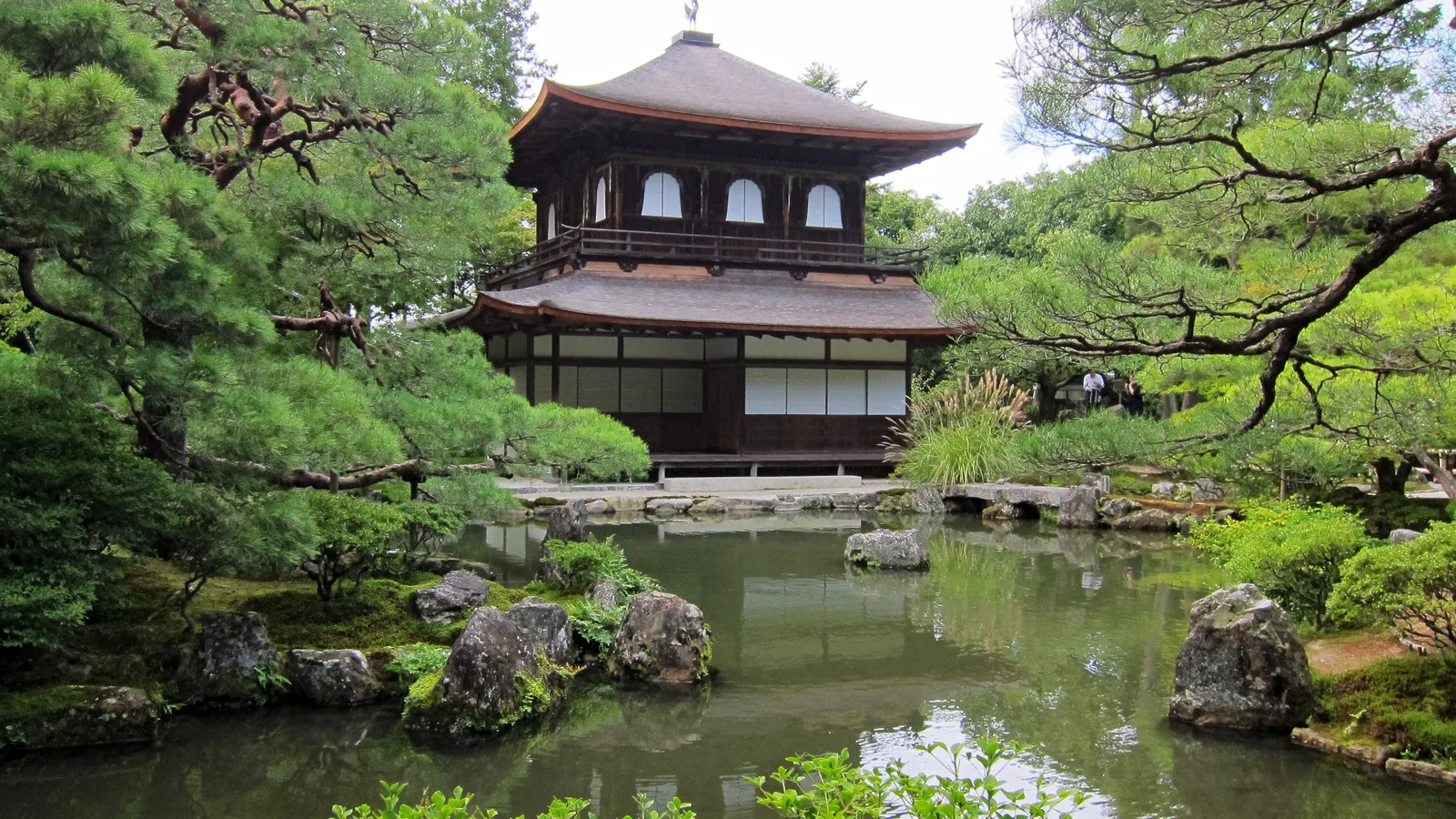
You will look for it (most people do) and you will not find it. The building at the heart of Ginkaku-ji is bare, dark wood, weathered to the color of old tea. The name came later: by the temple's own account it was likely given generations afterward, in the Edo period, to set this place beside the Golden Pavilion across the city. Another explanation holds that the black lacquer of its upper floor, fading to a silver-grey over the years, is where the word began. The temple does not insist on either. What it asks you to notice is the wood itself.
This is the part that surprises visitors, and sometimes disappoints them, especially anyone arriving from the gold of Kinkaku-ji. If the Golden Pavilion is a building that reflects (light, water, the turning seasons), the Silver Pavilion is one that absorbs. The two were raised by the same family, two generations apart: the gold by the grandfather, Ashikaga Yoshimitsu, at the height of his power; the silver-that-isn't by his grandson, Yoshimasa, who stepped away from rule and gave the rest of his life to this hillside, in a capital still scarred by a long and ruinous war.
What he was reaching for has a name here: kansō kotan, a withered, refined plainness. The aesthetic he gathered in these eastern hills (Higashiyama culture) is close to the foundation of Japanese taste. The tatami room, the alcove where a single scroll hangs, tea folded into ceremony, the arranging of flowers: much of what the world now calls "Japanese style" took its shape around this one man's retirement villa. So the plainness in front of you is not what was left when something richer fell away. It is the thing itself.
What Happens When You're There
Step 1: The Hedge, From the Street to the Garden
Before you see anything at all, you walk between two walls.
The approach from the gate is a short corridor, roughly fifty meters, bordered by a tall clipped hedge above banked stone, so distinctive it has its own name, the Ginkaku-ji-gaki, the Silver Pavilion hedge. The temple describes it as a prologue, the quiet opening before the main scene. You step in from a lane of souvenir shops and noodle stalls, and within a few paces the noise is behind you and there is only green on either side.
At the end of it you pay to enter (though, as at its sister temple, the temple frames the fee as an offering rather than an admission). Ginkaku-ji is a working Zen temple of the Rinzai school, and its formal name is Jishō-ji. Many Japanese visitors give a small, almost invisible nod as they pass through; this is the kind of small bow that Japanese people quietly register without anyone making a point of it. If you would like a fuller sense of what is welcomed when you enter a temple or shrine in Japan, we have a separate guide. Here, all you need to carry in is this: that this was once someone's home, and is still a place of prayer.
Step 2: The Sea of Silver Sand, the Shapes No One Can Quite Explain
Then the hedge opens, and you meet the strangest thing in the garden before you ever reach the pavilion it is named for.
A wide bed of pale sand, raked into long parallel ridges like a still sea: this is the Ginshadan, the Sea of Silver Sand. Beside it stands a flawless truncated cone of sand, around two meters tall and flat on top: the Kōgetsudai, usually translated as the Moon-Viewing Platform. Nothing else in the garden looks like them. They are not stone, not water, not planting; they are sand, shaped by hand and held in shape by hand.
People will tell you the cone is built to throw moonlight across the garden, or that someone once sat atop it to watch the moon rise over the eastern hills. The temple is gentle but honest about this: it treats those readings as popular stories, and notes that the sand forms most likely belong to a later age than Yoshimasa's own. So no one can tell you for certain what they mean, and sitting with that uncertainty is part of looking at them. What is plainly true is that sand does not hold a ridge, or a cone, on its own. Every line you see was placed there by someone, and is placed there again.
Walk along the rim and leave the sand untouched. From the path along the edge the ridges line up and the whole bed seems to ripple; that is the view it was shaped to give. The unspoken rhythm of moving through Japan's most-photographed places holds here as much as anywhere: take your picture from the edge, then step on, and the next person gets the same clean sweep of sand that you did.
Step 3: The Quiet Pavilion, Reading a Building You Cannot Enter
Only now do you come to the building the whole place is named for.
The Kannon-den, the Silver Pavilion, is smaller and darker than its fame suggests. Two stories of plain wood under a pyramidal roof of thin shingles. You cannot go inside; like the Golden Pavilion, it is meant to be read from without rather than toured from within. The lower floor is built as a residence, in the shoin style; the upper floor as a Zen Buddhist hall. It was raised in 1489, and Yoshimasa, who had given his last years to it, died early the next year without seeing it finished.
That fact sits quietly beneath everything here. The most famous building in the garden was never completed by the man who dreamed it, was never given the surface its name implies, and is, by common agreement, one of the most beautiful things in Kyoto. If you came from the Golden Pavilion expecting a louder echo of it, you will not find one. You will find something that asks less of your eyes and more of your attention.
A few steps away stands a second, smaller hall that most visitors walk straight past: the Tōgu-dō, also a National Treasure, and in its quiet way more consequential than the famous pavilion. Inside it, though you will not go in, is a small four-and-a-half-mat room called the Dōjinsai, with a built-in desk and shelves set beneath a window. It is often called the oldest surviving room of its kind: the ancestor of the shoin study, the tatami room, the tea room. If you have ever knelt on the floor of a Japanese inn before an alcove with a single hanging scroll, the shape of that room began near here.
Step 4: Moss, Water, and the Climb (the Half Most People Rush)
Most visitors photograph the sand and the pavilion and begin drifting toward the way out. The path, though, turns uphill, and the better half of the visit is up there.
It is a circuit garden, walked one way, and the grounds are designated a Special Historic Site and a Special Place of Scenic Beauty, among the highest protections Japan gives a landscape. You pass a pond and a slope thick with moss (dozens of shades of green, soft over stone and root) said to have been modeled on the famous moss garden of Saihō-ji. Then stone steps climb the hillside. They are uneven and a little steep, and they are worth it.
At the top, the view opens: the pavilion and the sea of silver sand below you, the temple roofs, and beyond them the whole northern bowl of Kyoto, laid out under the surrounding hills. Almost no one reaches this point and then complains the visit was too short. The people who climb tend to be the ones who leave saying it was the best part.
Step 5: The Philosopher's Path, Carrying the Quiet Out the Gate
When you come back down and out through the gate, you do not have to stop.
From just below the temple, a narrow stone walkway follows a canal south for about two kilometers: the Tetsugaku-no-michi, the Philosopher's Path. It takes its name from Nishida Kitarō, a Kyoto University philosopher who is said to have walked it each morning, lost in thought. In early April some four hundred cherry trees turn it into a tunnel of blossom; from mid-November the maples take over; in the plain weeks between, it is simply a quiet path beside moving water, which is, after all, what a philosopher would have wanted. When the crowds gather here in cherry season, they gather for the same reason people stop at the same spot before any famous view: a quiet agreement about where the beauty is.
The path will carry you, if you let it, toward other temples (Hōnen-in, Eikan-dō, Nanzen-ji), each a little quieter than the last. But you do not have to reach any of them. Ginkaku-ji is not a place that hands you one spectacular image to take home. It hands you something slower: a bare wooden hall, a bed of raked sand no one can fully explain, a hillside of moss, and a path along the water where the point was never to arrive. Carry that, and you have had the whole of it.
Good to Know
Getting there: From Kyoto Station, the temple itself recommends not taking a direct bus, which is slow and crosses the busiest part of downtown. Instead, take the Karasuma Subway Line to Imadegawa Station (about 9 minutes), then City Bus 203 from the Karasuma-Imadegawa stop to the "Ginkakuji-michi" stop, roughly 45 minutes door to door. City buses charge a flat 230 yen per ride (cash or IC card). From the Ginkakuji-michi stop it is about a 10-minute walk to the gate, gently uphill. On weekends and holidays, the EX100 Sightseeing Express bus runs directly from Kyoto Station to the "Ginkakuji-mae" stop (about 30 minutes, 500 yen), a 5-minute walk away. Planning your bus and train hops around Kyoto is worth a few minutes before you set out.
Hours: Summer (March 1–November 30) 8:30–17:00; winter (December 1–end of February) 9:00–16:30. Open every day of the year. Note that the opening time shifts with the season.
Admission (offering): 1,000 yen for adults (high-school age and up), 500 yen for elementary and junior-high students; free for younger children. No group discount. The adult rate rose to this level in April 2026; older guides and signs may still list less.
Time needed: The garden is a one-way loop, and the temple suggests about 30 minutes. Allow longer if you climb to the upper viewpoint and linger. Add the Philosopher's Path and it becomes a half-day.
You view the buildings from outside. Neither the Kannon-den (Silver Pavilion) nor the Tōgu-dō is open to the public. You walk the garden and read the buildings from the path. Interiors are shown only during limited special viewings in spring and autumn, with a Japanese-language guide and a separate fee.
The shapes in the sand are artworks. View them from the edge. Please don't step onto the Sea of Silver Sand or touch the cone. The raked ridges read best from the path along the rim, where the lines fall into place.
When to visit: Arriving at opening gives you the thinnest crowds. Cherry blossom on the Philosopher's Path peaks in early April; the maples turn from mid-November into early December. Both are lovely, and both are busy.
There is a climb. Stone steps lead to the upper viewpoint; they are uneven, and skippable if stairs are difficult; the lower garden is largely level.
A World Heritage Site. Jishō-ji is one of the component temples of the "Historic Monuments of Ancient Kyoto," inscribed by UNESCO in 1994. The Kannon-den and the Tōgu-dō are both National Treasures, and the garden is a Special Historic Site and a Special Place of Scenic Beauty.
Last verified: 2026-06
Official website: shokoku-ji.jp/ginkakuji
If Things Don't Go as Planned
You expected silver and feel let down. You are not missing anything: there is no silver to miss, and never was. Once you stop looking for shine and start looking at the wood, the moss, and the sand, the visit becomes the one it was always meant to be: a study in how much can be said with very little.
You came straight from Kinkaku-ji and this feels like less. That comparison is the single most common way to be disappointed here. Try seeing them as opposites rather than as a brighter and a dimmer version of the same thing: one is the art of addition, the other the art of subtraction. Many visitors who expect to prefer the gold find that the silver is the one they remember.
You finished in half an hour and feel cheated of time. Thirty minutes is the temple's own estimate for the loop, and it isn't a sign you rushed. The cure is the upper path: climb the stone steps to the viewpoint and slow down through the moss garden, where far fewer people linger.
It's the off-season and the Philosopher's Path looks ordinary. Without blossom or maple, it is a plain walk beside a canal, and that is closer to what it was named for than the crowds in April ever see. If it doesn't appeal, you lose nothing by skipping it; the temple itself is the destination.
The climb to the viewpoint looks like too much. It is genuinely optional. The lower garden (the sand, the pavilion, the moss at the foot of the slope) is mostly level, and you can take in the heart of the place without the steps.
The bus from Kyoto Station is slow or packed. This is expected, which is why the temple recommends the subway-then-bus route via Imadegawa instead. On weekends, the EX100 express bus is the simplest single ride. Carry cash for the fare and the offering; small temples and city buses do not assume card payment.
Sources:
- Jishō-ji (Ginkaku-ji) Official Site: Shōkoku-ji: History (Ashikaga Yoshimasa, the Higashiyama villa), the Kannon-den and Tōgu-dō, the Ginkaku-ji-gaki hedge, the garden and its sand formations (described as popular legend), the one-way circuit
- Ginkaku-ji Official: Access & Admission: Hours by season, the 2026 admission revision, bus stops, address
- Ginkaku-ji Official FAQ: Interior not open to the public, ~30-minute visit, special spring/autumn viewings
- Kyoto City Tourism: Comfortable access to Ginkaku-ji and the Philosopher's Path: Recommended subway + bus route from Kyoto Station, why to avoid the direct bus
- Kyoto City Tourism: Philosopher's Path: ~2 km path, Nishida Kitarō, cherry and autumn seasons
- Kyoto City Transportation Bureau: City bus flat fare (230 yen)
- Agency for Cultural Affairs: National Cultural Properties Database: Kannon-den (1489) and Tōgu-dō, National Treasures; Jishō-ji Garden, Special Historic Site & Special Place of Scenic Beauty
- UNESCO World Heritage: Historic Monuments of Ancient Kyoto: 1994 inscription; Jishō-ji as a component temple
- Japan Tourism Agency, Multilingual Commentary: Ginkaku-ji: "Not actually silver in color"; the two accounts of the name
Image: "Ginkaku-ji, Kyoto" by Oilstreet (CC BY 2.5), via Wikimedia Commons.
WMJS is written in Japan, in English, with AI help. We check every page, but English is not our first language. If a sentence reads oddly, tell us. One sentence is enough.
Thank you. A person reads every note.
Real voices
Is it worth it?
Were you there? Share your photos.
Your photo could appear in this guide — with your name and a link to your profile.
Submit a photoRelated Articles
Visiting Temples and Shrines: What Japanese People Notice
"Excuse Me, Can You Take My Photo?": What Japanese People Really Think

The Power of a Small Bow: Why a Simple Nod Makes Japanese People Smile
More guides in Kansai
Arashiyama — Why Japan Lists This Bamboo Grove Among the Sounds Worth Saving
An audio cultural guide to Arashiyama in Kyoto, verified against official sources. Understand why Japan lists the bamboo of Sagano among the sounds it wants to keep, how the Moon-Crossing Bridge earned its name, and how to walk the river, the grove, and Tenryu-ji's borrowed-mountain garden away from the crowds.
Arashiyama
Fushimi Inari Taisha: Ten Thousand Gates, Each One a Thank-You
The ten thousand vermilion gates at Fushimi Inari are thank-you notes you can walk through. A cultural audio guide verified against official sources: why the foxes are messengers not gods, why the summit has no view, and how to walk past the crowds.
Fushimi Inari Taisha
Gion — Walking Kyoto's Flower District, a Town That Is Still Lived In
An audio guide to Kyoto's Gion flower district: what geiko and maiko really are, the walk from Yasaka Shrine through Hanamikoji to the Shirakawa canal, when to go, and how to enjoy a town still lived in.
Gion
Kinkaku-ji — Why Everyone Stops at the Same Spot to Photograph the Golden Pavilion
An audio cultural guide to Kinkaku-ji, Kyoto's Golden Pavilion, verified against official temple sources. Why you view it from across the pond, what the gold really means, plus hours, admission, and access from Kyoto Station.
Kinkaku-ji (Rokuon-ji)