
Visiting Sendai & Matsushima, A Bay Beyond Words and the Lord Who Planted Its Trees
Sendai & Matsushima
By Kei · Born and raised in JapanIs Matsushima worth visiting from Sendai? By the voices we gathered, yes: of 49 international travelers who made the trip, weighted by how much each account resonated with fellow readers, 71% called Matsushima worth it, and Japanese reviewers rate the bay even more warmly at 84%. It is one of Japan's Three Views, about 40 minutes from Sendai on the local Senseki Line to Matsushima-Kaigan Station (not Matsushima Station), with roughly 260 pine-covered islands and a fifty-minute bay cruise. Come for a quiet, low beauty rather than dramatic cliffs, and know before you go that the view everyone remembers is from the hilltop lookouts rather than the crowded waterfront. What visitors actually said, including the one mix-up you can avoid, is further down this page.
The Meaning
In the summer of 1689, the most celebrated poet in Japanese history arrived at the most celebrated view in Japan, and could not write a single poem.
His name was Matsuo Basho, and he had walked north for weeks on the journey that became Oku no Hosomichi, the Narrow Road to the Deep North, composing as he went. Matsushima was supposed to be the high point. In his prose he reaches for everything he has: it is the finest view in all Japan, he writes, one that "need not feel ashamed" beside the famous lakes of China; the islands stand "like a beautiful woman freshly made up." And then he stops himself. What painter could ever paint this, he asks, what poet exhaust it in words? And he closes his mouth, lies down, and finds he cannot sleep. The only verse he records at Matsushima is not his own. It belongs to his traveling companion, Sora.
The famous little poem that tourists still quote here, Matsushima ya, ah Matsushima ya, Matsushima ya, was never Basho's at all. It first appears in print in 1820, more than a century after his death, credited to a comic-verse poet named Tawara-bo. Basho's real homage was the silence. He came to the bay of pine islands to write, and the beauty took the words out of his hands.
That is the first thing Matsushima asks of you: not to chase a dramatic, sweeping spectacle, but to stand before a low, quiet, almost shy beauty, the kind that resists a camera the way it resisted the greatest brush in the language. And there is a second thing, hidden in plain sight. This bay is not wild. Its roughly 260 islands are crowned with pines that have been pruned and tended for centuries; the islands are named, and ranked, and loved. One man, the warlord Date Masamune, rebuilt its great temple from cedar carried across the country, and laid out his city to the west, Sendai, still called the City of Trees, by having his people plant a forest into the streets. A bay beyond words, and a lord who planted its trees: hold both, and you will see far more here than a postcard.
What Happens When You're There
Step 1: Sendai, the City of Trees
You begin in Sendai, and it is worth not rushing through it. The largest city in the Tohoku region, ninety minutes north of Tokyo by bullet train, Sendai is often treated as a mere hub, the place you change trains for Matsushima. But the whole story starts here, because Sendai is where you first meet the lord who shaped this coast.
For four hundred years Sendai has been called Mori no Miyako, the City of Trees. The name is not poetic decoration. When Date Masamune founded the city around 1600, he had his retainers plant their estates with cedar, bamboo, chestnut and plum, partly as a hedge against famine, partly as windbreaks, until the whole town was wrapped in green. The character the city uses for "trees," mori written 杜, does not mean a wild forest; it means a grove that people tend together. Sendai's greenery was always something raised by hand.
It is worth knowing that the green you see today is not Masamune's. The old City of Trees burned in the air raids of 1945, and the leafy avenues that give Sendai its name now, above all the zelkova tunnel of Jozenji-dori, were deliberately replanted afterward. This is a city that lost its trees and chose to grow them back. Up on the wooded hill at the edge of downtown sits the site of Aoba Castle, the fortress Masamune built; almost nothing of it survives but the great stone walls, yet his bronze statue still rides there, looking out over the city he planted, all the way to the Pacific. Come down hungry and eat the thing Sendai invented after the war: gyutan, grilled beef tongue, served as a set with barley rice and oxtail soup, and keep the lord in mind as you board the train. You are about to meet the temple he planted, too.
Step 2: The Train, and the Two Matsushimas
From Sendai it is about forty minutes to the bay on the local Senseki Line, and there is one thing to get right before you go, because it catches a great many people: Matsushima has two railway stations, and only one of them is by the sea.
Get off at Matsushima-Kaigan Station (kaigan means "coast") and the bay is right in front of you: the cruise pier, the red bridges, the temples, all within a few minutes' walk. The other station, plain Matsushima on the Tohoku Main Line, sounds closer but sits on the far side of town, a fifteen-to-twenty-minute walk from everything you came to see. Even Japan's national tourism organization spells it out in capital letters: alight at Matsushima-Kaigan Station rather than Matsushima Station. If you take a regional rail pass and want to know how the bullet trains and these little local lines fit together, getting around Japan by rail is worth a glance first.
As the train runs along the water, the islands begin to appear in the window: small, dark-green humps of pine rising out of a shallow sea. Look closely and you'll notice the pines are shaped rather than shaggy. Even from the train, the tending shows.
Step 3: Where Basho Ran Out of Words
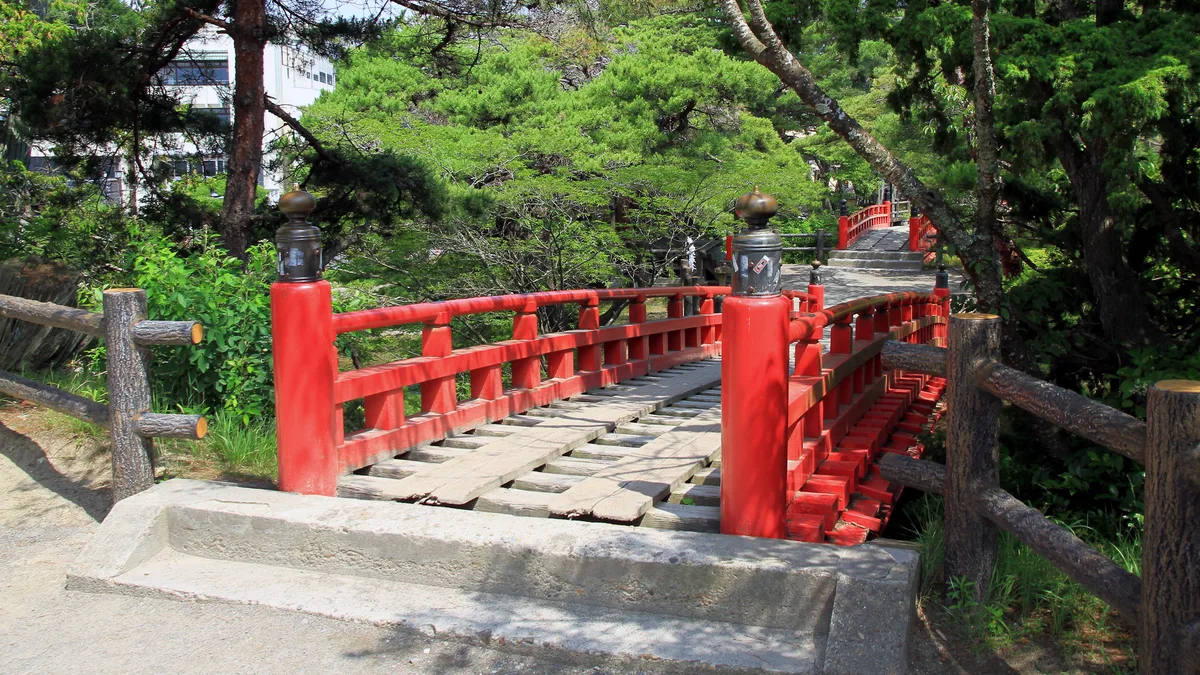
Walk down to the water and the first thing waiting is Godaido, a small dark hall on a cluster of rocky islets, the little building that appears on every postcard, the symbol of Matsushima. Date Masamune rebuilt it in 1604, and the temple calls it the oldest surviving Momoyama-period building in all of Tohoku. To reach it you cross a pair of vermillion bridges floored with slatted planks, the sukashibashi, the "see-through bridges," built with gaps you can watch the sea move through beneath your feet. They were meant to make you slow down and pay attention. They still do.
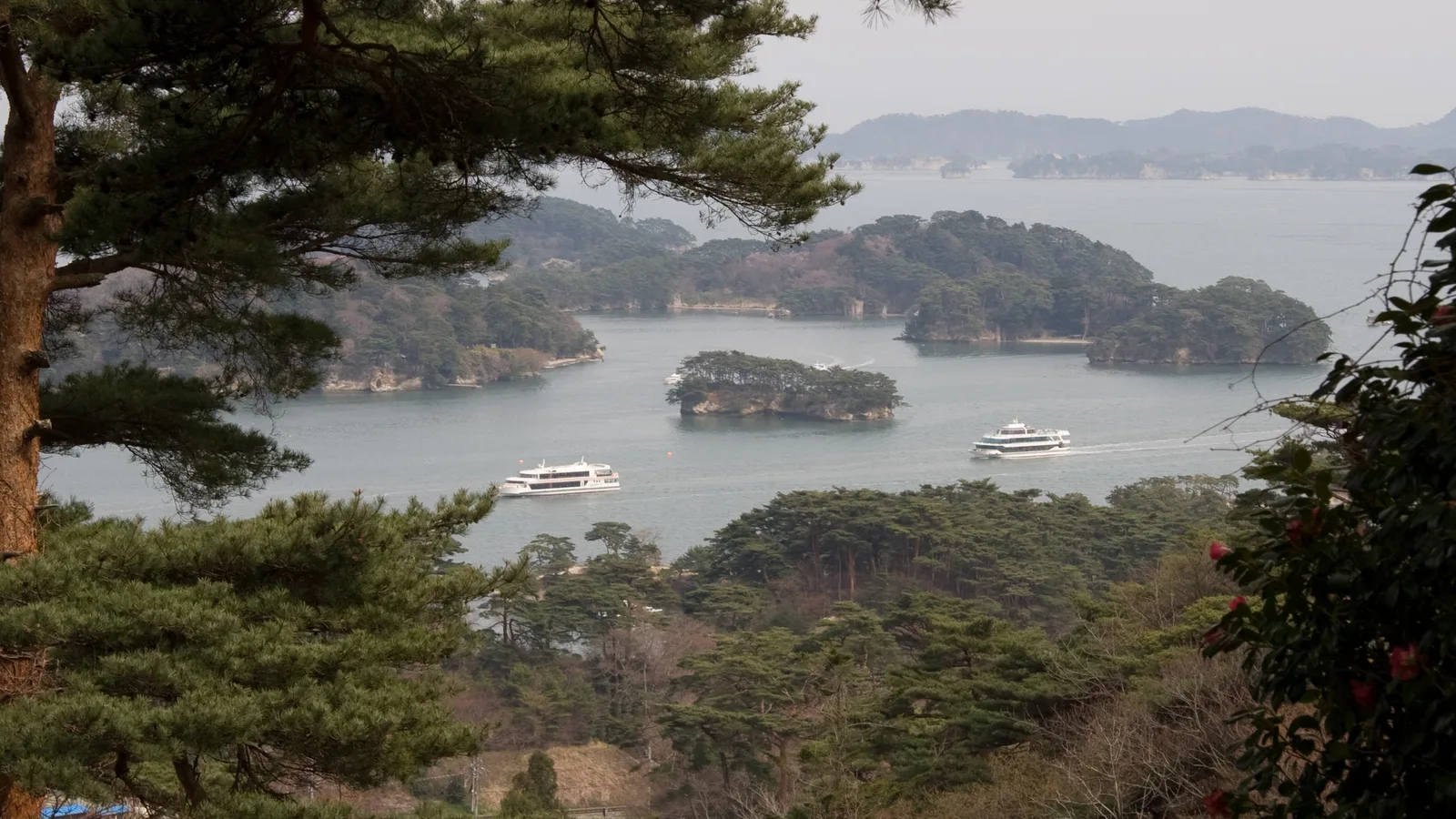
From here, the whole bay opens: roughly 260 pine-clad islands, scattered across the water as far as you can see. This is one of the Three Views of Japan, Nihon Sankei, a trio of scenes (with Amanohashidate and the shrine island of Miyajima) singled out for praise by a Confucian scholar, Hayashi Gaho, in a book published in 1643. Nearly four hundred years later, the verdict still holds: people have come to see exactly this for centuries. And this is the spot where Basho fell silent. Stand a while and you may feel why he did. The beauty here is not a thunderclap; it is low and wide and quiet, and it does not announce itself.
That quietness is also why some visitors come away muttering that Matsushima is overrated: they arrived braced for drama and met something gentler instead. If that thought crosses your mind, it is worth remembering that the most discerning eye in Japanese poetry had the same problem, and concluded that the only honest response was to stop talking. Matsushima rewards patience over a quick glance. (On the very same northern journey, days further on, the same poet stood over the ruins of a vanished golden capital and did find his words: the most famous lament in the language, summer grasses over the warriors' dreams. That place is Hiraizumi, and the two together make a quietly perfect pair: one view moved Basho to mourn what was lost, the other left him speechless at what still lives.)
These islands, it should be said gently, are not only beautiful. The ring of them has always sheltered the inner bay, and the town notes that this was true again in the great earthquake of 2011, when the islands softened the wave that struck this coast and Matsushima came through to welcome visitors once more. To see the bay properly, take to the water: the sightseeing cruises loop the islands in about fifty minutes, naming the strange rock formations as you pass, with an open upper deck you can pay a little extra for, lovely in fair weather, bracing in winter wind.
Step 4: The Temple Built of Imported Cedar
A short walk inland brings you to Zuiganji, the spiritual heart of the bay, and the clearest proof that Matsushima's beauty was made as much as found. A Zen temple whose origins are traced to a Tendai monk in the ninth century, it was rebuilt in its present form by Date Masamune between 1604 and 1609, five years of work for which he sent for the finest cypress and cedar from distant Kii, near the sacred peninsula in the south, and summoned a hundred and thirty master carpenters from the old capital region around Kyoto. The result, its main hall and living quarters, are designated National Treasures of Japan. You approach through an avenue of cedars and past caves carved into the rock face where monks once sat; inside wait the gold-leafed, painted rooms of the Momoyama age. Even the sacred center of this "natural" bay, in other words, was sourced, shaped, and carried here by hand. The simple courtesies for a working temple like this, when to bow, where to be quiet, are covered in visiting temples and shrines, and none of it is difficult.
Next door, smaller and greener, is Entsuin, built in 1647 as the memorial temple of Masamune's grandson, a boy lord named Date Mitsumune who died at nineteen. It is famous now for its gardens: a stone garden, a moss garden, a rose garden, one of them attributed to the great Edo designer Kobori Enshu, and for a curious detail: inside the mausoleum, by temple tradition, are painted Western roses said to honor an earlier Date envoy who had sailed all the way to Rome. In early summer the roses bloom; in autumn the maples turn, and the temple lights them after dark. A quiet bow before the young lord's tomb is never out of place here; the power of a small bow is felt as keenly at a place like this as anywhere in Japan.
Step 5: Climb for the View, Then Put the Camera Down
Here is the thing most visitors miss, and the cure for any sense of disappointment: the famous view of Matsushima actually comes from the hills, rather than the crowded waterfront. Ringing the bay are four lookout points known together as the Shidaikan, the Four Panoramic Views, each with its own old nickname: the Gorgeous View, the View of Harmonious Beauty, the Dynamic View, the Mysterious View. From the most photographed of them, a hill called Otakamori, the scattered islands compose all at once into the miniature-garden scene that made the bay legendary. They take some effort to reach (a bus or taxi and a walk uphill), and that effort is exactly why the people who make it remember Matsushima differently from the people who saw it for an hour from the pier.
And when you get there, try something. Take one photograph, and then put the camera away. Matsushima has always been hard to capture (too low, too wide, too quiet to fit in a frame), which is precisely the trouble Basho ran into with his brush. The bay does not reward the person trying to seize it; it rewards the person willing to simply look. The same instinct lies behind the etiquette of photography at Japan's loveliest places: some things are meant to be kept in the eye rather than the phone.
Sit on the hill a while before you go. You came north to a bay that defeated the greatest poet in the language, planted and pruned and tended for four centuries by a lord who grew trees into a city and carried a cedar forest to a temple. Understand why Basho went quiet (why a beauty can be too complete for words, and still ask nothing of you but your attention), and you will have understood Matsushima, and Sendai, and the patient, deliberate way this country has always loved its most beautiful places.
What Visitors Honestly Say
Before you plan the trip, it helps to hear from the people who have already made it out to the bay. We gathered 49 voices from international travelers who had actually been to Matsushima, weighted by how much each account resonated with fellow readers, and this is how they fell:
The doubt in that red band is almost always about expectation rather than the bay itself. "It's easily the least scenic of the Three Views," one traveler wrote, genuinely puzzled about why it gets top billing. The ones who loved it describe something quieter than spectacle: "It's a lovely area, and I always enjoy the boat tour," one regular wrote; "I do think it's quieter and doesn't have much in the way of shopping/activities for tourists, but I definitely think it's worth going to." One repeat visitor offers a correction that saves a lot of first trips: "Most of the islands are tiny; as far as I know, the ferries don't 'visit' the islands (which are empty), you're just sailing around them for different views."
Japanese visitors and locals, reviewing the same bay in their own words, land even more warmly:
For many Japanese travelers, this is a once-in-a-lifetime visit to one of the three landscapes their culture has singled out for centuries. "I've traveled to all of the Three Views of Japan," one wrote after the cruise; "every one of them is truly wonderful." And yet the same honest crack appears here too: one reviewer, sitting on the boat, put the foreign doubt into almost the same words, describing the islands "from a distance, so it's not that moving. If you expect it to live up to being one of the Three Views of Japan, you'll feel a bit let down." The single biggest variable both groups mention is the weather: "if it were sunny the scenery and mood would be the best," one wrote on a grey day, and nearly every lukewarm review shares that same sky.
The full picture, the let-downs included and what prevents each one, is in Is Matsushima Worth It?
Good to Know
Getting there: Sendai is about 90 minutes from Tokyo on the JR Tohoku Shinkansen (Hayabusa service; covered by the Japan Rail Pass). From Sendai, the bay is roughly 40 minutes on the local JR Senseki Line to Matsushima-Kaigan Station (about ¥410). Get off at Matsushima-Kaigan, not Matsushima Station: the latter is a 15–20 minute walk from the sights on the far side of town. Within Sendai, the retro Loople Sendai loop bus (about ¥260 per ride, ¥630 for a day pass) links the castle site, Zuihoden and the downtown. For how Shinkansen, local lines and passes fit together, see getting around Japan.
The bay cruise: Sightseeing boats leave from the pier beside Matsushima-Kaigan Station and loop the islands in about 50 minutes. Fares run around ¥1,500 for adults and ¥750 for children (under 6 free), with an open-air upper deck for roughly ¥600 more. Boats run year-round, roughly hourly from about 9:00 to 16:00 (the last departure is often dropped in winter). Winter brings oyster-themed lunch cruises.
Temples and admissions (Matsushima): Zuiganji is about ¥1,000 for adults (its treasure museum included), allow 30–40 minutes; the gate opens at 8:30, with closing times that shift earlier through the seasons. Godaido is free. Entsuin is about ¥500 (9:00–16:00, a little shorter in winter). The tea pavilion Kanrantei is about ¥300, and crossing the long red bridge to the botanical island of Fukuurajima costs about ¥200 (¥100 for children).
In Sendai: Zuihoden, Date Masamune's ornate mausoleum (rebuilt after the war), is about ¥570. The Aoba Castle site itself is free to walk; its small museum is around ¥700–¥770.
Best time to visit: The pines are evergreen, so the bay is rewarding in any season, but it has its moments. Autumn colour peaks from roughly mid-October to late November, when Entsuin lights its maples after dark. The full moon over Matsushima has been treasured since Masamune's day. Winter is oyster season (the Matsushima Oyster Festival falls in early February), and spring brings cherry blossom to the Saigyo-Modoshi-no-Matsu hilltop park. In Sendai, the great Tanabata Festival fills the streets with paper streamers on August 6–8, and the Pageant of Starlight lights the zelkova avenues throughout December. For how the seasons shape a trip, see the best time to visit Japan.
A note on "overrated": Some visitors expect a dramatic, towering landscape and find a low, soft, subtle one. That gentleness is the whole point: it is why Basho fell silent rather than gush. Give Matsushima a slow half-day, ride the water, and climb to one of the hilltop views, and it will not feel overrated at all.
Last verified: 2026-06
Official websites: matsushima-kanko.com (Matsushima Tourism Association), zuiganji.or.jp (Zuiganji Temple) and sentabi.jp (Sendai Tourism)
If Things Don't Go as Planned
You got off at the wrong Matsushima station. This is the single most common mix-up. Matsushima Station (Tohoku Main Line) is on the wrong side of town; the one you want is Matsushima-Kaigan Station (Senseki Line), right by the bay. If you find yourself at the wrong one, it's a 15–20 minute walk, and now you know for the trip home.
It felt a bit underwhelming, almost overrated. You are in famous company: the greatest poet in Japanese history had the same reaction and decided the only honest response was silence. Matsushima is a quiet beauty, not a spectacular one. The fix is almost always the same two things: get out on the water, and climb to one of the hilltop Four Views. Seen whole, from above, the bay becomes the scene that earned its fame.
The cruise felt short, or the deck was cold. Fifty minutes is enough to round the main islands and hear them named, and the standard lower deck is perfectly warm in winter; the open upper deck is a fair-weather pleasure, not a necessity. If the wind is up, stay below and watch through the glass: you miss nothing essential.
You wondered why Zuiganji charges when Godaido is free. Godaido is a small open hall on the rocks; Zuiganji is a National Treasure: a full temple complex Masamune rebuilt over five years with cedar carried across the country and a hundred and thirty master craftsmen. The cedar avenue, the rock-cut caves and the painted Momoyama halls are the reward. If your time or budget is tight, Godaido and the free shoreline still give you the heart of the view.
You only saw the waterfront and left. The most common regret here. The waterfront is crowded and flat; the view (the one on every poster) is from the hills. If you have even half a day, get up to Otakamori or another of the Four Views. It is the difference between having been to Matsushima and having seen it.
Sendai felt like there was nothing to do. Sendai rewards a slower look than its "just a hub" reputation suggests: the City-of-Trees avenues, the castle hill with Masamune's statue and its view to the sea, Zuihoden's mausoleums, the lantern-lit food alleys, and gyutan beef tongue invented right here. Half a day in Sendai and half a day in Matsushima make an easy, satisfying pairing.
Sources:
- Matsushima Tourism Association: official English site: Matsushima as one of the Three Views of Japan; the "260 small pine-covered islands"; the bay cruises; Date Masamune's positioning of Zuiganji and Kanrantei for moon-viewing; and the association's own note that 2011 tsunami damage was "relatively minimal thanks to the islands surrounding and shielding the bay"
- Official Three Views of Japan site (Nihon Sankei): Matsushima, Amanohashidate and Miyajima as the three views praised by the Confucian scholar Hayashi (Shunsai Hayashi / Hayashi Gaho) in his 1643 book; "the 260 pine-clad islands of Matsushima… have fascinated the Japanese people for over 1000 years"
- JNTO: Matsushima: the roughly 260 islands of Matsushima Bay; the explicit instruction to alight at Matsushima-Kaigan Station (Senseki Line), "not Matsushima Station," and the four hilltop Matsushima Shidaikan viewpoints
- Zuiganji Temple: official English: the Zen temple (Myoshinji school of the Rinzai sect) tracing its origin to the Tendai monk Jikaku Daishi Ennin; rebuilt by Date Masamune, construction begun 1604 and completed 1609, with 130 master craftsmen from the Kinai region; the main hall (Hondo) and living quarters (Kuri) designated National Treasures; ¥1,000 admission including the treasure museum
- Zuiganji: history and Godaido: the chronology of the temple; Godaido rebuilt by Masamune in 1604, "the oldest extant Momoyama-architecture building in the Tohoku region," its twelve-zodiac carvings, and the Godai Myoo statues opened to the public only once every 33 years (next in 2039); Basho's 1689 visit
- Entsuin Temple: official: the 1647 founding as the memorial temple of Date Mitsumune, grandson of Masamune; the Sankeiden mausoleum; the four gardens including a Kobori Enshu garden; the Western rose motif described by temple tradition as honoring the Hasekura Tsunenaga embassy to Europe; ¥500 admission
- Town of Matsushima: Kanrantei: the Kanrantei pavilion, said to be a structure of Fushimi-Momoyama Castle granted to Date Masamune by Toyotomi Hideyoshi and known as the "Moon-Viewing Palace," with Kano-school gold-ground paintings; admission information
- Tohoku Tourism: Fukuurajima: the 252-metre vermillion Fukuura Bridge ("Encounter Bridge") to the botanical island of Fukuurajima, its roughly 250 plant species, and the ¥200 / ¥100 crossing toll
- City of Sendai: "City of Trees" (Mori no Miyako): the origin of Sendai's "City of Trees" identity in Date Masamune's encouragement of estate-grove planting, the loss of the green in the 1945 air raid, and the post-war replanting of the Aoba-dori and Jozenji-dori street trees
- Sendai Tourism (sentabi.jp): Aoba Castle and Zuihoden: Date Masamune's founding of Sendai Castle (Aoba Castle) on Mount Aoba in 1601; Zuihoden, his mausoleum, built 1637, designated a National Treasure in 1931, destroyed in the war and rebuilt in 1979
- Sendai Tanabata Festival: official: the August 6–8 festival dating to the era of Date Masamune, one of the Tohoku region's great festivals, drawing more than two million visitors
- Yamagata University Museum: Basho's Narrow Road (Matsushima): that Basho recorded no haiku of his own at Matsushima, leaving only his companion Sora's verse; the leading scholarly reading that his deliberate silence expressed the depth of his admiration; and that the popular verse "Matsushima ya, ah Matsushima ya, Matsushima ya" was in fact written by another, later author
- Motsuji Temple / Gikeido: Basho at Hiraizumi: Basho's 1689 visit to Hiraizumi on the same Oku no Hosomichi journey, and the summer-grass haiku he composed there, the contrast with his silence at Matsushima
- Is Matsushima Worth It? (WMJS): the two visitor-voice gauges reproduced in "What Visitors Honestly Say" (49 international voices, 71/17/12; 119 Japanese voices, 84/13/3) and the verbatim visitor quotations
Image credits: Matsushima Bay from the Saigyo-Modoshi-no-Matsu overlook by Kimon Berlin (CC BY-SA 2.0); the Sukashibashi bridge to Godaido by Keihin Nike (京浜にけ, CC BY-SA 3.0), both via Wikimedia Commons.
WMJS is written in Japan, in English, with AI help. We check every page, but English is not our first language. If a sentence reads oddly, tell us. One sentence is enough.
Thank you. A person reads every note.
Real voices
Is it worth it?
Were you there? Share your photos.
Your photo could appear in this guide — with your name and a link to your profile.
Submit a photoRelated Articles

Getting Around Japan: The Tiny Things That Earn You a Nod
Visiting Temples and Shrines: What Japanese People Notice
"Excuse Me, Can You Take My Photo?": What Japanese People Really Think
More guides in Tohoku
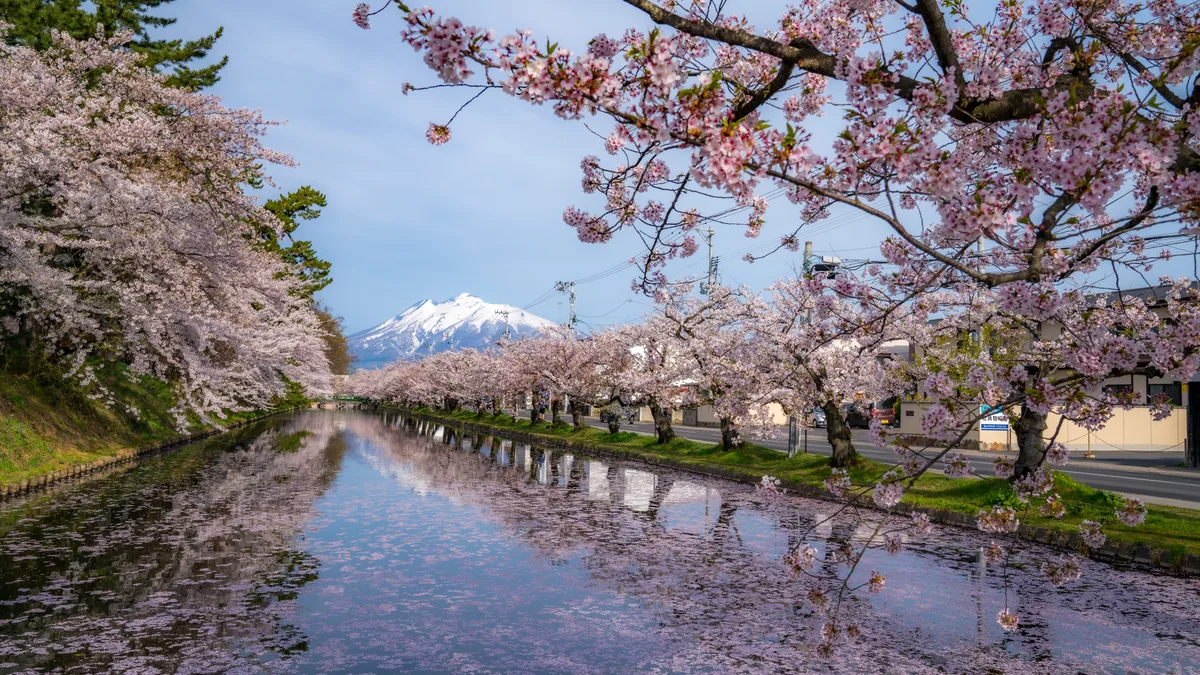
Hirosaki Castle — The Keep That Came Back Smaller, and the Cherry Trees Its Old Retainers Planted
A cultural audio guide to Hirosaki Castle in Aomori, verified against official sources — the only original castle keep left in Tohoku, a small tower rebuilt after the great five-story keep burned, the cherry trees its former retainers planted, and the once-in-generations stone-wall repair that has the keep sitting off its own foundation right now, with hours, tickets and how to get there.
Hirosaki Castle
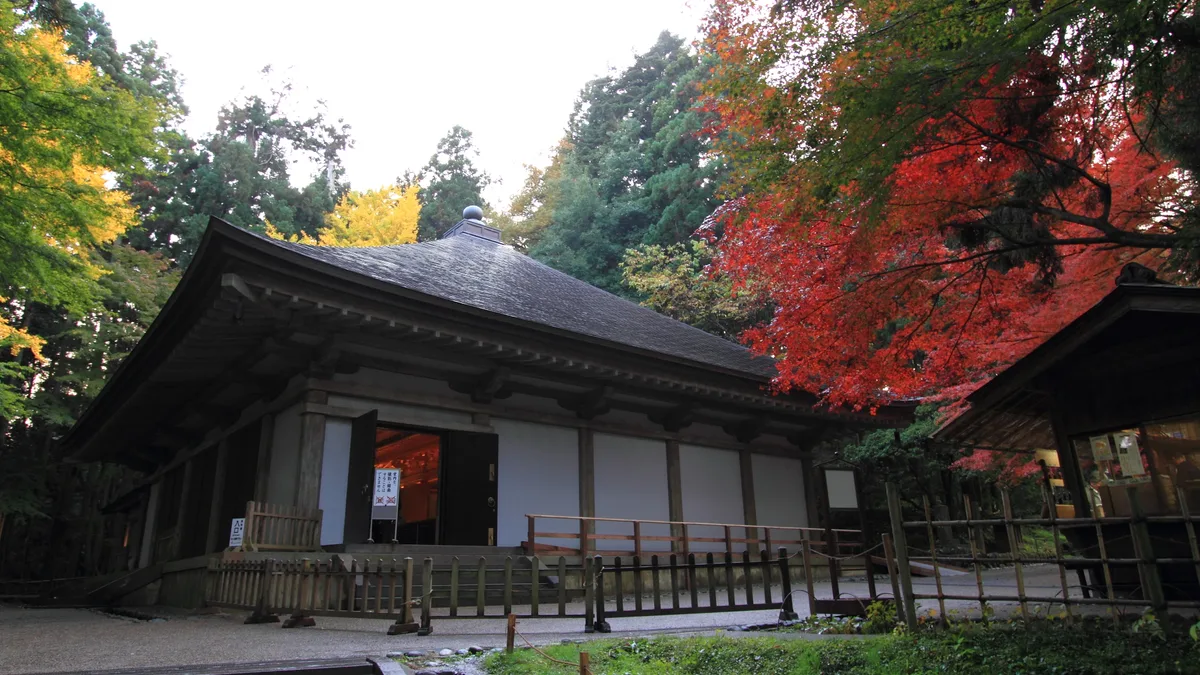
Hiraizumi — A Prayer in Gold, in a Capital That Vanished
An audio cultural guide to Hiraizumi and Chuson-ji's Golden Hall (Konjikido), verified against official sources. Why a lord covered a hall in gold as a prayer for peace, why it alone survived a capital that once rivaled Kyoto, why you cannot photograph it — and how to visit Chuson-ji and the Motsu-ji Pure Land garden, from Ichinoseki.
Chuson-ji & Hiraizumi
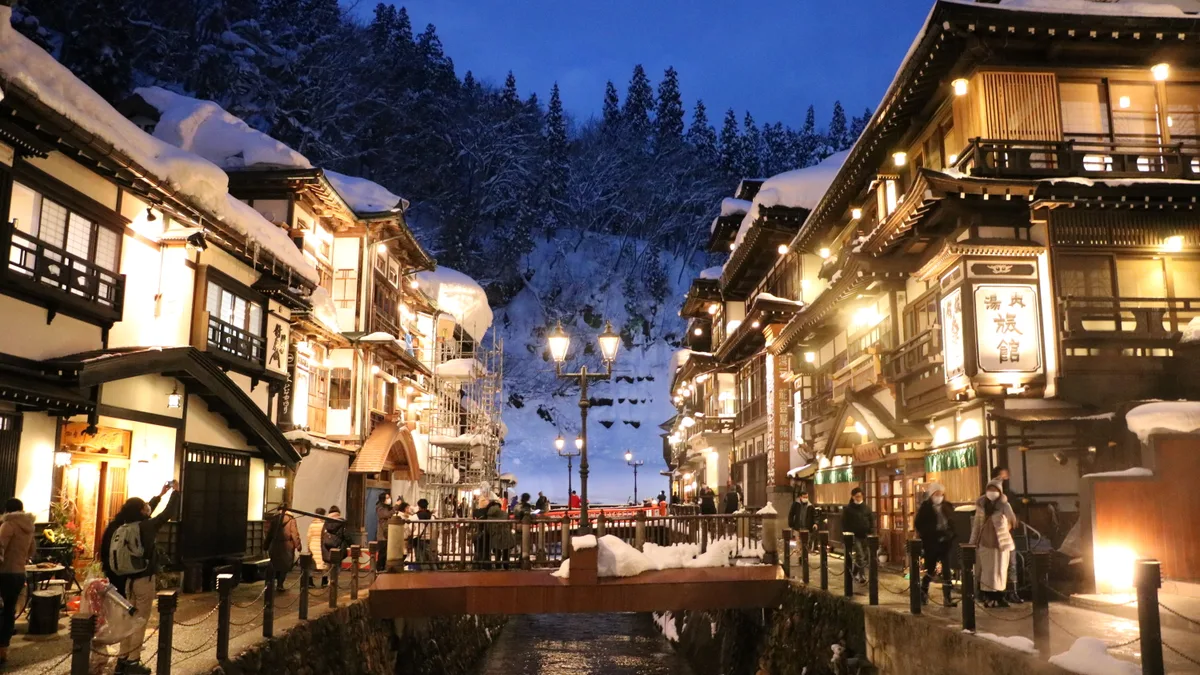
Ginzan Onsen — Where the Gas Lamps, and the Night, Belong to Those Who Stay
An audio cultural guide to Ginzan Onsen, verified against official sources. Understand why this lamp-lit Taisho-era street is a living village rather than a film set, why the famous snow-and-gas-lamp night belongs to those who stay over, how the silver mine became a hot spring, and how to actually get there in winter.
Ginzan Onsen (Ginzan River)