
Hiraizumi — A Prayer in Gold, in a Capital That Vanished
Chuson-ji & Hiraizumi
By Kei · Born and raised in JapanThe Meaning
Nine hundred years ago, a man who had lost almost everyone he loved to war set out to build paradise on the ground.
His name was Fujiwara no Kiyohira, the first lord of the Northern Fujiwara, and the wars he had survived, two long, brutal conflicts in Japan's far north at the end of the eleventh century, had cost him his family. When the fighting finally ended and he held the north, he did not build a fortress. He began, in 1105, to build a Buddha-land: a city laid out as the Pure Land, the Western Paradise of Amida Buddha, made visible on this earth. It was meant to console the souls of everyone who had died in those wars, whether friend or enemy, and to hold the killing at bay for good.
The heart of that vow still stands. In 1124 Kiyohira raised the Konjikido, the Golden Hall: a small building covered in gold leaf inside and out, its inner sanctuary inlaid with mother-of-pearl carried up the Silk Road and lacquered in sprinkled gold, work the temple calls the pinnacle of Heian Buddhist art. Beneath its three altars, in golden coffins, lie the remains of four generations of the Northern Fujiwara lords. It is at once a paradise and a tomb. The gold was never a display of wealth. It was a prayer that the dead might rest in the light, and the living might never fight again.
For about a hundred years it worked. Hiraizumi grew into a capital said to rival Kyoto in beauty. And then, in 1189, it fell: the clan destroyed, the warrior Minamoto no Yoshitsune dead here, the temples lost to fire in the years that followed. The Golden Hall is the only structure from that lost capital to survive in its original form. Everything else became fields and foundation stones. Five centuries later the poet Basho stood on the empty ground and wrote what is still the most famous lament in Japanese:
Natsugusa ya / tsuwamonodomo ga / yume no ato — Summer grasses: all that remains of the warriors' dreams.
Days earlier on the same northern journey, that same poet had stood before the pine islands of Matsushima and found he could not write at all: a beauty too complete for words. The living view silenced him; here, among the ruins, the lost one gave him his lament.
That is what Hiraizumi asks of you. Not to admire a shiny building, but to stand inside a nine-hundred-year-old prayer for peace, in a paradise that almost completely disappeared, and to feel, in the gold that lasted and the grass that took the rest, how much a person can mean by the word forever.
What Happens When You're There
Step 1: The Bullet Train Stops at Ichinoseki
The way in is by rail, north through Tohoku, and the first thing to understand is that the bullet train does not stop at Hiraizumi at all. It stops one town south, at Ichinoseki (a little over two hours from Tokyo on the Tohoku Shinkansen, or barely half an hour from Sendai), and from there you change to a small local train that ambles the last eight or nine minutes to Hiraizumi Station.
That last short ride matters. You step down from the sleek bullet train, wait on a quiet platform, and trundle into a station that is little more than a single building beside the rice fields. There is no grand approach, no crowd pouring out with you. It is hard to believe, standing there, that this drowsy country town was once a capital to rival Kyoto. But that gap, between what was here and what is left, is the whole point. You have not arrived at a monument. You have arrived at the site of a vanished city, and you will spend the day learning to see what time left behind.
Hiraizumi is small and the two great temples sit at opposite ends of it, so it helps to know how you will move between them before you set out; the practicalities of trains, the local line and the loop bus are gathered in Good to Know below, and the wider art of getting around Japan by rail is worth a look if this is your first time changing from a Shinkansen to a country line.
Step 2: Climbing the Moon-Viewing Slope
The approach to Chuson-ji is a long, gentle climb called the Tsukimizaka, the Moon-Viewing Slope, rising up a wooded ridge toward the temple at the top. It is lined with towering old cedars, many of them planted by the Date clan in the Edo period and now approaching three hundred years old, so that you walk the last stretch to the Golden Hall through green half-light and the smell of cedar.
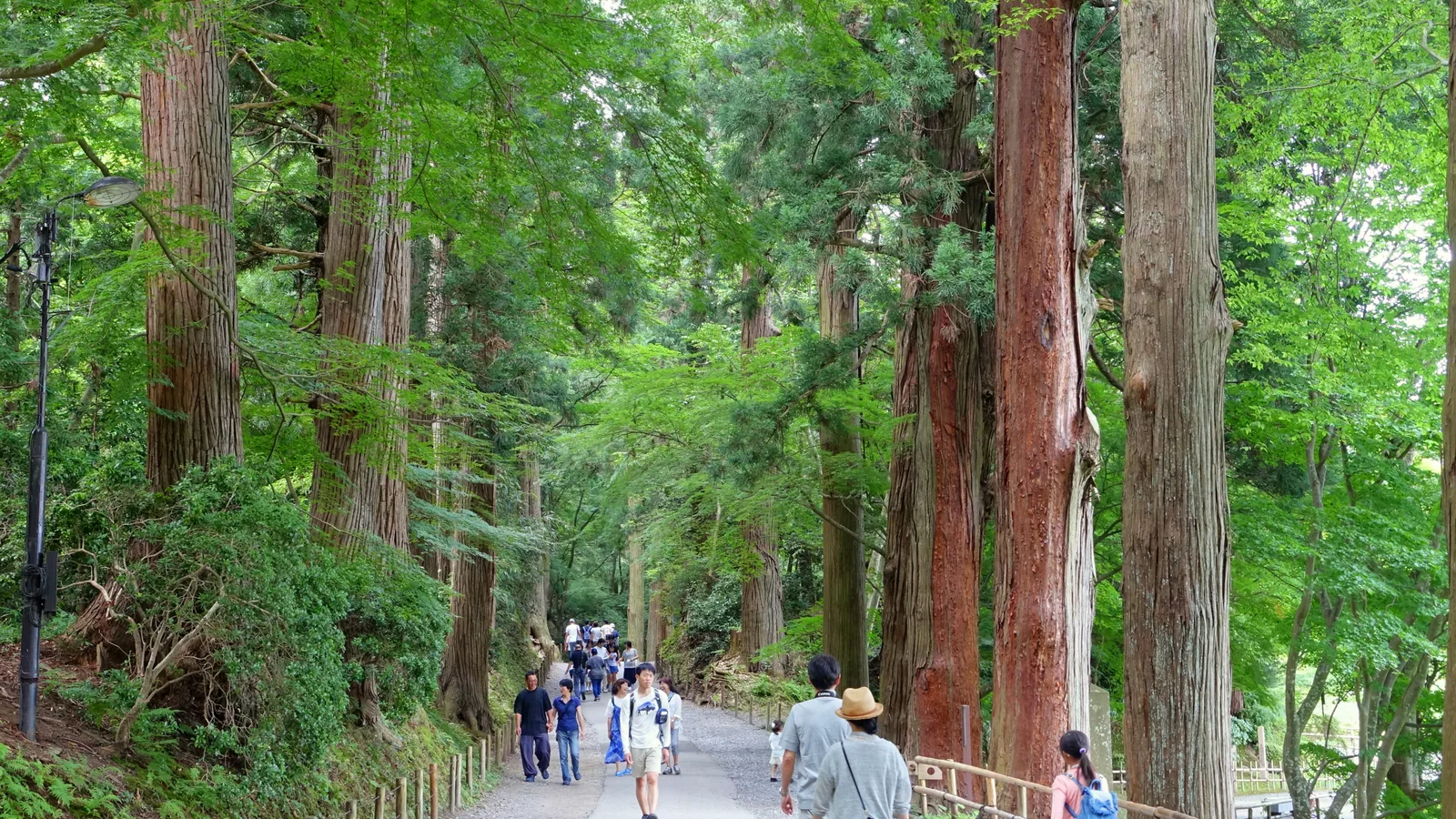
It is worth saying plainly that it is a real climb: a steady uphill, not a flight of stairs but a sustained slope, and that this is part of it rather than an obstacle to it. Basho climbed it. Pilgrims have climbed it for centuries. The slow ascent through the trees is the temple's way of letting the ordinary world fall behind you before you reach the gold; by the time you arrive at the top you have already slowed your breath and your pace. Small temples and halls line the route, and you may want to pause at them. If you are unsure how to carry yourself at a Buddhist temple (when to bow, where to put your hands), the simple customs of visiting temples and shrines cover everything you need, and none of it is complicated.
Step 3: The Gold You Cannot Photograph
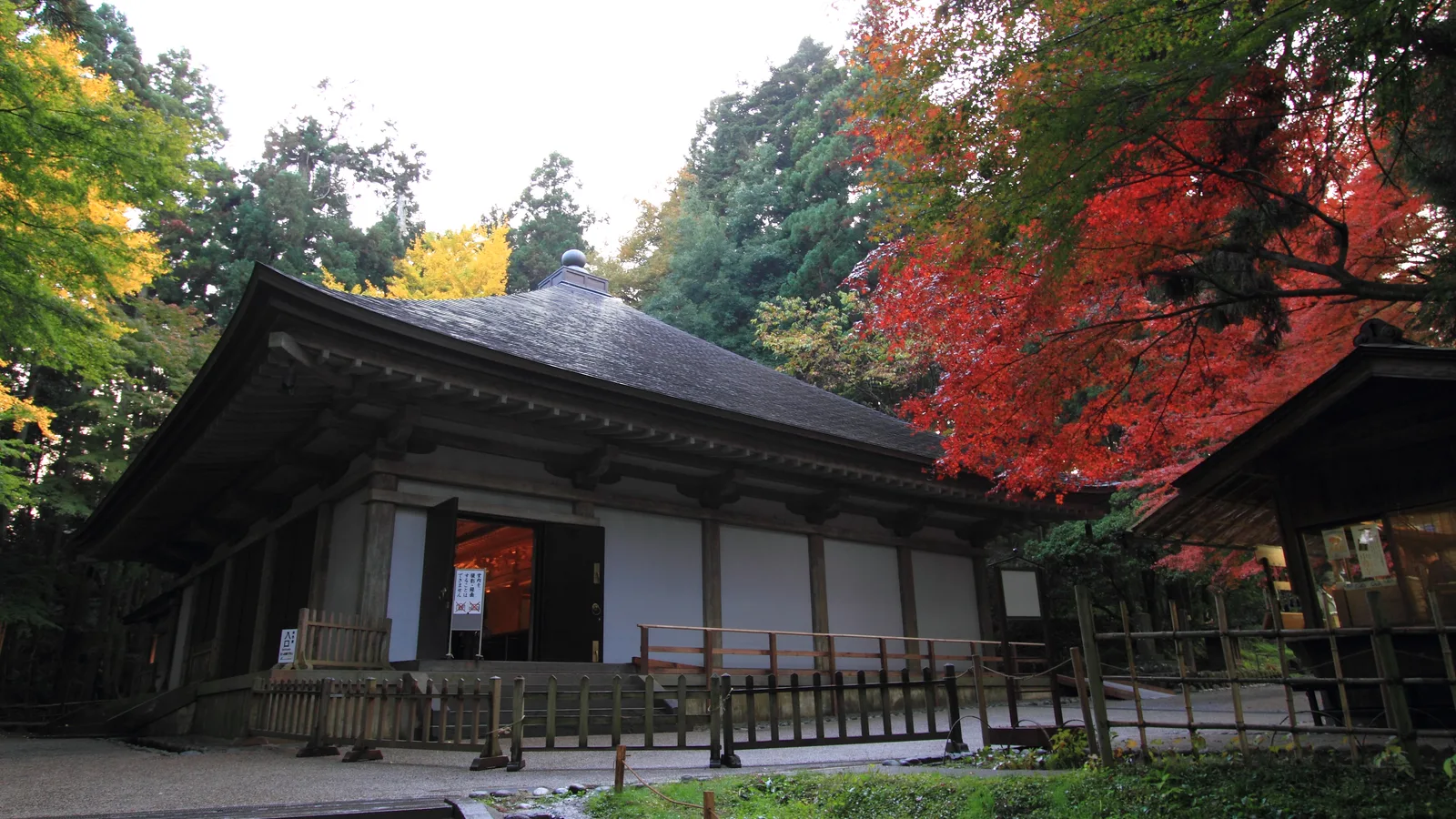
At the top, the Golden Hall is not out in the open. It stands inside a modern protective hall, sealed behind glass and kept at a constant temperature, and the first thing most visitors learn at the entrance is that you cannot photograph it. For some people that lands as a small disappointment, and it is worth knowing in advance so it doesn't. But it is also the quiet gift of the place.
Because here is the thing the cameras would miss anyway. This is not a replica. Unlike Kyoto's famous Golden Pavilion, which was rebuilt in the 1950s, the Konjikido is the actual hall raised in 1124: the real gold, the real mother-of-pearl, nine hundred years old, the only building of its kind to survive the fall of the capital. The glass and the climate control are not commercialization; they are what has kept a fragile wooden hall alive for nine centuries. And the no-photography rule is less a restriction than a difference between leaving with a picture and leaving with a memory. With no phone to raise, you simply stand in front of nine-hundred-year-old gold and look, which is, after all, how a prayer hall and a tomb were always meant to be met. The same instinct lies behind the etiquette of photography at Japan's sacred and crowded places: some things are kept, not captured.
It helps to remember, as you look, what you are looking at. Beneath the three altars lie the lords of the Northern Fujiwara: the first three, and the head of the fourth and last, Yasuhira, who was killed when the clan fell. This is a mausoleum as much as a shrine, and a small, still bow before it is never out of place; the quiet power of a small bow is felt as keenly here as anywhere in Japan. Down the path, the treasure hall holds more than three thousand objects the family left behind: sutras written in gold and silver, the things buried with the dead. And one of the strangest, gentlest stories in the temple belongs to a flower: when the Golden Hall was opened for study in 1950, about a hundred ancient lotus seeds were found inside the container that held Yasuhira's head. They were coaxed back to life, and every summer now they bloom beside the hall, a lost clan's flowers, returned.
Step 4: The Garden of What Is Gone
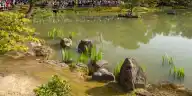
A short way back toward the station lies Motsu-ji, and at first it can seem as though there is nothing there. The great temple that once stood on this spot, forty halls and five hundred monks' quarters, a complex said to rival Chuson-ji itself, burned long ago. What remains is a garden: a wide, still pond called Oizumi-ga-ike, ringed by carefully placed stones and a slender stream, with the foundation stones of the vanished buildings resting in the grass around it.
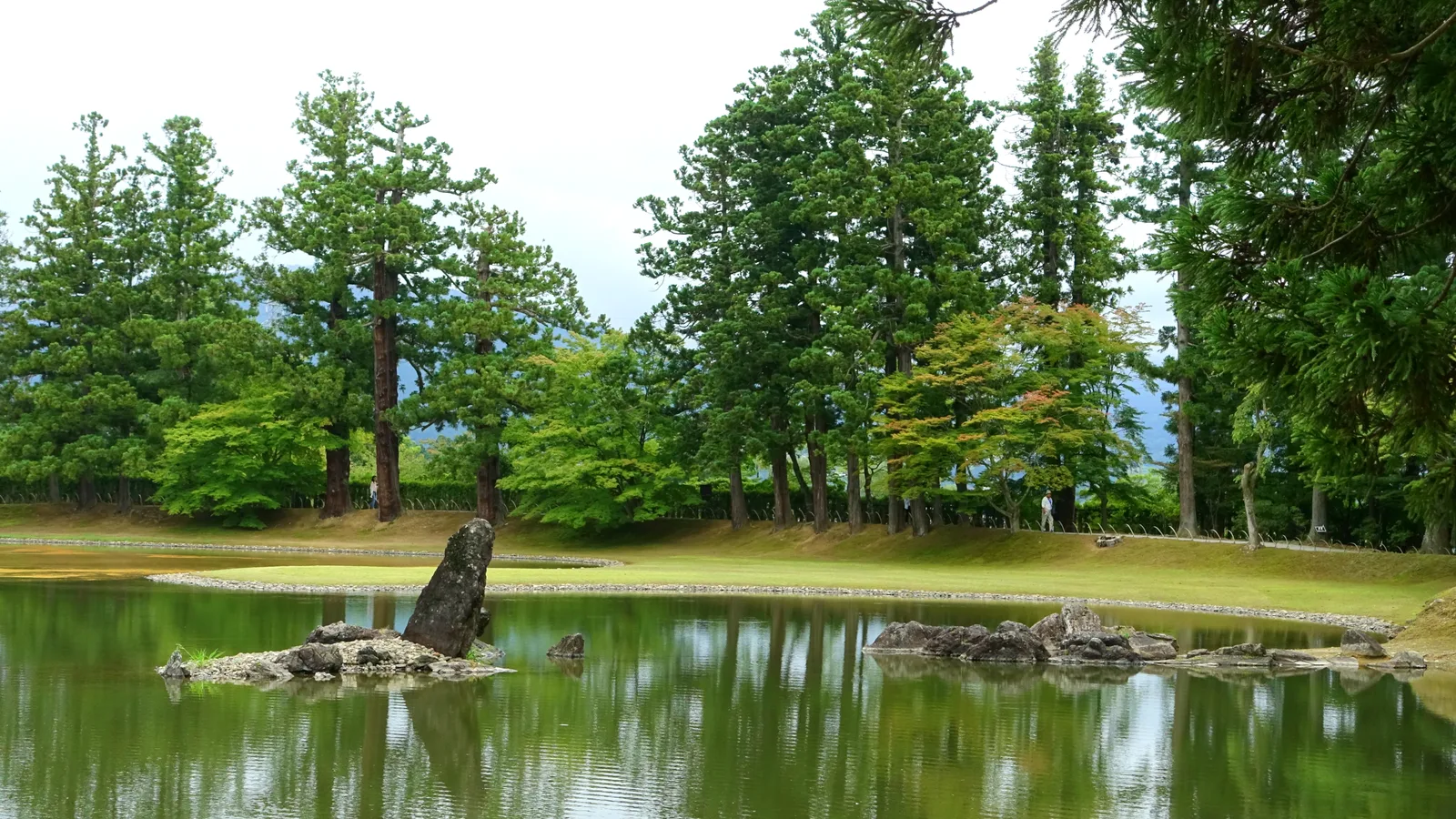
This is the part travelers are tempted to skip, and the part most worth slowing down for. The garden is not a pretty leftover: it is the thing itself, a Pure Land garden, paradise drawn on the ground in water and stone, built so that to walk its shore was to walk, for a little while, in the Western Paradise. It survives so completely from the Heian period that it carries Japan's highest designations for both a historic site and a place of scenic beauty, even though there is almost nothing left to enter. You are not visiting a building. You are reading a nine-hundred-year-old map of heaven, and learning the particular Japanese habit of finding meaning not in what was rebuilt but in the trace (the pond, the stones, the grass) of what was lost. Stand at the water's edge where Basho stood, and the summer grasses say the rest.
Step 5: Leaving the Vanished Capital
Walk back down toward the train in the late afternoon, and the small mystery of the day answers itself. You came a long way north: past the bullet train's last stop, onto a country line, up a wooded slope, to see a building you could not photograph, in a city that no longer exists.
Sit on the platform and you will feel why rather than have to be told. Hiraizumi does not offer grandeur; it offers something rarer. It offers the sight of a man's prayer for peace, made in gold, outlasting by nine hundred years the golden city it was meant to crown. The buildings burned and the clan vanished and the summer grass grew over the warriors' dreams, and still, at the top of the hill, the gold holds the light, exactly as it was meant to. You do not need to be a scholar of Buddhism to feel it. Walk up through the cedars once, stand quietly before the gold once, read the empty garden once, and you have understood Hiraizumi, and why, of everything a people can try to make last forever, it was a prayer, and not a fortress, that they chose to gild.
Good to Know
Getting there: Hiraizumi is in southern Iwate Prefecture, in the Tohoku region. The bullet train does not stop here; the gateway is Ichinoseki Station, a little over two hours north of Tokyo on the JR Tohoku Shinkansen (covered by the Japan Rail Pass) and roughly half an hour from Sendai. From Ichinoseki, transfer to the local JR Tohoku Main Line for the eight-to-nine-minute ride to Hiraizumi Station. The whole journey from Tokyo runs around two and a half to three hours, platform to platform. For how Shinkansen, local lines and passes fit together, see getting around Japan.
Getting between the two temples: Motsu-ji is an easy seven-minute walk from Hiraizumi Station. Chuson-ji sits farther out, about a twenty-minute walk (uphill toward the slope), or roughly ten minutes on the loop bus. The "Run Run" loop bus circles all the main sites roughly every thirty minutes (about ¥200 per ride, or a ¥550 all-day pass), but it is the single thing most likely to catch you out: in 2026 it runs only on weekends and national holidays, between April 11 and November 29. On a weekday, you will need the regular route bus, a taxi, a rental bicycle (available near the station, closed in winter), or your own two feet. Plan your day around this if you are visiting Monday to Friday.
Hours and admission (Chuson-ji): Open daily; roughly 8:30 to 17:00 from March, closing earlier at 16:30 in winter (from early November through the end of February). Buy your ticket at least ten minutes before closing. Admission is about ¥1,000 for adults, and the one ticket covers the Golden Hall, the Sankozo treasure hall, the sutra repository and the old wooden covering hall. Allow one to two hours. There are no coin lockers on the grounds; leave bags at Hiraizumi Station.
Hours and admission (Motsu-ji): Similar daily hours (to 17:00, earlier in winter), admission about ¥700 for adults. The Pure Land garden is mostly flat and far gentler than the climb up to Chuson-ji.
Photography: Photographs are not permitted inside the Golden Hall or the treasure hall. The cedar approach, the grounds and the garden at Motsu-ji are all yours to photograph freely. This is a long-standing on-site rule, so follow the signage when you arrive.
Best time to visit: Hiraizumi keeps all four seasons beautifully: cherry blossoms in spring, fresh green in summer, the famous Chuson-ji lotuses beside the Golden Hall from about mid-July to mid-August, fiery maples along the Moon-Viewing Slope in autumn, and a hushed, near-empty snow in winter (the Golden Hall is indoors, which makes a winter visit easier than you might expect). For how the seasons shape a Japan trip, see the best time to visit Japan.
A note on the gold: It is easy to picture Kyoto's Golden Pavilion and expect something huge and out in the open. The Konjikido is the opposite: one small hall, viewed through glass, that you cannot photograph. What makes it extraordinary is precisely that it is the real, original, nine-hundred-year-old building rather than the gold itself. Come for the meaning, not the spectacle, and it will not disappoint.
Last verified: 2026-06
Official websites: chusonji.or.jp (Chuson-ji, with an English guide) and hiraizumi.or.jp (Hiraizumi Tourism Association, access and the loop bus)
If Things Don't Go as Planned
You arrived on a weekday and there's no loop bus. This catches a lot of people: the "Run Run" loop bus runs only on weekends and holidays in season. On a weekday, take the regular route bus from the station, grab a taxi (Chuson-ji is only about five minutes by car), or walk: Motsu-ji is a seven-minute stroll, and Chuson-ji is a pleasant twenty-minute walk if you have the legs and the weather.
You expected something like Kyoto's Golden Pavilion, and the hall felt small. You are not the only one; it surprises many first-time visitors. The Konjikido is a single small hall behind glass, far from a towering golden temple. But it is the original from 1124, not a modern rebuild, and beneath it lie the lords who built this paradise. The size is not the point; the survival is. Knowing that before you climb the slope changes everything about how the gold looks when you reach it.
You were disappointed you couldn't take a photo. Almost everyone feels this for a moment, and almost everyone is glad afterward. With nothing to photograph, you end up doing the one thing the place rewards: standing still and looking. Take the picture into your eyes. You will remember it longer than any phone would have.
Motsu-ji looked like just a pond and some old stones. That is exactly what it is, and exactly what makes it precious. The buildings are gone; the Pure Land garden remains, almost unchanged for nine hundred years. Slow down, walk the full shore of the pond, and read it as a map of paradise rather than a ruined temple. This is the place Basho meant by "summer grasses": the meaning is in what time left behind rather than in what was rebuilt.
The climb up to the temple is harder than you expected. The Moon-Viewing Slope is a steady uphill through the cedars, and it can feel long, especially in summer heat or winter ice. Take it slowly; it was always meant to be walked slowly. If the climb is too much, Motsu-ji's flat garden gives you the heart of Hiraizumi without the hill, and there is help available at Chuson-ji for visitors who need it.
You only have half a day. That is enough for the essentials. The two World Heritage temples, the gold at Chuson-ji and the garden at Motsu-ji, are close together and can be seen, unrushed, in a single day or even an afternoon. Staying overnight adds the dawn quiet and the outlying sites, but if Hiraizumi is one stop on a longer Tohoku trip, half a day does it justice.
Sources:
- Chuson-ji Temple: official English guide: The Konjikido completed in 1124, "the only 12th century structure to survive in its original form," covered with gold leaf inside and out and dedicated to Amida Nyorai (the Buddha of Infinite Light); founded 850 by the priest Ennin; built by Fujiwara no Kiyohira to console the souls of those, "whether friend or enemy," who died in the late-11th-century wars; hours and ¥1,000 admission
- Chuson-ji: About the Konjikido (Japanese): The 1124 raising of the hall, the all-gold finish, the mother-of-pearl (raden) and gold-lacquer (maki-e) inner sanctuary, the unique arrangement of Amida with attendant bodhisattvas and guardians, and the remains of the four Fujiwara lords in golden coffins beneath the altars
- Chuson-ji: History (Japanese): The temple's traditional founding in 850 by Jikaku Daishi Ennin (told as legend), and Kiyohira's move to Hiraizumi and the start of construction in 1105 to build a Buddha-land that would console the war dead "equally"
- Chuson-ji: official English visitor guide (PDF): Konjikido completed 1124; the first three lords beneath the central and left altars and the third lord "with the head of fourth generation lord, Yasuhira, beneath the right altar"; the Sankozo's "more than 3,000 National Treasures and Important Cultural Assets"; the sutra repository damaged by fire in 1337
- Chuson-ji: Highlights (Japanese): The Tsukimizaka approach up a ridge of about 130 metres, lined with old cedars planted by the Date clan in the Edo period and nearing three hundred years old; the Sankozo's holdings; and the Chuson-ji lotuses grown from roughly 100 seeds found in 1950 inside the head container of the fourth lord, Yasuhira
- Motsu-ji Temple: Grounds and garden (Japanese): The Pure Land garden centered on the Oizumi-ga-ike pond, said to express the Buddha's world on earth, preserving Heian-period garden techniques from the Sakuteiki after more than 800 years
- Motsu-ji Temple: About (Japanese): The traditional founding in 850 by Ennin; the great expansion under the second and third Fujiwara lords to some 40 halls and 500 monks' quarters, said to rival Chuson-ji; and the loss of all the buildings by fire after the fall of the Northern Fujiwara, leaving the garden and the Heian-period ruins
- Motsu-ji / Gikeido: Basho at Hiraizumi (official English): Basho's visit to Hiraizumi on June 29, 1689 during the journey of Oku no Hosomichi, and his haiku composed at Takadachi overlooking the summer grasses: "The summer's grass / 'tis all that's left / of ancient warrior's dreams"
- JNTO: Hiraizumi (UNESCO World Heritage): Hiraizumi as "an ancient city that once rivaled Kyoto," the Oshu Fujiwara clan, the Konjikido as "a symbol of the gold culture of Hiraizumi" dedicated to the Buddha of Infinite Light, and the UNESCO inscription
- Hiraizumi Tourism Association: Access: Tohoku Shinkansen Tokyo–Ichinoseki and Sendai–Ichinoseki times, and the local-line transfer to Hiraizumi Station
- Iwate Kenkotsu: "Run Run" Hiraizumi loop bus: The loop-bus route and stops, the ¥200 single fare and ¥550 one-day pass, the roughly 30-minute frequency, and the 2026 operating period (April 11 – November 29, weekends and holidays only)
- UNESCO World Heritage Centre: Hiraizumi (List No. 1277): The 2011 inscription "Hiraizumi – Temples, Gardens and Archaeological Sites Representing the Buddhist Pure Land," covering Chuson-ji, Motsu-ji and the other sites as a vision of the Buddhist Pure Land expressed on earth
Photographs: the Golden Hall's protective hall in autumn by skyseeker (CC BY 2.0); the Moon-Viewing Slope and the Motsu-ji Pure Land garden by Daderot (CC0 / public domain), all via Wikimedia Commons.
WMJS is written in Japan, in English, with AI help. We check every page, but English is not our first language. If a sentence reads oddly, tell us. One sentence is enough.
Thank you. A person reads every note.
Real voices
Is it worth it?
Were you there? Share your photos.
Your photo could appear in this guide — with your name and a link to your profile.
Submit a photoRelated Articles
Visiting Temples and Shrines: What Japanese People Notice
"Excuse Me, Can You Take My Photo?": What Japanese People Really Think

The Power of a Small Bow: Why a Simple Nod Makes Japanese People Smile

Getting Around Japan: The Tiny Things That Earn You a Nod
More guides in Tohoku
Hirosaki Castle — The Keep That Came Back Smaller, and the Cherry Trees Its Old Retainers Planted
A cultural audio guide to Hirosaki Castle in Aomori, verified against official sources — the only original castle keep left in Tohoku, a small tower rebuilt after the great five-story keep burned, the cherry trees its former retainers planted, and the once-in-generations stone-wall repair that has the keep sitting off its own foundation right now, with hours, tickets and how to get there.
Hirosaki Castle
Visiting Sendai & Matsushima, A Bay Beyond Words and the Lord Who Planted Its Trees
Is Matsushima worth visiting from Sendai? We weighed 49 traveler voices: 71% say worth it, and Japanese reviews rate the bay even warmer at 84%. One of Japan's Three Views, a 40-minute ride from Sendai to Matsushima-Kaigan Station, with a bay cruise past 260 pine islands and the cedar-built Zuiganji temple, with an audio guide.
Sendai & Matsushima
Ginzan Onsen — Where the Gas Lamps, and the Night, Belong to Those Who Stay
An audio cultural guide to Ginzan Onsen, verified against official sources. Understand why this lamp-lit Taisho-era street is a living village rather than a film set, why the famous snow-and-gas-lamp night belongs to those who stay over, how the silver mine became a hot spring, and how to actually get there in winter.
Ginzan Onsen (Ginzan River)