
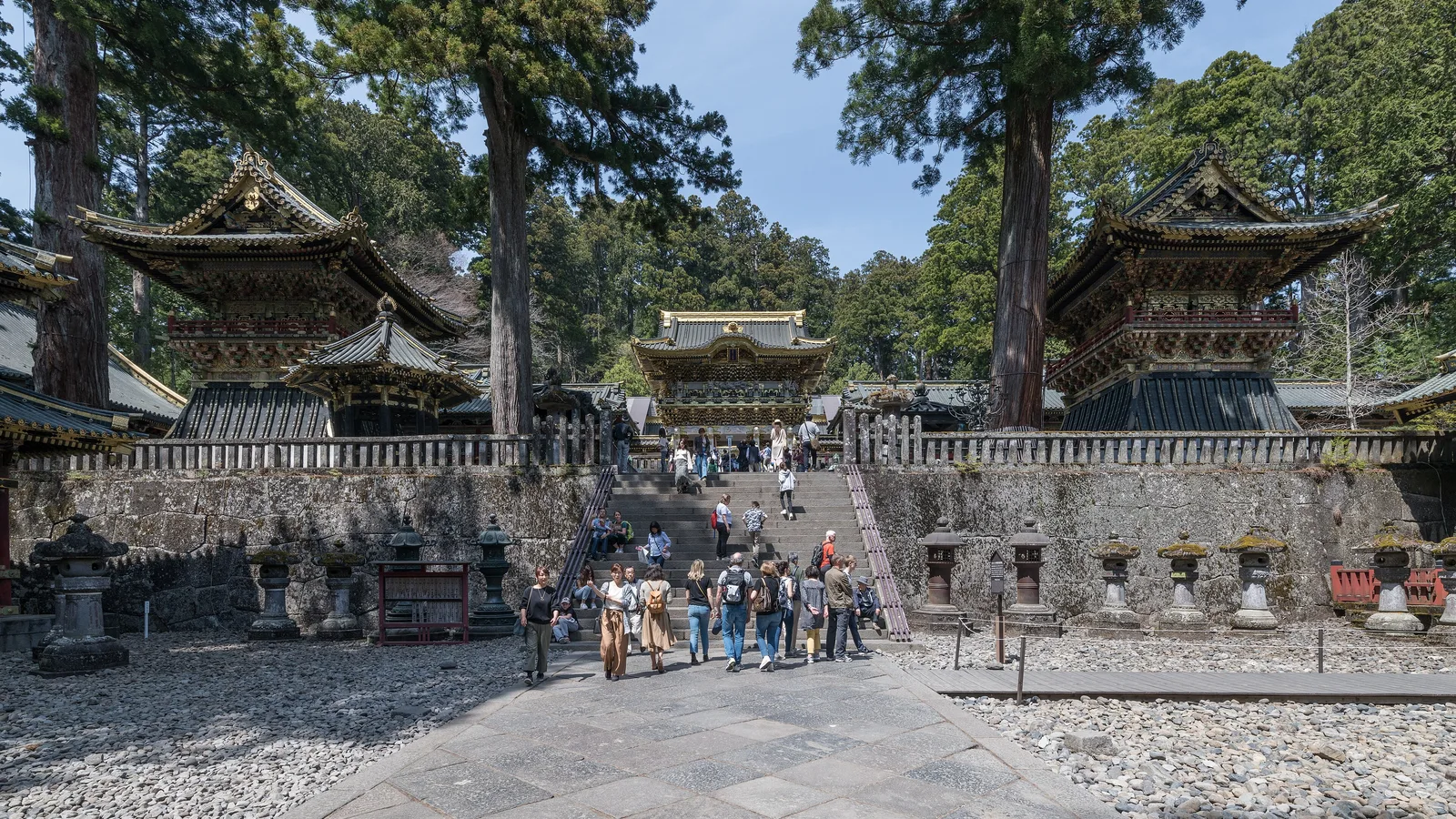
Nikko Toshogu — Why a Nation Covered a Forest in Gold for One Man
Nikko Toshogu
By Kei · Born and raised in JapanThe Meaning
Most Japanese shrines are built to be quiet. Plain cypress, bare wood left to silver in the rain, a deliberate restraint that treats simplicity as a form of respect. Nikko Toshogu is the opposite of all of it. It is drenched in gold leaf and lacquer, with carving worked into nearly every surface, blazing out of a dark mountain forest. The first reaction many visitors have is that it does not look very Japanese at all.
It looks that way for a reason. This is not an ordinary shrine. It is the mausoleum of a man who was turned into a god.
Tokugawa Ieyasu was the warlord who finally ended Japan's age of civil war and founded a peace that would hold for more than 250 years. When he died in 1616, he was first buried quietly on a hill far to the south. A year later, in 1617, his remains were carried north to Nikko, and the imperial court granted him a new name to be worshipped by: Tosho Daigongen, "the Great Avatar that Illuminates the East." A human being had become a guardian deity.
The shrine he was first given was modest. His grandson, the third shogun Iemitsu, who revered him, found that unbearable. In 1636 he tore the early shrine down and rebuilt it, in just one year and five months and at staggering cost, into the explosion of color and carving that stands today. So the excess is not vanity. Every gilded beam is the same sentence repeated thousands of times: this is the resting place of the man who gave us peace, and only the finest the country could make would be enough.
That single fact changes how you see everything here. You are not looking at a shrine that got carried away with decoration. You are looking at the highest honor a nation knew how to pay, to a person it had decided to keep, forever, as a god.
What Happens When You're There
Step 1: The Path of Cedars
You do not arrive at Nikko Toshogu. You cross into it. The way in begins at the Shinkyo, a vermillion bridge arching over a fast green river. For most of its history ordinary people were not allowed to set foot on it. In its present 1636 form it was reserved for the shogun and the emperor's messengers, a threshold between the everyday world and a sacred one.
Beyond the bridge, the road climbs through cedars. These are not ordinary trees. The avenue was planted from around 1625 by a retainer of the shogun and later donated to the shrine, and roughly 12,500 of those cedars still stand: the longest tree-lined avenue in the world, protected as a Special Natural Monument. The light goes dim and green. The air cools. You climb, and the forest does the work of quieting you before you ever reach the gold.
It helps to know what you are walking into. What people call "Nikko Toshogu" is really one corner of a larger sacred site: a World Heritage complex of 103 buildings inscribed in 1999, made up of two shrines and one temple (Toshogu, the Futarasan Shrine, and the Rinnoji Temple) that grew up tangled together over twelve centuries before the government formally separated them in 1871. They sit side by side on the same wooded slope, and each keeps its own gate and its own ticket. (What Japanese visitors quietly do as they pass through each gate is the same at all of them.)
Step 2: The Three Monkeys
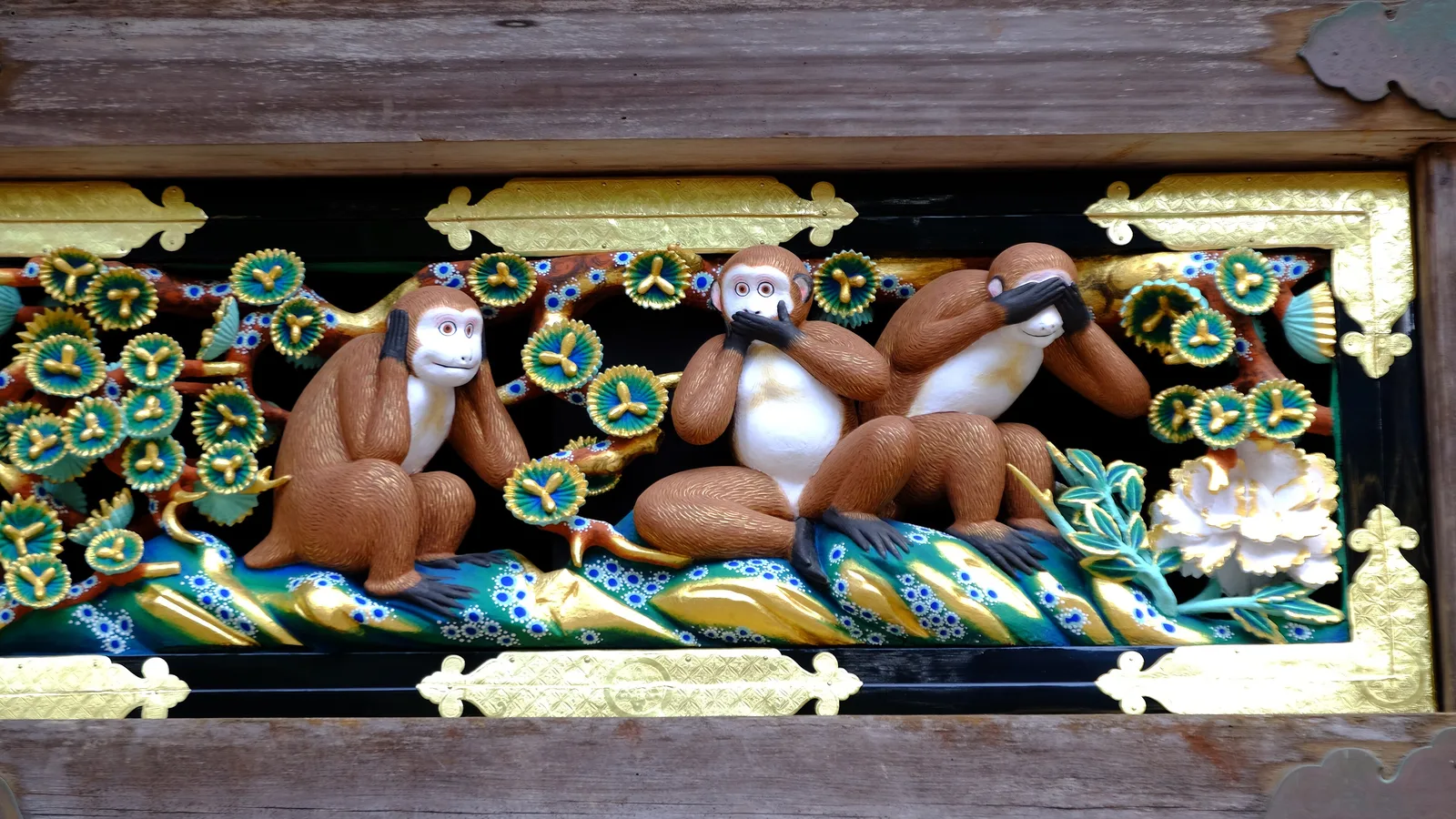
Near the start of the grounds stands a building that looks wrong for the place: the Shinkyusha, the sacred stable, left as plain unpainted wood while everything around it glitters. It is a stable for the shrine's sacred horse, and by old tradition monkeys protect horses, so its eaves are carved with monkeys. There are eight panels, and together, the shrine says, they depict the course of a human life.
One of those eight panels became one of the most recognized images on earth: three young monkeys, one covering its eyes, one its mouth, one its ears. See no evil, speak no evil, hear no evil. Most visitors photograph this single panel and move on, treating it as a charming stand-alone joke. But it is the second scene in a story. The monkeys here are children. The panels before and after them follow the same life forward, into independence, hardship, love, and a new generation that begins the cycle again.
The shrine is careful not to tell you exactly what the three monkeys mean. The phrase is far older than the carving, reaching back to the teachings of Confucius, and people have read it in many ways across the centuries. So rather than settle it for you, look at where the monkeys sit in the story, at the very beginning of a life, and decide for yourself what a child should be protected from seeing, saying, and hearing. There is one more thing worth knowing: mizaru, iwazaru, kikazaru is still a living phrase in everyday Japanese. When a Japanese visitor smiles at this carving, it is not only because it is cute. It is the small surprise of meeting a saying they have used all their lives, carved into a wall four centuries old.
Step 3: The Gate You Cannot Stop Looking At
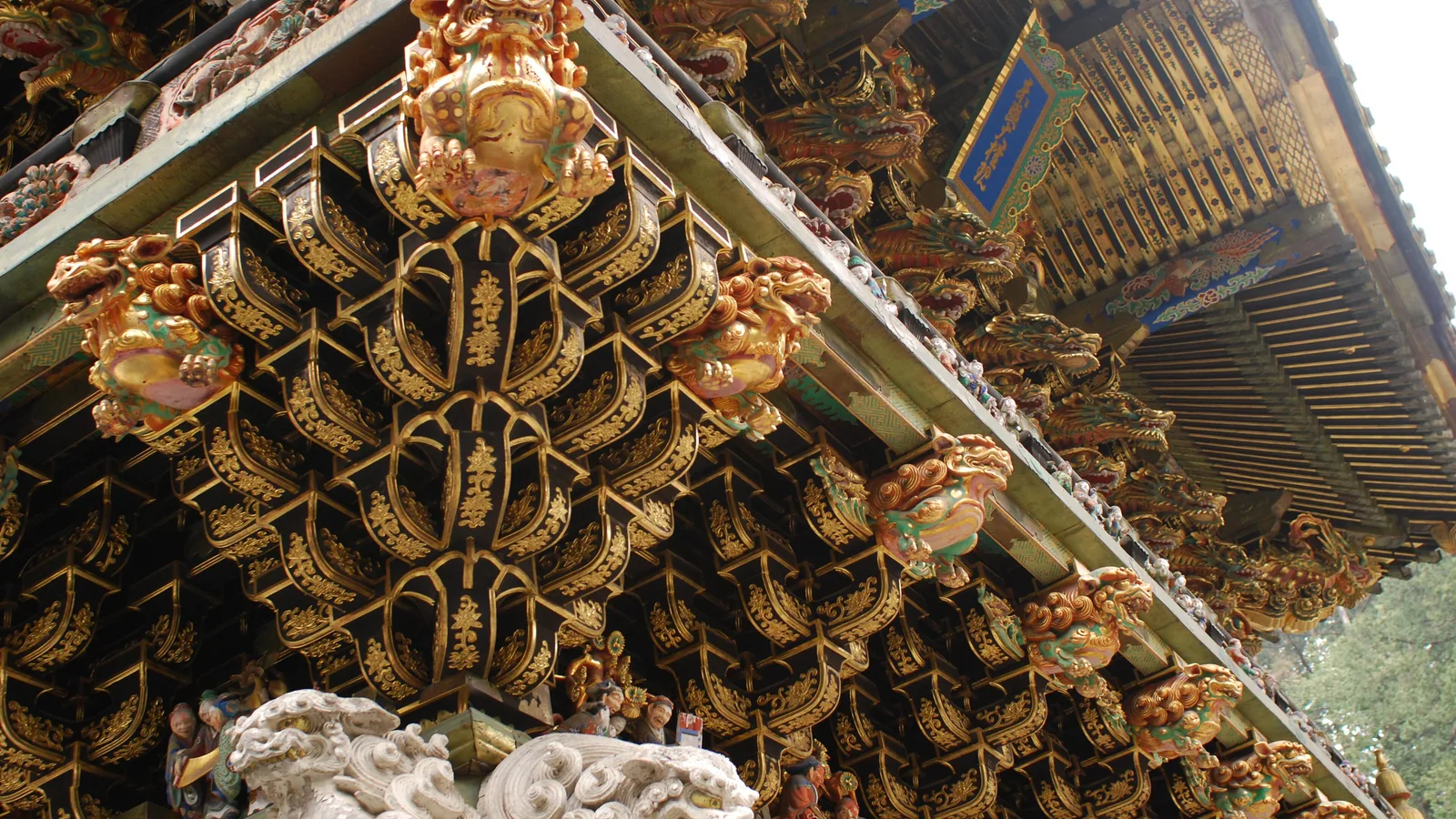
Then you reach the Yomeimon, and you understand the whole shrine at once.
It is a single gate, and it is covered in 508 carvings: sages and children, dragons and lions, flowers and clouds, painted in white and gold and packed into every available surface. It has a nickname that says everything about the intention behind it: the Higurashi-no-mon, "the gate of dusk," because you could stand and look at it until the day runs out and still not have seen it all. That is not an accident. It was built to hold you there.
This is the heart of what makes Nikko different. A gate like this is, of course, a display of power, proof of what the Tokugawa could command. But it is also, plainly, a gift to whoever stands in front of it. The carvings are not solemn. There are cats and bamboo, playing children, small jokes worked into the woodwork by craftsmen who knew people would come and look closely for hundreds of years. Authority and delight, built into the same gate.
And then there is one column that does not match. Among the twelve pillars holding up the gate, a single one has its decorative pattern carved upside-down. It is said this was done on purpose. A building, the old thinking went, begins to decay the very moment it is finished, so the makers left one small, deliberate flaw, so that the gate would never be quite complete, and never have to begin falling. Whether that story is literally true or grew up later, no one can fully prove. But it tells you how this place thinks about perfection: that a thing left slightly unfinished is a thing still alive.
Step 4: The Sleeping Cat and the Quiet Climb
Tucked into the carvings above a small side gate, easy to walk straight past, is the most beloved sculpture in Nikko, and one of the smallest. The Nemuri-neko, the sleeping cat, no larger than a hand, curled and dozing in a bed of carved peonies in the sun. By tradition it is the work of a legendary carver named Hidari Jingoro, though the shrine, true to form, says only that it is attributed to him.
Most people are surprised by how tiny it is. But the cat marks a door, and the door matters. Pass beneath it and the crowds fall away, because what lies beyond is a long climb of worn stone steps up through the cedars to the Okumiya: the inner shrine, and Ieyasu's actual tomb. Almost no day-trippers make it up here. The gold is behind you now. There is only forest, stone, the bronze gate, and the quiet weight of the grave itself. The slight bow people give at a threshold like this is barely visible, and no one is watching to check.
On the way back down, you will almost certainly pass some corner of the shrine wrapped in scaffolding. Nikko is, in some part of itself, always under repair. The Yomeimon you just stood before came out of a four-year restoration finished in 2017 that alone re-applied around 240,000 sheets of gold leaf. It is easy to feel cheated by netting over a famous view, but this is not decay; it is the opposite. A place like this survives only because each generation rebuilds it, exactly the way Japan's most sacred shrine is taken down and rebuilt from scratch every twenty years to keep it eternally new. The scaffolding is 400 years of care, still happening, right now. You climbed up through silence into gold and back down into silence, and you carry a little of both back across the bridge.
Good to Know
One site, three tickets. The biggest source of confusion at Nikko is that it is not one place but two shrines and one temple sharing a hillside, each with its own admission. Toshogu (the gilded mausoleum above) is the one most people come for. Next to it, the Rinnoji temple holds the great hall of three giant golden Buddhas and, a short walk on, the Taiyuin: the mausoleum of the grandson, Iemitsu, deliberately built in restrained black and gold so as never to outshine his grandfather. The Futarasan Shrine honors the sacred mountains. If you only have a half-day, see Toshogu; if you have more, the quieter Taiyuin is the one returning visitors love most.
Admission (Toshogu): ¥1,600 for adults and high-school students, ¥550 for elementary and junior-high students. Rinnoji and Futarasan charge their own separate fees. Last verified: 2026-06.
Hours: Toshogu is open daily from 9:00, closing at 17:00 from April through October and at 16:00 from November through March. Last entry is 30 minutes before closing. Last verified: 2026-06. Confirm seasonal hours on the official site before relying on them.
Getting there from Tokyo: Two main routes. By Tobu Railway, the SPACIA limited express runs from Asakusa to Tobu-Nikko in about 1 hour 50 minutes (a reserved-seat surcharge applies on top of the basic fare). By JR, take the Tohoku Shinkansen to Utsunomiya and change to the JR Nikko Line (about 1 hour 40 minutes in total), or take the direct JR–Tobu Nikko-go limited express from Shinjuku in about two hours. From either station, the shrine area is a 20–40 minute walk uphill or about 13 minutes on the World Heritage Tour bus. (For the bigger picture of trains, passes, and IC cards, see getting around Japan.)
The Nikko Pass: Tobu sells two travel passes for overseas visitors. The World Heritage Area pass (2 days) covers the round trip and buses around the shrine area; the All Area pass (4 days) extends to the mountains beyond: Lake Chuzenji, Kegon Falls, the hot springs. Neither includes the limited-express surcharge or the shrine admissions. Prices change, so check the current fares on Tobu's official site. Last verified: 2026-06.
Time needed: Allow a half-day for Toshogu alone, or a full day, roughly 4–5 hours of walking, to see all of the two-shrines-one-temple complex properly.
Best time to visit: The grounds open at 9:00 and the first hour is by far the calmest. The hillside is most crowded on autumn weekends, because Nikko's foliage is famous nationwide. But the timing is tricky: the leaves turn by elevation, coloring the high mountains around Lake Chuzenji from mid-October and only reaching the shrines themselves in early-to-mid November. For choosing your season, see the best time to visit Japan.
Photography: Permitted throughout the grounds. At the Three Monkeys and below the Yomeimon, where everyone stops, step to one side before raising your camera so the people behind you can keep moving. It's a small courtesy that keeps a crowded place pleasant. (More on reading the room at popular photo spots.)
Going up to the mountains (Okunikko): Beyond the shrines lie Lake Chuzenji, Japan's highest natural lake at 1,269 meters, and the 97-meter Kegon Falls, reached by the Irohazaka, a road of 48 hairpin turns. It is a beautiful trip, but a separate one: the mountain buses crawl in peak autumn traffic, and the day fills fast. If the mountains are your goal, plan to stay overnight rather than chase both in a single day.
Official website: toshogu.jp
If Things Don't Go as Planned
Something is wrapped in scaffolding. Some part of Nikko is almost always under restoration, because the shrine is constantly renewed rather than left to age. A famous view may be netted over, but the experience (the cedars, the gate, the carvings, the climb to the tomb) is intact. You are seeing a 400-year-old shrine being kept alive.
The Three Monkeys and the Sleeping Cat are smaller than you expected. Almost everyone is surprised, because photographs hide their scale. The value here was never size. The cat is a hand's width of wood; the meaning people have read into it for centuries is the part that travels. Look closely rather than expecting something grand.
You're not sure which parts to see, or which tickets to buy. Remember it is two shrines and one temple, each ticketed separately. Toshogu is the essential one. If you have time and energy left, the Taiyuin mausoleum next door is quieter and, for many returning visitors, the most moving spot in Nikko.
It's raining or the mountain is in fog. Bad weather spoils the lake and waterfall views, but it suits the shrines beautifully. The cedar avenue and gilded gates in drifting mist are how many people remember Nikko best. The shrine itself is just as worth the trip in the rain.
The crowds are overwhelming. Arrive at opening, 9:00, and avoid autumn weekends and public holidays if you can. The difference is dramatic, and the climb to the Okumiya, which most visitors skip, is quiet at almost any hour.
The trip up to the lake swallowed your whole day. The road to Okunikko is limited by mountain bus traffic, especially in autumn. There is no shame in turning a Nikko visit into the shrines one day and the mountains another; trying to do both in a rushed day trip is what leaves people frazzled.
Sources:
- Nikko Toshogu Shrine Official Website: Founding (1617), the deification of Ieyasu as Tosho Daigongen, the 1636 Kan'ei rebuild under Iemitsu, the 1645 grant of the "Toshogu" title
- Nikko Toshogu Official: Overview of the Shrine Buildings: The eight Shinkyusha monkey panels depicting a human life, the Yomeimon "more than 500 carvings" and "gate of dusk" name, the Sleeping Cat attributed to Hidari Jingoro and the path to the Okumiya, the 12,500-tree cedar avenue, National Treasure designations
- Nikko Toshogu Official: Admission & Hours: Seasonal opening hours and admission fees
- Cabinet Office, Government of Japan, Highlighting Japan: Nikko Toshogu: The 508 carvings of the Yomeimon, the 1999 World Heritage inscription, the 2013–2017 restoration and ~240,000 sheets of gold leaf
- UNESCO World Heritage Centre: Shrines and Temples of Nikko: 1999 inscription; 103 religious buildings across two shrines and one temple; 9 National Treasures and 94 Important Cultural Properties
- Agency for Cultural Affairs: Nikko Cedar Avenue (Cultural Heritage Online): The cedar avenue planted by a shogunal retainer from the 1620s and donated to the shrine
- Rinnoji Temple Official: History: The priest Tenkai, the fusion of Shinto and Buddhism, and the 1871 separation into "two shrines and one temple"
- Rinnoji Temple Official: Taiyuin Mausoleum: Iemitsu's mausoleum, restrained gold-and-black so as not to rival the Toshogu
- Tobu Railway Official: Nikko Pass: The two visitor passes and their coverage; access from Asakusa by SPACIA
- JNTO: Nikko (National Parks of Japan): Access by JR and Tobu, the Nikko-go through service, travel times
- Nikko City Tourism Association: Visit Nikko: Lake Chuzenji (1,269 m), Kegon Falls (97 m), the 48-curve Irohazaka, foliage timing by elevation
Image credits: Hero by DXR (CC BY-SA 4.0); thumbnail by Jpatokal (CC BY-SA 4.0); the Yomeimon carvings by Cristian O. Arone (CC BY-SA 3.0); the Three Monkeys by foooomio (CC BY 2.0); all via Wikimedia Commons.
WMJS is written in Japan, in English, with AI help. We check every page, but English is not our first language. If a sentence reads oddly, tell us. One sentence is enough.
Thank you. A person reads every note.
Real voices
Is it worth it?
Were you there? Share your photos.
Your photo could appear in this guide — with your name and a link to your profile.
Submit a photoRelated Articles
Visiting Temples and Shrines: What Japanese People Notice

The Power of a Small Bow: Why a Simple Nod Makes Japanese People Smile

Getting Around Japan: The Tiny Things That Earn You a Nod
More guides in Kanto
Visiting Akihabara, Tokyo's Electric Town Where You're Allowed to Love What You Love
Is Akihabara worth visiting? We weighed 149 traveler voices: 29% say yes outright, 44% say it depends on whether you love anime, games or electronics, and Japanese reviewers land warmer at 69%. How the district is laid out, getting there, and who it's for, with an audio guide.
Akihabara (Electric Town)
Visiting Harajuku, Where You Can Wear Anything and No One Turns to Look
Is Harajuku worth it? We counted 99 traveler voices: 64% say yes once you skip Takeshita Street's crush for Cat Street and Omotesando. Crepes, kawaii fashion, getting there, and how to walk it well, with an audio guide.
Harajuku
Visiting Meiji Jingu, Where 100,000 Trees Were Planted to Make a Forest That Tends Itself
Is Meiji Jingu worth visiting? We weighed 70 traveler voices: 75% say worth it, and Japanese locals rate it even higher at 82%. Free, a 70-hectare forest planted entirely by hand in 1920, home to the Great Torii and Kiyomasa's Well in the Inner Garden, with an audio guide.
Meiji Jingu
Visiting Senso-ji, Tokyo's Oldest Temple
Is Senso-ji worth visiting? We weighed 125 traveler voices: 54% say worth it outright. Hours, free admission, how long you need, and why the crowd has always been part of the prayer, with an audio guide.
Senso-ji Temple