
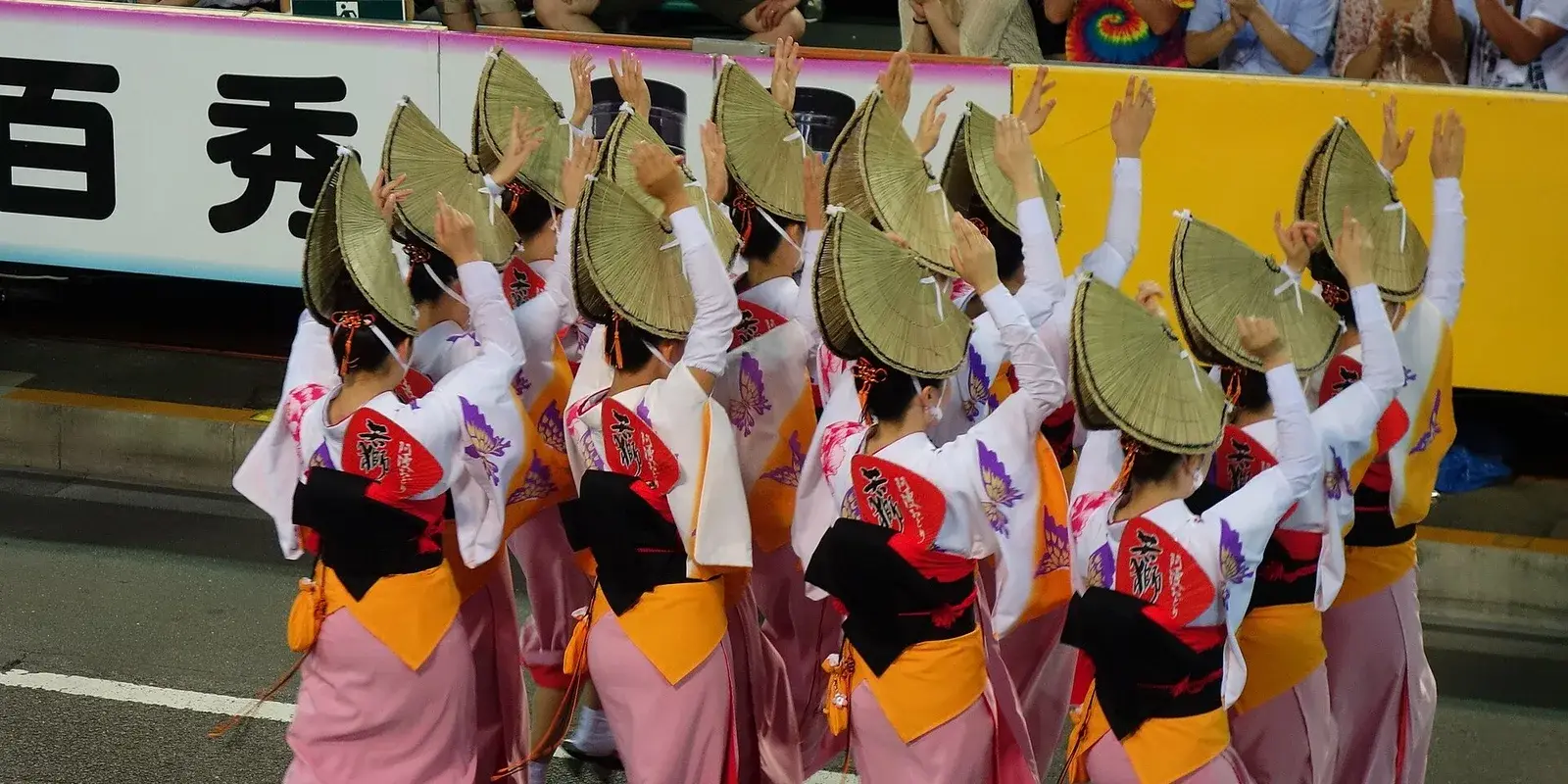
Awa Odori: Can You Really Just Jump In and Dance?
What you'll learn in this article:
- What more than 180 Japanese people said about Tokushima's Awa Odori, especially about joining in and dancing
- Why "the dancing fool and the watching fool" is a 400-year-old invitation, not a dare
- The one thing locals genuinely mind, and it isn't you dancing badly
If you've seen a clip of Awa Odori (that flowing river of dancers, the drums, the women gliding in their deep straw hats) and thought I could never do that, here's the lovely surprise: you absolutely can, and Tokushima has literally built a way for you to. The whole festival is wrapped around a single cheerful idea, you might as well dance, and it means it about you, too.
We gathered more than 180 voices from Japanese people, across public Q&A sites, blogs, social posts, and forums, about Awa Odori (the Awa Dance Festival, held every August in Tokushima City on the island of Shikoku). We weren't looking for a list of rules. We were looking for the honest feeling underneath the question almost every visitor asks: am I really allowed to join, or would that be embarrassing?
Can tourists really dance at Awa Odori? We gathered more than 180 Japanese voices about Tokushima's dance festival. The clear answer: yes, and Tokushima means it. There's an official open-to-anyone group, a niwaka-ren, that needs no costume, no reservation, and no skill. Of the voices we found about jumping in, 94% were warmly welcoming. The one thing people do mind isn't your dancing; it's blocking a paid grandstand or crashing a famous troupe's set.
Quick Guide
| Situation | What Japanese People Said | |
|---|---|---|
| 🟢 Just jump in | Joining the niwaka-ren | An official drop-in group anyone can join, with no costume, no booking, no skill required. 94% of voices welcomed it warmly. "Nobody blames you, nobody judges you." |
| 🟡 Don't stress about | Not knowing the steps | The basic move is a simple two-beat: same hand and foot forward. Even locals say there's no "correct" version. Mastery is hard; doing it is easy. |
| 🟢 Lean in | The chant and the beat | "Yattosā!" Shouting along is half the fun, and the zomeki rhythm tends to move your body before your brain catches up. |
| 🟡 Mind the place | Where you watch (and dance) | Most of the festival is free and on the open street. The two things people mind: blocking a paid grandstand, and crashing a famous troupe's set instead of using the open niwaka-ren track. |
The one thing to remember: Awa Odori isn't a performance you're lucky to watch from the outside. It's a 400-year-old invitation. Get into the right place (the niwaka-ren, or any of the open street corners where people are dancing) and you stop being a spectator. You become, in the festival's own happy word for it, a dancing fool, exactly like everyone around you.
How We Gathered These Voices
We gathered more than 180 Japanese-language voices across five aspects of Awa Odori: jumping into a niwaka-ren to dance, not knowing the steps, the chant and the rhythm, watching versus dancing (and where), and how feelings differ across generations. We collected these from public Japanese Q&A sites, personal blogs, travel reviews, social posts, and community forums.
A quick note: this isn't a controlled scientific survey; it's a collection of what real Japanese people said in their own words, on public platforms. The facts about the festival itself (the dates, the niwaka-ren program, the chant, the basic steps, the venues) come from a separate set of sources: Tokushima's official festival organizer, Tokushima Prefecture and city tourism pages, JNTO, and Japan's tourism ministry, all listed at the end.
The Temperature Gauge
Of all the famous festivals in Japan, Awa Odori is the one most openly built for you to join. A lot of Japanese etiquette is about blending in quietly. Awa Odori is the opposite: it's a festival that keeps handing you an instrument and a place in the line. The worries visitors carry ("I don't know the steps," "I'll look silly," "won't I be in the way?") turn out to be almost exactly the worries Japanese first-timers carry too. Let's walk through what people actually said.
🟢 Jumping In: The Niwaka-Ren
The single most reassuring fact about this festival: there is an official group, run by the organizers, whose entire purpose is to let absolute beginners dance, and it costs nothing.
A ren is a dance troupe, and to dance with an established one you normally have to be a registered member. But Awa Odori's organizers run a special one called the niwaka-ren (literally an "impromptu troupe") that anyone can join on the spot. No reservation. No fee. No costume. You gather at a set place and time, a famous troupe gives you a quick lesson and rehearsal, and then you dance out onto a real stage with everyone else. Of 33 voices about joining in, the feeling was overwhelming:
What surprised us was how often the welcome was described not as tolerance but as genuine joy: people in the troupes pulling visitors in and treating them like old friends:
連の人たちがみーーーんなすんごいウェルカム。めっちゃ優しいしフランクにあたたかく受け入れてくれて、踊り教えてくれてしっかりサポートしてくれる。行くなり「仲間」として扱ってくれる。 Everyone in the troupe is SO welcoming — so kind, so warm and easygoing, they teach you the steps and really look after you. From the moment you arrive, they treat you as one of them.
And the fear of dancing badly? People answered it directly, again and again, with the same gentle line:
上手じゃなくてもいい。リズムがズレていてもいい。誰も責めないし、誰もジャッジしない。 You don't have to be good. Your rhythm can be off. Nobody blames you, and nobody judges you.
There's a reason that pressure isn't there, and it's wonderfully freeing. There simply is no perfect version to fall short of:
くたくたに踊った初徳島本番。そこで感じたのは、徳島の懐の深さでした。阿波踊りは形にとらわれなくていい。正調は徳島の人でも分からない。 I danced myself exhausted at my first real Tokushima festival. What I felt was how big-hearted Tokushima is. Awa Odori doesn't tie you to a "correct form." Even people from Tokushima don't know the "proper" version.
You don't even strictly need the niwaka-ren. Once the music starts, the open street corners fill with troupes that happily wave passersby in, though the niwaka-ren is the easiest, most official front door, and the one we'd point a first-time visitor to. (You also don't need a costume of any kind; everyday clothes are completely fine. If you want to wear something summery, our yukata guide has you covered, but please don't think you need one to take part.)
💬 What do you think?
Japanese readers: How do you feel about this?Visitors: Have you experienced this in Japan?
Share your voice →💡 The festival built a door just for beginners
The niwaka-ren is an official, free, drop-in dance group. A famous troupe gives you a quick lesson, then you dance out onto a real stage with everyone else. No costume, no reservation, no experience: that's the whole point of it.
🟡 You Don't Know the Steps (Nobody Expects You To)
Here's the honest truth about the dance: the basic move is genuinely simple, and the people around you are not measuring you against anything.
The fundamental Awa Odori step is a two-beat motion where the same-side hand and foot go forward together, and that's the seed of the whole thing. Of 32 voices about the steps, most were reassuring, with a funny, honest undercurrent: the dance is easy to start and surprisingly tiring to keep doing.
People kept drawing the same line between joining in and mastering it, and you only need the first:
一流になるとムズいが、振りはかんたん。 Becoming a top dancer is hard — but the moves themselves are easy.
If your brain freezes when the music starts, here's a trick a longtime dancer shared, the kind of thing locals actually use:
初めて踊るときは混乱するので、「みぃぎ、ひぃだり、みぃぎ、ひぃだり」と頭の中で歌うとリズムが取りやすいです。 When you first dance you get confused, so it helps to sing "rii-ght, lee-ft, rii-ght, lee-ft" in your head to catch the rhythm.
And the "tiring" part is real, but it's a reassuring kind of real: the thing that aches isn't your dignity, it's your arms:
おっしゃるとおり、腕が超つらいです。男踊りは腕が疲れてくると少し下げたりできますが、女踊りはずっと上に上げっぱなしなので、女踊りの方がきついです。 You're right — the arms are the brutal part. In the men's dance you can lower them a bit when they tire, but the women's dance keeps them up the whole time, so it's tougher.
The deepest reassurance came, as it often does, from someone's grandmother. One person remembered visiting Tokushima as a child and asking their grandmother to "do Awa Odori," and being baffled when she just waggled her hands loosely, nothing like the crisp formations on TV:
テレビと全然ちゃうやんって言ったら、「阿波踊りは好きに踊るんや」言われて。 When I said "that's nothing like the TV," she told me: "Awa Odori is something you dance however you like."
💡 Easy to do, hard to master, but you only need the first
Same hand and foot forward, in a two-beat rhythm. That's the basic step. The polished version takes years, but the joining-in version takes about a minute, and even lifelong locals say there's no single "right" way to do it.
🟢 The Chant and the Beat
You don't have to understand the words to feel them. The chant is an open invitation, and the rhythm has a way of moving you before you decide to move.
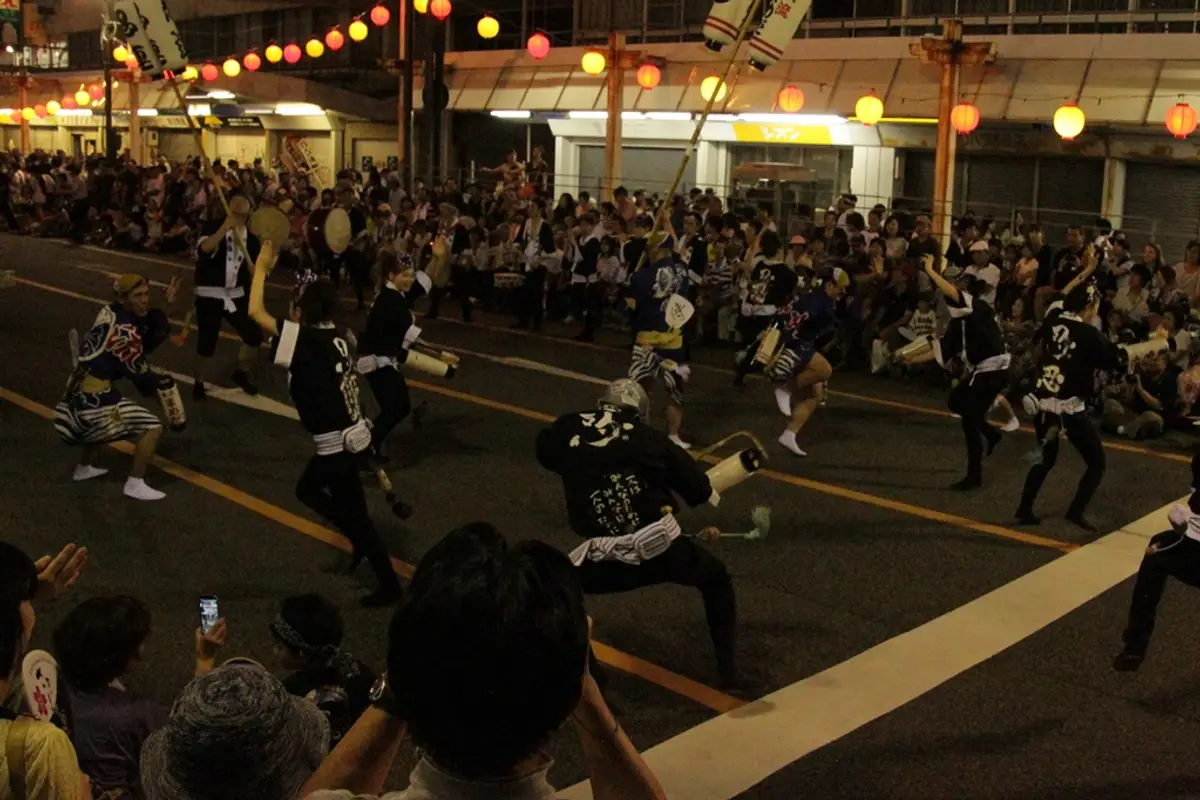
The famous call of Awa Odori is "Odoru aho ni miru aho, onaji aho nara odorana son son", roughly, "The dancing fool and the watching fool are both fools, so if you're a fool either way, you might as well dance." The music behind it, called zomeki, is a driving two-beat of shamisen, flute, big taiko drums, and a clanging kane bell. Of 36 voices about the chant and rhythm, the feeling was strongly, physically positive:
Over and over, people described the zomeki as something that bypasses your self-consciousness entirely:
あのぞめきを聞くと身体が勝手に反応する。 The moment you hear that zomeki, your body just reacts on its own.
The chant itself is meant lightly, and that lightness is the invitation:
「踊る阿呆に、見る阿呆。同じ阿呆なら、踊らにゃソンソン!」この言葉、半分冗談、でも半分本気。きっとあなたも、踊る阿呆になった瞬間にわかるはず。 "The dancing fool and the watching fool — same fool either way, so you'd be a fool not to dance!" Half a joke, but half serious. You'll understand the moment you become a dancing fool yourself.
Worried about shouting along in a language you don't speak? The call is short, just "Yattosā!", and the people who pushed through their shyness were glad they did:
かけ声の『やっとさー!』だけはサボらないようにちゃんと言えてた。最初は恥ずかしかったが、恥ずかしがってるほうが外から見て恥ずかしいので。 I made sure not to skip the "Yattosā!" call at least. It felt embarrassing at first — but being shy about it looks more embarrassing from the outside.
And if you feel that little knot of resistance, you are in extremely good company. One person put their finger on exactly what holds anyone back, and it has nothing to do with being a foreigner:
踊った方が得だろう、という優れた哲学だ。しかし、実行するとなると、これが難しい。邪魔なのだ、自身のプライド、恥、尊厳が。 "You might as well dance" is a fine philosophy. But actually doing it is hard. What gets in the way is your own pride, your shame, your dignity.
💡 The chant is the whole philosophy
"The dancing fool and the watching fool are both fools, so you might as well dance." It's said with a grin, but it's a real invitation. Shout the "Yattosā!" call, let the zomeki beat carry you, and the embarrassment dissolves.
🟡 Watch, Dance, or Both: Where to Do Each
You're completely free to just watch, and it's wonderful. The only thing worth understanding is where, because the festival has layers, and the small frustrations people mention all come down to being in the wrong one.
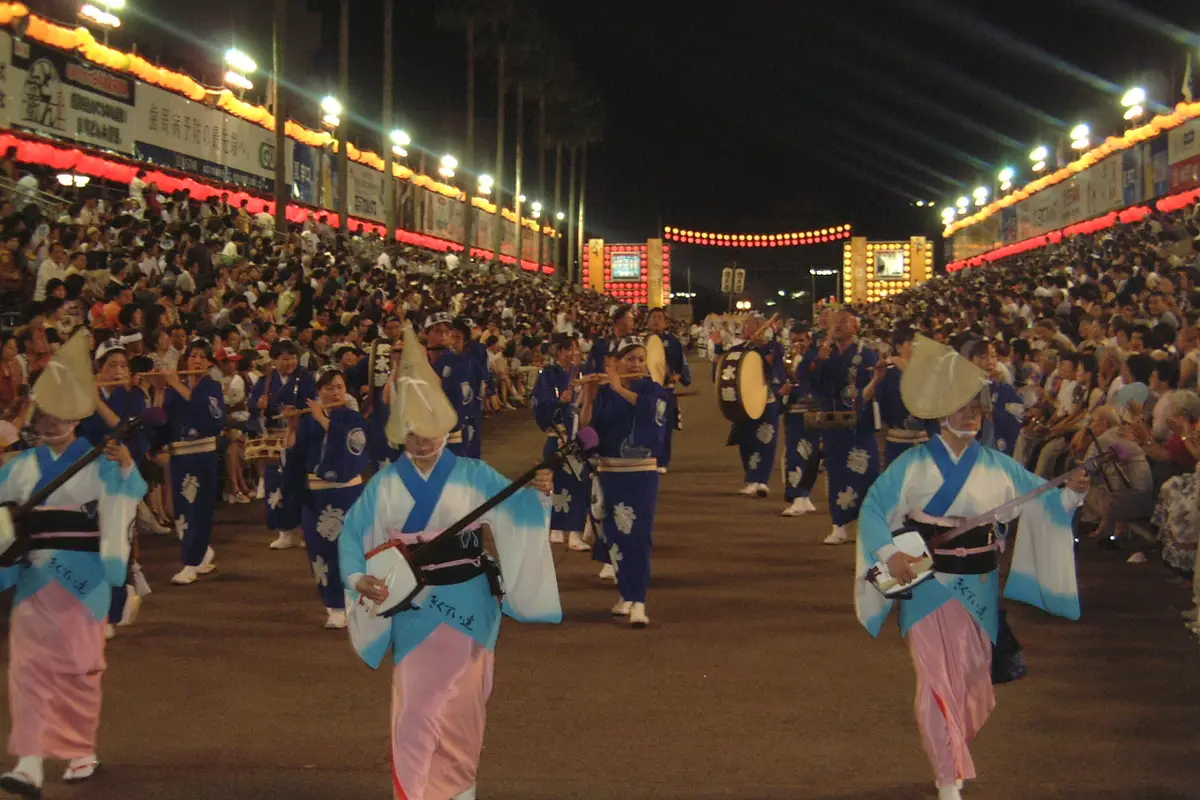
This is the one section that's genuinely practical, because Awa Odori isn't one event in one place. There are ticketed grandstand stages where polished famous troupes perform, free stages, and open street plazas where anyone, including you, can dance. Of 51 voices about watching, dancing, and where to do each, opinion was warm but more mixed, and the mix is the useful part:
First, the freeing part: the ticketed seats are a small slice of a huge, mostly-free festival.
有料席って、ごく一部なんです。街中広範囲を車両通行止にして、道路の上や橋の上や公園や広場や路地裏等、いたるところで踊る阿呆がいます。 Paid seats are only a tiny part of it. They close off streets across the whole town, and there are dancing fools everywhere — on the roads, the bridges, the parks, the plazas, the back alleys.
So where does the "bothered" feeling come from? Mostly from a mismatch of expectations at the paid grandstands. Some people buy a grandstand ticket specifically to watch the famous troupes (dancers who train all year) and feel shortchanged when a stage runs heavy on beginner groups instead. It's not anti-beginner; it's "I paid for the polished show." The takeaway for you is simply: the place to dance freely is the open street and the niwaka-ren, rather than a famous troupe's ticketed performance.
The second gripe is one you'll recognize from anywhere: people who block the view. This is really about photographers, and the feeling behind it is tender rather than territorial:
前でブルーシートを広げて、三脚を高く構えてずっと撮影されている方もいたり。それだと、遅れて来た地元の人が見られないじゃないですか。子どもたちには一番前で見てもらいたいですから。 Some people spread a blue tarp at the front and set up a tall tripod and film the whole time. Then the locals who arrive late can't see. I want the kids to be able to watch from the very front.
For the record on photos: dancers will often happily pose if you simply ask, so a friendly "may I?" goes a long way, and leaving the front row open lets late-coming locals and kids see too. (If you'd rather be a watcher than a dancer, by the way, that's a perfectly lovely way to do a Japanese festival: it's exactly how we'd approach Kyoto's Gion Matsuri, a festival built to be watched rather than joined.)
💡 Read the layers, and you can't go wrong
Ticketed grandstands are for watching the famous troupes; the free streets and the niwaka-ren are for dancing. The only real etiquette is to dance in the open spaces rather than a paid performance, and never block the people (and kids) behind you.
When and Where (and How to Find This Year's Details)
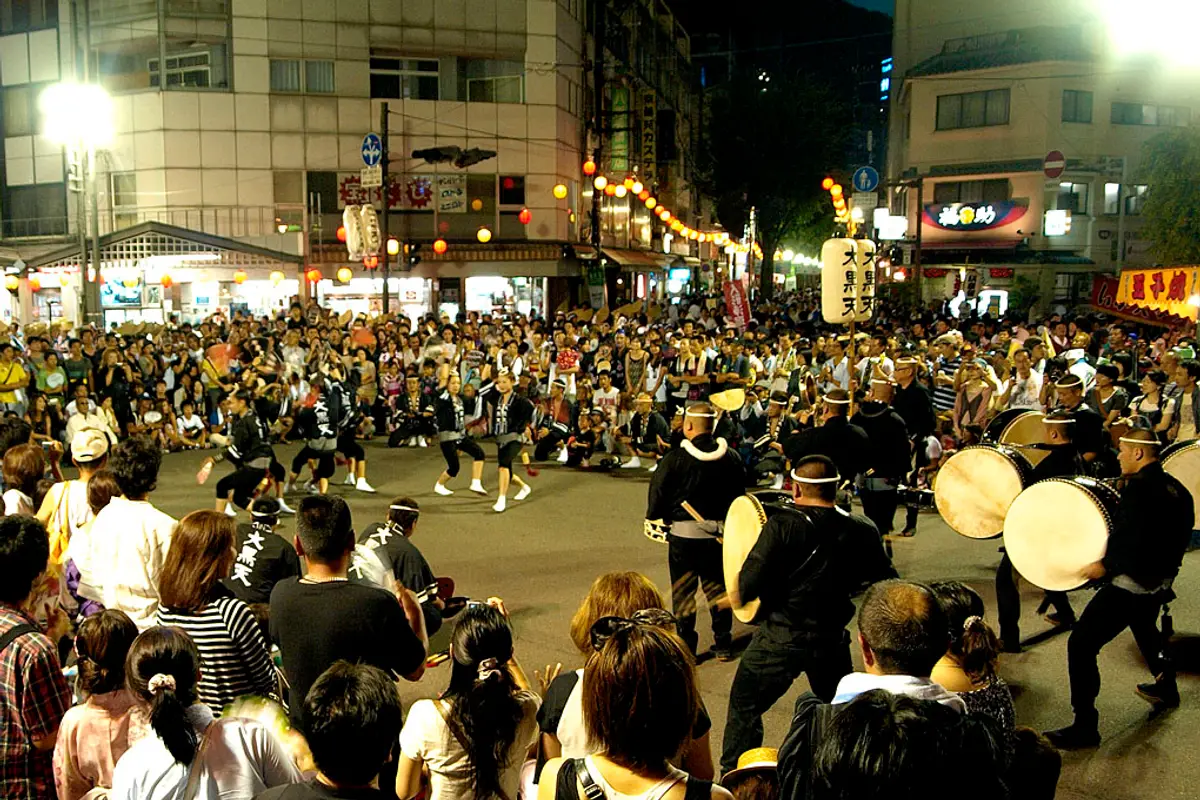
The main Awa Odori runs every year in Tokushima City, from August 12 to 15, the festival's own four nights, drawing close to a million people from across Japan and beyond. (Tokushima sits on the island of Shikoku; it's the home and namesake of the dance.)
The niwaka-ren runs on those festival evenings, with set gathering times each night. Recent years have gathered participants near the Awa Bank head office, about a ten-minute walk from Tokushima Station, where a famous troupe leads the lesson before everyone heads out to dance. Because the exact times, gathering point, and any seat details can shift year to year, the one genuinely useful thing to do before you go is check the official festival site for the current year rather than trust a fixed schedule, and there's no need to book or pay anything to take part.
If you're slotting Awa Odori into a wider trip, our month-by-month guide to visiting Japan can help you place mid-August (a season of festivals and heat) alongside everything else, and our look at where in Japan you're most warmly welcomed puts Tokushima's open-armed spirit in context.
The Bigger Picture
Step back from the niwaka-ren and the steps and the chant, and one gentle truth ties it all together, and it has almost nothing to do with Tokushima people being unusually outgoing.
It's a system, not a personality. "Anyone can dance" isn't a mood; it's built into the festival's bones. Awa Odori grew from the bon odori tradition (the communal summer dancing of Japanese festivals everywhere) where the whole point was that the circle has no entry requirements. Over 400 years it organized itself into ren, troupes you join, and then the organizers went one step further and built an official drop-in troupe, with a free lesson, specifically so that strangers could dance too. The basic step is a simple two-beat anyone's body can manage. And the festival's signature line has spent generations saying, out loud, you might as well dance. None of that requires anyone to be especially friendly in the moment. The structure does the welcoming for them.
And it was always meant to be a little wild. It's easy to look at the crisp grandstand formations and assume Awa Odori is a polished thing you'd need permission to touch. But the people who remember it longest remember the opposite. One person's grandmother, in her nineties, described the Awa Odori of her childhood like this:
昔はお盆になると、あっちこっちからお囃子が聞こえてきて、みんな家から出てきて好きに踊っていた。昔とはまるっと違うわよ。 Long ago, when Obon came, you'd hear the festival music drifting from every direction, and everyone would come out of their houses and just dance however they liked. It was completely different from now.
That memory is the festival's heart, and it cuts across the generations in a way that surprised us. Younger dancers, older organizers, lifelong locals, returnees who'd moved away and felt the pull of the zomeki from afar: the warmth toward outsiders joining didn't really split by age. If anything, the oldest voices were the ones insisting most fiercely that Awa Odori is, and always was, something you do rather than something you merely watch. As one local summed it up:
洗練された踊りと、好き勝手な踊り。どっちも良い。そしてどっちも阿波おどり。 The refined dancing and the dance-however-you-please dancing — both are good. And both are Awa Odori.
You don't need to know any of this to have a wonderful night in Tokushima. But it's why a visitor who jumps into a niwaka-ren is so genuinely loved. Without meaning to, you're doing the exact thing the festival has been about for four centuries: becoming, for one summer night, a dancing fool among dancing fools.
💡 The welcome is built in
Awa Odori's openness isn't a personality trait. A bon odori root, an official beginners' troupe, a step simple enough for anyone, and a 400-year-old chant that says you might as well dance: the festival itself invites you, so no one has to.
More Japanese Perspectives
Curious about other moments where a little understanding changes everything? These are built the same way, on hundreds of real Japanese voices.
- How to Blend In at a Japanese Summer Festival: bon odori, yukata, food stalls, and the general etiquette of any matsuri, from 325 voices.
- Gion Matsuri: What Kyoto Locals Really Think: if Awa Odori is a festival you join, Gion is one you watch. Here's how welcome Kyoto really makes you feel.
- Japan's Summer Has a Loud Side Too: the fireworks festivals that light up the same August nights, explained by 275 voices.
Share Your Experience
Have you danced, or watched, at Awa Odori, or another festival in Japan or your own country? We'd love to hear what it felt like. Your story helps us build a bridge between the people who travel here and the people who live here, and we may add new voices to this article.
Share your experience on Voice Box →
Sources
Primary Research Data
- WMJS Awa Odori research data (more than 180 Japanese-language voices collected June 2026), across five aspects:
- Jumping into a niwaka-ren: 33 voices
- Not knowing the steps: 32 voices
- The chant and the rhythm: 36 voices
- Watching, dancing, and where: 51 voices
- Generational differences: 48 voices
- (Some voices speak to more than one aspect; 183 are unique.)
Factual Sources (festival facts, Tier 1–2)
These public, official, and major sources were used to verify every factual claim in this article (the festival dates and scale, the niwaka-ren drop-in program and that it needs no costume, reservation, or fee, the chant and its meaning, the zomeki music and instruments, the basic two-beat step, and the paid/free venue structure).
- Tokushima Prefecture (official): Awa Odori overview, history, and instruments: https://www.pref.tokushima.lg.jp/en/japanese/natural_culture/traditional_culture/awa-odori
- Japan National Tourism Organization (JNTO): Awa Odori Festival, including the Niwaka Ren and "no costume required": https://www.japan.travel/en/spot/203/
- THE AWAODORI (阿波おどり未来へつなぐ実行委員会, the festival's official organizing committee): about the Niwaka-ren (no reservation, no materials, no fee): https://www.awaodorimirai.com/post/にわか連について
- THE AWAODORI: venues and seat categories: https://www.awaodorimirai.com/about-1-1
- Awa Navi (Tokushima Prefecture official tourism information): Niwaka-ren participation (casual clothing fine, lesson by a famous ren, no application/fee): https://www.awanavi.jp/archives/event/1730
- Awa Navi: paid and free performance stages and odori plazas: https://www.awanavi.jp/archives/event/1731
- Ministry of Land, Infrastructure, Transport and Tourism (MLIT) multilingual database: Awa Odori as a folk dance open to all, with an allocated niwaka-ren time: https://www.mlit.go.jp/tagengo-db/R2-01793.html
- Awa Odori Kaikan: definition of "famous ren" (有名連): https://www.awaodori-kaikan.jp/yumeiren
- Japanese Wikipedia: Awa Odori (chant wording, men's and women's dance, two-beat rhythm): https://ja.wikipedia.org/wiki/阿波踊り
Opinion Collection Sources
The following are places where real Japanese people shared their feelings about Awa Odori. They are not cited as factual authorities, but as public spaces where people spoke in their own words: public Japanese Q&A sites and community forums, personal blogs and travel journals, review sites, and social posts. Individual anonymous comments are gathered here under "Japanese voices" rather than attributed one by one.
Note on Quotations
Quotes from online platforms have been lightly edited for readability (fixing typos, formatting for clarity). The meaning and intent of each comment remain unchanged. Original sources are linked above.
WMJS is written in Japan, in English, with AI help. We check every page, but English is not our first language. If a sentence reads oddly, tell us. One sentence is enough.
Thank you. A person reads every note.
How well do you know Japan?
Built from 635 public posts by Japanese people
Want to know more? Ask Japanese people
Have a follow-up question about this topic? We'll ask real Japanese people.
Voice Box →