
Tenjin Matsuri: What Are You Really Watching on Osaka's River?
What you'll learn in this article:
- What more than 150 Japanese people said about Osaka's Tenjin Matsuri (天神祭): the boats, the fireworks, the crowds, and the meaning
- Why those lit boats crossing the river aren't a parade, and how knowing that changes everything you see
- Where to watch for free, what locals genuinely ask of you, and why Osaka is happier to have you there than you'd expect
If you're planning to catch Tenjin Matsuri on a July night in Osaka and you're not quite sure what you're looking at, relax. You don't need to understand every boat, drum, and lantern to belong on that riverbank. Honestly, even people who've lived in Osaka their whole lives can't explain all of it.
But here's the one thing worth knowing before you go, because it quietly changes the whole evening: Tenjin Matsuri is not a fireworks show. The line of lantern-lit boats moving slowly down the river is a sacred rite more than a thousand years old: a god of learning being carried out, once a year, to look over his city. The fireworks aren't the main event. They're an offering to him. Once you know that, the same night looks completely different.
What are you actually watching at Tenjin Matsuri, and is it okay to just show up and enjoy it? We gathered more than 150 Japanese voices about it. The clear answer: yes, come. Osaka loves sharing this. It's a 1,000-year-old Shinto festival of Osaka Tenmangu Shrine, where the deity Sugawara no Michizane rides a boat down the Ōkawa River while several thousand "offering fireworks" light the water. You don't need a paid seat, and you don't need to get it perfect. The only thing locals genuinely ask is wonderfully simple: take your trash home with you.
Quick Guide
| Your question | What Japanese people said | |
|---|---|---|
| 🟢 The big reframe | "What am I even looking at?" | Not a fireworks show. A sacred rite. A god of learning (Tenjin-san) is carried by boat down the river to bless the city. Knowing this is the whole experience. |
| 🟢 Where to watch | "Do I need a paid seat?" | No. Plenty of people watch for free from the riverbanks. Arrive early (late afternoon), pick a spot a little away from the launch, and plan your walk home. |
| 🟢 The boats | "What are those boats?" | About 100 boats: drums, music, and one carrying the deity. People on boats, bridges, and balconies trade a clapping call-and-response. Strangers, suddenly connected. |
| 🟢 The fireworks | "Why do these feel different?" | They're an offering to the deity, set off above the boats. The signature "red plum" bursts honor Michizane's beloved plum blossom. |
| 🟡 Manners | "Can I cheer? Be loud?" | Two moods: people quiet down and bow when the deity's boat passes; everyone cheers at the fireworks. Both are right. |
| 🔴 The one real ask | "What actually bothers locals?" | Litter. Every year residents beg visitors not to leave trash on the streets. Carry yours out, and you're a perfect guest. |
The one thing to remember: Osaka isn't watching to see if you understand the rituals. They're standing on the same riverbank, looking at the same boats and the same fireflies of light on the water. Learn just one thing (that the boats carry a god out to see his city) and you'll be seeing what they see.
How We Gathered These Voices
We gathered more than 150 Japanese-language voices across six aspects of Tenjin Matsuri: what the festival actually is, where to watch it, the boat procession (船渡御), the offering fireworks (奉納花火), viewing manners, and how people of different generations relate to it. We collected these from public Japanese Q&A sites, personal blogs and essays, social posts, and a community magazine from Osaka City.
A quick note: this isn't a controlled scientific survey. It's a collection of what real Japanese people said in their own words, on public platforms. The facts about the festival itself (its history, the meaning of the rituals, the dates, the deity) come from a separate set of sources: Osaka Tenmangu Shrine, the Osaka Convention & Tourism Bureau, Osaka City, and major news outlets, all listed at the end.
So, What Is Tenjin Matsuri, Really?
The one point almost every Japanese voice circled back to: the fireworks everyone photographs are, in a sense, the least important part. Tenjin Matsuri is the summer festival of Osaka Tenmangu Shrine (大阪天満宮), dedicated to Sugawara no Michizane, a real 9th-century scholar and statesman who, after his death, came to be worshipped as Tenjin-san (天神さん), the god of learning. For over a thousand years (the river ritual traces back to the year 951), the people of Osaka have staged a grand procession to carry the deity out of the shrine and let him survey his city, by land and by water, to confirm that all is well. It's counted as one of Japan's three great festivals, alongside Kyoto's Gion Matsuri and Tokyo's Kanda Matsuri.
That's the layer most visitors miss. And, it turns out, many Japanese people too.
Of the voices we read about "what is this festival," not one was negative. The split was simply between people who feel the sacred weight of it, and people gently pointing out that the meaning is slipping out of view:
「花火大会」ではないのです!でもほんと神事なんですね。神社の祭礼行事です。 It's not a "fireworks show." It really is a sacred rite — a shrine ceremony.
神様(天神様)に氏地の平安を御覧いただこうと、氏子たちが御迎えの行列を組んだのが陸渡御・船渡御の始まりだそうです。御鳳輦(ごほうれん)と呼ばれる御車に天神様が乗っていらっしゃると考えられていて、これを中心とした、陸と川の行列が陸渡御、船渡御です。 They say the land and river processions began when the parishioners formed a welcoming procession so the deity could look upon the peace of his lands. The deity is believed to ride in a sacred carriage called the gohōren, and the land and water processions move around it.
A few people worried, with real tenderness, that the meaning is fading, enough that one community started holding lectures about it:
「神事だと知らず、ただの花火大会と思っている人が増えた」と感じ、天神祭の由来や意味を知ってもらうため、講演会を開くことにした。 Feeling that "more and more people don't know it's a sacred rite and think it's just a fireworks show," they decided to hold lectures so people could learn where Tenjin Matsuri comes from and what it means.
So if you arrive knowing even a little (that this is a god of learning being carried out to bless his city), you're not just a spectator. You're seeing the festival the way the people beside you wish more people would.
💡 The reframe that changes everything
Tenjin Matsuri is the festival of Osaka Tenmangu Shrine, honoring Sugawara no Michizane, the god of learning. For 1,000+ years, Osaka has carried him out by boat once a summer to look over his city. The fireworks are simply an offering to him.
The Boats: What You're Looking At on the Water
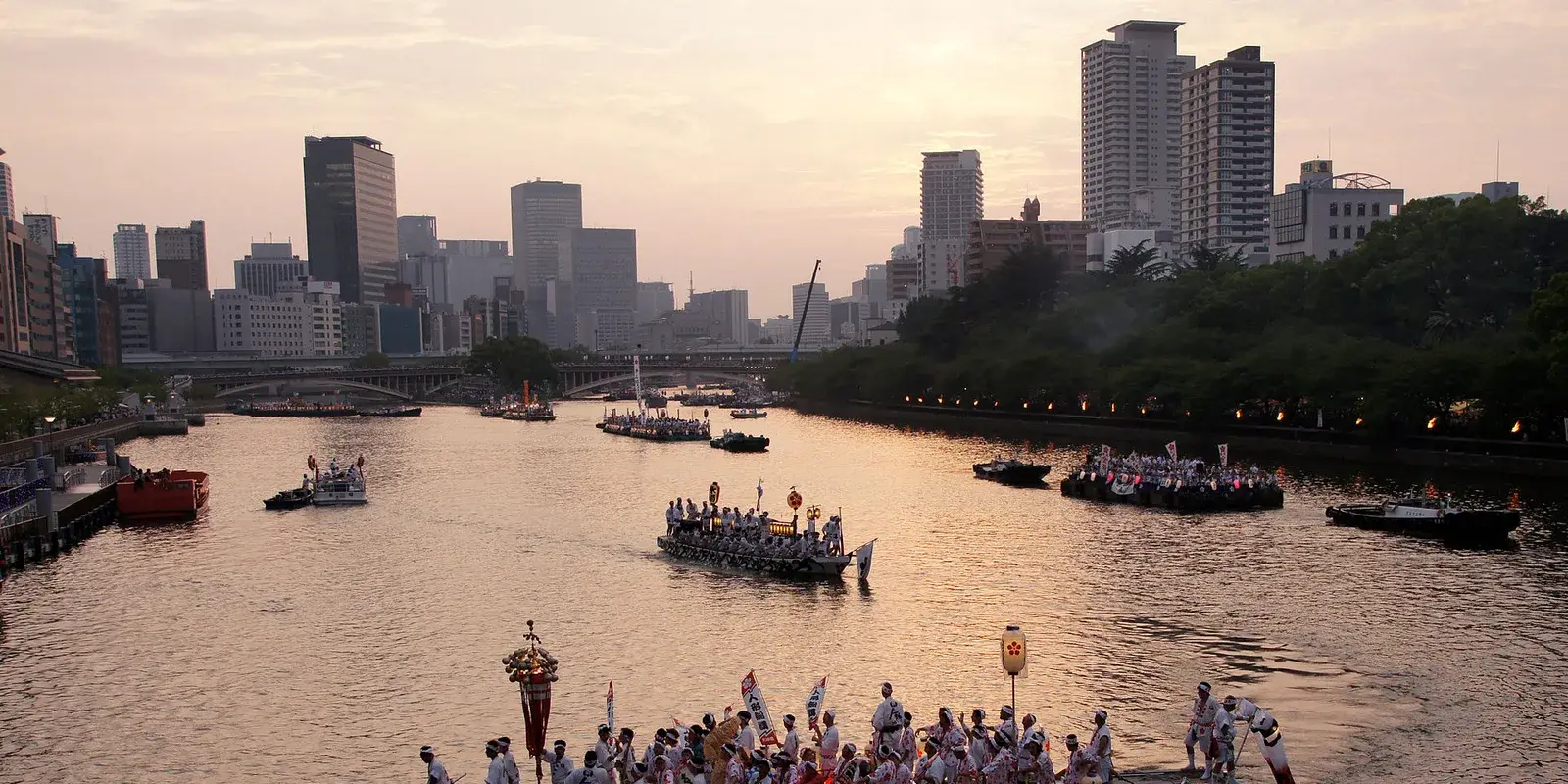
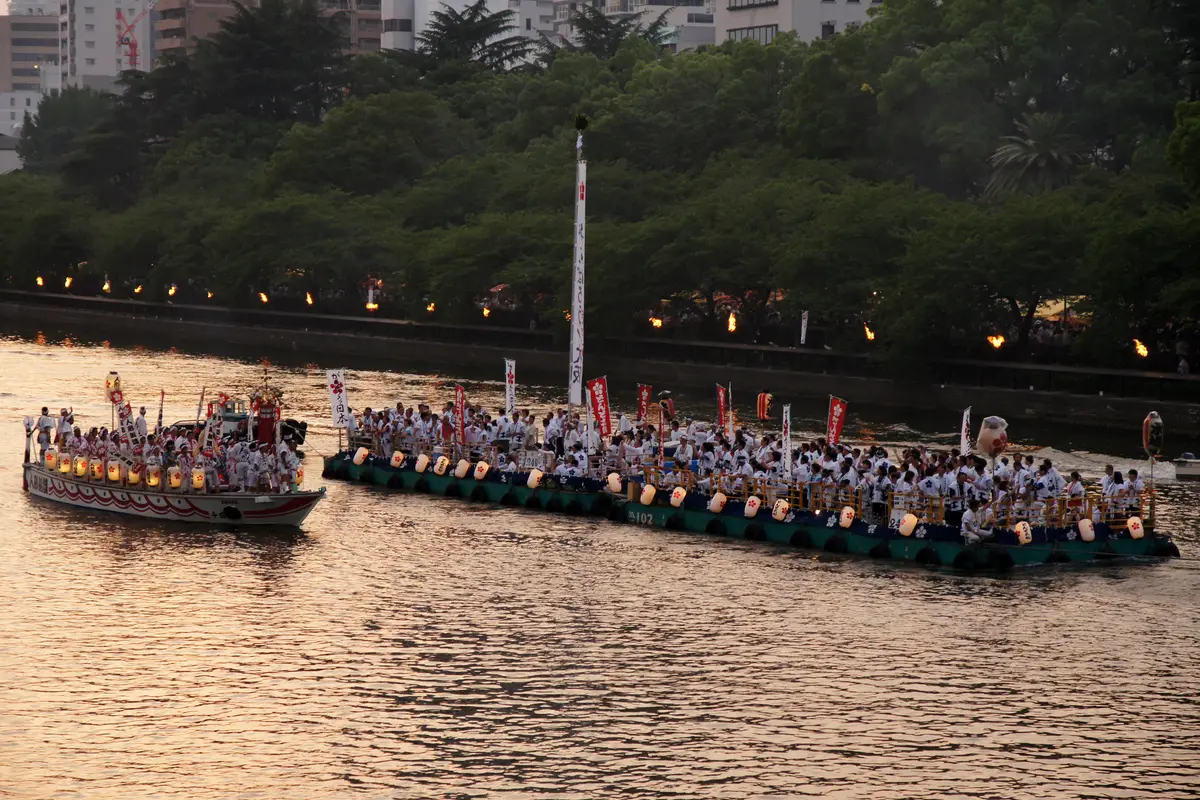
The heart of the festival is the funatogyo (船渡御): the boat procession. After evening falls on July 25, about a hundred boats move along the Ōkawa River: drum boats, music boats, worship boats, and at the center, the sacred boat carrying the deity's spirit. They don't roar along on engines; many are towed slowly, drifting. And that slowness, more than anything, is what people remember.
The voices here were almost pure wonder:
神様を乗せた御神霊船を中心に、100艘ほどの船が大川を巡行する、天神祭のメイン行事のひとつ。そのゆったりとした速度が、かえって気持ちをほどいてくれるような心地よさがありました。 About a hundred boats move along the Ōkawa around the central boat carrying the deity's spirit. That unhurried pace, somehow, had a comfort to it that loosened something inside me.
100隻の大船団のかがり火がなんとも言えず幻想的で、歴史の深さを感じさせる素晴らしい祭だなと改めて感じました。 The bonfire torches of the hundred-boat fleet were indescribably dreamlike — it struck me all over again what a wonderful festival this is, with such deep history.
And then there's the part that surprises everyone: the Ōsaka-jime, a rhythmic clapping call-and-response. As boats pass each other, and as they pass the crowds on the banks, the bridges, and the apartment balconies, both sides trade claps and shouts, over and over. People described it as the moment the crowd stopped being a crowd:
うちま〜しょ パチパチ!もひとつせ パチパチ!いおうてさんど パパっパチ。リズムを合わせた手拍子が、大川の水面に広がっていくようで、会ったこともない人たちとの心の距離が、ふっと近づく感覚がありました。 "Let's clap" — clap-clap! "One more" — clap-clap! "And once more to celebrate" — clap-pa-clap. The rhythm rippled out across the river's surface, and I felt the distance between me and people I'd never met suddenly close.
There's also a quieter beat woven through it, and it tells you everything about how the two moods of this festival fit together:
天神祭船渡御ではご神霊を載せた奉安船とまぢかに行き違う。そのときは人々もおしゃべりを止めて、きちんと拝礼をして柏手を打つ。これほどご神霊を近くに感じられる機会はふだんはない。 During the boat procession you pass close by the boat carrying the deity's spirit. At that moment people stop chatting, bow properly, and clap in prayer. There's rarely another chance to feel the deity this near.
If you can't explain which boat is which, you're in excellent company. Plenty of locals can't either. You don't need to. Watch the slow lights on the water, clap back when the boats clap to you, and you've understood the most important thing.
💬 What do you think?
Japanese readers: How do you feel about this?Visitors: Have you experienced this in Japan?
Share your voice →The Fireworks Are an Offering, Not a Show
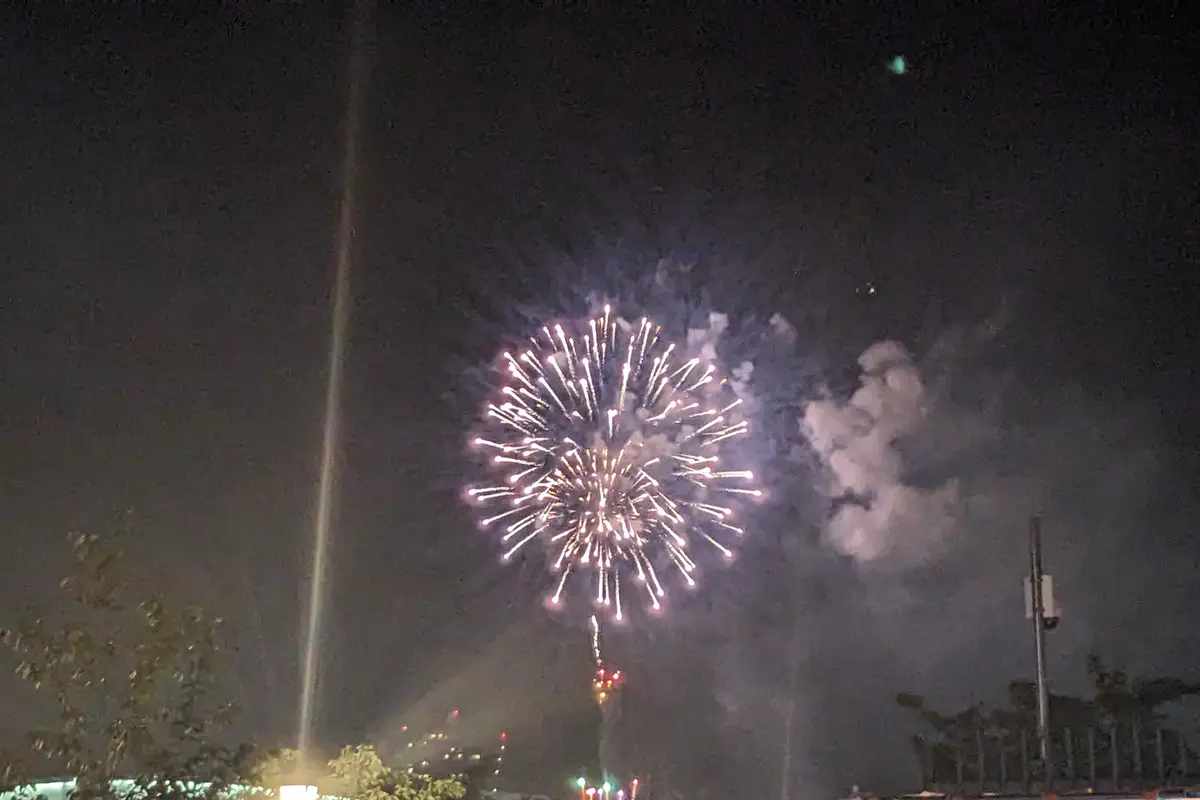
This is the second thing that quietly reframes the night. Tenjin Matsuri's fireworks (several thousand of them, somewhere around 3,000 to 5,000 depending on the year) are hōnō hanabi (奉納花火): an offering to the deity. They rise above the river to accompany the boat procession, and the festival's signature burst is the kōbai (紅梅), a "red plum blossom" shaped firework, named for the plum flower that Michizane loved all his life and that became his emblem. So when the sky fills with crimson blossoms over the water, that's not a finale effect. It's a flower being offered to a god.
One person who watched from a boat on the river put the whole idea perfectly:
その花火は、神様に向けた"奉納"としてのもの。私たちが見るのはあくまで「おすそ分け」とのことですが、それでも空を見上げるだけで、心が沸き立ちます。 Those fireworks are an "offering" directed at the deity. What we get to see is really just a "share" passed down to us — and even so, just looking up at the sky makes my heart leap. — A first-time boat rider
That word, "おすそ分け" (osusowake), a share passed along to you, is such a gentle way to hold it. The fireworks were never really for the audience. You're being let in on something offered to someone else. And the setting makes it unforgettable, because the fire and the river meet:
川の上から見る花火は、まるで自分のすぐ上に咲いているよう。静かにゆらゆらと揺れる船の上で、夜空と水面がつながって見えました。 Seen from on the water, the fireworks looked like they were blooming right above me. From the gently rocking boat, the night sky and the river's surface seemed to join into one.
This is exactly the place where Tenjin Matsuri parts ways with an ordinary fireworks night. If you want the full story of how Japanese people experience fireworks in general (the shouts of "tamaya," the yukata, the shared gasp), our guide to Japanese fireworks festivals covers that beautifully. Tenjin Matsuri keeps all of that, and adds a layer underneath it: every burst is addressed to a thousand-year-old god riding the river below.
💡 Why these fireworks feel different
They're an offering (奉納) to the deity, set off above the boat procession, and the signature "red plum" bursts honor the plum blossom, Michizane's lifelong emblem. As one viewer learned, the audience is simply getting "a share" of something meant for a god.
Where to Watch (and Why You Don't Need a Paid Seat)
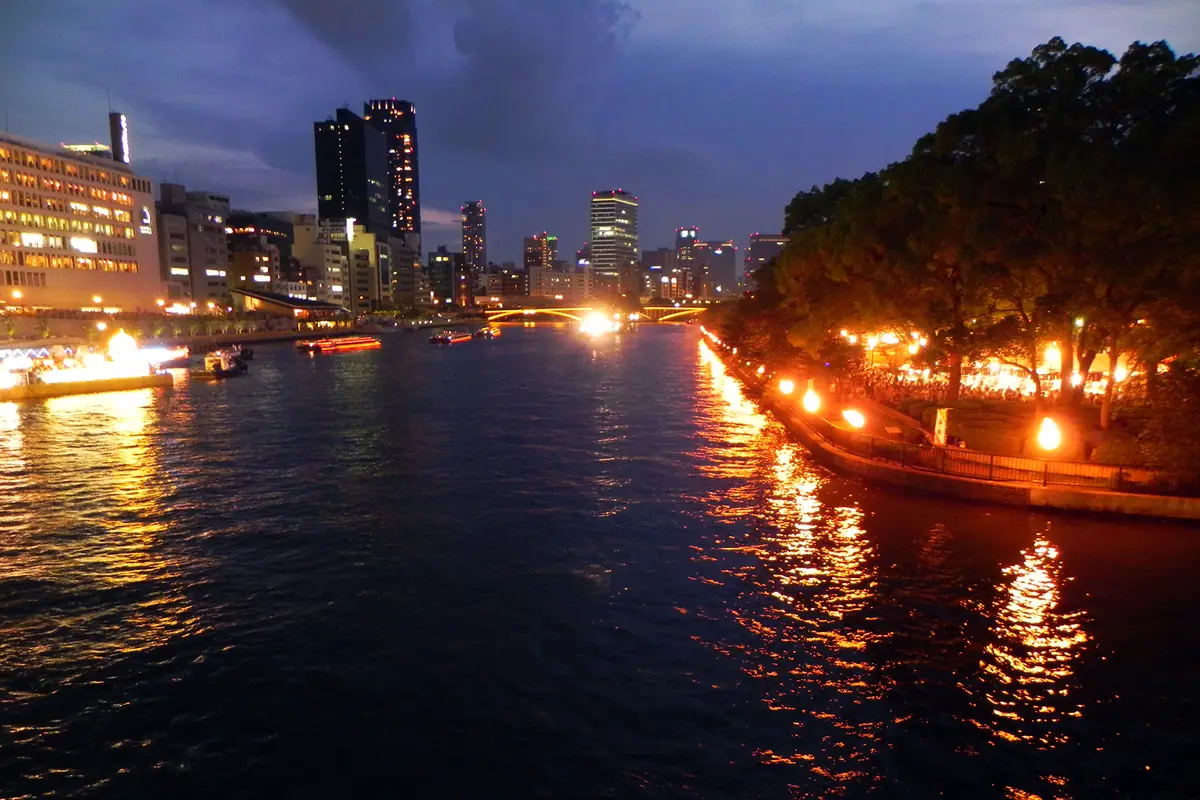
Now the practical question almost everyone actually worries about: where do I stand? The reassuring headline is that you can absolutely watch the boats and fireworks for free from the riverbanks, but it's genuinely crowded (around 1.3 million people come over the two days), so a little planning goes a long way.
The happiest voices had all figured out the same trick: pick a spot a little away from the launch points, and trade a perfect view for room to breathe.
川崎橋の東側。打ち上げ場所から少し離れているため、あまり混雑していません。人込みを避けて花火鑑賞したい方にお勧めです。 The east side of Kawasaki Bridge. Because it's a bit away from the launch site, it isn't too crowded — recommended if you want to watch away from the crush.
テントと木の間からええ感じに花火がチラ見え。全部が見えるわけではないけれど、ゆったり座って見られるし、密も避けられるし、風通しよくて快適。 The fireworks peeked nicely through the tents and trees. You can't see all of them, but you can sit comfortably, avoid the crush, and it's breezy and pleasant.
若干、マンションに隠れていますが充分楽しめます。 A building blocks part of it, but you can enjoy it plenty.
The neutral voices weren't unhappy. They were just honest about logistics. The recurring wisdom: come in the late afternoon to claim a spot, bring something to sit on, and remember that getting home afterward takes patience.
桜ノ宮駅より北側。人気のため、早めの時間16時頃〜には行って場所取りすることをオススメします。 North of Sakuranomiya Station. It's popular, so I recommend arriving early — around 4 p.m. — to claim your spot.
雑踏を抜けて駅まで戻るのにかなり時間が掛かると考えて行動することと、到着時に帰りの切符を用意しておく事ですね。 Plan for the fact that getting back through the crowds to the station takes quite a while — and buy your return ticket when you arrive.
And the frustrated voices? They're worth hearing too, because they tell you what to avoid. The honest disappointments clustered around two things: showing up late to a packed launch-side spot, and overpaying:
期待していた花火ですが、見えるポジションが限られているようです。天満橋で観ましたが、ビルの間にちらっと見える程度でがっかり。京橋や桜ノ宮まで寄った方がよいですね。 I'd looked forward to the fireworks, but the spots with a real view seem limited. I watched from Tenmabashi and only caught glimpses between the buildings — disappointing. Better to head over toward Kyōbashi or Sakuranomiya.
有料席を買いましたが、群衆が多すぎて入り口までたどり着けませんでした。 I bought a paid seat, but there were so many people I couldn't even reach the entrance.
The takeaway from all 56 voices is encouraging: you do not need to spend money or fight for the closest spot. A relaxed riverbank a little upstream, claimed in the late afternoon, beats a packed front-row crush almost every time. For fitting the late-July trip into the rest of your plans, our month-by-month guide to visiting Japan and our guide to getting around can help, and note that the train lines along the river get extremely busy right after the fireworks.
💡 The free-spot strategy
Skip the paid seat and the front-row crush. Pick a riverbank a little upstream of the launch points, arrive in the late afternoon with something to sit on, and expect the walk home to take a while. Trading a "perfect" view for breathing room is what the happiest watchers do.
Can I Cheer? Be Loud? The One Thing Locals Actually Ask
Here's a worry we saw a lot: is this a solemn religious thing where I have to be silent, or a party? The lovely answer is: both, at different moments, and you'll feel which is which. But there's also one honest request that came up again and again, and it has nothing to do with noise.
On the "join in" side, the festival is openly, warmly celebratory. Cheer at the fireworks. Clap back in the Ōsaka-jime. Wave at the boats, and watch what happens:
すごい迫力と花火の近さ、火の粉が感じられるくらい。橋に手を振ったら皆振り返してくれるし、環状線は船を乗客に見せるために鉄橋で止まってるし、花火の間ずっとゆっくり運転だし、大阪人の天神祭り愛を見せつけられました。 Incredible power, the fireworks so close you could feel the sparks. When I waved from the bridge, everyone waved back; the loop-line train even stopped on the railway bridge to show the boats to its passengers, and ran slowly all through the fireworks. Osaka's love for Tenjin Matsuri was on full display.
And the quiet side is just as real. It arrives on its own when the deity's boat passes, the way people naturally hush in a shrine. (If you've ever felt how Japanese people quiet down in certain spaces, this is the same instinct.) You don't have to manage the switch between the two moods. The crowd does it for you; just follow.
Which leaves the one genuine request. Across our voices, the single most common frustration (by a wide margin) wasn't about visitors at all. It was about litter:
天神祭来てる人、お願いだからゴミはちゃんと所定の場所に捨てて! To everyone coming to Tenjin Matsuri — please, just put your trash in the right place!
ボランティアさんが朝から掃除してくれてる。最低限自分のゴミくらいはちゃんと捨ててって欲しいですな。 Volunteers are out cleaning from early morning. I just wish people would at least take care of their own trash.
It sounds small, but it's the thing that genuinely wears on the neighborhood, and it's the easiest possible kindness to offer. Japan famously has very few public trash cans, and at a festival of over a million people they overflow fast, so the real move is to bring a small bag and carry your trash back to your hotel. Do that, cheer at the fireworks, bow when the boat passes, and you are, by the festival's own standards, a wonderful guest. None of the rest has to be perfect; this is the one that counts.
💡 The only rule that really matters
Cheer at the fireworks, clap in the Osaka-jime, quiet down when the deity's boat passes: the crowd will guide you. The single thing locals genuinely ask is the easiest: bring a bag and carry your trash home.
The Bigger Picture
Step back from the boats and the fireworks, and a single, gentle logic ties the whole festival together, and it has almost nothing to do with "Osaka people being warm by nature."
It's a system more than a personality. Every piece of the festival traces back to one idea: once a year, the god of learning is carried out of his shrine to look over his city and bless it. That's why there's a boat for the deity's spirit, why people bow when it passes, why the fireworks are an offering rather than a show, and why the whole thing moves at the slow, deliberate pace of a procession rather than a concert. You don't have to memorize the parts. The purpose writes the meaning for you.
Even Japanese people arrive not quite knowing, and find they belong anyway. This was one of the most reassuring things we read. Some Japanese visitors confessed they came for the food and fireworks and only later realized it was a religious rite; one wrote that they'd "never really come to a festival as a sacred event before," and resolved to read up before next year. Another even wondered, with real honesty, whether an outsider watching a religious festival "for fun" was quite right, and then discovered, standing there in the crowd, that they were welcome after all. If a Japanese person can feel unsure whether they belong and still be embraced, so can you.
And the warmth is real, and it crosses generations. In a community magazine, an older Osaka local described sitting by the lanterns every year, waiting for strangers to ask what the old characters mean, and lighting up when they do:
死んだ親父がね、ここに座ってたら、必ず誰かが聞いてくるから覚えとけちゅうて、教えてくれたんですわ。 My late father told me: if you sit here, someone's always going to ask, so learn it well. That's how he taught me. — An older Osaka local
That's the festival in one sentence. An old man, passing down what his father passed to him, hoping a stranger will ask, so he can hand the meaning along again. The visitor who asks isn't an intrusion. They're the reason the knowledge stays alive. You being curious on that riverbank is, quietly, part of how a thousand-year-old festival keeps going.
千年以上、形を変えながら続いてきたお祭りと、この街で暮らしてきた人たちのことが思われて、大阪は水運の街なんやというのを実感した。 I found myself thinking of this festival that's continued for over a thousand years, changing shape as it went, and of the people who've lived in this city — and I really felt that Osaka is a city built on its waterways.
You don't need to understand all of this to enjoy a Tenjin Matsuri night. But it's why a curious, considerate visitor is so genuinely welcome. Learn one thing (that the boats carry a god out to see his city), carry your trash home, and clap back when the river claps to you. You'll be doing exactly what the people around you have done for a thousand summers.
💡 The meaning writes itself
Tenjin Matsuri isn't about national character. Once a year, a god of learning is carried by boat to look over Osaka: that one purpose explains the slow boats, the bows, and the offering fireworks. Be curious and considerate, and you're already doing it right.
More Japanese Perspectives
Curious about other moments where a little understanding goes a long way? These are built the same way, on hundreds of real Japanese voices.
- Japanese Fireworks Festivals, the shouts of "tamaya," the yukata, the shared gasp: how Japanese people experience fireworks in general, from 275 voices.
- How to Blend In at a Summer Festival: yukata, food stalls, and joining the dance, explained by 325 Japanese people.
- Tanabata, the Star Festival: another summer night where your participation means more than you'd think.
- Visiting Temples and Shrines: the gentle instinct behind bowing when the deity's boat passes.
Share Your Experience
Have you been to Tenjin Matsuri, or watched another Japanese festival from the riverbank? We'd love to hear what it was like. Your story helps us build a bridge between the people who travel here and the people who live here, and we may add new voices to this article.
Share your experience on Voice Box →
Sources
Primary Research Data
- WMJS Tenjin Matsuri research data (more than 150 Japanese-language voices collected June 2026), across six aspects:
- What the festival is: 17 voices
- Where to watch (free spots, crowds, paid seats): 56 voices
- The boat procession (船渡御): 31 voices
- Viewing manners (the two moods, and litter): 37 voices
- The offering fireworks (奉納花火): 6 voices
- Generational connection: 10 voices
Factual Sources (festival history, rituals, dates, and figures, Tier 1-2)
These public, official, and major-media sources were used to verify every factual claim in this article (the dates, the deity and shrine, the origin and history, the boat and land processions, the meaning of the offering fireworks and the "red plum" display, the crowd size, and the viewing arrangements).
- Osaka Tenmangu Shrine, official Tenjin Matsuri overview: https://osakatemmangu.or.jp/saijireki/tjm
- Osaka Tenmangu Shrine, about the 2026 festival: https://osakatemmangu.or.jp/4077
- Osaka Tenmangu Shrine (official site): https://osakatemmangu.or.jp/
- Osaka Convention & Tourism Bureau (OSAKA INFO), Osaka Tenmangu / Tenjin Matsuri: https://osaka-info.jp/spot/osakatenmangu/
- Osaka Convention & Tourism Bureau (OSAKA INFO), Tenjin Matsuri event page: https://osaka-info.jp/event/osakatenmangu-tenjinsai/
- Discover Osaka (OSAKA INFO, English), Tenjin Matsuri explainer: https://discover.osaka-info.jp/en/articles/tenjin-matsuri-festivals
- Osaka City, Kita Ward Office, Tenjin Matsuri visitor guide: https://www.city.osaka.lg.jp/kita/page/0000001108.html
- Dazaifu Tenmangu, Tenjin-sama and the plum (Michizane-plum connection): https://www.dazaifutenmangu.or.jp/about/tenjinsama-ume
- Kansai TV (Kantele), 2025 Tenjin Matsuri crowd report: https://www.ktv.jp/news/feature/250725-tenjin/
- Nikkei, Tenjin Matsuri boat procession (2019): https://www.nikkei.com/article/DGXMZO47785900V20C19A7000000/
Opinion Collection Sources
The following are places where real Japanese people shared their feelings about Tenjin Matsuri. They are not cited as factual authorities, but as public spaces where people spoke in their own words: public Japanese Q&A sites and community forums, personal blogs and essays, social posts, and a community magazine published by Osaka City. Individual anonymous comments are gathered here under "Japanese voices" rather than attributed one by one.
Note on Quotations
Quotes from online platforms have been lightly edited for readability (fixing typos, formatting for clarity). The meaning and intent of each comment remain unchanged. Original sources are linked above.
WMJS is written in Japan, in English, with AI help. We check every page, but English is not our first language. If a sentence reads oddly, tell us. One sentence is enough.
Thank you. A person reads every note.
How well do you know Japan?
Built from 635 public posts by Japanese people
Want to know more? Ask Japanese people
Have a follow-up question about this topic? We'll ask real Japanese people.
Voice Box →