
Matsumoto Castle — Why a Fortress Built for War Has a Room for Watching the Moon
Matsumoto Castle
By Kei · Born and raised in JapanThe Meaning
Stand in front of most of Japan's famous castles and you are looking at concrete. Osaka, Nagoya, and dozens of others were rebuilt in steel and concrete in the twentieth century, after war and fire took the originals. They are faithful on the outside and modern within: elevators, glass cases, smooth flat floors.
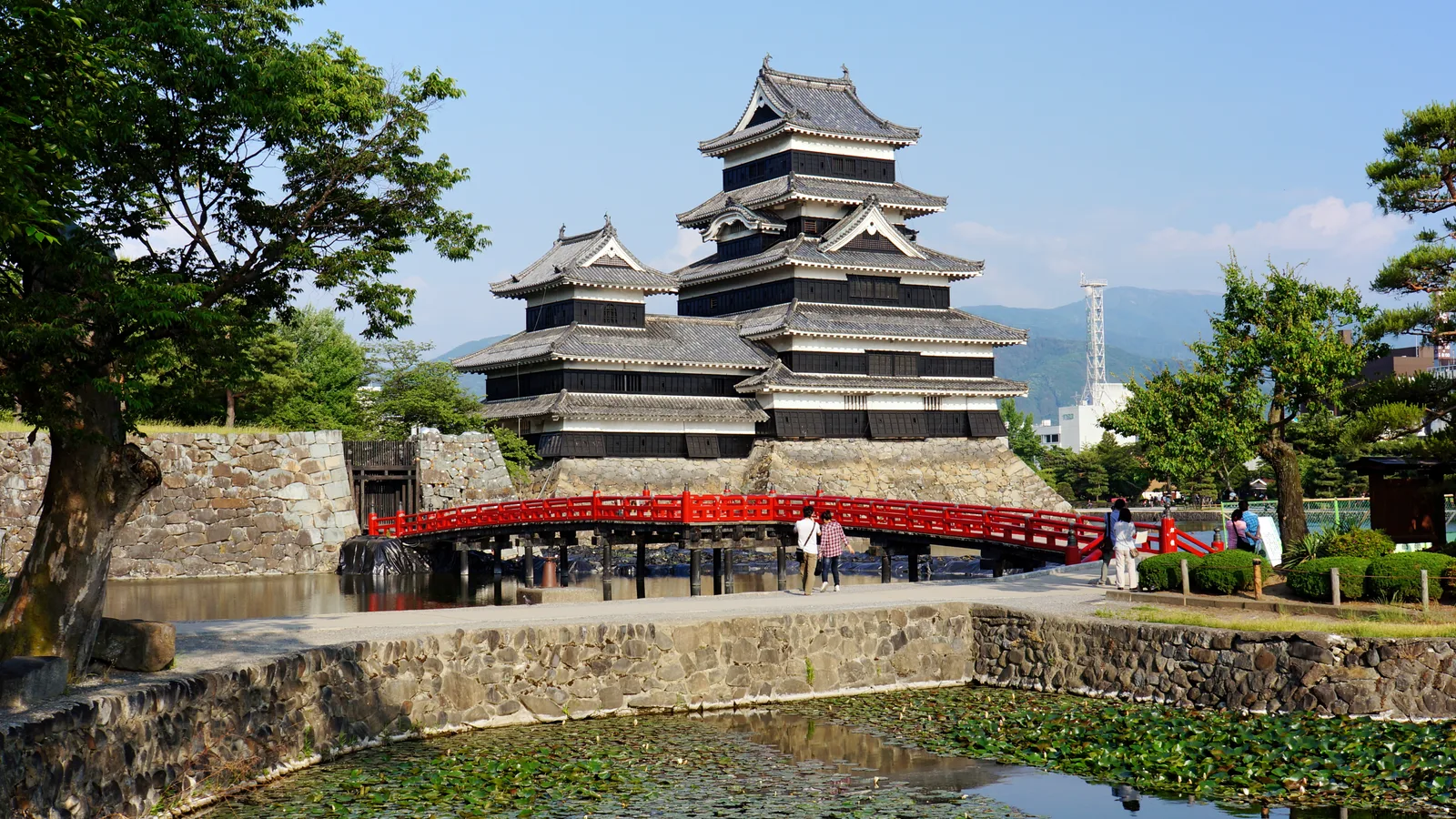
Matsumoto is not one of them. The black tower standing over the water in front of you is wood. It is the same timber frame raised in the 1590s (by the city's own account, the main keep, the small north keep and the passage that joins them were built around 1593 to 1594), never torn down and never rebuilt. Out of all the castles in Japan, only twelve still keep their original main keep standing; almost everything else a traveler calls "a castle" is a careful replica. Matsumoto is one of those twelve, and it is the oldest five-tier, six-story keep among them. The most complete of the twelve is the white-walled keep at Himeji to the west (a bright counterpoint to Matsumoto's black), and the northernmost is the small keep at Hirosaki, far up in Tohoku. All of it is real.
That changes what you are walking toward. You are not visiting a model of a castle. You are about to climb the actual building, and the first thing to know about it is that it was built for war.
Look at how black it is. The lower walls are clad in boards finished with black lacquer, a skin that throws off the rain a plaster coat alone could not survive in this climate. Behind that black are walls nearly thirty centimeters thick on the lower floors: thick enough, the castle notes, that a matchlock ball will not pass through them. Set into them are 115 slots for guns and arrows and eleven openings to drop stones on anyone climbing the base. The inner moat in front of you is about sixty meters wide, and that is not decoration either: it is the effective range of a matchlock gun, drawn in water. This is a fortress that thought carefully about the distance at which it could kill you.
And then the wars it was built for never came. By the time the keep was finished, Japan's long age of war was ending, and the peace that followed lasted more than two centuries. So a strange thing happened to this black war-machine: about forty years after the keep went up, in the quiet of the early Edo years, a lord added a room to it with almost no defenses at all: a Tsukimi Yagura, a moon-viewing tower, with an open veranda and a railing lacquered bright vermilion, built for nothing more warlike than watching the moon rise over the eastern mountains. A castle of two ages, the war structures and the peace structure joined into one building, is something the castle calls unique in Japan. Keep that joined shape in mind as you walk in. You are about to climb a fortress that, somewhere along the way, learned to look at the moon.
What Happens When You're There
Step 1: The Black Walls Across the Moat
You reach the castle on foot. It is about a fifteen-to-twenty-minute walk north from Matsumoto Station, through a city that sits in a high mountain basin, and you come on the castle the way it was meant to be come upon: across water. Unlike most surviving keeps, which crown a hill or a mountain, Matsumoto is a hirajiro, a castle built on the flat. There is no climb to it and no ridge it hides behind. It simply stands at the edge of its moat, on the open plain it was built to govern.
Stop at the water before you go in. From here you get the view the whole city is known for: the black keep doubled in the moat below it, a single vermilion bridge crossing the water to one side, and, on a clear day, the snow-edged peaks of the Northern Alps standing up behind the roofs. It is one of the most photographed sights in Japan, and the reason it exists is the flatness. A hill castle keeps its mountains at its back, out of the frame. A castle on the plain stands free, so the city's own mountains can rise behind it and the still moat can hold its reflection. The picture everyone takes here is not an accident of beauty. It is what a flatland fortress looks like when the fighting is over.
Step 2: Through the Black Gate
There is only one way in to the keep now: through the Kuromon, the Black Gate, on the far side of the bridge from the famous view. You cross into the Honmaru, the inner bailey, and the keep fills the space in front of you: five tiers of roofs outside, six floors within, rising 29.4 meters from the ground to the ridge.
The lawn you are standing on is worth a second look, because it is the answer to a question you will ask later, at the top. This open ground was once the Honmaru Goten, the inner palace, where the lord actually lived and worked. The great black keep was never a house. It was the watchtower and the last redoubt (the place you fell back to if everything else was lost), which is why everything around it was built to slow an enemy down. The castle was wrapped in three rings of water in its day, an inner, an outer, and a great outer moat, with earthworks and walls between them and the warriors' quarters filling the ground inside. On soft basin soil this was hard to build; the thousand-ton keep rests on sixteen buried hemlock pillars sunk into its stone base to keep it from sinking. You are looking at a defense improvised out of water and timber because there was no mountain here to do the job. Now walk to the foot of it, and take off your shoes.
Step 3: Climbing the Keep
At the entrance you remove your shoes, slide them into a bag, and carry them with you: the same instinct that runs through the Japanese habit of taking shoes off indoors, here protecting floorboards that are four hundred years old. You climb the rest of the way in your socks, and this is the honest part: it is hard. There is no elevator and there never can be in a National Treasure, so you go up roughly 140 steps on stairs that are steep and narrow, closer to ladders than staircases in places. The steepest of them, between the fourth and fifth floors, rises at sixty-one degrees. On a busy day the line backs up on these stairs, and the bare wood is cold and a little slippery under your socks. None of this is a flaw. The stairs were built this steep on purpose, to slow an armored attacker; if your legs are burning, you are climbing exactly the obstacle they were meant to be.
As you go, the building keeps telling you what it was for. The second floor holds racks of matchlock guns and the narrow barred windows they were fired through. One floor has no windows at all: a dim, hidden story tucked under a sweep of roof, used in war as a storehouse and a place to shelter. Higher up is a small room that was the lord's seat if it ever came to a siege, and a wider hall where his retainers would have held their councils of war. You are climbing through the inside of a weapon, and it does not pretend otherwise. That plainness catches some visitors off guard: there is no furniture up here, no recreated rooms, just timber and light. But the emptiness is the most honest thing in the building. It was never furnished, because no one was ever meant to live in it. What you are walking through is the truth of the place, left exactly as it was.
Step 4: The Moon-Viewing Room
Then, on your way through, you reach a room that does not belong to any of this, and that is the point.
The Tsukimi Yagura, the moon-viewing tower, was added to the keep in the early Edo years, about forty years after the fortress was built, in a time with no more wars to fight. The lord Matsudaira Naomasa is said to have begun it in 1633 to receive the visiting shogun Iemitsu, who was expected to stop at Matsumoto on his way to the Zenkoji temple. As the castle tells it, though, the shogun's road was blocked by rockfalls and he never came. The room was built anyway. It has almost no defenses. Where the rest of the keep is sealed, dark, and pierced with gun slots, this room opens on three sides, its outer walls nothing but light sliding panels that were lifted out entirely on a clear night so the lord could sit on the tatami and watch the moon climb over the eastern mountains. Around it runs an open veranda with a railing lacquered a warm vermilion: the one bright color in a black building.
Stand here for a moment with the gun racks a few steps behind you and the open railing in front, and the whole strange shape of the place is in one room. The same family that pierced its walls with 115 firing slots also built, in the same tower, a balcony whose only purpose was beauty. No one will tell you what to make of that. It is left for you to feel: a country putting down its weapons, mid-building, and finding it had room for the moon.
Step 5: The Top, and Walking Back Down
Climb the last stairs (gentler than the rest, with a small landing built into them) and you come out on the sixth floor, the very top of the war keep. Look up into the rafters and you can see how it stands: thick beams crossed in a grid, and long levered timbers fanning out beneath the eaves to hold the heavy tiled roof from sagging, a technique borrowed from temple builders centuries before. This top floor was first designed with an open balcony, like the moon-viewing room below. But Matsumoto's winters are hard, high in their cold basin, and the wind and snow won the argument: the walls were carried up to where the railing would have been, and the balcony was closed in. Even a fortress, in the end, bent its plans to the weather here.
And then there is the small shrine in this highest room, and it, too, is about the moon. Enshrined here is the deity of the twenty-sixth night's moon, a god of the old practice of moon-waiting, sitting up late to greet a particular moon as it rose. A lord who came to Matsumoto in 1617 is said to have honored it every month with cooked rice. So this is what waits at the summit of the black war-keep, above the gun racks and the council room and the steep killing stairs: not a weapon, but a moon-god, kept company by the moon-viewing room a few floors down. From the windows beside it, the Northern Alps stand white on the horizon, and the city the castle was built to watch spreads out small and peaceful below.
Then you go back down (slowly; many people find the descent harder on the knees than the climb) and out through the Black Gate, past the moat and the bridge, the way you came. You climbed all the way to the top of a fortress that was built to keep people exactly like you out, and you did it freely, in your socks, to look at the mountains and a shrine for the moon. The wars it was made for never arrived. What it kept instead was the moon, and four hundred years, and the black reflection still lying on the water as you leave.
Good to Know
Hours. The keep is open daily from 8:30, with the gates closing at 17:00, and the last admission is 16:30, half an hour before closing. The castle is closed only over the New Year, from December 29 to 31. Hours shift for the busiest weeks: they run longer in Golden Week (in 2026, roughly 8:00 to 18:00) and shorter over the New Year holiday (10:00 to 15:30 on January 1–3), so check before a holiday visit. Last verified: 2026-06. Confirm current hours on the official site before you rely on them.
Admission. Adult admission is ¥1,200 with a timed e-ticket or ¥1,300 for a same-day paper ticket; children of elementary and junior-high age (6–15) pay ¥400; children five and under enter free. A combined ticket with the Matsumoto City Museum is ¥1,500 for adults. The e-ticket is a timed-entry ticket and can be reserved up to three months ahead, which is the simplest way to skip the worst of the lines. Last verified: 2026-06.
Getting there. Matsumoto sits about two and a half hours from Tokyo: take the Limited Express Azusa from Shinjuku straight to Matsumoto Station (all seats reserved; a seat is free with a Japan Rail Pass, but you should still reserve one). From Nagoya, the Limited Express Shinano reaches Matsumoto in about two hours. Highway buses also run from Shinjuku in roughly three and a half hours. From Matsumoto Station it is about a 15–20 minute walk north to the castle, or a 10-minute ride on the Town Sneaker North Course loop bus to the "Matsumoto Castle / City Hall" stop. (For passes, IC cards and how the trains connect, see getting around Japan.)
Climbing the keep. Inside you must take off your shoes and carry them in a bag, so wear socks (the bare wooden floors are smooth and cold), and pack light: both hands help on the stairs. There are no lockers, no elevator, and no toilets inside the keep, and reaching the top means climbing about 140 steps, the steepest at 61 degrees. Photography is restricted on the stairs and the upper floors for safety. Most visitors spend 45–60 minutes inside.
Crowds. Lines to enter the keep can stretch to over an hour, or up to about two hours at the worst peaks, which are Golden Week (late April to early May), the Obon week in mid-August, and autumn-foliage weekends. During the busiest periods the castle caps how many people are inside at once and routes the queue through the Honmaru garden. The single best fix is to arrive right at opening and reserve a timed e-ticket in advance; mornings are by far the calmest.
Best time to visit. The grounds are loveliest early, with the morning light on the black walls and the moat still. The cherry blossoms (over 300 trees around the moats and inner garden) bloom in April, and for the eight days following the bloom announcement the Honmaru garden opens free in the evening (5:30–9:00 p.m.) for night-time viewing, with the keep and blossoms lit (you cannot climb the keep then). The keep is floodlit every night of the year from sunset until about 10:00 p.m. Autumn color peaks from late October into early November, and in winter the black keep stands against the snow-covered Northern Alps. Whatever the season, dress in layers: Matsumoto sits high, near 590 meters in a mountain basin, the gap between day and night warmth is large, and winters are genuinely cold.
Photography. The classic view (the black keep, the vermilion bridge, and the reflection) is from across the moat, best in the soft light of early morning or at night under the floodlights. Everyone stops in the same few spots, so step aside before you raise your camera so others can keep moving. (More on reading the room at popular photo spots.)
Around the castle. Matsumoto rewards an unhurried half-day. A few minutes from the gate, Nawate-dori is a riverside pedestrian lane of small shops, and Nakamachi-dori is an old merchant street of black-and-white storehouses; the Matsumoto City Museum of Art shows the work of Yayoi Kusama, who was born here. Many travelers also use Matsumoto as a base for the Northern Alps and Kamikochi.
Official website: matsumoto-castle.jp/eng
If Things Don't Go as Planned
The inside is empty and you expected rooms. This surprises almost everyone, especially anyone picturing the furnished halls of a European castle. The keep was a fortress and a watchtower, never a home; the lord lived in the palace that once stood on the lawn below, now an open garden. The bareness is not neglect; it is the building kept exactly as it was, and once you know no one was ever meant to live up here, the empty floors become the most authentic thing about it rather than a letdown.
The stairs are harder than you thought. They were built steep on purpose, to slow attackers, and the steepest is a genuine 61 degrees. There is no shame in taking them slowly, resting on a floor, or turning back partway: the views and the rooms on the middle floors are real, and the building is just as much itself whether or not you reach the very top. The way down is often harder on the knees than the way up, so save a little energy for it.
The line for the keep is long. On busy days the wait at the keep entrance can pass an hour. Arriving right at 8:30 with a timed e-ticket booked in advance is the single best fix. If the queue is still long, remember that much of what makes Matsumoto extraordinary (the black walls, the vermilion bridge, the moat reflection, the garden, and the Alps behind it) is outside the keep and free of any line.
It is cold, and you are in your socks. The keep is sealed timber with no heating, and the wooden floors stay cold; in winter, high in its basin, Matsumoto is properly cold. Wear warm socks, dress in layers you can adjust, and know that the top floor was walled in against exactly this weather. If you are driving in winter, note that local roads ice over from December to March.
You're worried about the climb, or visiting with someone who can't manage stairs. The keep's stairs are genuinely steep and the building cannot be made step-free inside. But the moat views, the bridge, the grounds and the garden are the heart of the experience for many visitors, and all of that is enjoyable without climbing the keep at all. A visit that stops at the foot of the tower is still a real visit to Matsumoto.
You only have half a day. That is enough. The keep itself takes 45–60 minutes; add the grounds, the moat views, and a walk through the castle town and you have a comfortable half-day, easily reached as a day trip from Tokyo or Nagoya. There is no need to rush all of it: the keep and the view across the moat are the things to prioritize.
Sources:
- National Treasure Matsumoto Castle, Official (English): The Castle Tower and Its Structure: The keep built by Ishikawa Kazumasa and Yasunaga in the Bunroku period (1593–94); the oldest surviving five-tier/six-story keep; the connected-complex form joining Sengoku-era war structures and early-Edo peacetime structures, "unique in Japan"; 115 gun and arrow slots; flatland castle on a 590 m basin; triple moats; ~1,000-ton keep on 16 hemlock log foundations; inner moat ~60 m matched to matchlock range; the moon-viewing tower added ~40 years later with almost no defenses
- Matsumoto Castle, Official (Japanese): The Great Keep (Daitenshu), floor by floor: Black-lacquered board cladding over white plaster and why (rain protection); walls ~29 cm thick that a matchlock ball will not pass; 11 stone-drops at ~57°; the windowless "hidden floor"; the lord's siege seat and the council hall; the steepest stairs at 61°; the top-floor balcony walled in against Matsumoto's cold; the Nijūrokuya-shin moon deity enshrined on the sixth floor; the keep saved from demolition by Ichikawa Ryōzō and from collapse by Kobayashi Unari's restoration (from 1903)
- Matsumoto Castle, Official: Watari Tower, Tatsumi-tsuke Tower & Tsukimi (Moon-Viewing) Tower: The moon-viewing tower begun under Matsudaira Naomasa (said to be from 1633, to receive Shogun Iemitsu, who in the end did not come); its three open sides and removable board panels for moon-viewing; the vermilion-lacquered railing of the encircling veranda; "a structure that looks every bit a building of a peaceful age"
- Matsumoto Castle, Official: National Treasure Designation and the History of Repairs: National Historic Site designation in 1930; designated under the old National Treasure law in 1936 and re-designated a National Treasure under the Cultural Properties Protection Law in 1952; all five structures designated; the castle that escaped war and fire
- Matsumoto Castle, Official: General Information (hours, admission, access, the climb): Hours 8:30–17:00 with 16:30 last admission, closed Dec 29–31, seasonal extended/shortened hours; admission (adult ¥1,200 e-ticket / ¥1,300 paper, children ¥400, under-6 free, ¥1,500 combined with the City Museum); timed e-ticket; ~140 steps at up to 61°, shoes off, no elevator, 45–60 minutes inside; queue cap and Honmaru-garden queue route at peak
- Cultural Affairs Agency, National Designated Cultural Properties Database: Matsumoto Castle Keep: National Treasure designation of the keep (five-tier/six-story; National Historic Site 1930; National Treasure designations 1936 and 1952)
- Japan Tourism Agency / MLIT, Matsumoto Castle (multilingual cultural property database): The 29.4-meter Great Keep built in 1594; the castle compound of some 390,000 m²; one of only five castles designated National Treasures; the 1930 National Historic Site designation
- Matsumoto City, Landscape Plan (official PDF): height of the keep: The Great Keep stands 29.4 m from the average ground level at the base of the stone wall to the top ridge
- JNTO (Japan National Tourism Organization), Matsumoto Castle: The oldest surviving castle tower in Japan; the black, moated castle on the plain; the area's cherry trees blooming in April; the nightly illumination from sunset to 10 p.m.
- Go! NAGANO (Nagano Prefecture Tourism), Matsumoto Castle: Access by Azusa (~2.5 hours from Shinjuku) and Shinano (~2 hours from Nagoya) and highway bus; over 300 cherry trees; autumn foliage late October to early November; the black keep against the snow-covered Northern Alps; peak-period queues of up to two hours; morning and timed-ticket crowd advice
Image credits: Hero and thumbnail by 663highland (CC BY 2.5) via Wikimedia Commons (cropped and resized).
WMJS is written in Japan, in English, with AI help. We check every page, but English is not our first language. If a sentence reads oddly, tell us. One sentence is enough.
Thank you. A person reads every note.
Real voices
Is it worth it?
Were you there? Share your photos.
Your photo could appear in this guide — with your name and a link to your profile.
Submit a photoRelated Articles

Why Removing Your Shoes Makes Japanese People Smile

Getting Around Japan: The Tiny Things That Earn You a Nod
"Excuse Me, Can You Take My Photo?": What Japanese People Really Think
More guides in Chubu
Visiting Mount Fuji, the Mountain That Hides for Half the Year
Is Mount Fuji worth seeing? We weighed 53 traveler voices: 36% saw it clear and call it unforgettable, and Japanese reviewers land warmer at 64%. The Fuji Five Lakes, the Fifth Station without climbing, and the short climbing season, with an audio guide.
Mount Fuji

Visiting Jigokudani Snow Monkey Park, and Why the Monkeys Bathe Only When It's Cold
Is Jigokudani Snow Monkey Park worth visiting? We weighed 70 traveler voices: 38% call it a highlight, another 42% say yes in winter, and Japanese locals rate it warmer at 64%. Wild macaques bathe only in the coldest months, Dec-Feb, to survive the cold, not to charm you. The walk in, hours, and the one season mistake to avoid, with an audio guide.
Jigokudani Yaen-koen (Snow Monkey Park)
Kanazawa — The Castle Town That Turned a Fortune Into Gardens and Gold Leaf, Not Armies
A cultural audio guide to Kanazawa, verified against official sources — why the Maeda domain spent a million-koku fortune on gardens, gold leaf and crafts instead of armies, plus Kenroku-en hours, access and how to visit well.
Kanazawa
Ghibli Park: A Forest You Walk Into, Not a Theme Park You Ride
Ghibli Park is a forest you walk into, not a theme park you ride. What the tickets really unlock, how to reserve, and how to enjoy it even if you are not a fan.
Ghibli Park