
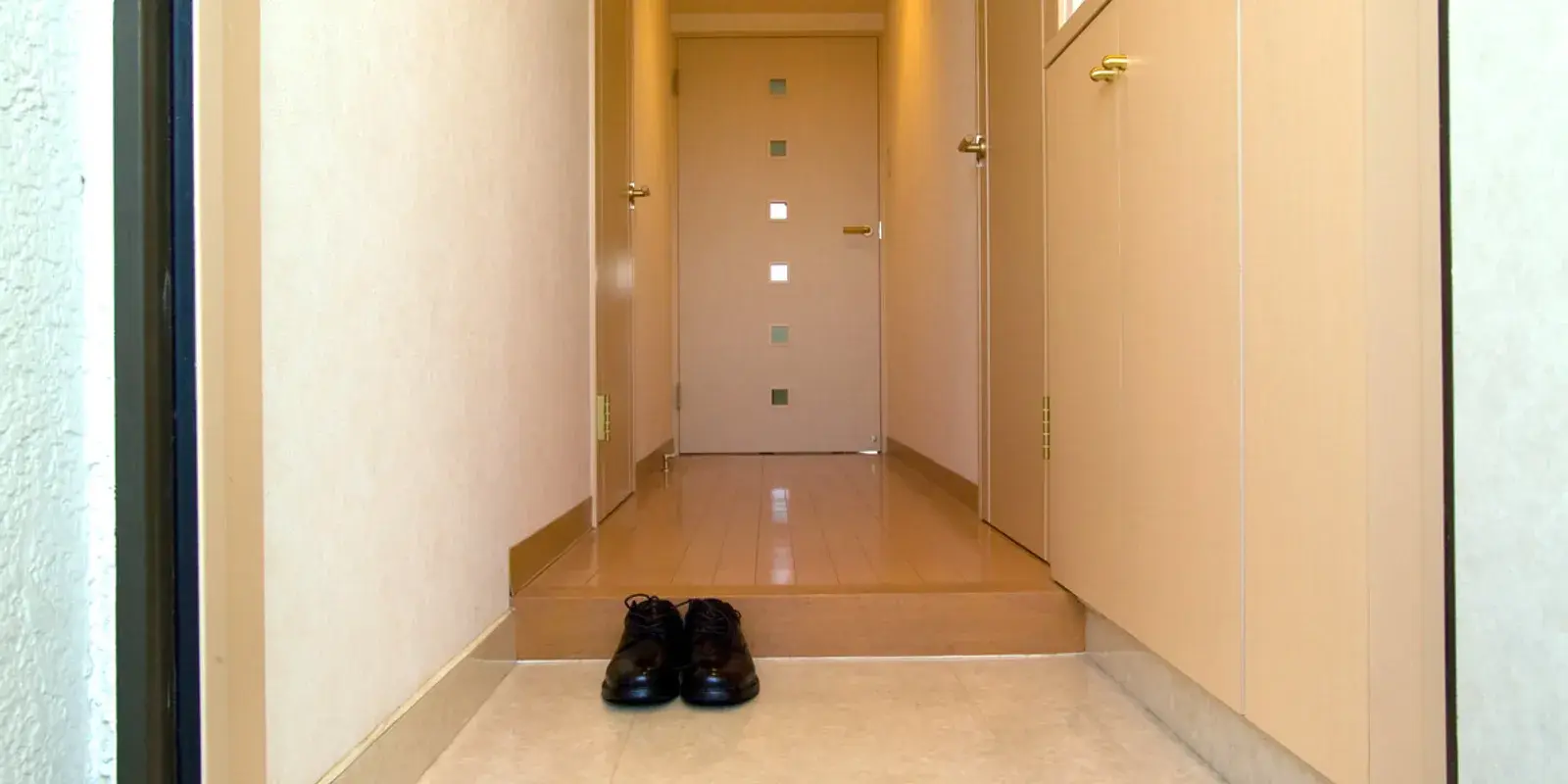
Why Removing Your Shoes Makes Japanese People Smile
What you'll learn in this article:
- What 335 Japanese people said about shoes in the house, slipper etiquette, and the genkan
- The gut reaction when shoes stay on, and the warmth when they come off
- Why you don't need to be perfect, just willing
If you're visiting Japan and staying at a ryokan, an Airbnb, or a friend's home, you've probably heard the rule: take off your shoes. But few guides explain how Japanese people actually feel about it. What happens inside their head when shoes stay on? What happens when you carefully line yours up at the door?
We collected 335 real opinions from Japanese people to find out. The answer is a lot warmer than you might expect.
Do you need to worry about shoes in Japan? We read what 335 Japanese people wrote. Walking in with shoes triggers a visceral "acha" reaction in 43%, but the moment you catch yourself and kick them off, 90% immediately understand or find it endearing. Line your shoes up neatly and 44% are genuinely moved, while many joke they can't even do this themselves. Japanese people don't expect perfection. They expect effort. The moment you reach for your shoes at the door, you've already passed.
Quick Guide
| Situation | What Japanese People Said | |
|---|---|---|
| 🟢 Relax | You forgot and caught yourself | Almost everyone finds this endearing. The "Oh! Sorry!" moment genuinely makes people smile. Your effort matters far more than perfection. |
| 🟢 Relax | You lined up your shoes neatly | This one gets a real emotional response. Many Japanese people said it moved them, and several joked that they can't even do this themselves. |
| 🟡 Good to know | Toilet slippers in the living room | This does bother people, and even Japanese husbands and kids make this mistake. It comes from hygiene habits, not any judgment of you. Just glance at your feet when you leave the bathroom. |
| 🔴 Worth noting | Walking in with shoes on | This triggers a visceral "あちゃ~" reaction for most Japanese people. It's not anger, it's a deep-seated instinct tied to how they think about home spaces. The good news: just trying to take them off immediately dissolves the tension. |
The one thing to remember: Japanese people don't expect perfection. They expect effort. The moment you reach for your shoes at the door, you've already passed. Everything after that is bonus points.
How We Gathered These Voices
We collected 335 Japanese-language responses across five shoe-related topics: walking in with shoes on (60 responses), neatly aligning shoes (70 responses), toilet slipper mix-ups (70 responses), catching yourself mid-mistake (60 responses), and generational attitudes (75 responses). Sources include public Japanese Q&A sites, forums, and social posts, news article comment sections, and survey data from kufura, Otonanswer, and LION research.
A quick note: Think of this less as a lab study and more as a collection of what real Japanese people said in their own words, in their own language, on public platforms. Most English-language guides simply tell you "take off your shoes." We wanted to show you why, and what Japanese people actually feel when you do (or don't).
The "あちゃ~" Moment: When Shoes Stay On
Let's start with the honest truth. When someone walks into a Japanese home with shoes on, there's a reaction. Japanese people have a word for it: あちゃ~, that gut-level "oh no" feeling. It's closer to watching someone accidentally sit on a freshly iced cake than to real anger.
Of 60 responses about shoes staying on:
That 43% "visceral reaction" is real. Look at what it actually sounds like:
公衆トイレとか入った靴で家の中歩き回るのか?と想像した子供時代、ちょっと気持ち悪く… When I was a kid, I imagined someone walking around the house in the same shoes they wore into a public bathroom... and felt a little sick.
昔見た海外ドラマでベッドに土足で上がったのを見たのは衝撃的だった。 Seeing someone climb onto a bed with shoes on in a foreign TV show — that was genuinely shocking.
仮に日本人が外国に住んだとしても多分家の中では靴を脱ぐルールにすると思うんだよね。靴のまま家の中に入るようにといわれても、内心承諾出来ないと思うんだ。 Even if a Japanese person moved abroad, they'd probably still have a no-shoes rule at home. If someone told them to keep shoes on inside, deep down, they couldn't accept it.
That last quote is key. This runs so deep it feels like part of who they are, more instinct than preference. And that's exactly why the reaction is so visceral.
What makes this data interesting: 30% of responses were understanding and tolerant.
生活習慣が違うから貴方は不衛生とお感じでしょうが、彼らにしてみれば、マットで泥を落としてきたんだから綺麗だと思うでしょう。 You feel it's unhygienic because of different lifestyles — but from their perspective, they wiped their shoes on the mat, so the shoes are clean.
衛生観念って国によって全然違うんですよね。 Hygiene norms are just completely different from country to country.
And several people pointed out something that might surprise you: the world is changing.
アメリカでも靴を脱ぐ家が増えた。理由は家の中が汚れるから。 More and more American households are taking shoes off too. The reason? It keeps the house cleaner.
The Moment That Makes Them Smile: Neatly Aligned Shoes
If the "shoes on" moment is the gut punch, this is the opposite. When a visitor takes off their shoes and lines them up neatly at the genkan, the emotional response from Japanese people is surprisingly strong.
Of 70 responses about neatly aligned shoes:
A viral video by LanCul, showing a foreigner's shoe behavior evolving over three years in Japan (from messy kick-off, to perfect alignment, to fixing other people's shoes), sparked a wave of affection online:
日本人よりも日本人になる3年目好き。 I love how by year three they're more Japanese than the Japanese.
ここまでできてるだけですげぇ。 Just getting to this level is already amazing.
気がきくね~。 How thoughtful!
The part that really stood out was the self-deprecating humor:
私36年日本人してるけど一年目しかやらない。 I've been Japanese for 36 years and I'm still at year-one level.
これができない日本人もたくさんいる。 Plenty of Japanese people can't even do this.
This is important context. Japanese people aren't holding you to a standard they consistently meet themselves. Many of them freely admit they don't always align their shoes either. When a visitor does it, they've gone beyond the baseline Japanese people hold for themselves.
The honest truth
Japanese people don't expect you to align your shoes. Many of them joke that they don't do it consistently either. But when you do, it lands. It's one of those small gestures that communicates something much bigger: "I see your culture, and I respect it."
In Japanese culture, there's even a Zen concept connected to this: kyakka shouko (脚下照顧), "look beneath your feet." It's the idea that awareness begins with the ground you're standing on. Aligning shoes reads as a small act of mindfulness that resonates deeply, well beyond simple tidiness.
The Classic Mix-Up: Toilet Slippers in the Living Room
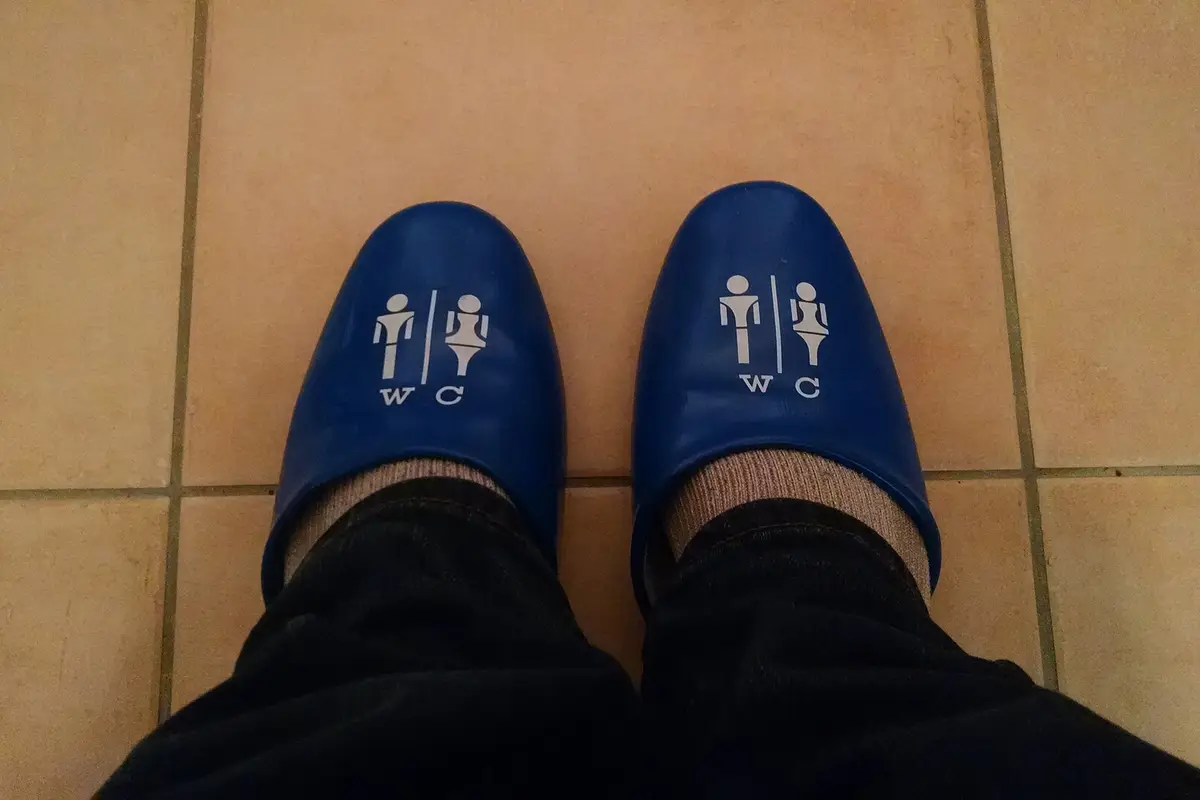
This scenario plays out in ryokans, guesthouses, and Japanese homes every day, and if you're planning a ryokan stay, it's worth knowing in advance: you step into the bathroom, slip on the dedicated toilet slippers, do your thing, and then walk right back out into the hallway, still wearing them.
This one makes Japanese people wince. But before you panic, read the data.
Of 70 responses about toilet slipper mix-ups:
The concept behind separate toilet slippers is what Japanese people call kejime (ケジメ), a sense of boundary or distinction:
トイレはフローリングだけど、スリッパは別です。ケジメみたいな感じで、同じスリッパでは嫌です。 The toilet floor is the same material, but the slippers are different. It's a sense of kejime — I just don't want the same slippers.
Why does this matter so much? Science backs up the instinct. Research by LION Corporation found that approximately 2,300 droplets of urine splash onto the floor around a toilet each day. That context makes the separate-slipper system seem less like fussiness and more like... pretty smart engineering.
The reassuring part: Japanese families deal with this exact issue constantly, too.
うちの旦那トイレのスリッパのまま間違えてリビングにきたりする。本当にやめてほしい! My husband walks into the living room wearing the toilet slippers by mistake all the time. I really wish he'd stop!
子ども達がトイレから出る時にスリッパを揃えないのがストレスになるから。 My kids never line up the toilet slippers when they leave. It's so stressful.
One data point might make you feel better: about 40% of Japanese households don't even use toilet slippers at all. Reasons include cleaning convenience, the hassle of switching, and the fact that "the slippers themselves become unsanitary."
トイレにスリッパがない家庭は4割存在します。 40% of Japanese households don't have toilet slippers.
Practical tip: When you enter a bathroom in Japan and see slippers on the floor, put them on. When you leave, take them off. That's it. If you forget (and you might), don't worry about it. Japanese husbands have been making the same mistake for decades.
💬 What do you think?
Japanese readers: How do you feel about this?Visitors: Have you experienced this in Japan?
Share your voice →The "Oh! Sorry!" Moment: When You Catch Yourself
Japanese people love this scenario: a visitor starts to walk in with shoes on, realizes the mistake halfway through, and hurriedly kicks them off with an apologetic "Oh! Sorry!"
This is the moment that dissolves any tension. Of 60 responses about catching yourself mid-mistake:
Look at that: 90% understand or find it endearing. Only 10% are still bothered. The overwhelming response is warmth.
Many Japanese people pointed out something important: the "all foreigners wear shoes inside" stereotype isn't even accurate:
イギリスのオクスフォードに留学していた時のホストファミリーの家では、靴はみんな普通に脱いでました。 When I studied abroad in Oxford, my host family took their shoes off normally.
ポーランドも靴を脱ぎ、家の中ではスリッパを履きます。 In Poland, people also take off shoes and wear slippers inside.
靴のまま家に入るなんてすごく汚い!ポーランドじゃありえないよ。 Walking into a house with shoes on is filthy! In Poland, that would never happen.
And Japanese people themselves offered the perfect way to explain the custom to visitors:
貴方の国でも靴を履いたままベッドで寝たりしないのと同じです。貴方の国でも靴を履いたままバスタブに入って身体を洗わないのと同じです。というように説明すればいっぱつでわかってもらえます。 Tell them: "You wouldn't sleep in your bed with shoes on, right? You wouldn't step into the bathtub with shoes on, right?" Explain it like that and they get it immediately.
The bottom line
You will probably forget at some point. You might step one foot onto the wooden floor before catching yourself. And when you do, just smile, say sorry, and take your shoes off. To the Japanese people watching, that moment of catching yourself is genuinely charming.
The Cultural Engine: Why Shoes Matter So Much
So what makes Japan different? Why does this one act, removing shoes, carry so much emotional weight?
The Genkan (玄関): The Boundary Between Worlds
Japanese homes have a genkan, a sunken entryway, usually one step lower than the main floor. It's more than architecture: a physical boundary between outside and inside, between soto (外, the public world) and uchi (内, the intimate home space). Stepping up from the genkan into the house is a transition, and shoes are what you leave behind.
Most Western homes don't have this architectural feature. There's no step, no built-in shoe area, no physical cue that says "shoes come off here." That's why visitors don't instinctively know: the architecture doesn't tell them.
Floor Living (床の生活): The Invisible Reason
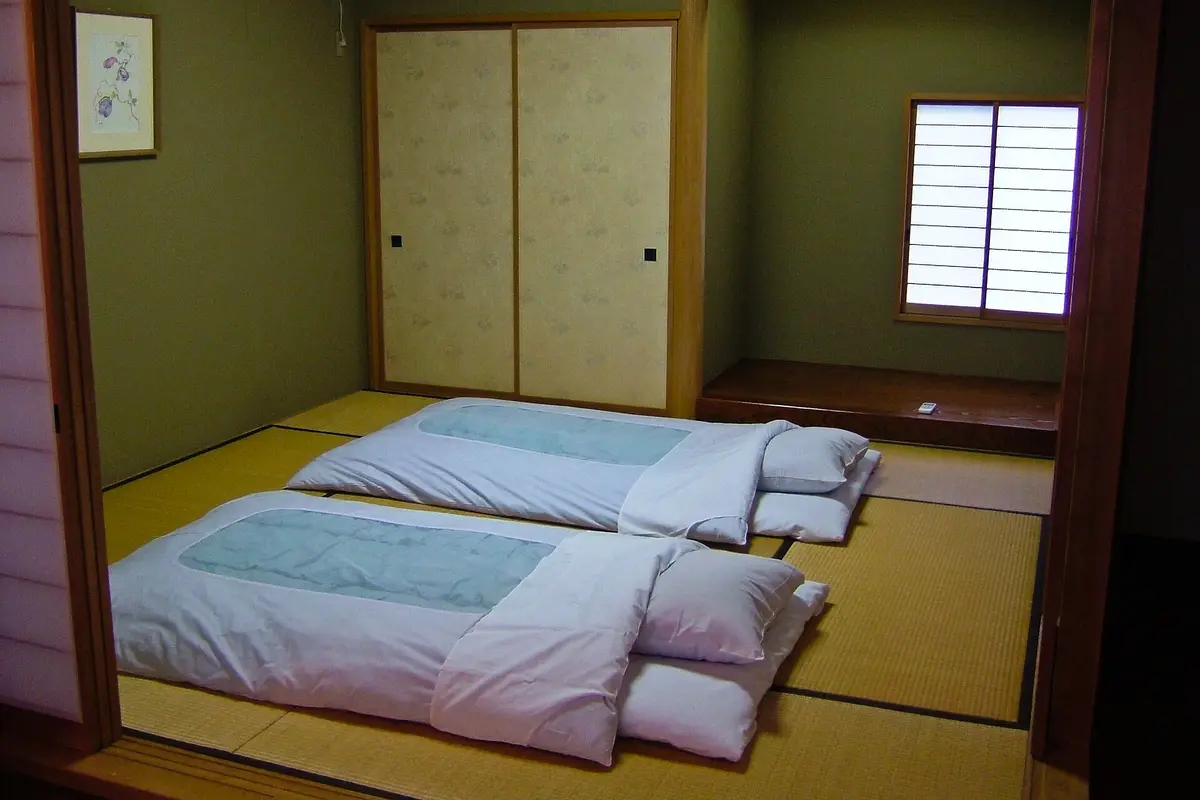
The practical reason behind the visceral reaction: Japanese people live on their floors. They sit on the floor. Children play on the floor. Many people still sleep on futons laid directly on tatami mats. The floor holds daily life far beyond something you simply walk across. It's the same care that has you slip off your shoes and carry them up the mountain in your hands to walk the genuine wooden floors of a 1680s keep like Bitchu-Matsuyama Castle, and at Kochi Castle, you slip them off to walk the rooms of the lord's own palace, the only castle keeping its honmaru residence intact.
欧米人は靴で生活してるから床は汚いと思ってる。日本人は海外でも靴脱いで。 Westerners live in shoes, so they think of floors as dirty. Japanese people take their shoes off even when they're abroad.
汚いとは思ってないみたいですよ。床に座ったり家具以外の物を置いたりあまりしませんからねぇ。 They don't think of it as dirty — they don't sit on the floor or put things on it much, so it doesn't matter to them.
This is the key difference. In cultures where shoes stay on, the floor is treated like an outdoor surface. You don't sit on a sidewalk either. In Japan, the floor is treated like furniture. The same instinct is why visitors climb the original wooden keep at Matsumoto Castle in their socks, carrying their shoes in a bag to protect 400-year-old floorboards. And once you understand that, the "あちゃ~" reaction makes perfect sense.
COVID Reinforced It
Several Japanese people mentioned that the pandemic strengthened their conviction about shoe removal:
コロナの被害が日本は少なかったのも靴を脱ぐ文化が大きかったと思ってる。 I believe Japan's lower COVID impact was partly because of the shoe-removal culture.
A CDC study on shoe-sole contamination, widely shared in Japanese media, provided scientific backing for what Japanese people had always practiced intuitively. If anything, the pandemic made the culture stronger, not weaker.
A Note on Generations
You might assume younger Japanese people are more relaxed about shoes. The data tells a more nuanced story.
We collected 75 responses about generational attitudes. The biggest finding: shoe removal is near-universal across all generations. Academic research (including work by architectural historian Inoue Shoichi) describes it as the most class-transcending cultural norm in Japan: the one thing that unites every household regardless of income, education, or region.
Where generational differences do appear is in school policy debates. Some schools, particularly in Kobe, Okinawa, and parts of Kyoto, have traditionally allowed outdoor shoes inside. Recent moves to eliminate indoor shoes (uwabaki) sparked fierce debate, with older parents overwhelmingly opposing the change:
日本人の衛生観念は幼少期のこういう細かな配慮から根付いて行くものなのに… Japanese hygiene awareness is built from these small practices in childhood...
母校が私の卒業した次の年に土足になって、2年後同窓会で行ったら信じられないくらい汚くなってた。 My school switched to outdoor shoes the year after I graduated. When I went back two years later for a reunion, it was unbelievably dirty.
The bottom line: while there are regional variations, the shoe-removal instinct runs deep across all age groups, and modern hygiene awareness is reinforcing it rather than letting it fade.
What Japanese People Actually Want You to Know
Read enough of the 335 responses and one theme surfaces again and again, more generous than a simple "follow the rules":
They know you might not know.
The genkan, the step, the slipper system: none of this is obvious if you didn't grow up with it. Japanese people understand that. What touches them isn't whether you do it perfectly, it's whether you try.
They know it's not just a "foreigner" thing.
Japanese husbands forget to switch toilet slippers. Japanese kids leave their shoes in a heap. Japanese adults admit they don't always align their own shoes. The standard they're holding you to? It's the same one they struggle with themselves.
The effort is the message.
When you take off your shoes at the door, even clumsily, even after a false start, you're communicating something that goes beyond footwear. You're saying: I see that this matters to you, and I want to respect it. It's the same dynamic we found with the power of a small bow: the gesture doesn't need to be perfect to land. That's what makes Japanese people smile.
And if you want to experience this in a traditional ryokan, stepping into a genkan, feeling the tatami under your feet, the month you choose can make the difference between a crowded tourist stop and a quiet, personal welcome.
More Japanese Perspectives
Curious about other aspects of daily life in Japan? These articles explore what Japanese people actually think, based on hundreds of real voices.
- Do Japanese People Actually Care How You Hold Chopsticks?: 163 Japanese people share the honest truth about chopstick etiquette. Spoiler: there's really only one thing worth knowing.
- Why Japanese Trains Are Silent: 177 Japanese voices reveal the real reason trains are quiet, and why nobody is judging you.
- No Trash Cans, No Problem: 232 Japanese people share how they really feel about the "carry your trash" culture.
- The Power of Itadakimasu: How two simple words before a meal can change the entire atmosphere.
- Onsen and Tattoos: A gentle guide to what's actually changing in 2026.
Share Your Experience
Had a shoe moment in Japan: the awkward step, the frantic kick-off, or the warm smile when you got it right? We'd love to hear it. Your story helps build a bridge between cultures.
Share your experience on Voice Box →
Sources
Primary Research Data
- WMJS shoe culture research data (335 Japanese-language responses collected April 2026)
- Walking in with shoes on: 60 responses
- Neatly aligned shoes: 70 responses
- Toilet slipper mix-ups: 70 responses
- Catching yourself mid-mistake: 60 responses
- Generational attitudes: 75 responses
Statistical Data
- LION Corporation research: approximately 2,300 urine droplets splash onto toilet floors daily
- Kufura survey: reasons Japanese households stop using toilet slippers
- Kao Corporation (Biore Z) survey, February 2019 (n=600, women aged 20-30): 48.6% dislike tatami/zashiki seating
- Daiwa House Industry 1995 survey: zero Japanese households reported living in shoes indoors
- CDC shoe-sole contamination study (widely cited in Japanese media during COVID)
Academic Sources
- Inoue Shoichi (architectural historian): research on shoe-removal as Japan's most class-transcending cultural norm
Opinion Collection Sources
The following sources were used to collect Japanese people's opinions and sentiments. These are not cited as factual authorities but as platforms where real Japanese people expressed their views on shoe culture.
Walking in with shoes on:
- https://stepforward-learning.com/wp/blog/walking-shoes-on/
- https://www.haradaeigo.com/dosoku-bunka/
- https://ryugakumagazine.com/usnews/1745/
Neatly aligned shoes:
- https://nlab.itmedia.co.jp/cont/articles/3369832/
- https://limo.media/articles/-/69421?page=1
- https://www.nippon.com/ja/guide-to-japan/gu020004/
Toilet slipper mix-ups:
- https://kufura.jp/life/clean-up/184985
- https://www.300-honne.com/about-toilet-slipper/
- https://otonanswer.jp/post/92982/
Catching yourself mid-mistake:
Generational attitudes:
- https://milltalk.jp/boards/24908
- https://www.moneypost.jp/1141416
- https://diamond.jp/articles/-/317473
Note on Quotations
Quotes from online platforms have been lightly edited for readability (fixing typos, formatting for clarity). The meaning and intent of each comment remain unchanged. Original sources are linked above.
WMJS is written in Japan, in English, with AI help. We check every page, but English is not our first language. If a sentence reads oddly, tell us. One sentence is enough.
Thank you. A person reads every note.
How well do you know Japan?
Built from 635 public posts by Japanese people
Want to know more? Ask Japanese people
Have a follow-up question about this topic? We'll ask real Japanese people.
Voice Box →