
Nishiki Market — Kyoto's Kitchen, One Bite at a Time
Nishiki Market
By Kei · Born and raised in JapanThe Meaning
At a pickle shop near the middle of the street, a woman behind the counter lifts a single pale slice of senmaizuke, a turnip sliced so thin you can almost see through it, and holds it out to you on the tip of a small wooden pick. It is one bite. You eat it standing there, in the narrow lane, while she watches your face. If your eyes change, she smiles and reaches for a bag. A minute later you are walking on with a small parcel of pickles that will become part of someone's dinner tonight.
That short exchange (a taste, a word, a parcel carried home) is what this street has been doing for four hundred years. Nishiki Market is often introduced as Kyoto's great food destination, a paradise of things to eat on a stick. But before it is anything for a visitor, it is a place where the cooks and households of a city have come, day after day, to buy the food they will actually cook. The people behind these counters are not performing a market for you. They are doing the quiet, exacting work of feeding Kyoto, and have been since long before anyone arrived with a camera.
That one fact gently changes how it feels to stand here. You are not a customer the street is arranged around. You are a guest in a working kitchen, the kitchen of a whole city, invited to taste what is good today and carry a little of it away. Hold on to that idea, that the counters are at work and not on display, and almost every custom that follows begins to make sense. It is the same feeling that lives inside the word itadakimasu, spoken before a meal: a small thank-you to the ingredient, the season, and every pair of hands that carried the food this far.
What Happens When You're There
Step 1: A Street Four Centuries Old
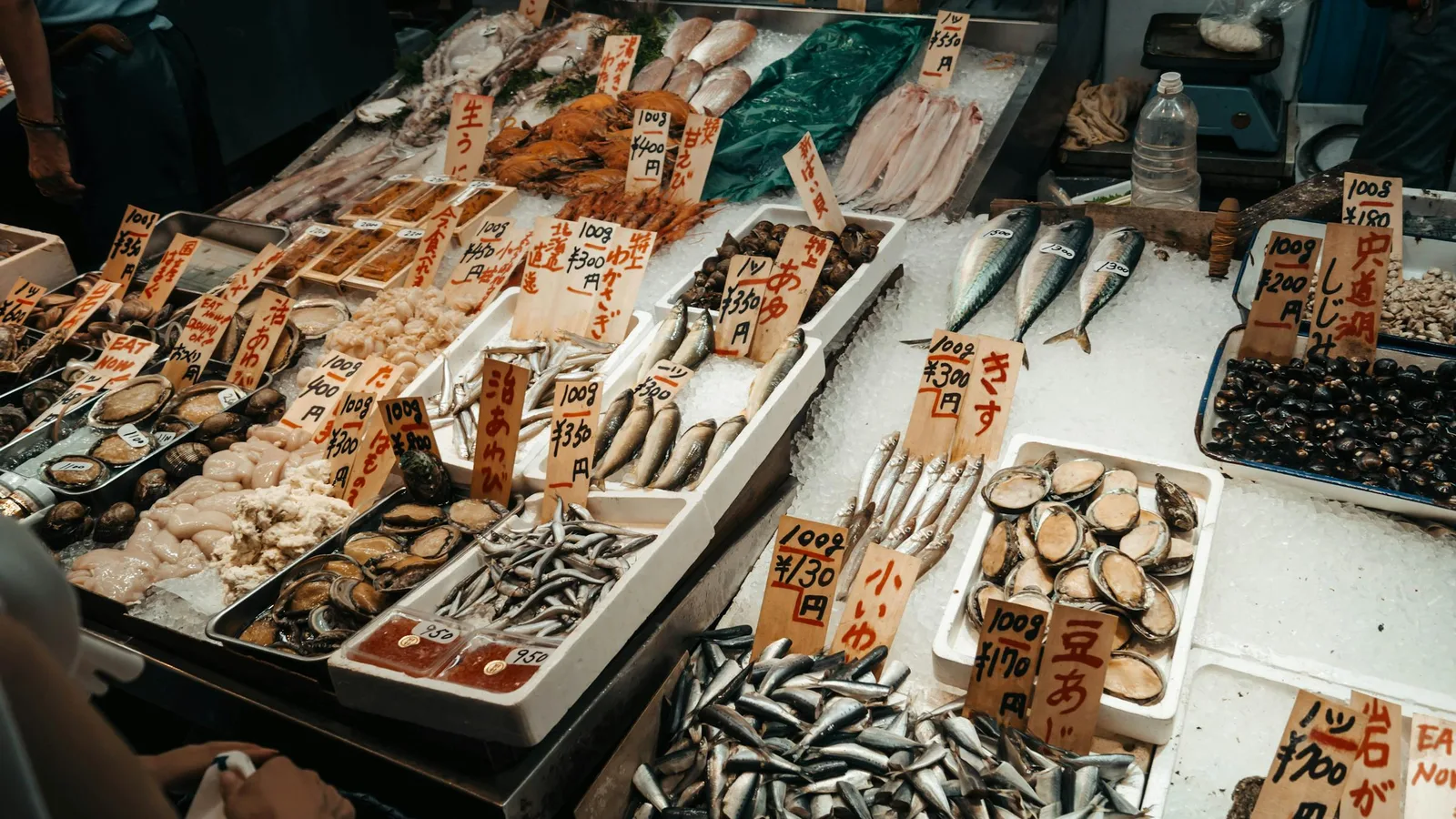
Begin by setting aside the first thing most people picture. This is not a fish market like the famous floors of Tokyo. There is no auction here, no wholesale hall, no viewing deck above a crowd of buyers. If you have seen our guide to Toyosu and Tsukiji, think of Nishiki as the opposite kind of place: not a wholesale market where professionals trade by the crate before dawn, but a narrow retail shopping street where you and a Kyoto grandmother stand at the same counter and buy a single portion by hand.
The street runs east to west for about three hundred and ninety meters, roofed by a low arcade of red, yellow, and green, and at its narrowest it is barely three and a half meters across. Into that one slender lane are packed more than a hundred small specialist shops: fishmongers, pickle makers, greengrocers selling Kyoto vegetables, sellers of yuba and fu, dried bonito and kelp, sweets, tea, and knives.
The market traces itself back centuries. Records are uncertain about its earliest days: there is a tradition that fish was sold along here more than a thousand years ago, though the market's own historians are careful to say no firm record survives. What can be dated is the year 1615, when the shogunate formally recognized the fish wholesalers of this street, and the market as we know it began. The name everyone uses now, Kyo no Daidokoro ("Kyoto's Kitchen"), came later, in the early twentieth century, when greengrocers and other food sellers joined the fishmongers and the street grew into a place you could buy almost anything for a meal.
One detail explains why a market grew on this exact spot rather than anywhere else. Beneath the street runs cold, clean groundwater that holds a steady temperature of around fifteen to eighteen degrees all year. Before refrigerators, shops sank wells into it and used that cool water as a natural icebox to keep fish and produce fresh. The market is here because the water is here. Four hundred years of trade rest on something you cannot see, flowing quietly under your feet.
Step 2: What the Counters Hold
Walk slowly and let the counters introduce themselves. A shop hung with sheets of golden dashimaki, rolled omelette folded warm to order. Next door, shallow wooden tubs of Kyoto pickles: senmaizuke in winter, the deep purple of shibazuke, the sharp tang of suguki. Then a greengrocer's table stacked with the vegetables that only Kyoto grows quite this way: slim kujo leeks, round shogoin turnips. Sheets of fresh yuba lifted from warm soy milk. Glossy ribbons of kombu weighed out for stock. Skewers of grilled eel, a fishmonger's morning catch, sweets the color of the season.
It can look, at first, like a long buffet built for browsing tourists. It is the opposite. Each of these counters is a specialist: a shop that may have sold only pickles, or only knives, or only dried fish, for generations. They cluster together not by accident and not because Kyoto people happen to be fussy about food, but because the city's cooking asked them into being. A cuisine built on subtlety (on dashi, on the exact season of a vegetable, on obanzai, the everyday home cooking of Kyoto) needs sellers who carry one thing and know it completely. The depth you are walking past is the practiced, almost invisible skill of people who have made a life of a single ingredient.
The most famous of the knife shops here has been forging blades for cooks for centuries, and chefs still travel across the world to buy from it. That, more than any snack, is the truest souvenir of Kyoto's Kitchen: not a thing to eat once, but a tool, or a packet of pickles, that carries a little of this street into your own cooking.
Step 3: The One Bite You're Offered
At some counters, pickle shops especially, a taste will be offered before you buy: a sliver on a pick, a small dish to try. It is worth understanding what that bite means, because it is easy to misread.
The sample is not a free buffet, and treating the street as a row of giveaways to graze through is the one thing that quietly strains it. The taste is an opening: a small act of trust from someone confident in what they sell, offered in the expectation that you are genuinely choosing rather than just collecting. Take the bite, mean it, and if it is good, buy a little; if it is not for you, a smile and a thank-you close the exchange just as warmly. Done that way, the sample is one of the kindest things on the street: a chance to know exactly what you are bringing home, given freely by the person who made it.
If you find yourself unsure how much to take, or whether a taste means you must buy, you are not alone, and not because you are foreign. Plenty of Japanese visitors from outside Kyoto feel the same small hesitation at a counter they don't know. The honest answer is simple: one taste, offered and received with attention, is exactly what it looks like. The person behind the counter would far rather you understood their food than felt obliged to it.
Step 4: Standing Still to Taste
Now the custom that surprises almost everyone. Many guidebooks call Nishiki a street-food paradise and send you off to eat as you walk. The market itself asks for something a little different, and once you see why, it becomes one of the most considerate things about the place.
The shopping cooperative that runs the street asks visitors, in its own words, to refrain from walking through the market while eating, and instead to eat in front of, or inside, the shop where you bought it. The reason is the lane itself: barely three and a half meters wide and, on a good afternoon, full. Hot food and sauce carried through a shoulder-to-shoulder crowd end up on a stranger's sleeve; wrappers dropped on the move end up underfoot. So when a shopkeeper calls out "eat here, eat here," they mean it kindly: hospitality doing its job, offering you the small space at the counter that is the proper place to enjoy what you just bought. Many shops keep a stand-up spot or a little eat-in corner for exactly this.
There is a quieter reward in it, too. A skewer of eel or a piece of dashimaki eaten standing at the counter, a step from where it was made, is simply better than the same thing eaten cold and hurried fifty meters down the lane. Standing still to taste is not a rule that takes something away. It is an invitation to slow down and let the food be at its best and, if you like, to exchange a word with the person who made it. The wider question of when eating-as-you-walk is welcome elsewhere in Japan is its own subject, and we look at it gently in is it rude to eat while walking; here on this one narrow street, the local answer is unusually clear and unusually kind.
If the street looks more touristy than you hoped, that is honest, and worth saying plainly. Over four centuries this market has changed shape more than once: from fish wholesalers to a general food market, and in recent decades toward the snacks and souvenirs that the passing crowd buys. Yet on the same morning, a Kyoto chef is still choosing hamo for tonight's service and a local cook is still buying the pickles for dinner. Both faces are real, side by side. You do not have to decide which is the true Nishiki; you only have to notice that a living market is one that keeps adapting to the people who walk through it, and to walk through it as one of the kinder ones.
Step 5: Walking Out with the Day's Kyoto
By late afternoon the street begins to fold up. Shutters come halfway down, the day's grilling winds to its last skewers, and the crowd thins as the light outside turns gold. You reach the end of the lane (Nishiki Tenmangu's lanterns at the eastern mouth, or the wider street by the big store at the western one) and step back out into the city with a small parcel in your hand.
That is the right way for a visit here to end: not with a finale, but with a bag. A twist of pickles, a packet of dashi, a single good knife wrapped in paper. You did not come to watch a spectacle and leave empty-handed. You came to a kitchen that has fed Kyoto for four hundred years, tasted what was good today, and carried a little of it home, the same thing the city's cooks have done on this street, in the same way, for longer than anyone can quite remember. Somewhere tonight, a slice of that turnip will be on a plate. The easiest way to honor a place like this is simply to taste it, thank it, and take a piece of it with you.
Good to Know
What Nishiki is (and isn't). Nishiki Market is a covered retail shopping street, about 390 meters long, running east–west one block north of Shijo Street in central Kyoto. It is "Kyoto's Kitchen": a row of more than a hundred small specialist food shops rather than a wholesale fish market with auctions. Come to taste, buy, and carry food away, rather than to watch professionals trade.
Which end to start from. The street runs between Teramachi (east) and Takakura (west). A common approach is to enter from the west, near the big Daimaru store by Takakura Street, and walk east, coming out by Nishiki Tenmangu Shrine at the eastern end, or simply do it in reverse. Either way it is a single straight lane, so you cannot really get lost.
Getting there. The nearest stations are Shijo Station (Subway Karasuma Line), Karasuma Station (Hankyu Kyoto Line), and Kyoto-kawaramachi Station (Hankyu Kyoto Line), each a short walk away: roughly a few minutes from the closest exit, or about five to ten minutes at an easy pace depending on which end you aim for. Kyoto's official travel guide recommends the subway over the city bus, which is often crowded. For routes and passes, see our guide to getting around Japan.
Hours. There are no single market-wide hours: each shop sets its own, and many are closed on Wednesdays. Most shops trade through the daytime and begin closing in the late afternoon; trade does not really start early in the morning. Kyoto's official guide suggests arriving close to late morning, before the busiest part of the day. If a particular shop is your goal, check that shop's own days and hours before you go.
When it's busiest. The middle of the day, especially in the afternoon, is the most crowded. For a calmer walk and more time to talk with the shopkeepers, come earlier. At the year's end the market fills with people shopping for New Year's food, a Kyoto tradition and wonderful, but shoulder-to-shoulder.
Eating on the street. Buy and then eat at the counter or just in front of the shop, rather than walking with food in hand: the lane is narrow and full, and this is what the market asks of its guests. Many shops keep a small stand-up or eat-in spot for the purpose; if you are unsure where to stand, the shopkeeper will happily show you.
Paying. Many of the small family shops prefer cash, and some take IC cards (such as ICOCA or Suica) but not credit cards. It helps to carry yen. More on why cash still matters in Japan.
Bringing food home. Much of what is sold here (pickles, dried goods, sweets, dashi) is made to be carried away and eaten later, not on the spot. If you would like to take some back to your accommodation or onward, see can you take food home.
Last verified: 2026-06
Official websites: Nishiki Market Shopping District Cooperative · Kyoto City Official Travel Guide
If Things Don't Go as Planned
You expected a wholesale fish market with an auction. That is Toyosu, across the country in Tokyo. Nishiki is a retail food street, with no auction and no trading floor. What it offers instead is the chance to actually buy and taste, by hand, from more than a hundred specialist shops. If the markets of Tokyo are also on your trip, our Toyosu and Tsukiji guide explains how that very different place works.
A shop you came for is closed. Each shop keeps its own days, and many close on Wednesdays, so it is easy to arrive and find a particular counter shuttered. Check that shop's own hours before you set out, and know that a closed shutter here is often painted with the artwork of Itō Jakuchū, the famous painter born to a greengrocer's family on this very street, so even a closed shop has something to see.
It's far more crowded than you imagined. The lane is narrow by nature, and the middle of the day is the peak. If the crush is too much, the calmer windows are earlier in the day; you can also step into one of the quieter side shops for a moment out of the flow. A short, unhurried visit at a gentle hour beats a long one at the busiest.
You're not sure where you're allowed to eat. Eat at the counter, or in the small space just in front of the shop, rather than walking with food through the lane. If a shopkeeper waves you to a spot or calls "eat here," they are being kind rather than curt: they are showing you the right place to enjoy it.
A vendor sounded abrupt and you worried you'd offended them. You almost certainly didn't. Many shopkeepers are focused on busy work and not always at ease in English, and a short phrase can land more bluntly than it is meant. A nod, a smile, and a sumimasen or arigatō smooth almost everything: the people behind the counter are, as a rule, glad you came.
The food costs more than you expected. These are specialist shops in the center of Kyoto, not discount stalls, and the price reflects the craft and the season. Approached that way (a single excellent bite, or a small parcel to cook with later) even a modest purchase becomes one of the better things you bring home from the city.
You wanted a proper sit-down meal. Nishiki is built for tasting and shopping, not for lingering over a full lunch in the crush. If you would rather sit, the food halls in the basements of the big department stores a few minutes away are calmer, and you can always carry a parcel from Nishiki back to eat at your own pace.
Sources:
- Nishiki Market Shopping District Cooperative: History. The market's own history: origins and the 1615 official recognition, the "Kyoto's Kitchen" name, the groundwater and descendible wells, Itō Jakuchū, and the arcade
- Nishiki Market Shopping District Cooperative: Requests to Visitors. The official wording asking visitors not to walk while eating and to eat in front of or inside the shop where they bought the food
- Nishiki Market Shopping District Cooperative: Cooperative Profile & Access. Street length (about 390 m), width (3.3–5 m), member shops, and access from the nearest stations
- JNTO: Nishiki Market. "Kyoto's Kitchen, thriving for 400 years," dimensions, foods, the east–west route, and best time to visit
- Kyoto City Official Travel Guide: Nishiki Market. Official tourism framing, more than 130 shops, access, and the recommendation to use the subway
Photos: sourced under free commercial-use licenses; see captions where attribution applies.
WMJS is written in Japan, in English, with AI help. We check every page, but English is not our first language. If a sentence reads oddly, tell us. One sentence is enough.
Thank you. A person reads every note.
Real voices
Is it worth it?
Were you there? Share your photos.
Your photo could appear in this guide — with your name and a link to your profile.
Submit a photoRelated Articles
Is It Rude to Eat While Walking in Japan? — What Japanese People Actually Think

The Power of "Itadakimasu": How Two Words Can Change a Meal
More guides in Kansai
Arashiyama — Why Japan Lists This Bamboo Grove Among the Sounds Worth Saving
An audio cultural guide to Arashiyama in Kyoto, verified against official sources. Understand why Japan lists the bamboo of Sagano among the sounds it wants to keep, how the Moon-Crossing Bridge earned its name, and how to walk the river, the grove, and Tenryu-ji's borrowed-mountain garden away from the crowds.
Arashiyama
Fushimi Inari Taisha: Ten Thousand Gates, Each One a Thank-You
The ten thousand vermilion gates at Fushimi Inari are thank-you notes you can walk through. A cultural audio guide verified against official sources: why the foxes are messengers not gods, why the summit has no view, and how to walk past the crowds.
Fushimi Inari Taisha
Ginkaku-ji — Why the Silver Pavilion Has No Silver, and Why Japan Finds That Beautiful
Why the Silver Pavilion has no silver — a free audio guide to Ginkaku-ji, Kyoto, verified against official temple sources. Higashiyama culture and the art of restraint, the sea of silver sand, hours, admission (1,000 yen), access from Kyoto Station, and the Philosopher's Path.
Ginkaku-ji (Jishō-ji)
Gion — Walking Kyoto's Flower District, a Town That Is Still Lived In
An audio guide to Kyoto's Gion flower district: what geiko and maiko really are, the walk from Yasaka Shrine through Hanamikoji to the Shirakawa canal, when to go, and how to enjoy a town still lived in.
Gion