
Nagasaki — The Port That Was Japan's One Open Window to the World
Nagasaki
By Kei · Born and raised in JapanThe Meaning
For more than two hundred years, while Japan kept most of its doors closed to the outside world, there was one window left open, and it was here. Not a metaphor: an actual managed gateway, in this harbor, through which nearly everything new that reached Japan had to pass. New words, new medicine, new tools, new ideas, the first sustained sight of Europe and of China: they came in through Nagasaki, were inspected and recorded, and made their way inland from this one point on the map. No other Japanese city was given that job, and no other city was shaped by it the way this one was.
That is the thing worth holding in mind as you walk Nagasaki, because it explains what can otherwise feel like a beautiful jumble. Cross one slope and there is a Buddhist temple; cross the next and there is a Catholic church; between them sits a Chinatown with red gates, and along the water a fan-shaped patch of ground that was once an island where Dutch traders lived. People here have a word for the result: wakaran, written with the characters for Japan, China, and Holland, and it is not really a tourism slogan; it is the honest description of a place where, for a very long time, things from the outside arrived, were taken in, and slowly became local. The food you will eat, the buildings you will climb to, the festival lanterns in winter: all of it is the residue of that one open window.
So Nagasaki rewards a particular way of arriving. Not as an "exotic European port" to be photographed and ticked off (that framing misses what is actually here) but as a place that spent centuries learning to live with difference, and is comfortable with it in a way that is rare and quietly moving. If you have come from the bright order of Tokyo or Kyoto, the mixing can surprise you. It surprises Japanese visitors too. You are not meant to have it all sorted out by the end of the day. You are just being let in, for a little while, to a town that has been holding its door open longer than almost anywhere else in the country.
What Happens When You're There
Step 1: The One Window
Begin at Dejima, because Dejima is the whole story in miniature. It was built in 1636, a small, fan-shaped island raised in the harbor on the order of the shogunate, paid for by twenty-five local merchants. At first the Portuguese lived on it; after they were expelled, the Dutch East India Company moved its trading post here from nearby Hirado in 1641, and for the next two hundred and eighteen years this single artificial island was Japan's only point of trade with the West. It was connected to the mainland by one short bridge, watched at both ends. The Dutch could not freely leave; the Japanese could not freely enter. Everything (every cargo, every piece of foreign news) crossed that one bridge, in both directions, under inspection.
Walk it now and the first thing you will notice is that it is not an island at all. There is no water around it. That is not a mistake and not your misreading: in the decades after Japan reopened, the harbor was filled in around Dejima: the land squared off in the 1880s, the bay reclaimed by 1904, until the fan-shaped islet that had floated in the sea was simply swallowed into the city. What you walk today is a careful restoration, rebuilt on the original footprint. The city has been at this since 1951, raising the old warehouses and the captain's quarters and the merchants' houses back into place, board by board; sixteen buildings stand again, with more to come, and there is a long-term plan to one day return water to all four sides.
Cross the reconstructed bridge and let the smallness of the place land on you. This narrow strip of ground is where a closed country met the world. Stand in the Chief Factor's residence, on the imported furniture, and you are standing where the first pianos, the first badminton, the first beer, the first clover and cabbage and coffee entered Japan and went no further until they were learned. The technique here is to let the island do the talking: it is not a grand monument, and it does not try to be; it is a quiet, restored trading post that happens to be the door through which an entire era of knowledge walked in.
Step 2: A Town That Mixed
A few minutes' walk from Dejima, past a bright red gate guarded by a stone creature, is Shinchi Chinatown, and it grew up here for the same reason Dejima did. While the Dutch were confined to their fan-shaped island, Chinese merchants were trading in Nagasaki too, and the land that became Chinatown was reclaimed from the sea in 1702 to warehouse their goods. It is one of Japan's three historic Chinatowns, alongside Yokohama and Kobe, and it is the smallest of them: a single cross-shaped street, four red gates at the four compass points, each carrying one of the old directional guardians: the azure dragon to the east, the white tiger to the west, the vermilion bird to the south, the black tortoise to the north. Do not come expecting the sprawl of Yokohama. Come because this is closer to where the mixing began.
You can taste that mixing directly, which is the best way to understand Nagasaki. Champon, a mountain of noodles in a rich, cloudy broth, piled with pork and seafood and vegetables, was invented in this neighborhood, generally traced to a Chinese restaurant that opened in 1899 and made it as a cheap, filling meal for Chinese students far from home. Sara-udon, its crisp-noodled cousin, came from the same kitchen. The man who created champon never trademarked it, so it spread; today it belongs to the whole city. If you want to understand where it sits among Japan's great bowls of noodles, that is its own long story, told in our map of Japan's regional noodles, but stand here first and taste the original.
And then there is castella, a tall, fine-grained sponge cake sold in long boxes all over town. It arrived with Portuguese traders in the sixteenth century, its name a worn-down echo of pão de Castela, "bread from Castile." It was foreign once. It is now, completely, a Nagasaki sweet: softer and moister than anything in Portugal, the kind of thing locals send to relatives as a gift from home. This is the quiet lesson of the whole town, sitting on a plate: the things that came through the window did not stay foreign. They were taken in, adjusted, and made to belong. A bowl of champon and a slice of castella are not "fusion food." They are what mixing looks like after a few hundred years.
Step 3: A Quiet Hour at the Peace Park
There is a part of Nagasaki that asks for a different kind of attention, and most people feel the shift before they understand it. North of the center, reached by the same streetcar, is the Peace Park, and as at certain places in Japan, you will notice voices drop and footsteps slow without anyone asking them to. This is not a sight in the way the rest of the city is; it is a place people come to be quiet in, and for many Japanese visitors it is not ordinary sightseeing at all but something closer to paying respects.
It helps to know that this is really three separate places, side by side. The Hypocenter Park, lower down, holds a simple black pillar marking the point above which the atomic bomb detonated on the morning of August 9th, 1945. Above it, on the hill, is the Atomic Bomb Museum, the one part you pay a small sum to enter. And higher still is the open Peace Park itself, where the great bronze Peace Statue sits, nearly ten meters tall, made by the Nagasaki-born sculptor Seibo Kitamura and unveiled in 1955; one hand raised toward the sky, the other held out level, the eyes closed. The city's own explanation of the figure is plain: the raised hand points to the threat above, the level hand reaches for peace, and the closed eyes are for the quiet repose of those who died. Every August 9th, the city gathers in front of it.
If you go into the museum, you may find it hard, and you should know that this is allowed. It does not argue or accuse; it shows what was here, and it can move you to tears, and the people who keep it have said in plain words that being moved is exactly what the place is for. You do not need to brace yourself, or see every room, or hold yourself together. The city is clear about what the place is for now: not a record of the past to be judged, but a wish to be carried forward and handed, intact, to the people who come after. You will see people stop before the statue, lower their heads, and press their hands together. There is no required form. If you would like to join them, you simply stand for a moment and mean it: a small, quiet bow of the kind Japanese people notice and value is enough, and standing still here is itself a kind of consideration for the people around you. People photograph the park, and that is expected; the only thing worth a moment's thought is the spirit of the picture, as anywhere people come to remember. If this visit moves you and you find yourself wanting to understand the other city that holds a place like this, Hiroshima keeps one too, a different story, told in the same quiet.
Step 4: The Hills of Glover Garden
Nagasaki is built on slopes (there is very little flat ground) and the southern hill called Minamiyamate is where the city's foreign residents built their homes when Japan reopened, looking out over the water. That hillside is now Glover Garden: an open-air collection of nine Western-style houses, gathered and preserved on terraces above the harbor, with the long view of the port and Mt. Inasa beyond. The oldest of them, the Former Glover House, was finished in 1863 and is the oldest surviving wooden Western-style building in Japan. You climb to it, and if your legs are tired from the rest of the city, know that the hill is handled for you, with a free public inclined elevator near the bottom and moving walkways inside. It is a slow, pleasant climb through other people's old verandas, with the harbor opening wider at every level.
Just below the garden stands the building many people come to Minamiyamate for: Oura Church, completed in 1864, the oldest surviving Christian church in Japan and a designated National Treasure. Its facts are remarkable on their own: it is part of a UNESCO World Heritage listing, the Hidden Christian Sites in the Nagasaki Region, inscribed in 2018, while the Former Glover House up the hill belongs to a different World Heritage listing, the industrial-heritage one from 2015. Two world treasures, a few minutes' walk apart, from two completely different chapters of the same open-window history.
One thing to carry up the hill with you: Oura Church is a working place of prayer, not only a monument, and it asks to be treated as one. Photography inside is not permitted, phones are set aside, and voices stay low, the same gentle quiet you would bring to any place of prayer in Japan, whether it is a temple, a shrine, or a church. You do not need to know what to do or believe anything in particular. Stepping in softly, looking quietly, and stepping out again is the whole of it. The mixing that makes Nagasaki is nowhere clearer than here: a Catholic church and a Buddhist temple and a Chinatown, all within a short walk, all simply part of how this town has lived for a very long time.
Step 5: The Lights on the Slope
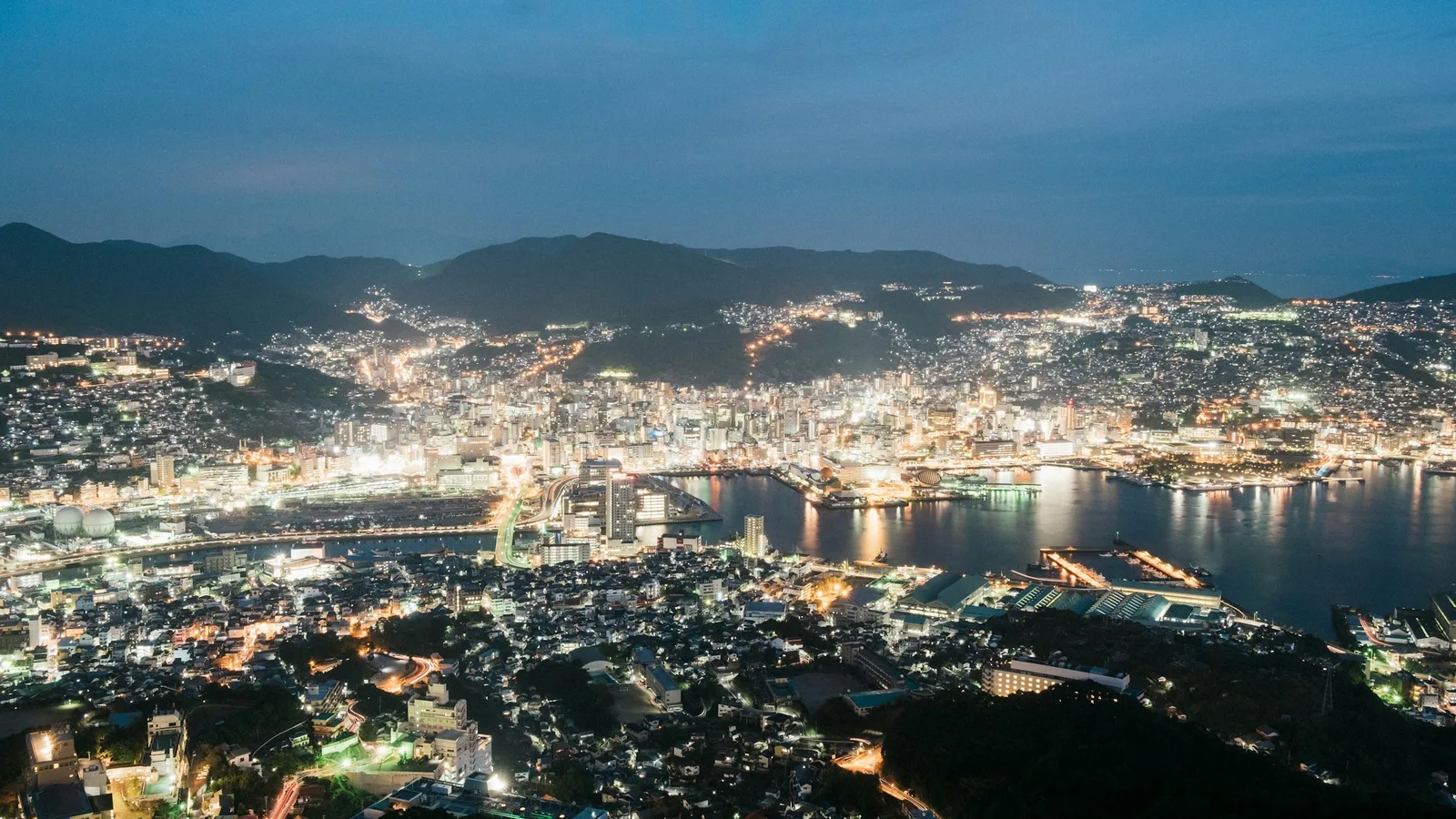
End the day above the city, on Mt. Inasa. A short ropeway lifts you to the summit, three hundred and thirty-three meters up, and what opens below you is the view Nagasaki is quietly famous for: one of Japan's traditional three great night views, alongside Hakodate and Kobe, and named, twice more, as one of the world's great night views. From up here the harbor is a dark seam, and the hills around it are covered, top to bottom, in light.
But look at what the light actually is. Nagasaki has so little flat ground that its houses climb the slopes in tight, stacked rows, all the way up the sides of the valley, the same steep streets that wore out your legs earlier in the day. So the famous "ten-million-dollar view" is not a skyline of towers or a strip of neon; it is windows. Each point of light is a kitchen, a stairwell, a room where someone is home, set into a hillside too steep to build on easily and lived on anyway. The thing that makes the night view possible is the same thing that makes the city hard to walk: people made their homes on the hills, and at night you can see every one of them.
That is a fitting place to end, because it is the whole of Nagasaki in one glance. A difficult geography, lived in fully. A harbor that took in the world one bridge at a time and turned it into champon and castella and red gates and a wooden church. A quiet hour earlier in the day that the city will never let go of. And, after dark, the ordinary lights of ordinary people, spread across the slopes like something far grander than they are. You came to a port that was once a country's only open window. You leave it having seen the light still on inside. Thank you for walking with us.
Good to Know
Getting around is mostly one streetcar. Nagasaki's classic trams connect almost everything a visitor wants: Dejima, Chinatown, the Peace Park, and the hill of churches and gardens, and the fare is a flat ¥150 for adults (¥80 for children) no matter how far you ride. A one-day pass is ¥600 (¥300 for children), and nationwide IC cards (Suica, ICOCA and the rest) work too. The stops that matter: Dejima (line 1) for Dejima; Shinchi-Chinatown (lines 1 and 5) for Chinatown; Atomic Bomb Museum and Peace Park (lines 1 and 3) for the peace sites; and Ōuratenshudo (line 5) for Glover Garden and Oura Church, with Ishibashi (line 5) the stop for the free inclined elevator up the hill. Last verified: 2026-06.
Getting there: the new bullet train, and the simpler bus. Since 2022 the Nishi-Kyūshū Shinkansen has reached Nagasaki, though not in a straight line yet: from Hakata (Fukuoka) you take a limited-express train to Takeo-Onsen and change (across the same platform) to the Shinkansen, reaching Nagasaki in about an hour and twenty minutes (from around ¥3,400). The transfer is easy and signposted; you barely have to think about it. From Nagasaki Airport, an airport bus reaches the city center in about 44 minutes (¥1,400). And a comfortable highway bus runs from Fukuoka (Tenjin/Hakata) in a little over two hours for ¥2,900, often the simplest option of all. For the wider picture of trains, trams, and passes, see getting around Japan. Last verified: 2026-06.
Dejima. Open every day, 8:00 to 21:00 (last entry 20:40); admission is ¥1,100 for adults and ¥550 for students. Allow about an hour. The English-language guide booklet and the restored interiors make it well worth the time rather than a quick photo stop. Last verified: 2026-06.
The peace sites: three places, two of them free. The Peace Park and the Hypocenter Park are open outdoor parks: free, unfenced, and walkable at any hour. Only the Atomic Bomb Museum is ticketed: ¥200 for adults, and free for high-school age and younger (bring student ID). Its hours shift with the season: 8:30–17:30 most of the year, until 18:30 from May through August, and later still (to 20:00) on August 7th–9th; last entry is 30 minutes before closing, and it closes December 29th–31st. Around August 9th the city holds its memorial ceremony at the Peace Statue, and the area is busiest and partly restricted that morning; other mornings are quietest. Last verified: 2026-06.
Glover Garden & Oura Church. Glover Garden is open 8:00–18:00 (last entry 20 minutes before close), with later evening hours in summer; admission ¥1,300 for adults, ¥650 for students, and the climb is eased by a free public inclined elevator near Ishibashi and walkways inside. Oura Church is open 8:30–18:00 (March–October) and 8:30–17:30 (November–February); admission ¥1,000 for adults (which includes the adjacent museum), and photography is not allowed inside: it is an active place of prayer. Last verified: 2026-06.
The night view. The Nagasaki Ropeway up Mt. Inasa runs 9:00–22:00 (last car up at 21:00); a round trip is ¥1,900 for adults. A free shuttle bus loops from several central hotels to the ropeway base in the evening, which spares you the bus connection. Full dark, naturally, gives the best view. Last verified: 2026-06.
If you come in winter, you may catch the lanterns. For about two and a half weeks each February, the Nagasaki Lantern Festival fills the city center with some fifteen thousand Chinese lanterns and transforms Chinatown completely, a direct inheritance of the city's Chinese New Year. In 2026 it runs February 6th–23rd; in 2027, February 5th–21st. It is beautiful and very busy; weekday evenings are calmer than weekends. Last verified: 2026-06.
Wear good shoes, and plan around the hills. Nagasaki is a city of slopes and stairs, and the best parts of it (Glover Garden, the old foreign quarters, the viewpoints) are uphill. The trams, the free inclined elevator at Glover Garden, and the ropeway do most of the climbing for you, but comfortable shoes matter more here than in flatter cities.
How long to stay. You can see the headline sights in a single full day: Peace Park in the morning, Dejima and a Chinatown lunch in the middle, Glover Garden and Oura Church in the afternoon, Mt. Inasa after dark. But Nagasaki genuinely rewards an overnight: the night view and a slower morning at Dejima are worth more than a rushed day trip from Fukuoka. If you can give it an evening and a morning, do.
A little cash helps. The trams, smaller shops, and some food stalls are easiest with coins and small notes in your pocket, though museums and larger places take cards.
Last verified: 2026-06
Official websites: Dejima · Discover Nagasaki (official visitor guide) · Nagasaki Atomic Bomb Museum
If Things Don't Go as Planned
Dejima didn't look like an island, and you wondered if you were in the wrong place. You were in the right place. The fan-shaped island really is there (you are walking its exact footprint) but the sea around it was filled in more than a century ago, and the islet was absorbed into the growing city. That surprise is part of the history: the window that was once surrounded by water is now surrounded by Nagasaki. The restoration even has a long-term plan to bring water back to its edges one day.
You weren't sure Nagasaki was worth the detour from Fukuoka. Many people ask this, because Nagasaki sits off the main line and you do change trains once. The honest answer most visitors reach is: yes, if you give it a night. The transfer at Takeo-Onsen is a single, easy, same-platform step, and what you get at the end is a city that feels unlike anywhere else in Japan: less crowded, more itself. A rushed day trip can leave you underwhelmed; an overnight rarely does.
The hills wore you out. They wear everyone out; this is the city's one real demand on you. Lean on the help: ride the trams between districts rather than walking, take the free inclined elevator up to Glover Garden instead of the stairs, and let the ropeway carry you up Mt. Inasa. Save your legs for the gentle, level wander of Dejima and Chinatown, and you will end the day far happier.
Chinatown felt smaller than you expected. It is smaller than Yokohama's: a single cross of streets rather than a district. But it is not trying to be the biggest; it is one of the oldest, grown straight out of the centuries when Chinese traders worked this harbor alongside the Dutch. Come for the four guardian gates, a bowl of the champon that was born on these very streets, and, if you are here in February, the lanterns. Size is not the point here. Origin is.
The Peace Park felt heavy, and you weren't ready for it. That is a common and completely human reaction, and there is no wrong way to feel it. You are allowed to take it gently: to skip rooms in the museum, to step outside for air, to simply stand in the open park rather than go in at all. Many visitors find Nagasaki's peace sites quieter and more reflective than they expected, with room to take your time. Whatever pace you need is the right one.
You weren't sure how to behave inside Oura Church. The rule is simple and kind: it is a place of prayer, so keep your voice low, put your phone away, and do not photograph the interior (outside is fine). You do not have to know any rituals or believe anything. Step in quietly, look, and step out; that is all that is asked, and it is exactly what local visitors do.
You only had one day. One full day is genuinely enough to see why Nagasaki matters: the window at Dejima, the mixed streets of Chinatown, a quiet hour at the Peace Park, the hill of churches and gardens. If the city moves you, let that be the reason to come back and stay the night for the view from Mt. Inasa. It is a place, and a feeling, that rewards the unhurried.
Sources:
- Dejima: Official Site (English): History: Dejima built 1636, Dutch trading post from 1641, the 218-year sole-window period, and the loss of the island's form through land reclamation
- Dejima: Official Site: Restoration Project: The 1951 restoration program, the 1904 reclamation that erased the island, and the long-term plan to restore water on all four sides
- Dejima: Official Site (English): Facility Information: Opening hours (8:00–21:00, last entry 20:40), admission (¥1,100 / ¥550, revised April 2026), and access
- City of Nagasaki: "Nagazine": Omotemon Bridge & restored buildings: Sixteen buildings restored (of a 25-of-49 plan) and the 2017 bridge
- JNTO: Dejima (Travel Japan): Standard English name and the one-hour visit, streetcar access
- Nagasaki City Tourism (at-nagasaki.jp): Shinchi Chinatown: One of Japan's three great Chinatowns, the 1702 land reclamation, the four directional gates, and its scale
- Shikairō: Official History (birthplace of champon): Champon and sara-udon created in 1899 for the Chinese community, and never trademarked
- Discover Nagasaki: Castella: The Portuguese (Nanban) origin of castella and its adaptation into a Nagasaki specialty
- Nagasaki Atomic Bomb Museum: Official Site: Seasonal hours, last entry, closed days, and admission
- City of Nagasaki: Atomic Bomb Museum fee revision (April 2026): ¥200 general admission and free entry for high-school age and younger
- Nagasaki Peace Site: Atomic Bomb Museum (official statement of purpose): The museum's stated mission to pass the experience on to future generations and work toward lasting peace
- City of Nagasaki: Peace Park "Wish Zone" (Peace Statue, Fountain of Peace): The Peace Statue (≈9.7 m, sculptor Seibo Kitamura, 1955) and the official meaning of its form
- JNTO: Nagasaki Peace Park (Travel Japan): The three-part layout (Peace Park, Hypocenter Park, Atomic Bomb Museum), standard English names, and tram access
- Glover Garden: Official Site: The nine relocated Western-style houses on the Minamiyamate hill and the harbor view
- Glover Garden: Hours & Admission / Former Glover House: Hours (8:00–18:00), admission (¥1,300 / ¥650, revised April 2026), the moving walkways; Former Glover House built 1863
- Glover Garden: Glover Sky Road (free inclined elevator): The free public inclined elevator from Ishibashi to the top of the garden
- Oura Church: Official Site (English Guide): Hours, admission (¥1,000), and the photography/quiet rules of an active place of prayer
- Agency for Cultural Affairs: Oura Tenshudo (National Treasure record): Completion in 1864 and National-Treasure designation
- UNESCO: Hidden Christian Sites in the Nagasaki Region (2018): The 2018 World Heritage inscription that includes Oura Cathedral
- UNESCO: Sites of Japan's Meiji Industrial Revolution (2015): The 2015 World Heritage inscription that includes the Former Glover House
- Nagasaki Electric Tramway: Fares & One-Day Pass (English): Flat ¥150 fare, the ¥600 one-day pass, IC cards, and stop-to-sight mapping
- JR Kyushu: Nishi-Kyūshū Shinkansen (Nagasaki route): The relay method via Takeo-Onsen and the ~1 hour 20 minute time from Hakata
- Nagasaki Kenei Bus: Airport Limousine: Airport-to-city fare (¥1,400) and journey time
- Inasayama Park / Nagasaki Ropeway: Official: Mt. Inasa (333 m), ropeway hours and fares, and the "World New Three Major Night Views" designation
- Nagasaki Lantern Festival: Nagasaki City Tourism: The festival period, the ~15,000 lanterns, and its Lunar New Year roots
Photos: sourced under free commercial-use licenses; see captions where attribution applies.
WMJS is written in Japan, in English, with AI help. We check every page, but English is not our first language. If a sentence reads oddly, tell us. One sentence is enough.
Thank you. A person reads every note.
Real voices
Is it worth it?
Were you there? Share your photos.
Your photo could appear in this guide — with your name and a link to your profile.
Submit a photoRelated Articles

Getting Around Japan: The Tiny Things That Earn You a Nod

The Power of a Small Bow: Why a Simple Nod Makes Japanese People Smile
Visiting Temples and Shrines: What Japanese People Notice
More guides in Kyushu
Visiting Dazaifu Tenmangu, the Shrine Where a Wronged Scholar Became a God
Is Dazaifu Tenmangu worth visiting? We weighed 49 traveler voices: 56% say worth it, and Japanese visitors land warmer at 77%. Free entry, getting there from Fukuoka, the umegae mochi and flying-plum legend, plum-blossom timing, and the Kyushu National Museum next door, with an audio guide.
Dazaifu Tenmangu
Visiting Beppu Onsen, the Town Where the Earth Boils Just Beneath Your Feet
Is Beppu worth it? We weighed 102 traveler voices: 46% say yes for the baths and boiling town, 44% say it depends on why you came, and Japanese reviewers are far warmer at 72%. The seven hells you look at but don't bathe in, steam-cooked eggs, the sand bath, and Beppu Hatto, with an audio guide.
Beppu Onsen (Kannawa)
Yufuin: A Town to Walk Slowly, and a Mist That Waits for Morning
An audio cultural guide to Yufuin, verified against official sources. A hot-spring town you walk rather than watch, where the famous morning mist on Lake Kinrin belongs to those who stay the night, how it differs from Beppu, and how to actually get there on the Yufuin no Mori train.
Yufuin (Lake Kinrin)
Kagoshima — The City That Lives With a Volcano
Kagoshima lives with an active volcano across the bay. An audio guide to Sakurajima: ash read like weather, a ferry to the mountain, a garden built around it.
Sakurajima