
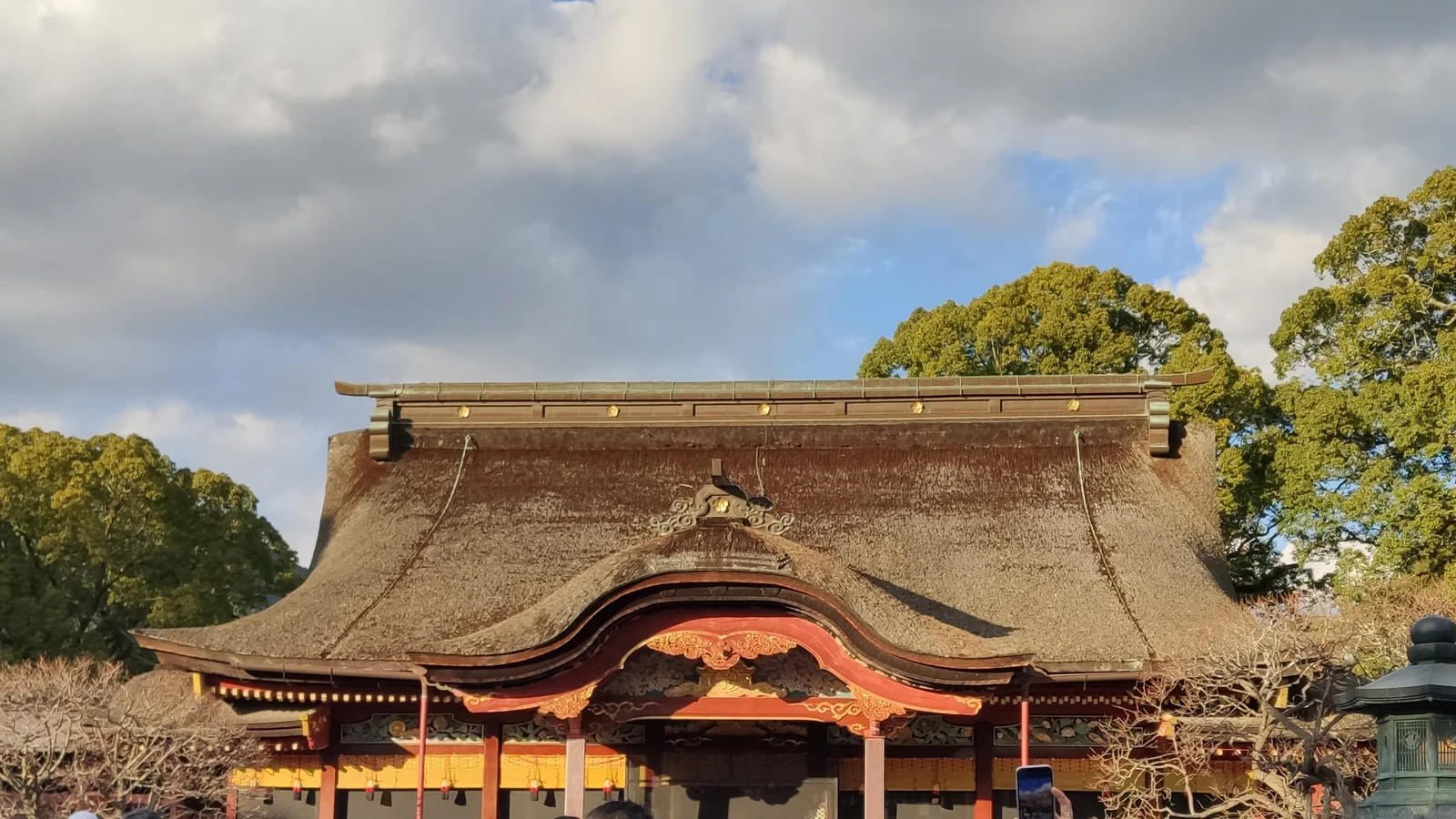
Visiting Dazaifu Tenmangu, the Shrine Where a Wronged Scholar Became a God
Dazaifu Tenmangu
By Kei · Born and raised in JapanIs Dazaifu Tenmangu worth visiting? By the voices we gathered, yes: of 49 international travelers debating the trip on Reddit, weighted by how strongly each opinion resonated with fellow readers, 56% called it worth it, 37% said it depends on how much time you give beyond a quick look at the shrine, and just 7% felt let down. Japanese visitors, who come mainly to pray to the god of scholarship, land far warmer at 77% glad they came. The grounds are free to enter, about a five-minute walk from Dazaifu Station on the Nishitetsu line, and a focused visit takes two to three hours, with the Kyushu National Museum next door for a full day. What visitors actually said, the letdowns included, is further down this page.
The Meaning
Before this was the most famous place in Japan to pray for an exam, it was a grave.
A little over eleven hundred years ago, a man named Sugawara no Michizane was carried to this spot in a cart and buried. He had been one of the finest minds of his age: a scholar who was reading Chinese poetry at eleven and lecturing on it as a young man, a statesman who rose almost to the top of the imperial court. And then, near the height of it, a rival family arranged his downfall. He was falsely accused, stripped of his rank, and sent into exile here at Dazaifu, far from the capital he loved, to live out his last years in something close to poverty. He died here in the year 903, at fifty-nine, having never been allowed to go home.
What happened next is the thing worth understanding before you go. The story the shrine tells is gentle, and it is the truest frame for the place: that even in disgrace and exile, Michizane never resented heaven or hated the men who ruined him; that he kept his learning and his sincerity to the end. After his death, in an age that believed a wronged spirit could trouble the living, the capital was visited by misfortunes that people came to connect to his name, and the court, in fear and in remorse, restored every honor it had taken from him and more, and began to worship him. Over the centuries that followed, the frightened reverence softened into something warmer. The brilliant, gentle scholar became Tenjin, a god. And because he had been, above all, a man of learning, he became the god of learning, of culture, and of the written word. This shrine, built directly over his grave by imperial order in 919, is the head of the Tenmangu shrines that now number in the thousands across Japan, and the one place where he is said to rest.
So when you arrive and find the approach crowded with students, with parents, with people clutching small wooden plaques, understand what you are seeing. They have not come for a photograph. They have come because a child has an examination that could change a life, and because a thousand years ago a man who knew exactly what it was to study hard and be treated unjustly was laid to rest under this ground. The prayers here are not casual. This guide asks only that you walk the approach a little more slowly than you might, and let the place be what it is for the people beside you: not an attraction, but a grave that grew, over a very long time, into a place of hope.
What Happens When You're There
Step 1: The Approach
You begin where everyone begins, on the short street that runs from the station to the shrine.
It is only about three hundred meters, this approach, the sandō, and you could hurry it in five minutes. Don't. The street is lined on both sides with shops selling one thing above all others: umegae mochi, a grilled rice cake with sweet red bean folded inside and the crest of a plum blossom pressed into its skin. They are made in front of you on hot iron molds, and they are best eaten while they are still almost too hot to hold, the outside crisp, the inside soft. A word that saves disappointment: despite the plum stamped on top, they are not plum-flavored. Here, the plum is a memory more than a flavor.
Because the little cake carries a story, and the story is the kind this whole place is built on. It is said that when Michizane was living here in exile, cold and short of food, an old woman who lived nearby took pity on him and slipped him mochi skewered on the branch of a plum tree, passed quietly through a gap so as not to shame him. The sweet you are eating is said to descend from that small, unasked-for kindness: a stranger's mercy to a lonely man. You will find more than thirty shops selling it along the approach, and there is no need to choose carefully or hunt for the "best" one; locally they are treated as one shared tradition, and you simply buy from whichever you are passing. (Two are worth knowing for the curious: on the seventeenth of each month some shops make a version with ancient rice, and on the twenty-fifth, one flavored with mugwort.)
Where the shops end, the shrine begins: three torii gates in a row, and then a pond shaped like the character for "heart," the Shinji-ike, crossed by three arched bridges that many visitors are told stand for the past, the present, and the future. Cross them slowly. You are stepping, deliberately, out of the everyday and toward the grave at the center of it all.
Step 2: The Ox by the Gate
Just past the first gate, you will meet a crowd around a bronze ox lying down, and you will notice before anything else that its head is worn bright and golden where ten thousand hands a day have touched it.
This is a goshingyū, a sacred ox, and there are eleven of them around the grounds, but this reclining bronze one near the entrance is the one everyone stops for. The reason it lies down, and the reason oxen are everywhere at this shrine, goes back to the day Michizane was buried. As the legend is told, the ox drawing the cart that bore his body suddenly lay down in the road and would not rise, and his followers took it as a sign and buried him on that very spot, the spot the main hall now stands over. So the ox is not decoration. It is the animal that chose this ground.
People stroke its head, and then often their own, because it is said that touching the ox can pass a little wisdom to the one who touches it: a quiet hope, before an exam, that some of the scholar's mind might rub off. There is no wrong way to do it; you wait your turn, you lay a hand gently on the worn bronze, and you move on so the next person can. If you would like to understand the small gestures Japanese visitors make at shrines more generally (the bow at the gate, the rinse of the hands, the way of standing before the hall), that is its own quiet language, and we have written about the customs that travel well at any temple or shrine. Here, the ox is enough to start with.
Step 3: The Plum That Followed Him
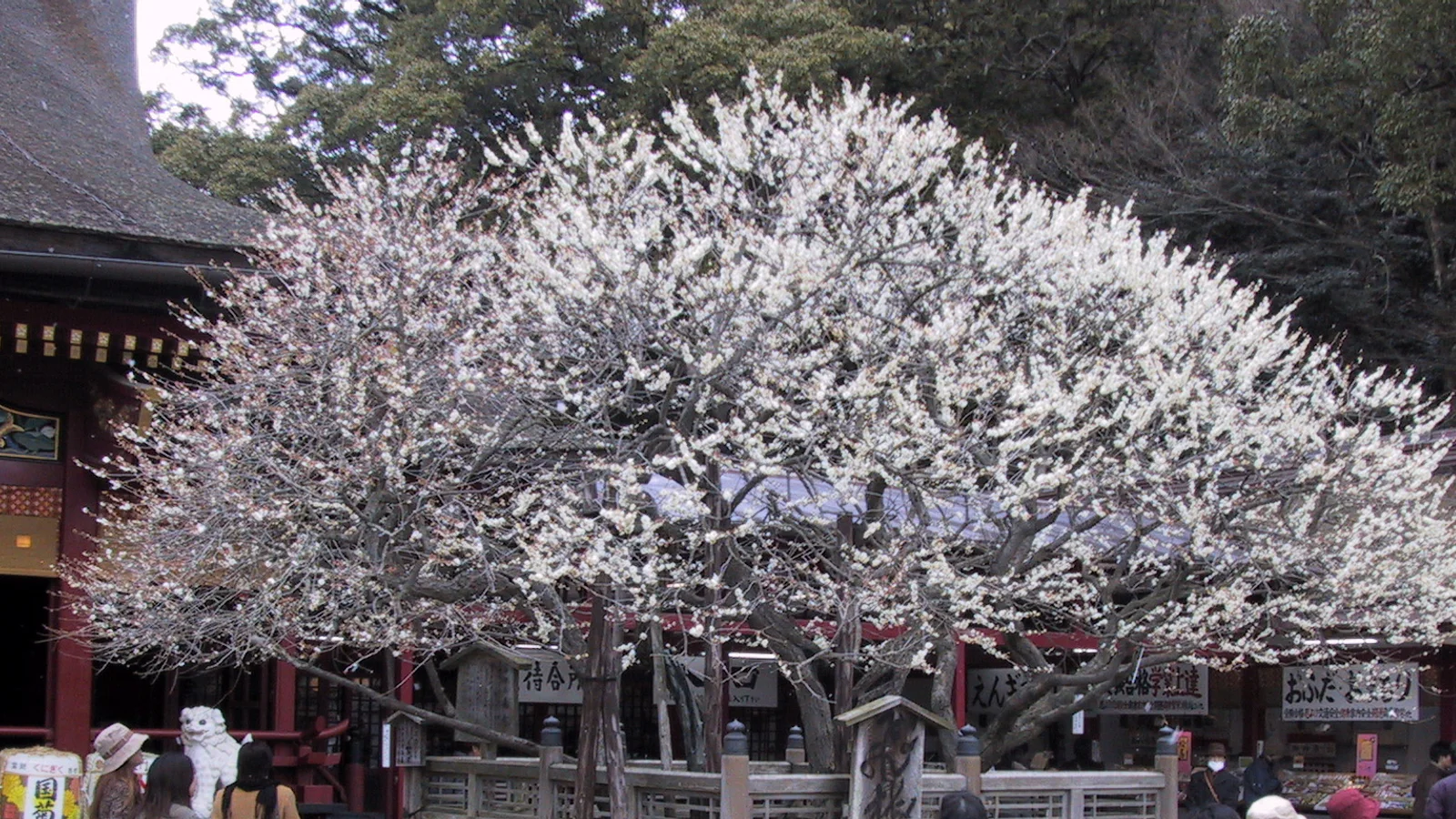
To the right of the main hall stands a single old plum tree, and of all the six thousand plums on these grounds, this is the one to find.
It is called the Tobiume, the "flying plum," and it is the heart of the most loved story here. Michizane adored plum trees all his life, and on the night before he left Kyoto for exile, he is said to have stood in his garden and spoken a farewell poem to his favorite among them: When the east wind blows, send your fragrance to me, plum blossom; though your master is gone, do not forget the spring. The tree, the legend goes, could not bear to be left behind. It tore itself up by the roots and flew through the night, all the way to Dazaifu, to be near him again. The tree that stands here now is held to be that plum, and it is an unusually early-blooming variety; year after year, it opens its flowers before any other tree on the grounds, as if it still cannot wait.
The other plums, some six thousand of them in around two hundred varieties, were every one of them donated, tree by tree, by ordinary people over the years, and they are tended by gardeners the shrine simply calls "plum keepers." They bloom in slow succession from late winter into spring, so that for a few weeks the grounds turn pale pink and white and the air goes sweet, and the shrine holds a ceremony among the blossoms each year on the anniversary of Michizane's death. If you have come in the cold months hoping to see it, the timing is worth checking before you set out: the plums are not cherry blossoms, they come earlier, and exactly when shifts a little every year with the weather. You will find what to expect, and when, in the section below.
Step 4: A Prayer, Not a Photo
Near the hall you will come to a wall (sometimes a whole grove of frames) hung thick with small wooden plaques, and if you read a few you will understand the place completely.
They are ema, prayer plaques, and at almost any other shrine they carry wishes of every kind. Here, overwhelmingly, they carry one: let me pass. The name of a school. The word for a university. A date a few months away. They are written by teenagers and by the parents of teenagers, and in the months before Japan's entrance examinations they hang here in their thousands, a forest of other people's hope. It is worth pausing in front of them, because this is the part that the guidebooks, with their tidy phrase "popular with students," tend to miss. What is happening here is not luck-buying. The shrine is careful to say that Michizane stood for learning in its fullest sense: not cramming for a test, but the patient, lifelong work of becoming a thoughtful person, and of using what you learn for the good of others. To pray here is, properly understood, to promise to study, and to ask for the strength to keep the promise.
If you would like to add a plaque of your own, you can, and you should not worry that you don't belong. The shrine describes itself, in plain words, as a place that welcomes everyone: anyone at all may offer a prayer here, whatever they believe or don't. And you need not write in Japanese; a wish set down in your own language is received exactly as kindly. The honest truth is that the Japanese visitors around you also learned all of this once, as children, from a parent showing them how: which hand, which way to bow, what to write. No one is born knowing. You are simply learning it a little later, and that is completely fine.
Step 5: Beside the Shrine
When you are ready to leave the hall, there is one more thing worth doing, and it is hidden in plain sight at the edge of the grounds.
Follow the path past the treasure hall and you will find an escalator and a long moving walkway running through a tunnel of soft, shifting light (the locals call it the rainbow tunnel), and it carries you, in a few unhurried minutes, straight to the Kyushu National Museum, one of the great museums of Japan, telling the long story of how this island traded and exchanged with the wider world. It is a rare and lovely thing, to step from a thousand-year-old grave into a national museum without ever leaving the trees, and if you have an afternoon it is the natural way to spend it. The practical details are below.
Or simply turn and walk back the way you came, down the approach, past the plum-cake shops now wrapping up the day's last orders, toward the station. As you go, it is worth asking yourself the question this place quietly poses. A scholar was wronged here, eleven hundred years ago, and died far from home with nothing. He could have been forgotten. Instead, generation after generation, people have walked this same short approach to stand at his grave: students before the hardest day of their year, parents who cannot sit the exam for their child and so come here to do the only thing they can. Why him? Why, of all the people history has buried, has this one gentle, unlucky man been remembered with such tenderness for so long? The shrine does not answer it for you. It just lets you stand where the answer is, and feel it. Thank you for walking with us.
What Visitors Honestly Say
Before you decide how much of the day to give it, it helps to hear from people who already made the trip. We gathered 49 voices from international travelers debating this exact question on Reddit, weighted by how strongly each opinion resonated with fellow readers, and this is how they fell:
One top-voted traveler put it simply: "You must go to the nearby Daizaifu Tenmangu. It is the most important shrine for education in Japan, and it is beautiful." The neutral band is mostly a scheduling question rather than a doubt about the shrine itself, weighing a quick look at the main hall against the two other shrines and the museum nearby. The rare flat no came from a Fukuoka resident who had seen other shrines: "Everyone always says Dazaifu. But if you've seen other shrines in Japan, this isn't anything too special."
Japanese visitors and locals, praying to the same god of scholarship in their own reviews, land far warmer:
The purpose shows up constantly. "I came to pray to the god of scholarship for my son's exam success," one visitor wrote. Their small red band is almost entirely logistical: one reviewer's flattest complaint was that the crowded approach kept them from praying as calmly as they had hoped.
The full picture, the letdowns included, is in Is Dazaifu Tenmangu Worth It?
Good to Know
Look around
What you'll see when you get there
On the approach street from Dazaifu Station, facing the second torii just ahead.
Street View shows one day. Crowds, construction and seasons change the scene.Open in Google Maps ↗
The most important thing to know first: the grounds are free, open to everyone, and meant for an unhurried walk. A focused visit (the approach, the bridges, the ox, the plum, the main hall, with an umegae mochi in hand) takes a comfortable two to three hours. Add the Kyushu National Museum next door, the quieter sub-shrines on the hillside, and a teahouse, and it becomes an unhurried full day. There is no single "right" length; size it to the time you have.
A note on the main hall (2026): Dazaifu Tenmangu completed the first major renovation of its main hall in 124 years in May 2026, and the deity has been returned to the restored hall. During the renovation, a celebrated temporary hall stood in front of it: a structure roofed with living trees, designed for this once-in-a-generation moment. It was taken down over about three months from May 2026, and since 19 September 2026 visitors can once again pray directly in front of the main hall, for the first time in about three and a half years. Formal prayer ceremonies were moved to a nearby hall during the work; the shrine's prayer page lists where they are held now. If you saw earlier news of the famous forest-roofed hall and came hoping to see it, this is the gentle reality: it was always meant to be temporary. Check the official site for the current state of the grounds on your dates. Last verified: 2026-10.
Getting there: Dazaifu sits about fifteen kilometers from central Fukuoka and makes an easy half-day trip, but the one thing that trips people up is that the train is the Nishitetsu line, not JR, and it leaves from Nishitetsu-Fukuoka (Tenjin) Station, rather than Hakata. From Tenjin, take the Nishitetsu line toward Ōmuta, change at Nishitetsu-Futsukaichi to the short Dazaifu branch line, and ride to Dazaifu Station; it is roughly 35 minutes in all, with no limited-express surcharge, and the shrine is a five-minute walk from the station. On the branch line you may catch the Tabito, a specially decorated sightseeing train, which needs no reservation and no extra fare. Coming from elsewhere: a direct bus runs from Fukuoka Airport to Dazaifu Station in about 25 minutes, and a direct bus from Hakata Bus Terminal takes about 40–45 minutes. There is no car park at the shrine, so come by train or bus. For the bigger picture of trains, buses, and passes, see getting around Japan. Last verified: 2026-06.
A useful ticket: Nishitetsu sells a Dazaifu Sansaku Kippu (Dazaifu Stroll Ticket) that bundles the round-trip fare from Tenjin with a voucher for one umegae mochi and a few local discounts, for around 1,000–1,040 yen, a tidy option for a simple there-and-back day. Last verified: 2026-06.
Hours and cost: Worshipping at the shrine and walking the grounds is free, and there is no entrance gate. The gates open early, around 6:00 to 6:30 in the morning depending on the season, and close in the evening, roughly 6:30 p.m. in winter, 7:30 p.m. in midsummer, and 7:00 p.m. in between. The on-site museums keep daytime hours and charge admission; the amulet and prayer-plaque counters take cash. Last verified: 2026-06.
When to visit (and the plums): The plum blossoms (the shrine's signature flower, earlier than the cherries) bloom from late January into early March, with the peak usually in February; the exact timing shifts every year with the weather, so don't be discouraged if you arrive to find them not quite open or just past. The grounds are busiest around the New Year and through the January-to-March exam season, and on weekends. For a quieter visit, come early in the morning, or walk a little past the main hall to the sub-shrines on the hillside, where the crowds thin quickly. For more on reading Japan's seasons, see the best time to visit Japan.
Next door, the Kyushu National Museum: reached from the grounds through the escalator-and-walkway tunnel in about ten minutes from the station, it opens 9:30 a.m. to 5:00 p.m. (last entry 4:30), closes on Mondays (the next day if Monday is a holiday), and charges 700 yen for its main exhibition, with separate pricing for special exhibitions; visitors under eighteen and over seventy enter the main exhibition free. Last verified: 2026-06.
Photography: the grounds, the plums, and the great bronze ox are yours to photograph; the kind habit at the busy spots (the ox, the wall of plaques, the bridges) is to take your picture and step aside rather than hold the place while others wait. A little awareness about where and whom you photograph keeps a crowded grave a peaceful one.
Bring cash: the amulet counters and many of the approach shops are cash-first. A little in your pocket makes the day smoother.
Last verified: 2026-06
Official sources: Dazaifu Tenmangu official site · Dazaifu City Tourist Association · Kyushu National Museum
If Things Don't Go as Planned
"I came for the famous forest-roofed hall, and it's gone." You are not too late for the shrine, only for one chapter of it. The temporary hall with its roof of living trees was built for a single purpose: to house the deity while the main hall underwent its first renovation in 124 years. That work is now finished, the deity is back in the restored main hall, and the temporary hall was dismantled in 2026. It was always meant to be passing: a once-in-a-generation sight, not a permanent one. What you can see now is the thing it was protecting all along: the renovated hall over Michizane's grave, ready for the next hundred years.
"It's packed." The grounds are busiest at New Year, through the winter exam season, and on weekends; this is, after all, the place a whole country comes to pray before its hardest exams. The two reliable fixes both work: come early in the morning, before the day-trip crowds arrive, or walk past the main hall and up toward the smaller shrines on the hillside, where the crowd falls away within minutes. The approach is liveliest in the middle of the day; the edges of the day are calm.
"I think I mistimed the plum blossoms." It happens to almost everyone, because the plums are not on a fixed schedule: they open earlier than cherry blossoms, anywhere from late January to early March, and the peak moves a week or two each year with the weather. If you have arrived to bare branches or fallen petals, the shrine is no less worth the visit: the story, the ox, the grave, the approach, and the museum next door are all there in any season. And if the timing matters to you, the single tree to look for first is the Tobiume, to the right of the main hall; it blooms before all the others.
"Which mochi shop should I go to?" Any of them. There are more than thirty along the approach, and locally they are treated as one shared tradition rather than a contest, so the honest answer is to buy from whichever you happen to be passing, and eat it hot. Don't spend your visit hunting for a "best" one that the people who live here don't really rank.
"I went to Hakata Station and couldn't find the train." A very common mix-up: the train to Dazaifu is the Nishitetsu line, which runs from Nishitetsu-Fukuoka (Tenjin) Station, rather than from JR Hakata. From Hakata, either take the subway two stops to Tenjin and switch to Nishitetsu, or, simplest of all, take the direct bus from Hakata Bus Terminal, which runs straight to Dazaifu Station in about 40–45 minutes.
"Is it really worth it, isn't it just for students?" It is honestly fine to feel this, especially if you have already seen the great shrines of Kyoto or Nara. Dazaifu is not trying to out-scale them. What it offers is different: a real, living place of prayer with a story you can feel in your chest, a beautiful approach, the plums in late winter, a tender local sweet, and a national museum a few minutes' walk away. You do not have to be a student, or religious, or Japanese to be moved by the grave of a wronged scholar who became a country's gentle god of learning. Give it a couple of unhurried hours, and let it be exactly what it is.
Sources:
- Dazaifu Tenmangu Official, History (English): Sugawara no Michizane (845–903) as scholar and statesman, the false accusation and exile to Dazaifu, posthumous exoneration, his veneration as Tenjin, deity of learning, culture, and the arts
- Dazaifu Tenmangu Official, Goyuisho / Origins (Japanese): Exile in 901, death on 25 February 903 at age 59, burial where the ox lay, the main shrine hall built by imperial order in 919, the present main hall donated in 1591 by Kobayakawa Takakage (a National Important Cultural Property), and the shrine as the head of the nation's Tenmangu shrines, built over Michizane's grave
- Dazaifu Tenmangu Official, Tenjin-sama and the Plum (Japanese): The Tobiume legend and farewell poem, the early-blooming Iro-tamagaki variety, the roughly 6,000 donated plum trees in about 200 varieties, the Baikasai plum-blossom ceremony on 25 February, and the umegae-mochi origin legend
- Dazaifu Tenmangu Official, The God of Learning (Japanese): Michizane's idea of learning as character and contribution to society, rather than mere study for examinations
- Dazaifu Tenmangu Official, Shrine Grounds (English): The eleven sacred oxen and the custom of stroking the bronze ox for wisdom, the Tobiume by the main hall, and the on-site museums
- Dazaifu Tenmangu Official, Visitor FAQ (English): Free entry to worship, seasonal opening hours, the plum-bloom window (late January to early March, varying with weather), exam-success prayers, and the welcome extended to all visitors
- Dazaifu Tenmangu Official, Notice on Worship in Front of the Main Hall, 19 September 2026 (Japanese): Worship directly in front of the main hall resumed on 19 September 2026, about three and a half years after it was paused for the renovation
- Dazaifu Tenmangu Official, Notice on Prayers from 17 May 2026 (Japanese): Formal prayer ceremonies held at the Seishinkan ceremonial hall from 17 May 2026
- Dazaifu Tenmangu Official, Prayers (Japanese): Where and when formal prayer ceremonies are received
- Nishinippon Shimbun, 18 May 2026 (Japanese): The main hall's first major renovation in 124 years completed, with the temporary hall's dismantling starting on 19 May
- TNC TV Nishinippon, 21 September 2026 (Japanese): The temporary hall taken down over about three months, and worship at the main hall resumed on 19 September
- Dazaifu City Tourist Association, Umegae Mochi (Japanese): What umegae mochi is (grilled red-bean rice cake with a plum crest, not plum-flavored), its origin legend, the more than thirty shops along the approach, and the monthly special varieties
- Nishitetsu, Dazaifu Sansaku Kippu (Japanese): The round-trip excursion ticket from Tenjin with an umegae-mochi voucher, and the rail route via Nishitetsu-Futsukaichi
- Kyushu National Museum, Visitor Guide (Japanese): Opening hours, Monday closures, admission for the cultural-exchange exhibition, and access from the shrine grounds via the connecting tunnel
- Kitano Tenmangu Official, About the Shrine (Japanese): The origin of the Tenjin faith: how the legends that arose after Michizane's death led to his veneration as Tenjin, the god of learning, culture, and the arts
- Is Dazaifu Tenmangu Worth It? (WMJS): The two visitor-voice gauges reproduced in "What Visitors Honestly Say" (49 international voices, 56/37/7; 160 Japanese voices, 77/18/5) and the verbatim visitor quotations
Photos: the main hall of Dazaifu Tenmangu by Drivephotographer, CC0 / public domain, via Wikimedia Commons; a plum tree in bloom before the main hall, CC BY-SA 3.0, via Wikimedia Commons.


WMJS is written in Japan, in English, with AI help. We check every page, but English is not our first language. If a sentence reads oddly, tell us. One sentence is enough.
Thank you. A person reads every note.
Real voices
Is it worth it?
Were you there? Share your photos.
Your photo could appear in this guide — with your name and a link to your profile.
Submit a photoRelated Articles
Visiting Temples and Shrines: What Japanese People Notice

The Power of a Small Bow: Why a Simple Nod Makes Japanese People Smile

More guides in Kyushu
Visiting Beppu Onsen, the Town Where the Earth Boils Just Beneath Your Feet
Is Beppu worth it? We weighed 102 traveler voices: 46% say yes for the baths and boiling town, 44% say it depends on why you came, and Japanese reviewers are far warmer at 72%. The seven hells you look at but don't bathe in, steam-cooked eggs, the sand bath, and Beppu Hatto, with an audio guide.
Beppu Onsen (Kannawa)
Yufuin: A Town to Walk Slowly, and a Mist That Waits for Morning
An audio cultural guide to Yufuin, verified against official sources. A hot-spring town you walk rather than watch, where the famous morning mist on Lake Kinrin belongs to those who stay the night, how it differs from Beppu, and how to actually get there on the Yufuin no Mori train.
Yufuin (Lake Kinrin)

Kagoshima — The City That Lives With a Volcano
Kagoshima lives with an active volcano across the bay. An audio guide to Sakurajima: ash read like weather, a ferry to the mountain, a garden built around it.
Sakurajima
Kumamoto Castle — A Fortress Being Put Back Together, One Numbered Stone at a Time
An audio guide to Kumamoto Castle — a fortress still being rebuilt after the 2016 earthquake. The miracle stone wall, the elevated walkway over the live repair, plus hours, tickets and access.
Kumamoto Castle