
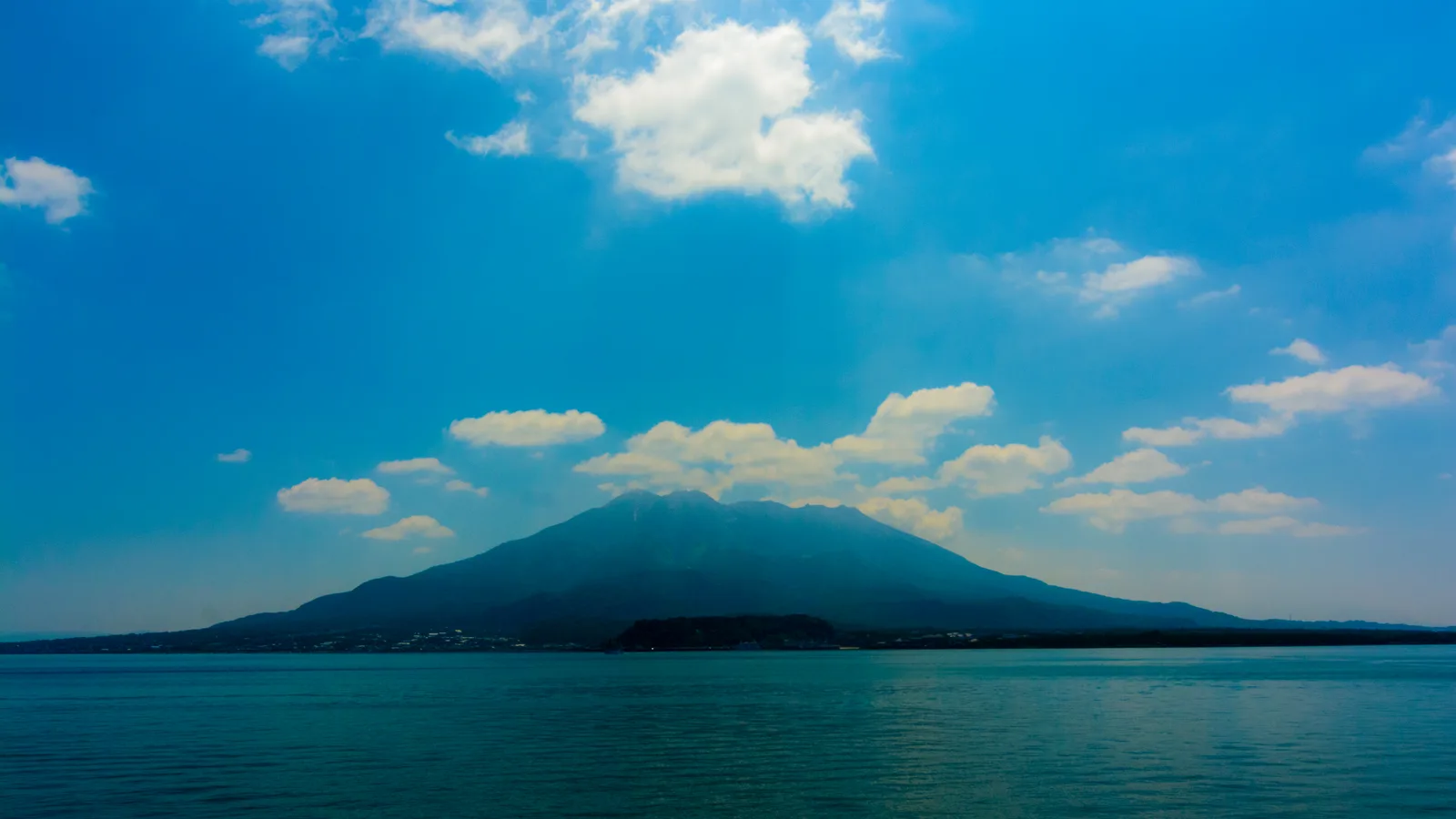
Kagoshima — The City That Lives With a Volcano
Sakurajima
By Kei · Born and raised in JapanThe Meaning
Kagoshima is a city of about six hundred thousand people, spread along a wide bay at the southern tip of Kyushu. Across that bay, a little under four kilometers of water away, stands Sakurajima, and it is anything but a sleeping mountain. It ranks among Japan's most active volcanoes, and on many days it is doing exactly what a volcano does: smoking, rumbling, and now and then dusting the city with a fine grey ash. Most cities have a mountain on the horizon. Kagoshima has a volcano that is awake, and close enough to fall on the laundry.
What you will not find here is a city bracing against its mountain. You will find a city living with it. The ash has a forecast, read like the weather: the national meteorological agency issues a Sakurajima ash-fall outlook of where it will fall and how much, and the city links to it right beside the temperature and the rain. When the ash does settle, the city hands its residents plain yellow bags to gather it in, the way another town might hand out bin liners, and street sweepers and water trucks come through to clear the roads. The volcano's own visitor center puts it plainly: the people of Sakurajima live together with the volcano, and today's eruptions are simply part of daily life.
That is the real subject of this guide. Not "an active volcano you can see from the city" (though you can), but the quiet, daily intimacy of a place that decided, long ago, not to fight the mountain but to live alongside it. And it is genuinely long ago. In 1658, the lord of this domain built his villa garden so that Sakurajima became the garden's centerpiece: the volcano as the hill, the bay as the pond. The relationship is more than three centuries deep, and it runs both ways: the same ash that is a nuisance also feeds the soil that grows the world's largest radish and its smallest orange. The visitor center calls these the gifts of the volcano.
So when you spend a day here, you are not ticking off a famous active volcano. You are watching what it looks like for people to live gracefully beside the earth's raw power: to read its moods, gather its ash, ferry across to it, eat what it grows, and frame it in a garden. We will look across the water at it, ride toward it, see what it takes and what it gives, find the garden built around it, and end the day warmed by the same earth.
What Happens When You're There
Step 1: The Neighbor Across the Water
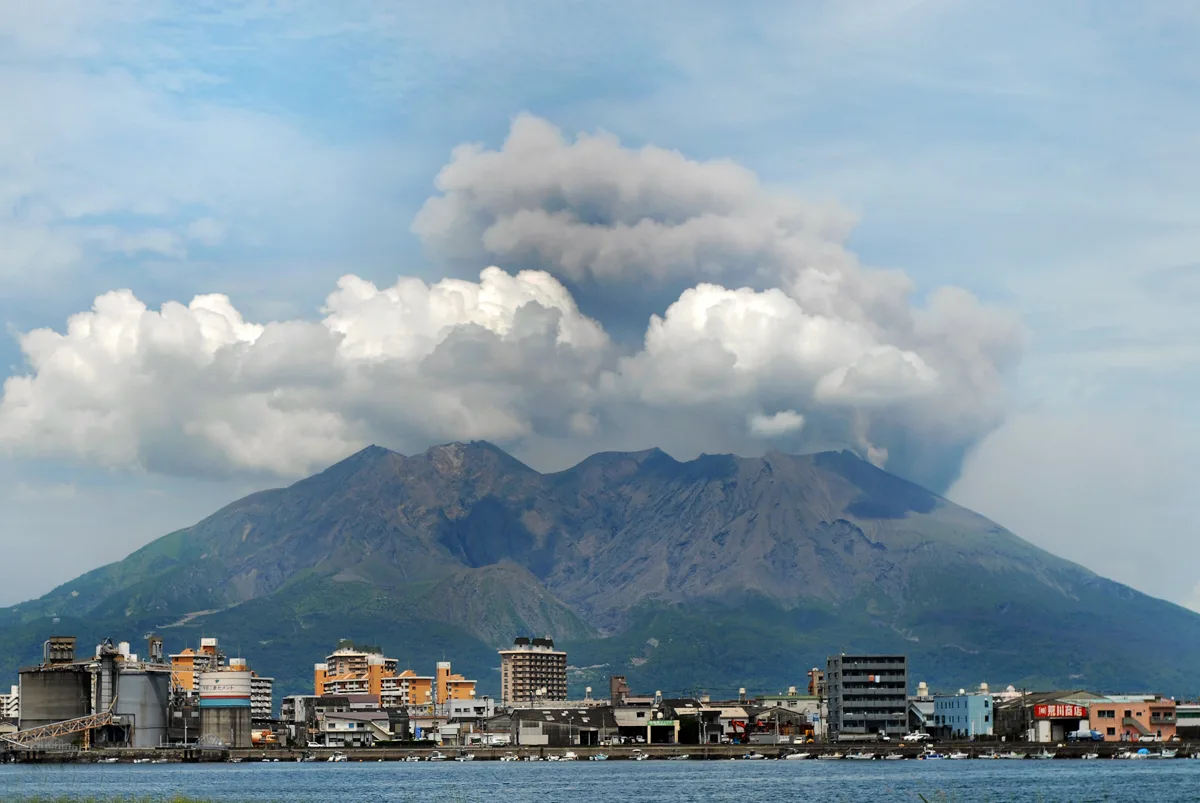
Start by simply looking at it. The classic vantage is Shiroyama, a green hill of just a hundred and seven meters rising right behind the downtown. From the observation deck at the top, the whole relationship fits into a single frame: the grid of the city in the foreground, the broad sweep of Kinko Bay, and Sakurajima filling the far side of the water, often with a thread of pale smoke leaning off its summit in whatever direction the wind is taking the ash today.
That wind direction is not idle scenery; it is the most-watched fact in town. Somewhere out on the bay, the little ferries are crossing back and forth; somewhere in a neighborhood downwind, someone is checking whether today is a day to bring the washing in. A city of six hundred thousand people lives its ordinary mornings under that plume, and has learned to read it the way other cities read a cloud bank.
Stand here a while before you do anything else, because this view is the whole guide in miniature. The volcano is not at the edge of life in Kagoshima, off in a national park to be visited. It is right there, across the water, woven into the morning. (If the smoke makes you wonder whether it is safe to be this close to an active volcano, that instinct is worth taking seriously and easy to satisfy: there is a simple, public answer, and we come to it next.)
Step 2: The Ferry That Goes Toward the Volcano
Here is the small, telling thing about Kagoshima: the ferry does not run away from the volcano. It runs toward it. The Sakurajima Ferry, operated by the city itself, crosses from central Kagoshima to the foot of the mountain in about fifteen minutes, and for a long time it ran around the clock, a genuine lifeline for the roughly three thousand five hundred people who live on the volcano. (As of October 2025 the deep-night sailings were stopped, but the ferry still carries an ambulance across at night whenever one is needed, casting off within about thirty minutes of the call. A boat that puts to sea in the dark to bring a doctor to people living on an active volcano tells you most of what you need to know about this place.)
And you can ride it. This is where the honest, reassuring detail matters most. You cannot climb Sakurajima: the summit is closed, and there is a no-entry zone within about two kilometers of the crater, a rule that has held since a fatal eruption in 1955. The volcano is kept at an official alert level (Level 3, "restricted entry," when this guide was written), which is exactly why visiting it is calm rather than reckless: every tourist site on the island sits more than two and a half kilometers from the crater, and on an ordinary day they are all simply open. (For the wider picture of how Japan manages its living landscape, Japan is safer than its dramatic geology suggests, and Sakurajima is one of the most closely watched mountains in the country.)
So you do not stand in the crater. You stand near it, which is plenty. The Yunohira Observatory, at three hundred and seventy-three meters, is the highest point visitors can reach, the closest you can lawfully get to the vent, with the lava slopes falling away below you and the bay and the city laid out behind. Down at sea level, the Nagisa lava walk runs about three kilometers across the black, jumbled rock that the volcano poured out in its great eruption of 1914, with a free public foot bath at one end where you can soak your feet on the edge of a lava field. The easiest way around the island is the Sakurajima Island View loop bus, which circles the main sights about fifteen times a day.
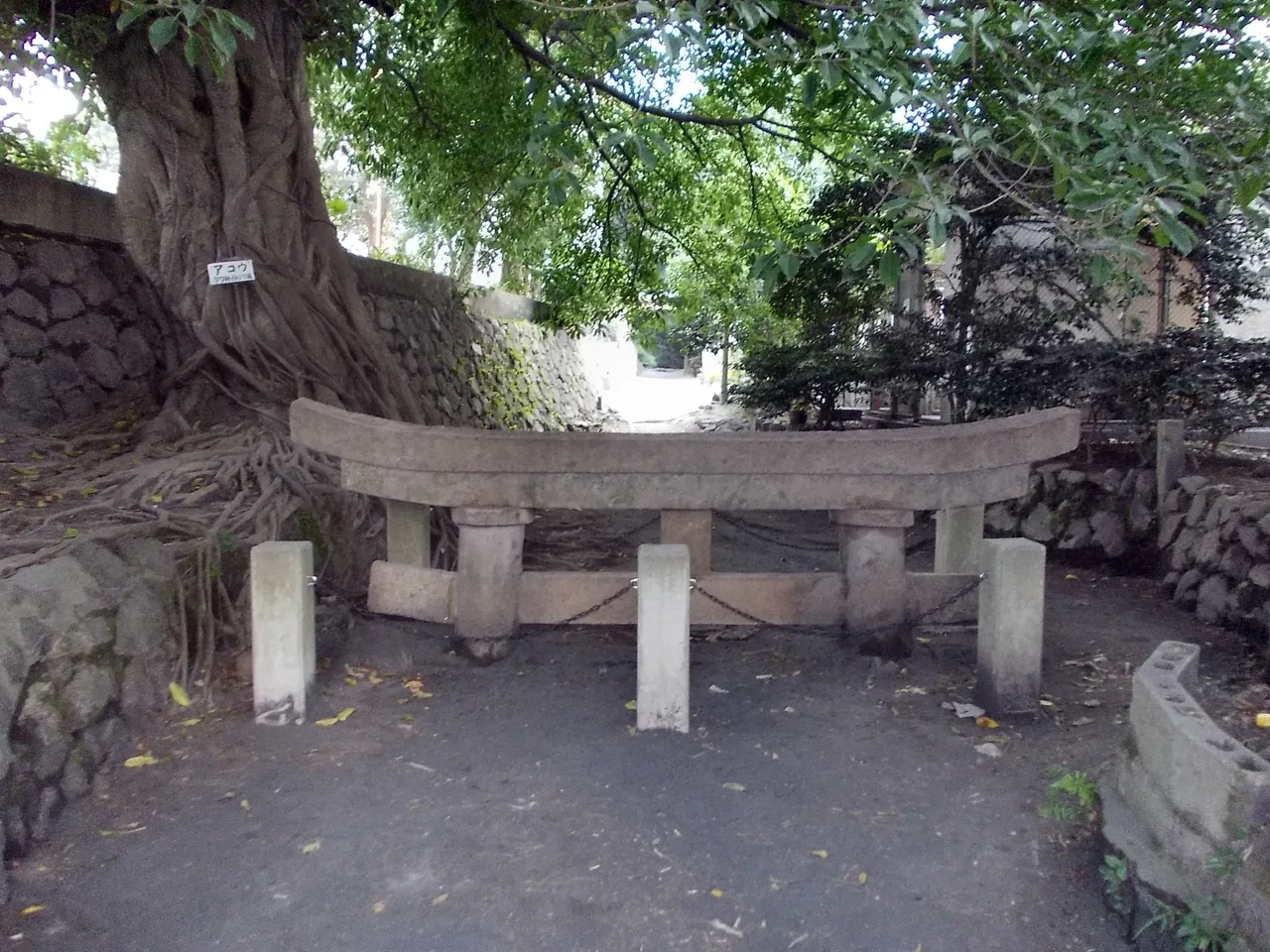
The 1914 eruption is worth pausing on, because it explains the ground you are standing on. Before it, Sakurajima was a true island in the bay. The eruption sent out so much lava that it filled the strait on the eastern side and welded the island to the Osumi Peninsula: the volcano literally redrew the map. And yet people stayed. The most quietly astonishing sight on the island is at Kurokami, where a shrine gateway, a torii once three meters tall, was buried up to its neck by falling ash and pumice in a single day. The villagers could have dug it out. Instead the village head chose to leave it half-swallowed, so that later generations would remember what the mountain can do. It still stands there today, a meter of stone above the ground and two meters below, a marker not of disaster but of a community that looked at what happened and decided to keep living here anyway.
Step 3: What the Ash Takes, and Gives
Back in the city, the ash is treated as a chore, not a catastrophe, and watching how Kagoshima has turned a volcano into a chore is the most human thing you can learn here. When ash settles on a neighborhood, residents sweep it into the yellow ash bags that the city gives out for free, tie them shut, and set them out at marked ash collection points, the same easy rhythm as putting out the recycling. Road sweepers brush the main streets; water trucks damp them down so the grey dust does not blow back up. None of this is heroic. It is just municipal housekeeping, designed around the fact that the sky occasionally turns to grit.
And then there is the other side of the ledger, the part the guidebooks almost never tell you. The same volcanic ground that has to be swept off the streets grows two things found nowhere else. One is the Sakurajima radish (the Sakurajima daikon), which the prefecture calls, in its own words, the largest radish in the world, recognized in the record books; an ordinary one weighs as much as a small child, and the champion of the annual contest is the size of a beach ball. The other is its mirror image: the Sakurajima small mandarin, the komikan, said to be the smallest mandarin orange in the world, barely five centimeters across and light enough to lose in your palm. The biggest radish on earth and the smallest orange, growing on the same volcanic island, a ferry ride from the ash bags. The visitor center does not call these an inconvenience. It calls them the gifts of the volcano, and that is the whole relationship in a single bite: the mountain takes a little off the top of your day, and hands back something the rest of the world cannot grow.
Step 4: The Garden Built Around the Volcano
If you want proof that living with this volcano is not a modern coping strategy but something woven deep into the place, go to Sengan-en. In 1658, the nineteenth lord of the Shimazu family, the clan that ruled this corner of Japan for some seven hundred years, laid out a villa garden on the shore of the bay. Most great Japanese gardens build their own miniature world: a small hill here, a pond there, a borrowed view of a distant temple. Sengan-en did something bolder. It took the volcano itself as the garden's hill and the entire bay as the garden's pond. The prefecture describes it exactly so: a garden of grand scale that treats the mighty Sakurajima as its artificial hill and Kinko Bay as its pond.
Think about what that means. Three and a half centuries ago, the most powerful family in the region looked across the water at a mountain that erupts, that rains ash, that had not yet even joined itself to the mainland, and decided it was the most beautiful thing they could place at the heart of their garden. Not a threat to be screened out, but the centerpiece. The smoke and the changing light on the slopes were part of the design.
The same restless ambition runs through the buildings beside the garden. In the nineteenth century the Shimazu lords built Japan's first cluster of Western-style factories here at Iso, reaching for the technology of the wider world; the surviving stone machine works, completed in 1865, is the oldest Western-style factory building left in Japan and now part of a UNESCO World Heritage listing. This was the launchpad of men who would help remake the whole country: Saigo Takamori and the leaders of the Meiji Restoration came out of this domain. But stand in the garden and look up, and the lesson is simpler than all that history. A family that could have built its view around anything chose to build it around the volcano.
Step 5: Warmed by the Same Earth
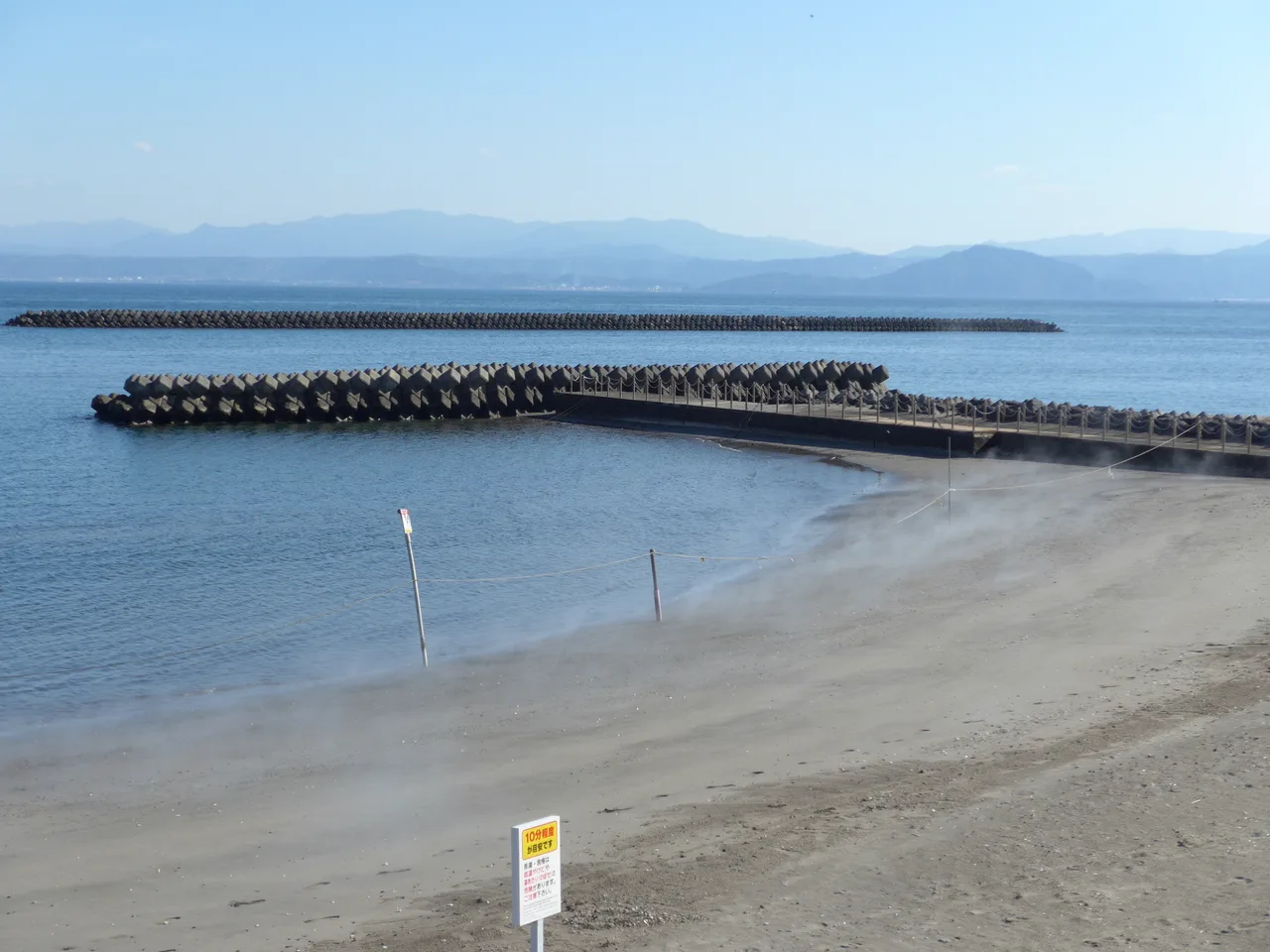
End the day by letting the same earth that rains ash do something kinder. An hour south of the city, on the coast at Ibusuki, the ground itself is hot, heated from below by the same volcanic forces that built Sakurajima, and for generations people have come not to bathe in water but to be buried in sand. You change into a cotton robe, lie down on the black volcanic beach, and an attendant shovels naturally heated sand over you until only your face is free. The warmth comes up through the sand and soaks into you from every side; ten quiet minutes under it is said to do you more good than a long soak in a tub. At the lowest spring tides they bury you right at the water's edge; when the tide is high or the weather turns, there is a roofed sand bath just behind the beach. It is, the local tourism office notes, a kind of bath found almost nowhere else on earth.
There is no better way to finish a day spent learning how Kagoshima lives with its volcano. In the morning you stood across the water from a mountain that drops ash on the city. By evening you are lying on the shore, pulled warm by the heat of that same restless ground, while the steam drifts off the sea. The volcano takes, and the volcano gives, and the people here have made their peace with both, and let you, a visitor, join them for a day.
Thank you for walking with us.
Good to Know
First, is it safe? This is the question almost everyone asks, and it has a clear public answer. Sakurajima is one of Japan's continuously monitored volcanoes, kept at an official volcanic alert level by the Japan Meteorological Agency; when this guide was written it sat at Level 3 ("restricted entry"), which closes the summit and bans entry within about two kilometers of the crater. Every tourist facility on the island lies more than 2.5 kilometers from the crater, and the city's tourism office states that on a normal day they are all open and operating. The alert level can change, so check the current status before you go. Last verified: 2026-06. (Japan Meteorological Agency: volcano information · Kagoshima City tourism: Sakurajima's volcanic activity) (More on why Japan's dramatic geology is well-managed.)
Getting to Kagoshima. The Kyushu Shinkansen runs to Kagoshima-Chuo Station: about 1 hour 16 minutes from Hakata (Fukuoka) on the fastest Mizuho, about 43 minutes from Kumamoto, and a through train of about 3 hours 41 minutes from Shin-Osaka. Those are the usual times. Since the line reopened on 18 September after the July 2026 earthquake in Kumamoto, trains have run slower on part of the line between Kumamoto and Kagoshima-Chuo, so as of October 2026 the fastest trips take about 1 hour 23 minutes from Hakata, about 50 minutes from Kumamoto and about 3 hours 50 minutes from Shin-Osaka, and a few trains on that stretch do not run. JR Kyushu calls this timetable temporary and has not given an end date, so check JR Kyushu's service information before you travel. Kagoshima Airport sits well outside the city; the airport limousine bus reaches Kagoshima-Chuo in about 40 minutes for ¥1,500, leaving every 10 to 15 minutes or so through the day. Last verified: 2026-10. (For the wider logic of Japan's trains, passes and IC cards, see getting around Japan.)
Getting around the city, and across to the volcano. Central Kagoshima runs on a flat-fare streetcar (¥170 a ride) and city buses; a one-day pass covering the tram, city buses and the Kagoshima City View loop is ¥600. The Kagoshima City View sightseeing loop links the main sights: Shiroyama, the Saigo statue, Tenmonkan, Sengan-en and the ferry pier. To reach Sakurajima, take the Sakurajima Ferry from the pier near the aquarium: about 15 minutes, ¥250 for an adult, with cars carried from ¥1,280, paid on the Sakurajima side. Note that the ferry's around-the-clock service ended in October 2025; it now runs roughly from 4:00–4:30 in the morning until about 23:00–23:30, with no sailings between midnight and 4 a.m. (ambulances excepted). On the island, the Sakurajima Island View loop bus circles the sights in about 55–60 minutes, around 15 times a day (ride ¥230, one-day pass ¥500). One quirk to plan for: the streetcar, city buses and Island View bus do not accept nationwide IC cards like Suica; carry some cash or the local Rapica card. Last verified: 2026-06.
On Sakurajima. You cannot climb the volcano or approach the crater, but you can get genuinely close. The Yunohira Observatory (373 m) is the highest point open to visitors and the closest lawful viewpoint to the crater. The Nagisa lava walk runs about 3 km across the 1914 lava field, with a free public foot bath at the Nagisa Park end. The Kurokami buried torii (a shrine gate swallowed to its neck by the 1914 eruption) is freely visitable. The Sakurajima Visitor Center (free; open 9:00–17:00) is the best place to understand the mountain, with multilingual subtitles. Last verified: 2026-06.
Sengan-en (the garden built around the volcano). Open 9:00–17:00 (last entry 16:30), closed only on the first Sunday of March. Admission ¥1,600 for an adult (¥1,500 online), which includes the historic residence and the Shoko Shuseikan museum. It is about 30 minutes from Kagoshima-Chuo on the City View bus. Last verified: 2026-06.
Ibusuki sand bath. About an hour south of the city by the JR Ibusuki–Makurazaki line (then a short taxi ride). Being buried in the naturally heated sand costs about ¥1,500 for an adult, cotton robe included; it is open daily, roughly 8:30–21:00. At low tide you are buried on the open beach, at high tide in the covered hall. Last verified: 2026-06.
What to eat. Kagoshima's table is its own world: kurobuta (the prized local black pork, fattened on sweet potato), shirokuma (a mountain of shaved ice with fruit and condensed milk, said to have been born in the city's Tenmonkan district), tsukeage (the local fried fish cake, known elsewhere as satsuma-age), kibinago sashimi, chicken sashimi, and imo-jochu, the sweet-potato distilled spirit with hundreds of local labels. Kagoshima also has its own light, often pork-bone ramen, though Japan's bowls of noodles vary wildly by region. Last verified: 2026-06.
Best time to visit. Kagoshima is one of the warmest cities in mainland Japan, pleasant for much of the year; summers are hot and humid, and the ash is more about wind direction than season. (More on choosing your season.)
Time needed. The city and Sakurajima make a comfortable two days (one or two nights); add a third for the Ibusuki sand bath or other day trips. The volcano is genuinely a place you live beside for a couple of days, not a sight you tick off in an afternoon.
Official websites: Visit Kagoshima City · Sakurajima Visitor Center · Sakurajima Ferry (Kagoshima City) · Sengan-en
If Things Don't Go as Planned
The volcano is erupting / there's an eruption in the news. Small eruptions are normal at Sakurajima, which can have dozens or hundreds in a year, and they are not the same thing as danger to a visitor. What matters is the official alert level and the two-kilometer no-entry zone, both of which keep the public well clear of the crater. The tourist sites sit 2.5 km or more away and stay open on ordinary days. Check the meteorological agency's current level before you cross, and you can enjoy the island with a clear mind.
Ash is falling on the city. Some days the wind carries the ash over Kagoshima, and it can dust the streets and, rarely, disrupt flights. For a visitor it is usually a minor thing: a film of grey on the railings, the occasional gritty breeze. Carry a small umbrella or a hat on a heavy-ash day, keep your camera lens covered, and take it the way the locals do: as weather, and not as catastrophe. Their yellow ash bags will be out at the collection points by morning.
You wanted to climb Sakurajima. You can't, and no one can: the summit and the area within two kilometers of the crater are closed for safety. But this is not the disappointment it sounds like. The Yunohira Observatory puts you on the volcano's flank with the crater steaming above you, and the lava walk takes you out across the rock it threw down in 1914. You will come away feeling you met the mountain, not just photographed it.
The ferry isn't running when you want it. Since October 2025 there are no sailings between roughly midnight and 4 a.m. If you are planning a late evening on the island, check the last boat back before you go, and build your day around the daytime crossings; they run frequently enough that the ferry rarely costs you much waiting.
Your Suica card won't tap in. Kagoshima's streetcars, city buses and the Island View bus run on a local system and do not take the nationwide IC cards that work almost everywhere else in Japan. It surprises a lot of travelers. Keep some coins handy, or buy the ¥600 one-day pass, and the problem disappears.
It's pouring, or the volcano is hidden in cloud. The views from Shiroyama and Yunohira depend on the weather, and Sakurajima keeps its own counsel; some days it simply vanishes into grey. If the sky is against you, this is a good day for the Sakurajima Visitor Center, the Sengan-en residence, the museums, or the covered hall at the Ibusuki sand bath. The mountain will still be there, and so will the warmth of the ground.
Sources:
- Kagoshima City: Volcanic ash removal measures and the free ash bags (kokuhai-bukuro): The city distributes free yellow ash bags to residents, who set the gathered ash out at designated collection points; road sweepers and water trucks clear the streets
- Sakurajima Ferry (Kagoshima City Ship Bureau): timetable, fares, and the October 2025 end of 24-hour service: ~15-minute crossing, ¥250 adult; round-the-clock sailings ended 1 Oct 2025 (no 0:00–3:00 boats), emergency vehicles still carried at night on request (~30 minutes to sail)
- Japan Meteorological Agency: Sakurajima (continuously monitored volcano #506) and national volcano warnings: Elevation 1,117 m (Kitadake); no-entry within 2 km of the Minamidake and Showa craters; in 1914 the lava joined the former island to the Osumi Peninsula
- Kagoshima City tourism (Yokanavi): About Sakurajima's volcanic activity: Current alert level (Level 3, restricted entry); every tourist facility is more than 2.5 km from the crater; "all sites are open as usual"
- Sakurajima Visitor Center: Learning about Sakurajima: "People live together with the active volcano"; about 3,500 people still live on Sakurajima; "today's eruptions are part of daily life"; the Sakurajima radish and small mandarin as "gifts of the volcano"
- Sakurajima–Kinkowan Geopark: The Aira caldera (~30,000 years ago) and Sakurajima's formation (~26,000 years ago); the 1914 lava that connected the island to the mainland; ash bags and road sweepers as everyday signs of living with the volcano
- Sakurajima tourism portal: Kurokami buried torii and the Nagisa lava walk: A 3-metre torii buried to ~1 m of its top crossbeam in a single day in 1914, left in place to remember the eruption; the ~3 km lava walk on the 1914 flow with a free foot bath
- Yunohira Observatory (Yokanavi): At 373 m, the highest point open to visitors and the closest viewpoint to the crater
- Kagoshima Prefecture: Sakurajima daikon (traditional vegetable) and the Sakurajima small mandarin (komikan): The radish "recognized in the record books as the world's heaviest" (a recognized individual of 31.1 kg); the komikan "said to be the world's smallest mandarin," 40–50 g and under 5 cm
- Sengan-en: history and Kagoshima Prefecture tourism: Sengan-en: Built in 1658 by Shimazu Mitsuhisa (19th head of the Shimazu family), a nationally designated Place of Scenic Beauty; a borrowed-scenery garden that "treats the majestic Sakurajima as its artificial hill and Kinko Bay as its pond"; Sakurajima was literally an island until the 1914 eruption
- Shoko Shuseikan: The 1865 stone machine works, the oldest surviving Western-style factory building in Japan, a component of the UNESCO "Sites of Japan's Meiji Industrial Revolution" (2015); the Shimazu family's 800-year history
- Ibusuki sand bath "Saraku" and Ibusuki tourism: the natural sand bath: Being buried in naturally geothermally heated sand on the beach (at the water's edge at low tide, in a roofed hall otherwise); "a natural sand bath found nowhere else in the world"
- Kagoshima City Transport Bureau: Sakurajima Island View and city transport: The Island View loop bus, the City View loop, streetcar and bus fares and the one-day pass
- JR West: Sanyo and Kyushu Shinkansen and Kagoshima Prefecture tourism: Getting to Kagoshima: The usual times to Kagoshima-Chuo, as little as 3 hours 41 minutes from Shin-Osaka, about 1 hour 16 minutes from Hakata and about 43 minutes from Kumamoto
- JR Kyushu: Kyushu Shinkansen timetable from 18 September 2026 and service information: After the July 2026 earthquake, trains run slower between Kumamoto and Kagoshima-Chuo on a temporary timetable, with some trains cut; the fastest Mizuho takes about 1 hour 23 minutes from Hakata and about 50 minutes from Kumamoto
- Nangoku Kotsu: Kagoshima Airport limousine bus and timetable from 1 April 2026: Adult fare ¥1,500; about 38 minutes from the airport to Kagoshima-Chuo on the direct bus; departures from the airport every 10 to 15 minutes or so from 8:40 to 21:30
- JNTO: Sakurajima, Sengan-en and Kagoshima and around: Standard English names and access times; "get close to one of Japan's most active volcanoes, located only four kilometers away from the bustling city of Kagoshima"
Image credits: Hero and thumbnail by Yoshikazu TAKADA (CC BY 2.0); Sakurajima across Kinko Bay by Mstyslav Chernov / Unframe (CC BY-SA 3.0); the Kurokami buried torii by STA3816 (CC BY-SA 3.0); the steaming shore at Ibusuki by BirdsEyeLV (CC BY-SA 3.0). All via Wikimedia Commons, cropped and resized.
WMJS is written in Japan, in English, with AI help. We check every page, but English is not our first language. If a sentence reads oddly, tell us. One sentence is enough.
Thank you. A person reads every note.
Real voices
Is it worth it?
Were you there? Share your photos.
Your photo could appear in this guide — with your name and a link to your profile.
Submit a photoRelated Articles

More guides in Kyushu
Visiting Dazaifu Tenmangu, the Shrine Where a Wronged Scholar Became a God
Is Dazaifu Tenmangu worth visiting? We weighed 49 traveler voices: 56% say worth it, and Japanese visitors land warmer at 77%. Free entry, getting there from Fukuoka, the umegae mochi and flying-plum legend, plum-blossom timing, and the Kyushu National Museum next door, with an audio guide.
Dazaifu Tenmangu
Visiting Beppu Onsen, the Town Where the Earth Boils Just Beneath Your Feet
Is Beppu worth it? We weighed 102 traveler voices: 46% say yes for the baths and boiling town, 44% say it depends on why you came, and Japanese reviewers are far warmer at 72%. The seven hells you look at but don't bathe in, steam-cooked eggs, the sand bath, and Beppu Hatto, with an audio guide.
Beppu Onsen (Kannawa)
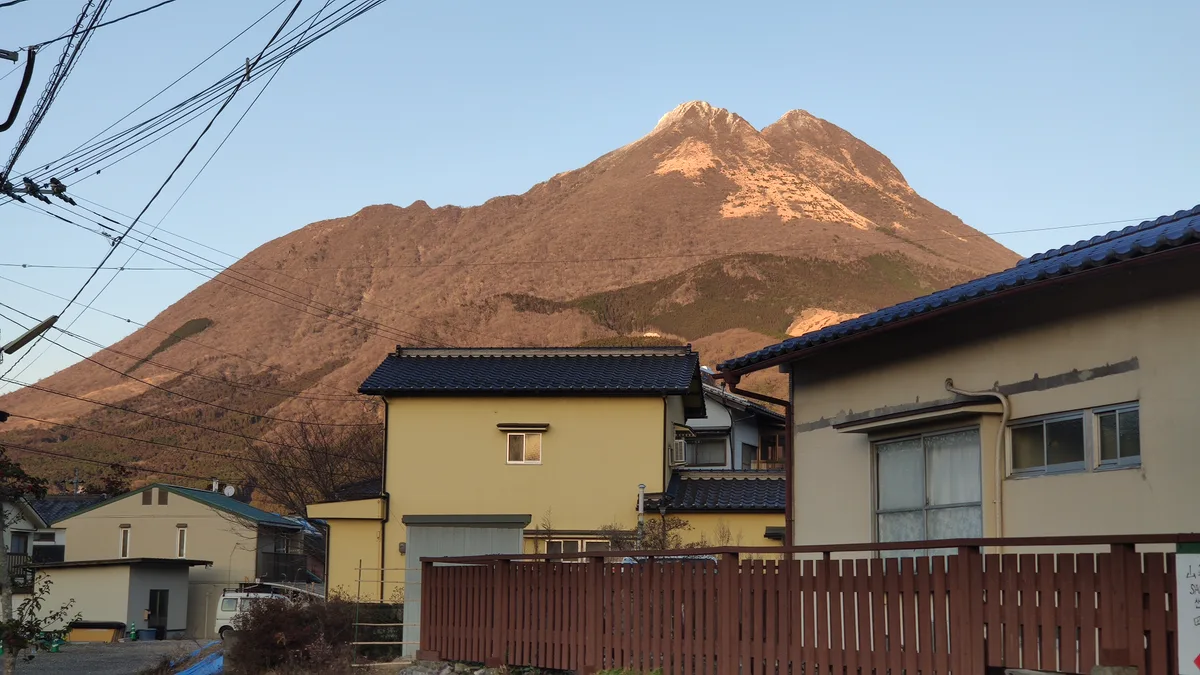
Yufuin: A Town to Walk Slowly, and a Mist That Waits for Morning
An audio cultural guide to Yufuin, verified against official sources. A hot-spring town you walk rather than watch, where the famous morning mist on Lake Kinrin belongs to those who stay the night, how it differs from Beppu, and how to actually get there on the Yufuin no Mori train.
Yufuin (Lake Kinrin)
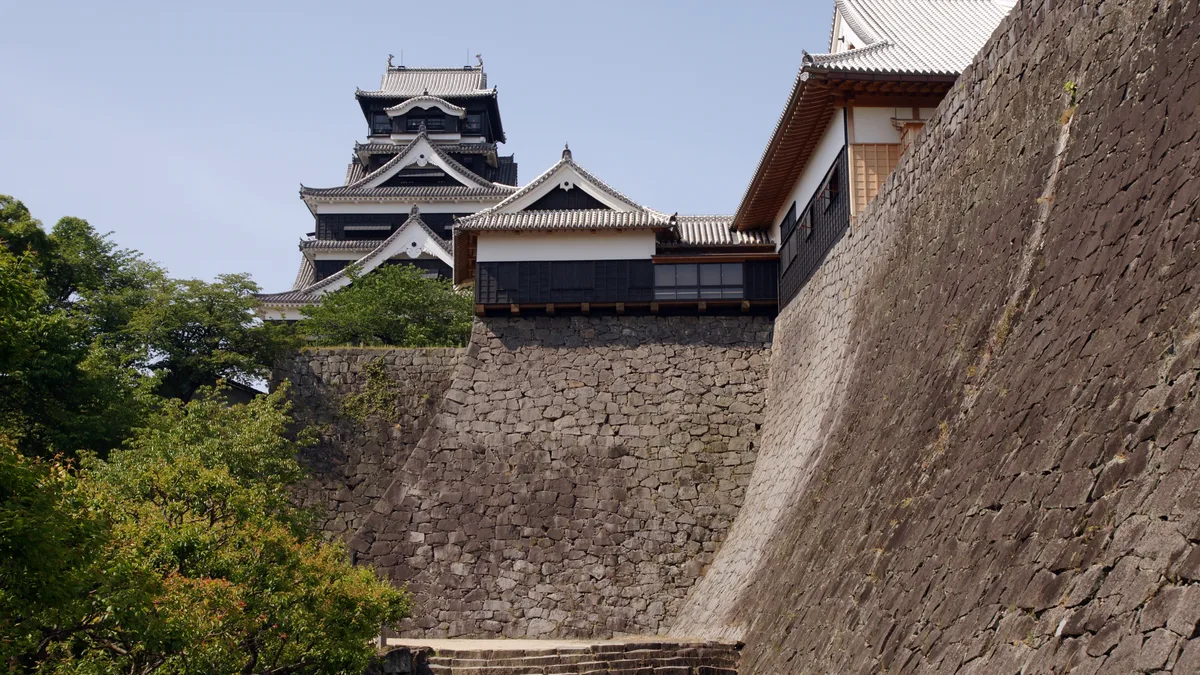
Kumamoto Castle — A Fortress Being Put Back Together, One Numbered Stone at a Time
An audio guide to Kumamoto Castle — a fortress still being rebuilt after the 2016 earthquake. The miracle stone wall, the elevated walkway over the live repair, plus hours, tickets and access.
Kumamoto Castle