
Visiting Koyasan, The Mountain Where a Thousand-Year Prayer Has Never Stopped
Koyasan (Mount Koya)
By Kei · Born and raised in JapanIs Koyasan worth visiting? By the voices we gathered, yes: of 83 international travelers who made the trip, weighted by how much each account resonated with fellow readers, 53% called it worth it, and Japanese reviewers rate the mountain even more warmly at 79%. Koyasan is a mountaintop temple town founded in 816 by the monk Kukai, reached from Osaka by a roughly two-hour train, cable car and bus journey, and the temple lodging you sleep in for the night, called a shukubo, is what most people mean when they say it was worth it. What those voices actually said, including the one letdown you can avoid, is further down this page.
The Meaning
In the year 816, an emperor granted a monk named Kukai a remote, flat-topped mountain ringed by eight peaks, roughly 800 meters above the plains of what is now Wakayama. Kukai had brought esoteric Buddhism back from China, and he wanted a place far from the capital and the world to practice it. He built the first halls here, and the mountain, called Koyasan, became the heart of the Shingon school he founded.
Then, in 835, something happened that still shapes everything you will feel on this mountain. Kukai did not, in the eyes of his followers, die. He is said to have entered nyujo, a deep, eternal meditation, sealing himself within a chamber at the eastern end of the mountain to wait for the Buddha of the future. He is known across Japan by the title an emperor gave him almost a century later: Kobo Daishi. And here, the temple does not say he was. It says he is: that he remains in meditation in his mausoleum, still listening, still offering help to those who come.
This is not a metaphor the monks reach for on special occasions. Twice every day, at six in the morning and again at half past ten, they carry a hot meal along the cedar-lined path to his tomb, as they have done without missing a single day for more than 1,200 years. The food is for someone they believe is still there.
So when guidebooks call the great forest of Okunoin "Japan's largest cemetery" (and with more than 200,000 memorial stones along its two-kilometer approach, the description is not wrong), they are also missing the reason it exists. People did not bring their stones here to mark the dead. They brought them to rest close to someone they believe is still alive. Koyasan holds a prayer that has simply never been allowed to stop.
What Happens When You're There
Step 1: The Long Climb Up, Leaving the World Behind
You cannot drive into the heart of Koyasan, and you are not really meant to arrive quickly. From Osaka, a train carries you south out of the city and into the Kii mountains, the houses thinning and the valleys deepening, until the ordinary rails simply run out of mountain to climb. At a small station called Gokurakubashi, whose name means "bridge to paradise," you step off and onto a cable car that hauls you up the final slope at an angle steep enough to press you back in your seat, climbing more than 300 meters through dense cedar in about five minutes.
At the top there is a station, and then a rule that surprises everyone: you may not walk down the road into town. A bus takes you the rest of the way, ten minutes through forest, before the trees open onto an actual mountaintop town, complete with temples, shops, a post office and schoolchildren, a small sacred city floating at 800 meters.
It is tempting to read all this connecting and transferring as a hassle, but the travelers who love Koyasan tend to describe it the other way: the slow climb is the first part of the experience, the hour or two it takes for the noise of the world below to fall away.
Step 2: The Heart of the Mountain, Danjo Garan and Kongobu-ji
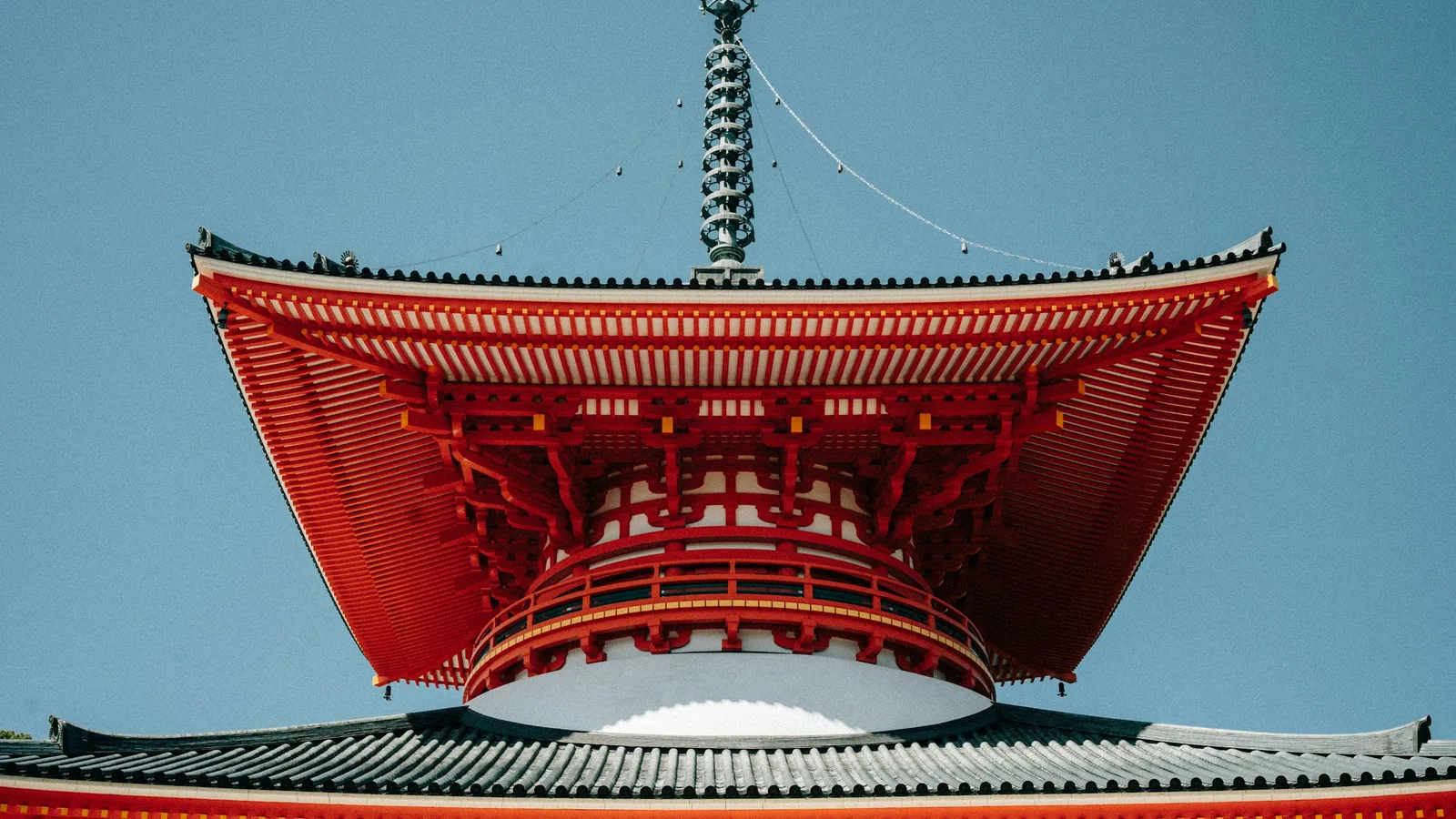
The town has two centers of gravity, and this is the first: Danjo Garan, the sacred precinct where Kukai began building in the ninth century. Its centerpiece is the Konpon Daito, the Great Pagoda: a vermilion tower 48.5 meters tall, rebuilt in the twentieth century in the shape of the original, the southern Shingon counterpart to the gold-leafed Golden Hall at Hiraizumi in the far north, raised in the Pure Land tradition. Step inside and you find that the pillars and the central image together form a three-dimensional model of the Buddhist cosmos. This was never mere decoration. It has always been a teaching tool you stand in the middle of.
A short walk away is Kongobu-ji, the head temple of the entire Shingon school. The name does not refer only to this building. In the original idea, the whole of Koyasan, all 117 of its temples, is Kongobu-ji: one temple the size of a mountain. There were once more than 1,800 temples here. Fire, time, and history reduced them to the 117 that remain, and walking between them you are walking through the surviving body of something that was once almost unimaginably large.
You can pay to enter the main halls, and it is worth it, but notice that the precincts themselves are open and free to walk. The mountain was built to be moved through on foot.
Step 3: A Night in a Temple, the Shukubo and the Evening Meal
Of the temples on the mountain, fifty-one open their doors to overnight guests. These are the shukubo: temple lodgings. They were never built as hotels. They began centuries ago as places for pilgrims to rest, and that is still, quietly, what they are. You sleep on a futon laid over tatami, in a room in a working temple, served not by hotel staff but by the monks and trainees who live there.
It helps to arrive with the right expectations. A shukubo is not a luxury inn. The buildings are old, the walls are thin, the bath is shared and closes early, and there is usually a curfew. If you have stayed at a Japanese inn before, some of the rhythm will be familiar, though the spirit is different, and the way a ryokan welcomes a guest is its own thing worth understanding on its own terms. Here, the simplicity is the point rather than a shortcoming.
Dinner makes that clear. It is shojin ryori: the Buddhist cuisine that uses no meat, no fish, and none of the pungent roots like garlic and onion, because the underlying principle is to take no life unnecessarily. What arrives is a quiet, careful spread of small dishes rather than a plate of things removed: simmered vegetables, pickles, koya-dofu (a freeze-dried tofu invented on this very mountain by monks using the bitter winter cold), and goma-dofu, a silky sesame "tofu" unique to Koyasan that takes hours to make and contains no soybean at all. Eat slowly and a question tends to surface on its own: why does a meal with so little in it take so much care to prepare? That question is the whole philosophy of the food, answered without a word.
Step 4: The Morning Prayer, Joining the Temple's Day
Most shukubo invite their guests to the otsutome, the morning service, and it begins early, usually around six. No one will drag you out of your futon; it is offered rather than required. But it is the reason many people come.
In a candlelit hall thick with incense, the monks chant sutras you will not understand a word of. You may be invited to add a pinch of incense, or to sit and simply listen. If you kneel formally, your legs will go numb; if your mind wanders, you are in good company. Here is the part worth holding onto: the Japanese guests in the room beside you do not understand the ancient words either, and their legs fall asleep too. No one expects you to follow along. What you are doing is not attending a performance so much as sitting in on the ordinary morning of a temple that has begun its days this way for over a thousand years, and for half an hour, you are simply part of it.
Step 5: The Walk to Okunoin, Where the Mountain Explains Itself
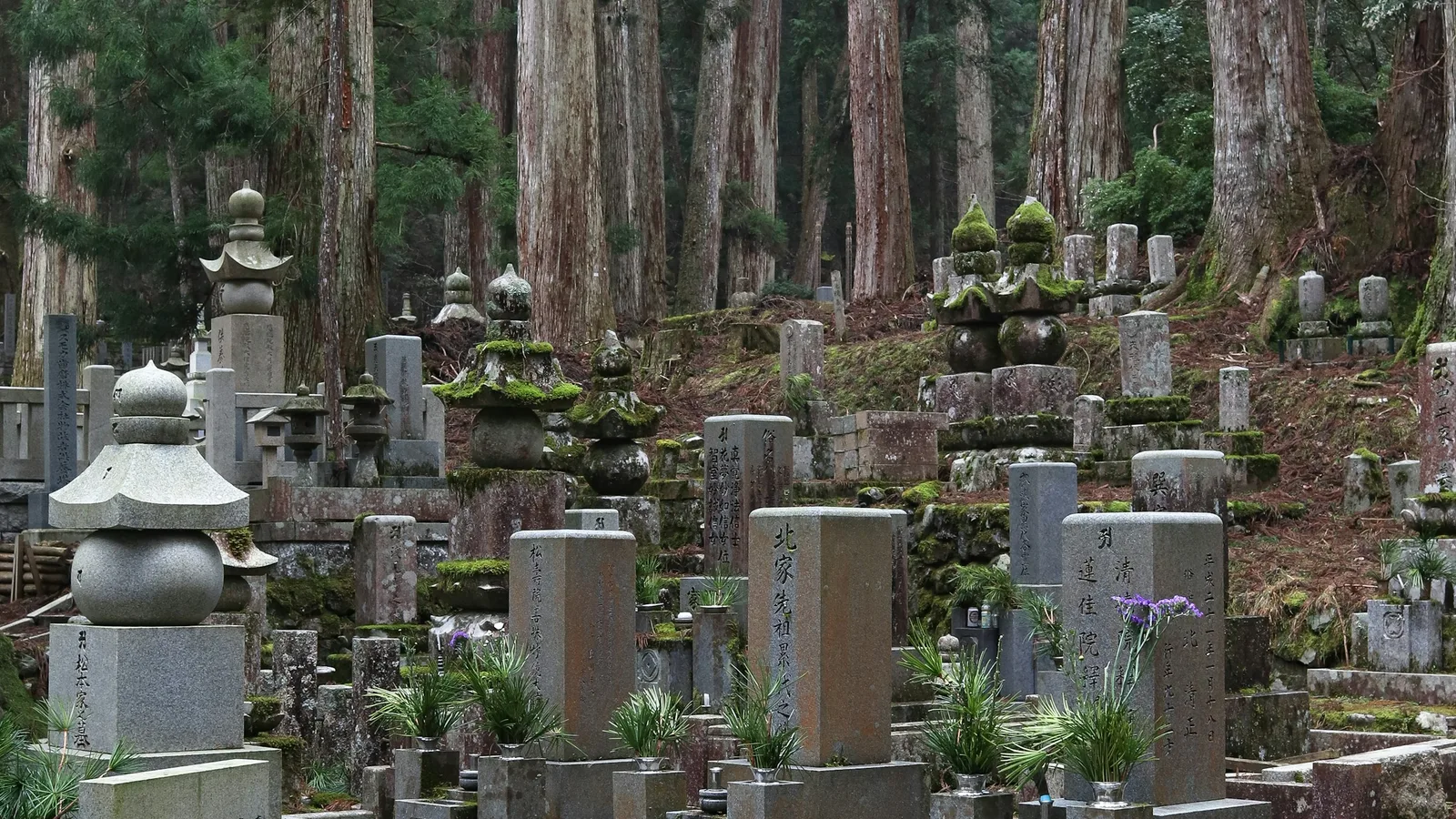
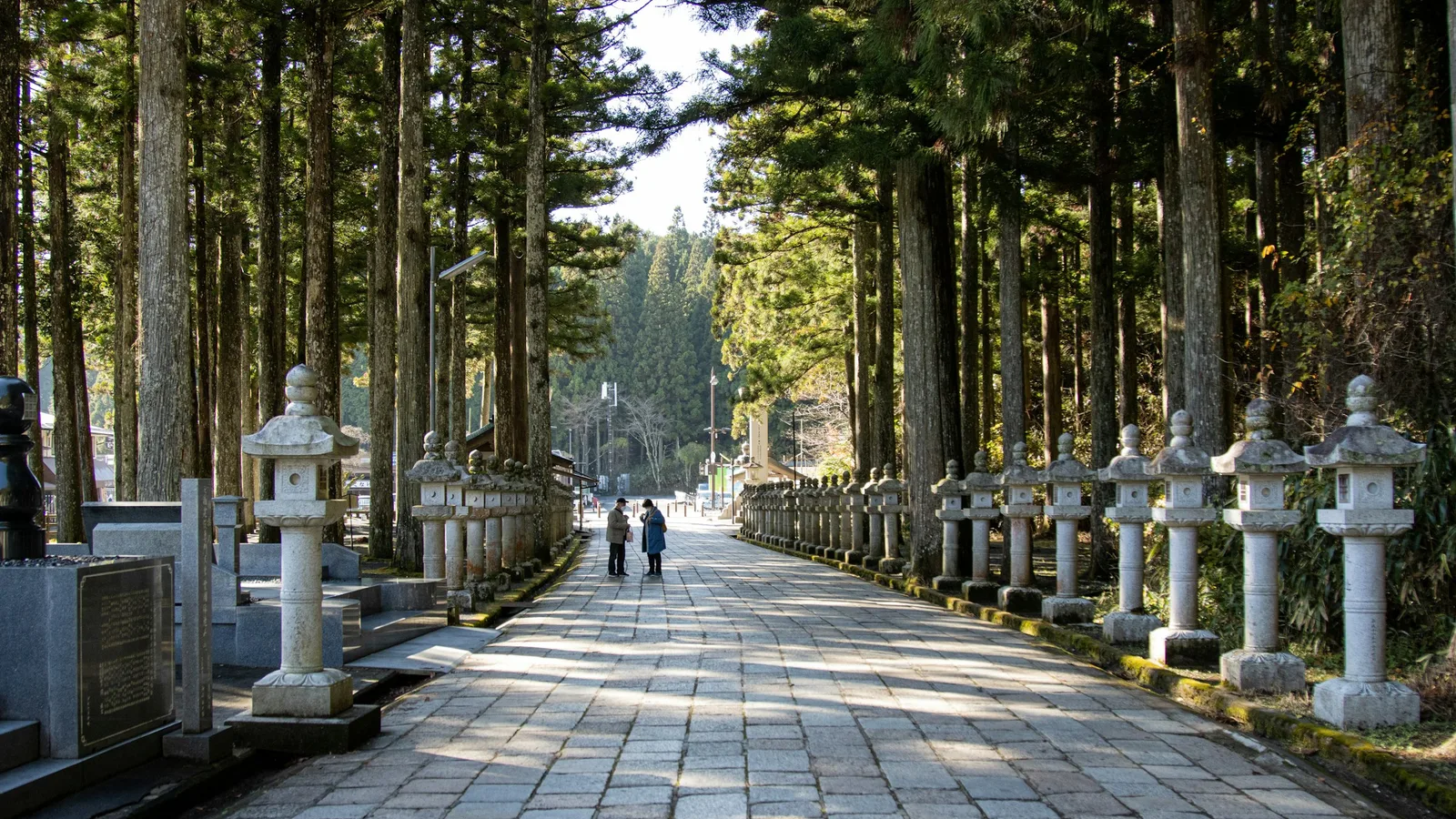
Leave the lodging early, before the tour groups, and walk to the bridge called Ichi-no-hashi, the first bridge. From here a path runs two kilometers under cedars so old and tall that the morning light arrives in shafts. On either side, stretching back into the green, stand the memorial stones: more than 200,000 of them, mossy and leaning, the graves of warlords and poets and ordinary families who all wanted the same thing, to lie close to Kobo Daishi.
The path narrows toward a small bridge, Gobyobashi. Past it lies the most sacred ground on the mountain, and the customs change at the threshold. People stop, bring their palms together, and bow before crossing. Beyond the bridge, cameras are put away and voices drop, not because a sign forbids it, but because everyone can feel they have stepped from a path into a presence. A simple bow at the bridge is all it takes to belong there.
Just before the mausoleum stands the Torodo, the Hall of Lanterns, where more than ten thousand lamps burn day and night. Two are said never to have gone out in nearly a thousand years. One of them, the temple tells, was offered by a poor woman who had nothing to give and so cut and sold her own long black hair to buy the oil for a single light. And beyond the hall is the chamber where the monks bring those two daily meals, to a teacher they believe never left.
Stand here in the early quiet and you may notice something the word "cemetery" never prepared you for. It does not feel like a place of the dead. It feels like a place where a great many people chose to wait, together, near someone they trusted. Why that should feel peaceful rather than sad is a question the mountain leaves with you, and the walk back down, into the trains and the noise and the world, is a good time to carry it.
What Visitors Honestly Say
Before you commit to the overnight stay, it helps to hear from people who already made the trip. We gathered 83 voices from international travelers who had actually been to Koyasan, weighted by how much each account resonated with fellow readers, and this is how they fell:
One traveler who stayed the night put it plainly: "We both thought it was absolutely worth it." Another, who only came for the day, described the opposite experience: "It's about two and a half hours both ways. It's just way too much time to rush through the attractions."
Japanese visitors and locals, reviewing the same mountain in their own words, land even more warmly:
One reviewer in his sixties named the difference precisely: "Tasting the crisp, dignified early-morning atmosphere is a privilege reserved for overnight guests."
The full picture, the letdowns included and what prevents each one, is in Is Koyasan Worth It?
Good to Know
Getting there: Koyasan is reached only by rail, and the trip is a small journey of its own. From Osaka's Namba Station, take the Nankai Koya Line to Gokurakubashi, about 80 to 90 minutes on the reserved-seat Limited Express "Koya," or around 100 minutes on the cheaper express (often with a transfer at Hashimoto). At Gokurakubashi, switch to the cable car up to Koyasan Station (about 5 minutes). From the station you cannot walk into town; take the Nankai Rinkan Bus (about 10 minutes to the Senjuinbashi stop at the town center). For the bigger picture of trains and transfers, see getting around Japan.
The pass that saves the hassle: The Koyasan World Heritage Ticket bundles the round-trip train, the cable car, two days of unlimited mountain buses, and discount coupons into one purchase, valid over two consecutive days. Buy it at Nankai stations in Osaka before you set out. Once on the mountain, a one-day bus pass is also sold at the station.
Hours and cost: The temple precincts and the Okunoin approach are open and free to walk, including after dark; the Torodo Hall of Lanterns opens early. Paid halls, including Kongobu-ji, the Konpon Daito and Kondo in the Garan, and the Reihokan museum, generally open around 8:30 to 9:00 and close by 17:00, each with its own admission, and a combination ticket covers several at once.
Staying overnight: Of the mountain's 117 temples, 51 take in overnight guests as shukubo. Reservations run through the Koyasan Shukubo Association, which can match you to a temple by phone or online; book well ahead for autumn and spring. Stays include dinner and breakfast (no room-only option), morning prayer is offered to guests, Wi-Fi is common, and check-in is usually mid-to-late afternoon with an evening curfew. Note that baths are shared and often unavailable in the morning, and people with tattoos should ask the temple in advance.
Food and dietary needs: Meals are shojin ryori, plant-based by Buddhist precept, which makes it naturally suited to vegetarians and many vegans. Because it follows religious rules rather than Western labels, the handling of eggs and dairy varies by temple, so confirm if it matters to you. For allergies, contact the temple in advance (a week ahead is wise). The portions are modest and intentionally so; some travelers like to carry a small snack.
When to go and what to wear: At 800 meters, Koyasan is cooler than the cities below; pleasant in summer, genuinely cold and often snowy in winter, when indoor heating is limited, so dress warmly and in layers. Autumn foliage usually peaks from late October into early November. Early morning, before the day-trippers arrive, is the quietest and most beautiful time at Okunoin. The temple asks visitors to dress modestly, especially at the Garan and Okunoin; the yukata provided at your shukubo is for indoors only rather than for the halls or sacred grounds.
How long you need: Koyasan rewards an overnight stay: the morning prayer and an early, empty Okunoin are the heart of it. A relaxed plan is the Garan and Kongobu-ji in the afternoon, a shukubo dinner and morning service, then Okunoin before you leave, a comfortable one night, two days. A day trip is possible but cuts away the quietest hours.
Last verified: 2026-05
Official website: koyasan.or.jp/en (Kongobu-ji) and eng-shukubo.net (temple lodging)
If Things Don't Go as Planned
The journey up feels long and complicated. Three connections (train, cable car, bus) sound harder than they are, and the Koyasan World Heritage Ticket turns the whole chain into a single purchase. Most people find the climb is the easiest part of the trip to enjoy: a slow, scenic ascent that is genuinely part of arriving rather than an obstacle before it.
You can only come for the day. You still can, and the Garan, Kongobu-ji, and Okunoin all fit into a daytime visit. Just know that the shops and paid halls close around 17:00, and the experience most people treasure, the morning service and a silent dawn at Okunoin, belongs to those who stay the night. If you can spare it, the overnight is what Koyasan is for.
The shukubo feels too basic, or the bath was closed. This is normal, and it is not a downgrade. A temple lodging is a working religious house rather than a hotel: thin walls, shared baths with early hours, a curfew. Arriving expecting that, rather than resort comfort, is the difference between disappointment and a night people remember for years.
The vegetarian meal left you hungry. Shojin ryori is meant to be modest. Restraint is part of its meaning rather than a mistake in the kitchen. Eat slowly, notice the care in each small dish, and it satisfies in a different way than a large meal does. If you know you need more, a snack tucked in your bag is no insult to the temple.
You don't understand the morning prayer, or your legs went numb. Neither does almost anyone, Japanese visitors included, and numb legs are practically a rite of passage: sit cross-legged or to the side and no one will mind. You are not being tested; simply being present, quietly, is the whole of what is asked. If you would like the general form of worship at temples and shrines before you go, we cover it on its own.
Okunoin feels eerie, especially toward dusk. Many visitors come precisely for the hush of the great cedar avenue, and a great many walk it alone without trouble; the main path stays open at all hours and the Torodo lanterns never go dark. Keep to the main approach, where the lanterns light the way, rather than the unlit side paths, and what can feel eerie at first usually settles into something closer to awe.
Sources:
- Koyasan Shingon Sect Head Temple Kongobu-ji: Official (English): Founding by Kukai, Shingon esoteric Buddhism, nyujo/eternal meditation, Okunoin and the mausoleum, Danjo Garan
- Kongobu-ji Official: Highlights / 見どころ (Japanese): Okunoin approach (~2 km), over 200,000 memorial stones, Torodo Hall and the "ever-burning lamps," Konpon Daito and Kondo, the mausoleum's nyujo faith (quoted as belief)
- Kongobu-ji Official: Column / もっと知りたい!金剛峯寺 (Japanese): Shojinku, meals offered to Kobo Daishi twice daily (6:00 and 10:30) for over 1,200 years without a missed day; 117 temples and shukubo count
- Kongobu-ji Official: Admission & Hours / 拝観料 (Japanese): Hall opening hours, admission fees, combination ticket, Torodo opening hours
- Kongobu-ji Official: Guidelines for Visits (English): Modest dress at Garan and Okunoin, designated no-photography areas, yukata indoor-only, gassho and bow at sacred thresholds
- Koyasan Shukubo Association: Official (English): What a shukubo is, reservation method, 51 temple lodgings, World Heritage inscription (2004)
- JNTO: Koyasan Shukubo / Temple Lodging: Temple lodging, shojin ryori, otsutome, vegan options, World Heritage context, standard English terms
- Visit Koyasan (Koyasan Tourist Association): Temple Lodging: Bath and futon customs, shojin ryori principle and origin, goma-dofu, historical temple count (1,812)
- Nankai Electric Railway: Koyasan World Heritage Ticket (English): Nankai Koya Line, Limited Express Koya, cable car, mountain bus, World Heritage Ticket contents and validity
- Is Koyasan Worth It? (WMJS): the two visitor-voice gauges reproduced in "What Visitors Honestly Say" (83 international voices, 53/35/12; 94 Japanese voices, 79/19/2) and the verbatim visitor quotations
Photos: sourced under free commercial-use licenses; see captions where attribution applies.
WMJS is written in Japan, in English, with AI help. We check every page, but English is not our first language. If a sentence reads oddly, tell us. One sentence is enough.
Thank you. A person reads every note.
Real voices
Is it worth it?
Were you there? Share your photos.
Your photo could appear in this guide — with your name and a link to your profile.
Submit a photoRelated Articles

Staying at a Ryokan: What Your Host Wishes You Knew
Visiting Temples and Shrines: What Japanese People Notice

The Power of a Small Bow: Why a Simple Nod Makes Japanese People Smile
More guides in Kansai
Arashiyama — Why Japan Lists This Bamboo Grove Among the Sounds Worth Saving
An audio cultural guide to Arashiyama in Kyoto, verified against official sources. Understand why Japan lists the bamboo of Sagano among the sounds it wants to keep, how the Moon-Crossing Bridge earned its name, and how to walk the river, the grove, and Tenryu-ji's borrowed-mountain garden away from the crowds.
Arashiyama
Fushimi Inari Taisha: Ten Thousand Gates, Each One a Thank-You
The ten thousand vermilion gates at Fushimi Inari are thank-you notes you can walk through. A cultural audio guide verified against official sources: why the foxes are messengers not gods, why the summit has no view, and how to walk past the crowds.
Fushimi Inari Taisha
Ginkaku-ji — Why the Silver Pavilion Has No Silver, and Why Japan Finds That Beautiful
Why the Silver Pavilion has no silver — a free audio guide to Ginkaku-ji, Kyoto, verified against official temple sources. Higashiyama culture and the art of restraint, the sea of silver sand, hours, admission (1,000 yen), access from Kyoto Station, and the Philosopher's Path.
Ginkaku-ji (Jishō-ji)
Gion — Walking Kyoto's Flower District, a Town That Is Still Lived In
An audio guide to Kyoto's Gion flower district: what geiko and maiko really are, the walk from Yasaka Shrine through Hanamikoji to the Shirakawa canal, when to go, and how to enjoy a town still lived in.
Gion