
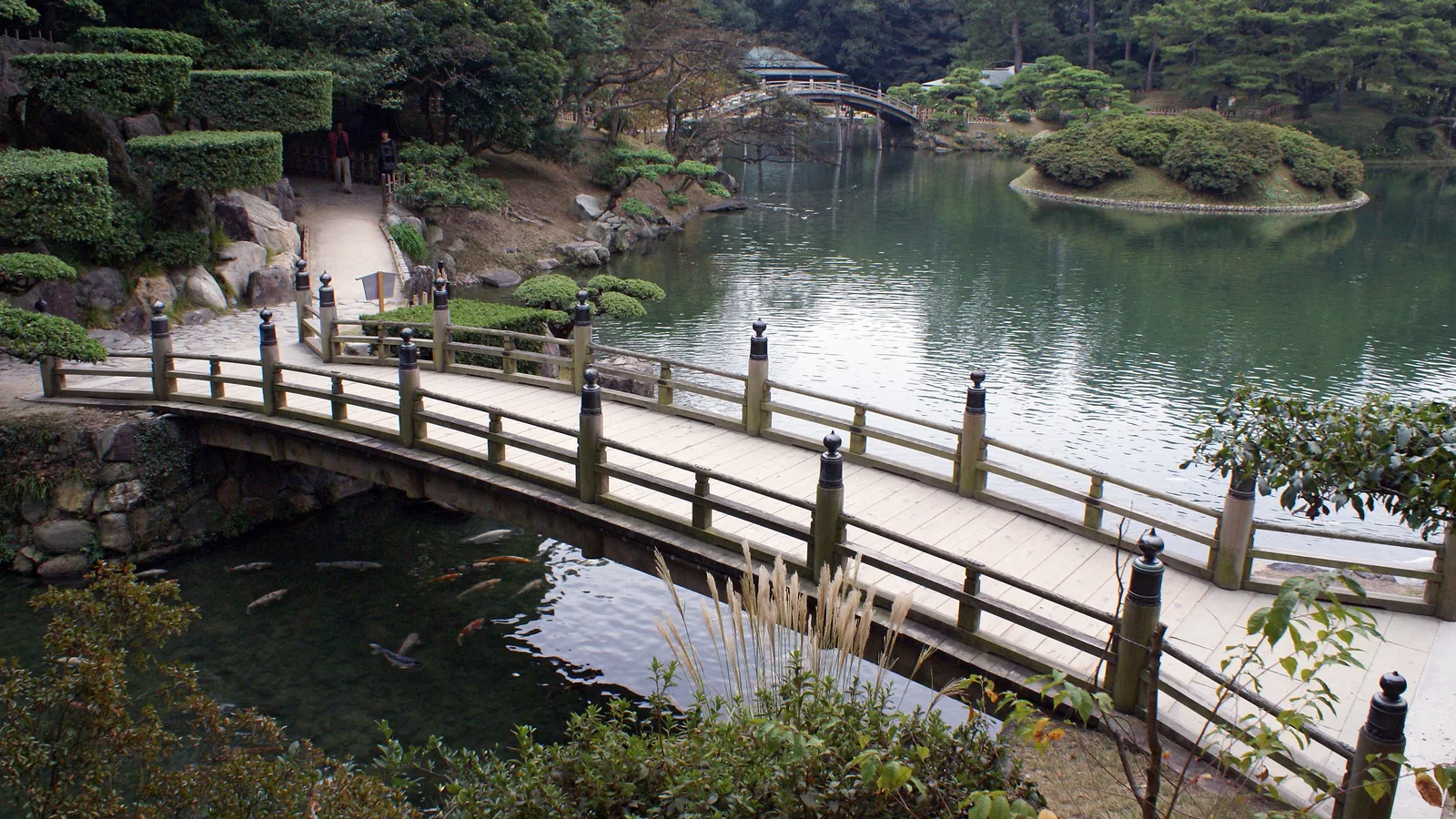
Ritsurin Garden — The Masterpiece Japan Left Off Its Famous List, Because Its Best View Is the Walk
Ritsurin Garden
By Kei · Born and raised in JapanThe Meaning
Japan keeps a famous list of three. Ask which gardens are the country's greatest and you will be handed the same trio every time: Kenroku-en in Kanazawa, Koraku-en in Okayama, Kairaku-en in Mito, the Three Great Gardens of Japan. Ritsurin is not on it.
And yet. Ritsurin holds the highest rank Japan gives a garden, Special Place of Scenic Beauty, the very designation those three carry. It is the largest cultural-property garden in the entire country. The Michelin Green Guide gave it three stars, the top mark, the one reserved for a place "worth a special journey." Travel writers who actually make the trip out to Shikoku tend to come back faintly indignant on the garden's behalf, calling it overlooked. So you arrive carrying a small puzzle: how is one of Japan's finest gardens not on the famous list of Japan's finest gardens?
Part of the answer is just the way lists are made. The famous trio is a modern, popular grouping rather than an old decree: three celebrated feudal-lords' gardens, in three widely separated regions, that a modernizing Japan settled on as a convenient short list a little over a century ago. Three were chosen; Ritsurin, off on a smaller island, was simply not one of them. Being left off was never a verdict on its beauty.
But the deeper answer is in the garden itself, and it is the reason to come. The Three Great Gardens are gardens you can rank because you can picture them: each has a signature view, a single postcard the whole place folds down to. Ritsurin does not fold down to one picture. It was laid out over more than a hundred years, finished in 1745, and kept as the private retreat of the Matsudaira lords of Takamatsu for two hundred and twenty-eight years across eleven generations before it opened to the public in 1875, and across all that time it was built around a single idea the garden's keepers still describe in three words: ippo ikkei, "one step, one view." Take a step, and the composition in front of you quietly rearranges itself. Take another, and a hill slides to hide what a bridge just revealed. You do not stand and look at Ritsurin. You walk into it, and it keeps recomposing around you for as long as you move.
That is why it cannot be reduced to a postcard, and it is the same reason it never quite fit a list built on famous single views. The garden's masterpiece is not any one of its scenes. It is the walking.
What Happens When You're There
Step 1: Getting Off at the Right Station
Ritsurin asks one thing of you before you even reach the gate: get off at the right station. This sounds trivial. It is the single most common way a visit starts badly, and locals have written whole articles trying to head it off.
The trap is a station named, very reasonably, Ritsurin. A train called the JR Kōtoku Line stops there, and travelers naturally assume a station called Ritsurin must sit in front of Ritsurin Garden. It does not: it leaves you a good twenty-minute walk away, on streets that give no hint which way the garden lies. The two stations you actually want are the next ones over. On the local Kotoden railway (the Kotohira line), Ritsurin-kōen Station is about ten minutes' walk from the garden's main East Gate. On the JR Kōtoku Line, Ritsurin-kōen-Kitaguchi Station drops you barely three minutes from the North Gate. Choose either of those and you step off the train almost into the garden, which is exactly how you want a place like this to begin: unhurried, with the gravel already crunching under your feet.
Pick your gate to match. The East Gate is the main entrance: it is where the volunteer guides gather, where the parking and lockers are largest, and the only gate open during the evening illuminations. The North Gate is the smaller, quieter way in. Either is a fine start; what matters is that you began at the garden, not a kilometre away from it, wondering whether you misread the map.
Step 2: Walking Into the Painting
Inside, follow the path toward the South Garden (the older, southern half, the part the lords laid out in the Edo period) and climb the small hill called Hirai-hō. It was raised and shaped on purpose to suggest the silhouette of Mt. Fuji, and from its top opens the view that, more than any other, is Ritsurin: the arched Engetsu-kyō bridge curving over the dark water of the South Pond like a half-moon, the Kikugetsu-tei teahouse low on the far bank, and behind all of it the green wall of Mt. Shiun rising into the sky.
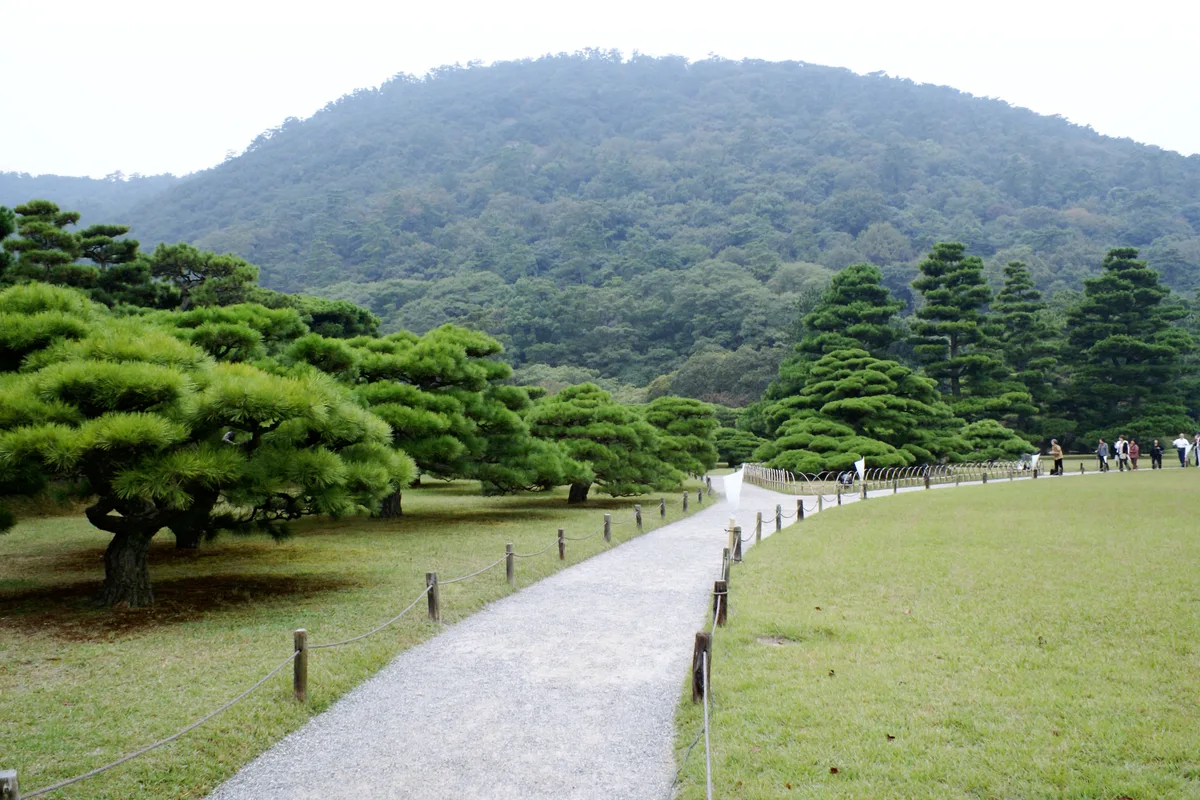
Look closely at that mountain, because it is doing something. Mt. Shiun is not inside the garden (it stands just beyond the western edge), and yet the whole garden was composed to pull it into the frame. The keepers call this shakkei, "borrowed scenery": the deliberate art of designing a garden so that a mountain it does not own becomes part of its picture. At Hirai-hō the borrowing is so complete that you cannot quite find the seam, the line where the made garden ends and the wild slope begins. The pond, the pines, the bridge and the mountain read as one continuous composition, which means someone, three centuries ago, stood roughly where you are standing and arranged a mountain into the view.
Now walk down, and watch what the view does. The bridge disappears behind a hill. A pine you hadn't noticed steps forward. The teahouse reappears from a new angle, framed differently. This is ippo ikkei working on you in real time, and it is also the polite explanation for the gentle crowds that gather at the best viewpoints. Hirai-hō is the most photographed spot in the garden, and the unhurried line of people waiting their turn for the classic shot is part of the deal. As at any much-loved viewpoint, a few moments' patience, and a step aside once you have your photo, keeps the small summit pleasant for everyone, and most of the people beside you in that line are Japanese.
Step 3: The Pines That Are Never Finished
Once you start noticing the pines, you cannot stop. There are about fourteen hundred of them in the garden, and roughly a thousand are shaped and held entirely by hand: pruned, needle by needle and branch by branch, by gardeners who have passed the work down, tree by tree, for some three hundred years. A few of these pines are themselves more than three centuries old. None of them is a bonsai in a pot. They are full-sized trees, sculpted in place over lifetimes.
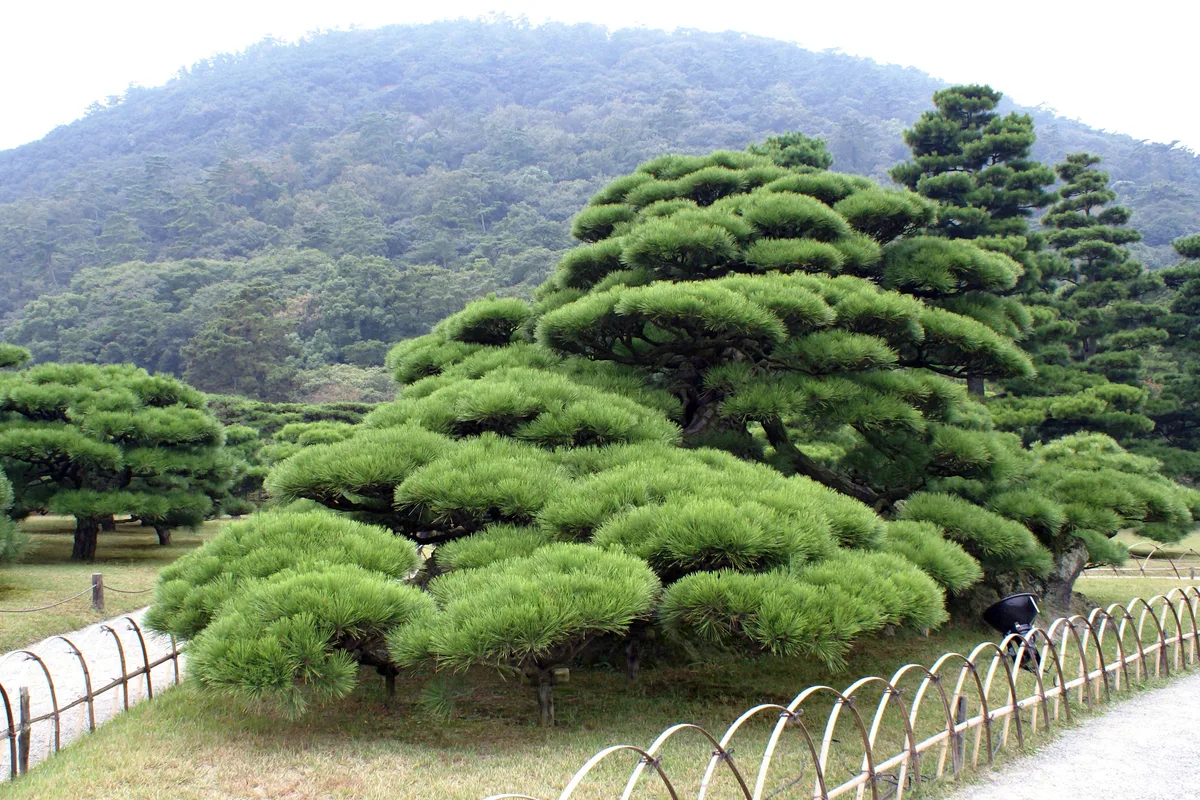
Three are famous enough to have names. The crane-and-turtle pine spreads above an arrangement of stones shaped like a turtle, its own branches lifting like a crane taking off, held by hands, year after year, in the gesture of a bird that never actually moves. The box pine is trained into a long, low, impossibly even green hedge of living pine, a shape so geometric it looks built rather than grown. And the Neagari Goyō-matsu, the garden's only five-needle pine, began as a single potted bonsai that the eleventh shogun gave to the ninth lord of Takamatsu in 1833; planted out, it has become a tree some eight metres tall, its roots heaved up out of the ground like a clenched hand.
Here is the thing most guides leave out when they print the number "1,400 pines." A garden like Ritsurin is not a finished object that opened in 1745 and has been sitting still ever since. It is closer to a practice than a monument: something a line of human hands has been making, and is still making, every single day. The pruning is never done; the moment a branch is shaped it begins to grow again, and the work simply continues, handed from one gardener to the next. The lords are long gone, the list of three was drawn up and Ritsurin left off it, and through all of it the pines have kept being tended, because a garden built to be walked has to be remade faster than it can grow wild. You are not looking at the past. You are standing inside something that is still being made.
Step 4: A Still Moment by the Pond
After all that walking, the garden offers two ways to stop, and many visitors run out of time and take neither, then wish they had. If you have only half an hour to spare, give it to one of them.
The quiet one is the Kikugetsu-tei, a small wooden teahouse that has stood at the edge of the South Pond since the late seventeenth century. Its name comes from a line of old Chinese verse: scoop up the water, and the moon is in your hand. You can sit on its tatami, slide back the screens, and be served a bowl of whisked green tea while the pond lies flat in front of you and the carp turn slowly below the veranda. You do not need to know any etiquette or kneel formally to do this; it is meant to be an easy pause, not a ceremony, though if it leaves you curious there is a whole quiet world inside the Japanese tea ceremony to step into later.
The moving one is the wasen, a flat wooden boat, poled by a boatman who narrates as he goes, that loops the South Pond in about thirty minutes. From the water the garden turns inside out: the hills you climbed now rise above you, the bridge passes overhead, and the borrowed mountain doubles in the pond's reflection. The boats are small, they take only a handful of passengers at a time, and they are popular enough that booking ahead is wise.
Whichever you choose, choose the morning if you possibly can. Ritsurin opens around sunrise, and for the first hour or two it is nearly empty: mist still lifting off the ponds, the birds loud, the light coming low and gold across the hand-shaped pines. The crowds, such as they are, begin to arrive around ten. People who come early almost never regret it; people who come at midday in summer, into the heat and the thin shade, sometimes do.
Step 5: Walking Out Toward the Sea
Cross into the North Garden on your way out, and the mood changes. Where the South Garden is the dense, deliberate world of the Edo lords, the North half was reworked in more modern times into something looser and more open: broad ponds, fewer rules, room to breathe. It is a gentle way to come down from the intensity of the South before you reach the gate.
And then you are back on an ordinary Takamatsu street, which is the last thing Ritsurin quietly teaches. This city is best known to most travelers as the place you change for a ferry: Takamatsu's harbour is the gateway to the art islands of the Seto Inland Sea, and many people treat the city itself as a thing to pass through on the way to the boats. There is a better order. Give the garden the first, still hours of the morning, when it is at its finest, and let the islands have the afternoon. The land has its masterpiece too, and it happens to be a daimyo garden that the famous list forgot, which is its own small lesson about the quieter corners of Japan that reward the traveler who actually stops.
You will not have seen every pond or climbed every hill, and that is fine. You walked into a garden that refuses to become a single picture, and for an hour or two the composition rearranged itself around you with every step. That is the whole of Ritsurin. It was never one view. It was always the walk.
Good to Know
Hours and admission. Ritsurin Garden is open every day of the year (closing only when a storm warning is issued for the Takamatsu area). It opens roughly from sunrise to sunset, so the hours shift through the seasons: as early as 5:30 in midsummer and around 7:00 in winter, closing anywhere between 17:00 and 19:00. Admission is ¥500 for adults and ¥170 for children; children of pre-school age enter free, and the garden is free for everyone on January 1 and on March 16, its opening anniversary. (A one-person annual pass is ¥3,180.) Note that the fees were revised upward in mid-2025, and some older pages still show the previous prices. Last verified: 2026-06. Confirm current hours and rates on the official Ritsurin Garden site.
The boat and the teahouse cost extra. The wasen boat ride on the South Pond is ¥850 for adults and ¥420 for children, runs about thirty minutes, takes only six passengers at a time, and is not open to children under three; reservations (from the first of the previous month up to the day before) are strongly recommended, with a limited number of same-day tickets sold from the morning. A bowl of matcha at the Kikugetsu-tei teahouse is ¥800 (or ¥600 for sencha), served with a sweet, roughly 9:00–16:30. Both are separate from garden admission. Last verified: 2026-06.
Getting there, and the station trap. From the main island, Takamatsu is reached by the JR Marine Liner, which crosses the Great Seto Bridge from Okayama in about 55 minutes; from Tokyo or Osaka you ride the Shinkansen to Okayama and change there. In Takamatsu itself, do not get off at JR "Ritsurin" Station: it is a 20-minute walk from the garden. Use the Kotoden Ritsurin-kōen Station (about 10 minutes' walk to the East Gate) or the JR Ritsurin-kōen-Kitaguchi Station (about 3 minutes to the North Gate). From JR Takamatsu Station the garden is about 7 minutes by taxi, or a bus to the "Ritsurin-kōen-mae" stop. (For passes, IC cards, and how Japan's trains connect, see getting around Japan.)
How long to allow. There is no single right answer, which is why advice online ranges from one hour to two days. A brisk walk through the highlights takes about an hour; a relaxed visit with the South Garden, the pines and Hirai-hō runs closer to two; add the boat, a bowl of tea, and the museums and you have filled a comfortable half-day. The garden was built to be strolled, not marched, so lean toward the longer end if you can.
The art islands. Takamatsu's port is the main hub for ferries into the Seto Inland Sea: Naoshima (about 50 minutes by ferry), Shōdoshima, Megijima and others. A natural day pairs the garden in the morning with an island in the afternoon. Sailing times and fares vary by route and season; check the ferry operators close to your trip.
Seasons and illuminations. Ritsurin is a year-round garden, but it has its peaks: plum and then cherry blossom in spring (with a special evening illumination of around ten nights, usually late March into early April, lighting some 300 cherry trees), fresh green and irises in early summer, and autumn colour in late November, when the maples are lit for another ten nights or so. The garden marked the 150th anniversary of its public opening in 2025. Illumination dates change every year, so check the official site before counting on them.
A few practical notes. The paths are spread with fine gravel, so suitcases on wheels are best left in the coin lockers at the gates; wheelchairs and strollers can be borrowed free at the ticket office. Free volunteer guides gather at the East Gate (a regular English-friendly tour leaves Sunday mornings), and private guides, including English-speaking ones, can be arranged in advance.
Official site: ritsuringarden.com
If Things Don't Go as Planned
You got off at JR Ritsurin Station and there's no garden in sight. This happens constantly: the station name is misleading. The garden is about a kilometre to the south; rather than wander, it is quickest to follow signs toward the East Gate, or hop a taxi for the short ride. Next time, the Kotoden Ritsurin-kōen Station or JR Ritsurin-kōen-Kitaguchi Station put you right at the gate.
It's the middle of the day and it's hot and busy. Ritsurin is never Kyoto-crowded, but midday in summer is its least magical hour: full sun, little shade, the largest groups. If your schedule allows nothing else, head straight for the shade of the South Garden's tree-lined paths and the cool of the Kikugetsu-tei, and save Hirai-hō for when a cloud passes. If you can possibly return at opening time another day, the early garden is a different, quieter place.
You're worried it's not worth the trip all the way to Takamatsu. Almost no one who actually walks the garden comes away thinking that; the regret you read online is nearly always about how people visited, not whether they should have: rushing it on the way to a ferry, arriving in the midday heat, running out of time for the boat or the tea. Give it a slow morning and it repays the journey. The disappointments are the avoidable kind.
You only have an hour. That is genuinely enough for the heart of it. Enter at the East Gate, walk straight to the South Garden, climb Hirai-hō for the signature view over the bridge and the pond, and let ippo ikkei do the rest on your way back out. You will have skipped the boat and the North Garden, but you will have walked the part that matters.
You couldn't get a boat reservation. The wasen books up, especially in peak seasons and on fine weekends. A limited number of same-day tickets are sold from the morning at the gate, so ask on arrival, and if it's full, the Kikugetsu-tei teahouse offers the same still moment by the same pond, from a tatami room instead of a boat, usually with no booking needed.
Everything's lit up at night and you weren't expecting it. During the spring and autumn illuminations the garden reopens after dark, and entry is through the East Gate only. It is a worthwhile, quite different experience (the pines and bridge lit against the black water), but it is ticketed separately from a daytime visit and runs only about ten nights each season, so check the dates rather than assuming.
Sources:
- Ritsurin Garden: Official Site (operator), Visitor Information: Open every day, year-round; opening hours that shift by month roughly from sunrise to sunset; admission ¥500 adult / ¥170 child, free on January 1 and the March 16 opening anniversary, annual pass ¥3,180; the East and North gates; the Michelin three-star rating
- Ritsurin Garden: Official Notice of Fee Revision, June 1 2025: The current admission, wasen boat (¥850 adult / ¥420 child) and Kikugetsu-tei tea (matcha ¥800 / sencha ¥600) prices in effect after the 2025 revision
- Kagawa Prefecture Tourism Association (Udon-ken Tabi-net): Ritsurin Garden, "Special": Completed over more than 100 years, finished in 1745; used by the Matsudaira clan as a private retreat for 228 years across 11 generations before opening to the public in 1875; the largest Cultural Property Garden in Japan; about 75 hectares total with an roughly 16-hectare strolling garden; six ponds and thirteen landscaped hills; about 1,400 pines, of which roughly 1,000 are kept hand-pruned; the Michelin Green Guide Japan three-star ("worth a special journey") rating; ippo ikkei, "one step, one view"
- Kagawa Prefecture Tourism Association: Ritsurin Garden, "Viewing/Highlights": Hirai-hō, a hill shaped to resemble Mt. Fuji and the garden's finest viewpoint; Engetsu-kyō Bridge; the Kikugetsu-tei teahouse on the South Pond; Mt. Shiun as the backdrop; the wasen boat ride; the Neagari Goyō-matsu pine grown from a bonsai given by the eleventh shogun in 1833
- Agency for Cultural Affairs: National Cultural Properties Database, Ritsurin-kōen: Designation as a Place of Scenic Beauty in 1922 and elevation to Special Place of Scenic Beauty on March 31, 1953, under the criterion for parks and gardens
- JNTO (Japan National Tourism Organization): Autumn Beauty: Ritsurin Garden: A "strolling-style daimyo garden" that took over 100 years to create and was completed in 1745; ippo ikkei as "every step, a different scene"; the autumn-colour illumination of roughly ten nights
- Takamatsu City Tourism (art-takamatsu.com): Access via the Marine Liner: The JR Marine Liner crossing the Great Seto Bridge from Okayama to Takamatsu in about 55 minutes, and Takamatsu as the gateway to the Seto Inland Sea art islands
- InsideJapan Tours: "The Incredible, Overlooked Beauty of Ritsurin Garden": The widely repeated framing that Ritsurin is often said to rival, or be overlooked beside, Japan's official Three Great Gardens
Image credits: Ritsurin Garden (hero and thumbnail: the arched bridge and South Pond below Mt. Shiun), the gravel path through the pines, and the hand-pruned pines below Mt. Shiun; all photos by 663highland, CC BY 2.5, via Wikimedia Commons (cropped and resized).
WMJS is written in Japan, in English, with AI help. We check every page, but English is not our first language. If a sentence reads oddly, tell us. One sentence is enough.
Thank you. A person reads every note.
Real voices
Is it worth it?
Were you there? Share your photos.
Your photo could appear in this guide — with your name and a link to your profile.
Submit a photoRelated Articles

Getting Around Japan: The Tiny Things That Earn You a Nod
Japanese Tea Ceremony for Visitors: You Don't Need to Know the Rules
Autumn Leaves in Japan: What Locals Really Feel When You Come for Koyo

More guides in Shikoku
Naoshima — The Island That Art Brought Back to Life
A walking guide to Naoshima, the Seto Inland Sea art island — Kusama's pumpkins, the underground Chichu Art Museum, and houses turned into art in a living village.
Naoshima Island
Dōgo Onsen — The 3,000-Year-Old Bath You Step Into, Not Just Look At
An audio cultural guide to Dōgo Onsen in Matsuyama, verified against official sources. Understand why this 3,000-year-old wooden bathhouse — a National Important Cultural Property you can actually bathe in — was repaired without closing, which of the three bathhouses and Honkan tickets to choose, and how the stories of Botchan and Spirited Away wrap around a bath the locals still use.
Dōgo Onsen (Matsuyama)
Kochi Castle — Where the Whole Castle Survived, Not Just the Tower
A cultural audio guide to Kochi Castle — the only original Japanese castle where the keep and its lord's palace both survive. Plus the 300-year Sunday market, hours, fees and how to visit.
Kochi Castle