
Visiting Dotonbori, Osaka's Neon Canal Built for Appetite
Dotonbori
By Kei · Born and raised in JapanIs Dotonbori worth visiting? By the voices we gathered, yes, but as a sight rather than a meal: of 200 international travelers who actually went, weighted by how much each account resonated with fellow readers, 37% called it worth it outright and another 36% called it worth a quick look before eating elsewhere, while only 27% felt let down, almost always after mistaking the main strip for a restaurant. Osaka's own visitors and locals rate the same street far warmer, at 62% treasured and just 11% let down. It is a neon canal-side street built on Osaka's kuidaore, "ruin yourself on food," spirit, best walked at dusk, and the core loop from the Glico sign to the quiet lane behind it takes an hour or two. What those voices actually said, including the one mismatch you can avoid, is further down this page.
The Meaning
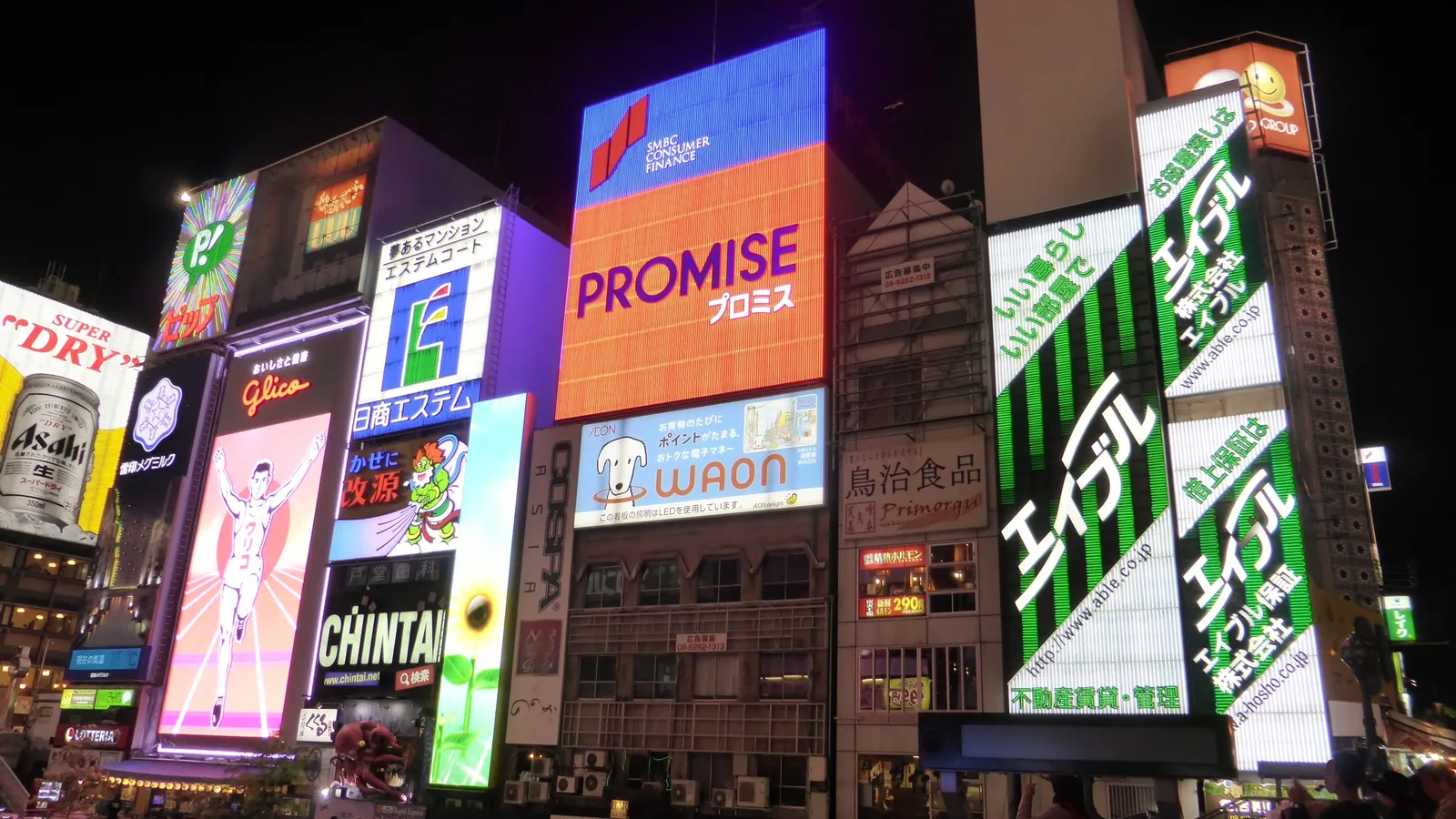
Stand on Ebisubashi at dusk, the short, wide bridge in the middle of it all, and look up. A man in a blue singlet is running across a vast lit billboard, arms thrown up at the finish line, and he has been running there, in one form or another, since 1935. Below him the canal throws his light back in ribbons. Around you a few hundred strangers are doing exactly what you're doing: holding up a phone, arms raised to copy his pose, laughing. Most guidebooks will have warned you by now that this is a tourist trap: too bright, too loud, too much. They are not entirely wrong. They have simply mistaken the point.
The word that explains Dotonbori is kuidaore (食い倒れ). Osakans use an old line about Japan's great cities: Kyoto ruins itself on clothing, Kobe on shoes, and Osaka on food. Taken literally it's a warning: eat and drink yourself into the poorhouse. Osaka took it as a compliment. Kuidaore here means something closer to a city that puts its money, its pride, and its whole personality into what's good to eat: into dashi stock, into a lighter soy sauce, into the conviction that a meal should be worth going a little broke for. You have come to the place that decided appetite was a virtue. The neon is loud because the eating is serious.
It did not begin as a food street, or even as a street. Four hundred years ago this was farmland, until a man named Doton spent his own fortune digging a canal through it. He died in the siege of Osaka before it was finished, in 1615, and his cousin completed the work, and the city named the waterway after him: Doton-bori, Doton's canal. Theaters crowded onto its banks until Dotonbori became, as the city's own tourism office still calls it, Japan's Broadway, a row of great stages where the playwright Chikamatsu premiered his tragedies for crowds who arrived by boat. The plays moved on; the crowds never did. The signs grew bigger, the stages became kitchens, and the river of people kept arriving for the reason it always had: to be fed and dazzled at once. So if Dotonbori overwhelms you, know that you haven't wandered into a circus. You've arrived, four centuries late, at a party thrown for exactly this: the pleasure of eating well, in public, with everyone.
What Happens When You're There
Step 1: Under the Running Man
The running man is a Glico sign, an advertisement, technically, for a confectionery company founded a century ago. Knowing that does nothing to diminish him. The figure dates to the company's beginning: its founder watched children sprint to a finish line, arms up, and decided that picture of pure health should be his emblem. The first sign lit over this bridge in 1935, a thirty-three-meter tower of neon. The one you're looking at is the sixth in the line. It went up in 2014, trades neon for roughly 140,000 LED chips, and stands twenty meters tall. If you'd been here in the 1960s you'd have watched its third incarnation spray twelve tons of water in a neon rainbow, and at the turn of the millennium seen the runner cross a backdrop of the city's own landmarks.
What matters is not the engineering. It's that for ninety years, across six rebuildings and a world that replaced almost everything else around it, this one figure has kept running in the same spot, and generations of Osakans have used him the way other cities use a clock tower or a fountain: as the place you say you'll meet. Under the Glico sign. Everyone knows where that is. When you raise your arms to match him for the photo (and you should) you're not performing a meme. You're joining a gesture that grandparents here made on first dates. Stand to the side rather than the center of the bridge while you shoot; it's the single busiest pedestrian crossing for a kilometer, and the small kindness of stepping out of other people's photographs is felt more here than almost anywhere.
Step 2: Takoyaki, and the Art of Standing Still
Somewhere within the first hundred meters the smell finds you: batter on hot iron, bonito flakes curling in the heat. Takoyaki, molten spheres of octopus and dough turned in their dimpled pans with a pick until they're crisp outside and almost liquid within, is a specialty this city made its own, and Dotonbori is where most people eat their first. They arrive scalding, six or eight to a little paper boat, with a single wooden pick. The first one will catch you out if you're brave with it; the people around you are blowing on theirs, waiting, eating it the way you'd wait out a too-hot tea. Give it a moment. The molten center is not a mistake. It's the whole idea.
Here you meet a small puzzle that confuses a lot of visitors. Everywhere else in Japan you'll have absorbed the quiet sense that you don't eat while walking, and yet here is a street built for snacks bought on foot. Dotonbori is one of the few places where eating as you go is genuinely part of the texture, but the graceful version, the one locals do, is to step just out of the current of people, stand near the stall you bought from, and finish there before moving on. It keeps the sauce off strangers and the flow of the crowd intact. (If the etiquette of eating on the move anywhere in Japan still nags at you, it's worth understanding properly.) You'll also notice there's almost nowhere to put the empty boat afterward, so people carry their rubbish back to the shop that sold it, or tuck it into a bag until they pass a bin. A folded plastic bag in your pocket turns out to be the most useful thing you can bring to a food street with almost nowhere to throw anything away.
Step 3: The Shared Sauce
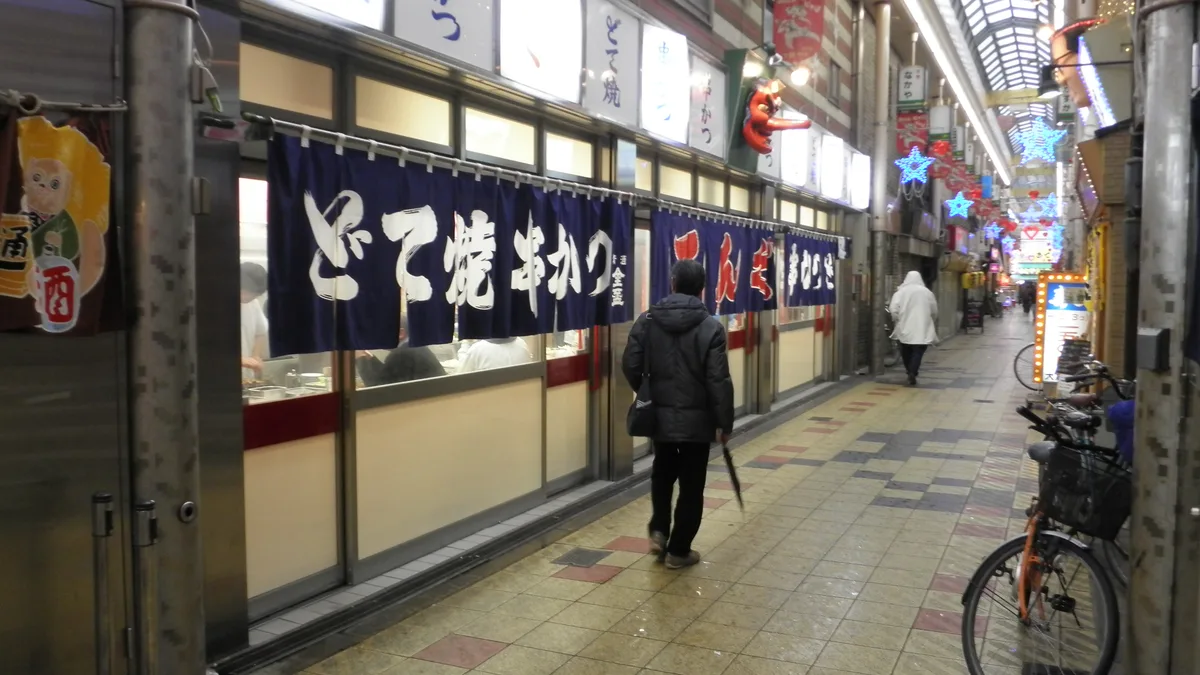
A few doors on you'll find the dish that comes with the most famous rule in Osaka, and it's worth slowing down for, because the rule is the opposite of what it first looks like. Kushikatsu is skewered meat and vegetables, breaded and deep-fried, eaten with a vat of thin brown sauce. At the traditional counters that sauce sits in a single steel tray shared by everyone at the bar, and the one law, printed on signs and announced by a doll outside more than one shop, is no double-dipping: you may dip each skewer once, before you've bitten it, and never again.
To a newcomer it sounds like a city being strict for the sake of it. It isn't. Read the rule the other way and the whole logic appears: the sauce in front of you is the same sauce the person before you used, and the same sauce someone will use after you've gone. The one-dip rule is not really about manners at all. It is the small piece of engineering that lets a single tub of sauce be shared, cheaply and safely, by strangers all night long, a quiet system, not a national quirk. Beside the tray sits a bowl of free raw cabbage, refilled without your asking; many people use a leaf as a spoon, scooping up a little extra sauce rather than going back to the well. And if you're anxious about getting it wrong, take heart: plenty of Japanese visitors from outside Osaka stiffen at that first counter too. Since the pandemic, many shops have quietly swapped the shared tray for a squeeze bottle at each seat, at which point you can dip to your heart's content and the old anxiety dissolves into a bottle of sauce. The rule survives anyway, because the courtesy underneath it was never really about the sauce.
Step 4: The River and the Lights
When the food has slowed you down, go to the water. The Dotonbori River runs the length of all this, a working canal, not a pretty one, about 2.7 kilometers threading the south of the city, and along the central stretch a walkway called the Tonbori River Walk drops you to the level of the canal itself, opened in 2004 to give the city back a river it had spent a century turning its back on. From down here the signs that tower over the street become a second city hanging upside-down in the water: the running man, the giant mechanical crab clawing the air over a restaurant, the whole menagerie of three-dimensional signs, all of it doubled and rippling.
This is also the honest place to admit what Dotonbori is. The water is not clean; the street can be sticky and loud and thick with cigarette smoke; people will work the evening crowd to steer you toward this bar or that one, and the famous shops on the main strip are the most crowded and rarely where a local would choose to sit down. None of that is a betrayal of the place. It is the place, the gaudy, crowded, slightly grubby underside of a country more often praised for its restraint. For some travelers, worn smooth by the politeness of everywhere else, that's exactly the relief Dotonbori offers: somewhere Japan stops being a museum and just shouts for a while. You don't have to love the noise. But the runner reflected in a not-quite-clean canal, ringed by people eating too much and grinning about it, is as honest a portrait of Osaka as exists.
Step 5: The Quiet Street Behind It
Before you go, take one turn off the brightness. A few steps south of the canal the neon simply stops, and you're in Hozenji Yokocho, a stone-paved lane barely wide enough for two, lined with tiny old counters, where a small moss-covered statue stands darkened and glistening because passers-by have ladled water over it in prayer for generations. After the spectacle of the main street, the stillness here is almost a sound of its own. It's worth standing in for a minute, because it answers a question the rest of Dotonbori raises without meaning to: whether a place this loud can hold anything quiet. It can. The showcase and the silent lane are a single street apart, and they always have been: the bright face Osaka turns to the crowd, and the smaller, older one it keeps just behind. Walk the loud street for its joy, and the quiet one to remember that the city was never only one thing. Thank you for walking with us.
What Visitors Honestly Say
Before you plan the evening, it helps to hear from the people who have already gone. We collected 200 voices from international travelers who had actually been, weighted each by how much it resonated with fellow readers, and this is how they fell:
That shape says it plainly: this isn't a place people love or hate, it's a place that rewards or disappoints depending on what you came for. One much-upvoted traveler put the whole thing in two sentences: "Dotonbori is much more of a sightseeing/photo spot than anything else, even within Osaka, it isn't exactly known or renowned for the food. I wouldn't call it overrated as something to go see, but anyone who has 'the best meal of their trip' there has missed out." The ones who felt let down nearly all describe the same avoidable thing, treating the main strip as a restaurant: "it's fun to take pictures of, but no, you're not going to get good food there."
Japanese visitors and locals, reviewing the same street in their own words, land far warmer:
Notice that the Japanese red band is less than half the visitors' one: 11% against 27%. What locals come for is the show itself. "I love Dotonbori! There are always tons of people and you almost get lost," one wrote, before the obligatory instruction to strike the Glico pose. They already know where to eat, so the street gets to just be the stage. Their thin red band is mostly the street straining under its own popularity, the crowds, the touristy prices, rather than a complaint about the street itself.
The full picture, the letdowns included and what prevents each one, is in Is Dotonbori Worth It?
Good to Know
Getting there: Dotonbori sits in Minami, the southern heart of Osaka, between two of the city's busiest stations. From most of Osaka the simplest route is the Osaka Metro Midosuji Line to Namba or Shinsaibashi; both are a short walk from the canal, and from Shinsaibashi you can follow the covered Shinsaibashi-suji shopping arcade straight south until it delivers you onto Ebisubashi, right under the Glico sign. Note that "Namba" is really a cluster of connected stations (Osaka Metro's Midosuji, Yotsubashi, and Sennichimae lines, Nankai, and the Kintetsu/Hanshin Osaka-Namba station), so check which one your train actually uses. Coming from the airport, the Nankai line runs from Kansai International Airport straight to Namba, fastest on the limited-express Rapi:t in around 34 minutes. For the bigger picture of trains and passes, see getting around Japan.
When to go: Dotonbori is an evening place. The lights come into their own after dark, and the energy peaks from just after sunset through the early evening. It's worth knowing that it winds down earlier than its reputation suggests: many shops along the street close around eight, and the crowd thins well before midnight outside the bars and later restaurants, so the magic hour is dusk, not the small hours. If crowds aren't your thing, a weekday late morning is calm and bright enough for photographs, with the running man almost to yourself.
What to eat: Dotonbori is the home street of Osaka's konamon, its "flour things": takoyaki (octopus dumplings), okonomiyaki (a savory griddled pancake), and kushikatsu (fried skewers). Eat them as snacks, one stall at a time, rather than sitting down to one big meal; that is what kuidaore looks like in practice. The dazzling shops on the main strip, with the mechanical crab and the running man, are the busiest and most photographed; for a quieter, calmer meal, locals tend to slip a street or two back, into Hozenji Yokocho or the lanes around it.
The shared-sauce rule, briefly: At a traditional kushikatsu counter, dip each skewer in the communal sauce once, before you bite it, and never again; the free cabbage beside it is yours to keep eating, and to scoop a little extra sauce with. Many shops now give each seat its own sauce bottle, in which case dip away.
Cash: Cards and IC transit cards are widely accepted, but small stalls and older counters can still be cash-only, so it's worth carrying some. Prices are marked and what you see is what you pay, with no tipping and no surprises.
Time needed: The core of Dotonbori (the bridge, the signs, the river, a few snacks) is an hour or two. It pairs naturally with the nearby Kuromon Market, the Shinsaibashi arcades, or the retro Shinsekai district to fill an easy half-day. For the same city with the volume turned down, it's a short ride to the green moats and stone walls of Osaka Castle and its park, the calm, historical counterweight to all this neon.
Last verified: 2026-06
Official guide: Osaka Official Tourism Guide: Dotonbori
If Things Don't Go as Planned
You arrived after dark and half the street was shut. Dotonbori looks like a place that runs all night, but it keeps earlier hours than it lets on: many shops shutter around eight, and the food stalls wind down not long after. The lights stay lit, so an evening stroll is never wasted, but if you've come to eat, aim for sunset through the early evening rather than the small hours.
It's so crowded you can't get a photo. The bridge is the busiest spot for a kilometer, and on a weekend evening you'll be shoulder to shoulder. For the running man to yourself, come back on a weekday late morning, when the light is good, the crush is gone, and you can stand in the middle of Ebisubashi without holding anyone up.
The food on the main strip felt touristy. The big, bright shops with the mechanical signs are the most photographed and the most crowded. Dotonbori's main street is really its stage; for a calmer and often better meal, do what locals do and step a street or two back, into Hozenji Yokocho, or the smaller lanes off the canal, where the counters are quieter and the cooks aren't feeding a queue.
You bit into takoyaki and the middle was molten. That's exactly right: good takoyaki is crisp outside and almost liquid within, and it comes off the pan hot enough to catch you out. Blow on it, wait a moment longer than feels necessary, and take a small first bite. The waiting is part of eating it.
You panicked at the kushikatsu counter. The rule is simpler than it sounds: dip each skewer in the shared sauce once, before your first bite, and not again; the cabbage is free and refillable, and you can use a leaf to scoop a little more sauce if you want it. If your shop gives you your own bottle instead of a shared tray, none of this applies and you can dip freely. Either way, getting it slightly wrong is not a scandal; plenty of Japanese visitors hesitate there too.
Someone tried to wave you into a bar. In the evening you'll be approached by people steering you toward restaurants and clubs. The easy, polite move is simply not to engage: a smile and a small shake of the head is plenty, and you're under no obligation to take a flyer or even slow down. Choose where you eat yourself, ideally somewhere you looked up beforehand, and be wary of anyone unusually eager to lead you somewhere you didn't ask to go.
Sources:
- Osaka Official Tourism Guide (OSAKA-INFO): Dotonbori: Kuidaore framing, "Japan's Broadway," Kuidaore Taro, the giant food signs
- Osaka Official Tourism Guide (OSAKA-INFO): Kushikatsu: The "no double-dipping" rule, shared sauce tray, free cabbage
- Dotonbori Shotenkai (Merchants' Association): About Dotonbori: Canal history (excavation begun 1612, completed 1615), naming after Doton, theater-town origins, the five stages, Chikamatsu
- Ezaki Glico: The Dotonbori Glico Sign (Official): Current (6th) sign: lit 2014, ~140,000 LED chips, 20.00 m tall; the running "goal-in" figure's origin
- Ezaki Glico: Corporate History (Official, English): First sign 1935; first generation 33 m; six generations; LED since 2014
- City of Osaka: About the Dotonbori River: River length (~2.7 km), classification, dimensions
- City of Osaka: Tonbori River Walk: Riverside walkway completed December 2004
- JNTO (Japan National Tourism Organization): Dotonbori: Glico Man over Ebisubashi, kuidaore, station and access overview, post-pandemic shift from shared trays to individual sauce bottles
- Nankai Electric Railway: Access from Kansai International Airport: KIX to Namba; limited-express Rapi:t fastest in ~34 minutes
- Osaka Metro: Namba Station Guide: Midosuji, Yotsubashi, and Sennichimae lines; transfers
- NHK WORLD-JAPAN: Kansai's kushikatsu: Using the complimentary cabbage to scoop more sauce
- Is Dotonbori Worth It? (WMJS): The two visitor-voice gauges reproduced in "What Visitors Honestly Say" (200 international voices, 37/36/27; 99 Japanese voices, 62/27/11) and the verbatim visitor quotations
Images: Via Wikimedia Commons: Dotonbori neon at night (CC0); kushikatsu (public domain).
WMJS is written in Japan, in English, with AI help. We check every page, but English is not our first language. If a sentence reads oddly, tell us. One sentence is enough.
Thank you. A person reads every note.
Real voices
Is it worth it?
Were you there? Share your photos.
Your photo could appear in this guide — with your name and a link to your profile.
Submit a photoRelated Articles
Is It Rude to Eat While Walking in Japan? — What Japanese People Actually Think


The Ramen Map: What Locals Want You to Know Before You Line Up
More guides in Kansai
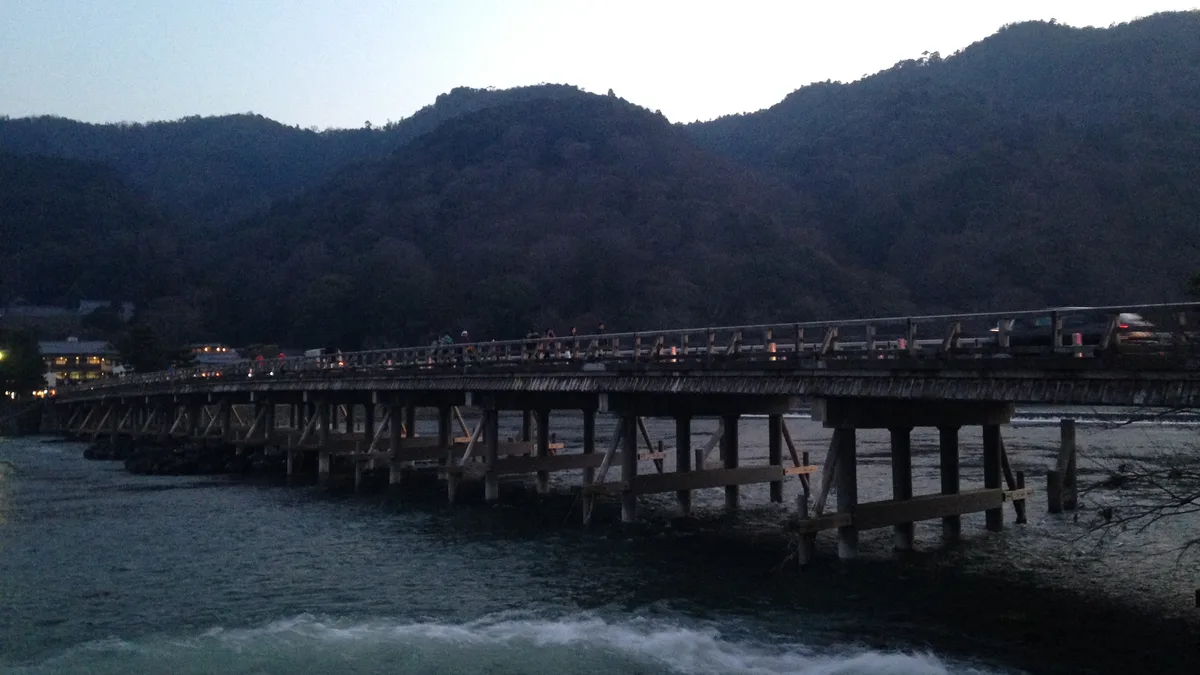
Arashiyama — Why Japan Lists This Bamboo Grove Among the Sounds Worth Saving
An audio cultural guide to Arashiyama in Kyoto, verified against official sources. Understand why Japan lists the bamboo of Sagano among the sounds it wants to keep, how the Moon-Crossing Bridge earned its name, and how to walk the river, the grove, and Tenryu-ji's borrowed-mountain garden away from the crowds.
Arashiyama
Fushimi Inari Taisha: Ten Thousand Gates, Each One a Thank-You
The ten thousand vermilion gates at Fushimi Inari are thank-you notes you can walk through. A cultural audio guide verified against official sources: why the foxes are messengers not gods, why the summit has no view, and how to walk past the crowds.
Fushimi Inari Taisha
Ginkaku-ji — Why the Silver Pavilion Has No Silver, and Why Japan Finds That Beautiful
Why the Silver Pavilion has no silver — a free audio guide to Ginkaku-ji, Kyoto, verified against official temple sources. Higashiyama culture and the art of restraint, the sea of silver sand, hours, admission (1,000 yen), access from Kyoto Station, and the Philosopher's Path.
Ginkaku-ji (Jishō-ji)
Gion — Walking Kyoto's Flower District, a Town That Is Still Lived In
An audio guide to Kyoto's Gion flower district: what geiko and maiko really are, the walk from Yasaka Shrine through Hanamikoji to the Shirakawa canal, when to go, and how to enjoy a town still lived in.
Gion