

Which Side of the Escalator Do You Stand On in Japan?
What you'll learn in this article:
- Why Tokyo stands on the left and Osaka stands on the right, and where that even came from
- The quiet change happening right now: Japan is asking everyone to stand still on both sides
- What Japanese people actually hope you'll do (it's simpler than the rule you may have memorized)
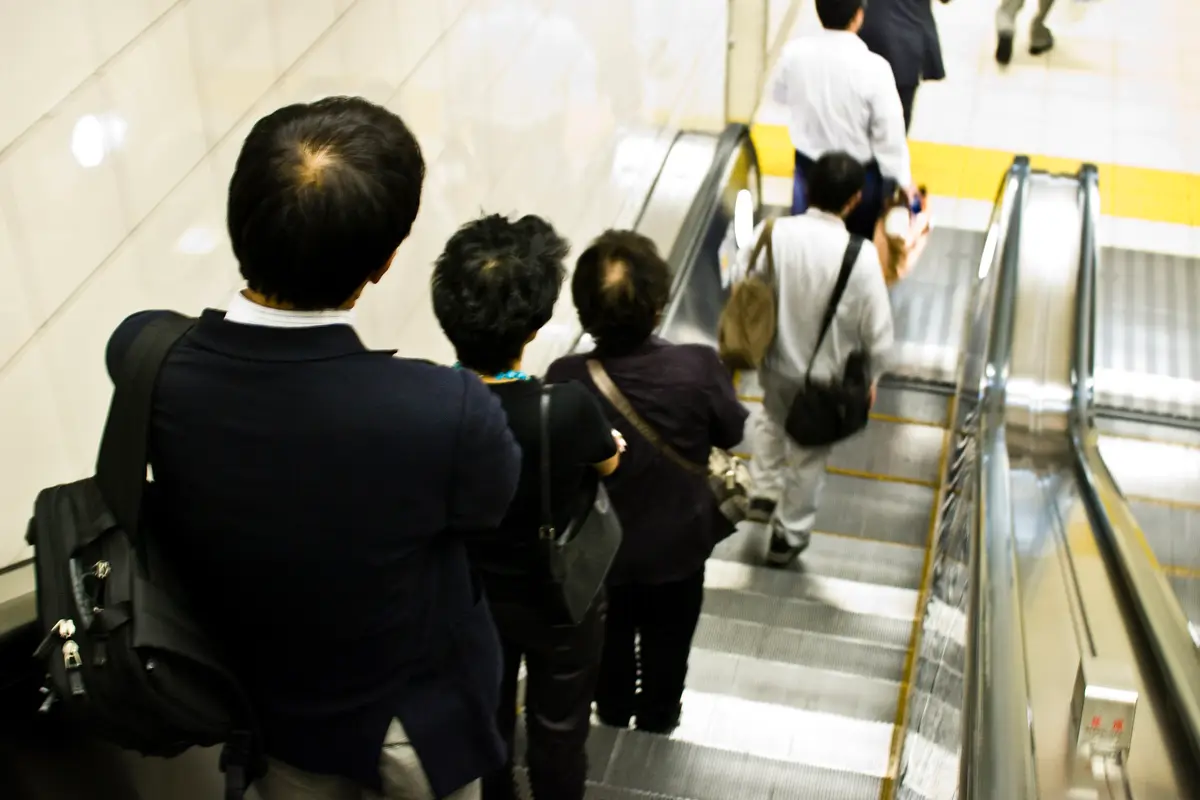
Which side of the escalator should you stand on in Japan? Traditionally, the left in Tokyo and the right in Osaka, leaving the other side open for people walking. But that custom is being quietly retired. Across Japan, you're now asked to simply stand still on both sides and hold the handrail. It's the walking that's being phased out, whichever side you stand on.
So here's the reassuring truth for 2026: the rule you carefully memorized matters less every year. More than 90% of Japanese people now say walking on escalators should stop, and the question "left or right?" is slowly dissolving into a much easier one: just stand, and hold on.
If you've ever stood frozen at the bottom of a station escalator in Japan, trying to remember whether this is a "stand left" city or a "stand right" city. First of all, you're not alone. Visitors agonize over this. Honestly, it's one of the most charming little anxieties people bring to Japan.
While guidebooks were busy teaching the left/right rule, Japan itself started moving on from it. The custom of leaving one side open for walkers (the very thing the rule is about) is being gently, deliberately retired. And that turns out to be a small window into something much bigger about how rules actually work here.
We gathered 48 Japanese voices about escalators: how people feel about the left/right divide, about the new "just stand still" message, and about what happens when someone gets it "wrong," to show you what's really going on, and why you can relax.
Quick Guide
| Situation | What's Really Going On | |
|---|---|---|
| 🟢 Relax | Which side to stand on | Tokyo/Kanto stands left; Osaka/Kansai stands right. But almost nobody minds if a visitor gets it "wrong." If you're unsure, just glance at the person in front of you and match them. |
| 🟡 Good to know | Standing still on both sides | This is the new normal Japan is moving toward. Ordinances in Saitama (2021) and Nagoya (2023), plus a nationwide campaign, now ask everyone to stand still and not walk. You'll see both lanes filling up. |
| 🔴 Worth noting | Walking / rushing up the escalator | This is the habit being phased out, for safety. The handrail and steps are designed for standing still. If you're in a hurry, the stairs are your friend. |
The one thing to remember: Don't agonize over left or right. The kindest, safest thing you can do in Japan today is simply stand still, hold the handrail, and let the escalator do the work. That's it. You're already doing it right.
How We Gathered These Voices
We collected 48 Japanese-language comments across three questions: how people feel about the shift to standing still on both sides (25 voices), what they think when someone stands on the "wrong" side (14 voices), and how attitudes differ across generations (9 voices). We gathered these from public Japanese Q&A sites, forums, and social media, alongside reporting from Japanese news outlets and official sources from railway operators, prefectures, and city governments.
A quick note: This isn't a controlled scientific survey. It's a collection of what real Japanese people said, in their own words, on public platforms. Most guides simply tell you "stand left in Tokyo, right in Osaka." We wanted to show you what Japanese people are actually doing now, because the answer has been changing, and it lands somewhere wonderfully forgiving.
First: Yes, There Really Is a Left/Right Divide
Let's start with the rule you've probably heard, because it's real.
In Tokyo and most of eastern Japan (Kanto), people stand on the left and leave the right side open. In Osaka and the Kansai region, it flips: people stand on the right and leave the left open. Step off the bullet train from Tokyo to Osaka and you'll see the whole crowd mysteriously swap sides.
So where did this come from? The honest answer: nobody fully knows, and that itself is telling.
The most commonly cited origin is Hankyu Railway's Umeda Station in Osaka. When the station was rebuilt in 1967 with a long new escalator, the railway began broadcasting an announcement asking riders to leave the left side open for people in a hurry, which is exactly why Kansai stands on the right. (That announcement reportedly continued until 1998.) There's a popular story that the 1970 Osaka Expo introduced "international-standard" right-standing, but historians are skeptical, and Hankyu itself says no detailed records survive explaining why the side was chosen.
諸説ありますが、関西は「左を空けて」と明言していた鉄道会社がかつてあったため、関東は自然発生的に左に立つ人が多かった、という説が有力です。 There are various theories, but the leading one is that in Kansai a railway once explicitly asked people to "keep the left open," while in Kanto, people just naturally tended to stand on the left.
The point worth holding onto: this "rule" was never a law; it grew as a habit that spread and settled, differently in different places. Which means it can also un-settle. And that's exactly what's happening now.
And then there's Kyoto
If you want proof that this is all softer than it looks, go to Kyoto (geographically between Kanto and Kansai), where the rule simply dissolves into politeness.
京都では「前に倣え」式なので左右ごちゃごちゃ。案外、境目は京都かも知れん。 In Kyoto it's a "follow-the-person-in-front" system, so left and right get all jumbled. The real boundary might actually be Kyoto.
大阪府民ですが定期的に京都へ行きます。大阪はもちろん右立ちですが、京都は左右両方あります。たまに左に立つ人がいると、その後ろは左立ちが続きます。 I'm from Osaka and go to Kyoto often. Osaka is right-standing of course, but Kyoto has both. Sometimes someone stands on the left, and then everyone behind them follows on the left too.
People aren't consulting a rulebook. They're reading the person in front of them and quietly matching. It's the same instinct that lets the famous Shibuya scramble crossing move thousands of people at once without anyone directing it. Hold that image; it explains almost everything about how visitors should approach this.
The Quiet Change: Japan Is Retiring the Walking Lane
Here's the part most guidebooks haven't caught up to yet.
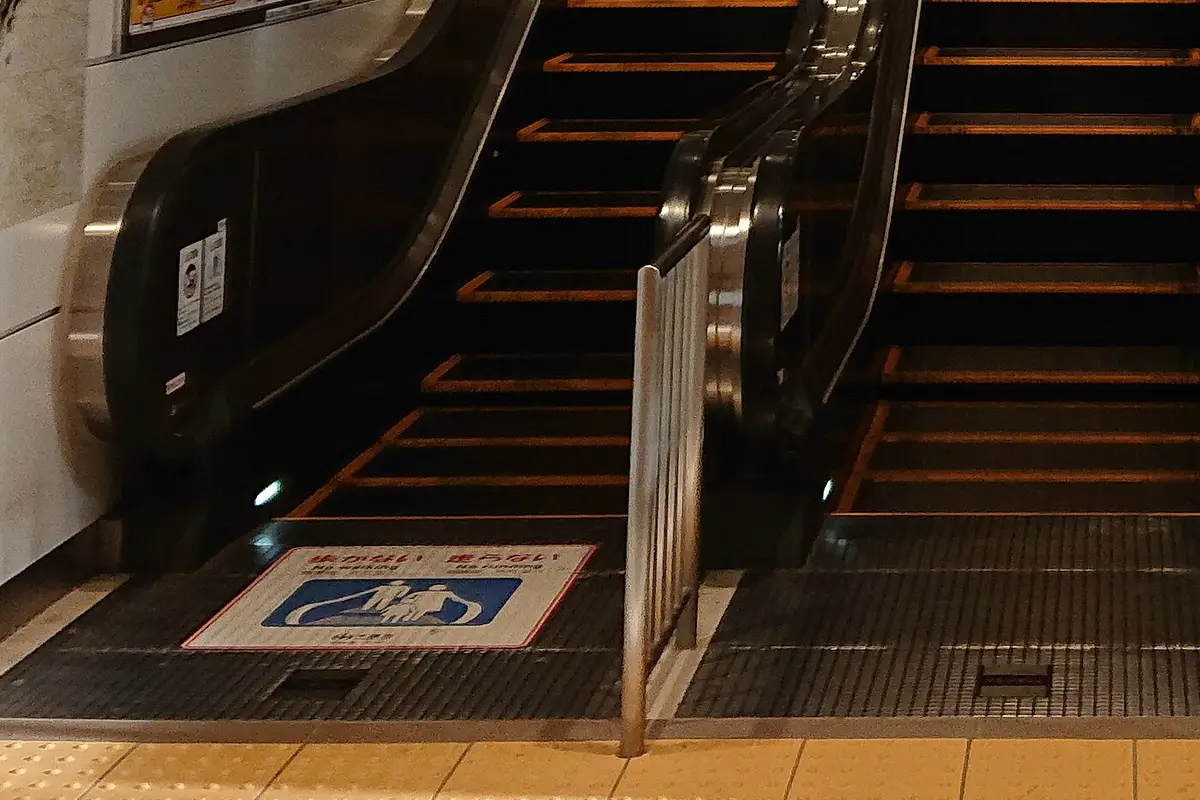
The whole reason for standing on one side was to leave the other side open for people to walk up. But walking on escalators turns out to be genuinely dangerous, and Japan has decided, step by step, to phase it out.
- In 2021, Saitama Prefecture passed Japan's first ordinance asking people to stand still on escalators rather than walk. It took effect on October 1, 2021. (Notably, there's no fine; it works through awareness, not punishment.)
- In 2023, Nagoya became the first major designated city to follow, with its own stand-still ordinance effective October 1, 2023, also with no penalty. The city even deployed a friendly awareness team in red jackets, the "Nagoyaka Standing-Still Squad," and from 2025 began installing AI sensors at subway stations that gently remind walkers to stop.
- Every year, more than 50 railway operators, airports, and facilities across Japan run a joint summer campaign with one message: Don't walk. Stand still.
And Japanese people, in the abstract, are already on board. In the Japan Elevator Association's annual survey, more than 90% said walking on escalators should stop, the second year running above that mark. The share who admit they sometimes walk has fallen to around 60%, down from 82% in 2018, six straight years of decline.
And where the message has been pushed consistently, behavior really does change. In a 2025 Nagoya city survey of 959 residents, nearly 94% of escalator users said they now stand still to ride; barely 1.5% said they walk, and essentially no one runs.
Why the push? Safety. The same association counted 2,060 escalator accidents in 2023–2024, up from about 1,550 a few years earlier, with falls as the single most common cause. Escalators are engineered on the assumption that you're standing still and holding the handrail; the steps are even a slightly unusual height, designed for standing, not striding.
There's also a timely backdrop: Nagoya hosts the Asian Games (September 19 – October 4, 2026), and the city frames its stand-still message partly around welcoming the many visitors (including travelers with disabilities) who'll arrive. The hope is simple: an escalator anyone can ride safely, at their own pace.
How Japanese People Actually Feel About the Change
So Japan is mid-transition, and the most interesting thing isn't the rule. It's that Japanese people themselves are split, caught between a habit they grew up with and a new norm they mostly agree with. Here's what 25 Japanese people wrote about the shift to standing still on both sides.
That's an almost perfectly even split, and that's the honest picture of a country in the middle of changing its mind.
The people ready to stand still often point to safety, or to the simple absurdity of the old habit:
片側空けするために片方が大行列になってるのを見ると、さすがに馬鹿だろって思う。 When I see one whole side backed up in a huge line just to keep the other side empty, I honestly think it's ridiculous.
名古屋は市の条例で歩かないことになって、両側で止まって乗る人が増えてる。堂々と歩かないで立ち止まれる。 In Nagoya the city ordinance means no walking, and more people now stand still on both sides. You can stand still with confidence.
Some of the most moving voices came from people for whom the walking lane was never safe to begin with:
後ろから来るのが一番こわい。片手で子供と手を繋ぎ、片手で荷物を持っていたら、後ろからぶつかるように追い越されて、本当に落ちそうになった。 People coming from behind are the scariest. I had my child's hand in one hand and luggage in the other, and someone overtook me so roughly I nearly fell.
The people attached to the walking lane are just as honest, and their reasons are almost always about being in a hurry:
急いでる時によく右側を歩くから、この文化は絶対になくなって欲しくない。 I often walk up the right side when I'm in a hurry, so I really don't want this culture to disappear.
歩いて登るために設計されてるんだもん。どんなにルール化しても、本能の方が勝つよ。 They're literally built for walking up. No matter how much you make it a rule, instinct wins.
And then there's the fascinating middle: the people who agree standing still is right, but can't quite bring themselves to do it:
本当はその方がいいって、みんなわかってるんだよ。ただ、止まってたら「どけよ!」って言ってくる人が現れるかも、と思うと誰もできないだけ。 Everyone actually knows standing still is better. It's just that the fear someone might come up and snap "move!" is the only reason nobody can do it.
ルールは知ってるけど、変な人にぶつかりたくないっていう自衛が働いて、結局いつもの側に立っちゃうんだよね。 I know the rule, but a kind of self-defense kicks in — I don't want to run into someone difficult — so I end up standing on the usual side after all.
💡 The gap that explains everything
In the abstract, more than 90% of Japanese people say walking should stop. In the actual moment, the habit (and a quiet fear of someone snapping "move!") keeps the walking lane alive. That gap between what people believe and what they do is the transition. You're visiting Japan right at the hinge.
What this means for you is oddly freeing: when you stand still on both sides, you're not breaking a rule; you're on the side history is moving toward. And if you instinctively leave a side open, that's fine too. Either way, you're matching some Japanese person standing right next to you.
"But What If I Stand on the Wrong Side?"
This is the question that keeps visitors up at night, so let's answer it directly. We gathered 14 voices specifically about people who stand on the "wrong" side or don't know the rule. Here's the temperature:
The dominant feeling is warm and forgiving. The clearest voice of all:
他地域から来た人が間違えても仕方ないし、気にすることじゃないです。私だって関東に行ったら、たぶん間違えますから。 If someone from another region gets it wrong, that's just how it is — nothing to fuss about. I'd probably get it wrong too if I went to Kanto.
Many Japanese people now find the whole left/right ritual a little silly, which is great news for you:
なぜ片側を空けないといけないのか理解できなかったから、両側で立つのが定着してほしい。 I never understood why we have to keep one side open, so I really hope standing on both sides catches on.
歩かないって話なんだから、もうどっちでもいいんじゃない? Since the whole point is not walking anyway, isn't either side fine now?
And the practical, friendly advice that came up again and again: the single best tip in this whole article:
巻き込まれて怪我をしたら馬鹿らしいので、その土地に合った側に寄って、流れの邪魔にならないようにするのがベスト。 It'd be silly to get caught up and hurt, so the best thing is to drift to the side that suits the area and not get in the way of the flow.
That's it. Glance at the person ahead, stand on the same side, hold the rail. You will never be "the visitor who got it wrong." You'll just be one more person, standing.
The Cultural Engine: Why the Rule Keeps Changing
So why is Japan, a country famous for its rules, actively dismantling one of its most recognizable ones? Because of a misunderstanding visitors often have about what a "rule" even is here.
The left/right custom was never a law. Nobody legislated it. It grew because, at one moment in history, leaving a side open felt like consideration, a kindness toward people in a hurry. And now that we know walking is dangerous, the same impulse (consideration for others) is pointing the other way: stand still, so no one gets hurt, so the person with a cane or a stroller or a heavy bag can ride safely too.
The rule changed because the kindness underneath it stayed the same.
A Japanese commuter put it beautifully, and it's the single best summary of how rules work in Japan:
マナーって固定されたルールじゃなくて、その時代と場所に合った人への配慮なんだよ。 Manners aren't fixed rules — they're consideration suited to the time and the place.
This is the same principle running quietly beneath so much of Japanese daily life. It's why Japanese trains are so silent, not because of a law, but because of a shared sense of the "air" in the room. It's why lining up matters so much. And it's the deeper logic behind why Japanese people choose the rules they do in the first place. Once you see it, Japan stops feeling like a country of strict, mysterious rules, and starts feeling like a country of people quietly looking out for each other.
💡 The whole idea in one line
The rule reversed, but the reason didn't. Leaving a side open once was the kindness. Now standing still is. Same heart, new shape.
A Note on Generations
You might expect the older generation to embrace standing still and the young to rush, but the picture is more tender and more surprising than that.
People who grew up in the era of "always leave a side open" describe a reflex they can't fully shake, even when they agree with the new rule:
感受性豊かな年頃に身についた感覚は、そう簡単には変わりません。社会のルールだから守りますが、心のどこかでは、まだ昔の感覚が残っているんです。 The sense you absorb in your impressionable years doesn't change so easily. I follow the rule because it's the rule — but somewhere in my heart, the old feeling is still there.
Meanwhile, several people noticed the stereotype quietly flipping:
条例やコロナのおかげか、若い人ほど普通に2列で立ち止まってる印象。むしろ上の世代の方がせかせか歩いてる。 Maybe thanks to the ordinances and the pandemic, younger people now just calmly stand two-abreast. If anything, it's the older generation who hurry up the side.
And there's real warmth toward those who simply can't move quickly, a reminder that "stand still" isn't only about safety, but about making room for everyone:
お年寄りは、立ち止まったり歩いたりの切り替えがすぐにできない。私たちも、いつか歳をとりますから。 Elderly people can't switch quickly between standing and walking. We'll all grow old someday too.
That last line is the quiet heart of the whole transition. Standing still isn't a restriction. It's room: for the person ahead of you, and for the person you'll one day be.
What Japanese People Actually Want You to Know
After reading all 48 voices, the message wasn't "memorize the rule." It was something much gentler:
Don't stress about left or right. The regional divide is real, but it's fading, and almost nobody minds if a visitor reads it wrong. Glance at the person ahead and match them. Done.
Just stand still and hold the handrail. This is genuinely what Japan is moving toward, what the ordinances ask, and what keeps everyone safe. When you stand still, you're not being a slow tourist in the way; you're doing exactly what your hosts now hope you'll do.
If you're in a hurry, take the stairs. They're almost always right next to the escalator, and you'll get there faster anyway.
That's the whole thing. The rule you were nervous about is dissolving into something far easier to follow, and far kinder. Step on, hold on, and enjoy the ride up. You're doing it right.
More Japanese Perspectives
Curious about the deeper logic behind Japan's everyday rules? These articles explore what Japanese people actually think, based on hundreds of real voices.
- Why Japanese Trains Are Silent: 177 Japanese people on the unwritten rule of the quiet train, and the "read the air" instinct behind it.
- Why Japanese People Choose These Rules: the bigger picture of how unwritten rules form, hold, and change in Japan.
- Getting Around Japan: a friendly, practical guide to trains, stations, and moving through Japan with ease.
Share Your Experience
Ever frozen at the bottom of an escalator wondering which side to pick? Or noticed both lanes filling up and wondered what changed? We'd love to hear your story; it helps build a bridge between cultures.
Share your experience on Voice Box →
Sources
Primary Research Data
- WMJS escalator research (48 Japanese-language voices collected June 2026)
- The shift to standing still on both sides: 25 voices
- Standing on the "wrong" side / not knowing the rule: 14 voices
- Generational differences: 9 voices
- Voices were collected from public Japanese Q&A sites, forums, and social media. These platforms are not cited as factual authorities, but as places where real Japanese people expressed their views.
Facts, Ordinances & Statistics (Tier 1–2)
- Saitama Prefecture: Escalator Safety Ordinance (effective Oct 1, 2021; no penalty): https://www.pref.saitama.lg.jp/a0310/escalator/escalator.html
- Nagoya City: Escalator Safety Ordinance (effective Oct 1, 2023; "Nagoyaka Standing-Still Squad"; AI detection from 2025): https://www.city.nagoya.jp/bousai/anzen/1034530/1015520/1015522.html
- Nagoya City: 2025 citizen survey on escalator use (N=959; 93.8% stand still: 80.0% left, 5.3% center, 8.5% right; ~1.5% walk; 0% run): https://www.city.nagoya.jp/_res/projects/default_project/_page_/001/015/522/r7survey.pdf
- Japan Elevator Association: annual "Don't Walk, Stand Still" campaign and survey (more than 90% say walking should stop; ~60% admit they sometimes walk, down from 82% in 2018): https://www.n-elekyo.or.jp/instructions/escalator.html
- Japan Elevator Association: survey of escalator user accidents, 10th report (2,060 accidents in 2023–2024; falls the leading cause): https://www.n-elekyo.or.jp/about/elevatorjournal/pdf/Journal56_06.pdf
- Government of Japan (Public Relations Office): escalator and elevator safe-use guidance: https://www.gov-online.go.jp/hlj/ja/march_2026/march_2026-09.html
- Origin of the regional left/right custom (Hankyu Umeda 1967; Osaka Expo 1970 attribution disputed): https://www.chunichi.co.jp/article/1005900
- 20th Asian Games, Aichi-Nagoya 2026 (September 19 – October 4, 2026): https://www.aichi-nagoya2026.org/en/
Note on Quotations
Quotes from online platforms have been lightly edited for readability (fixing typos, formatting for clarity). The meaning and intent of each comment remain unchanged.
WMJS is written in Japan, in English, with AI help. We check every page, but English is not our first language. If a sentence reads oddly, tell us. One sentence is enough.
Thank you. A person reads every note.
How well do you know Japan?
Based on 51,218+ real Japanese voices
Want to know more? Ask Japanese people
Have a follow-up question about this topic? We'll ask real Japanese people.
Voice Box →