
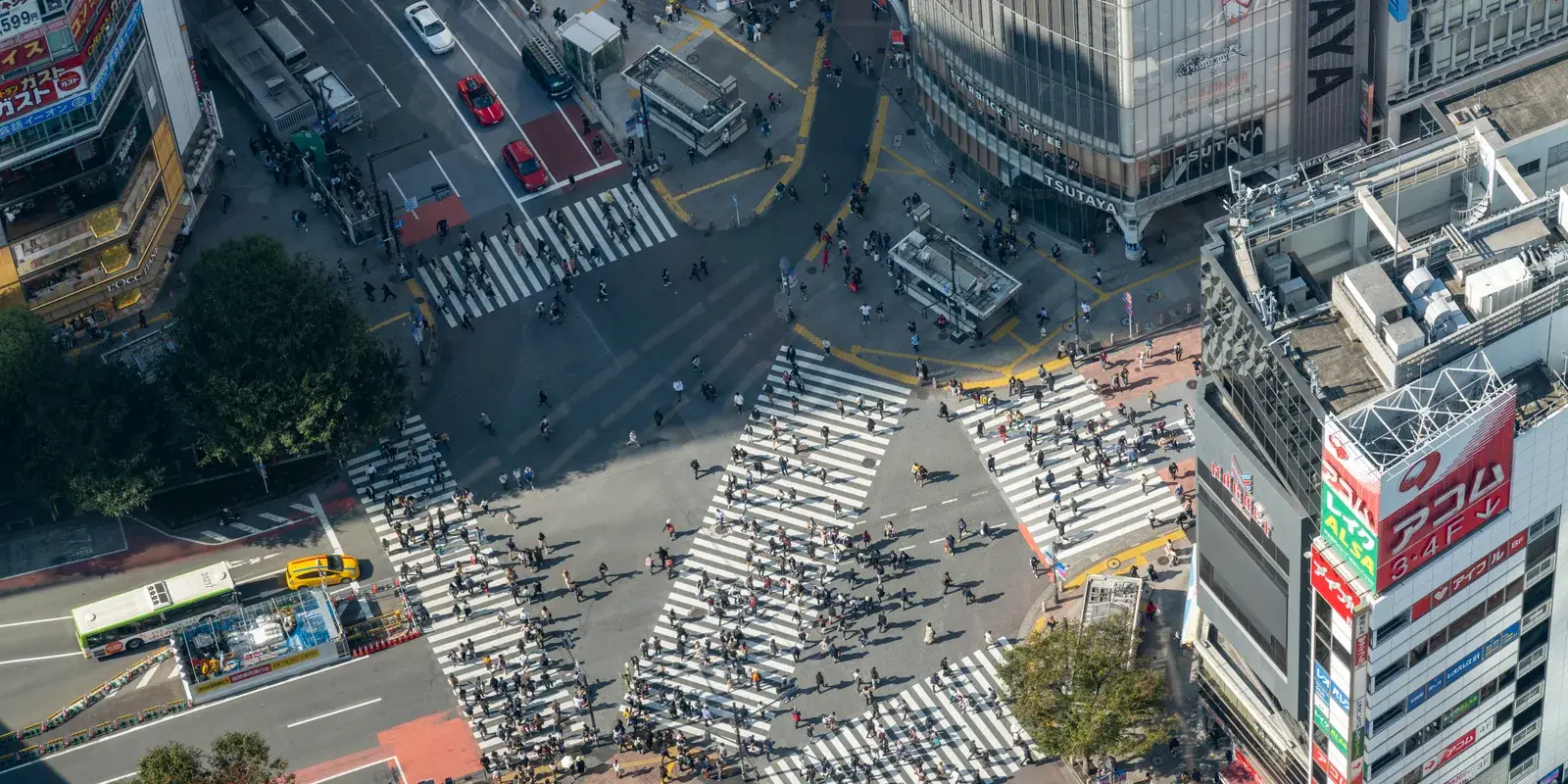
Is the Shibuya Crossing Worth It? The Answer Is Where You're Standing
You have seen the doubt, because it is one of the loudest on the internet: "it's just a crosswalk." People step off the train at Shibuya expecting something cinematic, find a very busy intersection, and leave a little let down. "Lower your expectations," one traveler wrote, "it's just a street crossing. There is not anything special to enjoy." Another, more bluntly: "I was like… that's it? Japan is incredible, but that crossing was nothing."
Here is the short answer, and everything below explains why: the let-down is almost never about the place. It is about where you were standing. Down in the crowd, it really is just a crosswalk. From above, it is thousands of strangers cooperating, perfectly, without a leader, over and over, all day long. The visitors who leave disappointed almost all judged it from the kerb; the ones who loved it watched it.
Is it worth it? (in visitors' own words)
We gathered the voices of international travelers who have actually crossed or watched the Shibuya Scramble Crossing. Weighted by how strongly each opinion resonated with other readers, here is how they fell:
That red bar is one of the largest we have gathered for a famous Tokyo sight, and it is worth reading closely, because the complaint is remarkably consistent. "It is, quite literally, just a crosswalk lol." "Whenever people ask if Shibuya crossing is worth it to see, I say no. It's just a busy crosswalk." Almost every one of them describes the same thing: standing at street level, inside the crush, expecting a spectacle and meeting an intersection.
But look at the middle bar, the biggest of the three. This is the tell. Most travelers do not land on "amazing" or "terrible"; they land on "it depends how you do it," and they keep naming the same fix. "Maybe get some tickets for Shibuya Sky. You can see the crossing and all the people crossing it from a very nice vantage point." "We took some pretty nice videos from the 11th floor of the Hikarie building, an amazing view for free with barely any crowd." "It's a popular tourist attraction, friend: Eiffel Tower, Times Square, Tower Bridge, same. My wife and I took pictures and moved on." The neutral voices are not bored. They are telling you the crossing has a wrong way and a right way to see it.
And the green bar, small as it is, says the right way pays off. "I like Shibuya crossing. It's fun to watch and it never gets old." "I crossed like five times just for fun, people were taking photos and waving at the cameras. It's silly, energetic fun for a couple of minutes." "Counterpoint: Shibuya is best on a Friday or Saturday night. Yes, there are lots of tourists. There are also thousands of locals out enjoying themselves, and the vibe is electric."
How the people who live with it feel
This is the side most guides never show you: what Japanese visitors and Tokyoites say, in their own reviews, about the same intersection they cross on the way to work.
Now put the two gauges next to each other, because the gap between the red bars is the whole story. A third of foreign visitors felt let down; barely a tenth of Japanese ones did. And the reason is hiding in a single Japanese review that uses the exact same words as the disappointed travelers, and means something completely different by them:
"It often comes up as a spot for visitors, but for someone who's been passing through it for years, it's just a crowded scramble crossing."
Read that beside "that's it? the crossing was nothing," and you can see the entire misunderstanding in one frame. Both the foreigner and the local arrive at the same sentence: it's just a crossing. But the visitor says it as a let-down, because they came expecting a sight; the local says it as plain fact, because it was never a sight to them in the first place. The crossing did not fail anyone. It was simply never the cinematic monument the photos promise, and the people who grew up with it never needed it to be.
What the local voices are full of is something the photos miss entirely. "As always I'm amazed by the crowds, and overwhelmed by the liveliness. Tourists from all over the world come here and it really gets me excited." "I was moved to finally see in person the place I'd always watched on TV." "You're overwhelmed by the number of people. If you don't go with the flow you'll bump into someone, and stopping is out of the question. But the surrounding scenery makes it worth it." They are not grading a landmark. They are enjoying a moment of their city at full volume.
And the thin red bar on the Japanese side is almost entirely about one thing, and it is not the place, it is a behavior. "It's always packed; that can't be helped. But what's a shame is how many people stop to take photos right in the crossing." That single sentence is the most useful warning on this page, because it is also the cure, and we will come back to it.
What the doubt is actually about
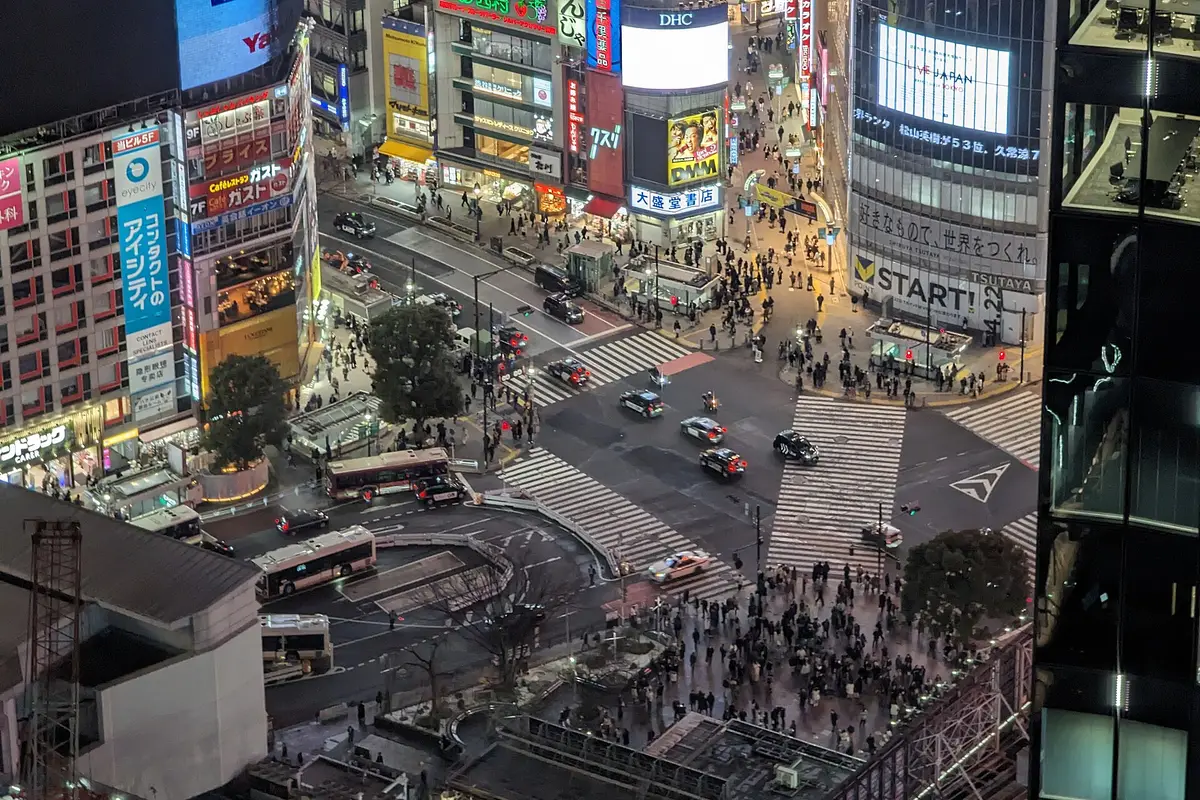
Stack the two gauges and the answer falls out. The disappointment is not really keyed to where you are from: a local will tell you it is "just a crossing" as readily as any tourist. It is keyed to a mismatch between the photo and the standpoint. The famous image is always shot from above: the surge, the pause, the surge again, a crowd breathing in and out like a tide. The thing most visitors actually do is the opposite: they walk into the middle of it at eye level, where you cannot see the pattern at all, only shoulders and phones. They go to be in the picture, and then wonder where the picture went.
So there are, in a sense, two Shibuya Crossings. There is the one at street level: genuinely just a busy intersection, the one that writes that big red bar. And there is the one from above: the world's most concentrated act of silent cooperation, where, in the words of Tokyo's own tourism office, everyone sets off together and yet they "seldom crash into each other." Come for the first and walk away; you will agree with the let-down camp. Watch the second for a few full cycles, and you join the people who never forget it. The single most reliable way to love the Shibuya Crossing is to get off the asphalt and look down on it.
What's actually there to see
The reward is a pattern, not a place, which is exactly why the people who go up keep out-loving the people who stay down. The full walk past Hachiko, Center-Gai and the quiet alleys is in the Shibuya guide just below; here is what turns a let-down into a highlight.
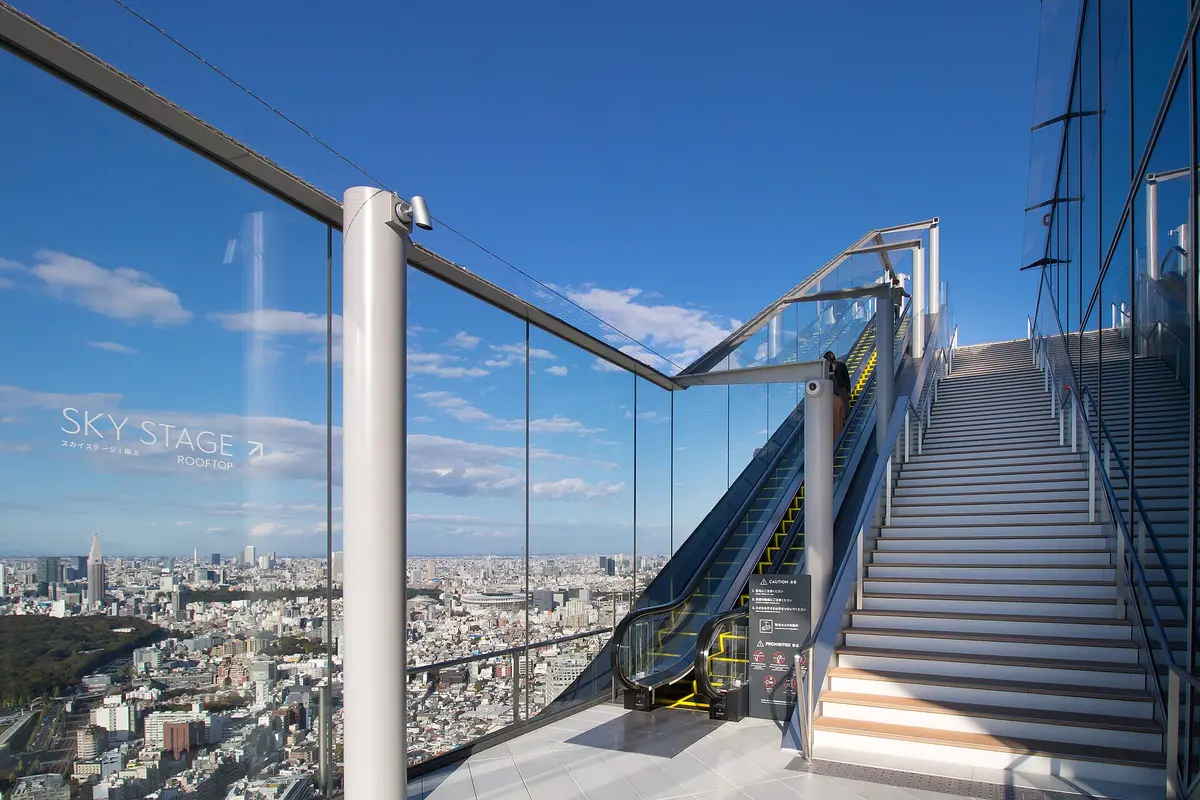
- The view from above is the headline, not the crossing itself. The grand way up is Shibuya Sky, the open-air rooftop deck 229 meters above the station, directly connected to it. From there the crossing is a small bright square far below, and you can finally see the thing you cannot see while you are in it: thousands of people dissolving into each other, wave after wave, without a snag.
- You do not have to pay for the height. Tokyo's tourism office points visitors to the café windows above the crossing and the nearby station walkway, where the same choreography plays for free. Travelers themselves keep recommending the second-floor café overlooking the scramble and the free upper floors of the buildings around it. A coffee buys you a window seat over the best free show in Tokyo.
- Give it two or three full cycles. What looks like chaos from the kerb only reveals itself as a tide if you watch it repeat. The wonder is the rhythm, and the rhythm takes a minute to appear.
- Come at night, and on a weekend, for the version locals love. The signs blaze, the energy peaks, and the crowd is at its most alive: the moment that turns "just a crosswalk" into "the Times Square of Japan," only busier and far more orderly.
- Then cross it once, on purpose. Walking through is genuinely fun for a couple of minutes. Just do it knowing the spectacle was the view, and the crossing is the souvenir.
Doing it well: the welcomed way
The crossing works because more than a thousand strangers extend each other a thousand tiny courtesies at once. You can be part of that, and the local voices are quietly clear about how.
- Don't stop in the middle. This is the one real friction the people who live here name: the photo-taker who plants themselves mid-crossing and breaks the flow. If you want a picture, take it on the move, or from the edge, or from above. "The crossing isn't the problem, neither is taking the picture," as one visitor put it. "Just don't block the road while you do it."
- Walk with the flow, and keep your line. Don't stare at the person coming toward you. Read the gap beside them, match the crowd's pace, and let the half-steps happen. It is the same unspoken sense that decides which side of the escalator you stand on, scaled up to a thousand people at once.
- Make way without being asked. In a crush this dense, the kindest thing (and the most Japanese) is to leave space, especially for anyone who needs more of it. The flow holds because people yield; be one of the people who yields.
- If it's too much, the cure is one street away. The side lanes behind Center-Gai empty out fast, and the quiet of Nonbei Yokocho is a two-minute walk from the loudest corner in the world.
- Check the rooftop before you bank on it. Shibuya Sky's open-air deck closes at short notice in wind or rain, and the sunset slots sell out first. Book ahead, and keep a free café window as your backup. There is no bad time to look down on Shibuya.
Why a crosswalk became a wonder
It helps to know what you are actually watching. When every light turns red at once, more than a thousand people step off the kerbs together (by the count of Japan's national tourism organization, as many as 2,500 of them) in the two minutes the signal allows. There is no officer in the middle waving them on. There is no system you can see. There is only a crowd, reading itself: each person not staring at the body coming toward them but at the gap beside it, matching pace, giving a half-step here and taking one there, a thousand silent negotiations settled in seconds.
That is the thing the photographs are really of, and the reason a plain intersection became one of the most filmed places on earth. It is the same quiet habit of reading the room and leaving space for others that runs underneath so much of daily life in Japan; only here it is compressed into forty seconds and made visible, thousands of times a day. The disappointed visitor stood inside it and saw a crosswalk. The local crosses it without a thought and calls it ordinary. Both are right. And both are missing the view from the window upstairs, where the ordinary turns, for a moment, into something close to a miracle.
So is it worth it? If you mean go stand in the intersection and expect to be amazed, no, and the forums will tell you so, loudly. But if you go up first, watch a few full cycles from above or over a coffee, come back at night, and then cross it once for the fun of it, you will have done exactly what the people who love it did. The Shibuya Crossing was never a monument to look at. It is a thing to watch happen.
Still deciding which famous places actually earn a slot on a short trip? Start with what actually matters in Japan. For the full walk (the loyal dog Hachiko, the view from above, Center-Gai and the quiet alleys beside the roar), the Shibuya audio guide is just below.
Sources
- GO TOKYO (Tokyo Convention & Visitors Bureau): Shibuya Scramble Crossing: "upwards of 1,000 people" crossing the multi-cornered intersection at a time; free; directly outside the Hachiko Exit.
- GO TOKYO: Explore Shibuya (walking route): the crossing as "essentially five separate crossings" where everyone sets off together and they "seldom crash into each other"; the café windows and station walkway as viewpoints.
- GO TOKYO: SHIBUYA SKY: open-air rooftop observation deck 229 meters above ground atop Shibuya Scramble Square; hours 10:00 to 22:30 (last admission 21:20); adult online tickets 2,700 / 3,400 yen; directly connected to the station.
- JNTO (Japan National Tourism Organization): Shibuya Crossing: 1,000 to 2,500 people crossing every two minutes at peak; pedestrians cross from all directions ("scramble"); the Hachiko Exit as the closest.
- SHIBUYA SKY (official site): the open-air rooftop, its weather closures, and timed-entry tickets, with sunset slots selling out first, which is why the site tells visitors to book ahead.
WMJS is written in Japan, in English, with AI help. We check every page, but English is not our first language. If a sentence reads oddly, tell us. One sentence is enough.
Thank you. A person reads every note.
How well do you know Japan?
Built from 635 public posts by Japanese people
Want to know more? Ask Japanese people
Have a follow-up question about this topic? We'll ask real Japanese people.
Voice Box →