
Ise Jingu — Why This Sacred Shrine Is Rebuilt From Scratch Every 20 Years
Ise Jingu
By Kei · Born and raised in JapanThe Meaning
Beside the most important building at Ise, there is an empty rectangle of white gravel. It is the same size as the shrine standing next to it, swept clean, fenced, and waiting. Twenty years from now, a new shrine will be raised on that empty ground, exactly as the old one was built, down to the joinery. The deity will be carried across in the dark. And the place where the shrine stands today will become, in turn, the empty rectangle, kept clean, kept ready, waiting for its own turn again.
This is the thing most worth understanding before you go. Ise Jingu, known simply as Jingu, is often described as the spiritual home of Japan and the head of its roughly eighty thousand shrines. You might expect, then, the oldest and grandest building you have ever seen. Instead you will find unpainted cypress, a thatched roof, and posts set straight into the earth, built in a style so plain it can take a moment to register that you are standing somewhere extraordinary. And the building itself is almost certainly young. Every twenty years, for some thirteen centuries, the main sanctuaries of Ise have been taken down and built completely new on the plot beside them, in the ceremony called Shikinen Sengu. The most recent was the 62nd, in 2013. The next, the 63rd, will move the deity to her new home in the autumn of 2033.
So the paradox at the center of Ise is this: it is one of the most revered places in the country, and the structure you bow before may be newer than the car you drove there in. It is sacred not because it is old, but because it is endlessly made new again. The Japanese have a word that gathers up this idea: tokowaka, "forever new," "ever-young." Stone temples elsewhere in the world try to defeat time by lasting. Ise does the opposite. It lets the wood return to the earth, and keeps the shrine alive by building it again, and again, handing the carpenters' craft to the next generation each time, so that nothing is ever truly old and nothing is ever truly lost.
The tradition says the deity of the Inner Shrine, Amaterasu-Omikami, was once worshipped within the imperial palace, and that a princess named Yamatohime-no-mikoto was sent to find her a permanent home. She traveled through many provinces, and when she came to the clear river at Ise she received word that the goddess wished to dwell here, by the water, forever. That was said to be around two thousand years ago. You do not have to take the story as history to feel what it asks of you. You are not visiting an old building. You are joining, for one morning, a line of people that has been walking to this river for a very, very long time.
What Happens When You're There
Step 1: Beginning at the Outer Shrine
By custom, an Ise pilgrimage begins not at the famous Inner Shrine but at the Outer Shrine, the Geku, formally Toyo'uke-daijingu. The shrine itself is gentle about this: there is no strict rule, it says, but the old way is to visit Geku first and Naiku after. There is a quiet logic to it. The deity enshrined here, Toyo'uke-no-Omikami, is honored as the provider of food and of the three foundations of daily life (clothing, food, and shelter), and for around fifteen hundred years she has prepared the sacred meals offered twice every day to the goddess of the Inner Shrine. You greet the one who sets the table before you greet the guest of honor.
Here you meet, for the first time, the architecture that defines Ise. There is no vermilion, no gold, no carved dragon. The sanctuary is shinmei-zukuri: bare cypress left its natural color, a roof of thatch, the gleam of plain wood. If your first reaction is "is this it?", you are in good company. Many first-time visitors, Japanese among them, expect something more dramatic and have to slow down before the building's restraint starts to speak. That restraint is the point, not a shortfall. This is the beauty of things left unadorned.
One small thing to know as you walk: at the Outer Shrine, people keep to the left side of the path. (At the Inner Shrine, as you will see, it is the right.) No one will scold you if you forget, but moving to the side, rather than straight up the middle, is itself a quiet form of respect, leaving the center of the path clear.
Step 2: Crossing the Uji Bridge
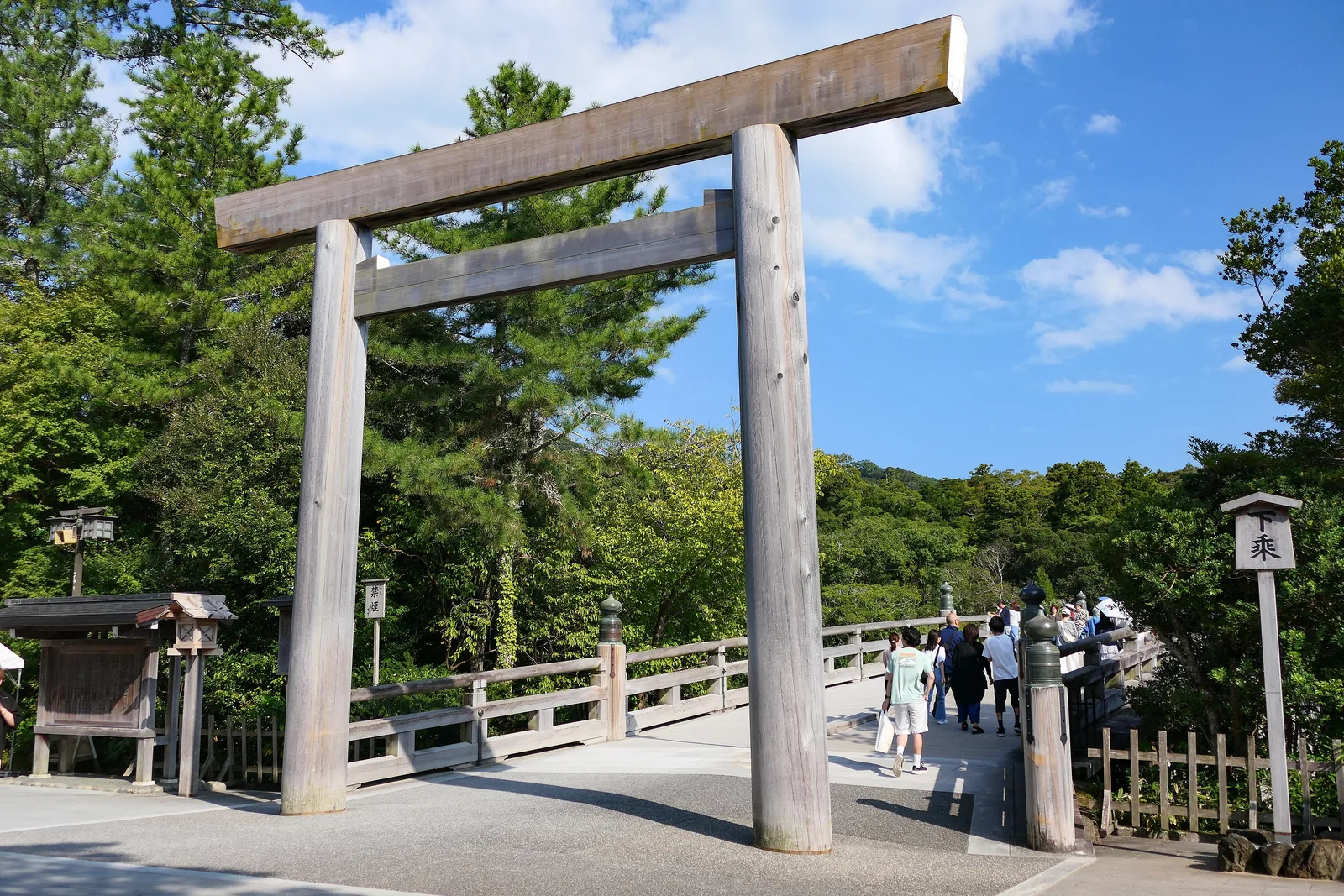
From the Outer Shrine, a bus carries you a few kilometers across the city to the Inner Shrine; the two are not within walking distance of each other, and the short ride is part of the day. Your visit to the Naiku begins at a bridge.
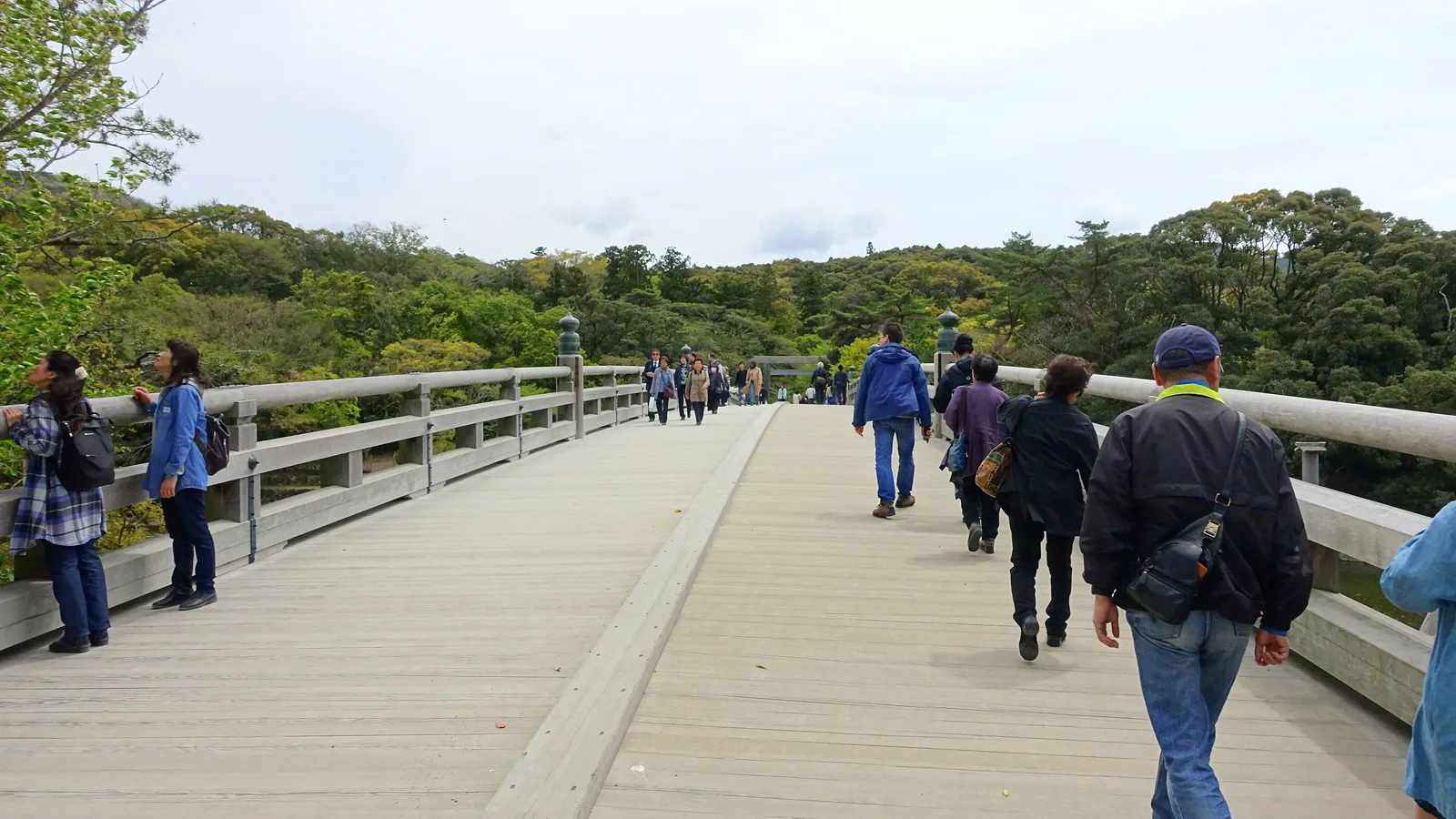
The Uji Bridge is a great arched span of cypress over the Isuzu River, just over a hundred meters long (101.8 meters, to be exact) with sixteen bronze caps along its railings and a tall wooden torii gate standing at each end, each one 7.44 meters high. It is said to mark the line between the everyday world and the sacred one. And like the shrine it leads to, the bridge is itself rebuilt for each Sengu, a few years ahead of the rest, so that pilgrims always cross on new wood.
Many people pause at the foot of the bridge and bow before stepping on. It is the kind of small gesture that Japanese people notice and quietly appreciate, a way of acknowledging that the path ahead is not an ordinary one. As you cross, keep to the right, the side that, here, leads you toward the river.
Step 3: The River and the Inner Shrine
Beyond the bridge, the path opens into a forest of old cedars, and partway along it bends down to the water. This is the Mitarashi, the purification place on the bank of the Isuzu River. At most shrines you rinse your hands at a stone basin; at Ise you may instead crouch at the river's edge and cleanse them in the clear, cold, running water, a small act people have performed here for centuries. The stone bank you kneel on is said to have been laid in 1692 as a gift from the mother of a shogun.
The path leads on to the shogu, the main sanctuary, raised at the top of a flight of stone steps behind a series of wooden fences. Here is the thing many visitors do not expect: you cannot go in, and you cannot really see the building. You bow at a gateway hung with a white silk curtain, and beyond it lies a courtyard you are not permitted to enter or photograph. What is enshrined within is Amaterasu-Omikami, honored as the ancestral deity of the imperial line; her sacred symbol, a mirror, is said to rest deep inside, unseen by anyone. The reverence at Ise has never been about looking at a holy object. It is about standing before a presence you take on trust.
The form of prayer is simple: a deep bow twice, two claps, one more deep bow, and if you would like the fuller picture of what Japanese people quietly notice about visitors at temples and shrines, we cover it on its own. One reassurance worth carrying up the steps: the main sanctuary is traditionally a place for gratitude rather than personal requests. If there is something you wish to ask for, there is a separate hall within the grounds, Aramatsuri-no-miya, set aside for exactly that.
Step 4: The Empty Ground Beside It
Step back from the sanctuary and look to the side, and you will see it: a second plot of ground the very same size, spread with white pebbles and empty. This is the heart of Ise, and the easiest part of it to walk straight past.
That empty ground is where the shrine stood twenty years ago, or where it will stand twenty years from now. The two plots, side by side, take turns. Every two decades the buildings, the bridge, the sacred treasures (714 kinds of them, more than fifteen hundred objects in all) are made again from nothing, by hand, using the same techniques, and the deity is moved across to the new shrine in a night ceremony. Then the old buildings come down, and the ground returns to gravel, and the waiting begins again.
It is fair to wonder why. Why not simply protect the old shrine and let it grow venerable, the way the rest of the world treats its monuments? The answer Ise offers is not written on any sign; you are left to arrive at it yourself, standing between the full plot and the empty one. The point was never to keep the building; it was to keep the knowing: the carpenter who learns the joints by cutting them, the weaver who learns the cloth by weaving it, passed living from one generation to the next, so the craft is never more than twenty years from being practiced again. Even the cypress is part of the plan: the shrine tends a forest of some 5,500 hectares and, a century ago, began planting the trees that the rebuildings two hundred years from now will use. Nothing here is meant to last forever. Everything here is meant to be renewable forever. That is tokowaka.
Step 5: The Town in Front of the Shrine
Cross back over the Uji Bridge, and the hush gives way to something warm and loud. The street just outside the Inner Shrine, Oharaimachi, runs downhill in old wooden storefronts and stone paving, and partway along it opens into Okage Yokocho, a lane of shops and food stalls. Here the air smells of grilled skewers and sweet bean paste, of Ise udon in its dark broth and of Akafuku, the soft red-bean rice cake people have bought near this shrine for three hundred years.
This is not a modern intrusion on a sacred place. In the Edo period, a journey to Ise was the trip of a lifetime: the dream was "to visit Ise, just once, before I die", and in some years a remarkable share of the whole country set out to do it. The towns along the way fed and sheltered these travelers, often for free, as their own offering of thanks. Worship and the warmth of the road were never separate things here. So when you finish at the shrine and step into the street for a hot skewer and a sweet, you are not leaving the pilgrimage. You are completing it the way it has always been completed.
You came to the plainest of shrines, where you could not see the building and were asked only to bow at a curtain by a river. And somehow that, and the empty plot waiting beside it, and the warm street outside, are the things you carry home. Thank you for walking with us.
Good to Know
The most important thing to know first: Ise Jingu is not one shrine but two main ones, in different parts of the city. The Outer Shrine (Geku) sits near Iseshi Station; the Inner Shrine (Naiku), the more famous of the two, is several kilometers away and reached by bus. By tradition you visit Geku first, then Naiku, but if your time is short, visiting only one is perfectly fine. You will not have done anything wrong.
Getting there: Most visitors arrive by Kintetsu Railway, roughly 90 minutes from Nagoya, about 1 hour 50 minutes from Osaka, and around 2 hours 30 minutes from Kyoto. Iseshi Station is served by both Kintetsu and JR; Ujiyamada and Isuzugawa stations are on the Kintetsu line only. Note that the nationwide JR Pass does not cover the Kintetsu line; if you are coming on a rail pass, it is worth checking a Kintetsu value ticket such as the Ise-Shima passes. Between the two shrines, the Sanco (Mie Kotsu) bus runs from Geku-mae to Naiku-mae for 520 yen (routes 51 and 55), taking roughly fifteen minutes. For the bigger picture of trains and passes, see getting around Japan. Last verified: 2026-06.
Hours and cost: Walking into either shrine is free: there is no admission gate and no ticket. The grounds open at 5:00 every morning. Closing time changes with the season: 17:00 from October to December, 18:00 in January through April and in September, and 19:00 from May to August. Hours can change over the New Year period. Last verified: 2026-06. For the exact times on your dates, check the official site below.
Time needed: Each shrine takes roughly an hour to walk at an unhurried pace. Allowing for the bus between them and time in Okage Yokocho, the full Geku-to-Naiku pilgrimage is comfortably a half-day to a full day. Many people enjoy it most without rushing.
When to visit: Early morning is the quiet, luminous Ise: the cedar forest in mist, the river bright, the paths nearly empty before the day-trippers arrive. The town street is busiest around midday. Crowds peak at the New Year; the shrine's most solemn festival, Kanname-sai, falls in October.
Photography: The bridge, the river, the forest, and the town are yours to photograph freely. The one firm line is the main sanctuary itself: photography is not permitted at the shogu, beyond a marked point near the steps, and a guard will gently remind you. A moment of awareness about where and whom you photograph is the kind of small courtesy locals notice.
Bring cash: Buses, offerings, and many of the older shops and stalls around the shrine are cash-friendly and not always card-friendly. A little cash in your pocket makes the day smoother.
Last verified: 2026-06
Official website: isejingu.or.jp/en
If Things Don't Go as Planned
You only have time for one shrine. That is genuinely okay. The custom is Geku first and then Naiku, but the shrine itself says there is no hard rule. If you must choose, the Inner Shrine (Naiku), with the river, the forest, and the bridge, is the one most visitors find unforgettable, and you can return for the other another year. A short, sincere visit is worth far more than a rushed attempt at everything.
The buildings look surprisingly plain: "is this really it?" Yes, and that reaction is so common that even Japanese first-timers feel it. Ise is deliberately the opposite of a gilded, ornate temple: unpainted cypress, a thatched roof, nothing for the eye to dazzle on. Once you know that the plainness is the whole idea (purity, and a building kept young by being made new every twenty years), the quiet starts to feel like the point rather than a letdown.
You were looking for an omikuji fortune slip and can't find one. You are not missing anything: Ise simply does not offer omikuji, and there is a kind word behind it: every day at Ise is considered a good day, so there is no need to draw your fortune. If drawing one is part of your trip, you will find them at countless other shrines along your travels.
You couldn't see the main hall, and felt slightly shut out. Everyone is: that is the design, not a snub. At Ise you bow at a curtained gate and the sanctuary stays hidden, as it has for centuries, even from most who serve there. What you are honoring is a presence held on faith. Many visitors find that standing before something they cannot see is the most quietly powerful part of the whole day.
The trip out felt long, and you're wondering if it was worth it. Ise rewards the unhurried far more than the rushed. If the journey from Kyoto or Osaka is eating your day, it is a place that genuinely repays an overnight stay: early morning at Naiku, before the crowds, is many people's favorite memory of Japan. If you can only manage a day trip, come early and let the forest and river, not a checklist, be the reason you came.
You didn't know to start at the Outer Shrine. Truly, don't worry, plenty of Japanese visitors don't know the Geku-first custom either, and the shrine is clear that it is a tradition rather than a requirement. Wherever you happen to begin, you are welcome, and you are doing it right enough.
Sources:
- Ise Jingu Official: About Jingu (English): The 125 shrines, the deities Amaterasu-Omikami and Toyo'uke-no-Omikami, the founding tradition of Yamatohime-no-mikoto
- Ise Jingu Official: The Thought of Shikinen Sengu / 式年遷宮の思想 (Japanese): The meaning of tokowaka, renewal of buildings and 714 kinds of sacred treasures, technique transmission
- Ise Jingu Official: The 63rd Shikinen Sengu (Japanese): The 20-year cycle, the 62nd Sengu in 2013, the first in 690, shinmei-zukuri
- Ise Jingu Official: Sengu Schedule / 遷宮予定年表 (Japanese): The 63rd Sengyo rite scheduled for autumn 2033
- Ise Jingu Official: Pray (English): Seasonal opening hours, the bow-clap-bow prayer form, photography prohibition at the sanctuary
- Ise Jingu Official: Etiquette and Manners / 参拝の作法とマナー (Japanese): Walking sides (Geku left, Naiku right), purification, prayer
- Ise Jingu Official: How to Tour Jingu / 神宮の回り方 (Japanese): The Geku-first custom of an Ise pilgrimage
- Ise Jingu Official: Uji Bridge and the Isuzu River (Japanese): Bridge length 101.8 m, the torii at each end, the Mitarashi purification spot
- Ise Jingu Official: The Eternal Forest / 永遠の森 (Japanese): The roughly 5,500-hectare shrine forest and its 200-year planting plan
- Ise Jingu Official: Access (English): Visit Geku first then Naiku, shrine addresses, the loop bus
- JNTO: Ise-jingu Shrine, Inner Shrine (Naiku): Official English visitor framing and practical information
- Ise City Tourism Association: Oharaimachi & Okage Yokocho (English): The approach town, access and hours
- Okage Yokocho Official (English): The town's history and the spirit of gratitude (shinon kansha)
Photos: sourced under free commercial-use licenses; see captions where attribution applies.
WMJS is written in Japan, in English, with AI help. We check every page, but English is not our first language. If a sentence reads oddly, tell us. One sentence is enough.
Thank you. A person reads every note.
Real voices
Is it worth it?
Were you there? Share your photos.
Your photo could appear in this guide — with your name and a link to your profile.
Submit a photoRelated Articles
Visiting Temples and Shrines: What Japanese People Notice

The Power of a Small Bow: Why a Simple Nod Makes Japanese People Smile
"Excuse Me, Can You Take My Photo?": What Japanese People Really Think
More guides in Kansai
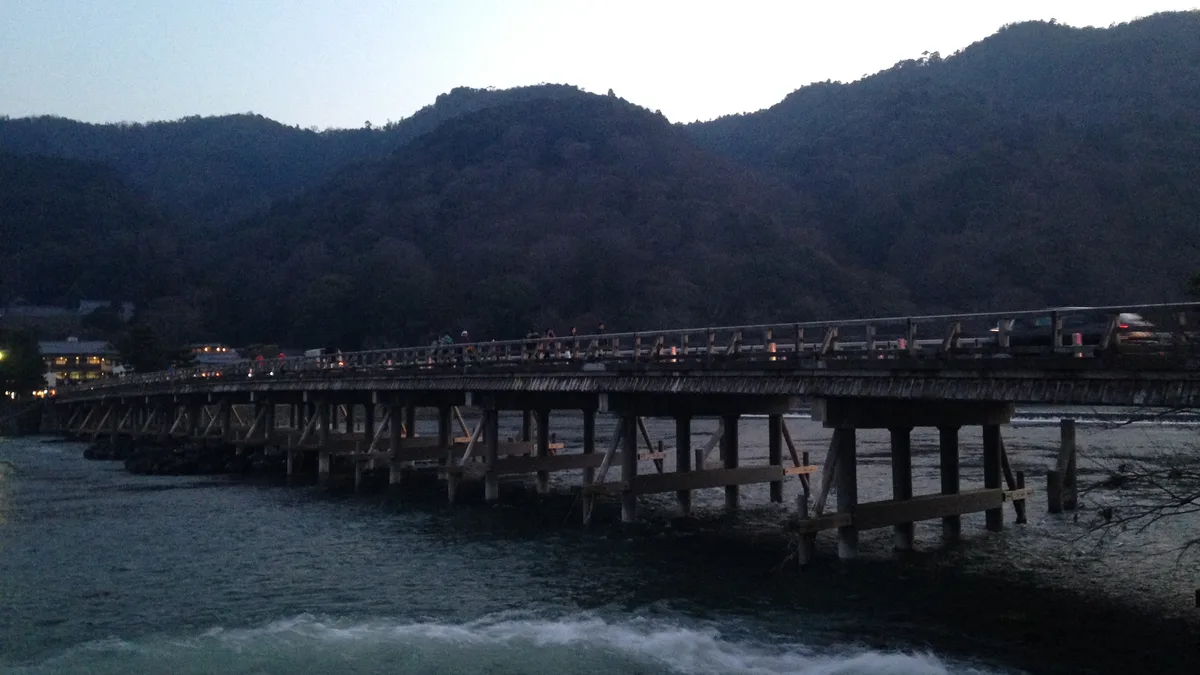
Arashiyama — Why Japan Lists This Bamboo Grove Among the Sounds Worth Saving
An audio cultural guide to Arashiyama in Kyoto, verified against official sources. Understand why Japan lists the bamboo of Sagano among the sounds it wants to keep, how the Moon-Crossing Bridge earned its name, and how to walk the river, the grove, and Tenryu-ji's borrowed-mountain garden away from the crowds.
Arashiyama
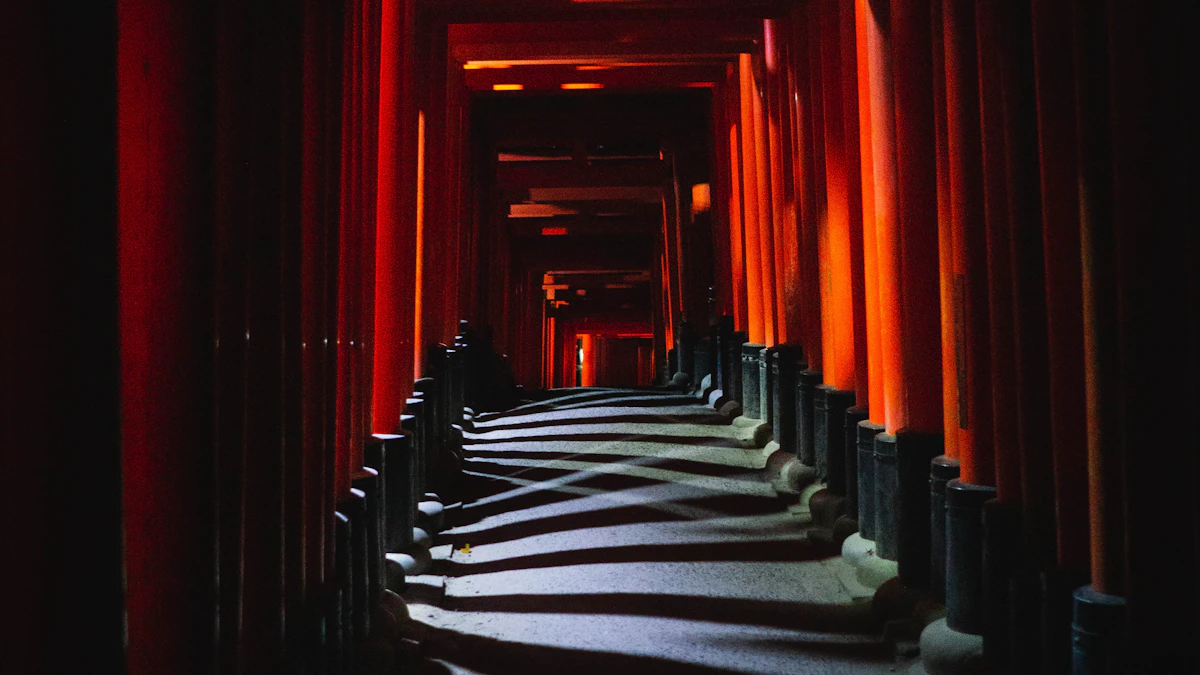
Fushimi Inari Taisha: Ten Thousand Gates, Each One a Thank-You
The ten thousand vermilion gates at Fushimi Inari are thank-you notes you can walk through. A cultural audio guide verified against official sources: why the foxes are messengers not gods, why the summit has no view, and how to walk past the crowds.
Fushimi Inari Taisha
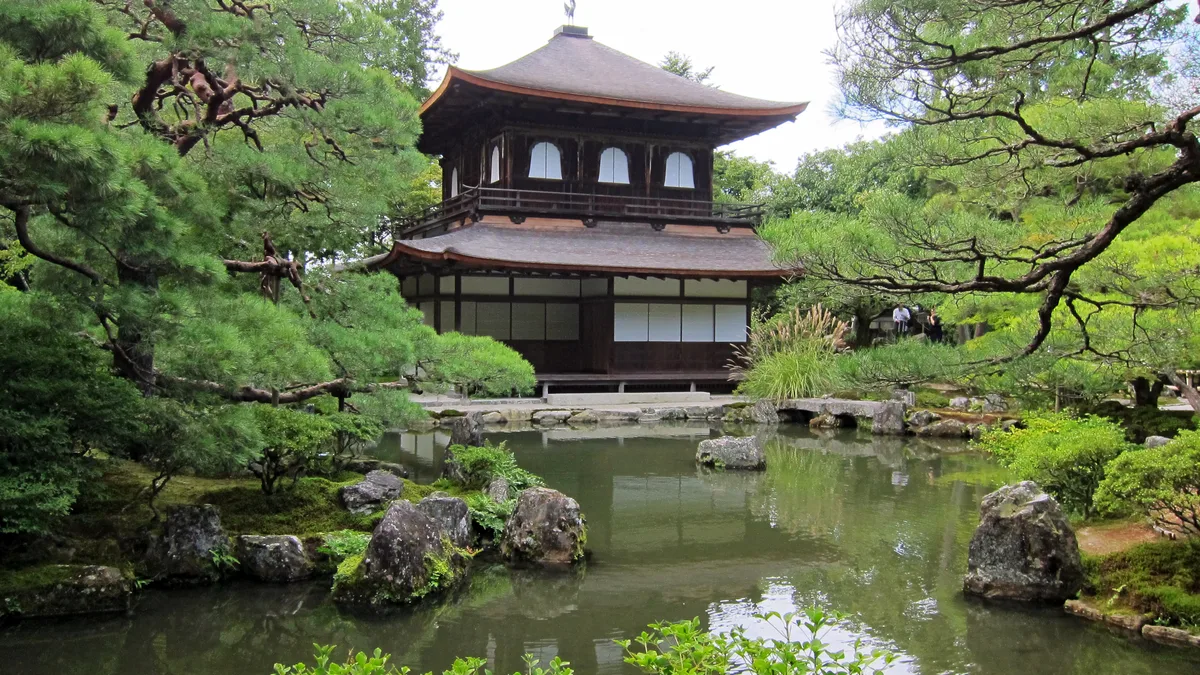
Ginkaku-ji — Why the Silver Pavilion Has No Silver, and Why Japan Finds That Beautiful
Why the Silver Pavilion has no silver — a free audio guide to Ginkaku-ji, Kyoto, verified against official temple sources. Higashiyama culture and the art of restraint, the sea of silver sand, hours, admission (1,000 yen), access from Kyoto Station, and the Philosopher's Path.
Ginkaku-ji (Jishō-ji)
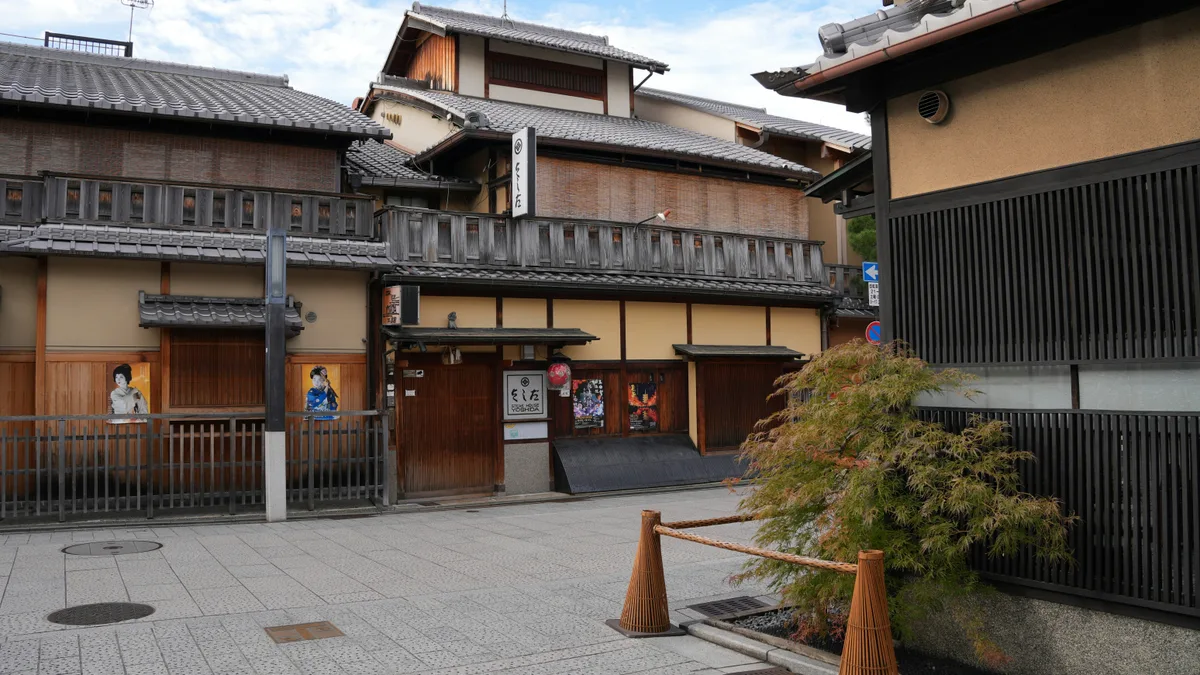
Gion — Walking Kyoto's Flower District, a Town That Is Still Lived In
An audio guide to Kyoto's Gion flower district: what geiko and maiko really are, the walk from Yasaka Shrine through Hanamikoji to the Shirakawa canal, when to go, and how to enjoy a town still lived in.
Gion