
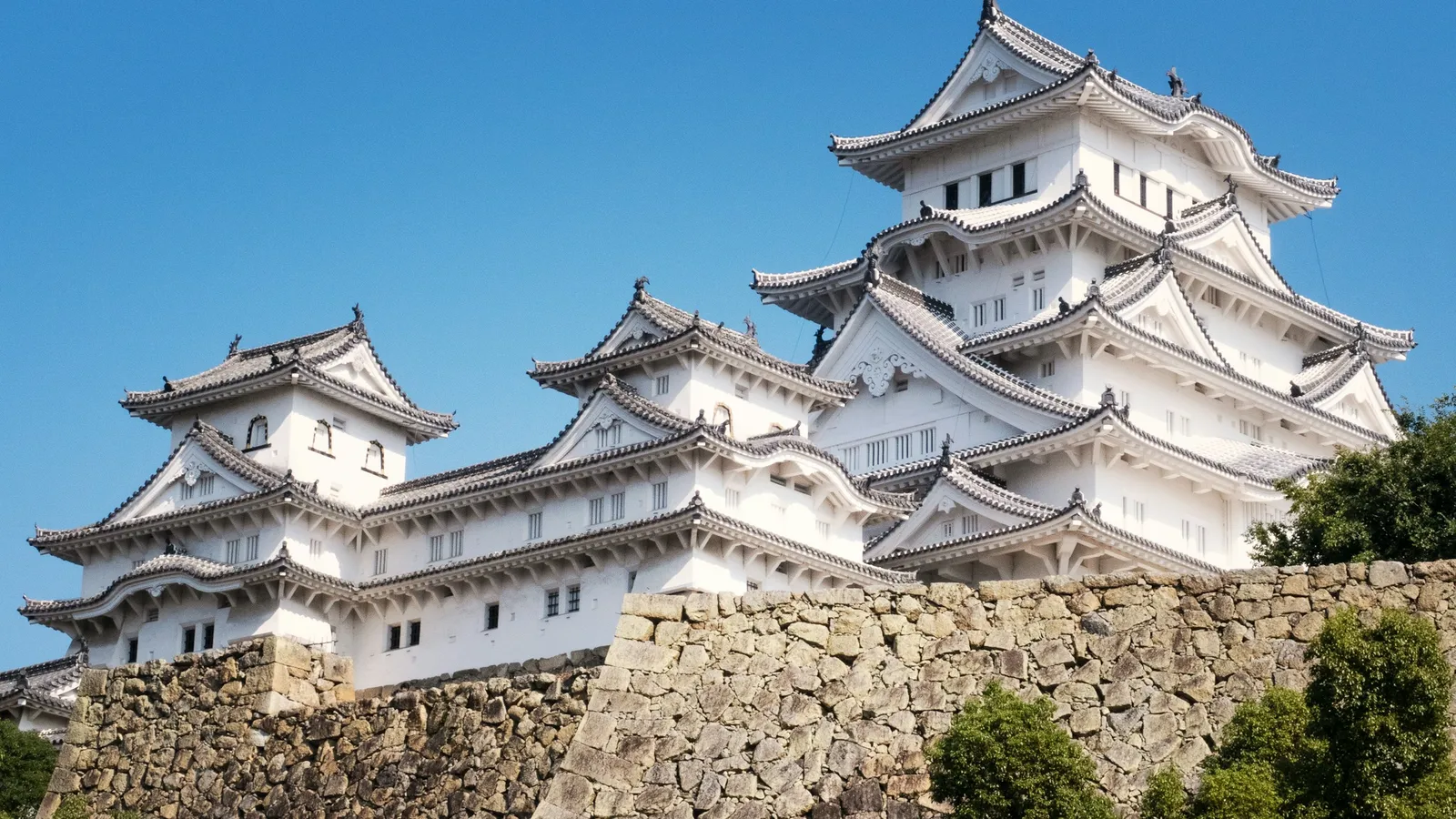
Visiting Himeji Castle, Japan's Finest Original Keep
Himeji Castle
By Kei · Born and raised in JapanIs Himeji Castle worth visiting? By the voices we gathered, yes: of 174 international voices, each counted once, 70% called it worth it, and Japanese reviewers rate the castle even more warmly. It is a real wooden keep finished in 1609, never rebuilt. Plan about 1.5 to 2 hours for the castle itself, ¥2,500 for adult admission, and a 15 to 20 minute walk from Himeji Station; arriving at 9:00 beats the worst queues. What those voices actually said, including the one letdown you can avoid, is further down this page.
The Meaning
Stand in front of most of Japan's famous castles and you are looking at concrete. Osaka, Nagoya, and dozens of others were rebuilt in steel and concrete in the twentieth century, after war and fire took the originals. They are faithful on the outside and modern within: elevators, glass display cases, smooth flat floors.
Himeji is not one of them. The white tower rising in front of you is wood. It is the same timber frame raised four hundred years ago, completed in 1609, never torn down and never rebuilt. Out of all the castles in Japan, only twelve still keep their original main keep standing; almost everything else a traveler calls "a castle" is a careful replica. Himeji is the most complete of those twelve (UNESCO calls it the finest surviving example of its kind), and all of it is real. Another of the twelve is its dark counterpart, the black-walled keep at Matsumoto, standing out on its plain.
That one fact quietly changes what you are walking toward. You are not visiting a model of a castle. You are about to climb the actual building.
And it is still standing by both luck and design. In its long history Himeji never fell in battle and never burned down, a rare thing for a Japanese castle. In 1945, bombing raids destroyed almost the whole city of Himeji around it, yet the castle escaped nearly untouched; by one well-known account a firebomb came through the top floor of the keep and failed to go off. When the smoke cleared, the white tower was still there, standing above the ash.
Here is the part the photographs never explain. The famous white, the color that earned the castle its name, Shirasagi-jo, the White Heron Castle, is not paint, and it is not there for looks. It is plaster: thick lime plaster sealing the whole building, coating the walls on both the inside and the outside, which the castle's own guide describes plainly as "not only fire resistant, but attractive." The white that makes it beautiful is the same white that helped it outlast the fires of four centuries.
So the way to understand Himeji is the reverse of how it looks. It was not built to be beautiful. It was built to survive: to shrug off fire, to break an attacking army, to outlast its enemies. The grace of it is what happened when people solved those hard problems as well as they could be solved. Keep that in mind as you walk in, and a fortress slowly turns back into a work of art in front of you.
What Happens When You're There
Step 1: The Approach
You will see the castle before you reach it. Walk out of the north exit of Himeji Station and it is already there, a white shape at the far end of a wide, straight avenue, Otemae-dori, about a kilometer ahead, growing as you walk. That head-on view down the avenue is deliberate. The castle was meant to be seen coming, and to be unmistakable about who was in charge of the plain it watched over.
The fifteen or twenty minutes it takes to walk there is worth doing on foot, because it lets the building grow on you the way it grew on everyone who ever approached it. By the time you cross into the grounds at the Sannomaru, the wide grassy outer bailey where the cherry trees stand, the keep fills the sky.
Stop here for a moment before you go in, because this is the easy part. From the Sannomaru, the white keep looks close enough to touch. It is not. Between you and it lies the thing the castle was really built to do, and you are about to walk straight through the middle of it.
Step 2: The Maze of Gates
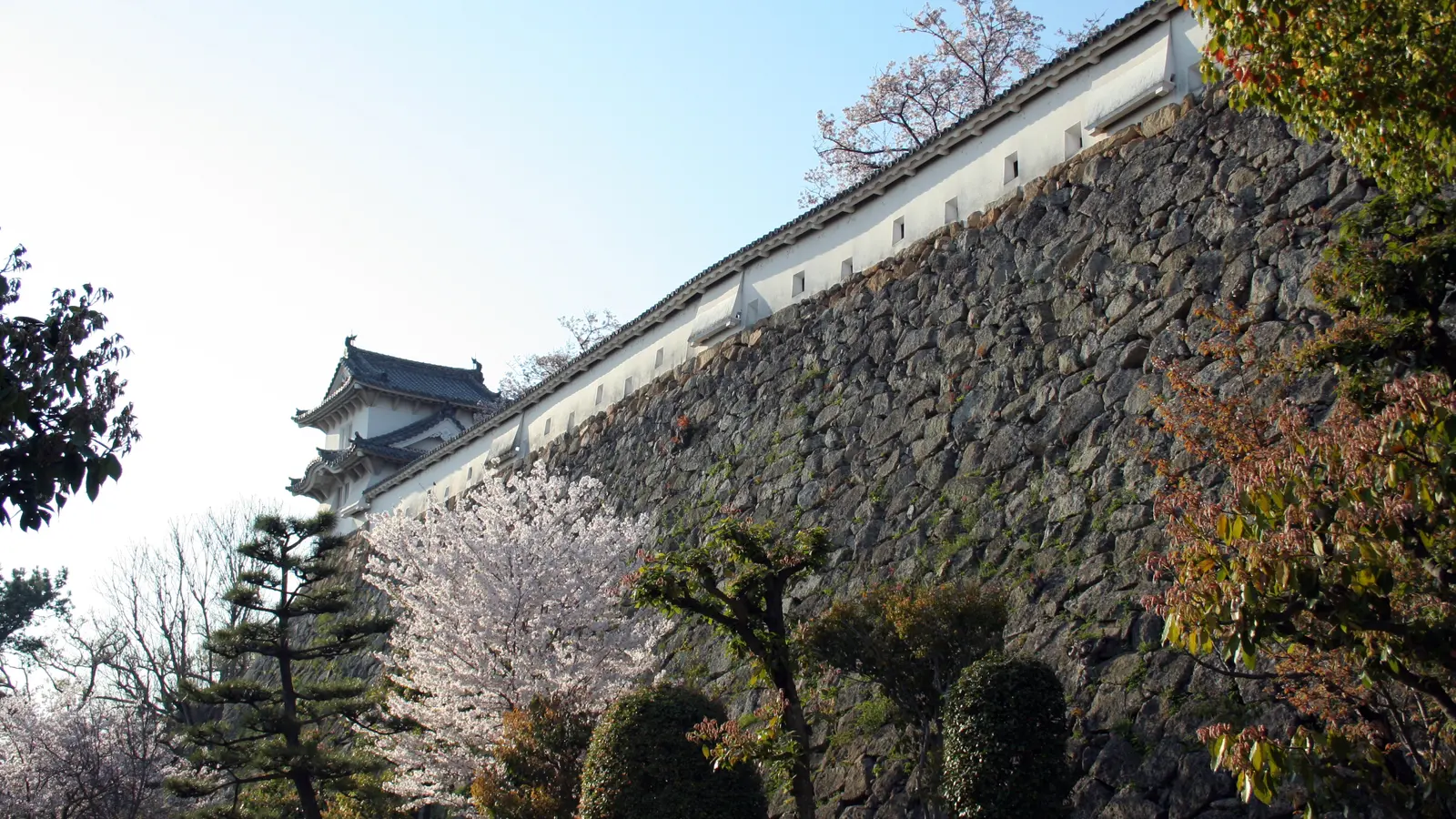
The path to the keep does not go in a straight line. It bends, climbs, doubles back, and passes through one gate after another, and the first feeling many visitors have is mild confusion: why am I being walked in circles?
That confusion is the design working exactly as intended. The route you are on was never meant to be a pleasant approach. Himeji's whole layout, its nawabari, the plan of its walls and gates, was drawn as a triple spiral curling to the left, a form so unusual that the city's records note its only real parallel is Edo Castle itself. An attacker who broke through the front gate would not find the keep ahead of them. They would find another wall, another turn, another narrow gate funneling them into a tight space, slowing them down, exposing them, while defenders watched from above. Some gates were built to vanish from view at an angle, so that a path seemed to dead-end where it secretly continued. You are walking, slowly and safely, through a machine that was designed to make sure no attacker ever could.
Look at the stone walls as you climb. The largest of them curve outward as they rise, gently at the bottom, steeply near the top: a shape the castle calls the "fan slope," made that way so that no one could scale the wall. And set somewhere among all that stone is a single famous one: a worn old millstone, said to have been given by a poor woman who sold rice cakes, when stone ran short during construction and she offered the one heavy thing she owned. The story goes that her gift shamed others into giving more. Four hundred years later the wall is still standing, and so, in a way, is she.
Step 3: The White Walls and the Loopholes
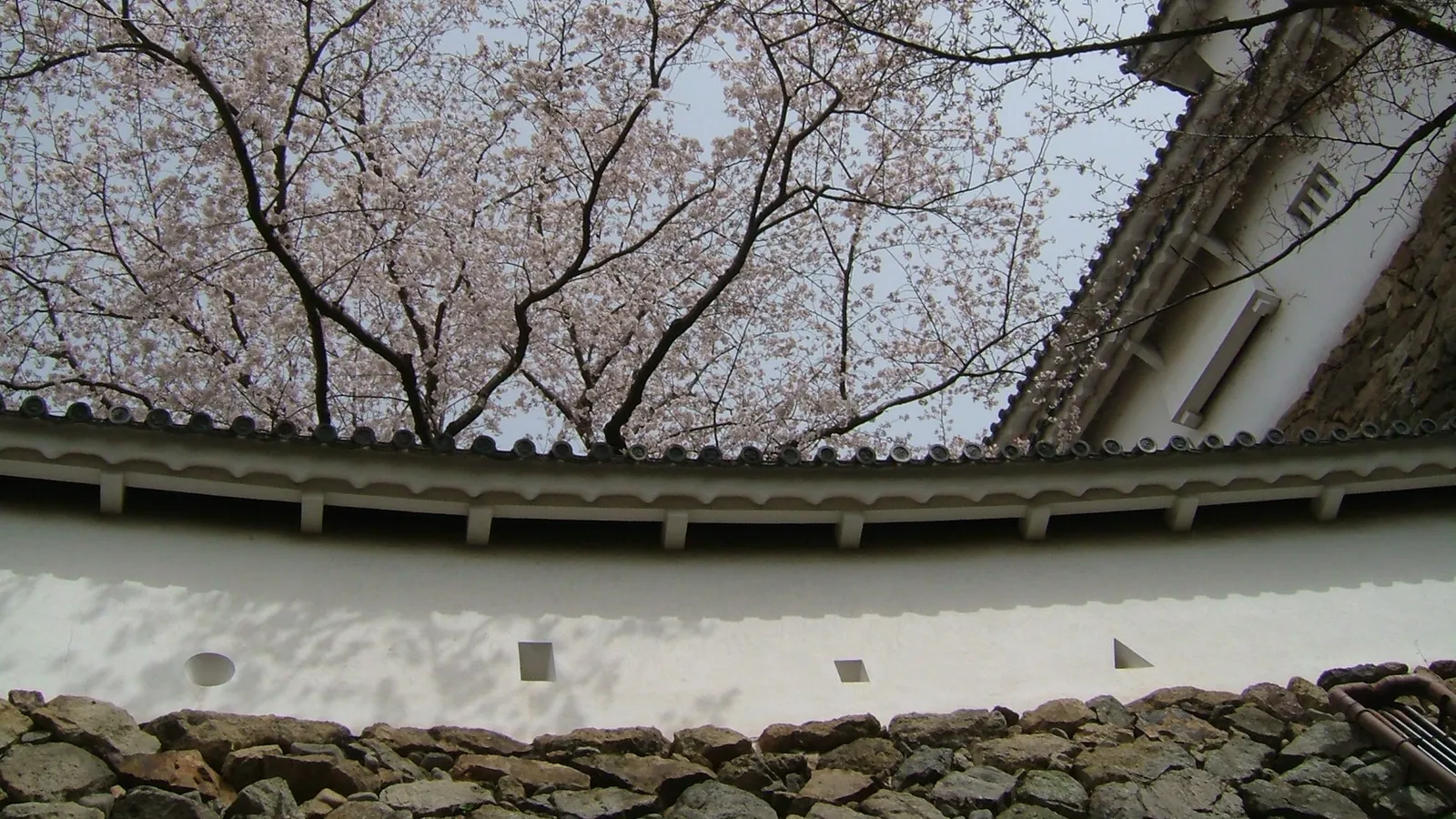
By now you are close enough to touch the white. Put your hand near it (not on the protected surfaces, but close) and you can see that it is not a smooth coat of paint but a deep, slightly uneven skin of plaster, rounded over every edge and corner. This is the White Heron up close: a building wrapped, like armor, in fireproofing.
Now look for the holes. Set into the white walls, at regular intervals, are small openings; some tall and narrow, some square, some round, some triangular. There are 997 of them across the castle. The tall, narrow slits were for archers; the smaller squares, circles, and triangles were for gunners; and they sit at three different heights so a defender could fire while standing, kneeling, or lying down. They look, from a distance, like a decorative pattern punched into the white. They are firing positions, each one aimed out at the very paths you just walked up.
This is the whole secret of Himeji standing in front of you at once. The beauty and the weapon are the same surface. The plaster that makes it glow is fireproofing; the pattern that decorates it is a field of gun slits; the elegant curve of the walls is there so no one could climb them. When you hear the castle praised as a masterpiece, when UNESCO calls it "a masterpiece of construction in wood, combining function with aesthetic appeal," this wall is what they mean. Nothing here is ornament for its own sake. It only looks that way because the people who built it were that good.
Step 4: Climbing the Keep
At the foot of the main keep, you take off your shoes. You will be handed a bag to carry them in, and you walk the rest of the way up in your socks, on bare wooden floors worn smooth by four hundred years of feet. It can feel strange the first time, but it is the same instinct that runs through the Japanese habit of removing shoes indoors: you are stepping onto something old and cared for, and you leave the street outside. The floor you are standing on is original. That is why you protect it.
Then you climb, and this is the honest part: it is hard. The stairs inside are steep and narrow, closer to ladders than to staircases in places, and they only get tighter as you go up. There are handrails, but no elevators and no air conditioning; on a summer day the keep is hot, and on a busy one the staircases back up with people. None of this is a flaw. The stairs were made steep on purpose, to slow an armored enemy; the building is a fortress that never pretended to be anything else. If your knees protest, you are in good company. Japanese visitors, schoolchildren, and grandparents all stop to catch their breath on the same steps.
And when you reach the top, you may be surprised by how empty it is. No furniture, no grand rooms, just timber, light, and the city far below. This catches a lot of people off guard, so it is worth knowing why: the lords of Himeji never lived up here. They lived in palaces and in the western bailey below. Princess Sen, granddaughter of the first shogun, kept her rooms along a long gallery there and had a small "powder turret" of her own to rest in. The great keep was never a home. At Kochi Castle, uniquely, that lived-in palace still stands beside the keep, the one place in Japan where you can walk straight from the lord's own rooms into the tower. It was the watchtower, the armory, the last place to fall back to if the castle were ever attacked. The emptiness is the truth of the building, left exactly as it was. At the very top sits a small shrine to the castle's guardian deity, and from beside it you can see the whole plain the White Heron has watched over since before your country was the shape it is now.
Step 5: Walking Back Down
Coming down the same steep stairs is its own small test. Many people find the descent harder on the knees than the climb, so take it slowly, and let the people behind you set their own pace.
As you walk back out through the gates, try the thought one more time. You have just done something no enemy in four hundred years ever managed: you walked all the way to the top of Himeji and back, freely, through every gate and up every stair, and you are leaving unharmed. The castle was built so that this exact journey could not be made by anyone who came in anger. It never had to prove it. It simply stood, through war, through fire, through the bombing of the city around it, and it is still standing, still white, the day you came to see it. You carry a little of that out with you, back down the long avenue toward the station.
What Visitors Honestly Say
Before you plan the trip, it helps to hear from the people who have already made it. We collected 174 voices from international travelers, most of whom had actually been, and counted each one once. This is how they fell:
The green band keeps returning to one idea: this castle is the genuine article. One frequent traveler called it "arguably the best castle in Japan. Absolutely worth the short trip from Osaka." The thin red band describes a single, avoidable mismatch. "The exterior is really nice, but inside it's quite bland," wrote a visitor who had expected a museum. The keep is bare on purpose, and knowing that before you climb is most of the cure.
Japanese visitors and locals, reviewing the same castle in their own words, land even more warmly:
What they treasure is the building's own body. One reviewer wrote, "touching the thick wooden beams that hold up the castle, I felt their energy." Their small red band is about the day of the visit rather than the building: crowds and queues, a closed day or a missed last entry, and one empty keep. The steep stairs come up mostly among those who loved the castle.
The full picture, the letdowns included and what prevents each one, is in Is Himeji Castle Worth It?
Good to Know
Look around
What you'll see when you get there
Out of the north exit of Himeji Station. The castle stands at the far end of Ōtemae-dōri, about 1.2 km ahead.
Street View shows one day. Crowds, construction and seasons change the scene.Open in Google Maps ↗
Hours. The castle is open daily from 9:00, with the gates closing at 17:00. The detail that catches people out: the last admission is 16:00, a full hour before closing, and the keep itself begins shutting its windows from about 16:30, so arriving in the late afternoon leaves you rushed. Hours can shift with the season. The castle is closed only on December 29 and 30. Last verified: 2026-06. Confirm current hours on the official site before you rely on them.
Admission. Adult admission is ¥2,500; visitors who are residents of Himeji City pay ¥1,000; children up to 18 enter free. A combined ticket with the adjacent Kokoen garden is ¥2,600. (The two-tier price was introduced in March 2026; if you are curious about why the rate differs for visitors and where the money goes, that is part of a larger story about how Japan is handling its surge in tourism.) Last verified: 2026-06.
Getting there. Himeji sits on the Sanyo Shinkansen line, which makes it an easy half-day trip from the Kansai cities. From Shin-Osaka it is roughly 30 minutes by Shinkansen; from Osaka about an hour on the JR Kobe Line rapid service; from Kobe (Sannomiya) about 40 minutes; from Kyoto around 40–45 minutes by Shinkansen. One thing to check: the fastest Nozomi trains do not always stop at Himeji, so confirm your train stops there, or take a Hikari, Sakura, or Kodama. From the station it is about a 15–20 minute walk straight up Otemae-dori, with the castle in view the whole way. (For passes, IC cards, and how the trains fit together, see getting around Japan.)
Climbing the keep. Inside the keep you must remove your shoes and carry them with you, so wear socks (the bare wooden floors are smooth and a little slippery), and pack light; both hands are useful on the steep stairs. There are no lockers inside and no elevators. Allow about 1.5 to 2 hours for the full visit, and up to an hour more of waiting at the keep entrance on the busiest days.
Crowds and the keep limit. To protect the building, the number of people allowed up into the main keep is capped at 1,000 per hour, so on peak days you may have to queue at the keep entrance even after entering the grounds. The grounds are calmest right at opening; cherry-blossom season (late March to early April), Golden Week, and autumn weekends are the most crowded. There is no reservation system for the keep; on busy days you simply join the queue at the entrance under that cap. Buying your admission ticket online in advance skips the ticket-counter line, but it does not reserve an entry time.
Best time to visit. Arrive at 9:00 if you can. The first hour is by far the calmest, and the morning light on the white plaster is the view the castle is famous for. The cherry blossoms around the Sannomaru are spectacular and, for that reason, the most crowded days of the year; you can enjoy the outer bailey's blossoms without a keep ticket if the queue is long.
Photography. Photography is allowed throughout the grounds. At the classic viewpoints (the Sannomaru lawn, the Nishinomaru bailey), everyone stops in the same spots, so step to one side before raising your camera so others can keep moving. (More on reading the room at popular photo spots.)
Kokoen garden. Right next to the castle is Kokoen, nine connected walled gardens laid out in 1992 on the site of former samurai residences. It is quiet, shaded, and a good place to rest your legs after the keep, and it is included in the ¥2,600 combined ticket.
Official website: himejicastle.jp/en
If Things Don't Go as Planned
The inside is empty and you expected rooms. This surprises almost everyone, so it helps to know in advance: the keep was a fortress and an armory, never a residence. The bareness is the building preserved exactly as it was. Once you know the lords lived in palaces below and the keep was the last line of defense, the empty floors become the most authentic thing about the place rather than a letdown.
The stairs are harder than you thought. They were built steep on purpose, to slow attackers. There is no shame in taking them slowly, resting on a landing, or turning back partway: the views from the middle floors are real views, and the building is just as much itself whether or not you reach the very top. The way down is often harder on the knees than the way up, so save a little energy for it.
The line for the keep is long. On busy days the 1,000-per-hour cap means a wait at the keep entrance. Arriving right at 9:00 is the single best fix. If the queue is still long, the grounds, the gates, the white walls, and the Nishinomaru bailey are all open and far less crowded. Much of what makes Himeji extraordinary is outside the keep.
It is hot, and there is no air conditioning. The keep is sealed timber with no cooling, and summer afternoons inside can be draining. Go early, carry water (a lidded bottle is fine inside), and don't push the climb in the worst of the midday heat.
You're worried about the climb's difficulty, or visiting with someone who can't manage stairs. The keep's stairs are genuinely steep and the building cannot be made step-free inside. But the grounds, the gardens, and the famous views of the exterior are the heart of the experience for many visitors, and all of that is enjoyable without climbing the keep at all. A visit that stops at the foot of the tower is still a real visit to Himeji.
You only have half a day. That is enough. The castle itself takes 1.5–2 hours; add Kokoen and the walk up Otemae-dori and you have a comfortable half-day trip from Osaka, Kobe, or Kyoto. There is no need to rush all of it in if your time is short: the keep is the thing to prioritize. If you have a full day in Hyogo, the inland castle pairs naturally with its coastal counterpart in the same prefecture, the open port city of Kobe, forty minutes away by train.
Sources:
- Himeji Castle Official Website: Guide & History: The white lime plaster as fireproofing ("not only fire resistant, but attractive"; "protect wooden structures against fire and seals them against wet rot"; walls plastered on both sides), the original wooden keep largely unchanged for four centuries, the castle escaping the 1945 bombing of Himeji
- Himeji Castle Official Website (English): Opening hours and 16:00 last admission, admission fees (¥2,500 adult / ¥1,000 Himeji resident / under-18 free / ¥2,600 combined with Kokoen), shoes-off rule and steep stairs ("no elevators… stairs are very steep and narrow"), no air conditioning, access from the stations and Kansai cities
- Himeji City: Himeji Castle Information: Hours and seasonal variation, the 1,000-per-hour keep capacity limit, shoe-carrying and indoor rules, station-to-castle walking time
- Himeji City: Scale of the Castle (規模): Keep height (31.5 m building on a 14.85 m stone base; ~92 m above sea level), five roofs / six floors above a basement, the connected-keep design, the triple left-turning spiral layout paralleled only by Edo Castle, the "never fought, never burned" castle
- Himeji City: Castle Guide (structures & defense): The winding defensive approach and funneling of attackers, hidden gates, the "fan slope" stone walls built to prevent climbing, the western bailey and Princess Sen's Hundred-Ken Corridor and powder turret
- Himeji City: History & Legends of Himeji Castle: Completion of the present castle in 1609 under Ikeda Terumasa, National Treasure designation (1931; redesignated 1951), the millstone given by the old rice-cake seller (Uba-ga-ishi)
- Japan Tourism Agency / MLIT: Loopholes (Sama) of Himeji Castle: The 997 loopholes; rectangular slits for archers and square, circular and triangular openings for gunners; firing positions at three heights
- UNESCO World Heritage Centre: Himeji-jo: 1993 inscription (criteria i and iv); "the finest surviving example of early 17th-century Japanese castle architecture… a masterpiece of construction in wood, combining function with aesthetic appeal"
- JNTO (Japan National Tourism Organization): Himeji Castle: Himeji as one of Japan's twelve remaining original castles, the White Heron nickname, the Otemae-dori approach, Kokoen garden (nine gardens, opened 1992)
- Is Himeji Castle Worth It? (WMJS): The two visitor-voice gauges reproduced in "What Visitors Honestly Say" (174 international voices, 70/21/9; 102 Japanese voices, 81/14/5) and the verbatim visitor quotations
Image credits: Hero and thumbnail by Svetlana Gumerova via Unsplash. The white wall and loopholes by Sakurai Midori (CC BY-SA 3.0) and the rising stone walls and turret by Corpse Reviver (CC BY-SA 3.0), both via Wikimedia Commons (cropped and resized).
WMJS is written in Japan, in English, with AI help. We check every page, but English is not our first language. If a sentence reads oddly, tell us. One sentence is enough.
Thank you. A person reads every note.
Real voices
Is it worth it?
Were you there? Share your photos.
Your photo could appear in this guide — with your name and a link to your profile.
Submit a photoRelated Articles


Getting Around Japan: The Tiny Things That Earn You a Nod

Why Removing Your Shoes Makes Japanese People Smile
More guides in Kansai
Arashiyama — Why Japan Lists This Bamboo Grove Among the Sounds Worth Saving
An audio cultural guide to Arashiyama in Kyoto, verified against official sources. Understand why Japan lists the bamboo of Sagano among the sounds it wants to keep, how the Moon-Crossing Bridge earned its name, and how to walk the river, the grove, and Tenryu-ji's borrowed-mountain garden away from the crowds.
Arashiyama
Fushimi Inari Taisha: Ten Thousand Gates, Each One a Thank-You
The ten thousand vermilion gates at Fushimi Inari are thank-you notes you can walk through. A cultural audio guide verified against official sources: why the foxes are messengers not gods, why the summit has no view, and how to walk past the crowds.
Fushimi Inari Taisha
Ginkaku-ji — Why the Silver Pavilion Has No Silver, and Why Japan Finds That Beautiful
Why the Silver Pavilion has no silver — a free audio guide to Ginkaku-ji, Kyoto, verified against official temple sources. Higashiyama culture and the art of restraint, the sea of silver sand, hours, admission (1,000 yen), access from Kyoto Station, and the Philosopher's Path.
Ginkaku-ji (Jishō-ji)
Gion — Walking Kyoto's Flower District, a Town That Is Still Lived In
An audio guide to Kyoto's Gion flower district: what geiko and maiko really are, the walk from Yasaka Shrine through Hanamikoji to the Shirakawa canal, when to go, and how to enjoy a town still lived in.
Gion