
Is Onomichi Worth It? A Day Out of Hiroshima, in Visitors' Words
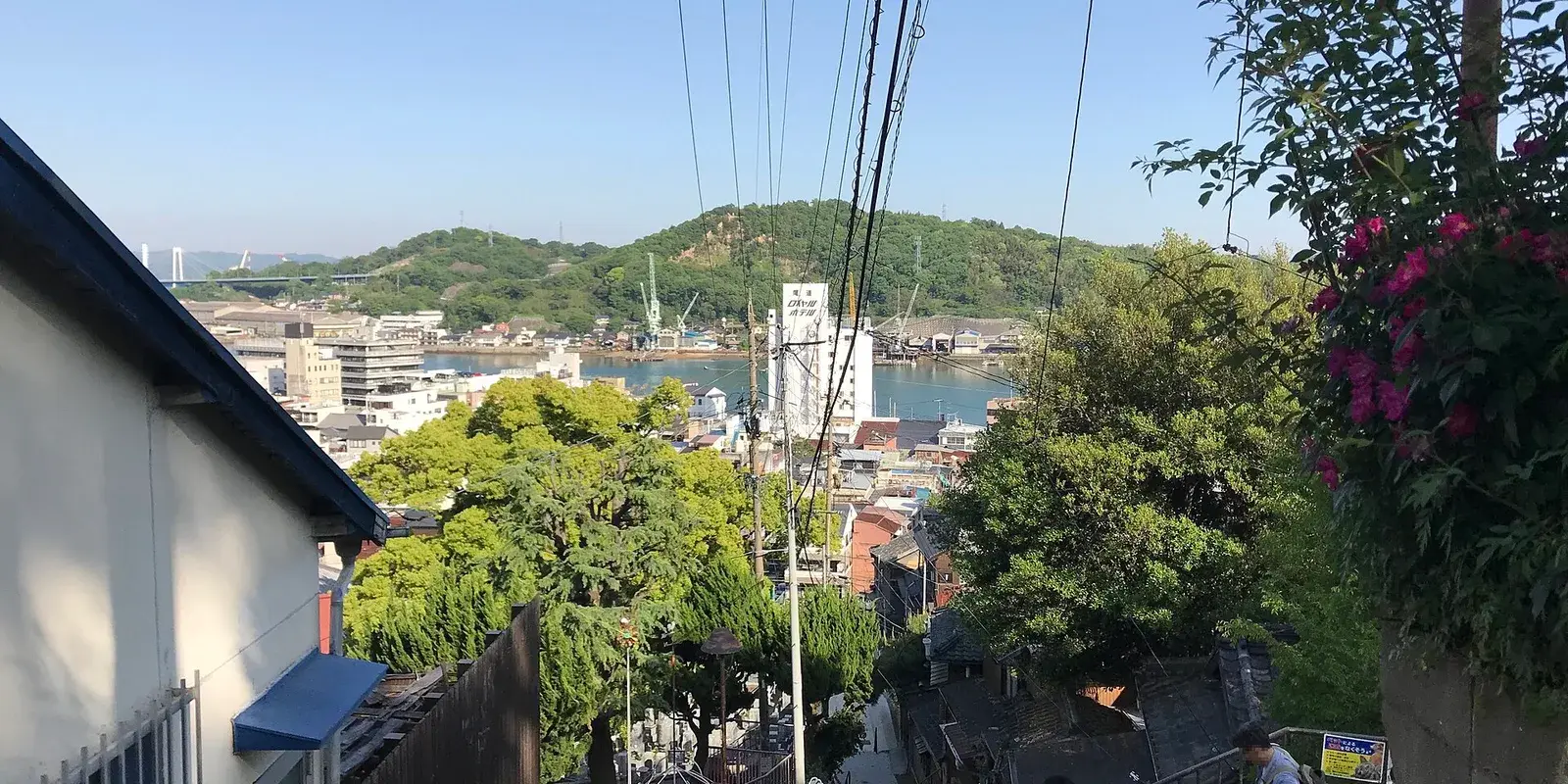
You have one spare day out of Hiroshima, and Onomichi is on the shortlist. Ask about it online and the answers come back in two versions that barely seem to describe the same town. In one, a hillside of temples and cats that a traveller with nineteen trips to Japan behind them calls their favourite place in the country. In the other, a quiet port where the covered shopping arcade is mostly empty and someone tells you kindly to give it a miss.
Both are first-hand accounts. Of the 71 international voices we collected, 53 land in the green band, and the doubt that does come up is nearly always the same one: whether there is enough here to fill a day. The two travellers who weighed the same day against Miyajima both chose Miyajima, and neither argued against the town.
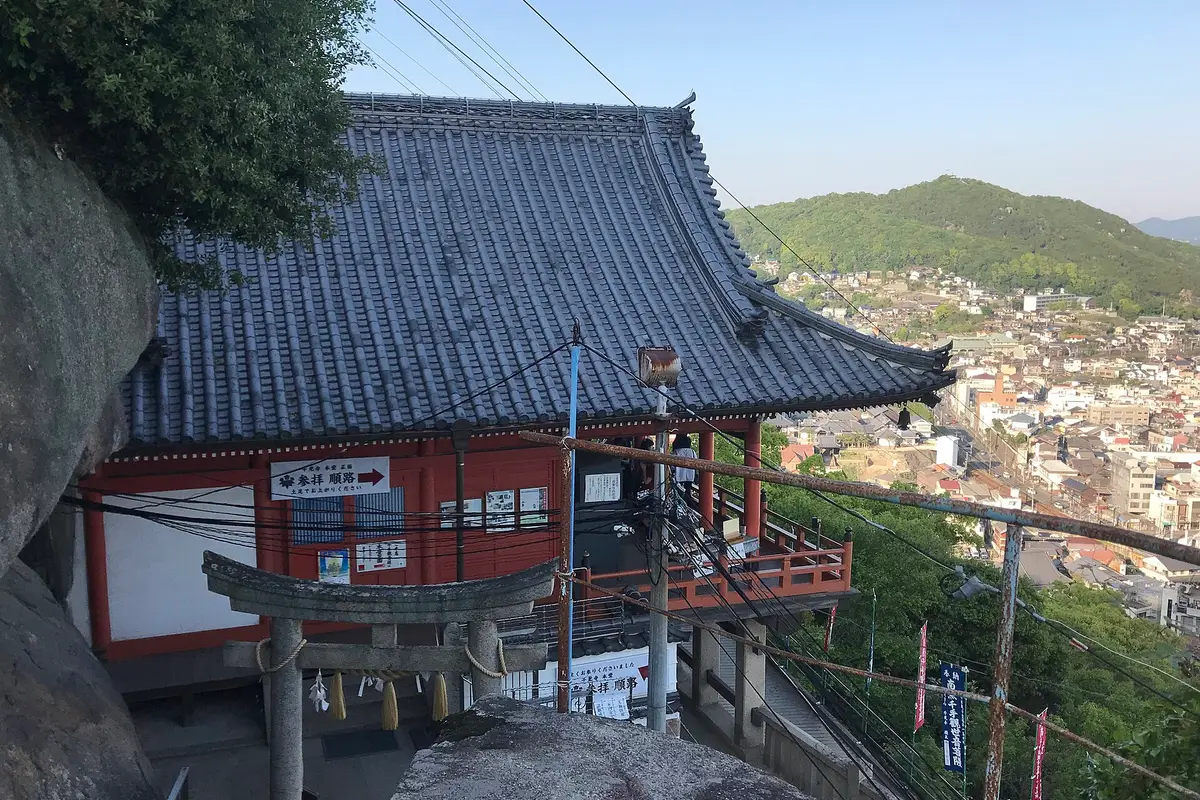
One thing is worth knowing before you buy anything. Senkoji, the temple you came to see, sits partway up the slope, below the ropeway's summit station, and the temple's own recommended route is to ride up on a one-way ticket and walk back down.
Is it worth the trip? (in visitors' own words)
We gathered the voices of international travellers writing about Onomichi from experience, on Reddit and Tripadvisor, and weighed each one by how strongly it resonated with other readers. Here is how they fell:
The traveller from the top of this page put it at the top of their list: "Onomichi is my FAVORITE place in Japan after 19 trips. It's like a 3D postcard of mid-century Japan." Another, comparing it with Kyoto and Nara, valued it because "its temples and shrines are more lived-in compared to the World Heritage tourist magnet locations of Kyoto and Nara." And a traveller who hauled a 20 kg suitcase up to their hotel added the practical part: "suck it up and take a taxi."
Onomichi against the alternatives
Two separate comparisons run through these voices. The first is Onomichi against Kurashiki and Iwakuni, the trio one long thread was built to settle. One reply put Onomichi at the top and sorted the rest by what kind of day you want:
Onomichi is the move here — the temple walk down the hillside is unlike anything in Kyoto, and the light off the Inland Sea is genuinely stunning.
The same reply dismissed the third: "Iwakuni is basically just the bridge photo and then you're done, I was there maybe 2 hours max." Another traveller who did all three agrees on the top slot. One voice names Kurashiki among several towns they find more interesting, and calls Onomichi "nice but very overrated."
The second comparison goes the other way. The two voices that weigh Onomichi against Miyajima as a choice for the same day both put Miyajima first, and neither argues against the town. One had been to Onomichi twice and loved it and still advised: "But I would recommend Miyajima instead for a day trip if your in Hiroshima anyway." Then they added: "And if you ever come to Japan again make sure to visit Onomichi!" The other simply ranks it lower: "Hiroshima and Miyajima and totally worth it. Onomichi is nice too, but behind those two." A separate voice, outside that comparison, calls Onomichi a love-it-or-hate-it place: they agree with one of the doubters below that it is an easy skip, and add that plenty of people love it anyway.
The eighteen who were not sold
The rest of the collection is less hostile than unconvinced. Eighteen voices sit outside the green band, six of them in the red, and thirteen of the eighteen are asking whether there is enough here to justify the trip. Not one of the thirteen complains about the hill.
A seventeen-day itinerary write-up contains one: "I wouldn't go to Onomichi, it's not awful but not really worth the detour. You think it's a colorful small town - it's actually quite industrial in some parts." Another had come specifically to start the cycling route: "I stayed there last year to do the Shimanami Kaido, and I'd say no. There's really not much there unless I missed something." One who found the town special anyway named the mismatch directly: "If you expect to “see something wow” then Onomichi just doesn't have it." Two describe the covered shopping arcade as mostly empty, one of them on a regular weekday.
The remaining five are different concerns: two about the climb and which way round to walk it, one about the clock, since the ropeway does not start until nine, one saying it depends on the kind of trip you are taking, and one that opens on a museum where the reviewer was told not to bother unless they were interested in Buddhism, before going on to rate the view and the side streets highly.
How the Japanese reviews read
Most of the Japanese reviews read as practical notes: which ticket, which direction, how many stairs.
The two collections were drawn from different places. One comes from threads asking whether a town is worth a day; the other from reviews written by people who had already gone. The bar heights are therefore two different measurements, and the gap between them is at least partly a difference in who sat down to write.
That shows in what each set argues about. The Japanese reviews barely raise the question of whether there is enough to see: one of the thirty outside the green band does, and even that reviewer gives the rest of the review to the ropeway: "The view is good but there are not that many highlights. There are a lot of slopes and stairs, so it is hard on small children and on anyone unsteady on their feet. But if you just ride the ropeway up and back, there is little to see."
Most of the grumbling is mechanical: which ticket to buy, which direction to walk, where to park, how many stairs, how hot it gets, where the signage runs out. Sixteen of the thirty are about that. Five are about atmosphere on the hill, three of them about the hard sell at the amulet stall and the recorded sutras, which two reviewers say made it hard to pray. One of those two ends by telling other people not to go, the only outright don't-go verdict in all 165 Japanese reviews. Against that, a visitor who came in full bloom was told at the amulet stall that the blossoms were out and good fortune was coming their way, and wondered whether a reviewer who had complained about the stall had met someone else entirely. The remaining nine are mostly description rather than verdict, several of them excerpts that break off mid-sentence; one came hoping for cherry blossom and did not find the picture they had imagined, and one is the access case in the wheelchair section below.
The ropeway ticket: one-way or return
The ticket is a real decision, and eleven Japanese reviewers stop to weigh it. The temple's own history page gives the reason.
Senkoji does not sit on top of the mountain. The temple places itself chūfuku, partway up the slope, and the ropeway's summit station is above it. One reviewer, who rode the ropeway both ways, put it in one line: "Senkoji is precisely the halfway point between the foot station and the summit station, so for anyone confident on their feet I would recommend visiting on foot." Ride up and buy a return, and you have to walk back up to the summit station to use the second half. One-way is 500 yen for an adult and 250 yen for a child; the return is 700 and 350. Two reviewers worked it out only after they had bought:
Since Senkoji is on the slope quite a way down from the ropeway's summit station, you have to walk back up again to catch the ropeway down, so I lost out by buying a round trip.
I bought a round-trip ticket, but on the way back I walked down slowly, so one half went unused. There are no refunds, so it pays to be careful when you buy.
Reviewers who checked first put it the other way round: "For the ropeway I recommend the one-way ticket, because even if you buy the return, climbing back up to the summit station after you have come down to Senkoji is hard work." Two of the eleven bought the return anyway because of their legs, one who was not confident on their feet and one with painful knees.
Walking down from the temple
Senkoji publishes a recommended route on its own website: a one-way ticket for the ride up, then down on foot, past the observation deck, the Path of Literature, the temple, the three-storey pagoda at Tenneiji and Cat Alley.
That is what most of the reviewers who mention the descent describe doing or recommend. Of the 165 Japanese reviews, 41 describe walking down themselves (26), recommend it (13), or report it as what most visitors do (2). Nine rode down or advise reversing the climb, and sixteen more walked only up.
One reviewer rested on a bench behind the main hall, which the temple dates to 1686 and describes as built in a stage style rare in this region, and was shown the townscape below by someone from the temple.
What the town is, and how long it takes to walk
Most of the doubt in the international collection is about a short list of things to see. The designation the town carries is built around density.
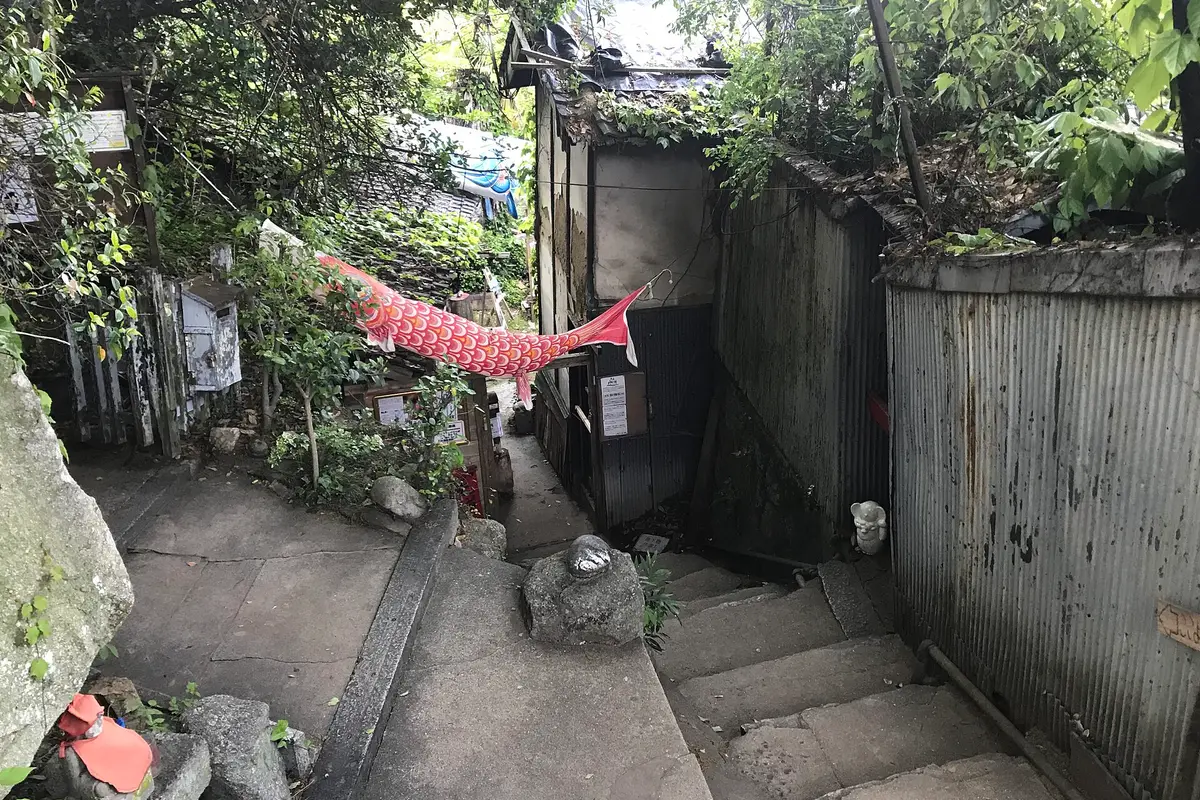
In fiscal 2015 the Agency for Cultural Affairs designated Onomichi under a title that translates roughly as "a miniature-garden city from the middle ages, woven by the Onomichi Channel": a medieval port squeezed between three hills and a strait so narrow it reads like a river, with 25 temples along about two kilometres of hillside and the houses pressing right down to the water. The official text quotes a fourteenth-century traveller who wrote that the houses stood so close together there was barely a garden big enough to dry a fishing net. Because the ground is so steep, some wells were built with two storeys, so that households above and below the lane could share the same water.
The walk through it is signposted and free. The old-temple route, the Kojimeguri, runs about two kilometres from Jikoji near the station east to Kairyuji, with stone waymarkers the whole way so you can wander without a map, and the city puts it at about three hours on foot. Several voices in the green band describe those streets and never mention an attraction at all.
The other reason people come: the Shimanami Kaido
Fifteen of the voices we gathered judge the cycling route without mentioning the town at all, and fourteen of those speak warmly of it; they sit outside the gauge because they are answering a different question. One voice that does sit inside the gauge answered the skip-it verdict head on:
You go to onimichi to cycle the world famous shimanami Kaido, not see onimichi. That was the highlight of our trip recent trip.
The Shimanami Kaido runs about 70 kilometres from Onomichi to Imabari across six islands of the Inland Sea, and according to the bridge operator it carries Japan's first cycling road built across a strait. Rental terminal No. 1 sits right by JR Onomichi Station, so you can step off the train and be on a bike within minutes. A cross or city bike is 3,000 yen a day for an adult and 1,000 for elementary-age and under; a power-assisted bike is 4,000 and an E-bike 8,000. A cross or city bike can be dropped at any of the ten terminals along the route for 1,000 yen, or 500 for elementary-age and under, which is what makes the one-way ride to Imabari practical. E-bikes and tandems have to come back the same day, and tandems to the terminal that lent them. Helmets come free, and riding after dark is not permitted.
Two riders who did the full run in a day put it at six and seven hours, and one of them wishes they had taken two days instead; others split it over two with a night on one of the islands. The Onomichi terminal opens 8:00 to 19:00 from March to November and 8:00 to 18:00 from December to February.
Before you go
- Budget about ninety minutes each way. Hiroshima Prefecture's tourism body puts Hiroshima to Onomichi at about 90 minutes on the Sanyo Main Line changing at Itozaki, about 60 to 90 minutes via the shinkansen to Fukuyama and a local train, or about 90 minutes by highway bus from Hiroshima Bus Center.
- Get off at the right station. Shin-Onomichi is the shinkansen stop and sits away from the town; Onomichi is the one you want. Onomichi City's access page, last updated in 2017, puts the gap at about 15 minutes by local bus (190 yen adult, 100 yen child) or about 10 minutes by taxi for around 1,000 yen, so check the current fare. From JR Onomichi the old-temple route begins a minute away, the cycle terminal is beside the station, and the ropeway is a three-minute bus ride.
- Buy the one-way ticket up and walk down. It is what Senkoji's own recommended route advises, and what most of the Japanese reviewers who mention the descent describe doing.
- If stairs are the problem, ride back down too. Nine of the 165 rode down or advise reversing the climb. Their reasons vary, and four name the physical part: narrow steps, tired legs, painful knees, and simply not feeling confident on their feet. Reviewers who walk it disagree on how hard it is; several call it an easy stroll downhill, and one warns the stone steps are uneven and slippery where sand gathers.
- How long people actually spend. The city offers three routes for a two-or-three-hour visit and puts a time on only one, the temple walk, at about three hours. One traveller who spent a full day wandering calls a two-hour plan "insanely tight"; a Japanese reviewer with two hours before check-in rode up one way, walked down past Senkoji, and came away saying the view was superb.
- The ropeway runs 9:00 to 17:15, and closes each December for its annual inspection. Cars leave every 15 minutes, with extensions announced for cherry-blossom season and festival days, and the notice dated 4 August 2026 sets this year's shutdown at 7 to 25 December. The mountain stays open through it: the operator puts the walk at about 30 minutes each way, and the PEAK observation deck is open around the clock, though the lift inside it runs only 9:00 to 17:15.
- Come by train if you can. Onomichi City asks visitors to use public transport, since the centre is a narrow strip between the channel and the slope and the lanes cannot be driven anyway. Senkoji Park's car park charges 800 yen (1,000 on weekends and holidays) and fills up in season; one reviewer queued an hour and a half during full bloom and watched other cars turn around.
- Dress for stairs, and pick your season. Parts of the walk are stone steps and steep slopes, and reviewers warn they are slippery in the wet (what to wear in Japan). One found the cats hiding from the heat; another went in September and wanted to come back in a cooler season.
- Onomichi ramen is the one food name that recurs. Seven of the 71 international voices mention it. The local style, as the Onomichi Tourism Association describes it, is a broth taken from seafood with plenty of pork back fat floating on top, and flat, medium-thin noodles.
Getting up the hill with a wheelchair
Here is what the official pages cover, and what they do not. The ropeway operator says both station platforms have a wheelchair lift on the Kamome car side, and that you can board without leaving the chair up to a combined 180 kg; its fare page gives a half-price fare for a disability-certificate holder and one carer.
Reviewers fill in a little more. One writes that the observation deck at the summit, in Senkoji Park, is barrier-free and well designed, and another that an elevator reaches it once you are off the ropeway.
Below the summit it gets harder. The way down to the temple is the Path of Literature, slope and stone steps; nothing we found describes it in wheelchair terms, and one reviewer suggests a stick for anyone unsteady on their feet. One review describes the approach from below rather than that path: a couple who could not get up the steep slope to the temple with a wheelchair.
The honest read
Onomichi is a walk, and the walk is what the reviews are about. Fifty-three of the seventy-one international voices land in the green band, and the ones who say why keep coming back to the temple walk, with the lived-in temples and the light off the Inland Sea among the reasons given.
All six red-bar voices are versions of the same question. Three say the list of things to see is short, one came away simply disappointed, one had pictured a colourful small town and found industry in parts of it, and one thought the towns nearby were more interesting. If a checklist of sights is what makes a day feel spent, those six are describing your trip.
Senkoji's own route advises the one-way ticket, and most of the reviews that mention the descent describe doing the same thing: walking down.
Weighing which famous places earn a slot on a short trip is the whole job of these pages. What actually matters in Japan is where they begin, and the closest neighbours to this decision are the other Setouchi day-trip calls travellers argue over: Is Miyajima Worth It? and Is Naoshima Worth It?
Sources
- Onomichi City, Senkoji Park (official tourism information). 24-hour park access, PEAK observation deck lift hours, car park charges (written without thousand-separators: 800 yen weekdays, 1000 yen weekends and holidays), and the bus link from JR Onomichi to the ropeway.
- Onomichi City, how to see Onomichi in two or three hours (official). The three-hour temple route around 25 temples, and the city's caution about steep slopes and stone paving.
- Hiroshima Prefecture tourism federation, Dive! Hiroshima: getting to Onomichi (official). Journey times from Hiroshima Station by local line and by shinkansen-plus-local, and from Hiroshima Bus Center.
- Onomichi City, access from Shin-Onomichi to JR Onomichi Station (official). Bus and taxi times and fares between the shinkansen station and the town (written without thousand-separators: bus about 190 yen adult, 100 yen child; taxi about 1000 yen).
- Senkoji Temple, official site (Access block). The two nearest stations, Shin-Onomichi on the shinkansen and Onomichi on the local line.
- Onomichi City, please tour the town centre by public transport (official). The narrow strip between channel and slope, the limited parking, and the town centre being walked rather than driven.
- Mt. Senkoji Ropeway, fares (official). One-way and return fares for adults and children (written without thousand-separators: one-way 500 yen adult, 250 yen child; return 700 yen adult, 350 yen child), and the half-price fare for disability-certificate holders and one carer.
- Mt. Senkoji Ropeway, equipment (official). The wheelchair lift on both station platforms, Kamome car side, boarding without leaving the chair up to a combined 180 kg.
- Mt. Senkoji Ropeway, operating hours (official). Service from 9:00 to 17:15, departures every 15 minutes, extended hours for cherry-blossom season and festival days.
- Mt. Senkoji Ropeway, notice of suspension for annual inspection, 4 August 2026 (official). 7 to 25 December 2026 closure, annual December inspection, walking times, PEAK open 24 hours.
- Senkoji Temple, history (official). The temple's mid-slope position, founding in 806, and the 1686 stage-style main hall described as rare in this region.
- Senkoji Temple, recommended visiting route (official). The temple's own advice to ride up on a one-way ticket and walk down; the Path of Literature from the summit to the temple; Tenneiji's pagoda and Cat Alley on the way.
- Onomichi Tourism Association, Kojimeguri old-temple route (official). Route length, walking time, endpoints, stone waymarkers, free access.
- Agency for Cultural Affairs, Japan Heritage Story #014 "A Miniature-Garden City from the Middle Ages, Woven by the Onomichi Channel". 25 temples along about two kilometres, the medieval port, the two-storey wells, the fourteenth-century travel account.
- Onomichi City, Japan Heritage designation and cultural properties (official). Fiscal 2015 designation of "A Miniature-Garden City from the Middle Ages, Woven by the Onomichi Channel".
- Shimanami Japan, rental cycle charges (official). Daily rates by bicycle type and age band (written without thousand-separators: cross/city bike 3000 yen adult, 1000 yen elementary-age and under; power-assisted 4000 yen; E-bike 8000 yen), the cross and city bike drop-off fee (1000 yen, or 500 yen elementary-age and under), tandem and E-bike return rules, helmet policy, night-riding rule.
- Shimanami Japan, terminal information (official). Ten terminals, Onomichi Station terminal location and seasonal hours (8:00 to 19:00 March to November, 8:00 to 18:00 December to February).
- Honshu-Shikoku Bridge Expressway Company, Shimanami Kaido press release. Route length of about 70 km, six islands, Japan's first cycling road across a strait.
- Government of Japan, Highlighting Japan, "Onomichi Ramen" (Cabinet Office public relations). The Onomichi Tourism Association on the seafood broth, pork back fat and flat, medium-thin noodles.
WMJS is written in Japan, in English, with AI help. We check every page, but English is not our first language. If a sentence reads oddly, tell us. One sentence is enough.
Thank you. A person reads every note.
How well do you know Japan?
Based on 51,218+ real Japanese voices
Want to know more? Ask Japanese people
Have a follow-up question about this topic? We'll ask real Japanese people.
Voice Box →