Okinawa — Why It Feels Like Another Country (Because, for 450 Years, It Was One)
Okinawa
By Kei · Born and raised in JapanThe Meaning
Right now, on a hill above the city of Naha, a wooden palace is being rebuilt board by board. Its name is Shuri Castle, and if you stand at the viewing deck the park has built for exactly this moment, you can watch carpenters fit the timbers of its great hall back into place. The roof is going on. The red lacquer is returning. This is not the first time the building has had to rise from nothing. It was destroyed in the war in 1945 and rebuilt, and then, on the last night of October 2019, its main hall burned again. What you are watching is a castle in the middle of coming back.
A traveler's first feeling in Okinawa is often a gentle confusion: this is Japan, and somehow it isn't. The light is harder and brighter. The roofs carry pottery lions. There is a stringed instrument on the music that is not quite the one you heard on the mainland, and a noodle called soba that turns out to be nothing like the soba you ate in Tokyo. Even Japanese travelers from the mainland feel it. They are not imagining things, and neither are you.
The reason is written into the castle on the hill. For about 450 years, from 1429, when a king named Shō Hashi united the island, until 1879, when it became a prefecture of Japan, Okinawa was not a part of Japan at all. It was the Ryukyu Kingdom, an independent country with its own king, its own court, and its own diplomats. From this small chain of islands, Ryukyu traded with China, Korea, mainland Japan, and the kingdoms of Southeast Asia, and grew wealthy as the place where all those routes met. A great bronze bell cast for the castle in 1458 carried an inscription that called the kingdom a bridge between myriad nations.
So when Okinawa feels like a different country, it is not a tropical illusion sold to tourists but the memory of a country that genuinely existed, still living in the things a kingdom leaves behind: a language, a cuisine, a kind of music, and a red palace that the people here have now chosen to rebuild for the third time. The "difference" you are about to feel everywhere is not decoration. It is history, doing what history does: staying. You are not visiting Japan's tropical resort. You are a guest in a place that was, for four and a half centuries, somewhere else entirely.
What Happens When You're There
Step 1: Landing in Another Japan
You will feel it before you have left the airport. Okinawa is the only part of Japan with a subtropical climate, and the air that meets you off the plane is warmer, wetter, and brighter than anywhere on the mainland. Naha sits roughly 1,600 kilometres south of Tokyo, about two and a half hours by air. Out on the street, the rooftops carry shisa: paired guardian lions, half dog and half lion, one with its mouth open to drive off harm and one with its mouth shut to keep good fortune in.
Then there is the writing. Among the ordinary Japanese signs you will catch words that look almost like Japanese and sound nothing like it: fragments of Uchinaaguchi, the Ryukyuan language of these islands. It is related to mainland Japanese the way distant cousins are related, and so different that the two cannot simply be understood across. If a place name leaves you completely lost, take comfort: a visitor from Tokyo standing beside you is often just as lost, and you do not need to speak Japanese to be looked after kindly here. The disorientation is not a sign that you have come unprepared. It is the first, faint edge of the kingdom: the moment you realize the rules you learned in Kyoto do not entirely apply.
Step 2: The Castle That Keeps Rising
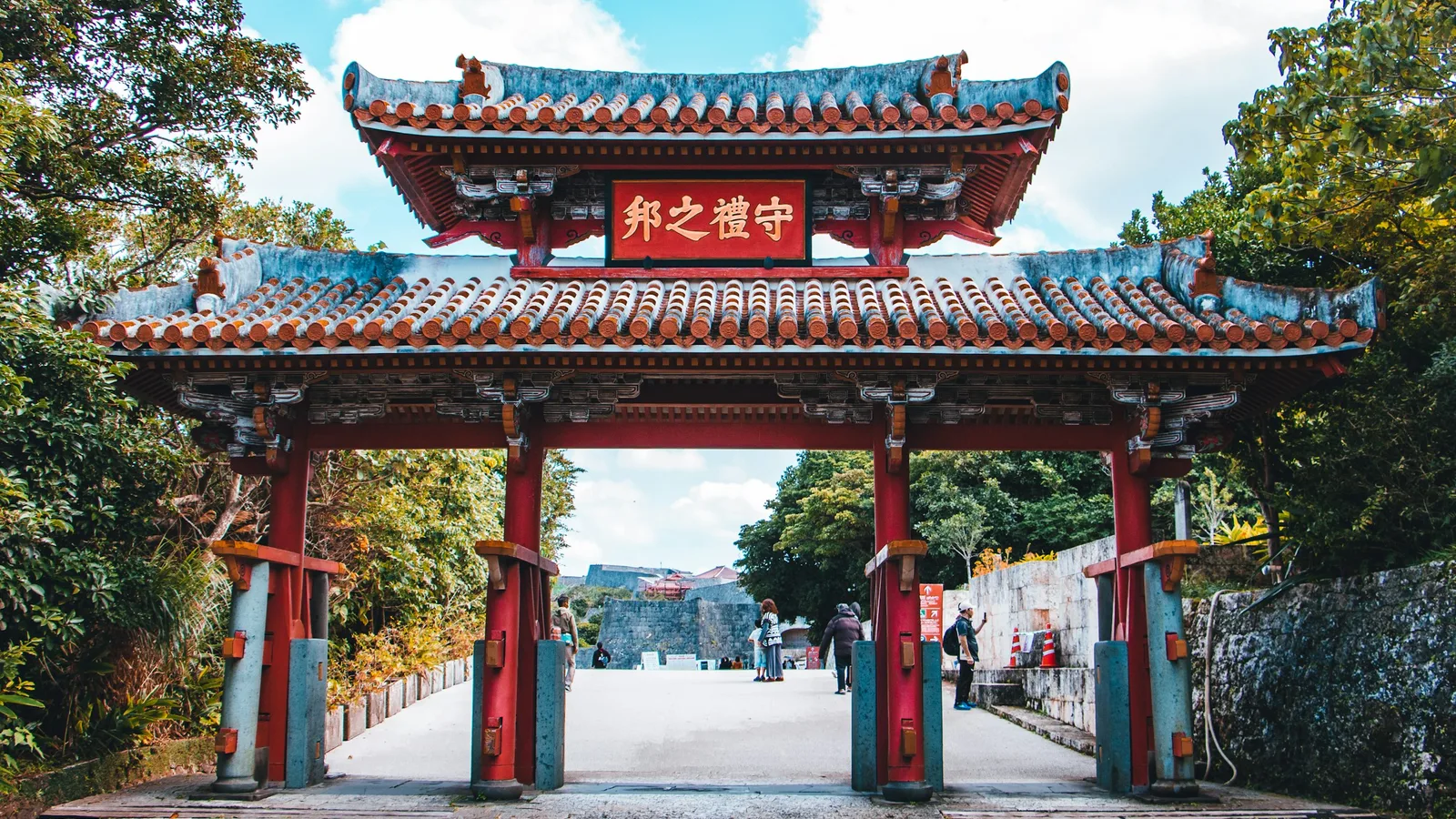
Begin where the kingdom began: at Shuri, on its hill above Naha. You enter through the Shureimon, a gate painted deep vermilion and roofed like a Chinese pavilion, with a tablet across it naming Ryukyu a land that honours courtesy. It is a gate with no doors, built to welcome rather than to defend, and it is so loved that its image was put on Japan's 2,000-yen note. Pass beneath it and you are climbing the same approach the kings climbed, on a rise of around 120 to 130 metres, from which they looked out toward the sea their ships crossed.
This was the centre of everything. Shuri Castle was the king's residence, the seat of the government that ran the kingdom, and the heart of its religious life all at once. The official guardians of the park put it simply: the history of Shuri Castle is the history of the Ryukyu Kingdom itself. And it is unmistakably not a mainland castle. There is no tall black keep built for war; there is a low, red, ceremonial palace shaped by China and Japan both, the architecture of a trading court rather than a fortress. It is not a temple or a shrine, either, so the etiquette you would use at a shrine is not quite what is asked of you here. This is a palace.
Most of what stood here burned on a single night in 2019, and the main hall is being rebuilt as you read this, with the work expected to reach completion in the autumn of 2026. It would be easy to assume there is nothing left to see. The opposite is true. The stone walls and the foundations, old enough to be inscribed on the World Heritage list in 2000 as part of the Gusuku Sites and Related Properties of the Kingdom of Ryukyu, were here long before the hall and are here still. And the park has deliberately turned the rebuilding itself into the thing you come for, opening viewing decks so visitors can watch a palace being reborn in real time. You will not see the finished castle that was here in 2018. You will see something rarer: the moment a country puts its centre back together. The exact areas open to visitors shift as the work moves on, so the current details are below, under Good to Know.
Step 3: A Different Table
By evening, find a plain shop with a sanshin playing: a three-stringed instrument, its small body covered in snakeskin, the ancestor of the mainland's shamisen, tuned to a scale that sounds like nowhere else in Japan. Sit down and order Okinawa soba. What arrives will quietly upend everything the word soba means on the mainland.
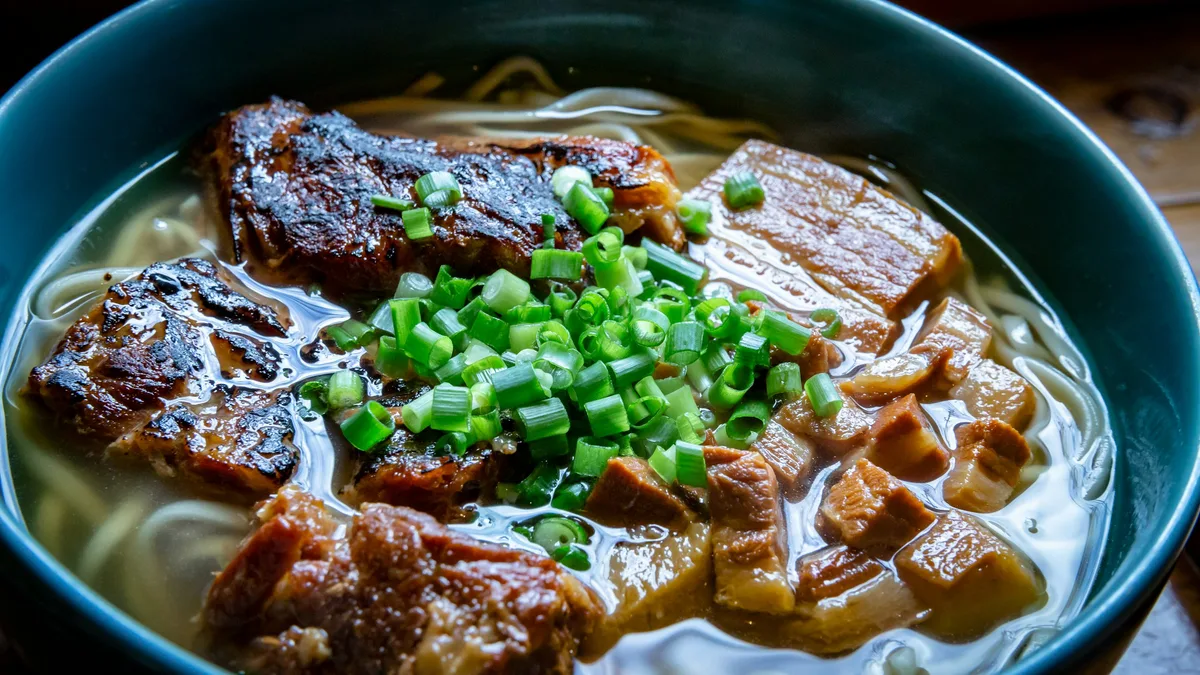
Mainland soba is made of buckwheat. Okinawa soba contains no buckwheat at all: it is made entirely of wheat flour, and the cooperative that holds the official right to the name says plainly that it belongs to the family of Chinese noodles. The broth is drawn from pork bone and bonito; on top sits pork simmered soft. This is the pattern of the whole table. The local word for the cooking is chanpurū, in the islands' own tongue to blend, to fuse, and it is the truest single word for Ryukyu food. Gōyā chanpurū stir-fries bitter melon with egg and shima-dōfu, an island tofu pressed heavier and firmer than the mainland kind and set with seawater. Rāfutē, slow-cooked pork belly in soy and the local rice spirit awamori, is close cousin to the Chinese braised pork it descends from.
None of this is mainland Japanese food with a regional accent. It is the kitchen of a different kingdom: court cuisine developed for entertaining foreign envoys, fused over centuries with the thrifty cooking of ordinary islands, at the one crossroads where China, Japan, and Southeast Asia all arrived by ship. If you order Okinawa soba expecting Tokyo soba, you will be briefly bewildered; order it expecting a kingdom's noodle, and it makes perfect sense. (The islands are also famous as a place people live remarkably long lives, and the food is often credited, but why some Japanese live so long is a longer and more careful story than any single dish.)
Step 4: North to the Sea
To understand Okinawa you have to leave Naha, and to leave Naha you generally need a car or a bus. The city's monorail is wonderfully easy but it does not reach the island's north, where most of the famous coastline lies. The drive itself becomes part of the trip: an hour and more of sugarcane, sea, and small towns before you reach the headland of Motobu and the Churaumi Aquarium.
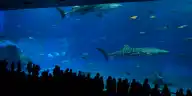
It is built around a single enormous tank called the Kuroshio Sea, named for the warm black current that runs past these islands and made them, long ago, a highway for ships. The tank holds 7,500 cubic metres of seawater behind an acrylic window 8.2 metres tall and 22.5 metres wide, and through it move manta rays and whale sharks, the largest fish in the sea, with the one on display measuring some 8.8 metres. Sit on the floor in front of that window for a while. The animals you are watching are the same ones the kingdom's sailors knew, in the same current that carried Ryukyu's trade across the world, and that is closer to the meaning of this place than any tank label says.
Step 5: Ichariba Chōdē
There is a phrase you will meet again and again in Okinawa: ichariba chōdē. The official translation is gentle and exact: once we meet, we are family. It belongs to a small constellation of Ryukyuan words the islands use to describe how people should treat one another: yuimāru, the spirit of helping each other, and chimugukuru, a warm, heartfelt care for others.
It would be easy, and wrong, to file this under "the islanders are just naturally friendly." Warmth is not a personality trait an island is born with; it is something a place learns. On a small chain of islands far out at sea, where survival depended on neighbours and where every kind of ship eventually came to call, treating the stranger as kin was not sentiment; it was how a trading kingdom stayed alive. The welcome you feel in Okinawa is the same welcome that island has extended to arrivals for centuries, and it is the deepest of the ways different parts of Japan greet the people who come to them.
So here is the question to carry home with you. Why would a place that was, for 450 years, a separate country, with its own king, its own language, its own gods, greet the travelers of the very nation it was folded into with the words once we meet, we are family? Sit with that on the flight back. The answer is the whole reason the kingdom mattered, and the whole reason it still does.
Good to Know
Shuri Castle: what you can see now. Because the main hall is being rebuilt, the areas open to visitors change as the work advances, and this is the single most important thing to check before you go. The park has built viewing decks specifically so you can watch the reconstruction of the main hall, and there is a reconstruction exhibition inside the paid area. The free outer area (gates, walls, the Shureimon) is open on its own hours; the paid inner area charges ¥400 for adults, ¥300 for high-school students, and ¥160 for elementary and junior-high students, with under-sixes free. Opening hours vary by season and the schedule is being adjusted during the rebuild. Last verified: 2026-06. Always confirm the current open areas and hours on the official Shuri Castle Park site before your visit.
Churaumi Aquarium: hours, admission, and getting there. The aquarium is in Ocean Expo Park on the Motobu peninsula in the north. Standard admission is ¥2,180 for adults, ¥1,440 for high-school students, and ¥710 for elementary and junior-high students, with under-sixes free; hours are generally 8:30–18:30 with last entry an hour before, extended later in summer. From Naha it is roughly two hours by car via the expressway, or about three hours by express bus, with a short walk from the bus stop. Last verified: 2026-06. Confirm on the official Okinawa Churaumi Aquarium site.
Getting around: the monorail reaches less than you think. Naha's Yui Rail monorail runs from the airport across the city to Shuri (the airport-to-Shuri trip is about 27 minutes for ¥360), and a one-day pass is ¥1,000 for adults (¥500 for children), valid 24 hours. It is the easy way to do Naha, the airport, and Shuri Castle. But the monorail goes no further than the Naha area: the aquarium, the northern beaches, and most of the island lie beyond it, reachable only by car, rental car, or bus. Plan the north around a car or a long bus ride. (For how Japan's trains, passes, and IC cards work in general, see getting around Japan.)
Naha itself: Kokusai Street. Naha's main artery is Kokusai-dōri, "International Street," about 1.6 kilometres of shops, food, and souvenirs reached from the Kenchō-mae or Makishi monorail stations. A block off it, the Daiichi Makishi Public Market, long called "Okinawa's kitchen," is the place to see and taste the island's ingredients in one room.
When to go: Okinawa runs on its own calendar. The seasons here do not match the mainland's. Many resort beaches open for swimming as early as March, months before mainland beaches; the sea is swimmable from spring well into autumn, with water temperatures running from about 21°C in February to about 30°C in August. The rainy season comes early too, roughly mid-May into late June, about a month ahead of most of Japan, and typhoons are most likely from summer into autumn. None of this should put you off; it simply means that the best time to visit elsewhere in Japan is not the right guide here. If you travel in typhoon season, keep an indoor day or two in reserve and you will be fine.
How long, and the shape of a trip. Okinawa's main island stretches far enough north-to-south that you cannot reasonably do Naha and the northern coast as a single day. A common, comfortable shape is two nights or more: Naha and Shuri at one end, the northern sea and the aquarium at the other, with the drive between them treated as part of the experience rather than a chore.
What to bring. The sun is stronger here than on the mainland; bring sun protection in any season, and light clothing in summer. Winter is mild but the sea wind can be cool, so a light layer is worth packing even then.
Official tourism site: Be.Okinawa / Visit Okinawa Japan
If Things Don't Go as Planned
You assumed you could get around by train. This is the most common Okinawa surprise. Outside the Naha monorail line there are no trains at all. The island runs on cars and buses. If you would rather not drive, you can still do Naha, Shuri Castle, and Kokusai Street entirely by monorail and on foot, and reach the aquarium by express bus; just build the north around bus times, which are less frequent than mainland services. Renting a car opens the whole island, but it is not the only way to have a good trip.
You think the burned castle isn't worth visiting. Many travelers assume that because the main hall burned in 2019, there is nothing left to see at Shuri. There is a great deal: the World Heritage stone foundations and walls, the gates, the Shureimon, and, uniquely, the rebuilding itself, which the park has opened up so you can watch a palace being put back together. With completion expected around autumn 2026, the in-between years are a rare thing to witness rather than a reason to stay away.
The weather looks bad on the forecast. A subtropical forecast almost always shows rain and cloud, and a full washout day is rarer than it looks: showers blow through and clear. Keep your plans flexible, save the aquarium and the indoor markets for the wettest hours, and don't cancel the day on the strength of a rain icon.
Okinawa soba isn't the soba you expected. It isn't supposed to be. There is no buckwheat in it; it is a wheat noodle from a different culinary tradition entirely. Order it as its own dish, a kingdom's noodle in a pork-and-bonito broth, rather than as a southern version of Tokyo soba, and it is one of the most comforting bowls in Japan.
Naha feels like an ordinary Japanese city. Naha is a working city, and its centre can feel much like any other in Japan; the older, more distinctly Ryukyuan texture is strongest at Shuri, in the markets, in the food, and out in the island beyond the city. If the centre underwhelms you, you have not seen the wrong place. You have simply not gone far enough into it yet.
You only have one day. Then keep it to the south: Shuri Castle, Kokusai Street, the public market, and the feel of Naha. Save the northern sea and the aquarium for a trip where you have a night to give them. A single day cannot hold the whole island, and trying to make it will turn the drive north into a race.
Sources:
- Shuri Castle Park (official): About / Ryukyu Kingdom / World Heritage / Reconstruction: Shuri Castle as the royal residence, seat of government and religious centre of the Ryukyu Kingdom ("the history of Shuri Castle is the history of the Ryukyu Kingdom itself"); the kingdom founded 1429 by Shō Hashi and abolished in 1879; the castle destroyed in 1945, partly reopened in 1992, and its main hall lost to fire on October 31, 2019; the "Gusuku Sites and Related Properties of the Kingdom of Ryukyu" inscribed as World Heritage in December 2000; the hilltop at an altitude of 120–130 m; the Shureimon ("land that honours courtesy"), a doorless gate later pictured on the 2,000-yen note
- Shuri Castle Park (official): Highlights / "Showing the Reconstruction" and current viewing areas: The viewing decks built so visitors can watch the rebuilding of the main hall, the reconstruction exhibition, and the main hall's completion expected in autumn 2026
- Shuri Castle Park (official): Admission fees and opening hours: Paid-area admission ¥400 adult / ¥300 high school / ¥160 elementary–junior high / free under 6; seasonal opening hours
- Okinawa Churaumi Aquarium (official): Exhibits, hours, admission, access: The "Kuroshio Sea" tank holding 7,500 m³ behind an acrylic panel 8.2 m tall × 22.5 m wide, displaying whale sharks (the displayed individual about 8.8 m) and manta rays; admission ¥2,180 adult / ¥1,440 high school / ¥710 elementary–junior high / free under 6; location in Ocean Expo Park, Motobu; about two hours from Naha by car and about three by express bus
- Okinawa Urban Monorail "Yui Rail" (official): The line from Naha Airport across the city to Shuri (airport to Shuri about 27 minutes, ¥360) and the one-day pass at ¥1,000 adult / ¥500 child valid 24 hours; the line does not extend to the north of the island
- Be.Okinawa / Visit Okinawa Japan (OCVB official): History, climate and seasons, world heritage: The Ryukyu Kingdom (1429–1879) as a trading nation linking China, Korea, Japan and Southeast Asia; the 1458 "Bridge of Nations" bell; the subtropical climate, sea temperatures of about 21°C (February) to 30°C (August), resort beaches opening for swimming as early as March, and the early rainy season
- Be.Okinawa / Visit Okinawa Japan (OCVB official): Ryukyuan languages and values: Ichariba-chōdē ("once we meet, we are family"), yuimāru (mutual aid) and chimugukuru (heartfelt care) as values carried in the Ryukyuan language (Shimakutuba)
- Be.Okinawa / Visit Okinawa Japan (OCVB official): Okinawan food culture: Chanpurū meaning "to blend / to fuse"; Ryukyu court cuisine and commoner cooking fused at a trading crossroads
- Okinawa Raw Noodle Cooperative (official, holder of the "Okinawa soba" regional trademark): Okinawa soba made entirely of wheat flour with no buckwheat, defined as belonging to the family of Chinese noodles
- Cabinet Office, Government of Japan, Highlighting Japan: the sanshin: The sanshin as a three-stringed, snakeskin-covered instrument of around 75–80 cm, ancestor of the mainland shamisen, tuned to the Ryukyuan pentatonic scale
- JNTO (Japan National Tourism Organization): Kokusai Street, Naha: Kokusai-dōri as Naha's roughly 1.6-kilometre main street; the shisa guardian lions
Image credits: Hero and thumbnail of the Shureimon gate at Shuri Castle, and the bowl of Okinawa soba, via Unsplash (free to use, no attribution required).
WMJS is written in Japan, in English, with AI help. We check every page, but English is not our first language. If a sentence reads oddly, tell us. One sentence is enough.
Thank you. A person reads every note.
Real voices
Is it worth it?
Were you there? Share your photos.
Your photo could appear in this guide — with your name and a link to your profile.
Submit a photoRelated Articles
Is Churaumi Aquarium Worth It? What 151 Real Visitors Say
Japan's Regional Welcome Map: What Residents Really Say About Their Own Prefecture