
Is Dazaifu Tenmangu Worth It? What Visitors and Locals Really Say
Ask which shrine to visit near Fukuoka and one name comes up almost automatically: Dazaifu Tenmangu. Reddit threads pit it against Nanzoin's giant reclining Buddha, weigh it against a day trip to Yanagawa, and argue over whether an hour at the main hall is plenty or a waste of a limited day. The doubt, when it shows up, has almost nothing to do with the shrine's beauty. It comes down to scale: is this a quick stop on the approach street, or does it deserve the whole afternoon once you count the garden next door and the museum down the hill?
Is it worth it? In visitors' own words
We gathered the voices of international travelers debating exactly this on Reddit, weighted by how strongly each opinion resonated with other readers. Here is how they fell:
Notice how little of the weight sits in the red. Almost nobody who actually goes comes away calling the shrine itself a mistake. One traveler laid out the whole question in a single comment, and it is close to the cleanest summary on the page:
If you're only doing Tenmangu in Dazaifu, a half day is more than enough. ... However, Dazaifu has two other beautiful shrines and the Kyushu National museum, which would occupy you for a full day.
That is the neutral 37% in a sentence. The debate is not really "should I go." It is "how big a piece of my day does Dazaifu get." A top-voted commenter, asked what a visitor to Fukuoka absolutely had to see, put it more simply: "You must go to the nearby Daizaifu Tenmangu. It is the most important shrine for education in Japan, and it is beautiful." The doubt lives almost entirely in logistics: one visitor called it "a day trip in itself," unsure how early anything opened; another warned that the approach street goes "ghost town" by 5pm and is best seen in the morning. The rare flat no came from a Fukuoka resident, unimpressed after comparing it to shrines elsewhere: "Everyone always says Dazaifu. But if you've seen other shrines in Japan, this isn't anything too special." That is one voice among forty-nine, an exception rather than the trend.
What locals and Japanese visitors say
Here is the layer most guides skip: how Japanese visitors talk about Dazaifu Tenmangu in their own jalan reviews. For them the shrine is rarely a sightseeing decision at all. It is where you go to ask Sugawara no Michizane, the god of scholarship, for help with an exam.
The purpose shows up constantly. "学問の神様に息子の試験合格をお祈りして来ました" (I came to pray to the god of scholarship for my son's exam success), one visitor wrote. Another visit was for grandchildren: "孫2人の合格祈願の為の参拝でした" (This visit was to pray for my two grandchildren's exam success). A third treated it as a lifelong habit: "何度も行っている場所ですが、合格祈願以外にも周辺のお店巡りだけでも1日楽しめるスポットです" (I've been many times, and beyond the exam prayer, just wandering the shops nearby is enough to fill a day). None of them are asking whether the trip earns its place. The question already has an answer before they arrive.
Look around
What you'll see when you get there
On the approach street from Dazaifu Station, facing the second torii just ahead.
Street View shows one day. Crowds, construction and seasons change the scene.Open in Google Maps ↗
Where the two sides genuinely differ
The gap has less to do with the shrine's worth than with which question each audience is even asking. Foreign visitors spend real energy on a question locals barely raise: is this a fifteen-minute stop or a half-day commitment, and which nearby spot deserves the leftover time? Japanese visitors, whose 18% neutral band is roughly half the size of the foreign one, are not weighing whether to come. They are absorbed in something else entirely: whether the crowd will let them pray calmly, and whether the plums are in bloom this week.
The two red bars tell a matching story. Almost none of the foreign disappointment and almost none of the Japanese disappointment is really about the shrine. A contrarian Fukuoka resident dismissed Dazaifu next to "other shrines in Japan." A Japanese reviewer's flattest complaint was purely logistical: "参道は観光客で混雑しているので...普通の状態の天満宮を混雑していない中で落ち着いて参拝できなかったことが残念である" (the approach was crowded with tourists, so it was a shame I couldn't pray calmly at the shrine in its ordinary, uncrowded state). Another honest one came from a family that drove in from Kagoshima for the neighboring museum, got directed to the wrong parking lot, and climbed a steep, hot approach road until an elderly relative nearly suffered heatstroke and they turned back without going inside. Neither of those is a verdict on Dazaifu Tenmangu. Both are a bad afternoon that a different route would have avoided.
The wider Dazaifu: the garden, the museum, and the plums
So what fills the "full day" that visitors keep mentioning almost in passing? Two places, both a short walk from the main hall, and both nearly invisible in the foreign-visitor conversation.
The first is Komyozenji, a small Zen temple just off the approach street, and Japanese reviewers describe it almost as Dazaifu Tenmangu's opposite. "天満宮参道から目と鼻の先にあるにもかかわらず、喧騒とかけ離れた空間となっており、知る人ぞ知る穴場の観光スポット" (even though it's a stone's throw from the Tenmangu approach, it's a space completely removed from the bustle, a hidden gem that only insiders know about), one visitor wrote. Another called it simply "苔寺で有名な" (famous as a moss temple) and described everyone sitting in front of the dry rock garden as if time had stopped. It is a paid garden, small enough to see in ten or fifteen quiet minutes, and at least one visitor arrived to find it closed to viewing that day, so it is worth treating as a bonus rather than a guarantee.
The second is the Kyushu National Museum, reached by an escalator and moving walkway that Japanese reviewers keep describing in the same wondrous language: "入り口のエスカレータートンネルがタイムトンネル効果でワクワクする" (the entrance escalator tunnel gives an exciting time-tunnel effect). Inside is a full national museum built around Kyushu's long history of contact with the rest of Asia, with free multilingual guided tours if you book ahead. Reviewers who came for a special exhibition, haniwa figures, an Edo-period painter, a Pompeii show, routinely stayed two to three hours and called it, in one reviewer's words, a place with "no end to how deep you can go" if the subject interests you.
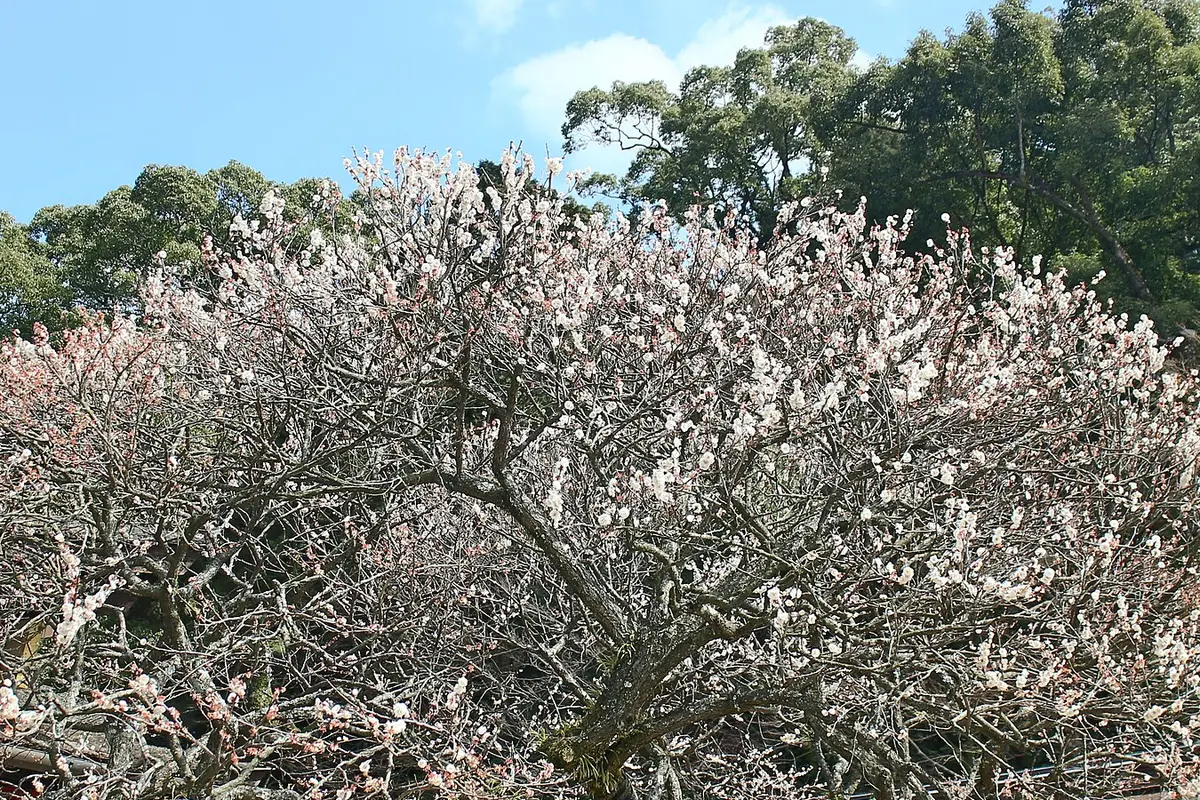
There is also the timing question that only the calendar controls: the plums. Roughly six thousand trees, in some two hundred varieties, bloom across the grounds from late January into early March, and the shrine's most-loved tree, the Tobiume, is said to be the one that flew here from Kyoto after Michizane's exile and is always first to open. Reviewers who caught it right talked about it with real warmth; reviewers who missed the window by a few weeks still called the visit worthwhile, just quieter on color.
One more thing worth knowing before you go: the forest-roofed temporary shrine (kariden) that circulates in a lot of photos, the one covered in living trees, is no longer there. The main hall's first major restoration in 124 years was completed in May 2026, the temporary hall was taken down over about three months starting on 19 May, and on 19 September 2026 worship directly in front of the main hall resumed for the first time in about three and a half years. So if you arrive expecting the tree-roofed hall from a photo you saw online, what you find is the restored 1591 main hall over Michizane's grave, in full view again. Formal prayers were moved to the nearby Seishinkan hall while the work went on; the shrine's prayer page shows where they are held now.
How to give Dazaifu the time it deserves
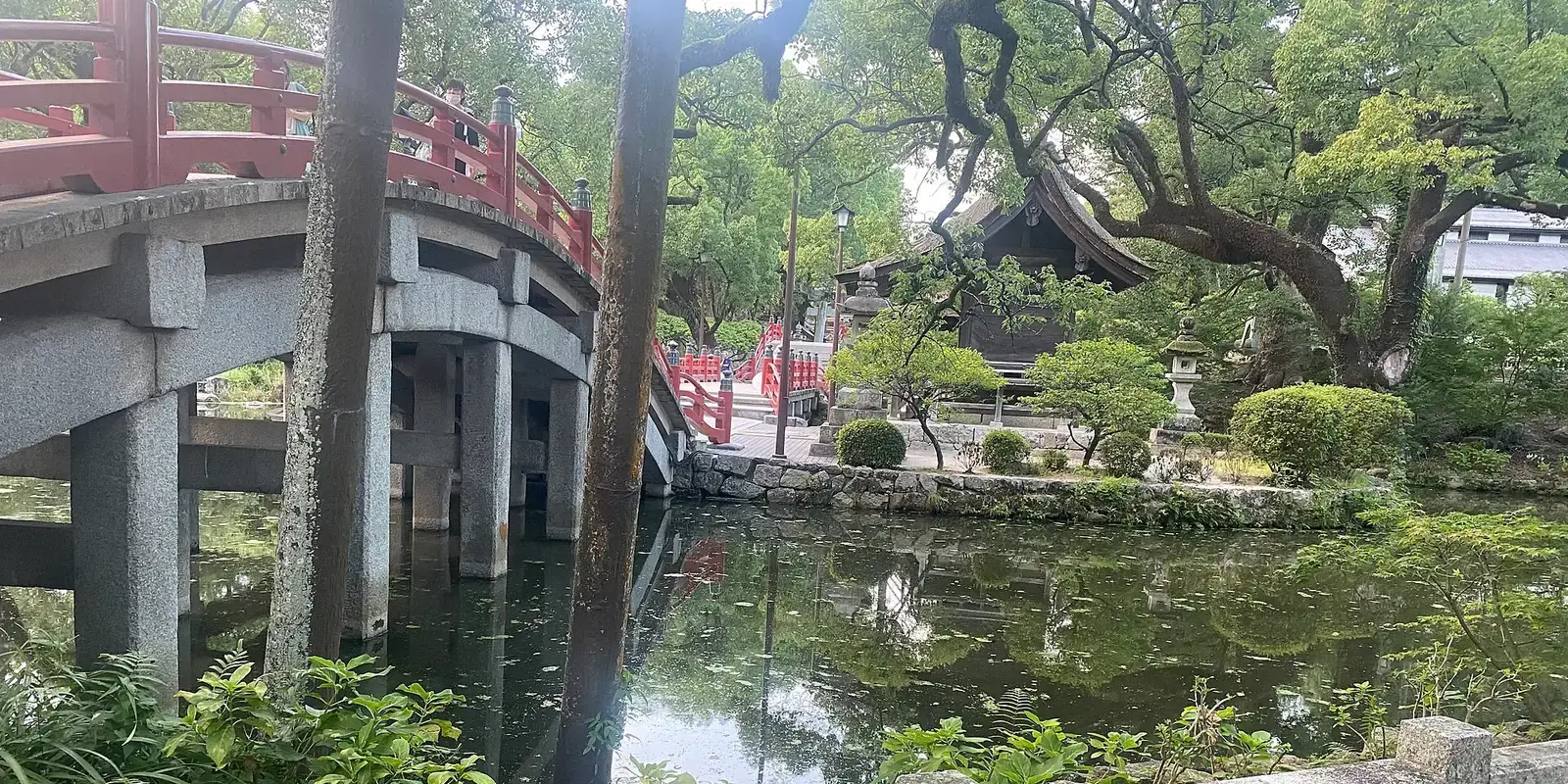
If you only have an hour or two, that is genuinely enough for the shrine itself. Walk the approach, cross the three bridges, touch the ox, stand at the main hall. Gates open early, typically between 6:00 and 6:30am, and several reviewers specifically recommend that window: less crowd, cooler air, and a chance to see the grounds before tour groups arrive.
If you have a half-day, add Komyozenji. It sits a few minutes off the approach street, costs a small entry fee, and gives you the quiet the main shrine mostly cannot, especially outside autumn foliage season when it draws its own crowds.
If you have a full day, add the Kyushu National Museum. It opens at 9:30am, closes Mondays, and charges a modest fee for its main exhibition, with free entry for visitors under 18 or over 70. Budget at least ninety minutes, more if a special exhibition is running, since several reviewers admitted losing track of time inside.
If you are chasing the plums, the calendar matters more than the guidebook. Late January through early March is the general window, but the peak shifts by a couple of weeks most years, so a review from last spring will not tell you this year's timing.
The lens: which Dazaifu
Almost everyone who goes, foreign or Japanese, comes away glad they did. The harder question is which Dazaifu you came for: the fifteen-minute photo at a famous shrine, the half-day that adds a quiet Zen garden, or the full day that closes with hours inside a national museum built on the same hill. Japanese visitors mostly skip the question altogether, because for them the destination was a specific prayer to a specific god, and everything else, the plums, the garden, the museum, was simply what a good day around that prayer could include.
If you are weighing what actually earns a day in a packed Japan itinerary, we keep a fuller guide to reading those choices in what actually matters when you visit Japan. And for the fuller story of the shrine itself, the ox, the plum tree, the approach, our Dazaifu Tenmangu guide walks you through it.
Sources:
- Dazaifu Tenmangu Official, History (English): Sugawara no Michizane's exile and death at Dazaifu, and his veneration as Tenjin, the god of learning
- Dazaifu Tenmangu Official, Goyuisho / Origins (Japanese): the main hall built by imperial order in 919 over Michizane's grave, and the present hall donated in 1591 by Kobayakawa Takakage
- Dazaifu Tenmangu Official, Tenjin-sama and the Plum (Japanese): the Tobiume legend, roughly 6,000 donated plum trees in about 200 varieties, and the blossom season
- Dazaifu Tenmangu Official, Notice on Worship in Front of the Main Hall, 19 September 2026 (Japanese): worship directly in front of the main hall resumed on 19 September 2026, about three and a half years after it was paused for the restoration
- Dazaifu Tenmangu Official, Notice on Prayers from 17 May 2026 (Japanese): formal prayers held at the Seishinkan ceremonial hall from 17 May 2026
- Dazaifu Tenmangu Official, Prayers (Japanese): where and when formal prayers are received
- Nishinippon Shimbun, 18 May 2026 (Japanese): the main hall's first major restoration in 124 years completed, with the temporary hall's dismantling starting on 19 May
- TNC TV Nishinippon, 21 September 2026 (Japanese): the temporary hall taken down over about three months, and worship at the main hall resumed on 19 September
- Dazaifu Tenmangu Official, Visitor FAQ (English): free entry to worship, seasonal opening hours, and the plum-bloom window
- Kyushu National Museum, Visitor Guide (Japanese): opening hours, Monday closures, admission for the main exhibition, and access from the shrine grounds via the connecting tunnel
- Kyushu National Museum, Volunteer Guide Info (Japanese): volunteer-led gallery tours in Japanese, English, Chinese, Korean, and sign language; group visits must book ahead, at least 10 days before the visit
WMJS is written in Japan, in English, with AI help. We check every page, but English is not our first language. If a sentence reads oddly, tell us. One sentence is enough.
Thank you. A person reads every note.
How well do you know Japan?
Built from 635 public posts by Japanese people
Want to know more? Ask Japanese people
Have a follow-up question about this topic? We'll ask real Japanese people.
Voice Box →