
Is Shinjuku's Golden Gai Welcoming to Foreigners?
What you'll learn in this article:
- What 183 Japanese people (bar owners, regulars, and nervous first-timers) actually said about walking into Golden Gai's tiny bars
- Why "locals only" and "tourist trap" are both more myth than reality, and what's genuinely true
- The small things that decide whether one of those tiny doors opens warmly for you
Is Golden Gai welcoming to foreigners? We collected what 183 Japanese people have said in public: owners, regulars, and nervous first-timers. The clear answer: yes, far more than its "locals only" reputation suggests. 51% of welcome voices were warm, 79% said language is no real barrier, and even Japanese people get nervous at these doors.
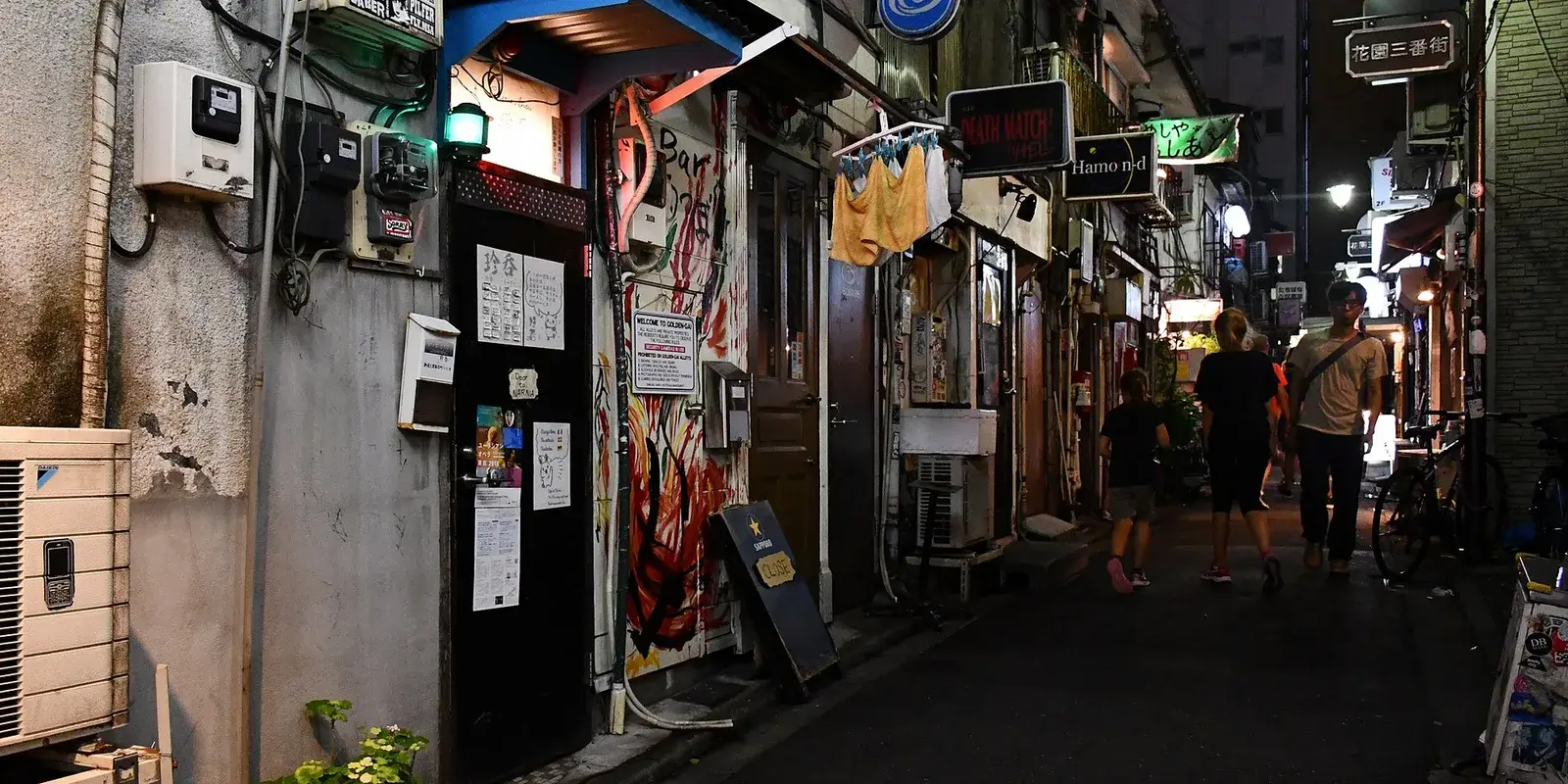
So you've heard about Golden Gai. A warren of more than 280 tiny bars, many barely three tsubo (about 10 square meters), crammed into a few dark lanes on the edge of Shinjuku's Kabukichō. You've also probably read the warnings: locals only, tourist trap, cover-charge scams, no English. It can sound less like a night out and more like an exam you might fail.
What almost nobody tells you: even Japanese people feel their pulse quicken at these doors. The alleys are narrow, the shops are the size of a walk-in closet, and you usually can't see inside. As one of Japan's most respected culture sites puts it, "the first time you set foot here, even Japanese people find it intimidating and may hesitate to go in."
Let's walk through it together, one door at a time.
Quick Guide
| The worry | What Japanese people say | |
|---|---|---|
| 🟢 Relax | Which door do I even open? | You're in good company: 42% of Japanese voices said the door takes courage for them too. Look for shops with an open door, an "English OK" or "beginners welcome" sign, or prices posted outside. (Shops that turn away newcomers usually say so: 会員制 / "members only.") |
| 🟢 Relax | Am I actually welcome? | Overwhelmingly yes. Owners say foreign visitors literally saved the street. 51% of welcome voices were warm; the cooler voices mostly read as longtime regulars feeling nostalgic rather than hostile. |
| 🟡 Good to know | The cover charge | Not a scam: it's a seat fee (¥500–1,000) that keeps a 10-square-meter bar alive. Most shops are clear about it. The real rip-off risk sits with touts off the main street rather than the Golden Gai bars themselves. |
| 🟡 Good to know | Those tiny seats | Go as one, two, or at most three people. The owner isn't judging your numbers; they're hoping you can "read the air" of a shared, shoulder-to-shoulder room. |
| 🟢 Relax | I don't speak Japanese | 79% of voices said it's fine. Attitude beats fluency every time, and "English OK" signs are multiplying. |
The one thing to remember: Golden Gai isn't a test of how cultured, fluent, or cool you are. The owner behind the counter mostly just wants you to have the courage to open the door, and to be kind once you're inside. That's the whole secret.
How We Gathered These Voices
We collected 183 distinct Japanese-language voices across the seven questions visitors actually ask about Golden Gai: which door to open (33 voices), whether you're really welcome (35), the cover charge (28), the tiny seats (31), the language barrier (34), photography (12 personal voices, alongside 10 official-rule notices from the district), and how the street is changing between generations (27). A handful of owners and regulars spoke to more than one question, so these add up to a little more than 183.
These came from public Japanese-language platforms: interviews with Golden Gai owners and staff in Japanese media, the Shinjuku Golden Gai shopping association's own pages, blogs and essays by Japanese visitors, and public Q&A and social posts, plus reporting from outlets including Nippon.com, Tokyo Updates, Money Forward, Gendai Media, and others.
A quick note: This isn't a scientific survey. It's a collection of what real Japanese people said in their own words, on public platforms. Most guides describe Golden Gai's surface: the cover charge, the "locals only" warning. We wanted to show you what the people behind the counter and on the next stool actually feel, including the surprisingly warm fact that they share many of the same nerves you do.
First, the Empathy Hub: That First Door Is Hard for Everyone
Before the practical stuff, here's the finding that surprised us most, and the one to hold onto: standing outside a Golden Gai bar, unsure whether to go in, is a deeply Japanese experience too.
Of 33 Japanese voices about opening that first door:
Listen to how honest people are about it:
そんな中に、初めて入っていくのはかなり勇気がいりますよね。 Walking into a place like that for the first time really takes quite a bit of courage, doesn't it.
And it isn't only tourists who imagine they'll be judged. One young Japanese writer described talking themselves out of going for ages:
「こんな若輩者が行ってもいいのかな?」って。文化人が語るような高尚な作品論や、サブカルチャーの知識などがないとダメなんじゃないか、とか。 I kept thinking, "Is it really okay for a young nobody like me to go?" I worried I wouldn't be allowed in unless I had the kind of lofty art talk or subculture knowledge that cultured people throw around.
A whole imagined entrance exam, invented entirely in their own head, in their own country. Sound familiar?
The people on the other side of the door know it, and they wish you wouldn't worry. One owner put it plainly:
ゴールデン街って見る人によっては特別な空間に思えますが、実際はそんなことなくて普通の飲み屋さんって感じなんです。 Golden Gai can look like some special space to certain people, but honestly it's not like that at all — it just feels like an ordinary little bar. Golden Gai bar owner
どんなお客様でもウエルカムなので、「それでも入店する勇気」を持って欲しいですね。 Any customer is welcome, so I really want people to find "the courage to come in anyway." Golden Gai bar owner
This shared hesitation is the same one we found in our article on first izakaya nerves, where 49% of Japanese people admitted the same thing, and it connects to a bigger truth: Japanese people overwhelmingly do want to meet you.
💡 The door is a shared moment of courage
42% of Japanese people say opening a Golden Gai door takes real nerve for them, too. One young writer even imagined they'd be quizzed on art and subculture before being let in. The hesitation you feel outside is a small, shared act of courage that Japanese people feel too, and the owner is rooting for you to take it.
How to Spot a Welcoming Door
The good news is that Golden Gai signals which doors are easy. Regulars and writers spell out exactly what to look for:
一見さんOKで雰囲気的にも受け入れてくれるお店がほとんどです。(一見さんNGなところは「会員制」と書いてあります。) Most shops are fine with first-timers and welcome you in feel. (The places that don't take first-timers write "members only" on them.)
昔より丸くなったとはいえ、ゴールデン街はとっつきづらい場所が多いです。が、アットホームに迎え入れてくれるお店もいっぱいあります! Even though it's softened compared to the old days, Golden Gai still has plenty of hard-to-approach spots. But there are also tons of shops that welcome you like family!
A quick field guide, drawn from the voices:
- An open door is an invitation. A shop that wants walk-ins often props it open.
- A sign in English, such as "English OK," "Tourists Welcome," or "Golden Gai beginners welcome", means exactly what it says. Quite a few shops post them now.
- Prices posted outside signal a shop that's happy to have newcomers.
- "会員制" (members only) is the one sign to skip. It's not personal; those shops simply run on regulars.
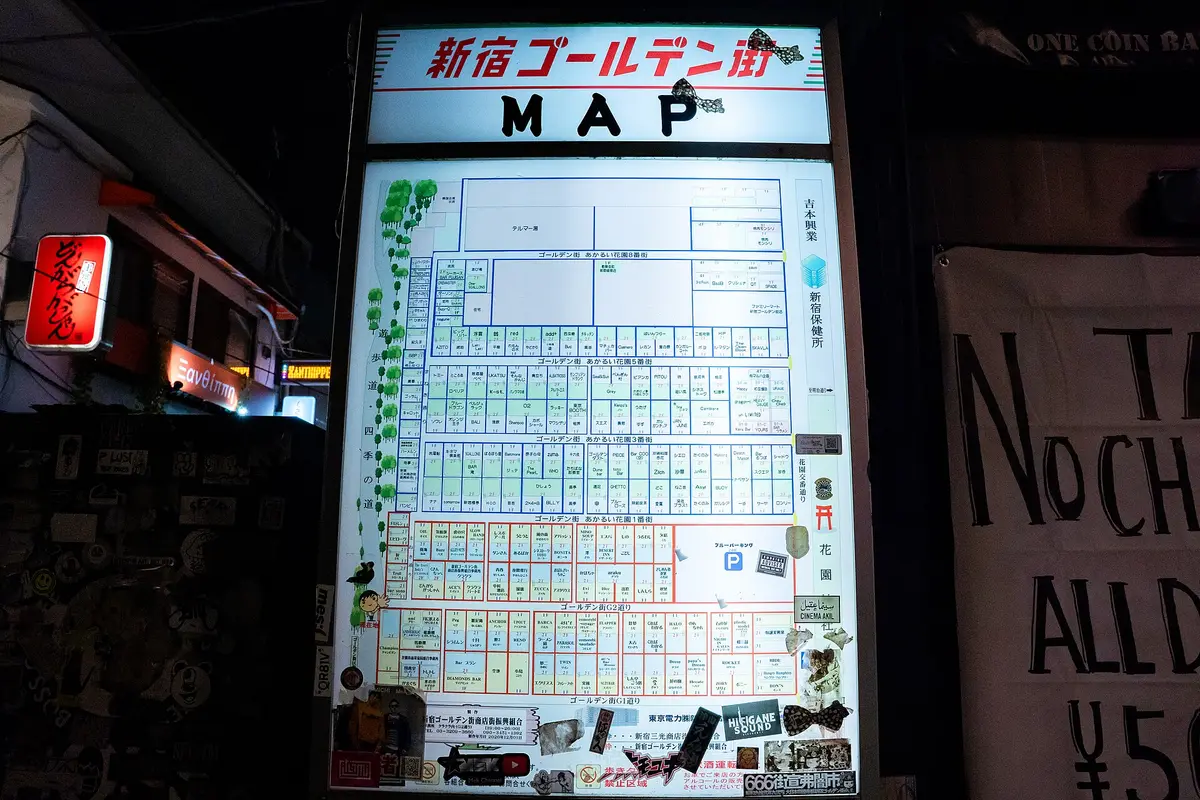
- Near the Shinjuku Station side, there's even a map listing the shops to help you choose.
And one small piece of etiquette that owners genuinely notice: how you come through the door.
敷居のまたぎ方は大事。お店が混んでいてもそうでなくても、扉を開けてこちらが席を案内する前にズカズカ中に入ってくる人は横柄で印象が悪いです。扉を開けて店員さんと目が合ったり、案内してくれるまで待ってくれる人は好印象です。 How you cross the threshold matters. Busy or not, someone who barges in before we've shown them to a seat comes across as arrogant. But someone who opens the door, catches the staff's eye, and waits to be seated — that leaves a great impression. Golden Gai bar owner
Open the door, smile, make eye contact, and wait half a beat to be welcomed in. That tiny pause does almost all the work.
Are You Actually Welcome? The Temperature Gauge
This is the big one, the question under all the others. The internet says "locals only." So we went looking for what the locals themselves say.
Of 35 Japanese voices from owners, staff, and regulars about welcoming foreign customers:
Here's what surprised us most. Far from resenting foreign customers, many owners say visitors saved the street. Listen to one owner explain it:
ゴールデン街はオーナーが高齢で店を畳んだり客離れが起きたりで、かなりさびれていたんです。そんな状況を変えてくれたのが外国人観光客。彼らは平日も土日も関係なくお金を落としてくれる。今日までゴールデン街が存続できたのは、間違いなく彼らのおかげでしょう。 Golden Gai had gotten pretty run-down — owners were aging out, shops were closing, customers were drifting away. The thing that turned it around was foreign tourists. They spend whether it's a weekday or weekend. There's no doubt Golden Gai has survived to this day thanks to them. Golden Gai bar owner
マナーの悪い人が一部いるとはいえ、正直うちとしては助かってます。 Sure, a few have rough manners — but honestly, for our shop, it's a real help. Golden Gai bar owner
One owner who runs a bar built specifically to welcome visitors tells every staff member the same thing before a shift:
ボクらにとっては毎日の営業。でも彼らにとっては一生に一度あるかないかの日本旅行。 For us it's just another day at work. But for them, it's a once-in-a-lifetime trip to Japan. Bar owner
And many owners want you to know there's far less to "get right" than you fear:
ゴールデン街には特別なルールなんてほとんどなくて、難しく考えずに気兼ねなくお酒の席を楽しんで欲しいなって感じます。 There really aren't many special rules in Golden Gai. I just want people to stop overthinking it and enjoy a relaxed drink. Golden Gai bar owner
What about that 23%? It's worth hearing honestly, because it's part of the real Golden Gai. Some longtime regulars miss the street the way it was:
昔のゴールデン街とは変わってしまった。今は外国人が増えすぎて……。もちろん彼らもフレンドリーなんだけど、言葉が通じないことも多いし、深い付き合いにはなりませんよね。 Golden Gai has changed from how it used to be. There are so many foreigners now… They're friendly, of course, but often we can't really communicate, and it doesn't turn into the deep regular friendships it used to. Regular customer in his 50s
In their own words, it reads as nostalgia for what has changed, the same feeling longtime regulars have in beloved neighborhoods everywhere. (We explore that quiet change in what's happening to Japan's neighborhood counter bars.) Knowing it's there simply helps you read the room: in a tiny shop full of old regulars deep in conversation, a quieter presence tends to be appreciated. Most of the time, though, the warmth in that 51% is exactly what's waiting.
💡 "Locals only" is mostly a myth
The headline finding: many Golden Gai owners say foreign visitors saved the street as aging owners closed up and regulars drifted away. "There's no doubt Golden Gai has survived thanks to them," one owner said. The cooler voices are nostalgic regulars missing the old street. You're not crashing the party; for many shops, you're keeping the lights on.
🟡 The Cover Charge, Decoded
You sit down. Before you order, you owe a few hundred yen. That's the cover charge (チャージ), and it's the single biggest source of Golden Gai anxiety.
Let's demystify it, because once you understand the system, the fear evaporates. Of 28 voices about the charge:
So what is it? The clearest voices explain it simply:
チャージとはざっくり言えばお通し代みたいなものです(でもお通しは出てこない)。入場料と言い換えてもいいかもしれません。 A charge is roughly like an otoshi (table) fee — except no dish comes out. You could just call it an entrance fee.
チャージは店によってまちまちで、だいたいがお酒一杯分くらいの価格に設定されています。 The charge varies by shop, but it's usually set at about the price of one drink.
The going rate, according to Nippon.com, is ¥500–1,000. Think of it as the rent for your stool in a bar the size of a small bedroom. That charge is literally how a ten-seat bar keeps its lights on.
Some Japanese people are honest that it can sting:
一杯しか飲まないのにチャージとられるとなんだか損した気分。 When you only have one drink but still get charged, you feel a little ripped off.
But the reassurance runs much stronger. Over and over, regulars insist the bars themselves are fair:
ぼったくりも絶対ありません。一杯数百円程度ですので、普通の居酒屋と同じくらいかと思います。 There's absolutely no overcharging. It's a few hundred yen a drink — about the same as a normal izakaya.
外からも空席があるのが分かるので入りやすい。しかもNo chargeとか書いてあると安心します。 You can see the open seats from outside, so it's easy to go in. And when a shop writes "No charge," it's reassuring.
And the math is friendlier than you'd guess:
1,000円札3枚あれば3軒楽しめます! With three 1,000-yen bills, you can enjoy three different bars!
Where does the "rip-off" reputation come from, then? Almost entirely from touts: people who approach you on the street and lead you somewhere. The established Golden Gai bars are not the danger.
客引きについていくとボッタクリが多いから避けた方がいい。 Following touts off the street leads to a lot of rip-offs, so it's better to avoid them.
The simple rule: choose your own door. Walk in off your own two feet, glance at the posted prices, and you're in safe, friendly territory.
💡 The charge is rent for your stool, never a scam
The cover charge (¥500–1,000) is how a bar the size of a bedroom stays open: a seat fee, not a trap. Japanese regulars are emphatic: the established bars don't overcharge. The actual risk is following a tout off the street. Pick your own door, check the prices outside, and you're fine.
🟢 Those Tiny Seats: Why Small Is the Whole Point
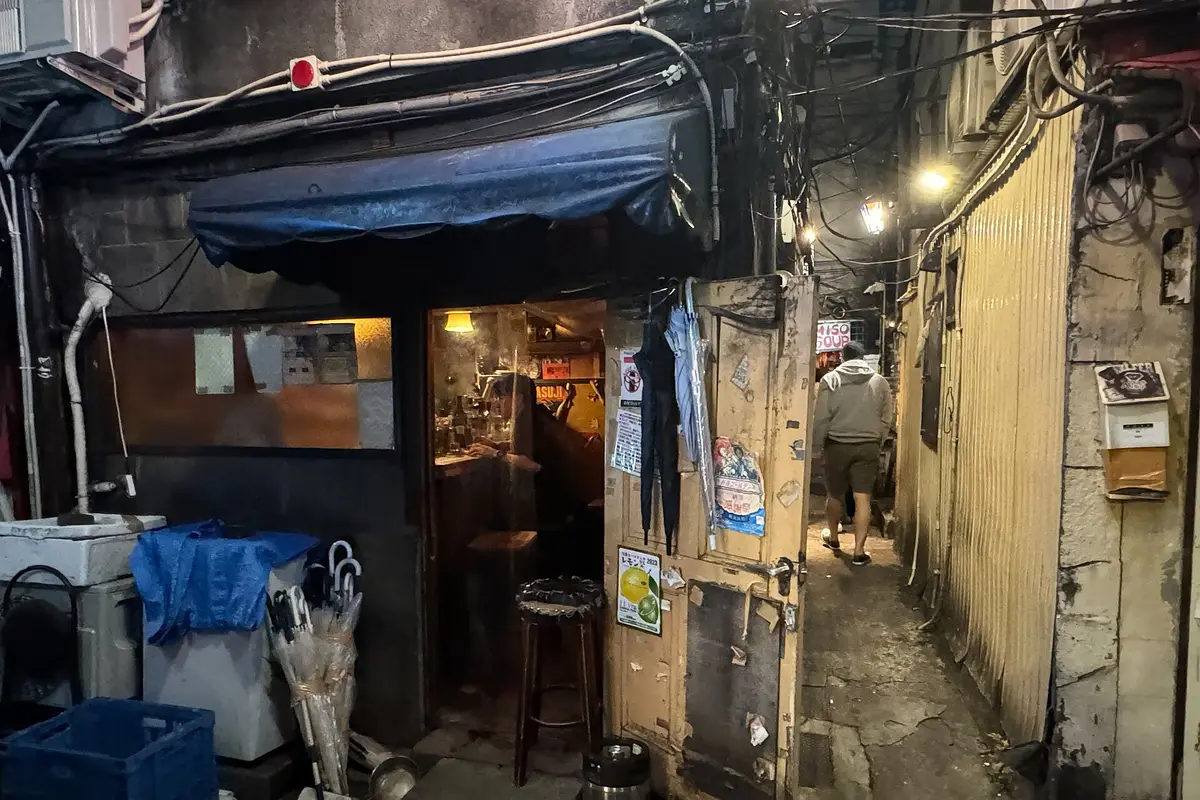
Golden Gai bars are famously, almost comically small: many no bigger than a small bedroom, with a handful of stools at a single counter. That tightness is the most-warned-about and most-misunderstood part of the experience.
Of 31 voices about the seats and the squeeze:
The single most practical thing to know is about group size. As Nippon.com and many voices put it:
団体客お断りの店もあるので、訪れるなら1人か2人、多くても3人程度までにとどめておいた方が無難だ。 Some shops turn away groups, so if you go, it's safest to keep it to one or two people — three at the very most.
This isn't gatekeeping. In a ten-seat room, a group of six doesn't just fill the bar; it changes its whole chemistry. What staff are really hoping for isn't a particular number of guests; it's a guest who can feel the room:
店内が狭いこともあるので、もし隣のお客様に声をかけられて、それを無視してしまうと全体の空気が悪くなってしまうことも。 Because the shop is so small, if the customer next to you says hello and you ignore them, it can sour the whole room's mood. Golden Gai bar staff
In other words, the close quarters come with one gentle expectation: a little openness to the person beside you. And when you lean into it, that closeness becomes the best part of the night. The warmth in our data was striking:
客が自ら立ち上がり、折りたたみ椅子を持ち出して二人分の座席を空けてくれた。 A customer stood up on their own, pulled out a folding stool, and made room for the two of us.
おとなり同士になった常連さんと一緒に乾杯しました。 I ended up next to a regular, and we raised a toast together.
名前も知らない他人だから、取り繕う必要がない。素でいられる環境が心地良い。ゴールデン街の魅力は、人の距離の近さだ。 Because they're strangers whose names I don't even know, there's no need to put on a front. Being able to just be myself feels good. The charm of Golden Gai is how close people are.
That's the secret the tiny seats are hiding: the squeeze is the welcome.
💡 The squeeze is the welcome
Come as one to three people. In a ten-seat bar, that's not a rule: it's the difference between joining the room and overwhelming it. What staff hope for isn't a number; it's a little openness to the person beside you. Give it, and the closeness turns into the best part of the night.
🟢 "But I Don't Speak Japanese": The Smallest Barrier of All
If one finding could dissolve a whole category of anxiety, it's this one. Of 34 voices about language, the warmth was almost unanimous:
79% positive: one of the warmest results in all of our research. The owner of one well-loved bar, who once spoke almost no English himself, summed up the whole philosophy:
話せないなり、コミュニケーションは人間同士なので、伝えようとすることを、互いに受け取り合うことはそんな間違わないものだと思いました。 Even when you can't really speak, communication is just human-to-human — when you try to get something across, the two of you receiving each other's meaning rarely goes wrong. Golden Gai bar owner
Staff who work the counter say the same, from experience:
皆さん、アクティビティのように日本人との会話を楽しんでくれます。英語が伝わらなくて怒られたことなんて一度もなく、積極的に話しかけることができました。 Everyone enjoys chatting with Japanese people like it's part of the fun. I've never once been scolded for my English not getting through, so I've been able to talk to people freely. Golden Gai bar staff
And the practical landscape keeps getting easier:
英語のメニューを用意したり、「English OK」と入口に張り紙を貼ったり、簡単な英語ができるスタッフも結構増えてきました。 More shops are putting out English menus, posting "English OK" at the door, and staff who can handle simple English have increased quite a bit.
When words run out, people simply find another way:
片言でもお互いの言語を教え合ったり、折り鶴の折り方を教えてあげたり。 Even in broken words, we'd teach each other bits of our languages, or how to fold a paper crane. Golden Gai bar owner
The lesson echoes what we found in why Japanese people switch to English when they see you: the warmth isn't in the grammar. It's in the trying. A smile, a "konnichiwa," a pointed finger and a laugh: that's a complete conversation in Golden Gai.
💡 A smile is a complete sentence
79% of voices say the language barrier is the smallest one. Owners and staff say they've never once been annoyed by clumsy English; they enjoy the effort. With English menus spreading and "English OK" signs at the door, the only thing you really need to bring is the willingness to try.
One Real Rule: Photography
If Golden Gai has a single firm rule, this is it, and it's worth knowing before you lift your phone. The lanes are atmospheric, the signs are gorgeous, and the temptation to photograph everything is huge. What most visitors don't realize is that the streets of Golden Gai are private property, and the shopping association is clear about photos.
From the district's own official notice:
この街での撮影につきましては、「許可」が必要であり「有料」となっています。街の風景及び看板のアップだけでも許可が必要です。 Photography in this district requires "permission" and is "paid." Even a simple close-up of the street scenery or a signboard requires permission. Shinjuku Golden Gai shopping association
基本的に「各店舗」内はそのお店の許可を個別に取って下さい。カウンター内の店主やスタッフ、そしてそのお店の常連さんには敬意を払って接しましょう。 As a rule, for the inside of each shop, please get that shop's permission individually. Treat the owner and staff behind the counter, and the shop's regulars, with respect. Shinjuku Golden Gai shopping association
That can sound stern, but the spirit behind it is simple and human: the people here are living their evening; they aren't posing for yours. And the moment you ask, the whole mood flips. One photographer who has shot in Golden Gai for years described how it works:
お客さんが携帯で撮り始めたら「撮りますよ」と声をかけて「私も1枚撮っていいですか?」と少しずつ、撮れる時に撮り続けていたらあっという間に10年が経っていました。 When customers started taking photos on their phones, I'd offer, "I'll take one for you," and ask, "Can I take one too?" — shooting little by little when I could. Ten years went by in a flash. Golden Gai photographer
新宿ゴールデン街はとにかく皆さん優しいし、安心して過ごすことができる場所だと思います。 Above all, everyone in Shinjuku Golden Gai is kind — I think it's a place where you can feel at ease. Golden Gai photographer
So: enjoy the view with your eyes first. To photograph the street or a shop, ask. A simple "Can I take a photo?", even in English, even by gesture, turns a forbidden snapshot into a shared moment. This is the same principle we cover in photo etiquette across Japan: the camera earns a smile when it asks first.
The Cultural Engine: Why Golden Gai Works This Way
So why is Golden Gai like this: tiny, charged with anxiety, run on unwritten feel? Three ideas explain almost all of it.
A bar the size of a living room
When a shop is barely the size of a living room, every choice it makes (the cover charge, the small-group preference, the closeness to your neighbor) flows from physics, not snobbery. There's no room for a buffer between you and the person beside you, so the culture turned that constraint into its charm. The intimacy is the product.
Ichi-go ichi-e: one meeting, once
Remember the owner who reminds his staff that for the guest, this is "a once-in-a-lifetime trip to Japan"? That's ichi-go ichi-e: the idea that each encounter happens only once. It's why an owner gets nervous about a first-time guest, why a regular will give up a stool so a newcomer can sit, and why a single evening at a tiny counter can feel oddly significant. Both sides know it won't happen again in quite the same way.
A street built on "face", and on trust
Golden Gai has always run on relationships more than rules. Owners describe it as a place of conversation and mutual respect, where regulars and newcomers share stories across a narrow counter. That's why "reading the air" matters more than any checklist, and why a little warmth from you goes a remarkably long way. As one veteran owner reassures:
外からやって来た人からすると、歌舞伎町の店よりもゴールデン街の店の方が敷居が高いという人もいるけれど、酒が好きであれば居心地の良い街だと思いますよ。 Some outsiders say Golden Gai's bars feel higher-threshold than Kabukichō's — but if you love a drink, I think it's a wonderfully comfortable place. Veteran Golden Gai owner
A Generational Shift
Golden Gai is changing, and you can hear it clearly across the generations of people who run it.
The old guard, the owners who built the street's legend, feel a deep protectiveness toward it:
ここは昔、アーティストや反体制的な人々の聖域でした。どのバーにも個性的な店主がいて、会話がはずみ創作意欲がわくような独特の雰囲気がありました。 This used to be a sanctuary for artists and anti-establishment types. Every bar had its own one-of-a-kind owner, and there was a unique atmosphere where conversation flew and creativity sparked. Veteran owner and former association chairman
今のゴールデン街は昭和の風情を残しているから、なるべく今のままで残したいというのが僕らの思いではあります。 Today's Golden Gai still keeps its Showa-era feel, so our wish is to preserve it as much as we can, just as it is. Former association chairman
But a younger generation of owners is opening shops with the door, literally and figuratively, flung wide. The current association chairman strikes a notably different note:
新しい人が増えるのは素晴らしいことです。 It's a wonderful thing that new people keep arriving. Golden Gai association chairman
ここでは誰も、何も決めつけたりしません。皆が余裕をもってお互いを受け入れています。 Here, nobody pigeonholes anyone or anything. Everyone accepts each other with a bit of room to spare. Golden Gai bar owner
Younger owners are streaming on Twitch, building bars "filled with the things I love," and treating overseas visitors as the future rather than a threat. For you, this means the Golden Gai you walk into now is, increasingly, a place that wants the door to open. The nostalgia is real and worth respecting, and so is the new generation's open-door spirit: both are part of the Golden Gai you walk into today.
Practical Tips for Your First Golden Gai Night
A short cheat sheet, drawn from everything above:
- Go as 1–3 people. Bigger groups get turned away from tiny shops, not to be unkind, but because there's no room. Solo is genuinely welcome.
- Read the doors. Open door, "English OK" or "beginners welcome" sign, posted prices = come on in. "会員制" (members only) = a regulars' shop, so pick another.
- Cross the threshold gently. Open the door, catch the staff's eye, and wait a beat to be seated. That small pause makes a great impression.
- Expect a cover charge (¥500–1,000). It's a seat fee rather than a scam: the rent on a tiny bar. Check the price posted outside if you want certainty.
- Choose your own door: never follow a tout. The bars themselves are fair; people who pull you off the street are the real risk.
- Don't worry about Japanese. A smile and a "konnichiwa" are plenty. Many shops have English menus now.
- Ask before you photograph. The streets are private property and the rule is real, but "Can I take a photo?" turns a no into a yes and a smile.
- Be open to the person next to you. In a room this small, a little friendliness is the whole etiquette. It's also where the magic happens.
If something goes sideways (you misread a door, you can't follow the menu, you're not sure about the bill), just ask. The people behind these counters have welcomed nervous first-timers for decades, and they can tell the difference between someone who's trying and someone who isn't. You're trying. You'll be just fine. And if you have the evening to spare, Golden Gai sits at the end of a whole night through Shinjuku: the Tocho observation deck at dusk, the grilled-skewer smoke of Omoide Yokochō, the neon of Kabukichō, with these lanes as the quiet, human last stop.
More Japanese Perspectives
If this was helpful, these related articles go deeper into the dining and drinking world Golden Gai belongs to:
- Your First Izakaya: The broader art of walking into a Japanese drinking spot: the noren, the otoshi, calling staff, and why even Japanese people get nervous at the door.
- Do You Have to Drink in Japan?: Spoiler: no. What Japanese people really feel when you order an oolong tea instead of a beer.
- Why Japanese People Switch to English: The reflex that's trying to be kind, and why your Japanese is still appreciated.
- Photo Etiquette in Japan: When a camera earns a smile, and when it doesn't.
- Are Japanese People Friendly?: 400+ voices on the question under every door in this article.
Share Your Experience
Have you opened one of those tiny Golden Gai doors, or are you still working up the courage? Did a stranger toast you, an owner take you under their wing, or a charge surprise you? We'd love to hear it. Your story helps build a bridge between cultures, and might end up in our next article.
Share your experience on Voice Box →
Sources
Primary Research Data
- WMJS Golden Gai research data (183 distinct Japanese-language voices collected June 2026)
- The first door: 33 voices
- Whether you're welcome (owners, staff, regulars): 35 voices
- The cover charge: 28 voices
- The tiny seats: 31 voices
- The language barrier: 34 voices
- Photography: 12 personal voices (plus 10 official-rule notices from the district)
- Generational change: 27 voices
Factual Sources (Tier 1–2)
- Shinjuku Golden Gai shopping association: official guidance and photography rules
- Nippon.com: Golden Gai guide (shop count, ~3 tsubo size, ¥500–1,000 charge, group-size guidance)
- Tokyo Updates (Tokyo Metropolitan Government media): Golden Gai owners across generations
Opinion Collection Sources
The following are places where real Japanese people (bar owners, staff, regulars, and visitors) expressed their views in interviews and essays. They are not cited as factual authorities, but as the source of the voices in this article.
The first door:
- https://bizspa.jp/post-742491/
- https://select-magazine.jp/2019/08/31/golden/
- https://life.saisoncard.co.jp/post/akagi01/
- https://mashup-kabukicho.com/article/5594
- https://dime.jp/genre/719117/
- https://getnavi.jp/gourmet/962152/
- https://hanako.tokyo/learn/22213/
Whether you're welcome:
- https://camp-fire.jp/projects/252365/view
- https://shueisha.online/articles/-/135992
- https://www.musicvoice.jp/news/95423/
- https://kabukicho-culture-press.jp/all/kabukimono/750
- https://gendai.media/articles/-/129389
- https://nikkan-spa.jp/1538240
- https://media.moneyforward.com/articles/3527
- https://www.tokyuhotels.co.jp/tabit/kanto/121
The cover charge:
- https://life.saisoncard.co.jp/post/akagi01/
- https://mashup-kabukicho.com/article/5594
- https://otonanswer.jp/post/4405/2/
The tiny seats:
- https://aumo.jp/articles/37663
- https://www.tokyuhotels.co.jp/tabit/kanto/121
- https://bizspa.jp/post-742491/
The language barrier:
- https://nikkan-spa.jp/2009402
- https://kabukicho-culture-press.jp/all/kabukimono/750
- https://www.musicvoice.jp/news/95423/
- https://matcha-jp.com/jp/3991
- https://camp-fire.jp/projects/252365/view
Photography:
- https://golden-gai.tokyo/photonotice/
- https://goldengai.jp/application.php
- http://golden-gai.tokyo/introduction/
- https://dc.watch.impress.co.jp/docs/essay/tokyoedge/1232068.html
- https://kabukicho-culture-press.jp/all/art/5255
Generational change:
- https://www.tokyoupdates.metro.tokyo.lg.jp/post-1444/
- https://mashup-kabukicho.com/article/8940
- https://www.e-aidem.com/ch/jimocoro/entry/wada01
- https://gendai.media/articles/-/129389
- https://media.moneyforward.com/articles/3527
- https://tms-media.jp/posts/2713/
Additional voices were gathered from personal blogs and essays by Japanese visitors and from public Japanese-language Q&A sites and social posts; following our editorial policy, these individual personal-platform links are not listed here.
Note on Quotations
Quotes from online platforms have been lightly edited for readability (fixing typos, formatting for clarity). The meaning and intent of each comment remain unchanged. Original sources are linked above.
WMJS is written in Japan, in English, with AI help. We check every page, but English is not our first language. If a sentence reads oddly, tell us. One sentence is enough.
Thank you. A person reads every note.
How well do you know Japan?
Built from 635 public posts by Japanese people
Want to know more? Ask Japanese people
Have a follow-up question about this topic? We'll ask real Japanese people.
Voice Box →