
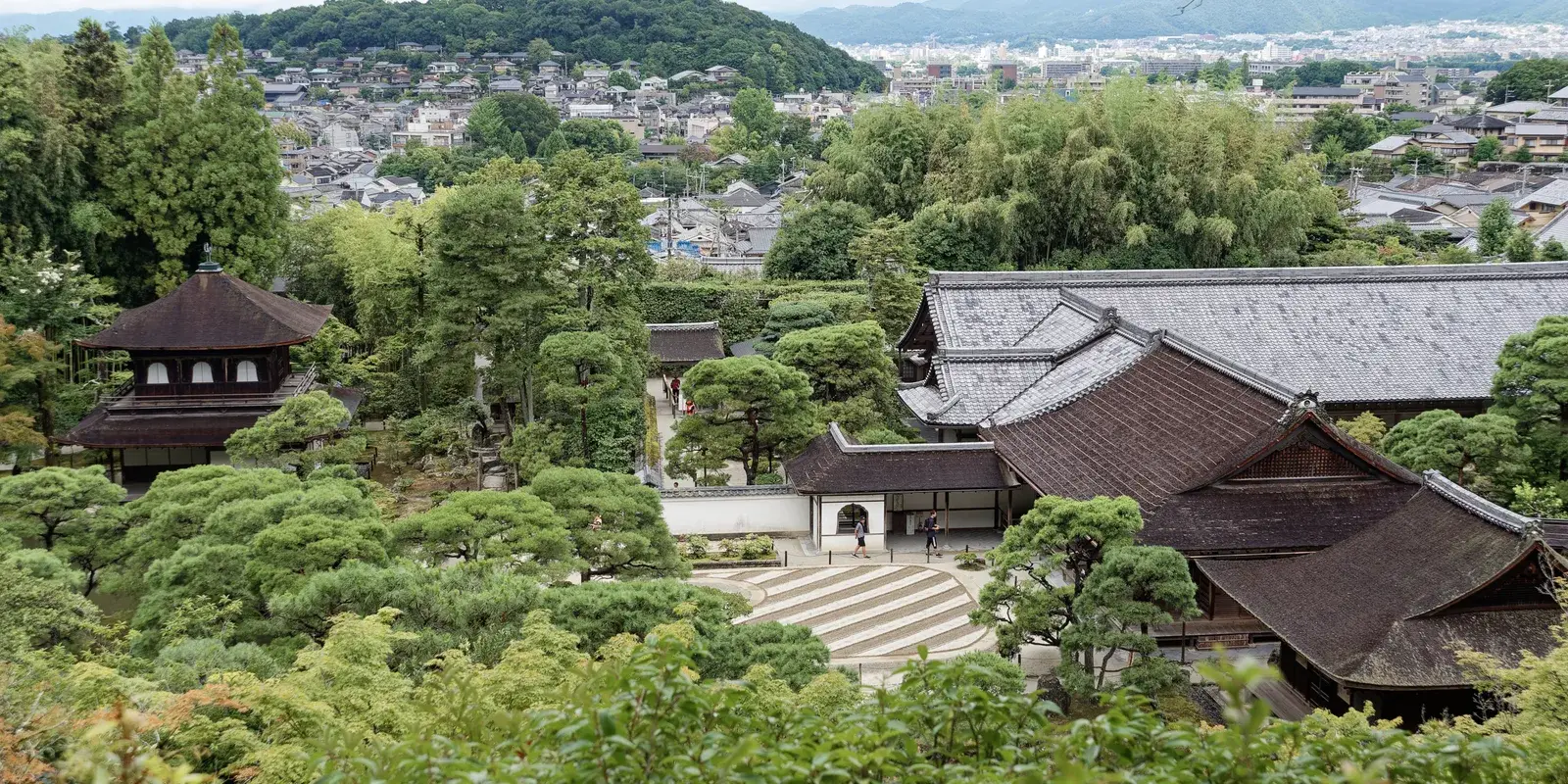
Is Ginkaku-ji Worth It? The Silver Pavilion Has No Silver, and That's the Whole Point
The questions are fair, and you have probably already asked them: there is no silver on the Silver Pavilion, the building is small, and you may have just stood in front of the dazzling Golden Pavilion across the city. So is the quieter sibling worth the trip, or is it, as one traveler bluntly put it, "overrated"?
Here is the short answer, and the voices below explain the twist inside it: yes, and with a twist almost no one expects. Among the people who actually go, Ginkaku-ji is one of the most quietly loved places in Kyoto, and a striking number of foreign visitors say they preferred it to the world-famous gold. Almost the only travelers who leave let down are the ones who came looking for a shiny silver building.
Is it worth it? (in visitors' own words)
We gathered the voices of international travelers who have actually been to Ginkaku-ji and read them with one question in mind: was it worth it? Weighted by how strongly each opinion resonated with other readers, here is how they fell:
That thin red bar is worth reading closely, because it tells you exactly who is disappointed here, and it isn't the people who came for a temple. It's the people who came for silver. One visitor flatly called the Silver Pavilion "overrated." Another warned it is "very, very small," and "if you're already templed out, both are very easy to skip." A third: "nice, but very small. Not worth the trip over when u can see other stuff." Every one of those is about scale and a missing shine, not about the place itself.
Turn to the green, and the register changes completely, and it keeps reaching for the same comparison. "I get why kinkakuji is so well known, but for me personally I'd take ginkakuji any day of the week and twice on Sundays. Beautiful, intimate, exquisite," one wrote. Another, with disarming honesty about the famous gold: "I went to Kinkakuji last time and it was mostly a feeling of 'yep, that's a big gold building all right.' I'm glad I've seen it, but it can't compare with the beauty of Ginkakuji for me. Ginkakuji is one of my favorite places in the world." A traveler who almost skipped it: "I thought Fushimi Inari would be my favourite experience, but it ended up being Ginkaku-ji."
And the people in the middle hold the key that unlocks both bars. "The temple itself is underwhelming," one conceded, "but the gardens and scenery around it are great, and you get a decent view of the city." Notice what that visitor did: they stopped grading the building, and started looking at everything around it. That single move is the difference between the red bar and the green one.
How the people who live with it feel
This is the part most guidebooks skip: what Japanese visitors and locals say, in their own reviews, about the same quiet temple.
This is the most useful thing on the page: the two gauges agree. The Japanese reviews start from the exact same observation the let-down visitors make, and then walk straight past it into affection. "Compared to Kinkaku-ji it's plain," one writes, "but when you walk through, it's quiet and relaxed, so I actually like it more than Kinkaku-ji." Another, on the famous building: "I was so overwhelmed by the stone garden you can only see here that I have no memory of the pavilion itself, ha." A third names the whole thing: "Ginkaku-ji has more refinement and calm. You can feel Japan's wabi-sabi here. This is exactly Higashiyama culture."
Even the "where's the silver?" moment is shared, and it lands the same way. "Exposed to years of wind and snow, honestly it doesn't give the impression of shining silver," one woman admits, before the turn: "but one winter morning, when I rushed over after hearing the news of the first snow, its white figure, that quiet dignity. I'll never forget it."
The red bar here is a single sliver, and it is gentle. The most pointed thing anyone says is a shrug: "a lovely place, but if you ask me whether I'd go again, well… hmm", and a fair warning that doubles as the cure: "it's plainer and calmer than Kinkaku-ji, but it's unexpectedly small and gets crowded, so it doesn't feel calm. Walk the Philosopher's Path early in the morning instead." When the people who live with a place are this close to unanimous, it tells you the doubt was never really about the temple.
What the doubt is actually about
Put the two gauges side by side and the answer falls out. The disappointment isn't keyed to where you're from: Japanese and foreign visitors make the very same "no silver, fairly small" observation. It's keyed to the name. "Silver Pavilion" makes a promise (a shining building, a twin to the gold) that the place was never built to keep. There has never been any silver here; by the temple's own account, the name came generations later, simply to set this hillside beside the Golden Pavilion across the city.
So there are, in a sense, two Ginkaku-ji. There is the one you picture from the name (a silver answer to the gold), and you will not find it, and if that is what you came for, you will write the red bar. And there is the one that is actually there: a composed garden of raked sand, moss, and water, with a plain dark-wood hall set into it and the whole northern bowl of Kyoto opening up from the top of the path. Come for the second one, and you join the 83% and the 91%. The single most reliable way to love Ginkaku-ji is to stop looking for the thing its name accidentally promised.
What's actually there to see
The reward here is a composition, not a single object, which is exactly why the people who slow down keep out-loving the people who don't. The full walk is in the Ginkaku-ji guide just below; here is what changes a let-down into a favorite.
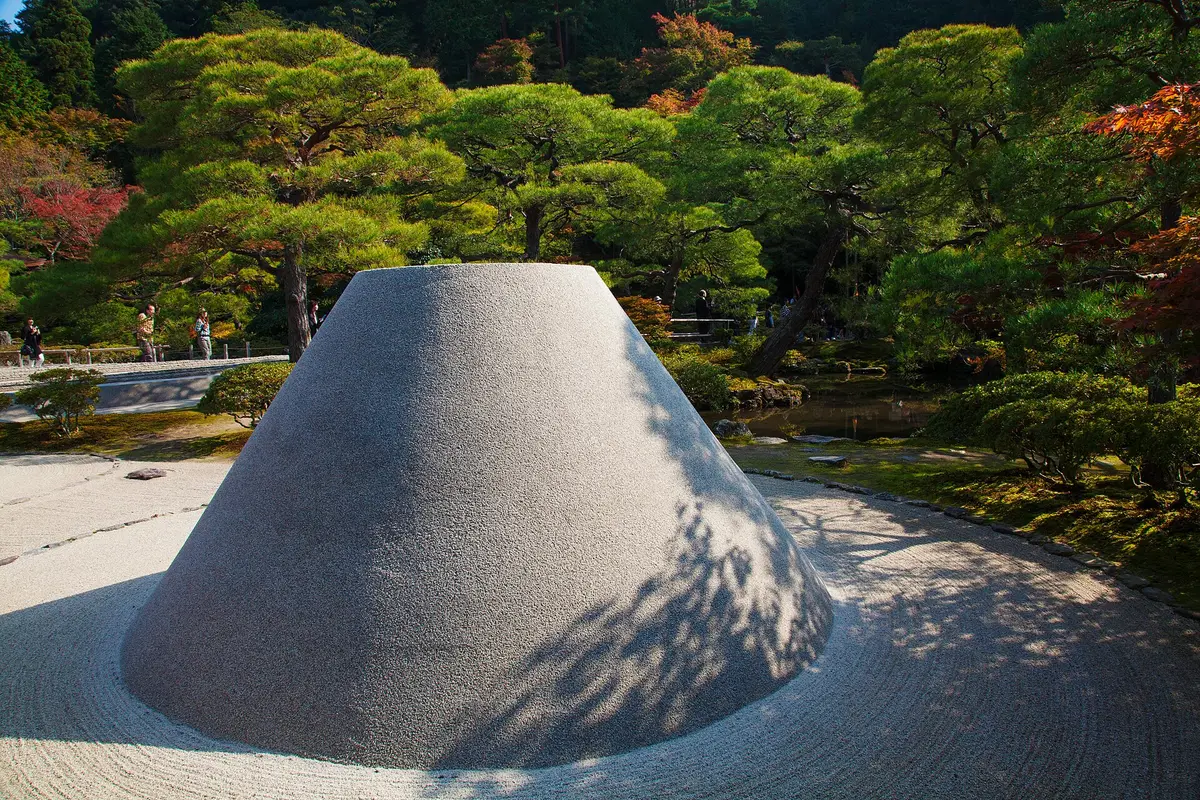
- The garden is the headline. Before you even reach the pavilion, you meet a wide bed of pale sand raked into long ridges (the Ginshadan, a "sea of silver sand"), and beside it a flawless, flat-topped cone called the Kogetsudai. No one can tell you for certain what they mean, and that uncertainty is part of looking at them. View them from the path along the rim, never by stepping onto the sand, and the ridges line up into the still sea they were shaped to be.
- You read the pavilion from outside. It is two stories of plain wood under a shingled roof. Like the Golden Pavilion, you cannot go in. It asks less of your eyes and more of your attention.
- The hall almost everyone walks past. A few steps away stands the Tōgu-dō, also a National Treasure, with a small four-and-a-half-mat room inside that is often called the oldest of its kind: the ancestor of the tatami room, the study, and the tea room. If you have ever knelt before an alcove with a single hanging scroll, the shape of that room began near here.
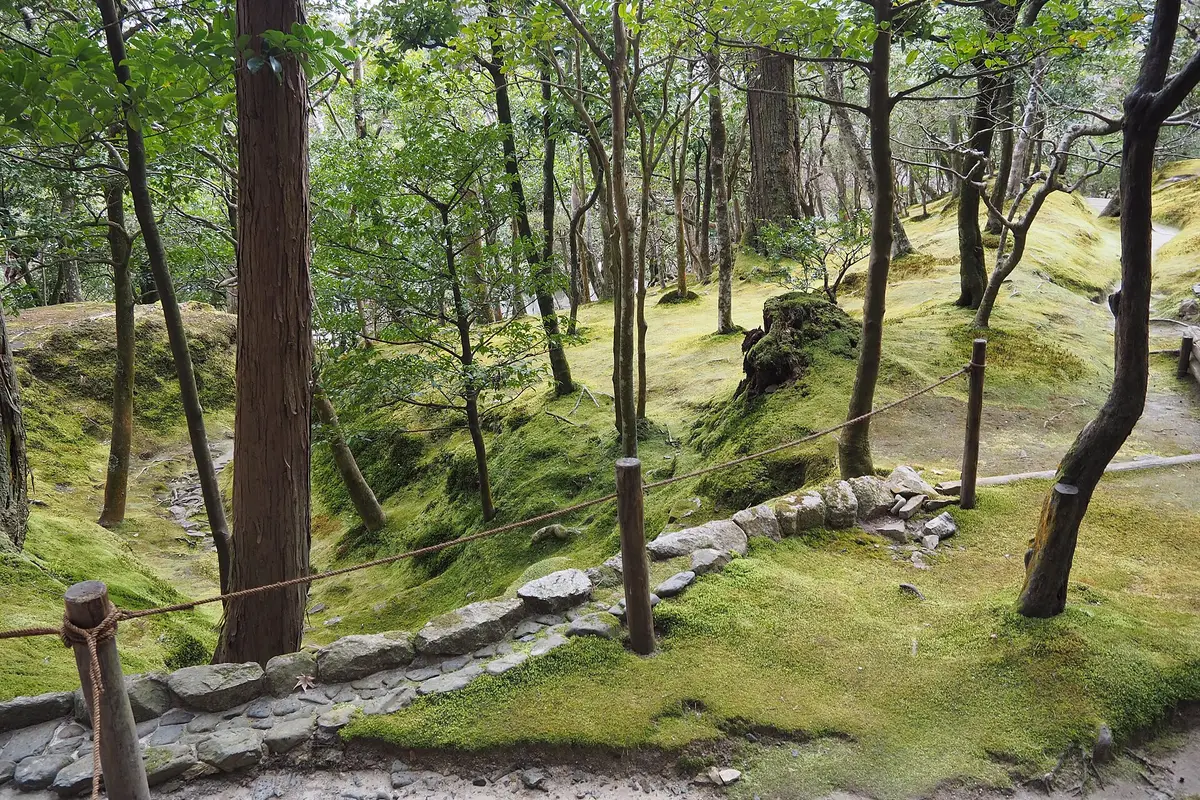
- The better half is uphill. Most people photograph the sand and drift toward the exit, but the path climbs through a slope of moss to a viewpoint over the pavilion, the sea of sand, and north Kyoto laid out under the hills. Almost no one who makes the climb then complains the visit was too short.
- The Philosopher's Path begins at the gate. A narrow stone walkway follows a canal about two kilometers south: cherry blossom in early April, maples from mid-November, and a quiet walk beside moving water in between.
How to Visit Ginkaku-ji the Welcomed Way
Everything above resolves into a handful of moves the temple quietly rewards.
- Go at opening. The thinnest crowds are first thing, and here the calm is the experience: it is the single most-repeated piece of advice from Japanese and foreign visitors alike.
- Don't hunt for silver. Look at the wood, the sand, the moss. The visitors who reset that one expectation are, almost without exception, the ones who leave glad.
- Walk the rim of the sand, not across it. The raked lines are an artwork held in shape by hand; take your photo from the edge and the next person gets the same clean sweep you did.
- Make the climb. The viewpoint is where the "too short" feeling goes to die. The lower garden is mostly level if stairs are difficult; the upper path is uneven and worth it.
- Pair it; don't make it a trek for one thing. The "skip it" verdict almost always comes from someone who bused across the city for a single 30-minute stop. String it together with the Philosopher's Path and the small temples along it, and a half-day quietly assembles itself.
- Carry cash, and know the practicals. You view the buildings from outside; the grounds are a one-way loop of about 30 minutes before the climb; admission (offered, rather than charged) is ¥1,000 for adults as of April 2026. Small temples and city buses don't assume card payment.
Why the plainness is the point
It helps to know what you're looking at. The gold and the silver-that-isn't were raised by the same family, two generations apart: the gold by the grandfather at the height of his power, this hillside by his grandson, Yoshimasa, who stepped away from rule and gave his last years to it in a capital still scarred by a long and ruinous war. What he gathered here has a name: a withered, refined plainness. The tatami room, the alcove with its single scroll, tea folded into ceremony, the arranging of flowers. Much of what the world now calls "Japanese style" took its shape around this one quiet villa.
So the restraint in front of you is not what was left when something richer fell away. It is the thing. If the Golden Pavilion is the art of addition (light, water, gold leaf, all turned up), Ginkaku-ji is the art of subtraction. They are not a brighter and a dimmer version of the same idea; they are opposites, and you need both to read Kyoto. Many travelers who expect to prefer the gold come home remembering the silver.
So: is Ginkaku-ji worth it? If you picture a shining silver building, no, and the forums will tell you so. But if you come at opening, stop looking for the shine, walk the rim of the sand and climb to the view, you will have done exactly what the 83% and the 91% did, and you may well find (as so many quietly do) that the quiet sibling is the one you remember.
Still deciding which famous places actually earn a slot on a short trip? Start with what actually matters in Japan, then weigh the pair: is the Golden Pavilion worth it? For the full walk past the sea of sand, the moss garden, and the viewpoint over Kyoto, the Ginkaku-ji audio guide is just below.
Sources
- Jishō-ji (Ginkaku-ji) Official Site, Shōkoku-ji: history (Ashikaga Yoshimasa, the Higashiyama villa), the Kannon-den and Tōgu-dō, the garden and its sand formations (described as popular legend), the one-way circuit; formal name Jishō-ji.
- Ginkaku-ji Official, Access & Admission: hours by season, the April 2026 admission revision (¥1,000 adult, written without a thousand-separator: 1000 yen), bus stops, address.
- Ginkaku-ji Official FAQ: the interior is not open to the public; the roughly 30-minute visit; the limited spring/autumn special viewings.
- Japan Tourism Agency, Multilingual Commentary: Ginkaku-ji: "not actually silver in color"; the two accounts of the name.
- Agency for Cultural Affairs, National Cultural Properties Database: the Kannon-den (1489) and Tōgu-dō as National Treasures; the Jishō-ji garden as a Special Historic Site and Special Place of Scenic Beauty.
- UNESCO World Heritage, Historic Monuments of Ancient Kyoto: 1994 inscription; Jishō-ji as a component temple.
- Kyoto City Tourism, Ginkaku-ji and the Philosopher's Path: the recommended subway-plus-bus access from Kyoto Station; the roughly 2 km Philosopher's Path.
WMJS is written in Japan, in English, with AI help. We check every page, but English is not our first language. If a sentence reads oddly, tell us. One sentence is enough.
Thank you. A person reads every note.
How well do you know Japan?
Built from 635 public posts by Japanese people
Want to know more? Ask Japanese people
Have a follow-up question about this topic? We'll ask real Japanese people.
Voice Box →