
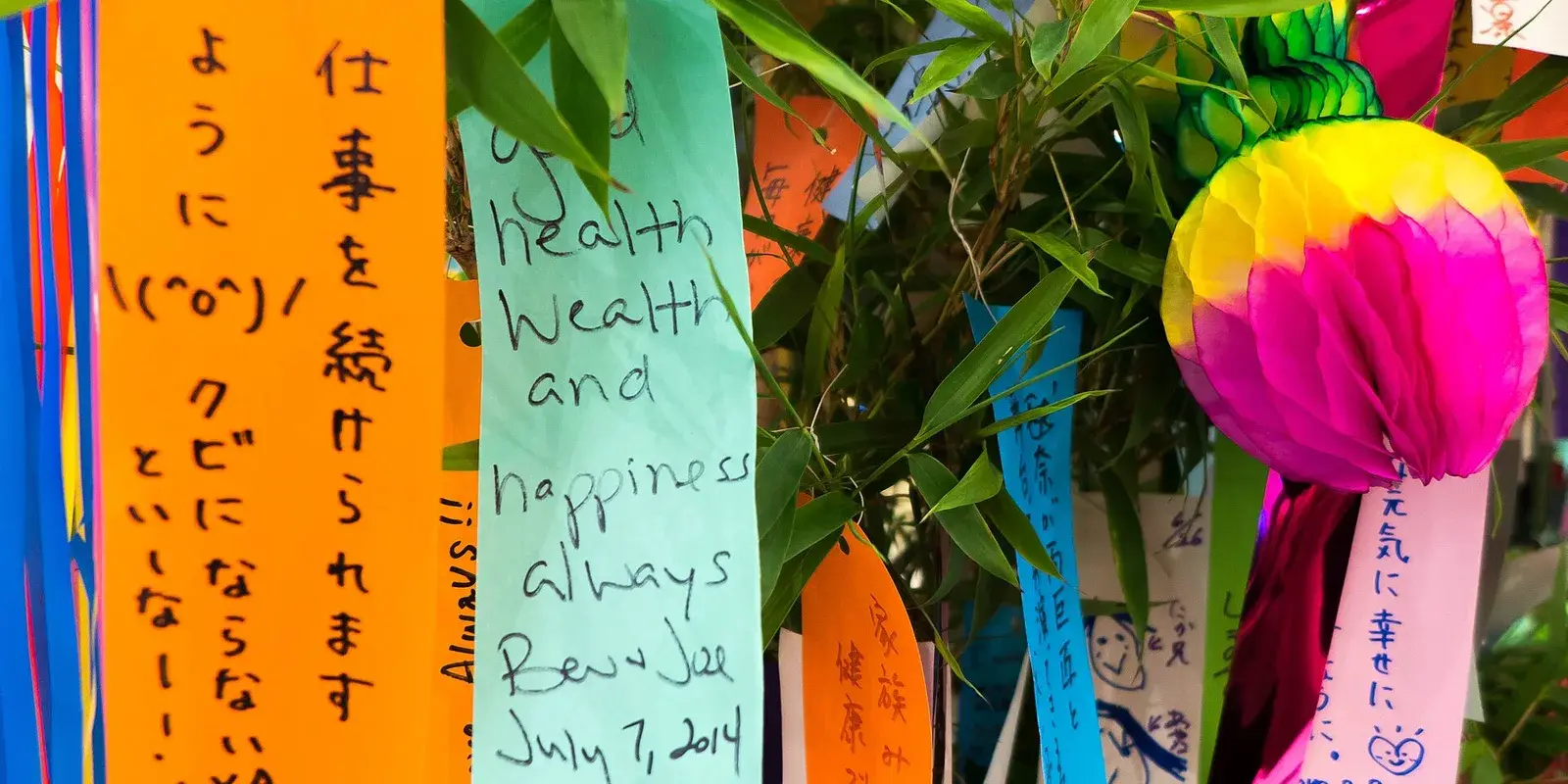
Tanabata Star Festival: What Happens When You Write a Wish in Japan
What you'll learn in this article:
- What 214 Japanese people said about foreigners writing wishes at the Star Festival, and why the welcome rate is 88% with zero objections
- The charming paradox: only 7.2% of Japanese adults celebrate Tanabata, but your participation touches something deeper than you'd expect
- Why writing in English or imperfect Japanese might be the most endearing thing you do all trip
Can foreigners write Tanabata wishes? We collected 214 public posts by Japanese people. The answer: absolutely. 88% reacted positively to foreigners writing tanzaku wishes, and not a single person objected. Here's the deeper story: only 7.2% of Japanese adults actively celebrate Tanabata anymore. It's a tradition many have quietly let go of. When you pick up a pen and write your wish, you're not just participating. You're touching something nostalgic that many Japanese people didn't know they missed.
214 Japanese voices on the Star Festival's most charming paradox
Most adults stopped writing wishes years ago. But they still love watching you write yours.
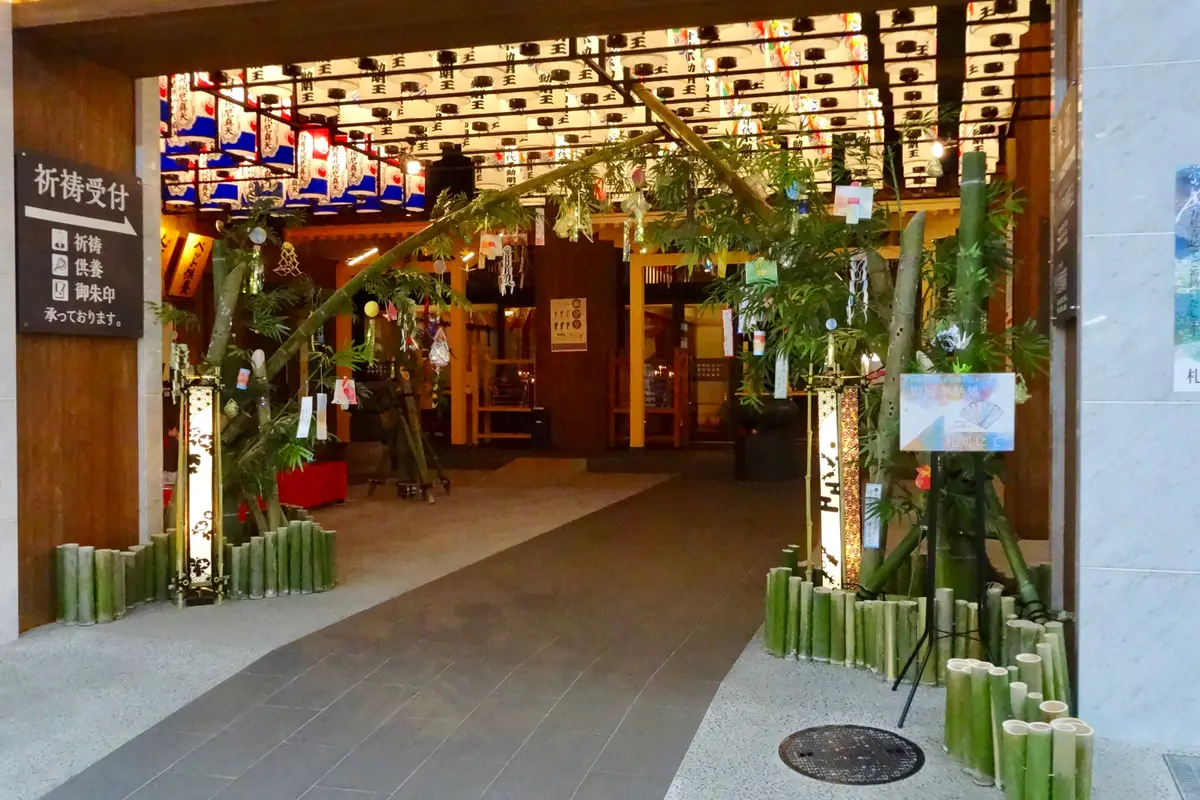
Every July 7, something quietly beautiful happens across Japan. Bamboo branches appear in shopping malls, train stations, and shrine entrances, their slender leaves hung with colorful strips of paper fluttering in the air conditioning. Each strip carries a wish, handwritten by anyone who picks up a pen.
This is Tanabata, Japan's Star Festival. It's one of the oldest traditions in the country, rooted in a love story over a thousand years old. And if you're visiting Japan in summer, you'll almost certainly walk past one of these bamboo displays and wonder: can I do that? Can I write a wish too?
The short answer: yes. And here's why it matters more than you'd think.
Quick Guide
| What | What Japanese People Said | |
|---|---|---|
| 🟢 Write a wish | Pick up a tanzaku and write | 88% welcome it, 0% object. "Even when words don't get through, festivals do." Write anything: the bamboo doesn't check passports. |
| 🟢 Any language works | English, your language, or imperfect Japanese | 87% positive. Broken Japanese is charming, not embarrassing. One person said: "Effort makes us twice as happy as fluency." |
| 🟡 Know the context | Tanabata's quiet paradox | Only 7.2% of Japanese adults actively celebrate. But 90.7% of children still write wishes every year. Your participation revives something most adults quietly miss. |
The one thing to remember: Tanabata tanzaku are the lowest-barrier way to participate in Japanese culture. No words needed, no skills required, no wrong answer. Just a wish, a strip of paper, and a bamboo branch waiting for your contribution.
How We Gathered These Voices
We collected 214 Japanese-language responses across four Tanabata topics: foreigners writing tanzaku wishes (52 responses), writing in English or imperfect Japanese (52 responses), whether Tanabata still matters to modern Japanese people (55 responses), and generational attitudes toward the festival (55 responses). Sources include public Japanese Q&A sites, forums, and social posts, plus Diamond Online, Chunichi Shimbun, Hakuhodo Institute of Life and Living, and surveys from Sirabee, MyVoice, @nifty, and SES Plus.
A quick note: This isn't a controlled scientific survey. It's a collection of what real Japanese people said in their own words, on public platforms, combined with data from published surveys. Most English-language guides explain what Tanabata is. We wanted to show you what it means, and what happens when you become part of it.
The Story Behind the Stars
Every culture has a love story written in the sky, and Japan's is one of the most beautiful.
Orihime (the Weaver Star, known as Vega) and Hikoboshi (the Cowherd Star, known as Altair) fell deeply in love. But they loved each other so much that they stopped working: Orihime stopped weaving, and Hikoboshi's cows wandered all over heaven. Orihime's father, the Sky King, grew furious and separated them on opposite sides of the Milky Way.
But he made one concession: they could meet once a year, on the seventh night of the seventh month. On that night, if the skies are clear, a bridge of magpies forms across the Milky Way so the lovers can reunite.
For over a thousand years, Japanese people have marked this night by writing wishes on small strips of paper called tanzaku and hanging them on bamboo branches. The bamboo reaches toward the sky, carrying your wishes closer to the stars.
Here's a detail that makes Tanabata feel more human: clear skies on July 7 in Tokyo happen less than 30% of the time. The star-crossed lovers are often separated by rain clouds. Japanese people have been writing wishes knowing the sky might not cooperate, and doing it anyway. There's something beautifully persistent about that.
What Japanese People Actually Think: The Temperature Gauge
🟢 Writing a Tanzaku Wish: "The Bamboo Has Room for Everyone"
The question visitors ask: "Is it OK for me to write one?"
This one surprised us, not because of the answer, but because of its unanimity. Of 52 responses about foreigners writing tanzaku wishes, zero people expressed opposition. Zero. In all the topics we've measured across hundreds of articles, that's almost unprecedented.
The positive responses came from everywhere: language schools, cultural exchange organizations, festival organizers, and everyday people:
日本びいきの外人を見るとなんか和む。自分たちが当たり前に思っているものを、外国の人がすごいと思ってくれるのが嬉しい。 Seeing foreigners who love Japan just makes you feel warm. It's nice when people from other countries think something we take for granted is amazing.
言葉が通じなくてもお祭りは通じているんだ!と、心から感じた。 I truly felt that even when words don't get through, festivals do!
Language schools across Japan, from Tokyo to rural Mie Prefecture, actively hold Tanabata events for foreign students. At one school, students from 13 countries wrote wishes and hung them on a shared bamboo branch:
中国、ベトナム、韓国、オーストラリア、フィリピン、ネパール、ミャンマー、トルコ、インド、インドネシア、ドイツ、日本、モンゴル、13か国23名の児童がひとりひとりが好きな色の短冊を選んで、自分の願いごとを書いて、大きな笹に吊るしました。 Children from 13 countries — 23 students in total — each chose their favorite color tanzaku, wrote their own wish, and hung it on a large bamboo branch.
The foreign students' wishes were touchingly real: passing exams, working in Japan, family health. Not tourist curiosity: genuine hopes written on paper and entrusted to a bamboo branch.
Why is the welcome so universal? Part of the answer lies in the nature of tanzaku itself. Unlike bon odori (where you might worry about getting the moves wrong) or carrying a mikoshi (where safety matters), writing a wish is inherently quiet, personal, and impossible to do "wrong." You pick up a pen, you write, you hang it up. There's no performance to judge, no technique to critique.
💡 Why this matters
Tanzaku are the most accessible entry point into Japanese cultural participation. No language required, no preparation needed, no risk of getting it wrong. The act of writing a wish and hanging it on bamboo is personal and quiet, exactly the kind of respectful participation that Japanese people appreciate most. If you want to participate in Japanese culture but feel nervous about doing something wrong, start here.
🟢 Writing in English or Imperfect Japanese: "Your Effort Makes Us Twice as Happy"
The honest truth: your language doesn't matter. But if you try Japanese, something magical happens.
Many visitors worry about the language on their tanzaku. Should I write in English? Will Japanese people be able to read my wish? Is it rude not to try Japanese?
Of 52 responses about language on tanzaku:
English wishes are completely fine, and Japanese people know that wishes transcend language:
言語は違っても気持ちは伝わる。 The feeling comes through regardless of language.
But if you decide to try writing in Japanese, even badly, something surprising happens. Japanese people don't just tolerate imperfect Japanese. They find it genuinely endearing:
外国人が頑張って日本語を話していると、大人でも「可愛い」と感じる。流暢な日本語よりカタコトで一生懸命話してくれる方が、倍嬉しい。 When foreigners try hard to speak Japanese, even adults find it "cute." Broken Japanese spoken with effort makes us twice as happy as fluent Japanese.
One person described the feeling with a vivid comparison:
外国人が話す片言の下手な日本語が可愛いと思うのは、生まれたての子馬が一生懸命立ち上がろうとしている姿に似ているから。 The reason broken Japanese from foreigners sounds cute is that it resembles a newborn foal trying hard to stand up.
This isn't condescending. It's the Japanese concept of ichishoukenmei (一生懸命, giving your all) being recognized and valued. The effort itself communicates respect:
外国人が頑張って日本語を話しているのを見ると「可愛い」と感じるのは、自分たちの言葉を大切にしてくれている、文化を尊重してくれていると感じるからではないか。 The reason we find foreigners cute when they try Japanese might be that we feel they're valuing our language and respecting our culture.
A beautiful example: a German friend wrote a letter in Japanese to her Japanese friend. Instead of the natural phrase "楽しくしてくれて" (made it fun), she wrote "さびしくなくしてくれて" (made it not-lonely). The "mistake" actually created something more powerful:
「ゆりちゃん、私の世界をさびしくなくしてくれてありがとう!!!」普通なら「楽しくしてくれて」と書くところを「さびしくなくしてくれて」と書いたのが、パワーのある素晴らしい言葉になっていた。 "Yuri-chan, thank you for making my world not-lonely!!!" Instead of "made it fun," she wrote "made it not-lonely" — which became a powerfully beautiful expression.
This is the magic of imperfect Japanese: sometimes the "wrong" word is more honest than the right one.
What about the 6% who prefer Japanese? Their concern is practical, not hostile: they simply noted that Japanese wishes are easier for passersby to read and appreciate. Even within this group, nobody said English wishes were unwelcome.
💡 What to write, and how
Write in whatever language feels natural. English is perfectly fine. If you want to try Japanese, here are a few starter wishes:
- けんこう (kenkou): health
- しあわせ (shiawase): happiness
- にほんがだいすき (nihon ga daisuki): I love Japan
- またにほんにきたい (mata nihon ni kitai): I want to come back to Japan
Don't worry about handwriting. Don't worry about grammar. The bamboo branch doesn't grade your work, and the Japanese people who read your wish will see the effort, not the mistakes.
🟡 Does Tanabata Still Matter? The Beautiful Paradox
Here's the truth about modern Tanabata that makes your participation even more meaningful.
If Tanabata were a universally celebrated tradition, like Christmas or New Year, your participation would be nice but unremarkable. Just another person at the party. But the reality of modern Tanabata is more complex, more human, and ultimately more touching.
According to the Hakuhodo Institute of Life and Living, which has tracked Japanese lifestyle habits for 32 years:
Only 7.2% of Japanese adults celebrated Tanabata in the past year.
Let that sink in. Tanabata is one of Japan's five traditional sekku (seasonal festivals) with over a thousand years of history, and fewer than one in thirteen adults does anything for it.
The data paints a vivid picture:
- 65-80% of adults do nothing special for Tanabata (multiple surveys: @nifty 2016, MyVoice 2015)
- Fewer than 30% of adults make wishes anymore (Sirabee, 706 respondents)
- Tanabata isn't a national holiday: it falls on a regular workday, and busy people don't have time to gaze at stars or write wishes on a weekday evening
- About 80% know the Orihime and Hikoboshi legend, but knowing and doing are different things
And yet. There's a reason Tanabata hasn't disappeared. When adults talk about it, something shifts:
大人になって七夕って何書くさ。子供の頃は「サッカー選手になりたい」とか「ゲームが欲しい」とか色々あったのに、大人になったら何を書けばいいかわからない。 What do you even write for Tanabata as an adult? When I was a kid, I had things like "I want to be a soccer player" or "I want a video game," but as an adult I have no idea what to write.
七夕飾りをして、童心に返った気がした。昔はたくさんお願い事があったけど、今は自分もみんなも元気で平和ならそれが一番の幸せ。 Making Tanabata decorations made me feel like a child again. I used to have so many wishes, but now the greatest happiness is just everyone being healthy and at peace.
This is Tanabata's beautiful paradox: it's a tradition that most adults have stopped practicing, but none have stopped feeling. It lives in the gap between "I don't do it anymore" and "but I remember."
Where Tanabata is alive and thriving:
Despite low home celebration rates, Tanabata thrives in three spaces:
Children's world: 90.7% of elementary and middle school students write tanzaku every year (Kids@nifty 2025). Schools and kindergartens keep the tradition alive, and parents are pulled back in through their children.
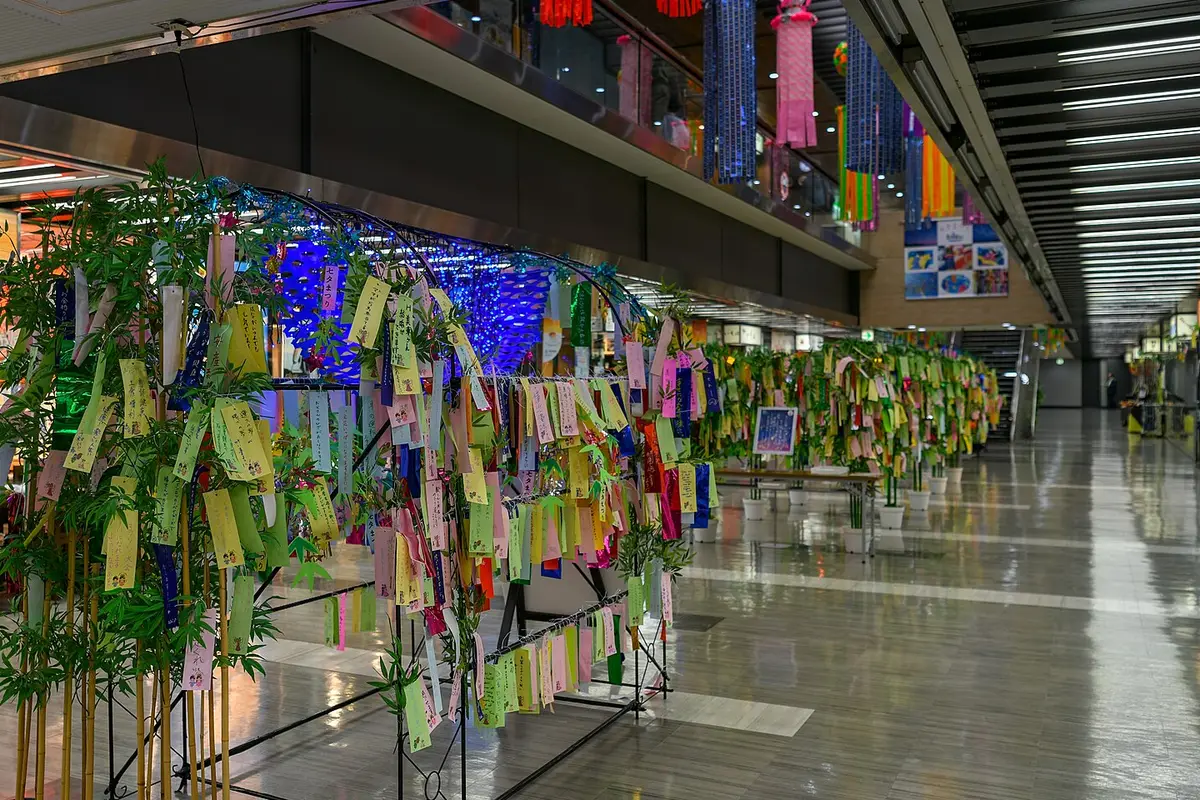
Commercial spaces: Shopping malls, train stations, and supermarkets put up bamboo branches every July, creating the only tanzaku-writing opportunity most adults encounter. These aren't soulless marketing exercises: they're the places where adults reconnect with a childhood ritual.
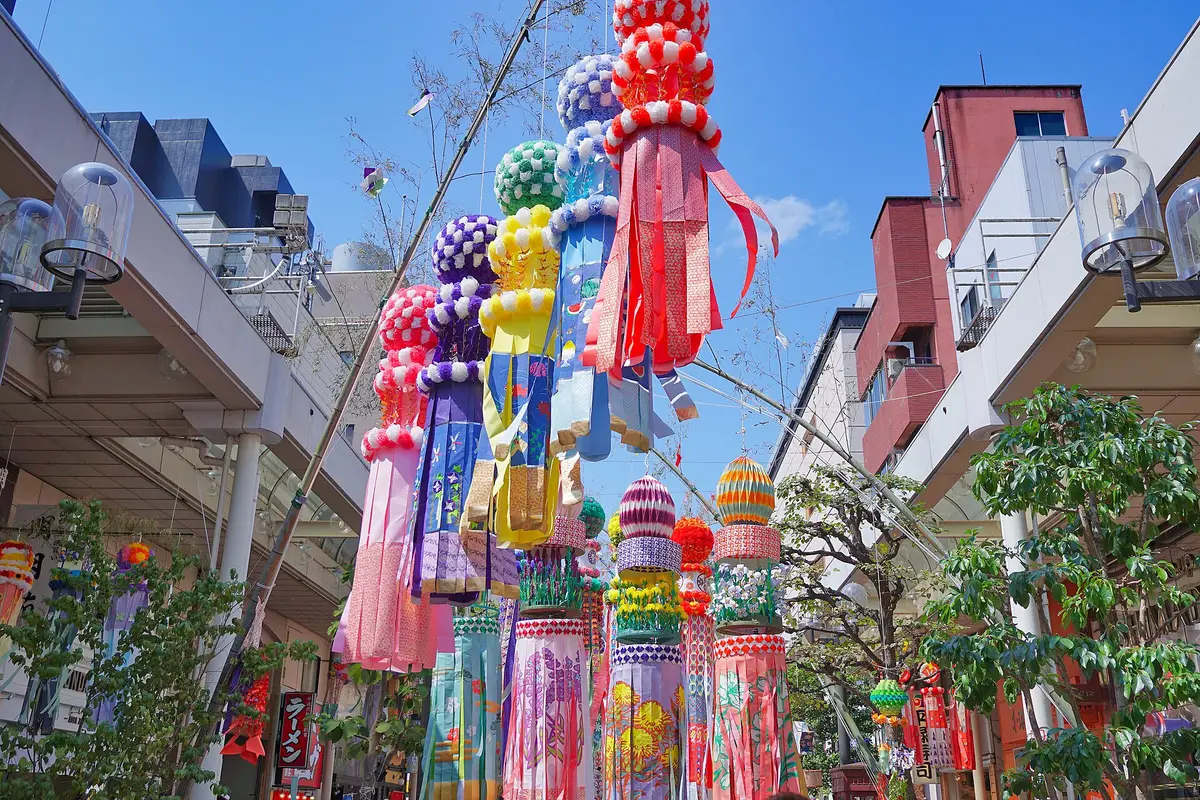
Major festivals: The Sendai Tanabata Festival draws over 2 million visitors with 400 years of history. Hiratsuka's festival attracts 3 million. These massive celebrations (born from community pride and, in Hiratsuka's case, postwar recovery) prove that Tanabata's communal spirit is far from dead.
And here's where you come in. When a visitor picks up a tanzaku at a shopping mall display and writes a wish, they're doing something that most Japanese adults in the same mall have stopped doing. Your participation isn't intrusive. It's a gentle reminder of something cherished. Seeing you write a wish might be the nudge that makes a Japanese adult think: maybe I should write one too.
七夕から読み取れるメッセージの一つに、「今日ぐらいは労働をやめて、恋人との逢瀬を楽しもうよ」というメッセージがある。これは労働に追われる現代人にピッタリのメッセージではないか。 One message of Tanabata is: "At least for today, stop working and enjoy time with your loved one." Isn't this the perfect message for modern people consumed by work?
💡 Why the paradox matters for you
Your tanzaku wish carries more weight than you'd think. In a country where most adults have quietly stopped writing wishes, a foreign visitor picking up a pen and participating, in any language, is a small act of cultural revival. You're not joining a crowd. You're reminding people that the tradition is worth returning to.
What Japanese People Wish For (And How It Changes With Age)
Tanabata wishes are a mirror of Japanese society: honest, practical, and quietly moving. Here's what people actually write when they think the stars are listening.
Children write with the fearless specificity that adults envy:
「プリキュアになれますように」「ニンテンドースイッチがほしい」 "I want to become Precure." "I want a Nintendo Switch."
76.4% of elementary students say they look forward to Tanabata. For them, it's still pure magic: you write a wish, you hang it on bamboo, and maybe the stars will help.
Adults write with a different kind of honesty. In a kufura (Shogakukan) survey of 500 adults, the number one wish was money: over 30% wanted to write something about financial security. But the wishes parents write at their children's school events are where the real tenderness shows:
保育園の短冊を見ると、子供は「プリキュアになれますように」「ニンテンドースイッチがほしい」、親は「有給が消化できますように」「腰痛が治りますように」。リアルな願いが並ぶのが面白い。 Looking at daycare tanzaku, kids write "I want to be Precure" or "I want a Nintendo Switch," while parents write "I hope I can use all my paid leave" or "Please let my back pain go away." The realism is amusing.
A survey of 200 fathers revealed wishes that are quietly beautiful:
「家族の笑顔がいつまでも絶えませんように」「妻がのびてないラーメン食べられますように」「我が子2人のケンカが少し減りますように」 "May my family's smiles never fade." "I hope my wife can eat ramen before it gets soggy." "I wish my two kids would fight a little less."
Older Japanese people shift to something broader. In multiple surveys, the most common wishes for those over 60 were health and world peace. One voice captured the entire arc:
昔はたくさんお願い事があったけど、今は自分もみんなも元気で平和ならそれが一番の幸せ。 I used to have so many wishes, but now the greatest happiness is just everyone being healthy and at peace.
The Japanese wish lifecycle tells a story: from I want a guitar to I want love to I want my family to be healthy to I want the world to be at peace. Desires shrink inward as a child, expand outward as an adult, and finally dissolve into something universal.
One unexpected development: In 2024, July 7 surpassed Christmas Eve as Japan's most popular day for marriage proposals. The Orihime and Hikoboshi love story, two people separated by the Milky Way who find their way back to each other once a year, has given Tanabata new life as a day for couples. Romance, it turns out, may be what keeps this ancient tradition alive.
The Generation Thread: Tanabata Through the Ages
The way different generations remember Tanabata reveals a tradition in transition: fading in some places, surviving in others, and finding new forms no one expected.
Grandparents remember a Tanabata that no longer exists. Their memories carry traditions that have largely disappeared from modern Japan:
半世紀前の頃は七夕飾りは川に流していました…母が作ってくれたホカホカのお団子を頬張りながら Half a century ago, we used to float our Tanabata decorations down the river... while eating the warm dango my mother made for us.
幼き頃は決まって祖父が朝早くに竹を切って来て…今では行われてはおりませんが。 When I was young, my grandfather would always cut bamboo early in the morning... but it's no longer practiced nowadays.
子供の頃の七夕は、浴衣姿に提灯と手提げ袋を持って「竹に短冊七夕祭り〜♪」と歌いながら町内の家々を訪ねて歩きました。知っている家でも知らない家でも子供が来たら用意しておいたロウソクとお菓子を渡します。 As a child during Tanabata, I'd walk through the neighborhood in a yukata carrying a lantern and bag, singing "Bamboo and tanzaku, Tanabata festival~". Every house, whether we knew them or not, would give candles and sweets to visiting children.
That last tradition (children going door to door on Tanabata night, like a Japanese version of trick-or-treating) has almost completely vanished. But the adults who remember it carry it as one of their most precious memories.
Parents re-engage through their children, and then lose it again. The 30-something age group shows the highest Tanabata celebration rate at 15.4% (Hakuhodo), driven almost entirely by having young children in daycare or elementary school. When the kids bring tanzaku home, parents are pulled back in:
保育園から短冊を持って帰ってくる季節。親としては何を書けばいいか毎年悩む。子供の分はいいけど、「保護者の方もどうぞ」と言われると困る。 It's that season when the kids bring tanzaku home from daycare. Every year I agonize over what to write. The kid's one is fine, but when they say "parents are welcome to write too," I'm stuck.
Once children grow past elementary school, parent participation drops sharply. The 50-something age group has the lowest celebration rate at just 2.9%.
Young adults have the weakest connection, but they're not hostile to it. 67% of young men do nothing for Tanabata. Among young women, participation is slightly higher. But one young voice offered a perspective that surprised us:
七夕は商業化されていないのが逆にいい。クリスマスやバレンタインと違って、お金を使わなくても参加できる。短冊と願い事だけ。 What's actually nice about Tanabata is that it hasn't been commercialized. Unlike Christmas or Valentine's Day, you can participate without spending money. Just a tanzaku and a wish.
This is the thread that connects all generations: Tanabata's power lies in its simplicity. No expensive gifts, no elaborate preparations, no social pressure. Just paper, bamboo, and a moment of honest hoping.
Your Tanabata Guide: Where, When, and How
Where to Find Tanabata Displays
You don't need to hunt for Tanabata. During late June through early July, bamboo branches with tanzaku strips appear almost everywhere:
- Shopping malls: The most accessible option. Most provide free tanzaku and pens right next to the bamboo display. No one will look twice if you pick one up and write.
- Train stations: Larger stations often set up displays in their concourses. Some provide tanzaku; others are for admiring.
- Shrines and temples: A more traditional setting. Visiting temples and shrines covers general shrine etiquette, but tanzaku displays at shrines are welcoming to everyone.
- Department stores and supermarkets: Especially in residential neighborhoods, these often have small bamboo branches near the entrance.
- Hotels and ryokan: Many accommodations set up displays for guests, often with multilingual instructions.
The Big Festivals
If you want the full Tanabata experience, three festivals stand out:
| Festival | When | Where | Scale |
|---|---|---|---|
| Sendai Tanabata | August 6-8 | Sendai, Miyagi | 2M+ visitors, 400+ years of history |
| Hiratsuka Tanabata | Early July | Hiratsuka, Kanagawa | 3M visitors, postwar recovery symbol |
| Shonan Hiratsuka | Early July | Near Tokyo | Easy day trip from Tokyo |
Note that Sendai's festival follows the old lunar calendar and falls in August, a month after July 7. If you miss Tanabata in Tokyo, Sendai gives you a second chance.
For summer festivals in general (the food stalls, the energy, the community spirit), How to Blend In at a Japanese Summer Festival has everything you need.
How to Write a Tanzaku
- Find a tanzaku strip: Usually available next to the bamboo display. They come in multiple colors (traditionally, each color has a meaning based on Chinese five-element theory, but nobody enforces this). Pick whichever color you like.
- Write your wish: In any language. One wish per strip is standard. Be as specific or as general as you want.
- Hang it on the bamboo: Thread the string through the hole at the top of the strip, and tie it to a branch. The higher branches are symbolically "closer to the stars," but any spot is fine.
What to wish for: Anything. Health, love, success, travel, peace. Japanese adults wish for paid leave and back pain relief. Kids wish for Nintendo Switches. There are no rules about what counts as a proper wish.
What NOT to worry about: Your handwriting. Your grammar. Your language. Whether you're "doing it right." The tradition has survived a thousand years of imperfect wishes. Yours will fit right in.
Tanabata Food: Somen Noodles
The traditional Tanabata food is somen: thin white noodles served cold. The noodles are said to represent the Milky Way, or the threads that Orihime weaves. If you're looking for an authentic Tanabata experience beyond tanzaku, ordering somen at a restaurant on July 7 is a nice touch, though this tradition isn't widely known even among Japanese people.
More Japanese Perspectives
Tanabata is one piece of Japan's rich summer season. If you're visiting during July and August, these articles explore other ways Japanese people welcome visitors:
- How to Blend In at a Japanese Summer Festival →: What 325 Japanese people said about foreigners at matsuri
- Japanese Fireworks Festivals →: The meaning behind "tamaya" and why shouting it makes locals smile
- Best Time to Visit Japan →: When to come, what each season offers, and what Japanese people recommend
- Visiting Temples and Shrines →: Shrine etiquette and what happens when you treat sacred spaces as sacred
Share Your Tanabata Experience
Have you written a tanzaku wish in Japan? Did someone help you? Did you see a wish that made you smile?
Sources
Surveys and Statistical Data
- Hakuhodo Institute of Life and Living, "Life Reference Point" survey (1992-2024): Tanabata celebration rate 7.2% of adults: seikatsusoken.jp
- Sirabee survey (May 2024, 706 respondents): Fewer than 30% of adults make Tanabata wishes: sirabee.com
- @nifty survey (2016): 65% do "nothing special" for Tanabata: chosa.nifty.com
- MyVoice survey (2015): About 80% of households do nothing special: myvoice.co.jp
- Kids@nifty (2025): 90.7% of elementary/middle schoolers write tanzaku
- SES Plus survey (2025, 209 respondents): Top wishes are health, peace, and money: prtimes.jp
- kufura / Shogakukan survey (500 adults): Over 30% want to write about money: kufura.jp
- B-Style Group survey (500 working mothers): 47.4% have no Tanabata plans: bstylegroup.co.jp
- Papa Shirube survey (200 fathers): Family-oriented wishes: papashirube.com
- Loyalty Marketing / Ponta survey (2022, 993 respondents): Top wishes health, peace: biz.loyalty.co.jp. Superseded by the 2025 SES Plus survey above for current wish trends.
- Mpac Marketing Pack: Adult celebration rate 30.6% vs children 71.2%: fgn.jp
- PR TIMES: About 80% know Tanabata origins: prtimes.jp
- shitakoe.com: July 7 surpassed Christmas Eve as top proposal date in 2024: shitakoe.com
Cultural and Festival Sources
- Sendai Tanabata Festival Official: 400+ year history, 2M+ annual visitors: sendaitanabata.com
- Hiratsuka City Official: Postwar recovery festival, ~3M visitors: city.hiratsuka.kanagawa.jp
- Diamond Online: Tanabata as "tree of earthly desires": diamond.jp
- JMLA (Japan Marketing Literacy Association): Tanabata commerce potential: marketing-literacy.org
Voice Sources
- Public Japanese Q&A sites, forums, and social posts: first-hand opinions on foreigners writing tanzaku, writing in imperfect Japanese, and Tanabata memories
- grape: German friend's letter in Japanese
- Chunichi Shimbun: Tanabata event at multicultural center (Nabari, Mie)
- Chofu International Friendship Association (CIFA): 13-country children's Tanabata event
- KJS Tokyo Japanese School: Foreign students' tanzaku wishes
- nipponbiyori.com: Festival international exchange experiences
- hontaka.jp: Elderly Tanabata memories
- silver-soken.com: Reminiscence therapy Tanabata memories
- ikumemo.com: Daycare tanzaku observations
Note on Quotations
Quotes from online platforms have been lightly edited for readability (fixing typos, formatting for clarity). The meaning and intent of each comment remain unchanged. Original sources are linked above.
This article is available in languages covering 95%+ of visitors to Japan (based on JNTO 2025 data). Need another language? Let us know through Voice Box.
WMJS is written in Japan, in English, with AI help. We check every page, but English is not our first language. If a sentence reads oddly, tell us. One sentence is enough.
Thank you. A person reads every note.
How well do you know Japan?
Built from 635 public posts by Japanese people
Want to know more? Ask Japanese people
Have a follow-up question about this topic? We'll ask real Japanese people.
Voice Box →