
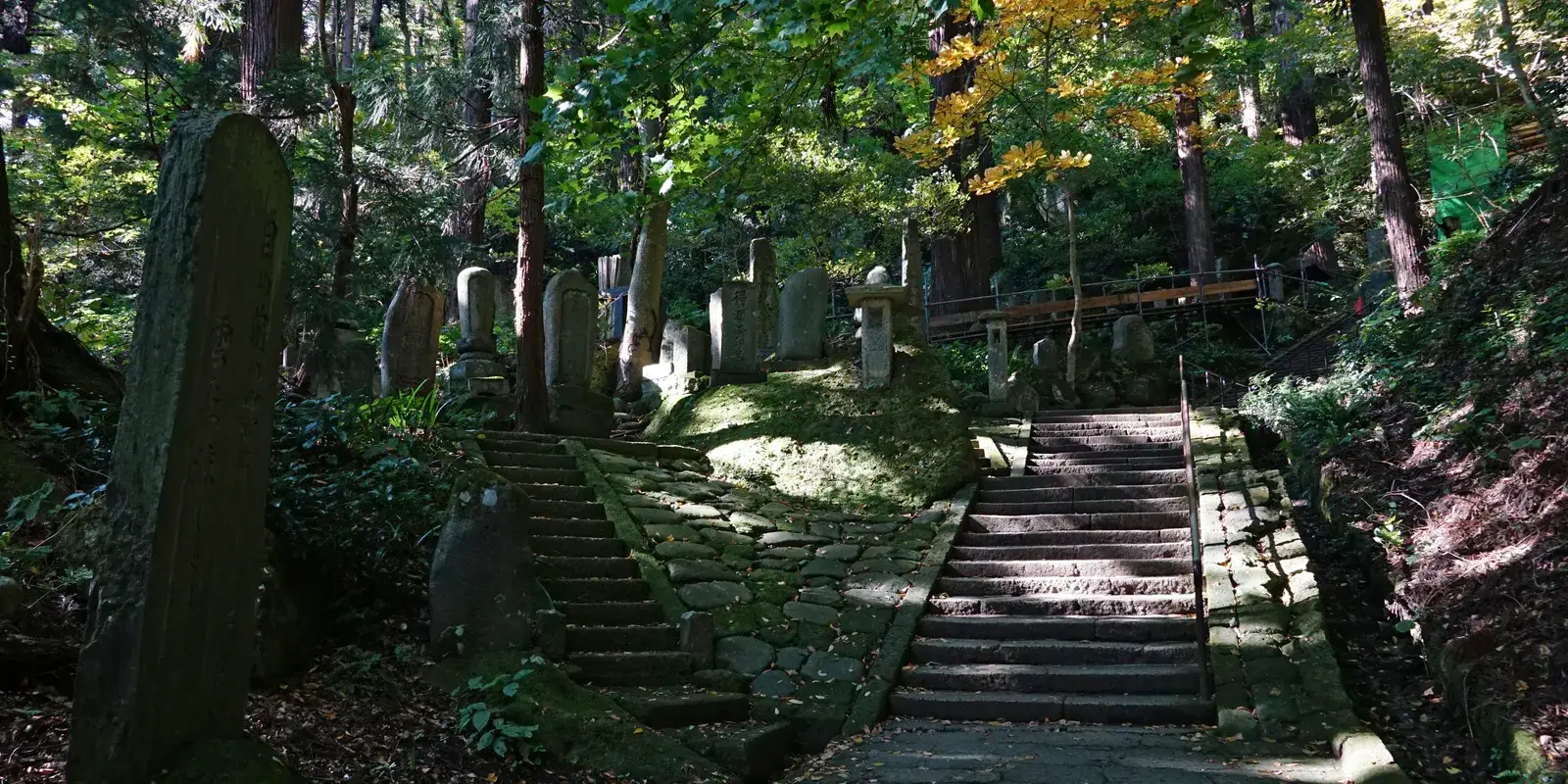
Is Yamadera Worth It? What 1,015 Stone Steps Are Actually For
Yamadera comes with a warning label built into every description of it: to reach the temple, you climb 1,015 stone steps up a cedar-covered mountainside in Yamagata, and there's no shortcut, no cable car, nothing but your own legs. People read that number before they've seen a single photo of the place, and some of them quietly drop it from the itinerary rather than find out the hard way whether it's worth a day of a short Japan trip.
Among travelers who make the climb, that hesitation mostly doesn't survive contact with the mountain. What follows is less about convincing you of that than about showing you why, in their own words, and in the words of the Japanese visitors who climb the same stairs for reasons that turn out to be a little different from yours.
Is the climb worth it? (in travelers' own words)
We collected what international travelers who've climbed Yamadera say about it, on Reddit and TripAdvisor. Counting each voice once, here's the shape of it:
Of the 58 foreign voices we gathered, 5 landed on the red side, and it's worth reading what they are about. One visitor had gone expecting an evening illumination at the top and found the lighting underwhelming once night fell and the halls had shut, admitting the moment "wasn't what we'd expected... a real let-down compared with what you can see in Kyoto." Another second-guessed the whole trip afterward: "Perhaps I had my expectations too high from online reviews or it could be due to the crowds during our visit to Yamadera, but we were underwhelmed..." A third, answering a traveler who asked whether Yamadera was worth it without the climb, advised against the detour unless you commit to going all the way up: "There is not much around the base, I'm afraid... Better go to Matsushima instead." The other two red comments, both from one traveler, are about a rainy day. None of the five describe the stairs themselves as the problem. The letdown sits somewhere else: rain, a base with little to see without the climb, or a specific expectation, built before arrival, that the mountain didn't match.
The green side has more texture than "nice temple, good view." One traveler had nearly written the day off before starting: "I was on the verge of saying 'enough temples, skip!' but I'm so glad I came." Another put language on something that surfaces in several of the positive reviews: "Yes, there are over 1,000 steps to get to the temple complex. But the climb itself is well worth the effort... It's the journey not the destination." A visitor from Munich, joking about the missing escalator, still finished all 1,015 steps and called it a must-visit. For several of these travelers, the climb turned out easier than the number suggested and became part of the reason they're glad they came.
How Japanese climbers feel about the same stairs
Most guides never show you what Japanese visitors write about Yamadera on the review sites they use to plan their own trips. We went and collected those too.
Line the two gauges up and the gap is worth sitting with. Of the 58 foreign voices, 5 (9%) came away disappointed. Of the 146 Japanese voices, barely 1%, a single review, did, and even that one wasn't really about the stairs. The group climbing the exact same 1,015 steps with the least doubt about whether the day was worth it is the one that already knows the mountain by reputation before they arrive.
Part of the answer is in how Japanese reviewers talk about the climb itself. "I climbed slowly, feeling the silence and listening to the cicadas, shaking off worldly attachments," one wrote, using a word for the small cravings and irritations Buddhism calls bonno. Another, doing rough math on the slope's steepness, ended up putting the whole experience almost like an equation: "The view is worth exactly the labor of climbing all the way up." One reviewer, who had driven their 76-year-old mother from the airport because she wanted to see Yamadera, wrote simply that they wanted people to visit "while they still have the stamina." One climber who had just turned 70, five years after their last climb, went back specifically to test whether their legs could still do it, made it to the top, and decided to keep climbing as a measure of their legs and stamina, for the cicadas in summer, the autumn leaves, and the snow in winter. For reviewers who talk about the stairs this way, the hardship is not only the entry fee for the view. It is part of what they came for.
What we wish you'd noticed
The 1,015 comes from the temple's own precise count. Risshaku-ji's own guidance counts the steps exactly, and the number shows up unprompted in visitor reviews, the way a hard number sticks with people: one traveler wrote that the stairs "make you hesitate for a moment" before you start, "but the steps are low and there are handrails, so I managed to climb it." Budget roughly 30 to 40 minutes climbing one way at a steady pace; the temple's own guidance puts the full round trip, stone steps the whole way, at about an hour and a half.
Risshaku-ji predates almost every building you'll pass through its gates. The temple was founded in 860 by Jikaku Daishi Ennin, the third head priest of the Tendai sect. Its main hall, Konponchudo, is built of beech wood and is believed to be the oldest building of its kind still standing in Japan. Inside it burns what's called the eternal light of Buddhism, a flame carried over from the head temple Enryaku-ji at the mountain's founding and said to have been kept lit ever since.
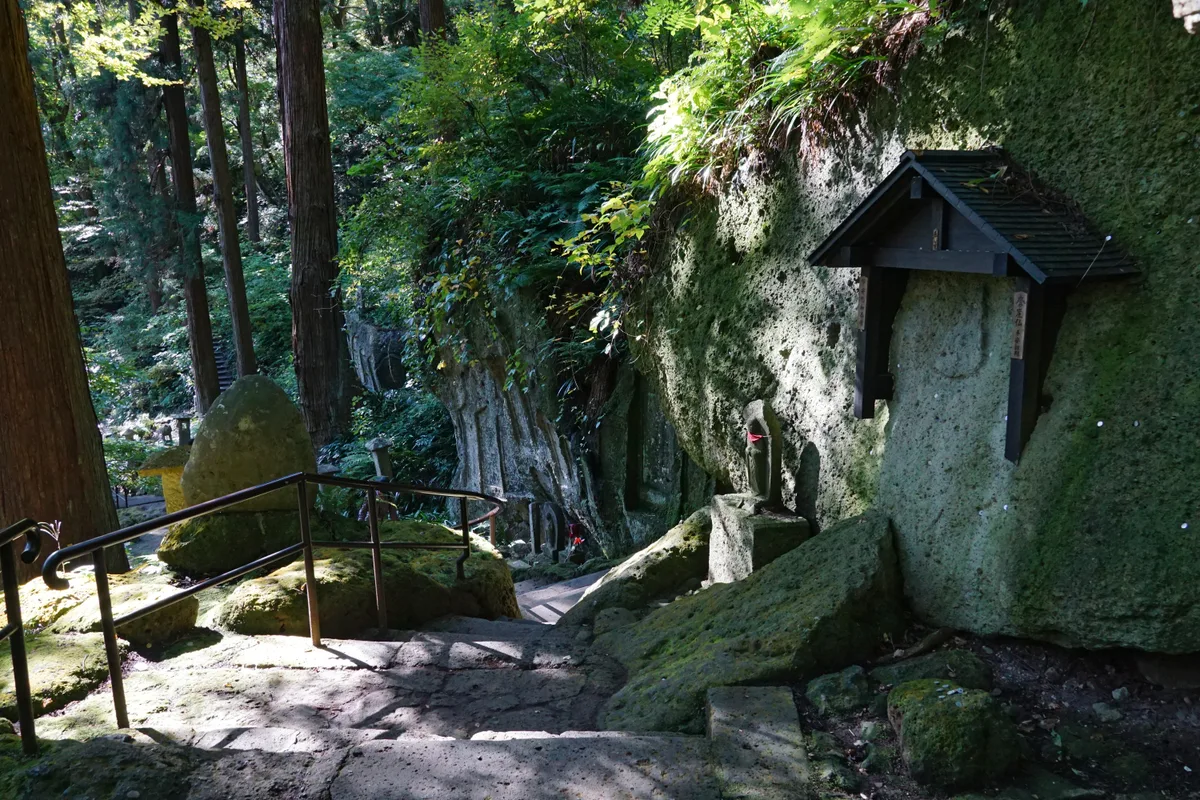
This mountain also produced one of the most famous lines in Japanese poetry. In 1689, Matsuo Basho climbed Yamadera and wrote shizukasa ya, iwa ni shimiiru, semi no koe, "such stillness, the cicadas' cry sinking into the rocks." A monument to the poem stands partway up the mountain, and outside peak hours, in the gaps between visitor groups, the forest still gets quiet enough for the line to make literal sense.
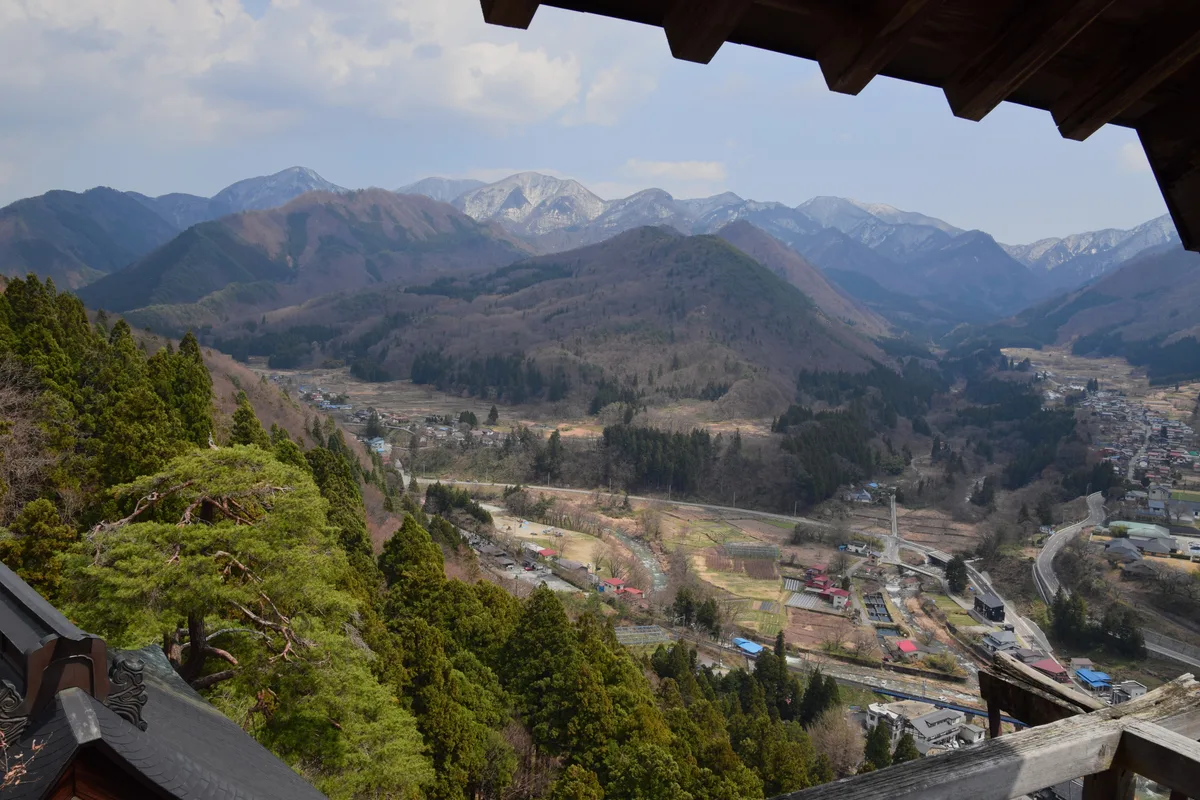
The famous view is from Godaido, a hall below the true summit. The scene everyone photographs, looking down over the Tachiya river valley and the town you started in, comes from a hall built out over the cliff edge near the summit, reached by a side path close to Kaisando Hall. Godaido and Okunoin, the innermost hall, are separate stops, and the side path is easy to miss: one Japanese reviewer couldn't find the way to the viewpoint and left without seeing it. Godaido is the one worth building your schedule around.
Admission is 500 yen for an adult, as of Risshaku-ji's own fee revision effective April 2025, paid in cash at the Sanmon gate where the climb proper begins; the lower precincts below the gate, Konponchudo included, carry no admission fee, though praying inside Konponchudo's inner sanctum costs a separate 200 yen. Reviews written before the revision still quote 300 yen, a figure the temple's current notice has superseded.
Doing it well, the welcomed way
Pace yourself against your own legs rather than the person passing you on the stairs. Several Japanese reviewers single out the walk back down, not the climb up, as the part that is hardest on the legs, and two trace their next-day soreness to it; one describes legs holding steady on the way up and only starting to shake once they're back at the bottom. Wear proper shoes rather than sandals, since the steps are uneven stone and can be wet or icy depending on the season, and carry water and a small towel, especially in summer when the open stretches near the top get hot fast.
If stamina or time is limited, build the day around Godaido rather than Okunoin; it's the hall with the view nearly every photo of Yamadera is showing you. Go early, and on a weekday if your schedule allows it. Reviewers on both sides of the gauge keep naming crowding, more than the stairs themselves, as the thing that can sour an otherwise good visit.
Match your footwear to the season: autumn brings the foliage and, on holidays, heavy crowds, spring brings cherry blossoms, and winter means genuinely icy steps, best handled in boots with real grip rather than regular sneakers.
And pay attention to who else is on the stairs with you. One traveler described the pull of climbing alongside strangers doing the same 1,015 steps, calling out the mutual "ganbatte" encouragement passed between climbers as part of what made the climb worth it. A separate visitor from Stuttgart, climbing the same route, put a similar feeling in different words: "It is always fun to climb with the Japanese as they appreciate a foreigner joining them." For half an hour on those stairs, you're not a spectator at someone else's custom. You're inside it.
Is it worth it, in the end? The stairs are real, the weather on any given day isn't guaranteed, and 5 of the 58 foreign voices we read came away let down, four of them because of rain or because of what they'd pictured beforehand. Against that: a flame that's reportedly burned since 860, a haiku that's still true if you time your visit right, and a staircase that the people who actually climb it, foreign or Japanese, overwhelmingly say was worth it, with some describing the climb itself as part of the point of the day rather than only the price of admission to it.
Weighing Yamadera against everything else on a short Tohoku itinerary? What actually matters in Japan is a good place to sanity-check the rest of your list.
Sources
- Risshaku-ji (Yamadera), official site, Visiting: the exact step count (1,015), current admission fees (500 yen adult, revised April 2025; 200 yen for Konponchudo's inner sanctum; visitor reviews from before the revision cite the prior 300 yen), the climbing route and its halls (Konponchudo, Niomon, Godaido, Okunoin), the Basho and Sora statues, and his haiku.
- Travel Japan (Japan National Tourism Organization), Risshakuji Temple (Yamadera): founding in 860, the "eternal light of Buddhism" at Konponchudo as the oldest beech-wood building of its kind in Japan, Basho's connection to the site, and a climb time of 30-40 minutes to the top.
WMJS is written in Japan, in English, with AI help. We check every page, but English is not our first language. If a sentence reads oddly, tell us. One sentence is enough.
Thank you. A person reads every note.
How well do you know Japan?
Based on 51,218+ real Japanese voices
Want to know more? Ask Japanese people
Have a follow-up question about this topic? We'll ask real Japanese people.
Voice Box →