
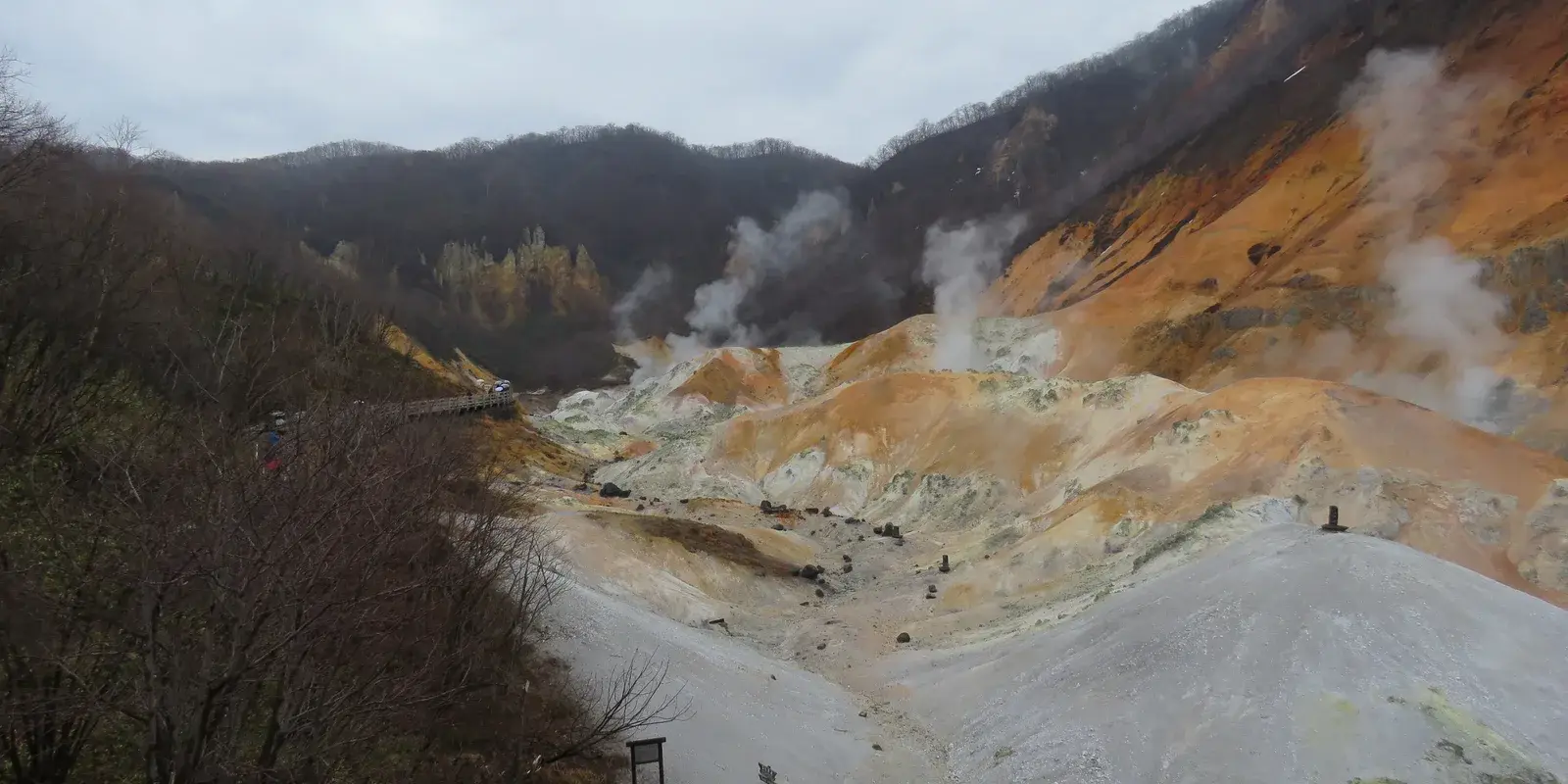
Is Noboribetsu Worth It, or Just a Steaming Valley You Photograph and Leave?
Noboribetsu is Hokkaido's most famous hot-spring town, and the honest question travelers ask is rarely whether the hot springs are good. It is whether the place is worth building a trip around, or whether you should just drop by, snap the smoking valley, and move on. One visitor who had been the week before put the doubt bluntly: "Honestly, there is nothing much to see there. U could just hang around at the entrance for a quick photo and leave." Another reduced the whole place to its baths in a single line, describing the "Whole experience" as "the Onsen soaking" with "not much of a town" around it.
Read the two lines again and you can already feel where the disappointment comes from. Both treat Noboribetsu as a sight to look at. The people who came away happy almost never describe it that way. And the Japanese who visit, some of them for the tenth time, barely hesitate at all, because they know the thing a quick photo misses. That smoking valley is the town's boiler. The hot-spring water welling out of the crater is piped straight into the baths of the hotels around it, which is the whole reason the town is here.
Is it worth it? (in visitors' own words)
We gathered the voices of international travelers who have actually been to Noboribetsu, from English-language travel boards and from Taiwanese forums, and read them for one question: was it worth it? Weighted by how strongly each opinion landed with other readers, here is how they fell.
The split here is unusually even, and the reason is worth slowing down for, because the green and the neutral bands are answering the same question with a different plan. Almost everyone agrees the town is small. Where they part is what they did with it. The people who reduced Noboribetsu to its sights ran out of things to do fast, which is exactly what the neutral band keeps saying: the valley, the pond and the footbath "only takes about 1 hour," and "Day is all you need." Said flatly like that, it sounds like faint praise. Said by the people who loved it, the same brevity becomes the whole point, because they did not come to sightsee. They came to sink into the water.
That divide plays out almost word for word in one exchange. When someone summed the place up as "not much of a town," another traveler pushed back directly: "I wouldn't say the whole experience is the onsen soaking tbh. There's Jigokudani which looks otherworldly and is certainly worth a visit, plus footbaths and little fun sights sprinkled throughout... the sights are genuinely fun and incredible even if there aren't many." The ones who stayed overnight are the least conflicted of all. One counted it out happily: "soaking in the onsen outdoors in below-zero weather felt amazing. Over these 3 days 2 nights I soaked a total of 6 times. Really so worth it." Another said the quiet luxury of it plainly, an open-air bath "while drinking a cold beer, with heavy snow falling overhead."
The thin red band is honest and it deserves reading, because most of it is a mismatch rather than a bad place. The sharpest complaint is the smell: "If your sensitive to sulphite, don't do it. Whole town smells like it." That is a real warning, and the sulphur is genuinely strong near the valley. A couple of voices found the town quiet after dark, "the town seemed dead at night." And one simply objected to the bill: "No. It's expensive." Every one of those is true, and every one of them describes the town of someone who treated an onsen resort as a checklist stop, when it is built to be a slow, warm night.
How the people who grew up with it feel
Here is the layer a guidebook skips: what Japanese visitors write about the same valley and the same baths in their own reviews. The warmth runs much higher, and the doubt about whether it is worth it simply is not there.
Set the two gauges next to each other and the gap opens where you would least expect it. Foreigners spend a seventh of their verdict feeling let down. In the Japanese reviews the disappointment is almost nothing, and the reason is that they are looking at the valley through completely different eyes. Where a first-timer sees a smoking field to photograph, a Japanese visitor sees the source. One who returns again and again wrote it simply: "once you actually reach Jigokudani, it truly moves me every time, even on this 10th visit." Another, from the Kanto region, measured it against the famous valley near Tokyo and did not blink: "I've been to Owakudani in Hakone many times, but it's nothing compared to the power of Noboribetsu's Jigokudani."
The most telling review names the mechanism the foreign doubters miss. It is, one visitor wrote, "a mountain where hot spring water gushes out, and you can see it much closer up than at Owakudani," and standing there they felt "overwhelmed by the blessings of the earth." The valley is the engine of the town, the thing making the baths themselves. The Japanese candor is in the neutral band, and it is fair: one wished "both the onsen town and the walking trail could have a bit more atmosphere," and another, back after thirty years, felt it had "become more developed... but somehow the old days felt more natural." Real notes, from people who still rated the day warmly.
What actually makes it worth it
Everything the gauges agree on points the same way. Noboribetsu rewards the visitor who comes to soak, and treats the valley as the wonder that feeds the soak.
The water is the reason, and it comes straight from a volcanic vent. Noboribetsu is the most famous onsen town in Hokkaido "for good reason," as one traveler put it: "the water quality is incredible." This is a town built directly on top of a working volcanic vent, and the sheer output, about ten thousand tons a day across many different spring types, is why a single ryokan here can offer you a dozen different baths under one roof. The people who understand that before they arrive are the ones who arrive already knowing what to do with it.
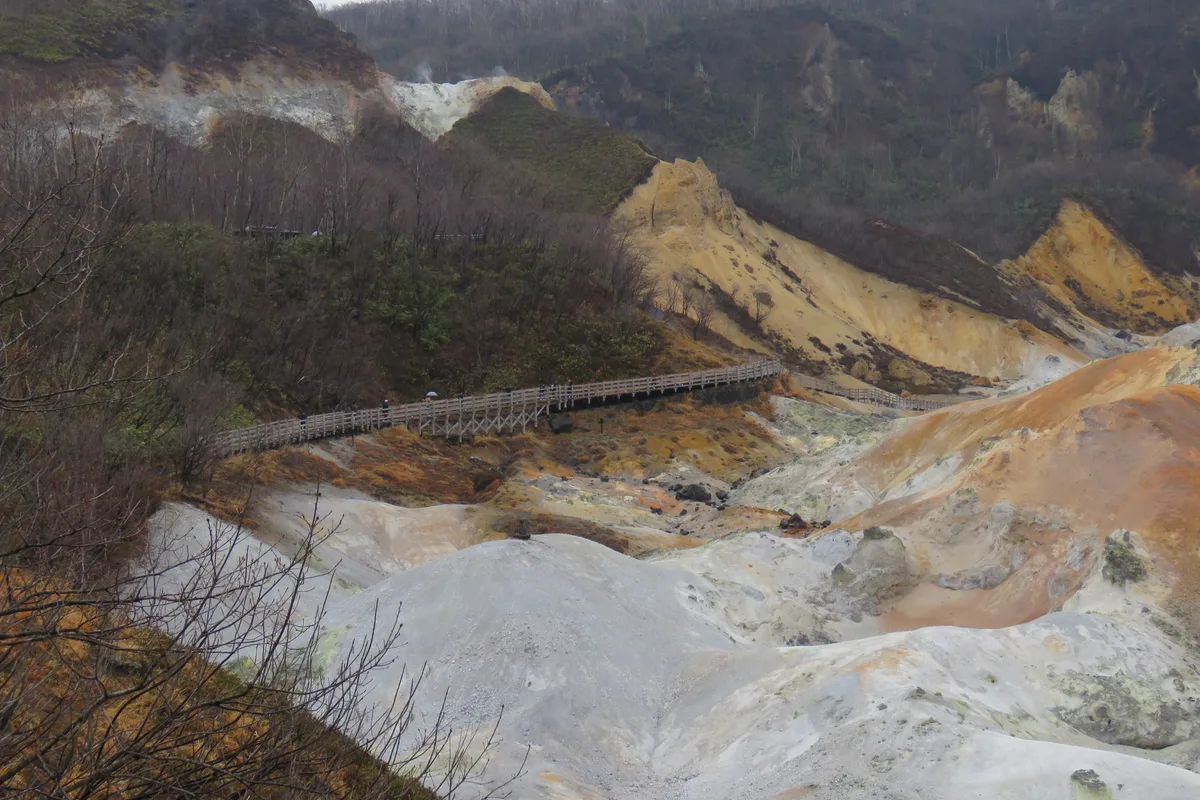
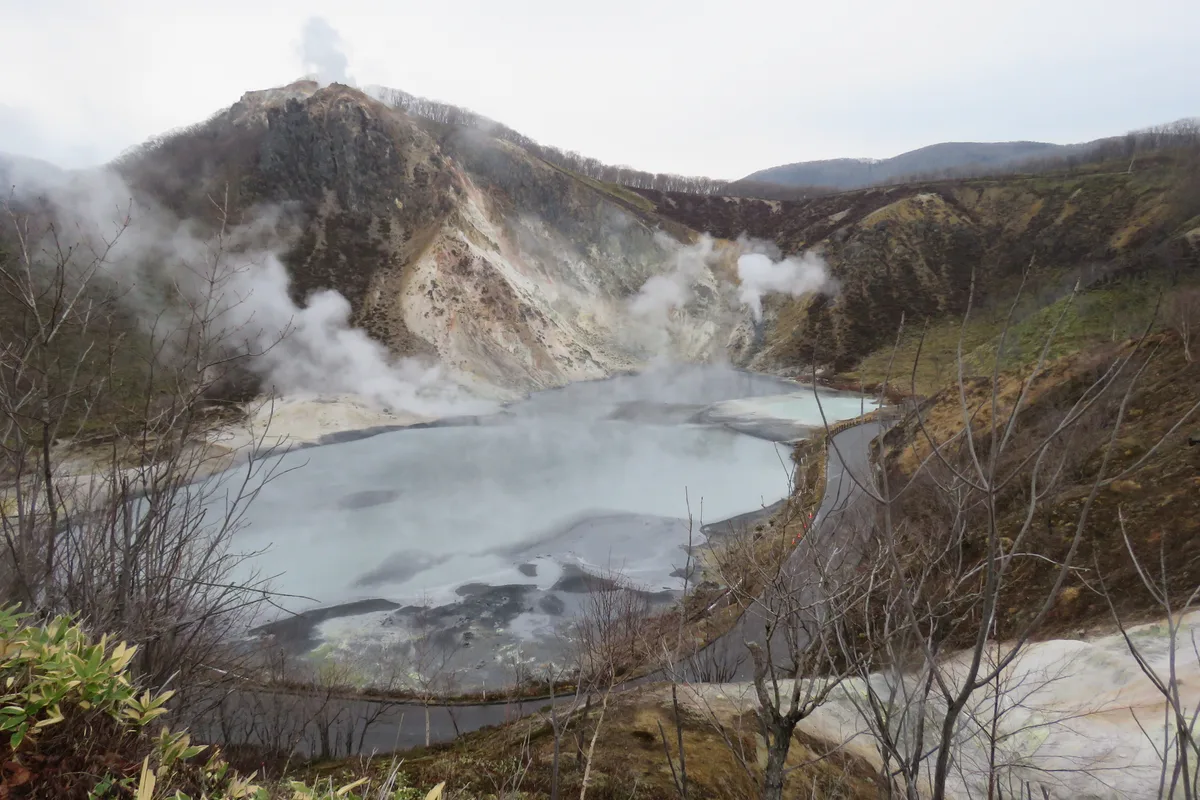
Jigokudani is the boiler, and it is best seen slowly and twice. The crater is a bare, reddish moonscape of vents and bubbling pools, and its name, meaning Hell Valley, comes from that steaming, hellish ground. Walk it slowly, past the entrance photo, and it changes character through the day. Japanese reviewers love it most at night, when the boardwalk is "softly lit by foot lights," giving "a fantastical nighttime Jigokudani... a different face by day and by night." Up the forest trail beyond the valley lies Oyunuma, a gourd-shaped crater pond where a sulphur spring boils at around 130°C below a grey-black surface, and a natural hot-spring stream feeds a free footbath in the forest.
It is compact on purpose, which is a feature once you stop rushing. The town is small enough to walk end to end, and its own visitors say so without complaint, because the point was never distance covered. As one put it, the shopping streets are "indeed small and you can walk through them quickly," yet the valley is "well worth... slowly taking in." Give it an evening and a morning and there is more than enough: the valley twice, the geyser in Sengen Park that erupts with sound and steam roughly every three hours, Oyunuma, and the long soak in between.
Doing it well: the welcomed way
All of it turns into a short, forgiving plan, built around the one thing both gauges quietly agree on: the town is small, and the soak is what you plan for.
- Stay a night if you possibly can. This is the single fix for almost every let-down in the red band. The day-trippers who found the town "dead at night" left before the best of it. The overnight guests are the ones who soaked six times and called it "really so worth it." An evening and a morning let you see the valley lit up, catch it again in the quiet of first light, and eat a proper kaiseki dinner in between.
- Come to soak, and pick your ryokan by its baths. The water is the attraction, so choose where you stay for its baths above all. Many ryokan offer both indoor and outdoor pools, and some sell day passes to partner baths, so a small town can hold a whole afternoon of bathing.
- Give the valley time, ideally at dusk and at dawn. Do not stop at the entrance photo. Walk the boardwalk out to the geyser and on to Oyunuma, and if you are staying over, return once after dark for the illuminated walk. It is a different place at night.
- Expect the sulphur, and mind winter footing. The smell is strong near the valley, which is worth knowing before you arrive. In winter the boardwalk slopes ice over, and slipping is the most common complaint in the Japanese reviews too, so wear real grip and take the downhill stretches slowly.
- If you truly only have a day, that can still work. Plenty of visitors do Noboribetsu well in an hour or two of sights plus a day-use bath, often on a loop out from Sapporo and paired with nearby Lake Toya. The valley, geyser and footbath really do fit inside an hour. Just go in knowing that the shorter you make it, the more it becomes a look and the less a soak.
So, is Noboribetsu worth it? If you picture a big town of sights, you will run out in an hour and wonder what the fuss was. If you come the way it is meant to be taken, for the rare volcanic water and the slow warmth of a night in it, the steaming valley that makes that water is right outside your window. Give it a night rather than a photo stop, and the travelers who plan it that way are the ones who leave glad.
Still deciding which famous places actually earn a slot on a short trip? We counted sixty of them one at a time. Start with what actually matters in Japan.
Sources
- Noboribetsu International Tourism & Convention Association: Noboribetsu Jigokudani (登別地獄谷). Official record: a blast-crater remnant of the Hiyoriyama eruption, about 450 m across and roughly 11 ha; countless vents and fumaroles; about 10,000 tons of hot-spring water of many types well up here each day and are piped to the town's hotels and ryokan; free admission; a wheelchair ramp runs to the observation deck. Last verified 2026-08.
- Noboribetsu International Tourism & Convention Association: Oyunuma (大湯沼). A gourd-shaped blast-crater pond about 1 km around; a sulphur spring erupts at roughly 130°C at the bottom, with a grey-black surface at about 40–50°C; free; the Oyunuma car park closes in winter.
- Noboribetsu International Tourism & Convention Association: Sengen Park geyser (泉源公園の間欠泉). A park built around a geyser on the hot-spring river flowing from Jigokudani; it erupts with sound and steam at intervals of about three hours; free.
- Noboribetsu International Tourism & Convention Association: Tessen-ike (鉄泉池). A small geyser near the centre of Jigokudani; the hot-spring stream visible from the boardwalk marks the source ground.
- Noboribetsu International Tourism & Convention Association: official site. Noboribetsu Onsen's spring types, spot list, and 30/60/120/180-minute model courses through the Jigokudani area.
WMJS is written in Japan, in English, with AI help. We check every page, but English is not our first language. If a sentence reads oddly, tell us. One sentence is enough.
Thank you. A person reads every note.
How well do you know Japan?
Built from 635 public posts by Japanese people
Want to know more? Ask Japanese people
Have a follow-up question about this topic? We'll ask real Japanese people.
Voice Box →