
Izumo Taisha, Where Japan's Gods Gather to Tie the Threads Between People
Izumo Taisha (Izumo Oyashiro)
By Kei · Born and raised in JapanIs Izumo Taisha worth the trip? By the voices we gathered, mostly yes, with a real caveat about distance: of 60 international travelers who weighed or made the trip, weighted by how much each account resonated with fellow readers, 52% called it worth the detour and only 5% said it wasn't, with the rest split on how to plan the day around it. Japanese worshippers who made the same long journey rate it warmer still, at 61% treasured. It sits off the Shinkansen network on the Sea of Japan coast, so allow half a day at minimum, a full day once you add Inasa Beach, and go on a weekday morning to beat the tour buses. What almost catches every first-time visitor off guard, including where the famous giant rope actually hangs, is further down this page.
The Meaning
There is one month each year when, all across Japan, the gods are said to be away from home. The old calendar calls the tenth lunar month Kannazuki: "the month without gods." Everywhere, that is, except here. On the Sea of Japan coast, the same month has the opposite name: Kamiarizuki, "the month with gods." Because this is where they are said to go.
Izumo Taisha (known formally as Izumo Oyashiro) is one of the oldest shrines in Japan. Its founding reaches back beyond record into the age of the gods, and it appears in the Kojiki (712) and the Nihon Shoki (720), Japan's earliest written histories. The deity enshrined here is Okuninushi no Okami, the Great Lord of the Land. Most travel guides introduce him with a single English word: matchmaking. They call this a love shrine.
That word is too small. The shrine's own teaching is careful about it. En-musubi, the thing Okuninushi is said to tie, is usually translated as matchmaking, but its meaning is far wider. It is the tying of bonds between people of every kind: not only husband and wife, but friend and friend, worker and workplace, the stranger you have not yet met. The shrine describes it as the precious connection that lets all living things flourish together. You do not come to Izumo only to be granted a good romance. You come to honor every bond your life will be made of, including the ones that have not formed yet.
And once a year, in Kamiarizuki, the eight million gods of Japan are said to leave their own shrines and travel here, to this far western coast, to hold a council. The matter they are said to discuss is en: which bonds, in the coming year, should be tied to which. That is the story this place has carried for more than a thousand years. Walk it slowly, and it explains itself.
What Happens When You're There
Step 1: The Approach (A Path That Goes Down to Meet You)
Most shrine approaches climb. This one descends. From the great wooden torii at Seidamari, the main gate at the top, the pine-lined path slopes gently downhill toward the shrine, a rare shape, and the first sign that Izumo does things its own way.
Walk to one side and leave the center of the path open. That middle strip is kept clear for the deities, and keeping to the edge is the quiet courtesy every Japanese visitor performs without thinking. Early on, you will pass a small shrine called Harae no Yashiro, the shrine of purification. Pausing here to be cleansed before you go on is part of the order of the visit: not a rule to pass or fail, but the way the path is meant to be walked.
What you will likely notice next is the quiet. Izumo sits far from the Golden Route, on a coast that most first trips to Japan never reach, and that distance keeps the crowds away. If you have stood shoulder to shoulder in the vermillion tunnels at Fushimi Inari, the contrast is striking: the same Shinto faith, an even older shrine, and yet space to hear your own footsteps. Shimane is one of the least-visited regions in the country, which is exactly why travelers who have already seen Kyoto come looking for it: the places where you are most welcomed precisely because so few have come.
The remoteness is not a flaw to apologize for. In the old stories, this coast is the edge where gods come ashore from the sea. The journey is long because the place was always meant to be at the far edge of things.
Step 2: Four Claps (The Greeting That Belongs to This Shrine)
At the worship hall, the Haiden, you will make an offering and pray. Here Izumo asks something different of you. At almost every shrine in Japan, the form is two bows, two claps, one bow. At Izumo, it is two bows, four claps, one bow.
Travel guides tend to flag this as a trap: careful, it's four here, don't get it wrong. The shrine sees it differently. Four is not a quirk to trip you up; it is this shrine's way of saying hello. The reason, in the shrine's own explanation, reaches up to its grandest rite: at the great annual festival each May, the priests clap eight times, and the number eight has meant the infinite since ancient times, a boundless applause offered to the deity. On ordinary days, that is halved to four. The feeling behind the prayer, the shrine adds, is no different either way.
So you bow twice, slowly. You clap four times. You let your hands come together and your head come down, and you bow once more. If your hands clap twice out of habit and you catch yourself, that is fine. Japanese worshippers do the very same thing here; the extra two claps surprise the locals too. Knowing the difference, and meeting it, is itself a small act of respect for the place. (The wider etiquette of approaching any shrine, including the water basin, the offering, and what to wear, is its own subject, and Japanese people are watching your heart more than your hands.)
Behind the Haiden stands the Honden, the main sanctuary, and it is the tallest shrine building in Japan at about 24 meters. Built in the taisha-zukuri style (an ancient form modeled on early palaces), the present structure dates to 1744 and was designated a National Treasure in 1952. You cannot go inside; beyond the Yatsuashi gate before it, only priests and those receiving special prayers may pass, and most visitors offer their prayers from in front of that gate. This is not a disappointment to manage but a thing to understand: the holiest space is kept apart so that it stays holy. There is a quiet detail worth knowing. Inside, the deity is enshrined facing west, not toward the worshippers at the south gate, so a small worship spot on the western side lets you stand, in effect, face to face with him. Old accounts say the ancient Honden once stood as tall as 48 meters; for centuries that sounded like legend, until excavations in 2000 unearthed the remains of enormous bundled pillars before the gate, and the legend grew harder to dismiss.
Step 3: The Great Rope (Five Tons of Welcome, Twisted by Hand)
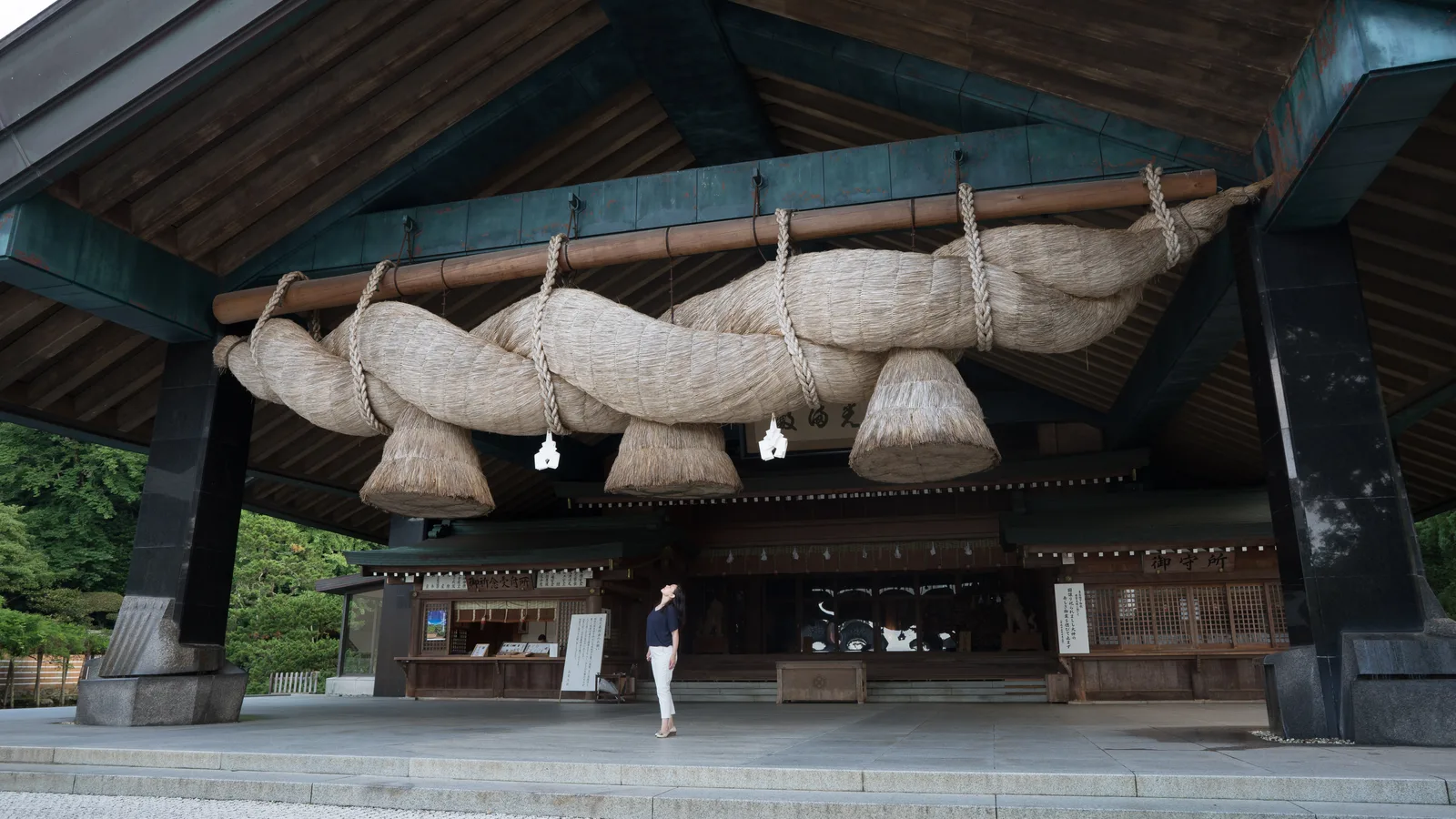
Walk to the Kaguraden, the hall of sacred dance, and you will stop without deciding to. Above its entrance hangs the O-shimenawa, a sacred straw rope so large it changes the scale of everything near it: about 13.6 meters long and weighing roughly 5.2 tons, among the largest in all of Japan. (Do not confuse it with the rope over the worship hall, which is itself substantial at 6.5 meters, but a fraction of this.)
A rope like this is handmade: woven by volunteers in the mountain town of Iinan, and replaced only once every six to eight years or so. Look closely and you will see it is twisted starting from the left: the reverse of nearly every other shrine in Japan, where the rope begins on the right. At Izumo, by long custom, the left side is the place of honor. Even the direction of a twist of straw carries the shrine's particular order of the world.
A shimenawa marks the boundary of sacred ground. You may have heard that tossing a coin up so it lodges in the rope brings luck. Please don't. The shrine is plain about this: the rope is a sacred threshold, not a wishing well, and coins thrown into it are neither lucky nor respectful. If you want to leave a wish, the proper places are waiting: an ema tablet to write on, an amulet to carry. The bonds you came to honor are tied with intention, not with a coin's lucky bounce.
Step 4: When the Gods Gather (The Month the Council Is Held)
Behind the main hall, tucked against the wooded slope, stand two long, low buildings called the Jukusha: "the nineteen shrines," each fronted by nineteen small doors. For most of the year they sit empty. But in Kamiarizuki, they are said to fill: these are the lodgings of the visiting gods.
The story runs like this. On the evening of the tenth day of the tenth lunar month, the eight million deities of Japan come in from the sea and come ashore at Inasa Beach, about a kilometer to the west. Priests light a fire and welcome them, and the gods are led in a long, hushed procession to the shrine, where they stay in the Jukusha. Over the following seven days they hold their council, deciding the bonds of the year to come, and people keep their voices low nearby, so as not to disturb the discussions. These dates move with the moon, not the modern calendar, which is why the gathering that the rest of Japan misses in October falls, in our calendar, in November.
Inasa Beach is part of the visit for many. There is a custom here that confuses almost every first-time visitor, so here is the order of it: you take a little dry sand from the beach first, carry it to the small shrine called Soga no Yashiro behind the main hall, exchange it there for sand that has been kept beneath the building, and carry that home as a quiet protection. Beach first, then the shrine: that is the sequence people miss.
Stand on that shore at dusk, where the sun drops into the Sea of Japan, and the question the place leaves you with is a gentle one. Why here? Why would all the gods of a whole country travel, once a year, to this far and quiet edge of it, to talk, of all things, about who should be bound to whom? Izumo does not press an answer on you. It lets you stand a while with the question, and then it lets you go home. Whether you believe the gods come ashore is, in the end, beside the point; people have walked down to this water to wish for their bonds for a very long time, and the wishing is real whatever you make of the rest.
What Visitors Honestly Say
Before you commit two days to reaching this coast, it helps to hear from people who already made the trip. We gathered voices from international travelers who weighed, or made, the trip out to Izumo, and weighted them by how strongly each resonated with other readers:
The green band is warm and unfussy. "I loved Izumo shrine. Cute bunnies everywhere!" wrote one traveller, and another said plainly: "My wife and I visited Izumo about two years ago, it was well worth our time." The thin red band mostly argues about distance, though one visitor points at a day that ran dry: "I went there via the Sunrise Izumo. Only spent one full day there - not much to do."
Japanese worshippers, reviewing the same long journey in their own words, land even warmer:
Distance shapes these reviews too. "I had wanted to visit for a long time, but because it's so far away I could never quite make it," one wrote, "this year I finally decided now was the time and went." The small red band names the one thing that catches almost everyone by surprise: the great rope people travel for does not hang above the first hall they reach. It hangs at the Kaguraden, a short walk further on.
The full picture, including exactly where that rope hangs and how to plan the day around it, is in Is Izumo Taisha Worth It?
Good to Know
Getting there: Izumo sits on the Sea of Japan coast, off the Shinkansen network, so reaching it takes a little planning. Several routes lead in. The simplest first leg is by air: Izumo Enmusubi Airport ("Izumo connection-of-bonds Airport") has a direct connecting bus to Izumo Taisha (about 40 minutes, ¥1,100, on limited services matched to flights), and a more frequent bus to JR Izumo-shi Station (about 30 minutes, ¥850). By rail, the limited express Yakumo runs from Okayama (on the Shinkansen) to Izumo-shi Station in about three hours; from Tokyo, the Sunrise Izumo (Japan's only remaining nightly sleeper train) arrives the next morning. From JR Izumo-shi Station, you have two ways to finish the trip: an Ichibata bus to the "Seimon-mae" main-gate stop (about 25 minutes, the most straightforward option), or the scenic Ichibata Railway, transferring once at Kawato to reach Izumo Taisha-mae Station (about 29 minutes, ¥550), then a 10-minute walk. Piecing together these legs is the trickiest part of the trip: our guide to getting around Japan covers the wider system.
Hours and cost: There is no admission fee to worship at the shrine; the grounds are open daily, generally 6:00 to 19:00, with the area behind the main hall (including Soga no Yashiro, for the sand custom) closing earlier, around 16:30. The amulet and prayer office is open roughly 8:30 to 16:30. Last verified: 2026-06.
When to visit: A weekday morning is the quietest and, many feel, the finest: the grounds are vast and calm before the buses arrive. Cherry blossoms come late March to mid-April; autumn color, early to late November. Note that the foliage overlaps Kamiarizuki and its festivals, making mid-to-late November the busiest stretch of the year. For the festival itself in 2026, the welcoming rite falls on November 18, the seven-day Kamiari festival runs November 19 to 25, and the Enmusubi-taisai (the great rite for the tying of bonds) is held on November 23 and 25. Because the dates follow the lunar calendar, they shift every year; always check the shrine's calendar before planning around them. Last verified: 2026-06. For the wider seasonal picture, see the best time to visit Japan.
What to wear: This is the Sea of Japan side, and winters are cold, grey, and often snowy or wet, with wind off the water. Dress warmly from December through February. Comfortable shoes are enough for the grounds, which are mostly flat.
How long to allow: Half a day covers the shrine itself unhurried: the approach, the worship hall, the great rope, and the Jukusha. Add Inasa Beach and the sand custom, and it fills a relaxed full day. Because Izumo is far from the Golden Route, many travelers stay a night and pair it with the surrounding San'in coast rather than rushing in and out.
A note on the main hall: You will not be able to enter the Honden, and that is normal: everyone, Japanese visitors included, prays from outside the gate. Knowing this before you arrive turns a possible letdown into something closer to awe.
If Things Don't Go as Planned
You're worried the journey is too far to be worth it. It is genuinely remote. There is no pretending otherwise. But that remoteness is the reason Izumo feels unlike the crowded shrines of Kyoto: space, quiet, and the sense of a place that asks you to make an effort to reach it. Travelers who go rarely regret the trip; they regret not allowing more time.
You clapped twice out of habit. So do many Japanese worshippers: the four-clap rule catches almost everyone the first time. Simply clap two more and carry on. No one is keeping score, and the gesture is welcomed, not graded.
You feel a little shy praying about en-musubi. You are in good company. Plenty of Japanese visitors feel sheepish wishing about relationships too, and not everyone who comes is sure what they believe. Remember the bonds in question are not only romantic: a prayer for good people to come into your life, in any form, is exactly what this shrine is for.
You couldn't exchange the sand at Soga no Yashiro. You most likely missed the first step: you need to bring a little dry sand up from Inasa Beach before you visit the small shrine behind the main hall, then trade it for the sand kept there. If you skipped the beach, it is a fine reason to come back.
It's raining or snowing. The Sea of Japan coast is often grey, and an overcast sky suits Izumo more than it spoils it: the great rope and the old timber look their part in soft light. Dress warm, watch your footing, and take your time.
You only have half a day. That is enough for the heart of the visit. Walk the approach, pray at the worship hall with its four claps, stand beneath the great rope at the Kaguraden, and see the Jukusha. Inasa Beach and the sand custom can wait for a return trip.
Sources:
- Izumo Oyashiro (Izumo Taisha) Official Website, English: Shrine overview, deity (Okuninushi), founding, en-musubi as bonds of every kind
- Izumo Oyashiro Official FAQ (Japanese): Two-bows-four-claps explanation, shimenawa dimensions, 2026 Kamiari festival dates, the Inasa Beach sand custom, guidance against tossing coins into the rope
- Izumo Oyashiro, The Precincts (English): The approach, Harae no Yashiro, the Yatsuashi gate, the bronze torii, worship from outside the main hall
- Izumo Oyashiro, The Honden / Main Sanctuary (English): Taisha-zukuri, 24 meters, National Treasure (1952), rebuilt 1744, the 48-meter tradition and the 2000 pillar excavation
- Izumo Oyashiro, The Kaguraden Sacred Dance Hall (English): The great shimenawa (13.6 m, 5.2 tons), left-handed twist, made in Iinan, replaced every six to eight years
- Izumo Oyashiro, The Kamiari Festival (English): Kamiarizuki, the gods' arrival at Inasa Beach, the Jukusha lodgings, the seven-day council
- JNTO, Izumo Oyashiro Shrine: Visitor overview, official English framing of en-musubi and prayer etiquette
- Visit Shimane (Official Tourism), Izumo Taisha: Regional access, Shinmon-dori, Inasa Beach, en-musubi as relationships of all kinds
- Is Izumo Taisha Worth It? (WMJS): The two visitor-voice gauges reproduced in "What Visitors Honestly Say" (60 international voices, 52/43/5; 149 Japanese voices, 61/37/2) and the verbatim visitor quotations
Photo: the great shimenawa rope at the Kaguraden of Izumo Taisha by Big Ben in Japan, CC BY-SA 2.0, via Wikimedia Commons.
.jpg)
WMJS is written in Japan, in English, with AI help. We check every page, but English is not our first language. If a sentence reads oddly, tell us. One sentence is enough.
Thank you. A person reads every note.
Real voices
Is it worth it?
Were you there? Share your photos.
Your photo could appear in this guide — with your name and a link to your profile.
Submit a photoRelated Articles

Visiting Temples and Shrines: What Japanese People Notice

The Power of a Small Bow: Why a Simple Nod Makes Japanese People Smile
More guides in Chugoku
Hiroshima Peace Memorial Park — How to Visit Quietly and with Respect
An audio guide to Hiroshima's Peace Memorial Park, verified against official sources: the Atomic Bomb Dome, the Cenotaph and Flame of Peace, the Children's Monument and its paper cranes, and the Peace Memorial Museum — with hours, access, paper-crane etiquette, and how to visit this place of remembrance quietly and with respect.
Hiroshima Peace Memorial Park
Visiting Miyajima, the Island That Built Its Shrine on the Sea
Is Miyajima worth visiting? We weighed 165 traveler voices: 58% say worth it, only 7% felt let down. The floating torii shrine built on the tidal flats off Hiroshima, how to read the tide, which ferry to take, and Mount Misen, with an audio guide.
Itsukushima Shrine
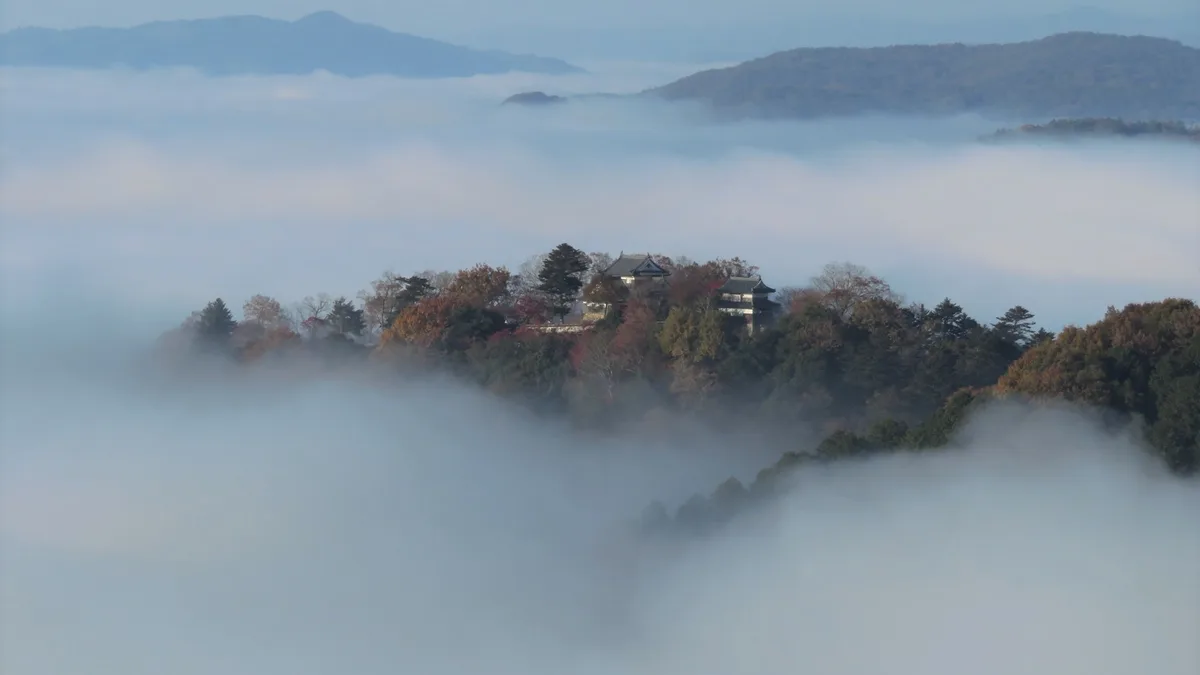
Bitchu-Matsuyama Castle — Why the Castle Is the Whole Mountain, Not the Keep at the Top
A cultural audio guide to Bitchu-Matsuyama Castle, verified against official sources — Japan's only original keep still standing on a mountaintop, why the climb itself is the castle, how the town saved it, and how to visit (and catch the sea of clouds).
Bitchu-Matsuyama Castle