
Visiting Kamakura, Japan's Seaside Samurai Capital
Kamakura
By Kei · Born and raised in JapanIs Kamakura worth visiting? By the voices we gathered, yes: of 177 international voices, each counted once, 73% called it worth it, and most Japanese reviewers were glad they came to see the Great Buddha up close. It is an open-air bronze that has sat under the sky for five centuries, in a former warrior capital with a shrine, a little coastal train, and a beach thirty minutes from the statue. Plan most of a day, about 55 minutes from Tokyo Station, and a ten-minute walk uphill from Hase Station for the Buddha itself. What those voices actually said, letdowns included, is further down this page.
The Meaning
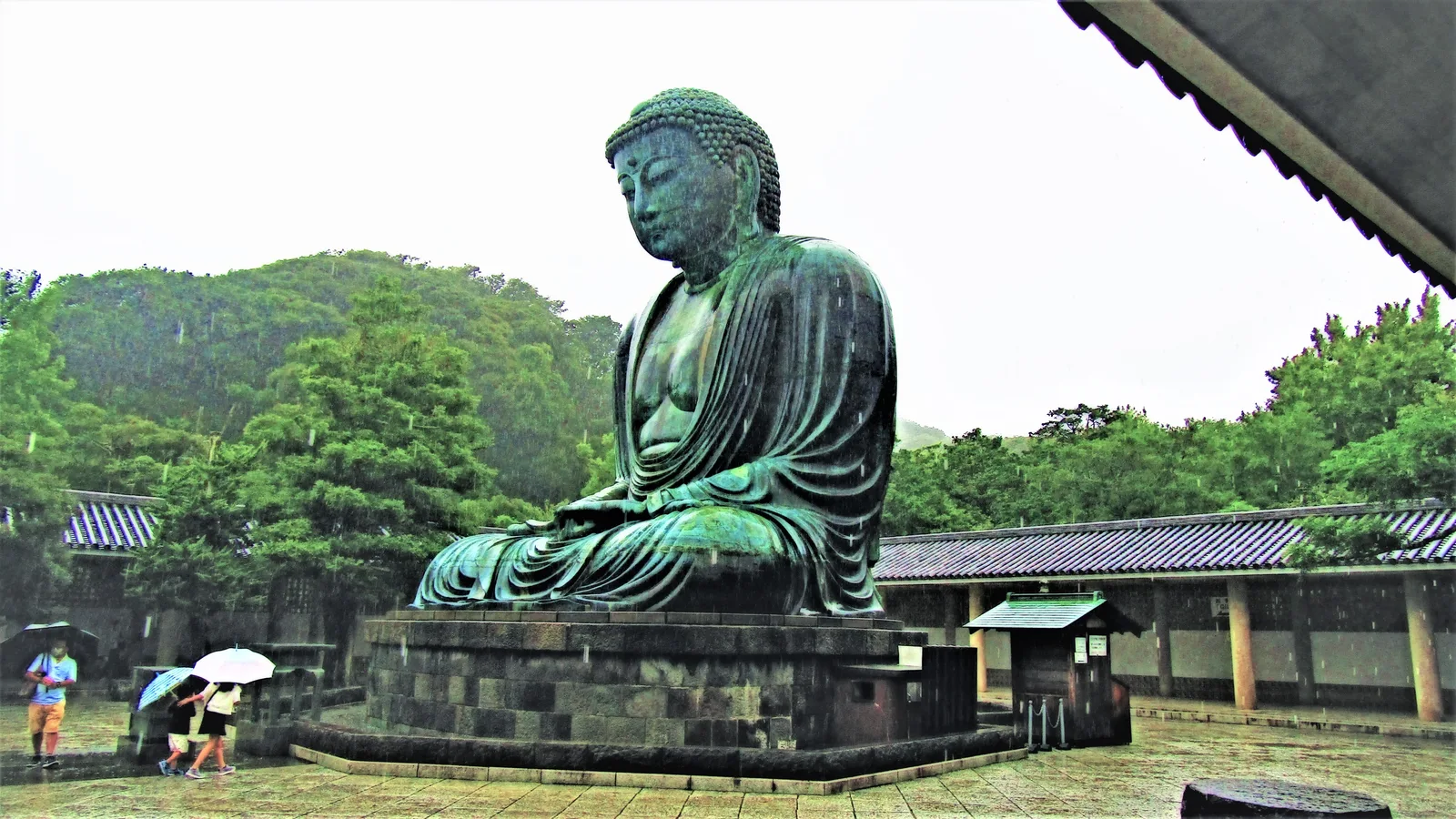
There is a moment, when you first come around the trees and the Great Buddha appears, when most people slow down without deciding to. The bronze is enormous and very still, sitting cross-legged with its eyes half-closed, and the first thing you notice, once you are close enough to feel its size, is that there is nothing over it. No roof, no hall, no ceiling. Just the figure, the stone beneath it, and the open sky.
This is the thing worth understanding before you go, because almost no photograph explains it: the Great Buddha of Kamakura was not built to sit outdoors. When the casting of the bronze began here in 1252, the figure stood inside a great wooden hall, the way Japan's other colossal Buddha, at Nara, still sits inside the largest wooden hall in the country. But the hall over this one did not last. Across the fourteenth century it was battered by typhoons, and near the end of the fifteenth, by the temple's own account, in a great earthquake of 1498 and the wave it sent up the valley, it was finally swept away. And then something quiet happened, or rather, did not happen: no one built it back. For more than five hundred years, the Buddha has sat exactly where it was left, under whatever sky the day brings.
That is the first of three things this town will ask you to feel, and they belong together. Kamakura was Japan's first capital of the warriors, the place where, in the 1180s, a man named Minamoto no Yoritomo set up the country's first government run by samurai rather than by the court at Kyoto. He chose this spot for plain, practical reasons: hills on three sides, the sea on the fourth, a natural fortress reached only through a handful of narrow cuts in the rock. The culture the warriors left here trades the gilded, courtly beauty of Kyoto for something plainer and more grounded: a preference for the simple and the strong over the ornate. And wrapped around all of it is the third thing: the sea. Kamakura is that rare town where an ancient capital, its temples, and a working beach all sit within walking distance, and where the little train that carries you between them carries schoolchildren and commuters in the very same car.
Hold those three together and you have the real Kamakura, the one the guidebooks tend to miss. It is not a preserved attraction, kept perfect behind glass. It is a town that has carried on broken (a Buddha whose hall was never rebuilt), unadorned (a warrior city that never learned to be showy), and lived-in (a real place, with a beach and a commuter line, that people still call home). You did not come to consume a monument. You came, whether you meant to or not, as a guest in someone's town. Slow down, and Kamakura gives you all three at once.
What Happens When You're There
Step 1: Getting There, from Tokyo to the Old Capital
You begin in Tokyo, because almost everyone does, and the going is easier than the old warriors would have liked.
The simplest route is the JR Yokosuka Line, which runs from Tokyo Station straight to Kamakura in a little under an hour, about fifty-five minutes, with the Shonan-Shinjuku Line offering another way in from the west of the city. But the thing worth knowing isn't the timetable so much as this: you are about to arrive in a town that was chosen, eight hundred years ago, precisely because it was hard to arrive in, ringed by hills and reached only through narrow passes cut in the rock. The train slips through them now in seconds. You are taking, in comfort, a journey that was once a fortress wall.
At Kamakura Station, most first-time visitors do the obvious thing: walk straight up the main approach toward the great shrine, into the thickest of the crowds. There is nothing wrong with this, and we will walk it too. But if you have the time and the legs, there is a quieter way that locals and seasoned travelers swear by: get off one stop early, at Kita-Kamakura, and walk down toward the town through the old Zen temples in the hills, arriving at the center on foot instead of fighting your way out of it. The crowd thins the moment you step away from the obvious, here as everywhere.
From the center, the way to the Great Buddha and the sea is its own small pleasure: the Enoden, the Enoshima Electric Railway, a single-track local line of fifteen little stations that threads between houses so closely you could almost touch the laundry, then breaks out along the coast. It is worth saying plainly what the Enoden is, because it changes how you ride it. It is a tourist train, yes, but it is first a commuter line. The same small car that carries you to the Buddha carries high-school students to class and grandparents home with their shopping. On a busy weekend it fills past comfort, and you may have to let a train or two go by before you can board. That is not a flaw in your plan. That is the town's daily life, and you are riding through the middle of it. Time your hop onto the Enoden away from the weekend afternoon peak and you will be more comfortable, and so will everyone trying to get home.
Step 2: Tsurugaoka Hachimangu, the Heart of the Warrior City
Before the sea and the Buddha, walk up to the shrine, because the shrine is where the town began.
Tsurugaoka Hachimangu sits at the head of Kamakura on a low rise, and the approach to it tells you, before you arrive, what kind of city this was. Down the center of the avenue runs a raised stone path called the Dankazura, a causeway about 450 meters long, lifted above the road on either side. Yoritomo had it built in 1182, and the reason is a surprisingly tender one for a warlord: his wife, Hojo Masako, was expecting their child, and the path was made as a prayer for her safe delivery. Walk it toward the shrine and you may notice the way it narrows as you go, the lanes drawing slowly closer together. That was not for beauty. In a city built to be defended, even the approach to the gods was shaped so that an attacker would find the way tightening against him. Tenderness and watchfulness, laid into the same stones. That is the warrior capital in a single path.
The shrine itself honors Hachiman, the deity the samurai took as their guardian, and it has stood as the spiritual center of Kamakura since Yoritomo moved it to this spot in 1180, the same year he based his government here. Climb the broad stairway and you will find it grand but not gaudy; the warrior taste ran to strength and clarity rather than ornament, and you can feel the difference if you have come from the gold and lacquer of Kyoto. If you would like to know what Japanese people quietly notice and appreciate at a shrine (where to bow, how to wash, how to stand at the offering hall), it is the same everywhere, and it travels well from here. The short version is simple enough to carry up the steps: pause at the gate, and let the place set the pace rather than your camera. A small bow, given without being asked, is understood here in a way that needs no language.
Step 3: The Great Buddha, the Figure Under the Sky
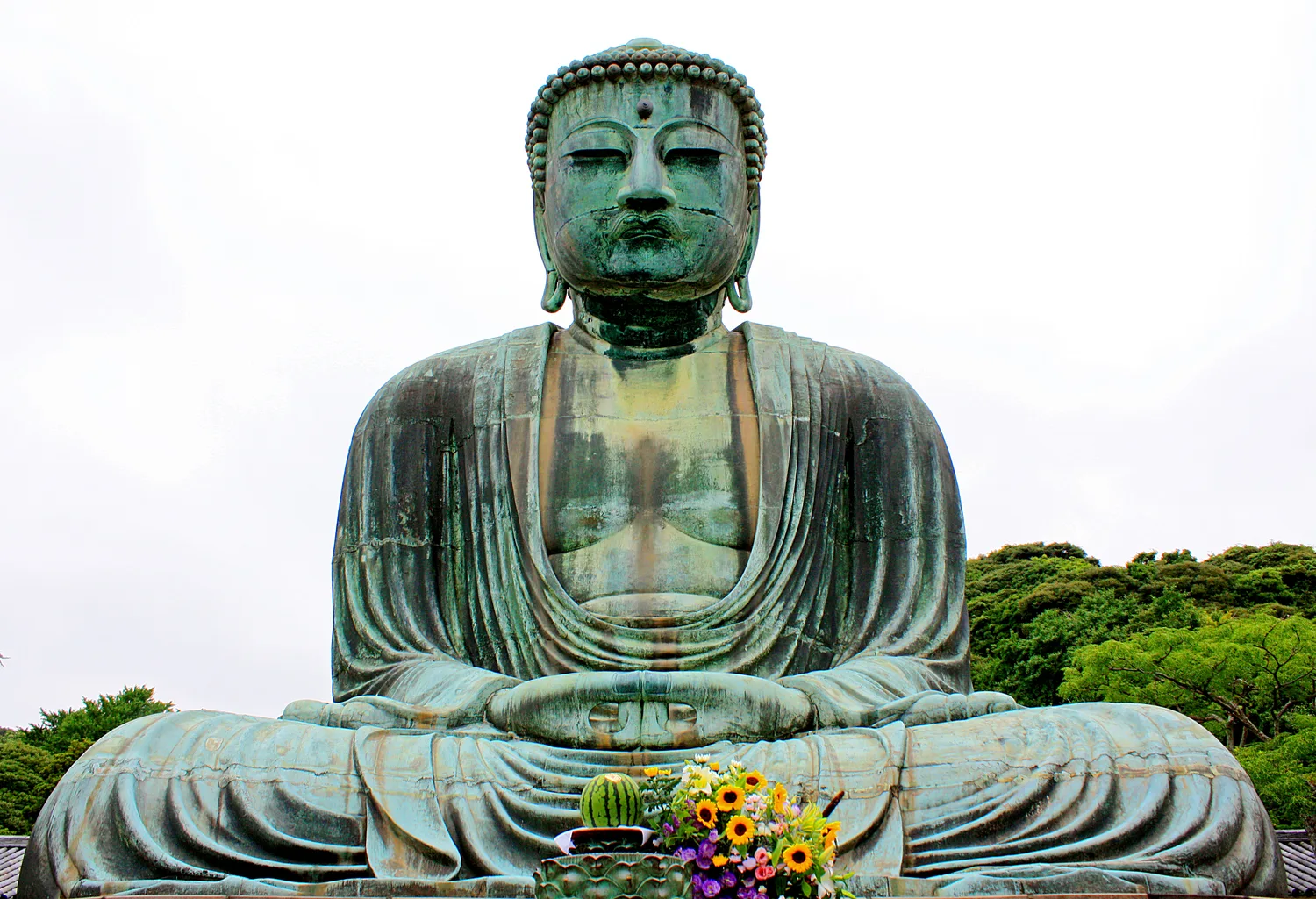
Take the Enoden a few stops west to Hase, and walk the ten quiet minutes uphill to Kotoku-in. The lane is ordinary: shops, a few cats, somebody's hydrangeas, and then the trees open, and the Buddha is simply there.
Let the numbers settle you first, because they are worth knowing and every one of them is on the temple's own record. The bronze stands 11.3 meters from base to crown (more than thirteen with its stone pedestal) and weighs around 121 tonnes. Its casting began in 1252; the sculptor's name was never written down, and the temple says so honestly to this day. When it was new it was not the soft green you see now but bright with gold leaf, blazing inside its lost hall. The figure is Amida, the Buddha of the Pure Land, hands folded in the gesture of deep meditation, and it is registered by the nation as a National Treasure. There is a small detail the temple is fond of: a poem-stone in the garden, set there in 1952, on which the poet Yosano Akiko called the figure "Shakyamuni" (the historical Buddha), when it is in fact Amida. The temple has never corrected the stone. It keeps the loving mistake exactly as she wrote it.
But the thing to actually do here is not to read or to count. It is to stand still, and notice what you noticed at the very start: the open sky above the bronze. Walk around to the back and you can see, near the figure's feet, the scattered stone bases where the great hall once stood, the footprint of a building that the sea took and no one rebuilt. For a small extra coin you can even step inside the Buddha, into the hollow dark of the bronze, and see the seams where it was cast in stages and raised from the ground up, eight centuries ago, by hands whose names are gone.
People grow quiet here, and they grow quiet for different reasons, and it is not this guide's place to tell you which is yours. Some are moved that something so large was made so long ago. Some are caught by the face, which is doing almost nothing and somehow a great deal. And some feel the particular thing this open-air Buddha does that no sheltered one can: it has sat out every season for five hundred years (rain, snow, the white glare of August, the long gold of a winter afternoon), and it has not flinched, and no one has hurried to protect it, because the protecting is no longer the point. What you make of that is yours to keep. If you find yourself wanting to mark the moment somehow, a quiet bow before you turn away is the most natural thing in the world, and the most welcome.
Step 4: The Sea and the Train Home
When you come back down to Hase and step onto the Enoden again, do not race back to the station. Ride it the other way for a little while, toward the coast, because the last thing Kamakura has to give you is the one the warriors saw first.
A few stops on, the houses fall away and the whole window fills with water. This is the same Sagami Bay that made Kamakura a fortress (the wall the samurai could not be attacked across), and it is now, on a warm day, simply a beach. Surfers sit out past the break. Families spread towels on Yuigahama, the long strand that in 2016 became the first beach in Asia to earn the Blue Flag for its water and its care. Eight hundred years folded into one view: a moat that became a place where children learn to swim. There is a station out here, Kamakurakokomae, where a railway crossing frames the sea so perfectly that it has become famous, and crowds gather to photograph it, which is its own small lesson, and a kind one. That crossing was never built as a viewpoint for tourists; it is a working level crossing on a working line, beside a school, on a road people actually use. A little awareness of where you stand and whom you photograph (taking your shot from the marked spot, then stepping clear so the cars and the students can pass) is the whole of what is asked, and it keeps the place pleasant for the next person and for the people who live there.
That, in the end, is the feeling to carry home from Kamakura, and it is the feeling the whole town has been handing you all day. Look around the Enoden car as it rocks along the shore: the tourists with their cameras, and beside them a boy in a school uniform asleep against the window, a woman with a bag of vegetables, someone who has ridden this exact line ten thousand times. You are not in a museum of a town. You are in a town, one that happens to keep, within a half-hour's walk, an open-air Buddha whose hall was never rebuilt, a shrine where a warrior prayed for his wife, and a sea that was once a wall. A much-loved place like this stays gentle only because the people passing through help carry it, the same way they help carry it everywhere in Japan. Come slowly, ride a little out of your way, lower your voice near the shrines, and step aside on the platform, and the town will feel, by the end of the day, less like somewhere you visited and more like somewhere you were welcomed. Thank you for walking with us.
What Visitors Honestly Say
Before you plan the trip, it helps to hear from the people who have already made it. We collected 177 voices from international travelers on Reddit, some writing about their own visit and some giving advice, and counted each one once. This is how they fell:
The green band keeps returning to one idea: the reward is the town rather than the statue. One traveler wrote, "I loved Kamakura. It's got the forest, the seaside, the cute cafés, more temples than you can shake a stick at. Hase-dera is spectacular." The thin red band has no single cause: of its nine voices, three found Kamakura overhyped, two found it too crowded, and two would rather have spent the day elsewhere. Only one had built the whole day around the statue: "There's nothing much of interest there besides the big Buddha. I only went there for the big Buddha."
Japanese visitors, reviewing the same Great Buddha in their own words, write about the statue itself rather than the town:
What they are glad of is the statue up close: its size, its gentle face, and the chance to go inside it. One reviewer wrote, "the sight of it sitting serenely under the open sky moves me every single time, no matter how many times I've seen it." Their red band is about the visit more than the Buddha: the crowds, too little else to see once you have seen it ("there's no main hall, so it's over in an instant"), and the manner of the guards.
The full picture, the letdowns included and what prevents each one, is in Is Kamakura Worth It?
Good to Know
The most important thing to know first: Kamakura is a town, not a single sight, and the Great Buddha is perhaps thirty minutes of it. The genuinely rewarding visit is the whole shape of the place: the shrine at the head of the valley, the little Enoden line, the open-air Buddha at Hase, and the sea beyond. Give it most of a day and walk it slowly; an hour spent racing to the Buddha and back is the surest way to leave underwhelmed.
Getting there: From Tokyo Station, the JR Yokosuka Line reaches Kamakura in a little under an hour (about 55 minutes); the Shonan-Shinjuku Line is an alternative from the west side of Tokyo. Within Kamakura, the Enoden (Enoshima Electric Railway) is the line you will actually use, threading from Kamakura Station to the coast and on to Fujisawa through fifteen small stations. If you plan to hop on and off it (to Hase for the Buddha, then out to the sea), the Noriorikun one-day pass (around 800 yen for adults) pays for itself quickly and lets you ride freely all day. For the bigger picture of trains and passes, see getting around Japan. Last verified: 2026-06.
The Great Buddha (Kotoku-in), hours and cost: The temple opens at 8:00 and closes in the early evening: until 17:30 from April through September, until 17:00 from October through March, with entry stopping fifteen minutes before. Admission is a few hundred yen (around 300 yen for adults, less for children). For a small extra charge you can step inside the hollow bronze, generally from 8:00 until about 16:30; selfie sticks and filming are not allowed in the interior. The nearest station is Enoden Hase, about a ten-minute walk away. Because seasonal hours and prices change, check the official site below for your exact dates. Last verified: 2026-06.
Tsurugaoka Hachimangu: The shrine grounds are open from early morning until evening (roughly 6:00 to 20:00) and free to enter; only the small treasure hall charges admission. It is about a ten-minute walk from the east exit of Kamakura Station, straight up the Dankazura approach. Last verified: 2026-06.
When to visit: Early morning is the Kamakura of quiet temples and empty paths, before the day-trippers arrive; weekday mornings are best of all. Weekends, public holidays, and especially the hydrangea bloom in mid-June bring serious crowds, and the temple gardens famous for hydrangea can be packed even on a weekday. Kamakura City publishes an official live crowd forecast for its main sights, worth a glance before you set out, and the simplest trick of all still works: come early, or walk a little farther than everyone else.
Photography: The Buddha, the shrine, and the coast are yours to photograph freely. The one spot that asks for a little extra care is the level crossing at Kamakurakokomae, which is a real, working railway crossing beside a school; take your shot from the marked area and step clear for the trains, the cars, and the students. A moment of awareness about where you stand keeps a popular place pleasant for everyone in it.
Eating as you walk: Kamakura's Komachi-dori, the shopping street near the station, is lined with tempting food stalls, but the town has politely asked visitors not to eat while walking. There is no fine; it is a request, in the soft Japanese way, for the comfort of everyone sharing a narrow, crowded lane. Buy your snack, step to the side or stand near the shop, enjoy it there, and you will be doing exactly what local custom hopes for.
Bring some cash: Smaller temples, the Enoden, and many of the little shops and stalls around Kamakura are friendlier to cash than to cards. A little in your pocket smooths the day.
Last verified: 2026-06
Official sources: Kotoku-in (the Great Buddha) · Tsurugaoka Hachimangu · Kamakura City official crowd forecast
If Things Don't Go as Planned
"The Great Buddha was smaller than I expected." Not everyone feels this, though: of the Japanese reviews that compare its size with what the writer expected or remembered, eight of ten found it bigger up close, so walk right up to it before you decide. The Buddha is not, in truth, the tallest in Japan, and it is not trying to be. Its meaning is not in its size but in its situation: a bronze that has sat under the open sky for five centuries, in a hall that was never rebuilt. Stop measuring it against the picture in your head, stand with it for a few minutes, walk around to the empty footprint of its lost hall, and the figure you were faintly disappointed by tends to become the one you remember.
The Enoden was too crowded to board. This is the single most common Kamakura frustration on a busy day: the line is small, single-tracked, and shared with everyone who lives along it. The fixes all work: travel outside the weekend afternoon peak, let one or two trains go and wait for the next, or simply walk part of the way, since the distances between the central sights are not large. The Shonan Monorail offers another route between Kamakura and the Enoshima area if the coast line is hopeless. None of this ruins a day; it just asks for a little patience with a train that belongs, first, to the town.
It's packed, far more than you pictured. High season, weekends, and the June hydrangea can turn the central streets into a slow river of people. Three things reliably help: come early (the hour after opening is a different town), get off at Kita-Kamakura and walk down through the quieter hill temples instead of starting from the busiest point, or simply go on a weekday and in the rain, which thins the crowds and, at an open-air Buddha, is its own kind of beautiful. The official crowd map will tell you which sights are worst at which hours.
You want the famous photo at the Kamakurakokomae crossing. It is a wonderful shot and you are welcome to it; just remember the crossing is a live railway beside a school rather than a viewing platform. Stand in the marked area, take your picture in the gap between trains, and step well clear for the cars and the students who use the road every day. Done that way, the same photo costs no one anything, and the place stays kind to the next person who wants it.
One day doesn't feel like enough. Then choose depth over breadth, because no one sees all of Kamakura in a day and trying to is the one sure way to enjoy none of it. If you can do only one line through the town, let it be this: the shrine at the top, the Enoden down to Hase, the open-air Buddha, and the sea. That single thread holds the warrior capital, the train, the Buddha, and the bay (the whole of what Kamakura is) and leaves the dozens of other temples as good reasons to come back.
You got turned around, or aren't sure which station is which. It happens: Kamakura has a JR station and an Enoden station side by side, and the Enoden's little stops can blur together. The town is small and well signed, and you cannot truly get lost: head for the shrine and the hills to go inland, or for the Enoden and the sound of the sea to go to the coast, and you will arrive. When in doubt, station staff and shopkeepers are used to helping, and a map app finds the Enoden stops easily.
Sources:
- Kotoku-in Official: About the Great Buddha (English & Japanese): The bronze Amida Buddha, the Jodo (Pure Land) sect, the casting begun in 1252 with the sculptor unrecorded, the loss of the Daibutsu-den hall to typhoons and the 1498 earthquake, and the figure's status as a National Treasure
- Kotoku-in Official: Characteristics of the Statue (English): The verified measurements: a statue height of 11.312 m, a total height of 13.35 m with the pedestal, and a weight of about 121 tonnes
- Kotoku-in Official: Visiting Hours, Admission and Interior Viewing (English): Opening hours by season, admission, and the interior (tainai) viewing of the hollow bronze, including the rules against selfie sticks and filming inside
- Tsurugaoka Hachimangu Official (English & Japanese): The shrine of Hachiman as guardian deity of the samurai, moved to its present site by Minamoto no Yoritomo in 1180, and the spiritual center of the warrior capital
- Japan Tourism Agency: Multilingual Commentary Database, the Dankazura (English & Japanese): The raised stone approach of about 450 m, built by Yoritomo in 1182 as a prayer for Hojo Masako's safe childbirth, narrowing toward the shrine for defense
- Enoden (Enoshima Electric Railway) Official: Hase Station: Hase as the nearest station to the Great Buddha, about a ten-minute walk, on the fifteen-station coastal line
- Enoden Official: Noriorikun One-Day Pass: The hop-on, hop-off one-day pass for the whole Enoden line
- JNTO: Kamakura and Around (English): Official visitor framing: the former political capital less than an hour south of Tokyo, the JR Yokosuka Line at about 55 minutes, and the coast
- Kamakura City: Official Crowd Forecast Map: The city's live, week-ahead crowd forecast for its main sights
- Kamakura City: Beaches and the Yuigahama Blue Flag (Japanese): The summer beaches and Yuigahama's 2016 Blue Flag certification, the first in Asia
- Is Kamakura Worth It? (WMJS): The two visitor-voice gauges reproduced in "What Visitors Honestly Say" (177 international voices, 73/22/5; 89 Japanese voices, 61/31/8) and the verbatim visitor quotations
Photos: the Great Buddha of Kōtoku-in by Dandy1022, CC BY-SA 3.0, via Wikimedia Commons; the Great Buddha at Kotoku-in by Andrea Schaffer, CC BY 2.0, via Wikimedia Commons.
.jpg)
_(3801505643).jpg)
WMJS is written in Japan, in English, with AI help. We check every page, but English is not our first language. If a sentence reads oddly, tell us. One sentence is enough.
Thank you. A person reads every note.
Real voices
Is it worth it?
Were you there? Share your photos.
Your photo could appear in this guide — with your name and a link to your profile.
Submit a photoRelated Articles
Visiting Temples and Shrines: What Japanese People Notice

Getting Around Japan: The Tiny Things That Earn You a Nod
More guides in Kanto
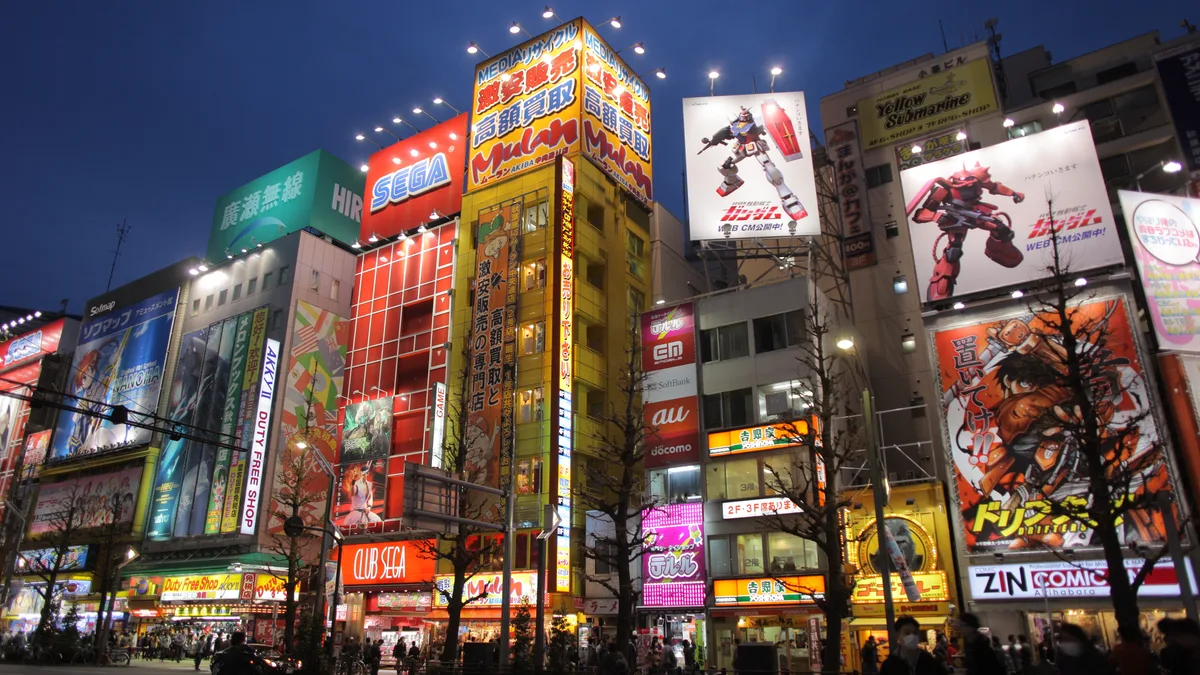
Visiting Akihabara, Tokyo's Electric Town Where You're Allowed to Love What You Love
Is Akihabara worth visiting? We weighed 149 traveler voices: 29% say yes outright, 44% say it depends on whether you love anime, games or electronics, and Japanese reviewers land warmer at 69%. How the district is laid out, getting there, and who it's for, with an audio guide.
Akihabara (Electric Town)
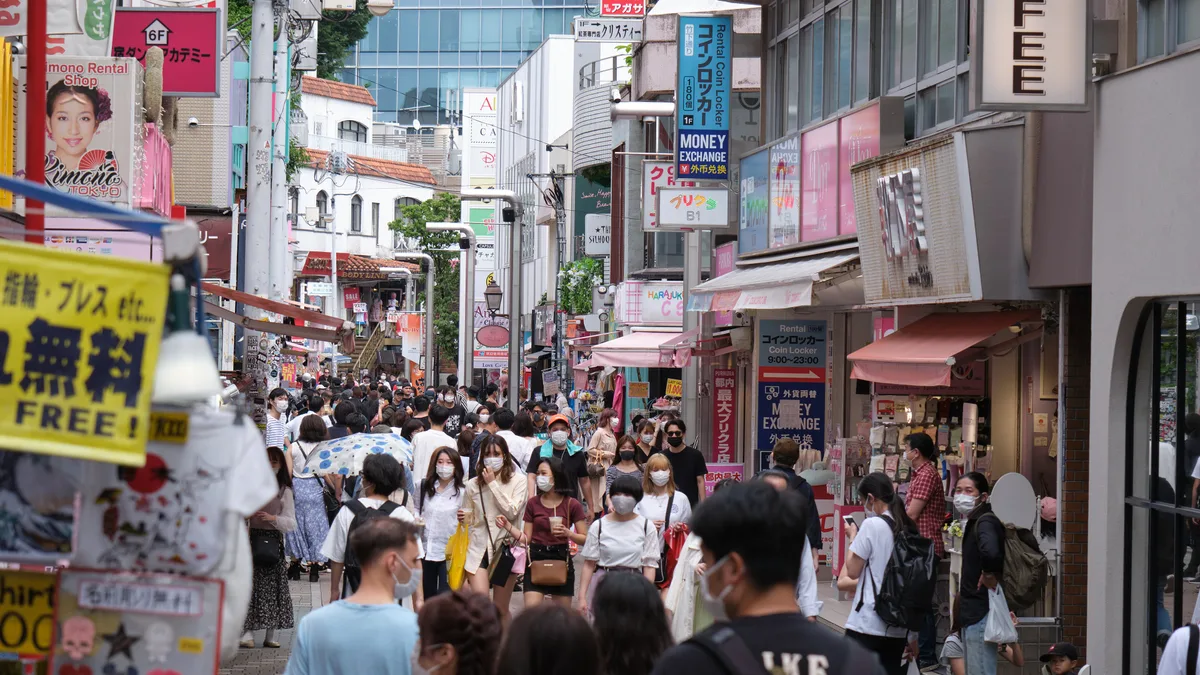
Visiting Harajuku, Where You Can Wear Anything and No One Turns to Look
Is Harajuku worth it? We counted 99 traveler voices: 64% say yes once you skip Takeshita Street's crush for Cat Street and Omotesando. Crepes, kawaii fashion, getting there, and how to walk it well, with an audio guide.
Harajuku
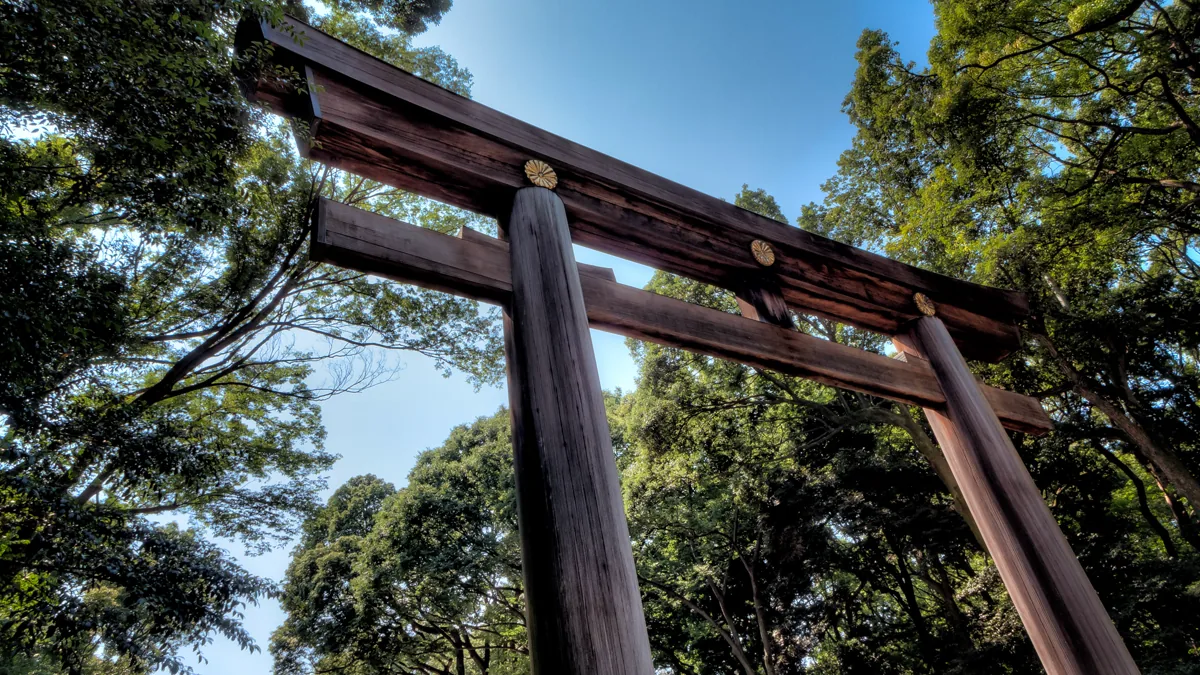
Visiting Meiji Jingu, Where 100,000 Trees Were Planted to Make a Forest That Tends Itself
Is Meiji Jingu worth visiting? We weighed 70 traveler voices: 75% say worth it, and Japanese locals rate it even higher at 82%. Free, a 70-hectare forest planted entirely by hand in 1920, home to the Great Torii and Kiyomasa's Well in the Inner Garden, with an audio guide.
Meiji Jingu
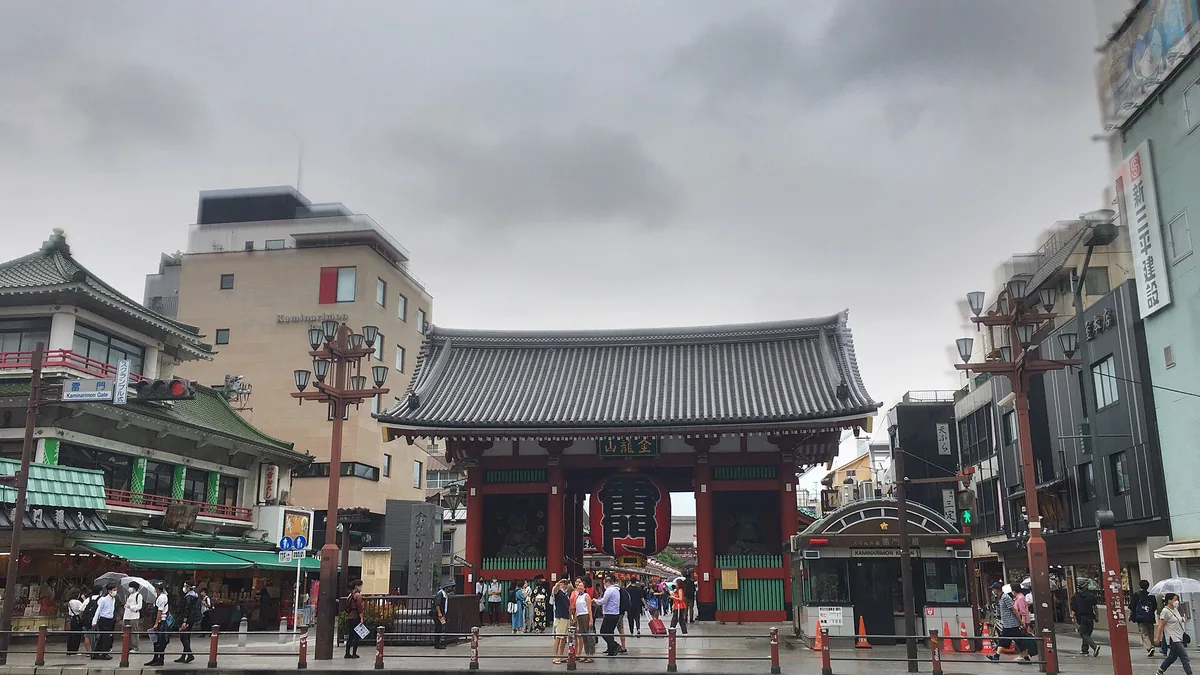
Visiting Senso-ji, Tokyo's Oldest Temple
Is Senso-ji worth visiting? We weighed 125 traveler voices: 54% say worth it outright. Hours, free admission, how long you need, and why the crowd has always been part of the prayer, with an audio guide.
Senso-ji Temple