
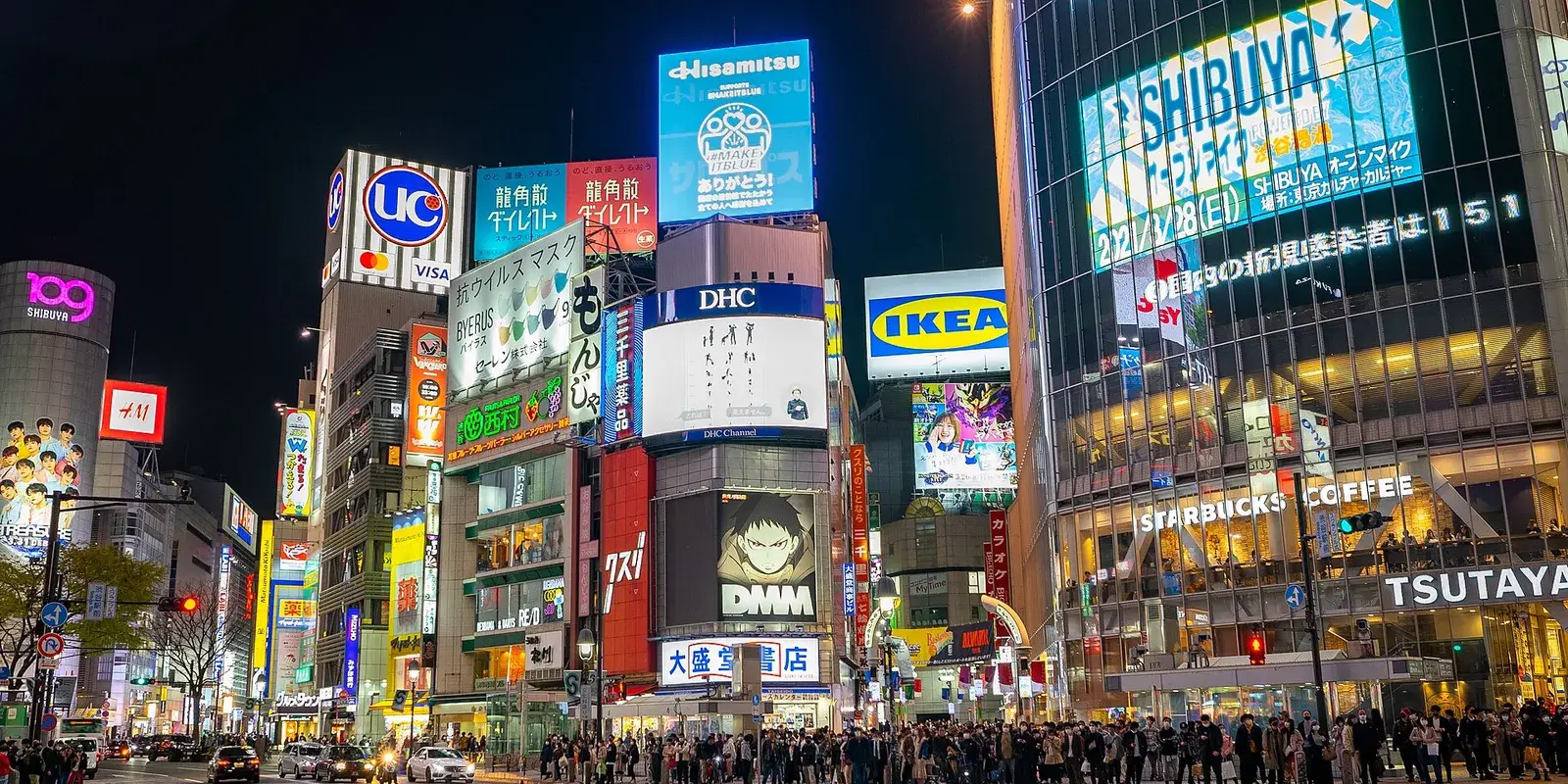
Where a Quiet Country Roars: How Japan Watches the Big Game
What you'll learn in this article:
- The cultural switch (hare and ke) that lets a normally reserved Japan erupt for one night
- Where to actually watch a big match: sports pubs, public viewing, an all-night izakaya, or your hotel room
- What 118 Japanese voices say about watching together, the famous Shibuya crowd, and whether you're welcome to join
- Why Japanese people are far more divided about the Shibuya celebration than the admiring foreign coverage suggests
Where does Japan watch the big game? In British-style sports pubs like HUB, on public-viewing screens in parks, in all-night izakaya, and free at home on NHK and ABEMA. We also gathered 118 Japanese voices on what it feels like: watching together is mostly joyful (57% positive, the rare night strangers high-five), even as Japanese themselves are far more split about the famous Shibuya crossing crowd (only 20% admiring) than the praising foreign coverage suggests.
If you've spent a few days in Japan, you already know the baseline. The trains are almost silent. People lower their voices in restaurants. Nobody wants to be the loud one. So the first time you see a packed Tokyo pub erupt at 5 a.m. (grown adults in blue jerseys screaming, hugging the person next to them, spilling beer), it can be genuinely disorienting. Wait, isn't this the country that apologizes for sneezing?
Yes. And that contrast isn't a contradiction. It's the whole point.
Quick Guide
| Where to Watch | What to Expect | |
|---|---|---|
| 🍺 Sports pubs | HUB and other British-style pubs | The classic choice. HUB alone has run football screenings for 30+ years, with several branches around Shibuya. Loud, friendly, crowded; arrive early or reserve. |
| 📺 Public viewing | Park screens & event spaces (e.g. Miyashita Park) | Big screens, big crowds, free or low-cost. The closest thing to a stadium atmosphere without leaving the city. |
| 🌙 All-night izakaya | 24-hour izakaya & dedicated viewing bars | Because knockout matches land at 1–4 a.m., many bars open all night. Food, drinks, and a seat until the last train runs again. |
| 🏨 Free at home | NHK & ABEMA | NHK shows Japan's matches free; ABEMA streams all 104 matches free with no subscription. Perfect if you'd rather watch quietly from your hotel. |
| 🚦 Shibuya crossing | The famous scramble | After a Japan win, it becomes an impromptu street party, guided by police, cleaned up by fans. Fun to witness; not a venue you "go to watch." |
The one thing to understand: Japan doesn't get loud despite being a quiet country. It gets loud because it is one. The big game is a sanctioned release valve, and that makes the celebration feel different from anywhere else.
How We Gathered These Voices
Alongside the cultural background, we collected 118 Japanese-language voices across three questions: how people feel watching a big match together with strangers (42), how they really feel about the Shibuya celebration crowds (50), and how the fervor differs by generation (26). We gathered them from public Japanese Q&A sites, forums, blogs, and social posts.
A quick note: this isn't a scientific survey. It's a collection of what real Japanese people said in their own words on public platforms. Most English-language guides just list bars. We wanted to show you why a quiet country roars, and how Japanese people themselves feel about it.
The Switch: Why a Quiet Country Suddenly Roars
To understand why Japan watches the big game the way it does, it helps to know two old Japanese words: ke (褻) and hare (晴れ).
Ke is ordinary life: the everyday rhythm of commuting, working, washing the dishes, keeping your voice down on the train. Hare is the extraordinary: festivals, ceremonies, the days you put on your best clothes and celebrate together. The folklorist Kunio Yanagida, who studied how Japanese communities organized their lives, described culture as a steady pulse of ke punctuated by bright bursts of hare. A village spent most of the year in quiet routine, then poured everything into the harvest festival. The contrast is what gave the festival its meaning.
Modern Japan still runs on that rhythm; it just has new festivals. A national-team match in a major tournament is a modern hare: a day when the usual rules about volume, restraint, and keeping to yourself are quietly suspended.
The sociologist Kensuke Suzuki, writing about why crowds gather in Shibuya for the World Cup, framed it simply: a society that normally keeps its emotions tightly managed gives itself rare, collective permission to let go. The everyday space of a street corner or a pub becomes, for a few hours, something communal and a little transgressive. The energy doesn't come from nowhere. It comes from all the days of quiet that surround it.
That's why the roar lands so hard. In a country where strangers don't usually make eye contact, the big game is one of the few nights it's not just allowed but expected to turn to the person beside you and shout with joy.
Where Japan Actually Watches
The sports pub
The default answer is the British-style sports pub. HUB, a chain of pubs that has been showing football in Japan for more than three decades, is the most reliable bet: it has several branches clustered around Shibuya alone, and during a big tournament every one of them fills. Independent sports bars across Tokyo, Osaka, and other cities do the same.
The vibe is exactly what you'd hope: big screens, cold beer, mixed crowds of locals and visitors, and a room that breathes together with every near-miss. The catch is capacity. For a marquee match, popular bars fill hours ahead and many take reservations or charge a cover. If there's a specific game you want to watch in a specific place, book it.
Public viewing
When the team goes deep into a tournament, cities set up public viewing: large screens in parks, plazas, and event halls. In Tokyo, spots like Miyashita Park in Shibuya have hosted screenings, and other venues open up as the stakes rise. It's free or inexpensive, and it's the closest thing to a stadium crowd you'll find without a stadium. Bring patience for the lines and a willingness to stand.
The all-night izakaya
Here's the practical wrinkle that shapes everything: the 2026 World Cup is in North America, which means most matches kick off between roughly 1 a.m. and 8 a.m. Japan time. The knockout rounds, and the final at 4 a.m., happen while the country would normally be asleep.
So Japan adapts. Many izakaya and dedicated viewing bars stay open all night for big matches, some charging a flat entry (often around ¥1,000) and letting you settle in until the first trains start running again near 5 a.m. If you've never been to one, an izakaya is Japan's casual pub-restaurant (small plates, drinks, long conversations), and our guide to your first izakaya covers how they work. (And if you're wondering whether you have to drink to fit in, you don't: here's the honest answer.)
Free, at home
You don't have to go anywhere at all. NHK, the public broadcaster, shows Japan's matches free on television and via its app, and ABEMA is streaming all 104 World Cup matches free, no subscription required. Plenty of Japanese fans watch exactly this way: quietly, at home, alone or with family, then check the morning news to see the Shibuya crowd they didn't join.
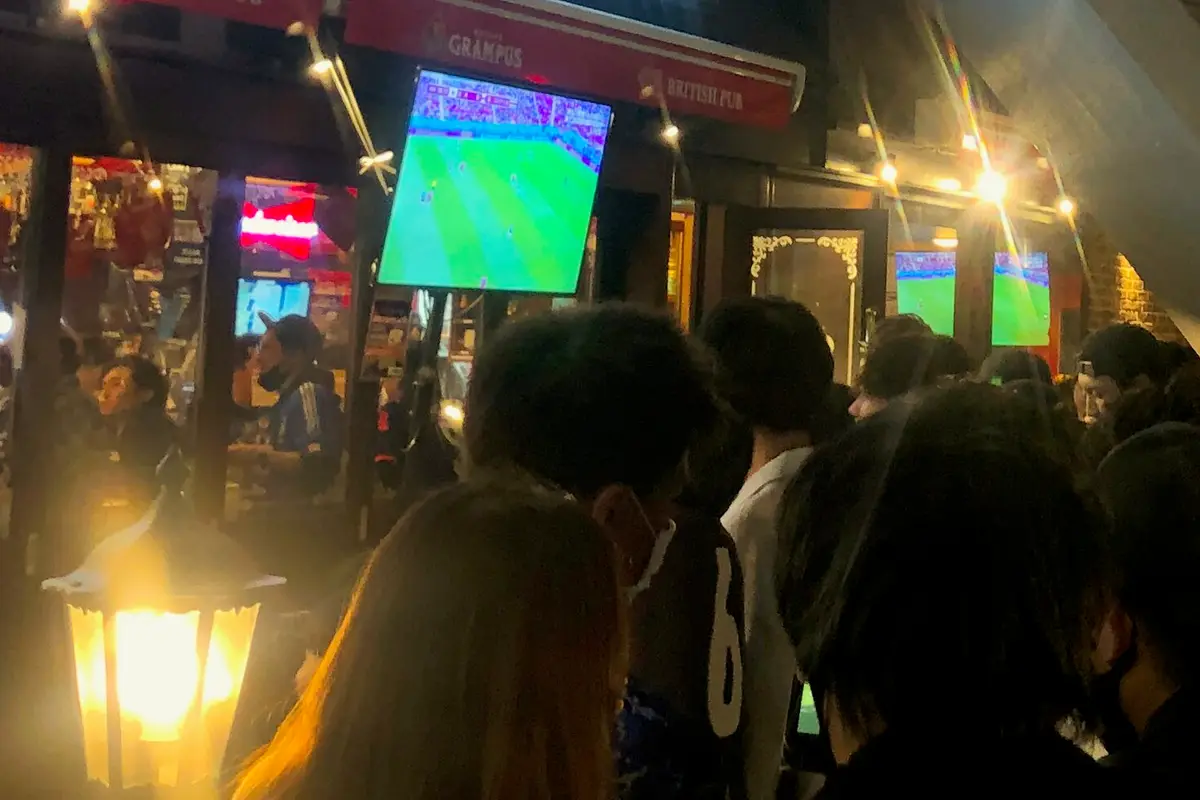
The One Night You High-Five a Stranger
Here's the part guidebooks miss. The reason the big game matters in Japan isn't really the football. It's that, for a few hours, the invisible wall between strangers comes down.
We read what Japanese people wrote about watching together, and the warmth was clear.
Of 42 voices about watching together, most described it as the highlight of the whole experience, and again and again, the magic was sharing it with people they'd never met.
点が入ったときには、みんなで乾杯したり肩を組んだりすることもあります。勝ったときには、知らない誰かとハイタッチしたりハグしたりするケースも少なくありません。 When a point is scored, everyone toasts or links arms. When your team wins, it's not rare to high-five or even hug a complete stranger.
勝った瞬間、隣の知らないおじさんと抱き合ってしまった。あんなこと、普段は絶対にない。 The moment we won, I ended up hugging the stranger next to me. That kind of thing never happens normally.
And if you're a visitor worried about being an outsider, listen to this one:
一人で来ていた外国人観光客と、言葉は通じないのに一緒に盛り上がれた。 I got hyped together with a foreign tourist who'd come alone — even though we couldn't understand each other's words.
That's the gift hiding inside the noise. The same restraint that makes Japanese trains feel like libraries is what makes the shared roar of a big match feel so unguarded and warm. You're not watching a country break its character. You're watching it spend, all at once, the warmth it usually keeps folded away.
A genuine minority (14%) would rather watch alone or at home, and they're worth hearing too. Nobody is obligated to join the crowd.
騒がしいのが苦手な人は、無理せず家で観ればいいと思う。 If you don't like noise, I think it's perfectly fine to just watch at home without forcing yourself.
So there's no wrong way to do it. But if you find yourself in a Tokyo pub at 4 a.m., surrounded by strangers in blue, don't hang back. Cheer when they cheer. That's the whole invitation.
💡 The wall comes down
On an ordinary day, the person beside you at the counter is someone you'd never speak to. During the big match, they're your teammate: you groan at the same miss, leap at the same goal, and clink glasses when it's over. In a culture built on not imposing on others, that sanctioned permission to connect with strangers is rare and precious.
The Shibuya Phenomenon: A Crowd Japan Argues About
You've probably seen the footage. After Japan wins an important match, Tokyo's Shibuya scramble crossing (the busiest pedestrian intersection in the world) turns into a spontaneous celebration. Fans in blue flood the center, sing chants, wave flags, and high-five everyone in reach.
It's worth understanding this as public coordination, not chaos. When a big win is expected, Tokyo police plan ahead: they manage the flow, sometimes restrict access, and guide the crowd with a friendly, almost theatrical style. One officer's good-humored loudspeaker announcements during a past tournament earned him the nickname "DJ Police" and a small wave of national affection. The crowd surges when the pedestrian light turns green, celebrates, then pulls back to the sidewalks when it turns red, over and over. Afterward, fans are known for picking up the trash they leave behind, a habit that foreign media regularly singles out for praise.
But here's what surprised us. Foreign coverage tends to gush over the disciplined, self-cleaning crowd, and Japanese people themselves are far more divided. Of 50 voices, more were critical than admiring.
The admiring voices are real, and they focus on the discipline:
暴徒化しないあたり、やっぱり日本人だなって思う(笑) The fact that they never turn into a mob really makes me think, yep, that's Japanese people (lol).
海外メディアにゴミ拾いが取り上げられるのは、少し誇らしい。 It's a little bit of a proud feeling that foreign media highlights the fans cleaning up.
But the larger share roll their eyes at the bandwagon energy, the choice of venue, or simply the noise:
なんで渋谷駅前でやるの?引き分けたくらいで騒ぐな。 Why do it right in front of Shibuya station? Don't make a fuss over just a draw.
本当のファンは、スタジアムやスポーツバーで静かに見ていると思う。 I think the real fans are watching quietly at the stadium or a sports bar.
正直、毎回ニュースになるのが恥ずかしい。 Honestly, I find it embarrassing that it makes the news every time.
This is the honest picture, and it's good news for a visitor. The Shibuya crossing is something to witness, not a place you go to actually watch the match (there's no screen, just a crowd). Watch the game at a pub or public viewing. If the team wins and you happen to be near Shibuya afterward, you'll understand the footage from the inside, including why the locals around you might be smiling and shaking their heads at the same time.
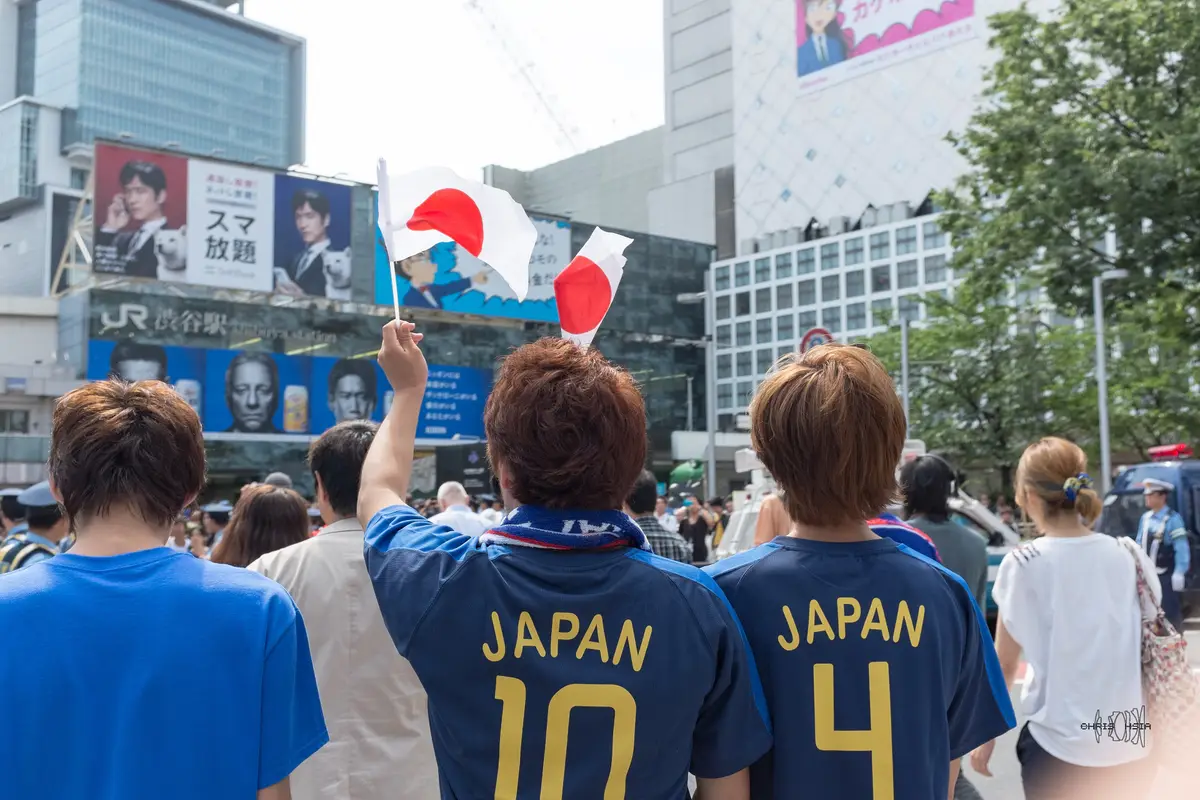
The Generation Gap
One more thing the voices revealed: the fervor isn't evenly spread. Different generations run at very different temperatures.
Of 26 voices that mentioned age, many older fans described a passion that has quietly cooled, and younger viewers leaning toward highlights over full 90-minute matches:
若い頃は徹夜で観たけど、今は録画して朝にダイジェストで十分。 When I was young I'd stay up all night, but now recording it and watching the highlights in the morning is plenty.
上の世代は代表戦を皆で観るのが当たり前だったけど、自分たちはスマホで各々観る感じ。 For the older generation, watching the national team together was the norm; for us it's more each of us watching on our phones.
Yet the World Cup keeps proving the exception: the one event that still pulls every generation in when Japan plays well:
若者のサッカー離れと言うけれど、ワールドカップだけは別。あれは特別な空気がある。 People talk about youth drifting from soccer, but the World Cup alone is different — it has a special air.
結局、日本がいいプレーをすれば、世代に関係なく盛り上がる。 In the end, if Japan plays well, it heats up regardless of generation.
So if the pub you walk into skews older or younger, that's not random: it's a quiet map of how a tradition is changing.
After the World Cup: Japan's Other Big Nights
The 2026 World Cup is the entry point, but the hare switch flips for plenty of other moments, so this isn't a one-summer story. If you're visiting outside the tournament, look for:
- Samurai Blue qualifiers and friendlies. The national football team draws that same pub-and-Shibuya energy whenever it plays, just on a smaller scale.
- The World Baseball Classic and NPB pennant races. Baseball is Japan's deepest sporting passion. A tight Nippon Series or a WBC run lights up the same bars and screens.
- Rugby. Japan hosted the 2019 Rugby World Cup, and the "Brave Blossoms" turned casual viewers into roaring fans almost overnight. Rugby viewing has had a foothold here ever since.
- Koshien. Summer's high-school baseball tournament is a quieter, more tearful cousin of all this: collective emotion turned inward rather than out. We explore why in Why an Entire Nation Cries Over a High School Baseball Game.
The venue and the sport change. The underlying rhythm (long stretches of ke, then a bright burst of hare) does not.
How to Join In
A few gentle, practical notes:
Pick your spot early. For a big match, reserve a pub or arrive well ahead. Public viewing means lines; budget time.
Mind the clock, literally. Late-night kickoffs mean the trains may have stopped. Either choose a place near your hotel, plan to stay until the first morning trains (around 5 a.m.), or check the all-night options.
Wear blue if you're rooting for Japan. Nobody expects it of a visitor, but a blue shirt is an instant icebreaker, and locals love seeing it.
Learn one chant and copy the room. You don't need to know the words in advance. Watch what the people around you do, and follow half a beat behind. That's all "reading the room" ever asks.
Don't overthink the volume rule. The same instinct that keeps you quiet on the train tells everyone in the pub that right now, here, loud is correct. For one night, you're allowed (encouraged, even) to roar.
Share Your Match-Day Moment
Have you ever watched a big game in Japan, in a pub, at public viewing, or surrounded by strangers in Shibuya? We'd love to hear what it felt like.
Sources
Tournament & Broadcast (Tier 1)
- FIFA: 2026 World Cup official schedule, dates, and host cities (June 11 – July 19, 2026; final at MetLife Stadium): https://www.fifa.com/en/tournaments/mens/worldcup/canadamexicousa2026/articles/match-schedule-fixtures-results-teams-stadiums
- NHK: public broadcaster carrying Japan's matches free: https://www.nhk.or.jp/
- ABEMA: free streaming of all 104 matches in Japan: https://abema.tv/
Reporting & Analysis (Tier 2)
- President Online: Kensuke Suzuki on why Japan's orderly society erupts for the World Cup in Shibuya: https://president.jp/articles/-/9806
- Sirabee: coverage of the Shibuya scramble-crossing crowd and the "looks like a nuisance, but admirably Japanese" debate: https://sirabee.com/2026/06/15/20163557253/
- THE ANSWER: international praise for the orderly conduct of Japanese fans in Shibuya: https://the-ans.jp/news/284389/
- Nikkei: reporting on supporters gathering in Shibuya and police crowd-safety operations: https://www.nikkei.com/article/DGXZQOUE210VZ0R21C22A1000000/
Cultural Background
- The concept of hare (晴れ) and ke (褻), as developed by folklorist Kunio Yanagida (Japanese Wiki Corpus): https://www.japanesewiki.com/culture/Hare%20and%20Ke.html
Japanese Voices (Public Platforms)
- 118 Japanese-language voices collected June 2026 from public Japanese Q&A sites, forums, blogs, and social posts, across three questions:
- Watching a big match together with strangers (42 voices)
- How Japanese people feel about the Shibuya celebration crowds (50 voices)
- Generational differences in big-match fervor (26 voices)
- These platforms are not cited as factual authorities, but as places where real Japanese people expressed their views. Individual source links are recorded in our research data.
Note on Quotations
Quotes from online platforms have been lightly edited for readability (fixing typos, formatting for clarity). The meaning and intent of each comment remain unchanged.
WMJS is written in Japan, in English, with AI help. We check every page, but English is not our first language. If a sentence reads oddly, tell us. One sentence is enough.
Thank you. A person reads every note.
How well do you know Japan?
Based on 51,218+ real Japanese voices
Want to know more? Ask Japanese people
Have a follow-up question about this topic? We'll ask real Japanese people.
Voice Box →