
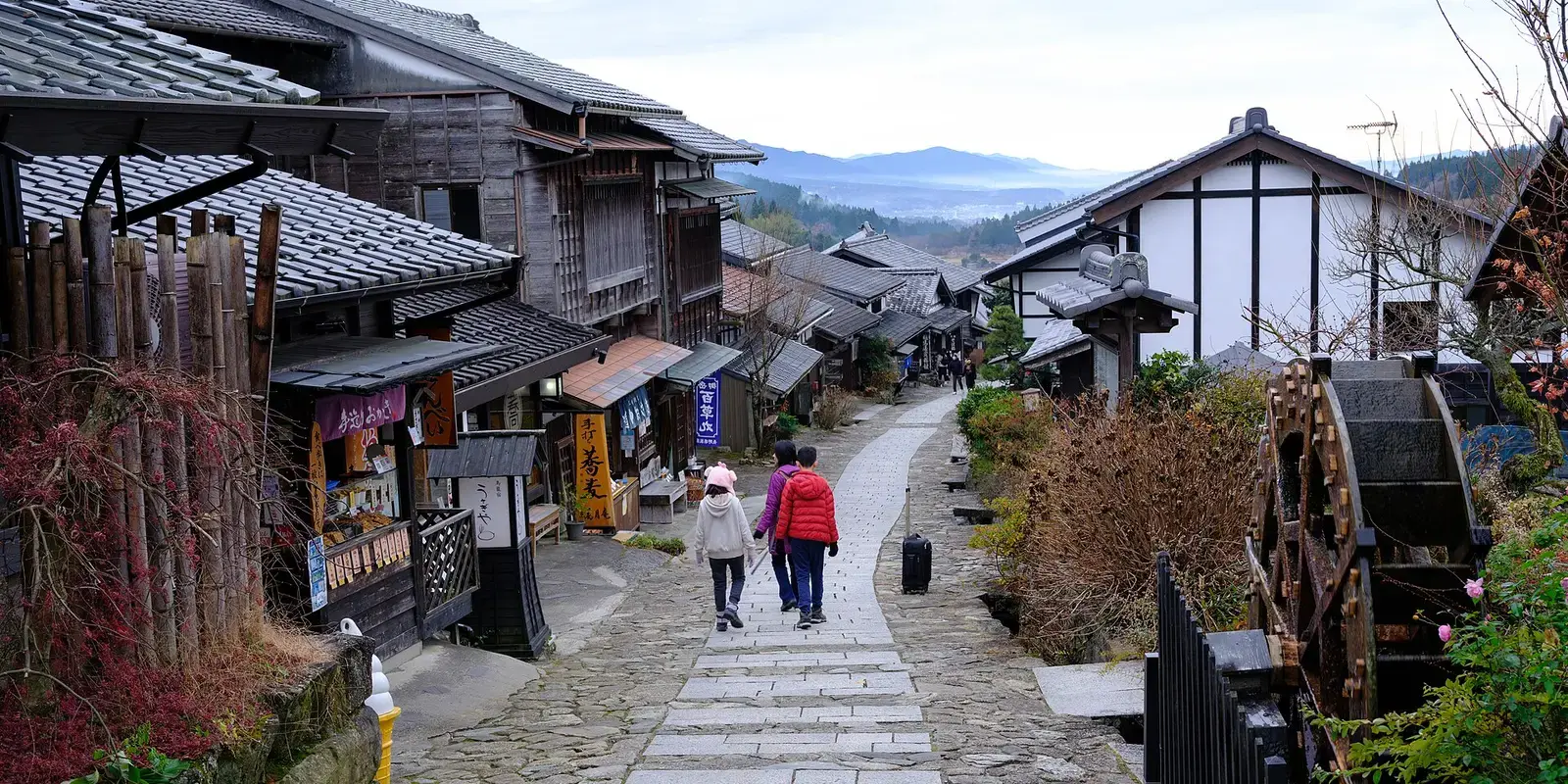
Is the Nakasendo Worth It? The Question Is Really Whether You Walk
Ask whether the Nakasendo is worth it and you will get answers about a nine-kilometre stretch between two post towns, Magome and Tsumago, that most people finish in about three hours. That stretch is what the internet means by "the Nakasendo." The argument is somewhere else: which direction, which month, which segment, and whether to walk at all, because the bus over the pass exists and the town's own tourist office will happily tell you about it.
Here is what happens when you sort the voices by that argument. Worth it is the largest single answer among these voices, but a large middle band answers "it depends" rather than yes, and the disappointment that does show up almost never lands on the Magome-to-Tsumago section. It lands on the segment past it, on August, or on a body that was not ready for the climb.
Was it worth it? (in visitors' own words)
We gathered voices from international travellers who have walked, planned, or deliberately skipped the Magome-Tsumago section, and asked, in effect, was it worth it?
Read the red slice closely and most of it stops being about the Magome-Tsumago walk at all. Two walkers carry almost all of that complaint between them, both in the same November trip-report thread, and both describing the segment past Magome, heading south toward Nakatsugawa. "The least interesting segment was Magome to Nakatsugawa. It was actually really boring," one wrote. The same walker traced exactly where it turned: "Everything was nice until we got into what I would call the suburbs." A second walker, coming the same way through Ochiai, found "Nothing about this segment stood out to me except for a few impressive old houses with beautiful roofs." The first put it plainly elsewhere in the thread and owned it as opinion: "There wasnt much to see once I left magome heading south imo." Two more of the eight are a month and a body. "We went in August, which was a mistake," one hiker wrote. Another was honest about the climb in a way guidebooks are not: "I;m fat and not in the best physical shape so it took longer than the usual 2.5 hour forecast, it took me 4. That section from Magome to the pass is nothing but uphill the whole time."
The green side is not quiet either. A traveller who spent two weeks across Tokyo, Kyoto and Nagano landed on this: "my time on the trail was the most memorable experience I had and I highly recommend it to anyone who wants a quieter experience of Japan." Others treat it as the break in a city-heavy trip: "I'll go once a year to Japan and do one of these in the middle of my trip to break it up a bit. That is, to get away from the concrete forests and into the mountains." And the middle band on this gauge holds people naming a condition rather than hesitating. Direction is the most common: "From Magome it's a fairly short, but steeper climb to the pass, and then a long downhill towards Tsumago. The other way around you spend almost all of the hike going gradually up." Season is next: "decent hiking season for Nakasendo is fairly short: April/May and late October/November." Then pace: "2 hours is about the minimum - if you walk briskly and don't stop anywhere. It's not a 'hike' hike in the sense that it's a well-made path, you're not going to cross any terrain, but if you're not accustomed to purposeful walking for a sustained period of time, closer to 3 hours would be more realistic."
How the Japanese reviews read
Japanese visitors write about the same two towns constantly, and the question they are answering is a different one.
The middle band here is only 18%, less than half the size of the visitors' one, and the reason is that these reviewers are not deciding whether to come. They are deciding what hour to arrive. One went early precisely to photograph the street with nobody in it, and reported that at 8:30 in the morning during Golden Week there was almost nobody there. Another, during the Obon holiday, arrived before 8:30 and left just after 9, and named the trade honestly: most of the tourist-facing shops had not opened yet. A third recommends bringing a packed lunch for exactly that reason: "On weekdays, Tsumago has few tourists and is quiet, with no crowding. However, few shops are open, so you may struggle to find food…"
That last complaint recurs more than any other, and it is worth understanding before you read it as a warning. A reviewer returning after twenty years wrote that the scenery had barely changed but the open shops had thinned, and that the tourist information centre confirmed the number really had dropped. The scale of it surfaces in the visitors' corpus too, from a traveller who asked a local directly: of the thirty-plus inns operating fifteen years ago, he was told, around nine remain. The rest of the red slice is physical or practical: a steep stone-paved slope in summer heat, a ¥500 car park on the Tsumago side, steps that make it hard going in a wheelchair. A reviewer who returns every few years is warm about the place overall and still names what sits under that 9%: "The streetscape has a nice atmosphere, but as I've gotten older, the steep slopes have become harder. I think it's a destination to visit while your legs and back are still strong."
What we wish you'd noticed
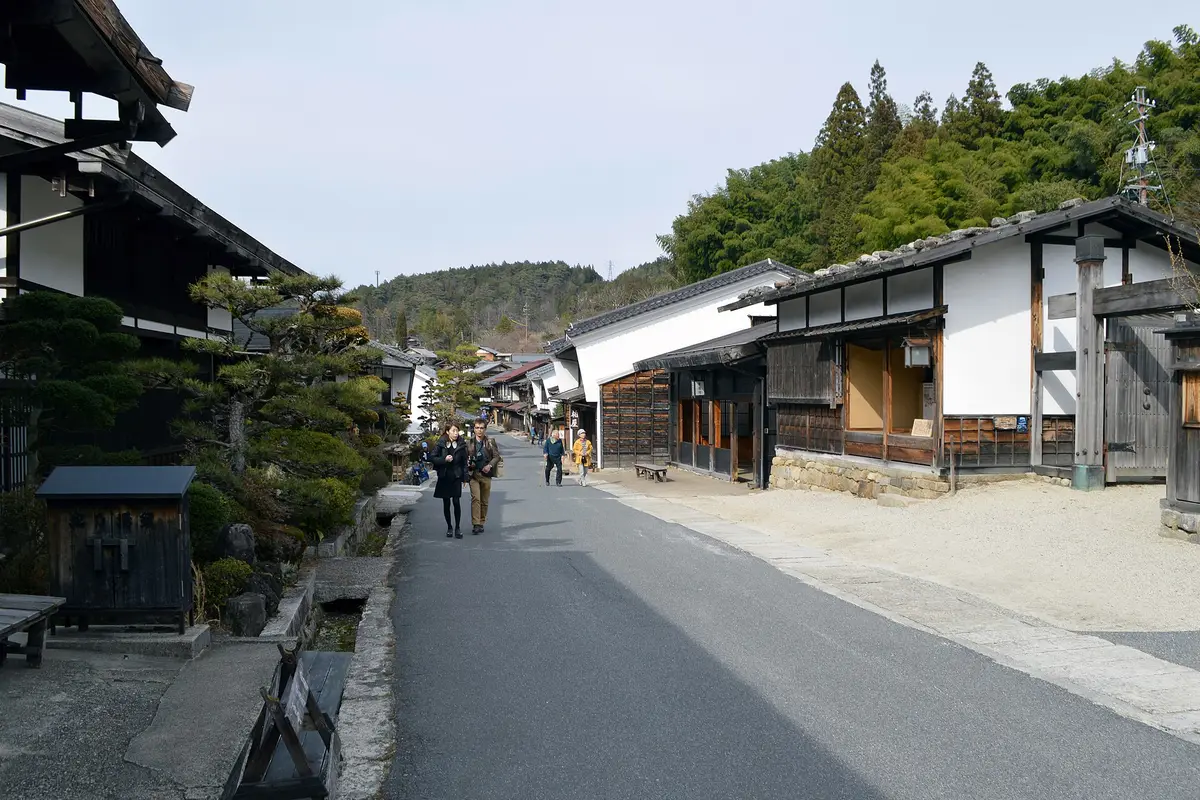
The most upvoted Japanese review in this whole corpus is about a promise the residents made, rather than about food or photographs. In the 1960s and 70s, while old buildings were coming down all over Japan, the people of Tsumago agreed on three rules for the houses they lived in: do not sell them, do not rent them out, do not tear them down. The reviewer who recounted that ended with a wish rather than a rating, hoping the post town would remain for a long time to come. Several reviews say the same thing: Tsumago was the first post town in the country to take up that kind of townscape preservation, and what you walk through is not a reconstruction. People still live in those houses, the same way people still live in the gassho farmhouses of Shirakawa-go.
When the reviewers reach for a reason the shops keep closing, it is succession. The reviewer who came back after twenty years put the thinning down to shops run by elderly owners with nobody to take over, and the same walker who asked about the inns put it down to family lines running out, plus an approval process for handing a building on that, as he described it, few new parties are willing to work through. Reviewers notice the quiet and read it two ways. One, after a weekday visit where nothing was open and the only person he met was the parking attendant, read it as a place emptying out. Another read the same silence as the whole point: "There wasn't anything especially delicious to eat or particular activities to do, but it felt like blending into a scene from Japan's original landscape, and it left me feeling very calm."
There is one more thing the Japanese reviews do that foreign itineraries rarely do. They treat the walk as one-way. A reviewer from neighbouring Gifu parks in Magome's free car park, walks the trail to Tsumago, and rides the bus back instead of retracing. Another walked it in about three hours, bused back to Magome, and went to a hot spring to recover. One review goes further and splits the family in two: the older members are dropped at the top to walk down and wait at a teahouse, while the younger ones climb up from the bottom to meet them. Tsumago's own tourist association publishes the same idea as an official short course. What these reviewers keep deciding is not whether to see the Nakasendo, but how much of it goes under their own feet. The same question of how much walking a reward is worth decides the long haul to Yakushima's Jomon Sugi, a full day's climb for a few minutes at the tree.
Doing it the welcomed way
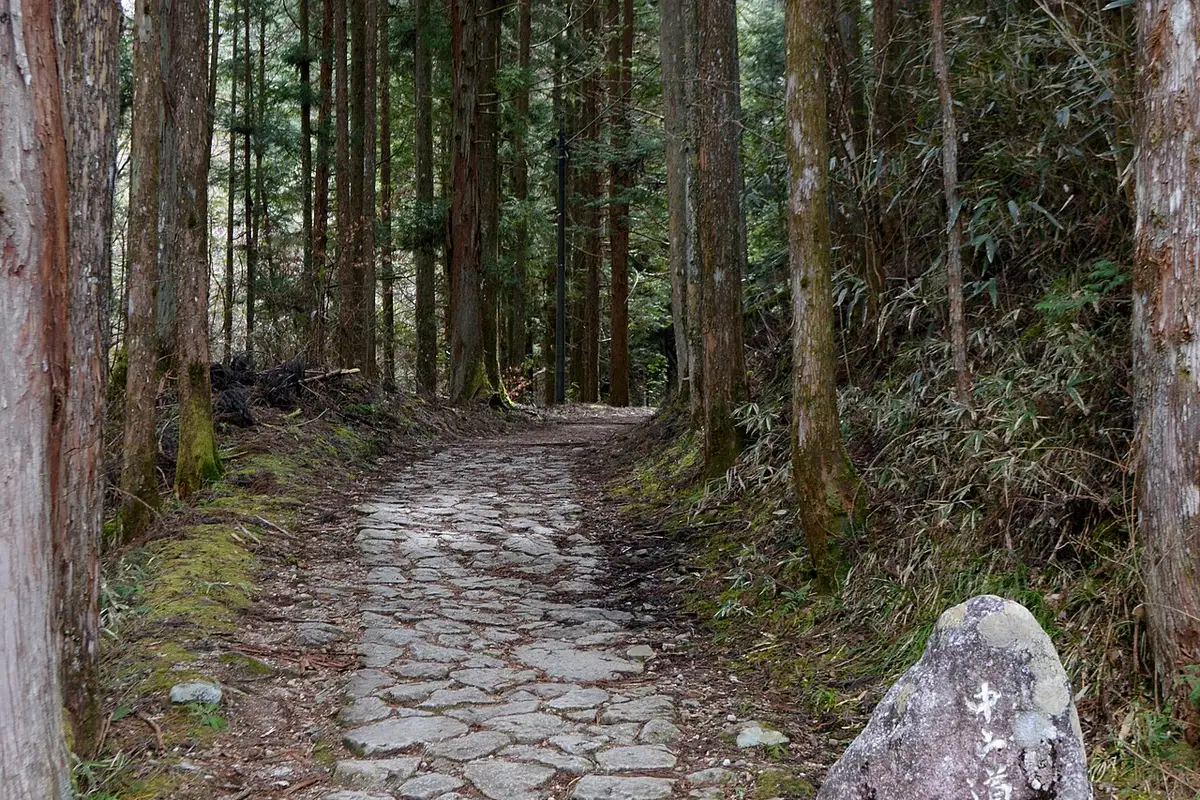
- Pick the direction before you pick the day. Tsumago's tourist association puts the full course at 9 km and 2.5 to 3 hours, and describes the two halves differently: Magome to the pass is a short steep climb, Tsumago to the pass is a gentle long one. Start in Magome and the hard part is over early, finishing downhill into Tsumago. Start in Tsumago and you climb gradually for most of the day, then drop into Magome's cafes and its valley view, which several travellers said they preferred as an ending.
- You are allowed to walk only half of it. The same tourist association publishes a shorter course: reach the pass by bus or car, then walk the downhill side only, roughly ninety minutes into Tsumago. Nagiso town's community bus revised its fares on 1 April 2026: the pass sits on the Magome line, at ¥300 between Magome Pass and Magome or ¥1,000 from Nagiso Station through to beyond the pass, while the separate Tsumago line is a flat ¥300 for adults. The town's 18 August 2026 notice has the community bus running as normal; it is the separate Kiso trunk bus on the Sakashita route that is detoured for road works until 26 February 2027.
- Send your bag ahead instead of carrying it. The luggage forwarding service between Magome and Tsumago runs 20 March to 30 November 2026 at ¥1,000 per bag, dropped off between 8:30 and 11:30 and collected between 13:00 and 17:00 at the tourist offices on either end. Outside that window there is a charter run at ¥4,500 for up to three bags. Magome's visitor centre also holds bags for the day at a flat ¥500.
- Borrow a bell at the office. Both tourist offices lend a bear bell: you pay ¥2,100 and get ¥2,000 back when you return it, so the rental itself is ¥100. The tourist association notes reports of bears coming down into inhabited areas, and recommends carrying something that makes a sound as a precaution.
- Aim for the shoulder months, and start early. The one traveller who sets the season out plainly puts it at April and May, then late October and November, and warns off midsummer for rain, heat and typhoons; the dated trip reports around it fall mostly in those same months. On autumn colour the voices disagree in a useful way: one traveller found the trees already bare around 20 to 23 November while Kyoto was peaking, and a Japanese reviewer hit full colour on a weekday in mid-November. The Kiso valley appears to run earlier than the city maples, so check the year rather than the calendar.
- Decide what you want from the shops before you leave. Early morning buys you an empty street and closed shutters. Late morning buys you open shops and tour buses. Both are in the reviews above, described by people who got the one they did not want.
There is a finishing certificate, if you like that sort of thing: ¥300 at either tourist office, or ¥150 if you picked up a hiking ticket at your inn. A small wooden one, cut from hinoki cypress. And one of the warmest lines we gathered is about neither town: halfway along the trail, a man tends a preserved farmhouse, and "you can sit by the fire and he'll serve you tea." That is the part nobody plans for.
Working out which parts of a Japan trip actually earn a day? Start with what actually matters in Japan, or see how the same question plays out in autumn colour season.
Sources
- Tsumago Tourist Association, official walking guide: the Magome to Tsumago course at 9 km and 2.5 to 3 hours; the Magome side described as a short steep climb and the Tsumago side as a gentle long one; the shorter energy-saving course of taking a bus or car to the pass and walking the roughly 90-minute downhill into Tsumago; the bear bell loan at ¥2,100 with ¥2,000 refunded on return (written without thousand-separators, that is 2100 yen and 2000 yen); the finishing certificate at ¥300, or ¥150 with a hiking ticket from your inn.
- Tsumago Tourist Association, 2026 luggage forwarding service notice (20 March 2026): the regular service between Tsumago and Magome running 20 March to 30 November 2026 at ¥1,000 per bag (written without thousand-separators, that is 1000 yen), drop-off 8:30 to 11:30 and collection 13:00 to 17:00; the out-of-season charter at ¥4,500 for up to three bags (that is 4500 yen).
- Nagiso Town Hall, community bus and fares (updated 18 August 2026): fares revised from 1 April 2026, with the Tsumago line at ¥300 for adults, and on the Magome line ¥300 between Magome Pass and Magome and ¥1,000 from Nagiso Station through to beyond the pass; the community bus running as normal, with the Kiso trunk bus Sakashita route on a road-works detour from 19 August 2026 to 26 February 2027.
- Magome Tourist Association, Magome-juku BASE visitor centre: luggage forwarding from Magome to the Tsumago tourist office at ¥1,000, accepted 8:30 to 11:30; same-day luggage holding at a flat ¥500, 8:30 to 17:00.
WMJS is written in Japan, in English, with AI help. We check every page, but English is not our first language. If a sentence reads oddly, tell us. One sentence is enough.
Thank you. A person reads every note.
How well do you know Japan?
Built from 635 public posts by Japanese people
Want to know more? Ask Japanese people
Have a follow-up question about this topic? We'll ask real Japanese people.
Voice Box →