
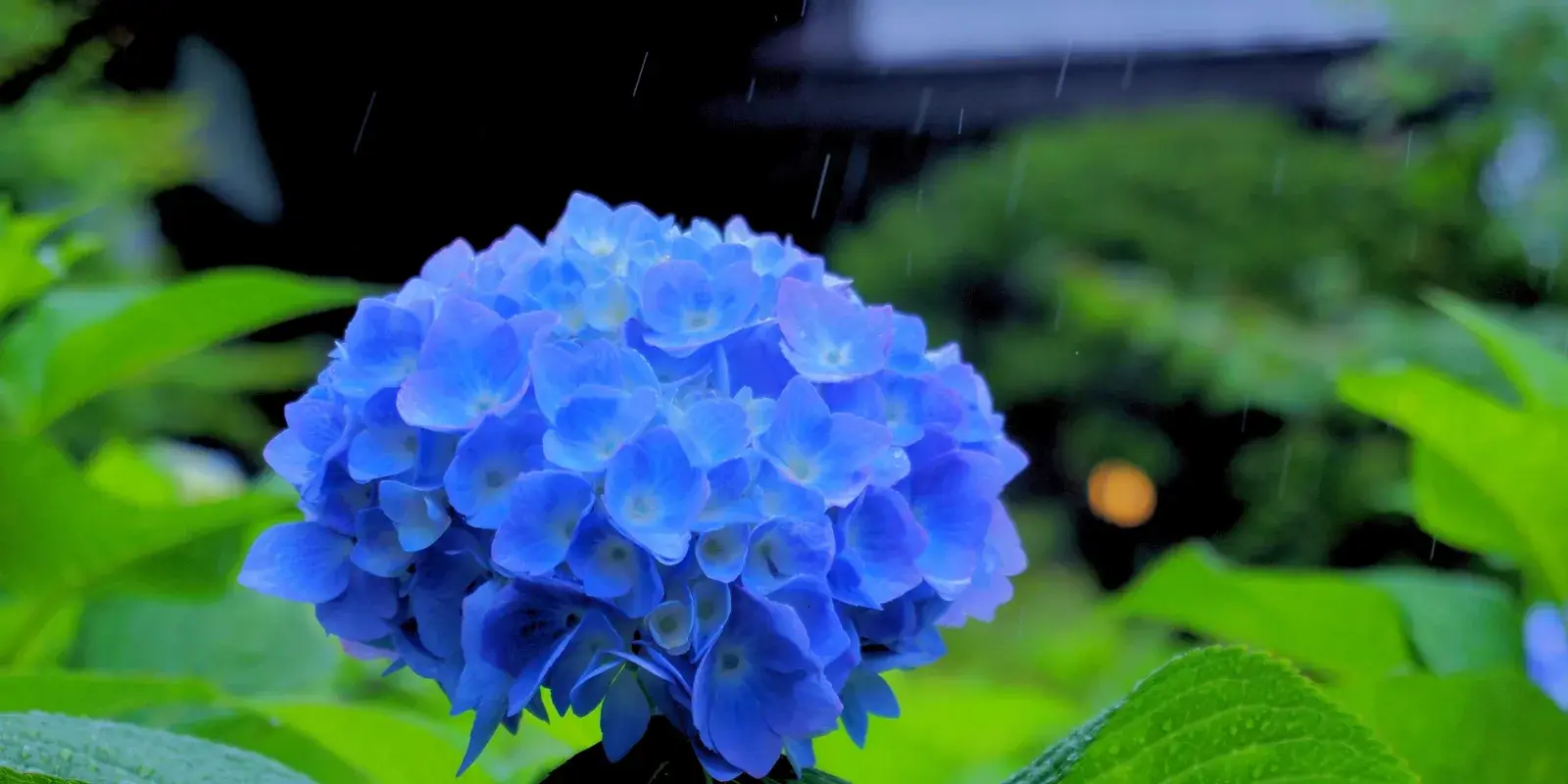
Hydrangeas in Japan (Ajisai): The Flower That Only Looks This Beautiful Because It's Raining
What you'll learn in this article:
- Why Japanese people say ajisai (紫陽花) looks its best because it's raining, and what 251 Japanese voices say
- What an "ajisai temple" actually is, and the one quiet courtesy that matters more than any rule
- Why the blues, pinks, and greens shift on the same plant, and why even Japanese people aren't quite sure
- How to enjoy the season even if you miss the peak (Japanese people miss it constantly too)
Are hydrangeas in Japan really better in the rain? We collected more than 250 public posts by Japanese people about ajisai, the signature flower of Japan's June rainy season. The result was clear: of the 57 posts about hydrangeas in the rain, 77% said rain makes them more beautiful, not less. Japanese people don't treat a rainy-day flower walk as a washout: to them, the rain is the whole point. This is the one flower that quietly forgives the gloomiest month of the year.
If you're looking at a June forecast full of rain clouds and worrying that your flower-viewing plans are ruined, take a breath. There's one flower in Japan that doesn't just tolerate the rain. It waits for it.
Hydrangeas, known in Japanese as ajisai (紫陽花), bloom right through tsuyu (梅雨), Japan's rainy season that runs from early June to mid-July. While the cherry blossoms of spring are long gone and the summer sun hasn't arrived, ajisai fill temple gardens, stone steps, and ordinary roadsides with deep blues, soft pinks, and impossible purples. And this is what Japanese people will tell you again and again: they look their best under a grey sky, beaded with rain.
That's not a tourist-brochure line. It's something Japanese people genuinely feel, and it's the reason this one flower can make even a damp, heavy June feel a little kinder.
This article is about the flower itself. If you want to know how Japanese people feel about the rainy season as a whole (the humidity, the mood, the quiet beauty of rain), that's a different (and lovely) story, told in Japan's Rainy Season: What Japanese People Actually Think About Tsuyu.
Quick Guide
| What to Know | What Japanese People Said | |
|---|---|---|
| 🟢 Rain is the point | 77% of voices said hydrangeas look better in the rain. You're not unlucky to see them on a wet day: you're seeing them at their best. | "Hands down, hydrangeas look livelier and brighter on a rainy day." |
| 🟡 Even locals are puzzled | The shifting blues and pinks confuse Japanese people too. If you wonder why one plant has five colors, so do they, and many find that mystery beautiful. | "The colors are all mixed up. The roots are in the same soil, though. It's a mysterious, almost magical thing." |
| 🟢 Crowds, not judgment | At famous ajisai temples, the crowds are mostly Japanese visitors. They line up too, and almost everyone says it's worth it. Go early or on a weekday. | "Brace for crowds, but I highly recommend it." |
| 🟢 Timing is forgiving | Even Japanese people miss the peak all the time. The bloom shifts by days each year. The reassuring truth: you don't need the perfect day. | "If it rains, well, of course it does, and a break of sunshine feels like a gift." |
The one thing to remember: Japanese people don't pretend June is wonderful. They complain about the damp just like you would. But ajisai is the flower that lets them forgive it, and you're welcome to walk under the same umbrella and feel the same small relief.
How We Gathered These Voices
We collected 251 Japanese-language responses across six topics about ajisai: how rain affects the flower's beauty (57 voices), visiting ajisai temples (45 voices), the mystery of its changing colors (47 voices), the difficulty of timing the bloom (47 voices), photographing the flowers without crowding others (30 voices), and how appreciation of ajisai differs across generations (25 voices). Sources include public Japanese Q&A sites, blogs, travel diaries, social posts, and a handful of temple notices and dictionaries.
A quick note: This isn't a controlled scientific survey. It's a collection of what real Japanese people said in their own words, on public platforms. Most travel guides hand you a map of "best hydrangea spots" and a bloom calendar. We wanted to show you something guides leave out: how Japanese people actually feel about this flower, and why a rainy June would feel emptier without it.
The Rain Doesn't Ruin Ajisai. It Feeds It.
Let's start with the worry that brings most people here: does rain ruin hydrangea-viewing?
Of 57 voices about hydrangeas in the rain:
The most common feeling, by a wide margin, is that rain is exactly when ajisai comes alive:
断然、雨の日の方が紫陽花が元気よく、輝いて見えますね。 Hands down, hydrangeas look livelier and brighter on a rainy day.
雨の日の紫陽花が好きです。雨に濡れた紫陽花は、水を含んだ絵の具みたい。晴れの日には見られない鮮やかな色。 I love hydrangeas on rainy days. A rain-soaked hydrangea is like paint full of water — colors so vivid you'll never see them in sunshine.
One voice put its finger on exactly why this flower is different from everything else you might photograph:
景色の多くは、やっぱり雨や曇りの日よりも、晴れの日差しが似合う。けれど、紫陽花の場合は、雨や曇りが紫陽花のしっとりとした美しさを引き立てるような気がして。 Most scenery suits bright sunshine better than rain or clouds. But with hydrangeas, somehow the rain and the grey draw out their soft, moist beauty.
This isn't just poetry. There's a plain physical reason behind it. Hydrangeas drink heavily, and they sag when the soil dries out, so the June rain is, quite literally, what perks them up:
アジサイはよく水不足になる傾向があります。日照りが続くとその所為でハリがなくなります。そこに雨が降ると、アジサイは活気がでて瑞々しい。葉や枝にハリが出てきます。色鮮やかにもなります。 Hydrangeas tend to run short on water. A dry spell leaves them limp. Then the rain comes, and they spring back — fresh and full, leaves and stems firm again, colors brighter.
There's an optical reason too, and a Japanese commenter explained it more clearly than most guides do: a wet surface stops scattering light, so the color reads deeper and richer. Rain doesn't dull ajisai: it turns up the saturation.
💡 You didn't get unlucky with the weather
A rainy forecast over your hydrangea day isn't a disappointment to manage. It's the flower at its best. Japanese people aren't being romantic to save face about bad weather. The rain genuinely revives ajisai and deepens its color. You're seeing something a sunny visitor never will.
And for many people, that turns into something deeper than aesthetics. Ajisai is the flower they credit with making a heavy month bearable:
梅雨という鬱屈な気候をわざわざ選んで咲くところ。 What I love is that it chooses to bloom in the gloomiest, most oppressive weather on purpose.
そんなことを、憂うつな梅雨を乗り越えさせてくれる紫陽花の美しさが教えてくれた。 The beauty of the hydrangea — the thing that carries me through the dreary rainy season — taught me that.
Not everyone agrees, and we'd be hiding the truth if we pretended they did. A few people simply don't enjoy it, and the practical misery of standing in the rain is real:
梅雨時に咲く花なのでそういうイメージがあるのだろうが、私は雨の日のアジサイは嫌いだがね。 People picture them as a rainy-season flower, so they have that image. But personally? I don't like hydrangeas on rainy days.
『紫陽花は雨が似合う』とは思うけど、この日は花を楽しむ余裕もなくなってしまうほどの大雨。 I do think hydrangeas suit the rain — but that day it poured so hard there was no room left to enjoy the flowers.
That last voice draws the honest line: a soft drizzle is the magic; a downpour that soaks your shoes is just a downpour. If you can pick your moment, a light rain or the hour just after it (when raindrops still cling to the petals) is what most people mean when they say ajisai is beautiful in the rain.
The Colors That Puzzle You Puzzle Japanese People Too
Here's a question almost every visitor asks at an ajisai temple: why is that one plant blue, pink, and purple all at once? Is part of it dying?
It turns out you're in excellent company. The shifting colors of ajisai are a genuine, everyday mystery to Japanese people as well.
Of 47 voices about hydrangea colors:
Listen to how closely this matches your own first reaction:
アジサイって色が段々と変わるのが不思議やなって思ってて。色がバラバラ。根っこは同じ土なはずなんやけどな。まぁなんにせよ不思議で神秘的な事象ではある。 I've always thought it's strange how hydrangeas slowly change color. The colors are all over the place — even though the roots are in the same soil. Anyway, it's a mysterious, almost magical thing.
一つの場所から生えているのに、紫陽花の色がバラバラなのです。土が同じはずなのに、そもそも同じ根っこから生えているはずなのに、見事に色がバラバラです。理由があるのか?と疑問に思い、調べてみることにしました。 Even though they grow from one spot, the colors are all different. The soil should be the same — they should be from the same roots — yet they're beautifully scattered. I wondered if there was a reason, and decided to look it up.
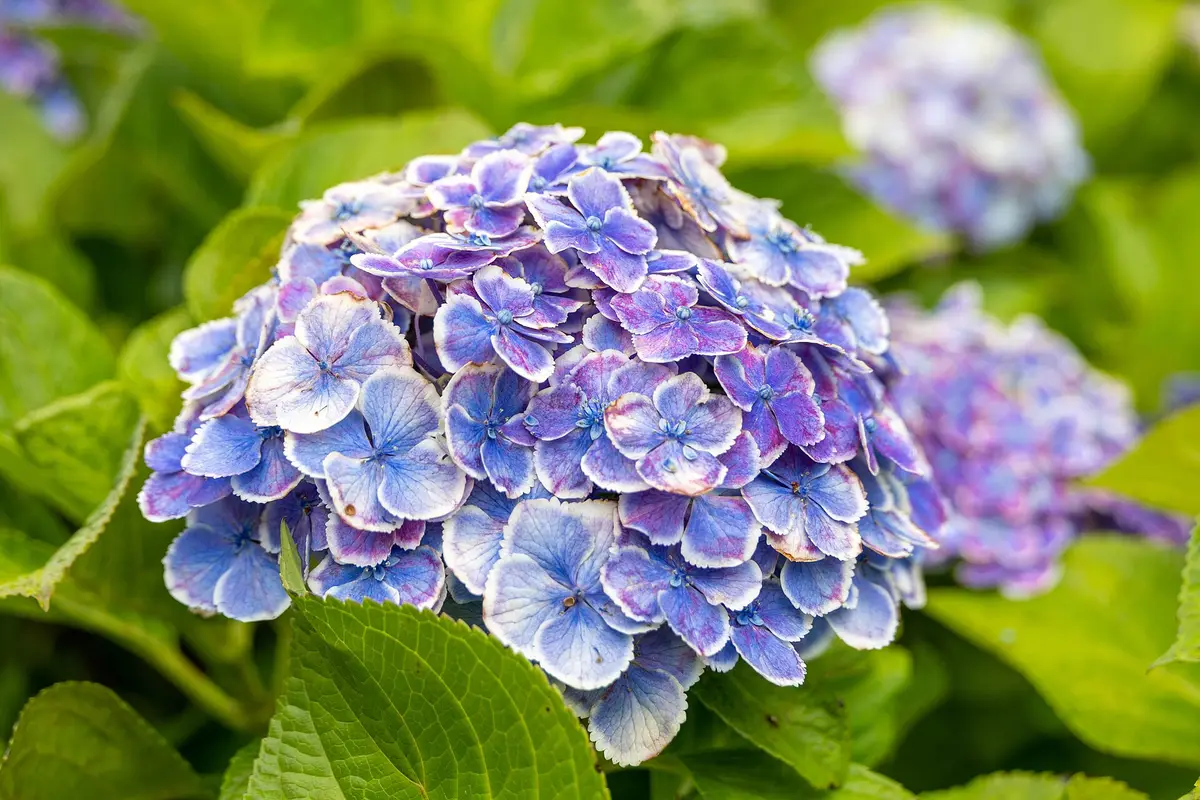
So what is the reason? Here's the short version, and it's genuinely interesting. The color depends less on soil pH directly than on aluminum. In acidic soil, aluminum dissolves and gets drawn up into the flower, where it binds with the plant's pigment (a delphinidin-based anthocyanin) and turns the sepals blue; in more alkaline soil, the aluminum stays locked away and the flower stays pink. White varieties, which lack that pigment, don't change at all, and some types are simply fixed by their breeding. In other words, even the "rule" everyone half-remembers isn't a rule. Japanese people argue about this too:
アジサイの花は土のPHによって青とか赤色になると、物知り顔の人が言いますが、嘘ですよね?色の異なる2本のアジサイを同じ土に植えても、それぞれの最初の色を維持し続けます。 People who think they know say hydrangea color comes from soil pH — but that's not true, is it? Plant two different-colored hydrangeas in the same soil and each keeps its original color.
The part that's harder for newcomers to read is the fading. As the season goes on, those vivid blues and pinks soften, dull, and turn green or rusty-brown, and yes, plenty of Japanese people mistake that for the flower dying:
アジサイの花の色が抜けてしまい、まだらのうす茶色になってしまいました。花はぴんとしているのですが、枯れたのでしょうか? My hydrangea's color drained away and it turned a patchy pale brown. The flower itself is still firm, but — has it died?
But here's the lovely twist, and it's pure ajisai: many people treasure exactly that faded stage. There's even a name for it: aki-ajisai, "autumn hydrangea," and dried, it sells for a premium:
綺麗に秋色になりましたねー これは紫陽花観賞の最終形です! It's turned a beautiful autumn shade — this is the final stage of hydrangea-viewing!
秋に、こんなに綺麗な紅色に染まった紫陽花を見るのは初めて。深みのある美しい色に染まり、とても誇らしげに見えました。雨の日も夏の猛暑の日も、ずっとここで辛抱強く咲き続けていた花たち。 I'd never seen hydrangeas dyed such a deep crimson in autumn. The rich, beautiful color looked almost proud — these flowers that had patiently kept blooming here through the rainy days and the brutal summer heat.
This is the heart of how Japanese people love ajisai. The flower has an old nickname, shichi-henge (七変化), "seven transformations," for the way it never holds one color. Where you might see a plant that "can't decide," many Japanese people see something worth admiring:
『移り気』と言われたら、なんだかあまり良くない印象を持ってしまいますよね。ただ、見方をかえると、1日たりとも同じ色の日なんてない。1日1日を大切に、と大切なことを教えてくれているようです。 "Fickle" sounds like a bad thing, doesn't it? But look at it differently: there isn't a single day it stays the same color. It's as if it's teaching us to treasure each day.
So if you stand in front of a hydrangea and can't tell whether it's blooming, peaking, or fading, relax. That uncertainty is the flower. Even the person beside you is probably just enjoying the mystery.
💡 Confusion is the correct response
You don't need a botany lesson to enjoy ajisai. The shifting colors genuinely puzzle the people who grew up with them. And the muted, "going-over" flowers that look dead to fresh eyes are often the ones Japanese people find most beautiful. Whatever stage you catch it in, you're seeing it the way a local would.
What Exactly Is an "Ajisai Temple"?
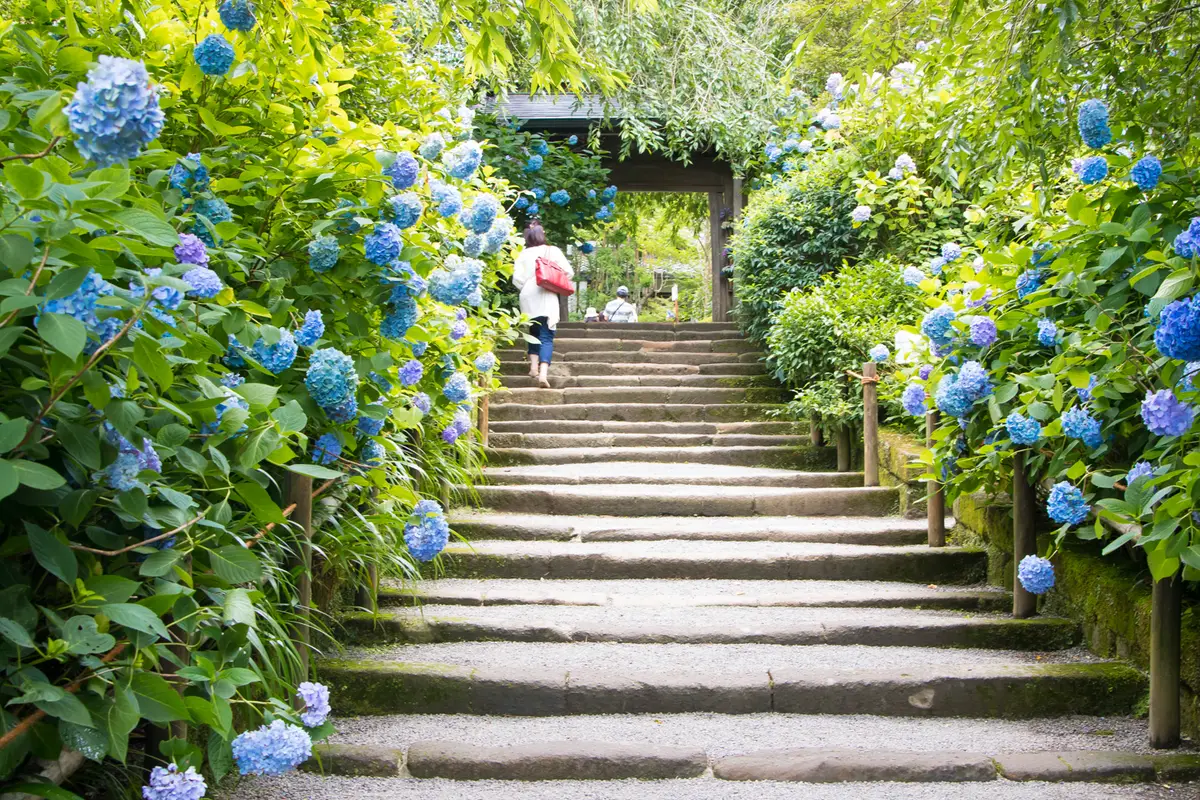
You'll see the phrase everywhere in June: ajisai-dera (あじさい寺), "hydrangea temple." It simply means a temple that has planted hydrangeas in great numbers, often on slopes and stone steps, so that for a few rainy weeks each year, the grounds turn into a sea of blue and violet. A few of the most famous:
- Meigetsu-in (Kita-Kamakura) is so associated with one shade of blue that it has its own name: Meigetsu-in blue. Its roughly 2,500 hydrangeas turn the whole approach a single, deep blue.
- Hasedera (Kamakura) has a hillside "hydrangea path" with more than 40 varieties and around 2,500 plants, with sweeping views toward the sea. At peak season it runs a timed-entry "ajisai ticket" to manage the crowds.
- Mimuroto-ji (Uji, near Kyoto) has a hydrangea garden of some 50 varieties and 10,000 plants, including a few heart-shaped blooms that visitors hunt for.
- Yatadera (Nara) grows around 60 varieties across its grounds and is one of the Kansai region's signature hydrangea temples.
Should you brave the crowds to see them? Here's how Japanese visitors themselves feel.
Of 45 voices about visiting ajisai temples:
The most common feeling is that the crowds are real, and the flowers are worth them anyway:
うっとうしい季節にブルー一色に染まる明月院は最高です!ちょうど最盛期でラッキーでした。 In this dreary season, Meigetsu-in dyed a single shade of blue is the best! I was lucky to catch it at its absolute peak.
混雑覚悟ですが、オススメのスポットです。圧巻のアジサイの量、スゴいです。360度、アジサイに囲まれてる感じで愛でました。 Brace for crowds, but I recommend it. The sheer volume of hydrangeas is overwhelming — I felt surrounded by them on all sides, and just drank it in.
The honest counterweight is worth hearing too, because it tells you what to expect, and notice that none of it is about foreign visitors. It's about queues, ticket prices, and the occasional bad bloom year:
まだ2~3割位しか咲いてなく、しかも月曜日の朝9時すぎだというのに何でこんなに混むの。信じられない! Only 20–30% in bloom, and it's this crowded at past 9am on a Monday — I can't believe it!
年々混雑が凄まじくなっていますね。冬の貸し切り状態の境内が嘘のようです。 The crowds get more intense every year. You'd never believe it's the same temple that's practically deserted in winter.
That last point matters for how you read the scene. The crush at an ajisai temple in June is overwhelmingly made up of Japanese visitors, lining up beside you for the same photo of the same blue. You're not an intruder on a local secret. You're one more person who came for the flowers, exactly like the family next to you.
And the people who'd been once before almost all converged on the same simple advice: go early, or go on a weekday, or go a little before the official peak. Several described arriving to near-empty paths by beating the crowd:
あえて午後に行ってみた。待ち時間ゼロで入園。有名な写真スポットも、根気強く待てば無人タイムが訪れるくらいの混雑具合だった。 I deliberately went in the afternoon. Walked right in, no wait. Even the famous photo spot cleared out for a moment if you waited patiently.
ちょっと早いかなと思いながら紫陽花を見に明月院へ。さほど混雑もしておらずゆっくり見て回れました。 Went to Meigetsu-in thinking it might be a touch early — but it wasn't crowded, and I could take my time.
One more reassuring note: a modest admission fee is normal, and some temples charge a little extra for the hydrangea garden specifically during peak season. (Figures change yearly, so check the temple's own page before you go.) None of that is a barrier. It's just part of how these gardens are maintained for the few weeks they're spectacular.
Photographing the Flowers: The One Quiet Courtesy
If there's a single thing visitors quietly worry about, it's this: is it rude to stop and take photos? What about a tripod? Will my umbrella be in the way?
Good news first: taking photos is completely welcome. Ajisai temples exist to be admired and photographed, and Japanese visitors are doing exactly the same thing all around you. When we read through what genuinely bothers Japanese people, it was almost never the act of photographing. It was one specific thing: occupying, planting yourself (or a tripod) in a narrow spot and not letting others through.
The pattern people described, again and again, is a gentle rotation that keeps a crowded stone staircase moving:
数枚撮った後に交代。さらに撮りたい方は一番後ろに並び再度待つ。こうすることで、全員に平等に撮影するチャンスが訪れます。 Take a few shots, then yield. If you want more, go to the back of the line and wait again. That way everyone gets a fair turn.
若い方はみんな交代で撮影していました。 The younger visitors were all taking turns to shoot.
The principle underneath it is simple and kind, and one photographer summed it up perfectly: everyone paid the same to be there, so no one has the right to take the good spot hostage.
同じようにお金を払って見に来ているのに、三脚を置くことによって、いい場所から眺め、写真を撮る機会を奪う権利は、誰にもない。 Everyone paid the same admission to see this. No one has the right to plant a tripod and rob others of the chance to stand in the good spot and take a photo.
That's why several temples gently ask visitors not to use tripods on busy paths. One Nara ajisai temple puts it plainly in its own notice:
境内の混雑する場所においては、参拝者の事故防止のため、三脚及び一脚の使用をご遠慮いただくことになりました。 In crowded areas of the grounds, to prevent accidents, we now ask visitors to refrain from using tripods and monopods. (Yatadera, an ajisai temple in Nara)
So the whole "rule" comes down to one friendly instinct: shoot, enjoy, and keep moving. Don't camp on a spot others are waiting for. Even a minute of blocking the path is felt, as one careful photographer admitted ("I photograph the explanatory signs and read them at home, so I'm not standing in anyone's way"). Take your picture, step aside, and rejoin the flow.
The same instinct covers your umbrella on a rainy day. In a packed, narrow approach, an umbrella is just one more thing you're sticking out into other people's space. Japan even has a small, old gesture for this: kasa-kashige (傘かしげ), tilting your umbrella away from someone as you pass so the drips don't catch them:
傘は体の中心で真っすぐに持ちましょう。人とすれ違うときは、相手と反対側に傘を傾けましょう。傘同士がぶつかったり、露先から垂れる水滴が相手にかかることを避けられます。 Hold your umbrella straight, centered over your body. When you pass someone, tilt it to the opposite side. That way umbrellas don't clash and the drips don't land on the other person.
It's the same idea as taking turns at the camera: a small courtesy that lets a lot of people share a small, wet, beautiful space. You can read more about these quiet considerations in our article on omoiyari, and about photographing people (a different question entirely) in photo etiquette at tourist spots.
Timing the Bloom: Even Japanese People Miss the Peak
Maybe your biggest worry is timing: when exactly is the peak? It's going to rain, so should I still go? What if I get it wrong?
Here's the most reassuring thing we found across 47 voices about timing: Japanese people miss the peak all the time, and they make their peace with it.
The bloom is genuinely hard to pin down: it shifts by days from year to year, and a hot spell can scorch it early. The disappointment of mistiming it is something locals know well:
6/4の夕方のインスタに、入り口横の手水が今年初のグラデーションになったってあがってました!1日早かったかぁ…今年もグラデーション見られなかったのは残念。 The temple's evening post on June 4 said the entrance had its first gradient bloom of the year. I was one day too early… missing it again this year is such a shame.
あ~紫陽花はダメだなあと感じた瞬間。紫陽花は多分次週ぐらいから綺麗に咲いているでしょうね。 That sinking moment when you realize — ah, the hydrangeas aren't ready. They'll probably be blooming beautifully starting next week, I guess.
今年の紫陽花は開花が遅かったにもかかわらず、連日の猛暑でまだ小さなお花たちが一部茶色く枯れたようになっていて痛々しい。 Even though they bloomed late this year, the relentless heat had left some of the still-small flowers browned and withered — it was painful to see.
If lifelong locals can show up a day early or a week late, you don't need to feel any pressure to hit a perfect window. As a rough guide, hydrangeas are generally at their best in June, with mid-June the usual peak across much of Japan (it comes earlier in the south and later in the north). A bloom typically holds for about two weeks, and the big temples, with early and late varieties mixed in, stay good for three to four. For detailed month-by-month data on crowds and the best windows to travel, see Best Time to Visit Japan.
But the voices we'd most like you to carry are the ones that let go of the whole anxiety. The healthiest relationship with ajisai isn't perfect timing. It's taking the season as it comes:
雨が降ってもそりゃそうだと潔く諦めがつくし、たまの晴れ間はとびっきり嬉しく感じる。 If it rains, well, of course it does — you just accept it. And the occasional break of sunshine feels like a real gift.
何が目的ってわけでもない旅でしたが、どこも混んでいなくてゆったり余裕の時間を過ごしました。 The hydrangeas were early and I sort of missed them — but nowhere was crowded, and I had a wonderfully relaxed time.
And you don't even need a famous temple. Some of the warmest voices were about the hydrangeas on an ordinary street corner:
けだるいときは町の紫陽花をみて気持ちにバフをかけていきましょう。 When you're feeling sluggish, look at the hydrangeas around town and give your mood a little boost.
💡 You don't need the perfect day
The peak is a moving target even for people who've chased it for years. Aim for June, lean toward mid-month, and then let it go. A rainy day, a slightly-early bud, a street-corner bush: Japanese people find all of them worth stopping for. So can you.
The Generation Thread: One Flower, Many Ways to Love It
One quiet pleasure of ajisai is that it means something a little different to every generation, and yet it keeps getting handed down.
For many older people, hydrangeas are something you grow rather than just photograph. They cultivate plants in the garden over years, taking cuttings, coaxing the colors:
母への贈りものとして選び続けてきたのが、紫陽花の鉢植えでした。母が大の花好きだったから。玄関周りや庭先には、いつも色とりどりの鉢植えが並び、母は毎回おおげさなくらい喜んでくれました。 What I kept choosing as a gift for my mother was a potted hydrangea — because she loved flowers. Her doorway and garden were always lined with colorful pots, and she'd be almost exaggeratedly delighted every single time.
For an older generation, ajisai also lives in poetry. It's a kigo, a seasonal word for early-summer haiku, and people who grew up with that tradition tend to seek out a quiet temple over a photogenic one:
紫陽花の花に目を奪われる人も多い中、やはり、ここはお寺なのだ。 Many people are captivated by the hydrangeas — but after all, this is a temple.
For younger people, the same flower often means a day out: riding the little Enoden train along the Kamakura coast, hunting film-location spots, photographing "Meigetsu-in blue," stopping for coffee. Different ritual, same flower.
And here's the part that's genuinely touching: the generations keep meeting over it. One grandmother wrote about being pulled into her grandchild's version of the season:
「ばぁ、江ノ電でロケ地巡りしたい」。孫からのリクエスト。ボックスシートがレトロで、気分は女子高生。 "Grandma, I want to ride the Enoden and visit the filming spots" — my grandkid's request. The retro box seats had me feeling like a high-school girl again.
You'll also notice that hydrangeas have quietly become a Mother's Day gift in Japan: younger family members giving a potted ajisai to the older generation, who then nurse it for years. The flower travels down the family, in both directions. And more than a few people described disliking ajisai as children and growing into it as adults:
こどもの頃、同じ時期に咲く紫陽花はあまり好きでなかった。しかし、大人になるにつれ、なぜだか、紫陽花が気になり始めた。 As a kid I didn't much like the hydrangeas that bloom this time of year. But as I grew up, somehow, they began to draw me in.
What this means for you as a visitor is simple and warm: whoever you end up talking to about ajisai (an older person who grows them, a young photographer chasing the light), they're delighted by the same flower you are. You're not outside the tradition. You're just one more person it's pulling in.
Why This Flower? The Quiet Engine Behind Ajisai
It helps to see why hydrangeas inspire such a different kind of flower-viewing from Japan's other famous bloom.
Cherry blossoms are a scarce, fleeting resource: they explode all at once and scatter within days, and that urgency built a culture of gathering: the lively hanami picnic under the trees, racing to catch the bloom before it's gone. Ajisai is the opposite in almost every way, and so is the way people enjoy it.
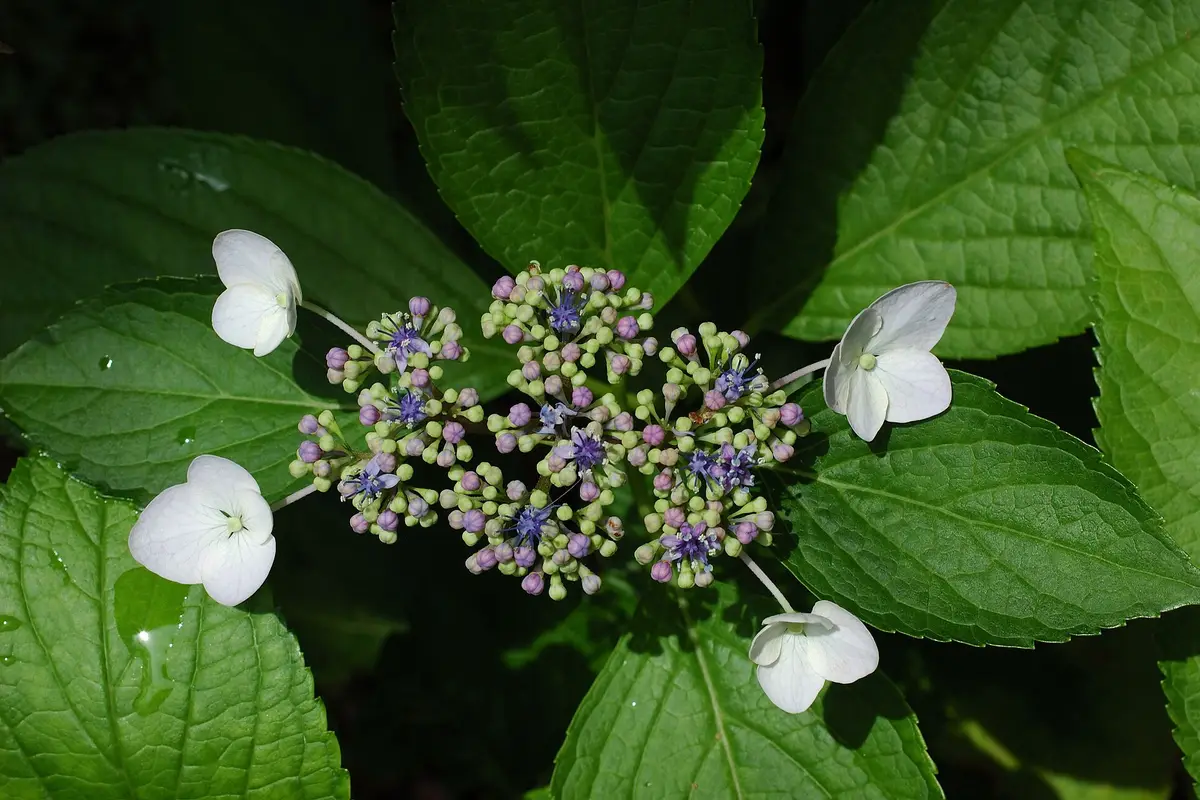
- It blooms for weeks rather than days. What looks like flower petals are mostly sepals, modified leaves that hold their color far longer than true petals would. The real flowers are the tiny dots at the center. That's why the season stretches on, and why there's no franticness to it: you can walk slowly, in the rain, and the flower waits for you.
- It drinks the rain. The June rains that make the rest of the season feel dreary are exactly what this flower needs: restoring its droop, washing the leaves, deepening the color. The gloom and the beauty come from the same weather.
- Its color is a small chemistry experiment. Acidic soil frees up aluminum, which the plant carries into its sepals to turn them blue; alkaline soil keeps them pink; white varieties don't change at all. Hence the old name shichi-henge, "seven transformations," a flower that refuses to settle on one color, even on a single plant.
- The temples leaned into it. Planting hydrangeas thickly across slopes and stone steps turned quiet, off-peak rainy weeks into a reason to visit, and over time, the ajisai-dera became a season of its own.
Put those together and you get a flower that rewards exactly the opposite of cherry-blossom urgency: slowness, grey skies, an umbrella, and the patience to notice that the "fading" bloom in front of you is its own kind of beautiful. Where hanami is a party, ajisai is a quiet walk, and it asks nothing of you except that you take your time.
That's the whole gift of it. In the month Japanese people most want to complain about, this one flower gives them a reason not to. And you're welcome to share it: same rain, same umbrella, same small, stubborn beauty.
And when the daylight fades, early summer offers its quiet counterpart: in the same June, after the rain, Japanese people slip into the dark to watch fireflies drift over the water, never catching them, just watching them glow. The hydrangea is the flower of the rainy day; the firefly is the light of the same warm night.
Share Your Experience
Have you seen hydrangeas in Japan, at a temple, on a quiet street, in the rain? Did the flower change how you felt about a rainy June? Or is there an ajisai spot you'd tell others about?
More Japanese Perspectives
Exploring how Japanese culture works across the seasons:
- Japan's Rainy Season: What Japanese People Actually Think About Tsuyu: The bigger story of the season ajisai blooms in: the humidity, the mood, and the beauty most visitors miss
- Best Time to Visit Japan: Month-by-month visitor numbers, hotel occupancy and weather, what Japanese people say about when visitors come, and where June fits in
- Visiting Temples and Shrines: The basics of temple manners, for your day at an ajisai-dera
- Omoiyari: Japan's Culture of Quiet Consideration: Where small gestures like umbrella-tilting come from
Sources
Japanese Voices (251 responses across 6 topics)
Hydrangeas in the rain (57 voices)
- Public Japanese Q&A sites, blogs, essays, and travel diaries: first-hand opinions on whether hydrangeas look better wet or dry
Visiting ajisai temples (45 voices)
- Public Japanese review sites, blogs, travel diaries, and social posts: first-hand accounts of Meigetsu-in, Hasedera, Mimuroto-ji, and other hydrangea temples
The mystery of the colors (47 voices)
- Public Japanese Q&A sites, blogs, and gardening forums: first-hand reactions to why hydrangea colors shift and mix
Timing the bloom (47 voices)
- Public Japanese Q&A sites, blogs, and travel diaries: first-hand accounts of catching (and missing) the peak
Photography and shared paths (30 voices)
- Public Japanese forums, blogs, and a temple notice: first-hand opinions on photographing flowers in crowded spaces
Generational differences (25 voices)
- Public Japanese essays, Q&A sites, and blogs: first-hand accounts of how ajisai is enjoyed across generations
Factual Sources (Tier 1–2)
- Hydrangea color chemistry: Royal Horticultural Society, Hydrangeas: changing the colour; Encyclopædia Britannica, Hydrangea; Schreiber et al., "The chemical mechanism for Al³⁺ complexing with delphinidin," Journal of Inorganic Biochemistry (2010), PubMed
- "Seven transformations" (七変化) nickname: Kotobank (Shogakukan, Seisenban Nihon Kokugo Daijiten / Digital Daijisen), 七変化
- Bloom timing / phenological observation: Japan Meteorological Agency, 生物季節観測 (seasonal observations); ajisai remains an officially observed species
- Ajisai temples: Hasedera (Kamakura) official, hydrangea path information; Hasedera's own hydrangea-path admission runs a numbered, timed-entry "ajisai ticket" (advance web reservation for an entry time slot) during the peak weeks to manage crowds, per Hasedera's seasonal announcements and Kamakura-area visitor guides; Mimuroto-ji (Uji) official, hydrangea garden; Kyoto City official tourism (Mimuroto-ji, 50 varieties / 10,000 plants), Kyoto Travel; Kanagawa prefectural tourism (Meigetsu-in, ~2,500 plants / "Meigetsu-in blue"), Kanagawa Kankou; Yatadera (Nara) official notice on tripods, yatadera.or.jp. Temple admission figures and ticket procedures change yearly; please check each temple's own page before visiting (verified June 2026).
Selected voice sources
- https://www.shuminoengei.jp/?m=pc&a=page_qa_detail&target_c_qa_id=12311
- https://www.jalan.net/kankou/spt_14204ag2130009773/kuchikomi/
- https://www.jalan.net/kankou/spt_26204ac2102080103/kuchikomi/
- https://www.jalan.net/kankou/spt_14204ac2102035571/kuchikomi/
- https://bbs.kakaku.com/bbs/-/SortID=22161051/
- https://ganref.jp/m/potomacriver/reviews_and_diaries/diary/35410
- http://www.yatadera.or.jp/ajisai.html
- https://allabout.co.jp/gm/gc/220662/
- https://4travel.jp/travelogue/11983603
- https://4travel.jp/travelogue/11909445
Note on Quotations
Quotes from online platforms have been lightly edited for readability (fixing typos, formatting for clarity). The meaning and intent of each comment remain unchanged. Original sources are linked above.
This article is available in languages covering 95%+ of visitors to Japan (based on JNTO 2025 data). Need another language? Let us know through Voice Box.
WMJS is written in Japan, in English, with AI help. We check every page, but English is not our first language. If a sentence reads oddly, tell us. One sentence is enough.
Thank you. A person reads every note.
How well do you know Japan?
Built from 635 public posts by Japanese people
Want to know more? Ask Japanese people
Have a follow-up question about this topic? We'll ask real Japanese people.
Voice Box →